   Define Token Economy
   Understand steps/components of the
    method
   Identify Advantages and Disadvantages of
    Token Economy
   Describe 3 studies that supports the
    effectiveness of the method
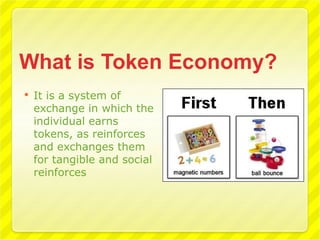
   It is a system of
    exchange in which the
    individual earns
    tokens, as reinforces
    and exchanges them
    for tangible and social
    reinforces
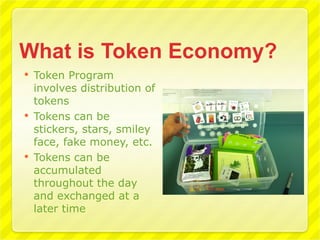
   Token Program
    involves distribution of
    tokens
   Tokens can be
    stickers, stars, smiley
    face, fake money, etc.
   Tokens can be
    accumulated
    throughout the day
    and exchanged at a
    later time
   Tokens are flexible
   Tokens can be used for several needs
   There is no delay giving tokens after the
    desired behavior has been shown
   It does not matter who gives the tokens
   It can be consistently applied by multiple
    teachers in multiple settings
   Prevent Boredom
   Takes a lot of             Parental follow
    preparation and             through does not
    tracking of the             always occur
    behavior, tokens, and      Can lead to
    rewards.                    dependency
   Not everyone will          Maybe easily abused
    respond to token           Can be expensive
    system.
                               Require organization
   Once the system is          and structure
    implemented in one
    class, it may not
    followed through
11 Basic Rules when establishing Token
               Economy
      Select the Target         Implement the token
      Behavior                    economy
     Present the target         Provide immediate
      behavior                    reinforcement for
     Post the Rules and          acceptable behavior
      Review it frequently       Gradually change from
     Select a token              continuous to variable
     Establish Reinforcers       schedule of reinforcers
      which the tokens can       Provide Time for child
      be exchanged                to exchange token
     Develop a reward           Revise the reward
      menu                        menu frequently.
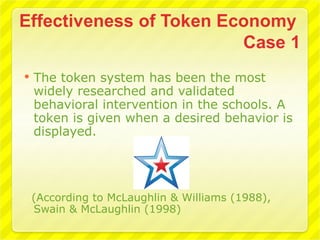
   The token system has been the most
    widely researched and validated
    behavioral intervention in the schools. A
    token is given when a desired behavior is
    displayed.


    (According to McLaughlin & Williams (1988),
    Swain & McLaughlin (1998)
   Purpose of this investigation was to determine
    if a token reinforcement program could
    decrease three inappropriate behaviors (out of
    seat, talking out, and poor posture) of an
    elementary student with learning disabilities.

   The effects of the token program were
    examined using a multiple baseline design
    across behaviors. The results indicated that
    awarding tokens for the absence of the three
    target behaviors was an effective procedure.
   Study investigated the effect of social and token
    economy reinforcements on academic
    achievement of ten, 9th grade boys with
    Intellectual disabilities in three junior high school.
    Age range from 13-17 and their IQ was between
    60-70 were randomly selected. Each assigned in
    one of the three groups: Token Economy, Social
    reinforcements and control group.
   Used a teacher-made test and the Wechsler
    Intelligence test
   Token Economy and social reinforcements
    increase the academic achievement of students
    with ID.
Results:
   Token economy and social reinforcements
    increased the academic achievement of student
    with ID
   Token economy reinforcements even resulted in
    an increase in academic achievement than the
    social reinforcements
   A study examined the effectiveness of a
    combined token economy and self-monitoring
    package for a 13 year-old male displaying a
    major mental illness and severe aggressive and
    persistent disruptive behavior.

   Diagnosis of Bipolar Disorder and Conduct
    Disorder
   The student received points for lower rates of
    aggressive/disruptive behavior and ‘bonus’ points
    for accurately self-monitoring and recording his
    own behaviors.

Results:

   The results replicated previous research on the
    effectiveness of token economy in reducing
    minor, disruptive and aggressive classroom
    behaviors.

Retrieved on 7/12/12 from
http://educ6725group2.wikispaces.com/file/view/Token+Economy+Plus+Self-Moni
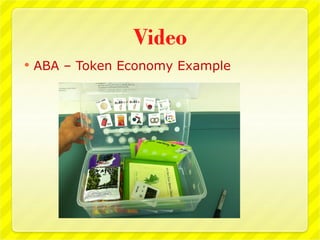
Video
   ABA – Token Economy Example
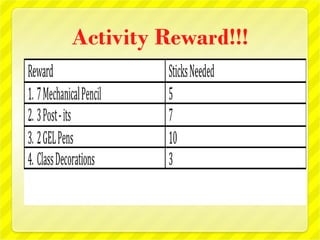
Activity Reward!!!
Summary
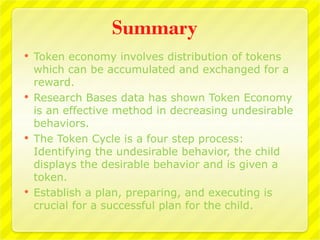
   Token economy involves distribution of tokens
    which can be accumulated and exchanged for a
    reward.
   Research Bases data has shown Token Economy
    is an effective method in decreasing undesirable
    behaviors.
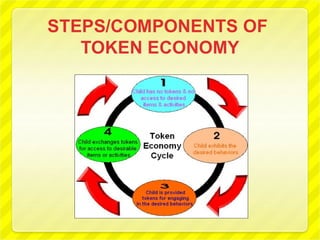
   The Token Cycle is a four step process:
    Identifying the undesirable behavior, the child
    displays the desirable behavior and is given a
    token.
   Establish a plan, preparing, and executing is
    crucial for a successful plan for the child.
 Walker, J.E. Shea, T.M. & Bauer A.M. (2007). Behavior
  Management: A practical approach for educators (9th ed.).
  Columbus, OH: Pearson
 Case 1
  (According to McLaughlin & Williams (1988), Swain & McLaughlin
  (1998)
 Case 2
  Mirzamani, Ashoori, Sereshki (2011)
  Retrieved on 7/12/12 from
  http://www.sid.ir/en/VEWSSID/J_pdf/109520110105
Case 3
   Retrieved on 7/12/12 from
  http://educ6725group2.wikispaces.com/file/view/Token+Economy+Plus+Se
 YouTube. Retrieved on July 11, 2012 from:
  http://www.youtube.com/watch?v=ybIr6NCfA2U

Ed457 tokeneconomy

  • 3.
    Define Token Economy  Understand steps/components of the method  Identify Advantages and Disadvantages of Token Economy  Describe 3 studies that supports the effectiveness of the method
  • 4.
    It is a system of exchange in which the individual earns tokens, as reinforces and exchanges them for tangible and social reinforces
  • 5.
    Token Program involves distribution of tokens  Tokens can be stickers, stars, smiley face, fake money, etc.  Tokens can be accumulated throughout the day and exchanged at a later time
  • 6.
    Tokens are flexible  Tokens can be used for several needs  There is no delay giving tokens after the desired behavior has been shown  It does not matter who gives the tokens  It can be consistently applied by multiple teachers in multiple settings  Prevent Boredom
  • 7.
    Takes a lot of  Parental follow preparation and through does not tracking of the always occur behavior, tokens, and  Can lead to rewards. dependency  Not everyone will  Maybe easily abused respond to token  Can be expensive system.  Require organization  Once the system is and structure implemented in one class, it may not followed through
  • 8.
    11 Basic Ruleswhen establishing Token Economy  Select the Target  Implement the token Behavior economy  Present the target  Provide immediate behavior reinforcement for  Post the Rules and acceptable behavior Review it frequently  Gradually change from  Select a token continuous to variable  Establish Reinforcers schedule of reinforcers which the tokens can  Provide Time for child be exchanged to exchange token  Develop a reward  Revise the reward menu menu frequently.
  • 10.
    The token system has been the most widely researched and validated behavioral intervention in the schools. A token is given when a desired behavior is displayed. (According to McLaughlin & Williams (1988), Swain & McLaughlin (1998)
  • 11.
    Purpose of this investigation was to determine if a token reinforcement program could decrease three inappropriate behaviors (out of seat, talking out, and poor posture) of an elementary student with learning disabilities.  The effects of the token program were examined using a multiple baseline design across behaviors. The results indicated that awarding tokens for the absence of the three target behaviors was an effective procedure.
  • 12.
    Study investigated the effect of social and token economy reinforcements on academic achievement of ten, 9th grade boys with Intellectual disabilities in three junior high school.  Age range from 13-17 and their IQ was between 60-70 were randomly selected. Each assigned in one of the three groups: Token Economy, Social reinforcements and control group.  Used a teacher-made test and the Wechsler Intelligence test  Token Economy and social reinforcements increase the academic achievement of students with ID.
  • 13.
    Results:  Token economy and social reinforcements increased the academic achievement of student with ID  Token economy reinforcements even resulted in an increase in academic achievement than the social reinforcements
  • 14.
    A study examined the effectiveness of a combined token economy and self-monitoring package for a 13 year-old male displaying a major mental illness and severe aggressive and persistent disruptive behavior.  Diagnosis of Bipolar Disorder and Conduct Disorder
  • 15.
    The student received points for lower rates of aggressive/disruptive behavior and ‘bonus’ points for accurately self-monitoring and recording his own behaviors. Results:  The results replicated previous research on the effectiveness of token economy in reducing minor, disruptive and aggressive classroom behaviors. Retrieved on 7/12/12 from http://educ6725group2.wikispaces.com/file/view/Token+Economy+Plus+Self-Moni
  • 16.
    Video  ABA – Token Economy Example
  • 17.
  • 18.
    Summary  Token economy involves distribution of tokens which can be accumulated and exchanged for a reward.  Research Bases data has shown Token Economy is an effective method in decreasing undesirable behaviors.  The Token Cycle is a four step process: Identifying the undesirable behavior, the child displays the desirable behavior and is given a token.  Establish a plan, preparing, and executing is crucial for a successful plan for the child.
  • 19.
     Walker, J.E.Shea, T.M. & Bauer A.M. (2007). Behavior Management: A practical approach for educators (9th ed.). Columbus, OH: Pearson  Case 1 (According to McLaughlin & Williams (1988), Swain & McLaughlin (1998)  Case 2 Mirzamani, Ashoori, Sereshki (2011) Retrieved on 7/12/12 from http://www.sid.ir/en/VEWSSID/J_pdf/109520110105 Case 3 Retrieved on 7/12/12 from http://educ6725group2.wikispaces.com/file/view/Token+Economy+Plus+Se  YouTube. Retrieved on July 11, 2012 from: http://www.youtube.com/watch?v=ybIr6NCfA2U