

BEHAVIORAL CHANGE:
KEY TO ENDING OPEN
DEFECATION – A
ROTARY PROJECT
CASE STUDY
Dr. Prakash Tata, Ph.D.,
BCES, QEP (Emeritus)
Rotary Club of
Naperville, Naperville,
IL USA
Outline of Presentation
Prevalence of open defecation in the world
Why the prevalence of open defecation
Rotary Project case study made in the village of Duppada, District:
Vizianagaram, Andhra Pradesh, India
The conditions prevailing at the beginning of the study in a village
community of 400
Attempts made to mitigate open defecation
Construction and implementation of water supply-sanitation facilities
Progress made and lessons learned
Summary
Prevalence of Open Defecation in the World
Country Wide %
India 48.3
All South Asia 38.1
Pakistan 23.1
Bangladesh 4
Subsaharan Africa 24.9
Nigeria 23
South East Asia 12.5
Indonesia 21.9
Rural Areas %
India 65
All South Asia 52.5
Pakistan 31.3
Bangladesh 5
Subsaharan Africa 34.4
Nigeria 31.5
South East Asia 17.1
Indonesia 30.7
http://www.thehindu.com/data/What-numbers-tell-us-about-Open-Defecation-in-India/article15422326.ece.
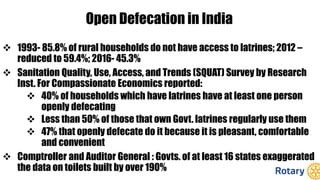
Open Defecation in India
 1993- 85.8% of rural households do not have access to latrines; 2012 –
reduced to 59.4%; 2016- 45.3%
 Sanitation Quality, Use, Access, and Trends (SQUAT) Survey by Research
Inst. For Compassionate Economics reported:
 40% of households which have latrines have at least one person
openly defecating
 Less than 50% of those that own Govt. latrines regularly use them
 47% that openly defecate do it because it is pleasant, comfortable
and convenient
 Comptroller and Auditor General : Govts. of at least 16 states exaggerated
the data on toilets built by over 190%
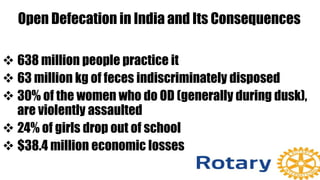
Open Defecation in India and Its Consequences
 638 million people practice it
 63 million kg of feces indiscriminately disposed
 30% of the women who do OD (generally during dusk),
are violently assaulted
 24% of girls drop out of school
 $38.4 million economic losses
Open Defecation in India
 Comptroller and Auditor General : 30% of toilets built were dysfunctional
 National Institute for Transformation of India (NITI): Visible improvement
of coverage of latrines across India undermined by poor quality of
operation and maintenance
 BEHAVIOR CHANGE IS A KEY PRIORITY OF SWACHH BHARATH ABHIYAN (CLEAN
INDIA CAMPAIGN) .
 BUT, 97% OF THE MONEY WAS SPENT ON CONSTRUCTION OF TOILETS; BUT, FIGURES
SHOW ONLY 1% OF TOTAL EXENDITURE FOR INFORMATION, EDUCATION, AND
COMMUNICATION (IEC) ACTIVITIES.
 IEC EXPENDITURE REDUCED FROM RS. 170 CRORES (~$26 MILLION) IN 2013-2014 TO RS.
109 CRORES (~$17 MILLION)
 As of March 31, 2016 54,732 villages are declared OD free of the more than
600, 000 villages. (Answer to a question in the Parliament of India)
Why OD is Prevalent in India
PERCEIVED BENEFITS
Pleasure and Comfort
Get up early, take a walk in the fields in open air, and ease (Healthy
exercise)
UNAFFORDABLE COST FOR CONSTRUCTION OF LATRINES
LACK OF WATER IN SOME AREAS
AGE OLD HABITS (FOR GENERATIONS)
Rotary Project Site
Duppada Village - 400 Population
District: Vizianagaram, A.P. India
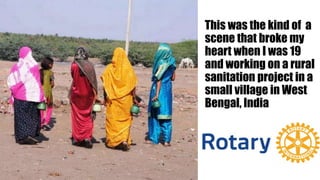
This was the kind of a
scene that broke my
heart when I was 19
and working on a rural
sanitation project in a
small village in West
Bengal, India
CONDITIONS PREVAILING PRIOR TO
PROJECT IMPLEMENTION
Open Defecation– Rotary Project Site
Duppada Village - 400 Population
Before the Project Implementation Open
Defecation in the Community is
Approximately 100 %
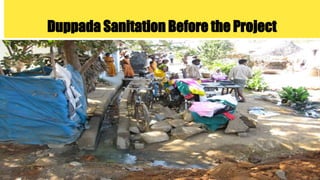
Duppada Sanitation Before the Project
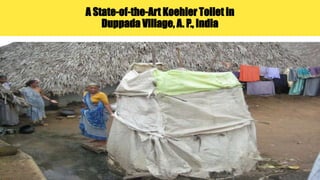
A State-of-the-Art Koehler Toilet in
Duppada Village, A. P., India
 Before the Implementation of the Project Met with the
Villagers Numerous Times and Discussed the
Following:
1. Benefits of the Project (Safe Drinking Water ,
Hygienic Sanitation, Safety, etc.)
2. What they Need to Do and Pledge
3. How Much they are Willing to Contribute
4. Role of Rotarians to Help and Monitor Progress
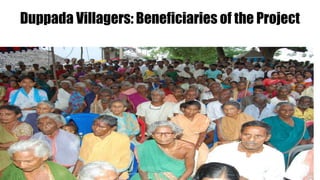
Duppada Villagers: Beneficiaries of the Project
 We got assurances and pledges from the villagers
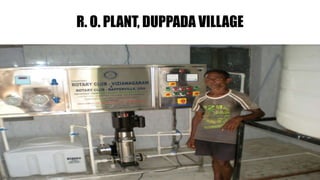
that they will pay a small amount for buying safe
drinking water
--Got pledges that they will regularly use the
bathrooms and latrines, Rotary Clubs of Naperville, IL,
USA and Vizianagaram, Andhra Pradesh, India
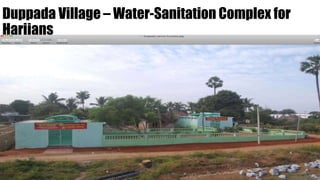
--Built a safe drinking water and sanitation complex
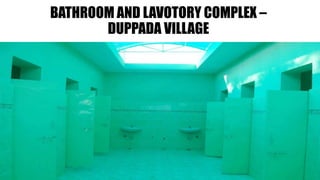
consisting of separate bathrooms and lavatories for
use by men and women.
Villagers agreed to pay Rs. 2 ( $0.03) per 12 liters of
drinking water and regularly use latrines
Duppada Village – Water-Sanitation Complex for
Harijans
BATHROOM AND LAVOTORY COMPLEX –
DUPPADA VILLAGE
R. O. PLANT, DUPPADA VILLAGE
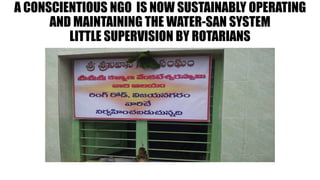
A CONSCIENTIOUS NGO IS NOW SUSTAINABLY OPERATING
AND MAINTAINING THE WATER-SAN SYSTEM
LITTLE SUPERVISION BY ROTARIANS
PROGRESS MADE AND LESSONS LEARNED
 86% OF OPEN DEFECATION ELIMINATED
REVENUE COLLECTED BY THE SALE OF WATER IS SUFFICIENT TO MAINTAIN
AND OPERATE THE WATER-SANITATION COMPLEX
HANDING OVER THE MAINTENANCE AND OPERTATION AND THE SALES OF
WATER BY A COUPON SYSTEM TO A CONSCIENTIOUS NGO RELIEVED THE
BURDEN OF THE ROTARIANS IN VIZIANAGARAM !
I VOLUNTEER TO VISIT THE SITE ANNUALY TO MAKE SURE THAT THE PROJECT
IS WORKING AND SUSTAINING
PROGRESS MADE AND LESSONS LEARNED
DO NOT EXPECT TOO MUCH FROM POLITICIANS
BEHAVIOR OF VILLAGERS CAN BE CHANGED; IMPLEMENT A PROJECT ONLY
AFTER ENSURING THAT VILLAGERS WILL COOPERATE
Success of the project will be assured when ROTARIANS, WHO ARE
INVOLVED WITH THE DESIGN AND IMPLEMENTATION OF THE PROJECT WORK
WITH A “SERVICE ABOVE SELF” ATTITUDE , AND REGULARLY VISIT THE
VILLAGERS TO INQUIRE ABOUT THEIR SAFETY, HEALTH, AND WELLBEING
SUMMARY
Dreams can be realized if one does work with
PASSION
PERSISTENCE
PERFECTION
--PRAKASH
“Be The Change That You Want to See in The World.” - M. K. Gandhi

Behavior Change: The Key To Ending Open Defecation

  • 1.
    BEHAVIORAL CHANGE: KEY TOENDING OPEN DEFECATION – A ROTARY PROJECT CASE STUDY Dr. Prakash Tata, Ph.D., BCES, QEP (Emeritus) Rotary Club of Naperville, Naperville, IL USA
  • 2.
    Outline of Presentation Prevalenceof open defecation in the world Why the prevalence of open defecation Rotary Project case study made in the village of Duppada, District: Vizianagaram, Andhra Pradesh, India The conditions prevailing at the beginning of the study in a village community of 400 Attempts made to mitigate open defecation Construction and implementation of water supply-sanitation facilities Progress made and lessons learned Summary
  • 3.
    Prevalence of OpenDefecation in the World Country Wide % India 48.3 All South Asia 38.1 Pakistan 23.1 Bangladesh 4 Subsaharan Africa 24.9 Nigeria 23 South East Asia 12.5 Indonesia 21.9 Rural Areas % India 65 All South Asia 52.5 Pakistan 31.3 Bangladesh 5 Subsaharan Africa 34.4 Nigeria 31.5 South East Asia 17.1 Indonesia 30.7 http://www.thehindu.com/data/What-numbers-tell-us-about-Open-Defecation-in-India/article15422326.ece.
  • 4.
    Open Defecation inIndia  1993- 85.8% of rural households do not have access to latrines; 2012 – reduced to 59.4%; 2016- 45.3%  Sanitation Quality, Use, Access, and Trends (SQUAT) Survey by Research Inst. For Compassionate Economics reported:  40% of households which have latrines have at least one person openly defecating  Less than 50% of those that own Govt. latrines regularly use them  47% that openly defecate do it because it is pleasant, comfortable and convenient  Comptroller and Auditor General : Govts. of at least 16 states exaggerated the data on toilets built by over 190%
  • 5.
    Open Defecation inIndia and Its Consequences  638 million people practice it  63 million kg of feces indiscriminately disposed  30% of the women who do OD (generally during dusk), are violently assaulted  24% of girls drop out of school  $38.4 million economic losses
  • 6.
    Open Defecation inIndia  Comptroller and Auditor General : 30% of toilets built were dysfunctional  National Institute for Transformation of India (NITI): Visible improvement of coverage of latrines across India undermined by poor quality of operation and maintenance  BEHAVIOR CHANGE IS A KEY PRIORITY OF SWACHH BHARATH ABHIYAN (CLEAN INDIA CAMPAIGN) .  BUT, 97% OF THE MONEY WAS SPENT ON CONSTRUCTION OF TOILETS; BUT, FIGURES SHOW ONLY 1% OF TOTAL EXENDITURE FOR INFORMATION, EDUCATION, AND COMMUNICATION (IEC) ACTIVITIES.  IEC EXPENDITURE REDUCED FROM RS. 170 CRORES (~$26 MILLION) IN 2013-2014 TO RS. 109 CRORES (~$17 MILLION)  As of March 31, 2016 54,732 villages are declared OD free of the more than 600, 000 villages. (Answer to a question in the Parliament of India)
  • 7.
    Why OD isPrevalent in India PERCEIVED BENEFITS Pleasure and Comfort Get up early, take a walk in the fields in open air, and ease (Healthy exercise) UNAFFORDABLE COST FOR CONSTRUCTION OF LATRINES LACK OF WATER IN SOME AREAS AGE OLD HABITS (FOR GENERATIONS)
  • 9.
    Rotary Project Site DuppadaVillage - 400 Population District: Vizianagaram, A.P. India
  • 10.
    This was thekind of a scene that broke my heart when I was 19 and working on a rural sanitation project in a small village in West Bengal, India
  • 11.
    CONDITIONS PREVAILING PRIORTO PROJECT IMPLEMENTION
  • 12.
    Open Defecation– RotaryProject Site Duppada Village - 400 Population Before the Project Implementation Open Defecation in the Community is Approximately 100 %
  • 13.
  • 14.
    A State-of-the-Art KoehlerToilet in Duppada Village, A. P., India
  • 15.
     Before theImplementation of the Project Met with the Villagers Numerous Times and Discussed the Following: 1. Benefits of the Project (Safe Drinking Water , Hygienic Sanitation, Safety, etc.) 2. What they Need to Do and Pledge 3. How Much they are Willing to Contribute 4. Role of Rotarians to Help and Monitor Progress
  • 16.
  • 17.
     We gotassurances and pledges from the villagers that they will pay a small amount for buying safe drinking water --Got pledges that they will regularly use the bathrooms and latrines, Rotary Clubs of Naperville, IL, USA and Vizianagaram, Andhra Pradesh, India --Built a safe drinking water and sanitation complex consisting of separate bathrooms and lavatories for use by men and women. Villagers agreed to pay Rs. 2 ( $0.03) per 12 liters of drinking water and regularly use latrines
  • 18.
    Duppada Village –Water-Sanitation Complex for Harijans
  • 19.
    BATHROOM AND LAVOTORYCOMPLEX – DUPPADA VILLAGE
  • 20.
    R. O. PLANT,DUPPADA VILLAGE
  • 21.
    A CONSCIENTIOUS NGOIS NOW SUSTAINABLY OPERATING AND MAINTAINING THE WATER-SAN SYSTEM LITTLE SUPERVISION BY ROTARIANS
  • 22.
    PROGRESS MADE ANDLESSONS LEARNED  86% OF OPEN DEFECATION ELIMINATED REVENUE COLLECTED BY THE SALE OF WATER IS SUFFICIENT TO MAINTAIN AND OPERATE THE WATER-SANITATION COMPLEX HANDING OVER THE MAINTENANCE AND OPERTATION AND THE SALES OF WATER BY A COUPON SYSTEM TO A CONSCIENTIOUS NGO RELIEVED THE BURDEN OF THE ROTARIANS IN VIZIANAGARAM ! I VOLUNTEER TO VISIT THE SITE ANNUALY TO MAKE SURE THAT THE PROJECT IS WORKING AND SUSTAINING
  • 23.
    PROGRESS MADE ANDLESSONS LEARNED DO NOT EXPECT TOO MUCH FROM POLITICIANS BEHAVIOR OF VILLAGERS CAN BE CHANGED; IMPLEMENT A PROJECT ONLY AFTER ENSURING THAT VILLAGERS WILL COOPERATE Success of the project will be assured when ROTARIANS, WHO ARE INVOLVED WITH THE DESIGN AND IMPLEMENTATION OF THE PROJECT WORK WITH A “SERVICE ABOVE SELF” ATTITUDE , AND REGULARLY VISIT THE VILLAGERS TO INQUIRE ABOUT THEIR SAFETY, HEALTH, AND WELLBEING
  • 24.
    SUMMARY Dreams can berealized if one does work with PASSION PERSISTENCE PERFECTION --PRAKASH
  • 25.
    “Be The ChangeThat You Want to See in The World.” - M. K. Gandhi