
Community Led Total Sanitation (CLTS), Origin, Spread and Scaling upDr. Kamal KarCLTS Foundation, Calcutta, IndiaPresented at the WASH Conference 201116-20 May  2011
Globally millions of tones of human excreta poured in the open everydayIn India alone nearly 600 millions are practicing open defecation, thousands of truck loads of shit is being released in the open everyday, more than 42 children dying every hour from diarrhea, & waterborne enteric diseasesOD contaminates water bodies on a daily basis and valuable human excreta not used in food security A child dies in every 15 second, millions of U5 children suffering sever bouts of diarrhea (mostly poor)
Traditional - professional ‘mind-set’ in tackling the problemsSubsidize   * Standardize *Prescribe * Top-down hygiene behaviour teaching* Health as key motivator for hygiene behaviour change Attract the poor in ways like rewards so that they use toilets
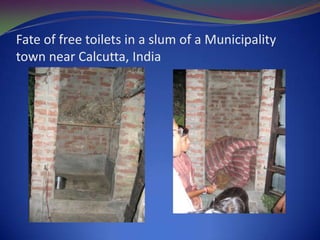
Fate of free toilets in a slum of a Municipality town near Calcutta, India
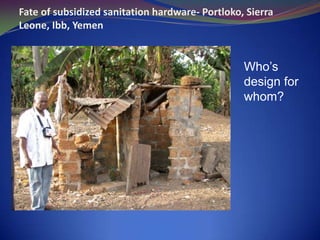
Fate of subsidized sanitation hardware- Portloko, Sierra  Leone, Ibb, Yemen Who’s design for whom?
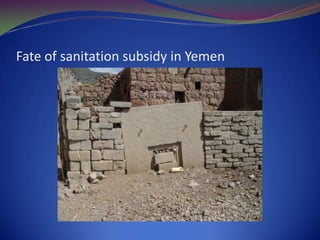
Fate of sanitation subsidy in Yemen
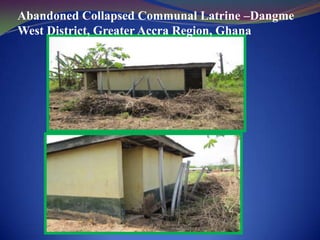
Abandoned Collapsed Communal Latrine –Dangme West District, Greater Accra Region, Ghana
The OriginOriginated in Bangladesh in 1999-2000 from the process of evaluation of a traditional WATSAN projectSpread rapidly in Bangladesh through NGOs mainly Water Aid, Plan International and partner NGOsDFID supported scaling it up in BangladeshWSP (SA and EAP) was instrumental in bringing it to India, Indonesia, and other countries in South Asia and East Asia Pacific regionsThrough Plan International introduced in 13 countries in Eastern and Southern Africa in 2007Since 2008 with support of UNICEF introduced in 22 countries in Africa including West and Central Africa and in Latin America (Bolivia)
More than 20 million people in 44 countries across Asia, Africa and Latin America benefit from CLTS
More than 1000 facilitators and trainers in these countries have been actively engaged in implementing and training of CLTS
The Hand Book on CLTS has been translated in to at least ten different languages including French, Spanish and PortugueseWhat  is Community – Led Total Sanitation ?They are total & involve/affect everyone in communities e.g. total elimination of open defecation, total freedom from hunger)Collective Community decision & collective local action are the keysSocial Solidarity and cooperation are in abundance They are locally decided and don't dependent on external subsidies and prescriptions or pressuresNatural Leaders emerge from collective local actions who lead future collective initiativesThey often don’t follow externally determined mode of development and blue print Local diversity and innovations are main elements
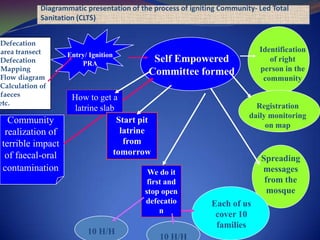
Identification of right person in the communitySelf Empowered Committee formedDefecation     area transect Defecation    Mapping Flow diagram
 Calculation of    faeces  etc.Entry/ IgnitionPRA How to get a latrine slabRegistration daily monitoring on mapStart pit latrine from tomorrowCommunity realization of terrible impact of faecal-oral contaminationSpreading messages from the mosqueWe do it first and stop open defecationEach of us cover 10 families10 H/H10 H/HDiagrammatic presentation of the process of igniting Community- Led Total Sanitation (CLTS)
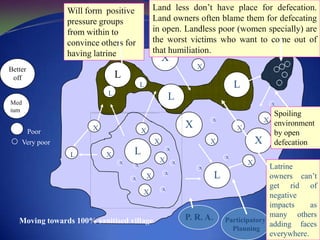
Land less don’t have place for defecation. Land owners often blame them for defecating in open. Landless poor (women specially) are the worst victims who want to come out of that humiliation.Will form  positive pressure groups from within to convince others for having latrineXBetter offXXLXXLXLXLLMediumXSpoiling environment by open defecationXXXXXXPoorXXXVery poorLLXXXXLatrine owners can’t get rid of   negative impacts as many others  adding faces everywhere.LXXXXXXXXParticipatory PlanningP. R. A.XXXMoving towards 100% sanitised village
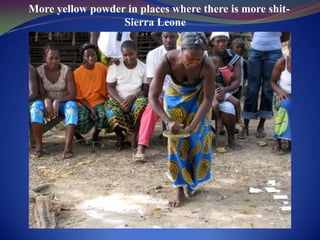
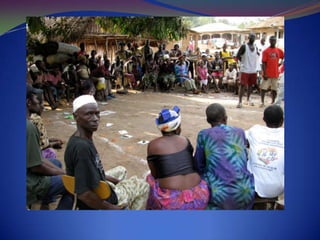
More yellow powder in places where there is more shit- 			Sierra Leone
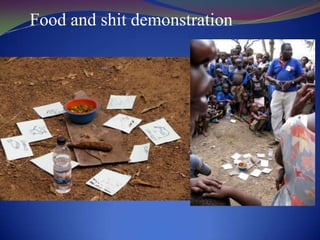
Food and shit demonstration
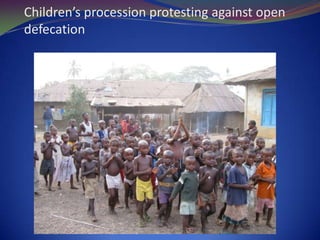
Children’s procession protesting against open defecation
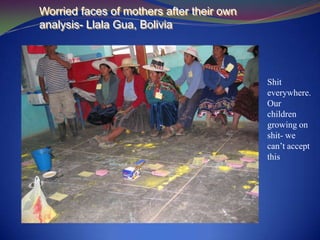
Worried faces of mothers after their own analysis- Llala Gua, BoliviaShit everywhere. Our children growing on shit- we can’t accept this
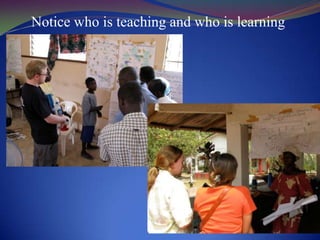
Notice who is teaching and who is learning
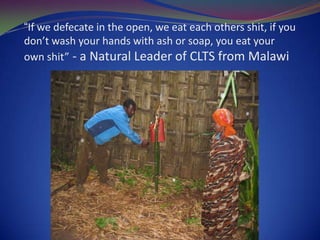
“If we defecate in the open, we eat each others shit, if you don’t wash your hands with ash or soap, you eat your own shit” - a Natural Leader of CLTS from Malawi
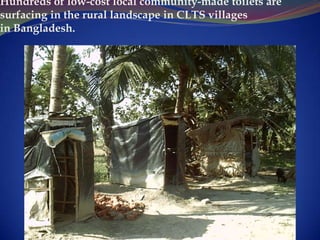
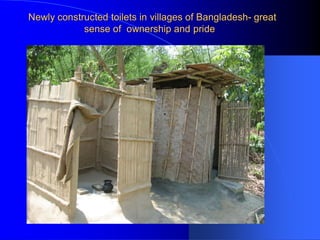
Hundreds of low-cost local community-made toilets are surfacing in the rural landscape in CLTS villages in Bangladesh.
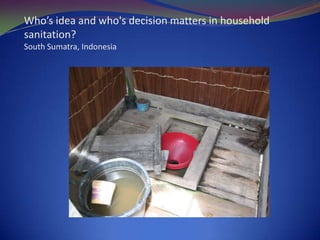
Who’s idea and who's decision matters in household sanitation?South Sumatra, Indonesia
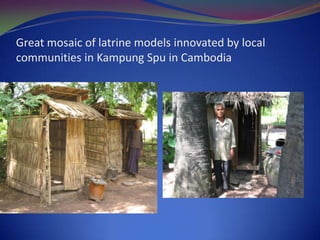
Great mosaic of latrine models innovated by local communities in Kampung Spu in Cambodia
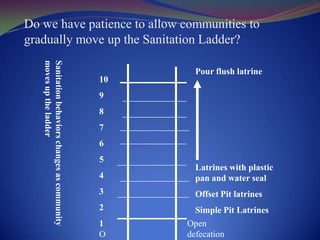
Do we have patience to allow communities to gradually move up the Sanitation Ladder? Sanitation behaviors changes as community moves up the ladderPour flush latrineLatrines with plastic pan and water sealOffset Pit latrinesSimple Pit Latrines10987654321Open defecationO
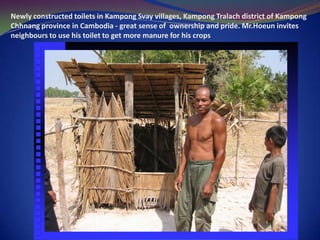
Newly constructed toilets in Kampong Svay villages, Kampong Tralach district of Kampong Chhnang province in Cambodia - great sense of  ownership and pride. Mr.Hoeun invites neighbours to use his toilet to get more manure for his crops
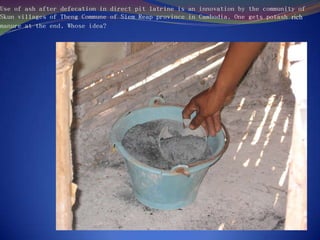
Use of ash after defecation in direct pit latrine is an innovation by the community of Skun villages of Tbeng Commune of Siem Reap province in Cambodia. One gets potash rich manure at the end. Whose idea?
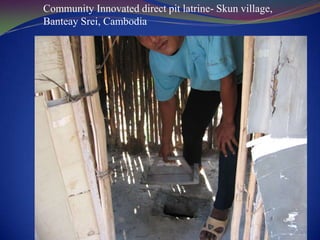
Community Innovated direct pit latrine- Skun village, Banteay Srei, Cambodia
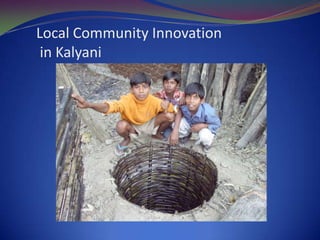
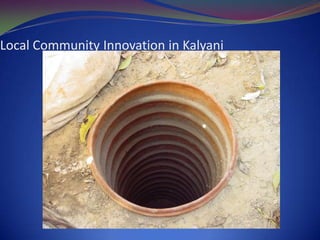
Local Community Innovation in Kalyani
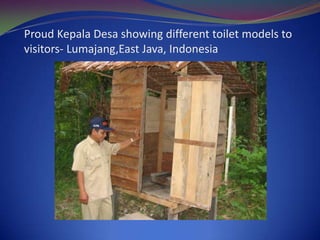
Proud Kepala Desa showing different toilet models to visitors- Lumajang,East Java, Indonesia
Local Community Innovation in Kalyani
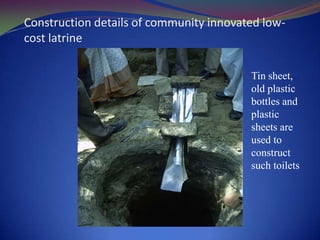
Construction details of community innovated low-cost latrineTin sheet, old plastic bottles and plastic sheets are used to construct such toilets
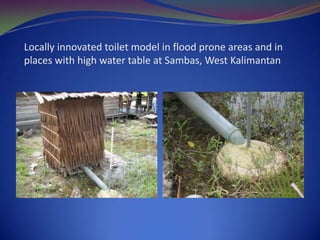
Locally innovated toilet model in flood prone areas and in places with high water table at Sambas, West Kalimantan
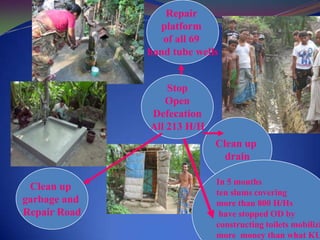
Repair platform of all 69 hand tube wellsStop Open DefecationAll 213 H/HClean up drainIn 5 monthsten slums covering more than 800 H/Hs have stopped OD by constructing toilets mobilizing more  money than what KUSP could offer as subsidy  Clean up garbage and Repair Road
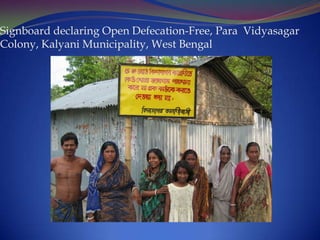
Signboard declaring Open Defecation-Free, Para  Vidyasagar Colony, Kalyani Municipality, West Bengal
Are these all sustainable change or just another jargon?Communities in ODF villages in Bangladesh, Kenya, in Mekong delta and in other countries rebuilt their toilets after they were destroyed by flooding
Reduction in Cholera and diarrhea in the districts of Nyando, Busia, Siaya in Nyanza and Western provinces of Kenya after CLTS was introduced never returned back with that severity. All communities seriously maintain ODF status
100% ODF villages in many communities did loose that that status but never returned to the level where they were before CLTSQuack doctors in thousands of villages lost their income seriously
Sale of medicines of diarrhea/dysentery dropped in village medicine shops
Sale of sanitary hardware in shops in village shops in Indonesia increased sharply
Everyday new villages all over the world are declaring themselves ODF
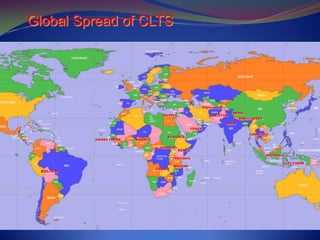
For more please look at the book “Shit Matters”Global Spread of CLTS AfghanistanNEPALPAKISTANEGYPTBANGLADESHINDIAYEMENCAMBODIAETHIOPIASIERRA LEONENIGERIAUGANDAKENYAINDONESIATANZANIAEAST TIMORMALAWIZAMBIABOLIVIA
What are the major challenges of sustainability? In the next slide
Challenge of multiplying Facilitators, Trainers and Community ConsultantsThe pace with which demand for CLTS is growing there is need to train hundreds of trainers immediately in Africa and Latin America (Franco phone Africa, Spanish speaking countries specially)Thousands of ‘Natural Leaders’ turned in to ‘Community Consultants’ with in countries Dozens of Champions with in the Government Ministries and DepartmentsA few Ministers and MPs or elected people’s representatives in each countries
Institutional ChallengesAttitudes and mind sets of professionals in the institutions and their belief on local community capacityFeeling of loosing control and technical and academic supremacy by engineering, health and social development professionalsInstitutional hierarchy and unclear understanding of the ground reality including poor functional linkages with the front line
Institutional ChallengesDifficulty to escape from the old established mind-set of ‘donor’ and ‘recipient’ defining ‘uppers’ and ‘lowers’Inertia in moving out of the preference of ‘things’  to ‘people’. Shiftfrom‘latrine construction’ to ‘creating Natural Leaders’ and ‘ODF villages’Pressure of spending huge sums Variations in the focus of institutions working only on water and sanitation versus those working with wider humane objectives
Institutional ChallengesCLTS as a fad and some have their own version of ‘community led’(subtle difference between ‘functional participation’ to ‘interactive participation’ or ‘self mobilization’)Struggle to streamline other approaches of sanitation with true empowerment encouraged in CLTS. TSSM in Indonesia, TSC in India, others in Ethiopia, individual house hold vs communityCLTS is just one another approach and it might survive better if other sanitation approaches work freely without using this label. All approaches have uniqueness.
Institutional ChallengesChallenges of intellectual institutional supremacy- who knows more and who prescribes the best solutions?Competition for attracting more donor funding by implementing agenciesStruggle and compromise to fit in a new community led approach in the old existing system of government structure designed to perform in a ‘supply driven’ rather than ‘demand driven’ mode
Political ChallengesAsia: Countries like India, China with better per capita still support subsidized, externally prescribed household sanitation where as countries like Bangladesh, Cambodia scaled up CLTS exponentially. Percentage of usage of externally funded toilets are appallingAfrica: Quicker understanding and acceptance of the approach by governments of Sierra Leone, Malawi, Zambia, Ethiopia
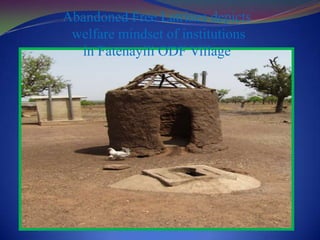
Abandoned Free Latrines depicts welfare mindset of institutions in Fatenayili ODF Village
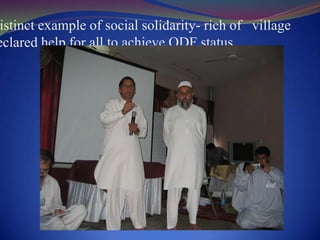
Existing ‘Social solidarity and community cooperation’ as insider to insider subsidy- can those be recognized?Need to document and recognize huge local resources mobilized by local communities

Community-Led Total Sanitation (CLTS)

  • 1.
    Community Led TotalSanitation (CLTS), Origin, Spread and Scaling upDr. Kamal KarCLTS Foundation, Calcutta, IndiaPresented at the WASH Conference 201116-20 May 2011
  • 2.
    Globally millions oftones of human excreta poured in the open everydayIn India alone nearly 600 millions are practicing open defecation, thousands of truck loads of shit is being released in the open everyday, more than 42 children dying every hour from diarrhea, & waterborne enteric diseasesOD contaminates water bodies on a daily basis and valuable human excreta not used in food security A child dies in every 15 second, millions of U5 children suffering sever bouts of diarrhea (mostly poor)
  • 3.
    Traditional - professional‘mind-set’ in tackling the problemsSubsidize * Standardize *Prescribe * Top-down hygiene behaviour teaching* Health as key motivator for hygiene behaviour change Attract the poor in ways like rewards so that they use toilets
  • 4.
    Fate of freetoilets in a slum of a Municipality town near Calcutta, India
  • 5.
    Fate of subsidizedsanitation hardware- Portloko, Sierra Leone, Ibb, Yemen Who’s design for whom?
  • 6.
    Fate of sanitationsubsidy in Yemen
  • 7.
    Abandoned Collapsed CommunalLatrine –Dangme West District, Greater Accra Region, Ghana
  • 8.
    The OriginOriginated inBangladesh in 1999-2000 from the process of evaluation of a traditional WATSAN projectSpread rapidly in Bangladesh through NGOs mainly Water Aid, Plan International and partner NGOsDFID supported scaling it up in BangladeshWSP (SA and EAP) was instrumental in bringing it to India, Indonesia, and other countries in South Asia and East Asia Pacific regionsThrough Plan International introduced in 13 countries in Eastern and Southern Africa in 2007Since 2008 with support of UNICEF introduced in 22 countries in Africa including West and Central Africa and in Latin America (Bolivia)
  • 9.
    More than 20million people in 44 countries across Asia, Africa and Latin America benefit from CLTS
  • 10.
    More than 1000facilitators and trainers in these countries have been actively engaged in implementing and training of CLTS
  • 11.
    The Hand Bookon CLTS has been translated in to at least ten different languages including French, Spanish and PortugueseWhat is Community – Led Total Sanitation ?They are total & involve/affect everyone in communities e.g. total elimination of open defecation, total freedom from hunger)Collective Community decision & collective local action are the keysSocial Solidarity and cooperation are in abundance They are locally decided and don't dependent on external subsidies and prescriptions or pressuresNatural Leaders emerge from collective local actions who lead future collective initiativesThey often don’t follow externally determined mode of development and blue print Local diversity and innovations are main elements
  • 12.
    Identification of rightperson in the communitySelf Empowered Committee formedDefecation area transect Defecation Mapping Flow diagram
  • 13.
    Calculation of faeces etc.Entry/ IgnitionPRA How to get a latrine slabRegistration daily monitoring on mapStart pit latrine from tomorrowCommunity realization of terrible impact of faecal-oral contaminationSpreading messages from the mosqueWe do it first and stop open defecationEach of us cover 10 families10 H/H10 H/HDiagrammatic presentation of the process of igniting Community- Led Total Sanitation (CLTS)
  • 14.
    Land less don’thave place for defecation. Land owners often blame them for defecating in open. Landless poor (women specially) are the worst victims who want to come out of that humiliation.Will form positive pressure groups from within to convince others for having latrineXBetter offXXLXXLXLXLLMediumXSpoiling environment by open defecationXXXXXXPoorXXXVery poorLLXXXXLatrine owners can’t get rid of negative impacts as many others adding faces everywhere.LXXXXXXXXParticipatory PlanningP. R. A.XXXMoving towards 100% sanitised village
  • 15.
    More yellow powderin places where there is more shit- Sierra Leone
  • 17.
    Food and shitdemonstration
  • 18.
    Children’s procession protestingagainst open defecation
  • 19.
    Worried faces ofmothers after their own analysis- Llala Gua, BoliviaShit everywhere. Our children growing on shit- we can’t accept this
  • 20.
    Notice who isteaching and who is learning
  • 21.
    “If we defecatein the open, we eat each others shit, if you don’t wash your hands with ash or soap, you eat your own shit” - a Natural Leader of CLTS from Malawi
  • 22.
    Hundreds of low-costlocal community-made toilets are surfacing in the rural landscape in CLTS villages in Bangladesh.
  • 23.
    Who’s idea andwho's decision matters in household sanitation?South Sumatra, Indonesia
  • 25.
    Great mosaic oflatrine models innovated by local communities in Kampung Spu in Cambodia
  • 26.
    Do we havepatience to allow communities to gradually move up the Sanitation Ladder? Sanitation behaviors changes as community moves up the ladderPour flush latrineLatrines with plastic pan and water sealOffset Pit latrinesSimple Pit Latrines10987654321Open defecationO
  • 27.
    Newly constructed toiletsin Kampong Svay villages, Kampong Tralach district of Kampong Chhnang province in Cambodia - great sense of ownership and pride. Mr.Hoeun invites neighbours to use his toilet to get more manure for his crops
  • 28.
    Use of ashafter defecation in direct pit latrine is an innovation by the community of Skun villages of Tbeng Commune of Siem Reap province in Cambodia. One gets potash rich manure at the end. Whose idea?
  • 29.
    Community Innovated directpit latrine- Skun village, Banteay Srei, Cambodia
  • 30.
  • 31.
    Proud Kepala Desashowing different toilet models to visitors- Lumajang,East Java, Indonesia
  • 32.
  • 33.
    Construction details ofcommunity innovated low-cost latrineTin sheet, old plastic bottles and plastic sheets are used to construct such toilets
  • 34.
    Locally innovated toiletmodel in flood prone areas and in places with high water table at Sambas, West Kalimantan
  • 35.
    Repair platform ofall 69 hand tube wellsStop Open DefecationAll 213 H/HClean up drainIn 5 monthsten slums covering more than 800 H/Hs have stopped OD by constructing toilets mobilizing more money than what KUSP could offer as subsidy Clean up garbage and Repair Road
  • 36.
    Signboard declaring OpenDefecation-Free, Para Vidyasagar Colony, Kalyani Municipality, West Bengal
  • 37.
    Are these allsustainable change or just another jargon?Communities in ODF villages in Bangladesh, Kenya, in Mekong delta and in other countries rebuilt their toilets after they were destroyed by flooding
  • 38.
    Reduction in Choleraand diarrhea in the districts of Nyando, Busia, Siaya in Nyanza and Western provinces of Kenya after CLTS was introduced never returned back with that severity. All communities seriously maintain ODF status
  • 39.
    100% ODF villagesin many communities did loose that that status but never returned to the level where they were before CLTSQuack doctors in thousands of villages lost their income seriously
  • 40.
    Sale of medicinesof diarrhea/dysentery dropped in village medicine shops
  • 41.
    Sale of sanitaryhardware in shops in village shops in Indonesia increased sharply
  • 42.
    Everyday new villagesall over the world are declaring themselves ODF
  • 43.
    For more pleaselook at the book “Shit Matters”Global Spread of CLTS AfghanistanNEPALPAKISTANEGYPTBANGLADESHINDIAYEMENCAMBODIAETHIOPIASIERRA LEONENIGERIAUGANDAKENYAINDONESIATANZANIAEAST TIMORMALAWIZAMBIABOLIVIA
  • 44.
    What are themajor challenges of sustainability? In the next slide
  • 45.
    Challenge of multiplyingFacilitators, Trainers and Community ConsultantsThe pace with which demand for CLTS is growing there is need to train hundreds of trainers immediately in Africa and Latin America (Franco phone Africa, Spanish speaking countries specially)Thousands of ‘Natural Leaders’ turned in to ‘Community Consultants’ with in countries Dozens of Champions with in the Government Ministries and DepartmentsA few Ministers and MPs or elected people’s representatives in each countries
  • 46.
    Institutional ChallengesAttitudes andmind sets of professionals in the institutions and their belief on local community capacityFeeling of loosing control and technical and academic supremacy by engineering, health and social development professionalsInstitutional hierarchy and unclear understanding of the ground reality including poor functional linkages with the front line
  • 47.
    Institutional ChallengesDifficulty toescape from the old established mind-set of ‘donor’ and ‘recipient’ defining ‘uppers’ and ‘lowers’Inertia in moving out of the preference of ‘things’ to ‘people’. Shiftfrom‘latrine construction’ to ‘creating Natural Leaders’ and ‘ODF villages’Pressure of spending huge sums Variations in the focus of institutions working only on water and sanitation versus those working with wider humane objectives
  • 48.
    Institutional ChallengesCLTS asa fad and some have their own version of ‘community led’(subtle difference between ‘functional participation’ to ‘interactive participation’ or ‘self mobilization’)Struggle to streamline other approaches of sanitation with true empowerment encouraged in CLTS. TSSM in Indonesia, TSC in India, others in Ethiopia, individual house hold vs communityCLTS is just one another approach and it might survive better if other sanitation approaches work freely without using this label. All approaches have uniqueness.
  • 49.
    Institutional ChallengesChallenges ofintellectual institutional supremacy- who knows more and who prescribes the best solutions?Competition for attracting more donor funding by implementing agenciesStruggle and compromise to fit in a new community led approach in the old existing system of government structure designed to perform in a ‘supply driven’ rather than ‘demand driven’ mode
  • 50.
    Political ChallengesAsia: Countrieslike India, China with better per capita still support subsidized, externally prescribed household sanitation where as countries like Bangladesh, Cambodia scaled up CLTS exponentially. Percentage of usage of externally funded toilets are appallingAfrica: Quicker understanding and acceptance of the approach by governments of Sierra Leone, Malawi, Zambia, Ethiopia
  • 51.
    Abandoned Free Latrinesdepicts welfare mindset of institutions in Fatenayili ODF Village
  • 52.
    Existing ‘Social solidarityand community cooperation’ as insider to insider subsidy- can those be recognized?Need to document and recognize huge local resources mobilized by local communities