Submitted to :-
Dr. Naveen Bishnoi
Submitted by:-
Bhanuja Jodha
Objectives of the project
• What is sanitation ?
• Introduction to the problem.
• Ill effects of poor sanitation on health in rural
and urban areas.
• Obstacles in achieving proper sanitation
• What can be done ?
• Some facts on sanitation
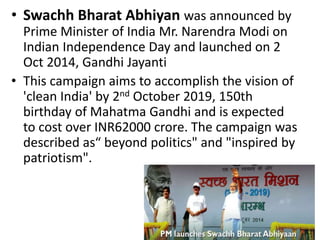
• Swachh Bharat Abhiyan was announced by
Prime Minister of India Mr. Narendra Modi on
Indian Independence Day and launched on 2
Oct 2014, Gandhi Jayanti
• This campaign aims to accomplish the vision of
'clean India' by 2nd October 2019, 150th
birthday of Mahatma Gandhi and is expected
to cost over INR62000 crore. The campaign was
described as“ beyond politics" and "inspired by
patriotism".
Definition of sanitation
• . Sanitation generally refers to the provision
of facilities and services for the safe disposal
of human urine and feces. The word
'sanitation' also refers to the maintenance of
hygienic conditions, through services such as
garbage collection and wastewater disposal
Poor
education
POOR
SANITATION
DISEASES
Poverty
VICIOUS CYCLE
RURAL sanitation
• Rural School Sanitation focusing on separate toilets for
girls and boys. Water will be provided inside the
toilets.
• Children can be effective sanitation communicators
to spread the message of safe sanitation to all.
• Women and girls will no longer have to wait for
darkness to defecate.
• Inadequate access to water, sanitation and hygiene
services keep children especially adolescent girls out
of school, and keeps women in poor health and in
poverty and destined to bear and raise children who
are sick and nutritionally poor.
• Construction of individual house hold latrines
• Behavioral problem is the biggest obstacle.
• Community Sanitary Complexes comprising an
appropriate number of toilet seats, bathing cubicles
,washing platforms, wash basins etc, can be set up in a
place in the village acceptable and accessible to all.
• Proper Solid and Liquid Waste Management.
Urban sanitation
• Inadequate availability of spaces in slums and
urban areas promote open defecation.
• Increased population in cities
• No proper waste disposal management is
present. Poor unhygienic conditions prevail.
• The old sewage system has not been renewed
to meet the today's demands
• Socio economic inequalities
Impact of poor sanitation on health
• Diarrhoeal diseases
• Environmental enteropathy
• Nematode infections
• Malnutrition ,shunting
• Fecally transmitted diseases.
• The Human waste is full of disease-causing
bacteria contaminating the air, food and water.
When the human shit is produced in the open
and remains untreated, it interacts with the
food chain through soil, water and crops.
• Swachh bharat mission-Garmin
• • Coordinated by ministry of drinking water and sanitation.
1,86,208 villages has been declared ODF. Almost all gram
panchayats are directly connected to SBM. Formation of
monitoring groups named as ‘nigrani samiti’.
• • Swachh app was launched on
• Swachh bharat mission-Urban
• • Coordinated by ministry of urban development. 531 cities has
been declared
• open defecation free. Compost banao compost apnao for
making compost
• from urban solid waste.• 1,15,786 communities toilets to be
made.
• • Door to door collection of domestic waste.
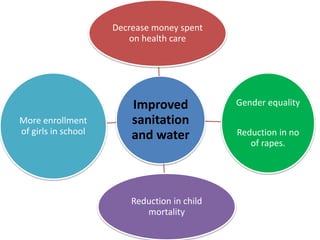
Improved
sanitation
and water
Decrease money spent
on health care
Gender equality
Reduction in no
of rapes.
Reduction in child
mortality
More enrollment
of girls in school
Obstacles in achieving proper
sanitation
• Lack of awareness in people about proper
sanitation.
• Delayed implementation of laws.
• To change the mind set of the people to stop
defecation in open. Behavioral changes in
people are more important.
• Availability of water for toilets especially in
rural areas.
• Lack of proper disposal system.
• Socio – economic factors like poverty and
caste discrimination.
Impact of proper sanitation on health
• There is also suggestive evidence that improving sanitation can decrease
stunting.
• Proper sanitation decreases morbidity and mortality rates
• Sanitation so described is important as it separates humans from excreta. A
safe toilet accompanied by hand washing with soap, provides an effective
barrier to transmission of disease
• Improved school sanitation facilities have an impact on attendance and
retention,
• Increasing employment rates and quality of life
• Improved sanitation and hand washing facilities have a particularly positive
impact on the education opportunities of young girls, who are
disproportionately affected by lack of privacy and cleanliness during their
period.
• PRIVACY AND DIGNITY IS MAINTAINED
We can do little things
• Self awareness is most important
• Organize different awareness programs on cleanliness
and sanitation.
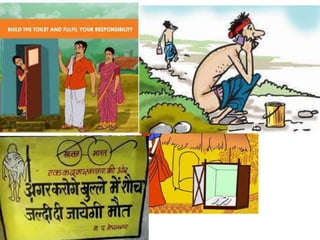
• Construction of toilets in schools and public places.
• Programs to eliminate open defecation.
• Make people aware about the health issues raise
because of open defecation.
• Solid and liquid waste management.
• Always keep your home and workplace Clean.
• Not just constructing toilets, but changing social norms
Not individuals, but the community
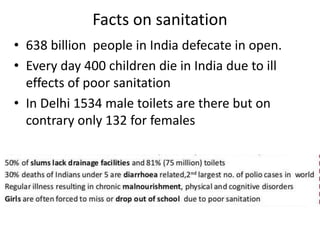
Facts on sanitation
• 638 billion people in India defecate in open.
• Every day 400 children die in India due to ill
effects of poor sanitation
• In Delhi 1534 male toilets are there but on
contrary only 132 for females
Sanitation is more important than freedom.
THANK YOU !!!

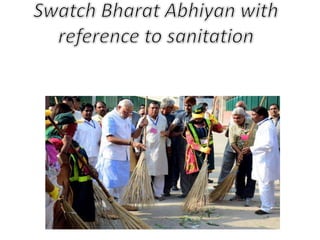
Swatch bharat abhiyan

  • 1.
    Submitted to :- Dr.Naveen Bishnoi Submitted by:- Bhanuja Jodha
  • 4.
    Objectives of theproject • What is sanitation ? • Introduction to the problem. • Ill effects of poor sanitation on health in rural and urban areas. • Obstacles in achieving proper sanitation • What can be done ? • Some facts on sanitation
  • 5.
    • Swachh BharatAbhiyan was announced by Prime Minister of India Mr. Narendra Modi on Indian Independence Day and launched on 2 Oct 2014, Gandhi Jayanti • This campaign aims to accomplish the vision of 'clean India' by 2nd October 2019, 150th birthday of Mahatma Gandhi and is expected to cost over INR62000 crore. The campaign was described as“ beyond politics" and "inspired by patriotism".
  • 6.
    Definition of sanitation •. Sanitation generally refers to the provision of facilities and services for the safe disposal of human urine and feces. The word 'sanitation' also refers to the maintenance of hygienic conditions, through services such as garbage collection and wastewater disposal
  • 7.
  • 8.
    RURAL sanitation • RuralSchool Sanitation focusing on separate toilets for girls and boys. Water will be provided inside the toilets. • Children can be effective sanitation communicators to spread the message of safe sanitation to all. • Women and girls will no longer have to wait for darkness to defecate. • Inadequate access to water, sanitation and hygiene services keep children especially adolescent girls out of school, and keeps women in poor health and in poverty and destined to bear and raise children who are sick and nutritionally poor. • Construction of individual house hold latrines
  • 9.
    • Behavioral problemis the biggest obstacle. • Community Sanitary Complexes comprising an appropriate number of toilet seats, bathing cubicles ,washing platforms, wash basins etc, can be set up in a place in the village acceptable and accessible to all. • Proper Solid and Liquid Waste Management.
  • 10.
    Urban sanitation • Inadequateavailability of spaces in slums and urban areas promote open defecation. • Increased population in cities • No proper waste disposal management is present. Poor unhygienic conditions prevail. • The old sewage system has not been renewed to meet the today's demands • Socio economic inequalities
  • 11.
    Impact of poorsanitation on health • Diarrhoeal diseases • Environmental enteropathy • Nematode infections • Malnutrition ,shunting • Fecally transmitted diseases. • The Human waste is full of disease-causing bacteria contaminating the air, food and water. When the human shit is produced in the open and remains untreated, it interacts with the food chain through soil, water and crops.
  • 12.
    • Swachh bharatmission-Garmin • • Coordinated by ministry of drinking water and sanitation. 1,86,208 villages has been declared ODF. Almost all gram panchayats are directly connected to SBM. Formation of monitoring groups named as ‘nigrani samiti’. • • Swachh app was launched on • Swachh bharat mission-Urban • • Coordinated by ministry of urban development. 531 cities has been declared • open defecation free. Compost banao compost apnao for making compost • from urban solid waste.• 1,15,786 communities toilets to be made. • • Door to door collection of domestic waste.
  • 13.
    Improved sanitation and water Decrease moneyspent on health care Gender equality Reduction in no of rapes. Reduction in child mortality More enrollment of girls in school
  • 14.
    Obstacles in achievingproper sanitation • Lack of awareness in people about proper sanitation. • Delayed implementation of laws. • To change the mind set of the people to stop defecation in open. Behavioral changes in people are more important. • Availability of water for toilets especially in rural areas. • Lack of proper disposal system. • Socio – economic factors like poverty and caste discrimination.
  • 15.
    Impact of propersanitation on health • There is also suggestive evidence that improving sanitation can decrease stunting. • Proper sanitation decreases morbidity and mortality rates • Sanitation so described is important as it separates humans from excreta. A safe toilet accompanied by hand washing with soap, provides an effective barrier to transmission of disease • Improved school sanitation facilities have an impact on attendance and retention, • Increasing employment rates and quality of life • Improved sanitation and hand washing facilities have a particularly positive impact on the education opportunities of young girls, who are disproportionately affected by lack of privacy and cleanliness during their period. • PRIVACY AND DIGNITY IS MAINTAINED
  • 16.
    We can dolittle things • Self awareness is most important • Organize different awareness programs on cleanliness and sanitation. • Construction of toilets in schools and public places. • Programs to eliminate open defecation. • Make people aware about the health issues raise because of open defecation. • Solid and liquid waste management. • Always keep your home and workplace Clean. • Not just constructing toilets, but changing social norms Not individuals, but the community
  • 18.
    Facts on sanitation •638 billion people in India defecate in open. • Every day 400 children die in India due to ill effects of poor sanitation • In Delhi 1534 male toilets are there but on contrary only 132 for females
  • 19.
    Sanitation is moreimportant than freedom. THANK YOU !!!