Department of Environmental Engineering
Delhi Technological University
Bawana Road, Rohini
110042 Delhi
Presentation Title: Transportation of Solid Wastes
Anthony Nimely Chea, Jr.
2k19/ENE/17
Objectives
To create an understanding of the Solid Wastes(SW) stored at wastes storage deports at regular
interval so as to
 ensure that no garbage bins/containers overflow
 ensure that no waste is seen littered on streets
To safeguard the
 efficiency of the transport system
 cost effectiveness of the system
 maintainability of the system
 synchronization of the storage deports
Transfer and Transport
 This is the 5th functional element of Solid Wastes Management System
 Even though Transfer and Transport is not a part of the hierarchical order of an Integrated Solid
Wastes Management System, they are carried out from the 1st rank to the 4th rank of Solid Wastes
Management.
 It indicates that transportation of SW cannot be done without transferring the waste. Therefore,
this functional element takes place in two steps:
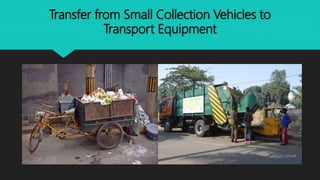
 The transfer of the wastes from the smaller collection vehicle to the larger transport equipment
and
 the subsequent transport of the wastes, usually over long distances, to a processing or disposal
site.
Transfer from Small Collection Vehicles to
Transport Equipment
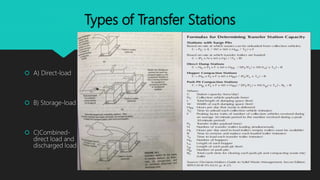
Types of Transfer Stations
 A) Direct-load
 B) Storage-load
 C)Combined-
direct load and
discharged load
Transport Means & Methods
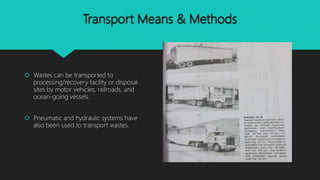
 Wastes can be transported to
processing/recovery facility or disposal
sites by motor vehicles, railroads, and
ocean-going vessels.
 Pneumatic and hydraulic systems have
also been used to transport wastes.
 Typical transport vehicles used
Transport Means & Methods Cont’d
 Railroads
 Rails were commonly used for the transport
of SW in the past, they are now used only by
few communities.
 Renewed interest is now developing in the
used of railroads, especially in transporting
wastes to remote landfills
 Usually done over a distance of 300 miles
 Vessels
 25 to 28 tons of waste are compacted in
40ft container and placed on shipping
 One of the major problems encountered is
that it is often impossible to move the barges
and boats during time of heavy seas
 This is no longer in used in some parts of
the world
Transport Means & Methods Cont’d
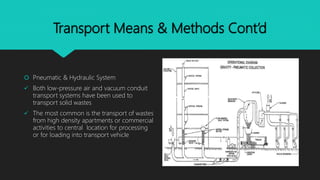
 Pneumatic & Hydraulic System
 Both low-pressure air and vacuum conduit
transport systems have been used to
transport solid wastes
 The most common is the transport of wastes
from high density apartments or commercial
activities to central location for processing
or for loading into transport vehicle
Present Indian Scenario
 Inefficient and Unscientific Manual Loading
of Waste
 Manual Handling of Wastes
 No synchronization between b/w waste
storage depots & Transportation
 Wastes are loaded in bags
 Consumes time
 Reduces productivity
 Unhealthy
 Loading through Front-End Loader
Advantage
 Cost effective
Disadvantage
 Improper cleaning of wastes depots
 Damages floor and screen walls, leads to nuisance if
repairs are not carried out
 In cities where Dhalavs or large masonry bins are
used, waste is not regularly removed from inside of
such structures
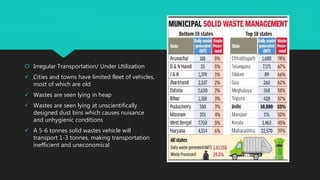
 Irregular Transportation/ Under Utilization
 Cities and towns have limited fleet of vehicles,
most of which are old
 Wastes are seen lying in heap
 Wastes are seen lying at unscientifically
designed dust bins which causes nuisance
and unhygienic conditions
 A 5-6 tonnes solid wastes vehicle will
transport 1-3 tonnes, making transportation
inefficient and uneconomical
Present Indian Scenario Cont’d
 Bio-Medical Waste From Hospitals, Nursing
Homes, Health Care Establishments Etc.
 Has to be arranged by waste producers or their
associations and wastes aren’t collect
 The instructions contained in the Biomedical
Waste (Management and Handling) Rules 1998
may be followed
 Waste From Hotels & Restaurants
 Hotels and restaurants waste should be collected
once or twice daily through a contract given by the
associations of hotels and restaurants, or at their
request by local bodies on cost recovery basis
 The entire collection and transport system could
be privatized and rates may be prescribed by the
associations or local bodies.
Present Indian Scenario Cont’d
 Workshop facility for vehicles maintenance
 All local bodies must have adequate workshop facilities for the maintenance of their fleet of
vehicles and containers, handcarts etc.
 The workshop, public or private, should have adequate technical staff, spares and preventive
maintenance schedules to ensure that at least 80% of the vehicles remain on the road each
day and the down time of repair/maintenance is minimized to the extent possible.
Present Indian Scenario Cont’d
 MEASURES TO BE TAKEN TO IMPROVE THE
SYSTEM
i. System of transportation should be such
that it can be easily maintained
departmentally or through private garages
ii. Manual loading should be discouraged and
phased out expeditiously and replaced by
direct lifting of containers through hydraulic
system or non-hydraulic devices or direct
loading of waste into transport vehicles
iii. Transportation of waste should be done
regularly to ensure that the containers
/trolleys and dustbin sites are cleared
before they start overflowing.
iv. The system of transportation of waste
must synchronize with bulk storage of
waste at the temporary waste storage
depots.
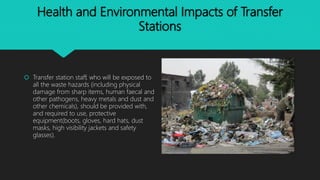
Health and Environmental Impacts of Transfer
Stations
 Transfer station staff, who will be exposed to
all the waste hazards (including physical
damage from sharp items, human faecal and
other pathogens, heavy metals and dust and
other chemicals), should be provided with,
and required to use, protective
equipment(boots, gloves, hard hats, dust
masks, high visibility jackets and safety
glasses).
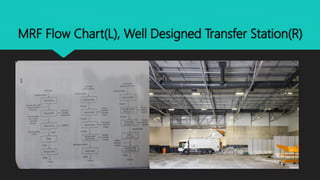
MRF Flow Chart(L), Well Designed Transfer Station(R)
Conclusion
Small cities having a few vehicles can have parking in the workshop itself; but in big cities where large
distances are to be travelled.
It is desirable to have parking depots in different parts of the city to reduce dead mileage of vehicles.
Cities above 5 lacs population should think of having more than one depot for parking of vehicles in
different directions of the city.
Cities above 2 million should think of having at least 3 to 4 such depots to reduce the congestion in the
workshop and also to cater the needs of the different sectors of the city from the depot close by. This
will save lot of dead mileage and add to the efficiency of transport system.
Transportation of solid wastes

Transportation of solid wastes

  • 1.
    Department of EnvironmentalEngineering Delhi Technological University Bawana Road, Rohini 110042 Delhi Presentation Title: Transportation of Solid Wastes Anthony Nimely Chea, Jr. 2k19/ENE/17
  • 2.
    Objectives To create anunderstanding of the Solid Wastes(SW) stored at wastes storage deports at regular interval so as to  ensure that no garbage bins/containers overflow  ensure that no waste is seen littered on streets To safeguard the  efficiency of the transport system  cost effectiveness of the system  maintainability of the system  synchronization of the storage deports
  • 3.
    Transfer and Transport This is the 5th functional element of Solid Wastes Management System  Even though Transfer and Transport is not a part of the hierarchical order of an Integrated Solid Wastes Management System, they are carried out from the 1st rank to the 4th rank of Solid Wastes Management.  It indicates that transportation of SW cannot be done without transferring the waste. Therefore, this functional element takes place in two steps:  The transfer of the wastes from the smaller collection vehicle to the larger transport equipment and  the subsequent transport of the wastes, usually over long distances, to a processing or disposal site.
  • 4.
    Transfer from SmallCollection Vehicles to Transport Equipment
  • 5.
    Types of TransferStations  A) Direct-load  B) Storage-load  C)Combined- direct load and discharged load
  • 6.
    Transport Means &Methods  Wastes can be transported to processing/recovery facility or disposal sites by motor vehicles, railroads, and ocean-going vessels.  Pneumatic and hydraulic systems have also been used to transport wastes.  Typical transport vehicles used
  • 7.
    Transport Means &Methods Cont’d  Railroads  Rails were commonly used for the transport of SW in the past, they are now used only by few communities.  Renewed interest is now developing in the used of railroads, especially in transporting wastes to remote landfills  Usually done over a distance of 300 miles  Vessels  25 to 28 tons of waste are compacted in 40ft container and placed on shipping  One of the major problems encountered is that it is often impossible to move the barges and boats during time of heavy seas  This is no longer in used in some parts of the world
  • 8.
    Transport Means &Methods Cont’d  Pneumatic & Hydraulic System  Both low-pressure air and vacuum conduit transport systems have been used to transport solid wastes  The most common is the transport of wastes from high density apartments or commercial activities to central location for processing or for loading into transport vehicle
  • 9.
    Present Indian Scenario Inefficient and Unscientific Manual Loading of Waste  Manual Handling of Wastes  No synchronization between b/w waste storage depots & Transportation  Wastes are loaded in bags  Consumes time  Reduces productivity  Unhealthy  Loading through Front-End Loader Advantage  Cost effective Disadvantage  Improper cleaning of wastes depots  Damages floor and screen walls, leads to nuisance if repairs are not carried out  In cities where Dhalavs or large masonry bins are used, waste is not regularly removed from inside of such structures
  • 10.
     Irregular Transportation/Under Utilization  Cities and towns have limited fleet of vehicles, most of which are old  Wastes are seen lying in heap  Wastes are seen lying at unscientifically designed dust bins which causes nuisance and unhygienic conditions  A 5-6 tonnes solid wastes vehicle will transport 1-3 tonnes, making transportation inefficient and uneconomical
  • 11.
    Present Indian ScenarioCont’d  Bio-Medical Waste From Hospitals, Nursing Homes, Health Care Establishments Etc.  Has to be arranged by waste producers or their associations and wastes aren’t collect  The instructions contained in the Biomedical Waste (Management and Handling) Rules 1998 may be followed  Waste From Hotels & Restaurants  Hotels and restaurants waste should be collected once or twice daily through a contract given by the associations of hotels and restaurants, or at their request by local bodies on cost recovery basis  The entire collection and transport system could be privatized and rates may be prescribed by the associations or local bodies.
  • 12.
    Present Indian ScenarioCont’d  Workshop facility for vehicles maintenance  All local bodies must have adequate workshop facilities for the maintenance of their fleet of vehicles and containers, handcarts etc.  The workshop, public or private, should have adequate technical staff, spares and preventive maintenance schedules to ensure that at least 80% of the vehicles remain on the road each day and the down time of repair/maintenance is minimized to the extent possible.
  • 13.
    Present Indian ScenarioCont’d  MEASURES TO BE TAKEN TO IMPROVE THE SYSTEM i. System of transportation should be such that it can be easily maintained departmentally or through private garages ii. Manual loading should be discouraged and phased out expeditiously and replaced by direct lifting of containers through hydraulic system or non-hydraulic devices or direct loading of waste into transport vehicles iii. Transportation of waste should be done regularly to ensure that the containers /trolleys and dustbin sites are cleared before they start overflowing. iv. The system of transportation of waste must synchronize with bulk storage of waste at the temporary waste storage depots.
  • 14.
    Health and EnvironmentalImpacts of Transfer Stations  Transfer station staff, who will be exposed to all the waste hazards (including physical damage from sharp items, human faecal and other pathogens, heavy metals and dust and other chemicals), should be provided with, and required to use, protective equipment(boots, gloves, hard hats, dust masks, high visibility jackets and safety glasses).
  • 15.
    MRF Flow Chart(L),Well Designed Transfer Station(R)
  • 16.
    Conclusion Small cities havinga few vehicles can have parking in the workshop itself; but in big cities where large distances are to be travelled. It is desirable to have parking depots in different parts of the city to reduce dead mileage of vehicles. Cities above 5 lacs population should think of having more than one depot for parking of vehicles in different directions of the city. Cities above 2 million should think of having at least 3 to 4 such depots to reduce the congestion in the workshop and also to cater the needs of the different sectors of the city from the depot close by. This will save lot of dead mileage and add to the efficiency of transport system.