Spatial Clustering and Drivers of Open
Defecation Practice in India
Mr. Margubur Rahaman, M.Phil
Senior Research Fellow, UGC, Government of India
International Institute for Population Sciences (IIPS), Mumbai (INDIA)
Global Virtual Summit on Healthcare and Patient Safety
Introduction
• In LMICs open defecation practice is a serious public health concern, which is
one of the main barriers to achieving SDG goals.
• Open defecation practice has detrimental impacts on health, causing high rates of
under-5 deaths, premature deaths, and malnutrition.
• The practice also increases the risk of contagious infectious diseases, diarrhea,
cholera, dysentery, typhoid, and intestinal worm infections.
• Studies also suggests a significant link between open defecation and adverse
birth outcome.
• Therefore, the WHO focuses on the eradication of open defecation to achieve
sustainable health and well-being in LMICs.
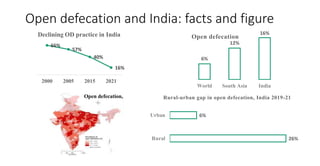
Open defecation and India: facts and figure
6%
12%
16%
World South Asia India
Open defecation
Open defecation,
66%
57%
40%
16%
2000 2005 2015 2021
Declining OD practice in India
26%
6%
Rural
Urban
Rural-urban gap in open defecation, India 2019-21
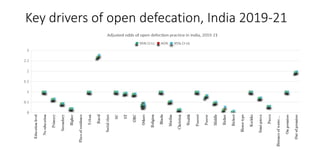
Key drivers of open defecation, India 2019-21
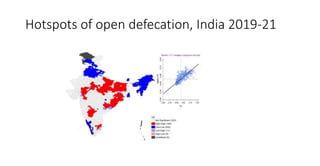
Hotspots of open defecation, India 2019-21
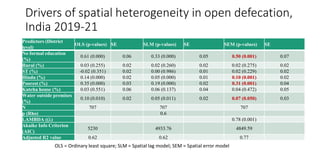
Drivers of spatial heterogeneity in open defecation,
India 2019-21
Predictors (District
level)
OLS (p-values) SE SLM (p-values) SE SEM (p-values) SE
No formal education
(%)
0.61 (0.000) 0.06 0.33 (0.000) 0.05 0.50 (0.001) 0.07
Rural (%) 0.03 (0.255) 0.02 0.02 (0.260) 0.02 0.02 (0.275) 0.02
ST (%) -0.02 (0.351) 0.02 0.00 (0.986) 0.01 0.02 (0.229) 0.02
Hindu (%) 0.14 (0.000) 0.02 0.05 (0.000) 0.01 0.10 (0.001) 0.02
Poorest (%) 0.35 (0.000) 0.03 0.19 (0.000) 0.02 0.31 (0.001) 0.04
Kutcha house (%) 0.03 (0.551) 0.06 0.06 (0.137) 0.04 0.04 (0.472) 0.05
Water outside premises
(%)
0.10 (0.010) 0.02 0.05 (0.011) 0.02 0.07 (0.050) 0.03
N 707 707 707
p (Rho) 0.6
LAMBDA ((λ) 0.78 (0.001)
Akaike Info Criterion
(AIC)
5230 4933.76 4849.59
Adjusted R2 value 0.62 0.62 0.77
OLS = Ordinary least square; SLM = Spatial lag model; SEM = Spatial error model
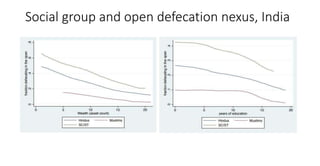
Social group and open defecation nexus, India
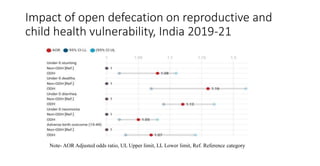
Impact of open defecation on reproductive and
child health vulnerability, India 2019-21
Note- AOR Adjusted odds ratio, UL Upper limit, LL Lower limit, Ref. Reference category
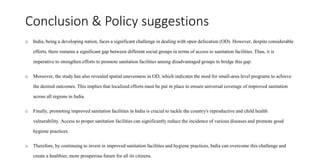
Conclusion & Policy suggestions
o India, being a developing nation, faces a significant challenge in dealing with open defecation (OD). However, despite considerable
efforts, there remains a significant gap between different social groups in terms of access to sanitation facilities. Thus, it is
imperative to strengthen efforts to promote sanitation facilities among disadvantaged groups to bridge this gap.
o Moreover, the study has also revealed spatial unevenness in OD, which indicates the need for small-area level programs to achieve
the desired outcomes. This implies that localized efforts must be put in place to ensure universal coverage of improved sanitation
across all regions in India.
o Finally, promoting improved sanitation facilities in India is crucial to tackle the country's reproductive and child health
vulnerability. Access to proper sanitation facilities can significantly reduce the incidence of various diseases and promote good
hygiene practices.
o Therefore, by continuing to invest in improved sanitation facilities and hygiene practices, India can overcome this challenge and
create a healthier, more prosperous future for all its citizens.
References
• WHO. Sanitation. 2020. Geneva: World Health Organization (WHO)
• https://www.who.int/news-room/fact-sheets/detail/sanitation
• Spears D. Exposure to open defecation can account for the Indian enigma of child height. Journal of Development Economics. 2020;146:102277.
• Dwivedi LK, Banerjee K, Jain N, Ranjan M, Dixit P. Child health and unhealthy sanitary practices in India: evidence from recent round of national
family health Survey-IV. SSM-population health. 2019;7:100313.
• Spears D, Thorat A. The puzzle of open defecation in rural India: evidence from a novel measure of caste attitudes in a nationally representative
survey. Economic Development and Cultural Change. 2019;67(4):725-55.
• Ghosh P, Hossain M, Alam A. Water, Sanitation, and Hygiene (WASH) poverty in India: A district‐level geospatial assessment. Regional Science
Policy & Practice. 2022;14(2):396-416.
• Anselin L, Syabri I, Kho Y. GeoDa: an introduction to spatial data analysis. In Handbook of applied spatial analysis: Software tools, methods and
applications 2009; (pp. 73-89). Berlin, Heidelberg: Springer Berlin Heidelberg.
• Kumar DS. Swachh Bharat Abhiyan: What are the barriers for toilet construction. DownToEarth. September 10, 2019,
https://www.downtoearth.org.in/blog/waste/swachh-bharat-abhiyan-what-are-the-barriers-fortoilet-construction-66656
• International Institute for Population Sciences (IIPS) and ICF. National Family Health Survey (NFHS-5), 2019-21. 2021: India. Mumbai: IIPS
Thank You
Happy to connect
margubur48@gmail.com
margubur10@iipsindia.ac.in
+91 7001971180

Open defecation in India

  • 1.
    Spatial Clustering andDrivers of Open Defecation Practice in India Mr. Margubur Rahaman, M.Phil Senior Research Fellow, UGC, Government of India International Institute for Population Sciences (IIPS), Mumbai (INDIA) Global Virtual Summit on Healthcare and Patient Safety
  • 2.
    Introduction • In LMICsopen defecation practice is a serious public health concern, which is one of the main barriers to achieving SDG goals. • Open defecation practice has detrimental impacts on health, causing high rates of under-5 deaths, premature deaths, and malnutrition. • The practice also increases the risk of contagious infectious diseases, diarrhea, cholera, dysentery, typhoid, and intestinal worm infections. • Studies also suggests a significant link between open defecation and adverse birth outcome. • Therefore, the WHO focuses on the eradication of open defecation to achieve sustainable health and well-being in LMICs.
  • 3.
    Open defecation andIndia: facts and figure 6% 12% 16% World South Asia India Open defecation Open defecation, 66% 57% 40% 16% 2000 2005 2015 2021 Declining OD practice in India 26% 6% Rural Urban Rural-urban gap in open defecation, India 2019-21
  • 4.
    Key drivers ofopen defecation, India 2019-21
  • 5.
    Hotspots of opendefecation, India 2019-21
  • 6.
    Drivers of spatialheterogeneity in open defecation, India 2019-21 Predictors (District level) OLS (p-values) SE SLM (p-values) SE SEM (p-values) SE No formal education (%) 0.61 (0.000) 0.06 0.33 (0.000) 0.05 0.50 (0.001) 0.07 Rural (%) 0.03 (0.255) 0.02 0.02 (0.260) 0.02 0.02 (0.275) 0.02 ST (%) -0.02 (0.351) 0.02 0.00 (0.986) 0.01 0.02 (0.229) 0.02 Hindu (%) 0.14 (0.000) 0.02 0.05 (0.000) 0.01 0.10 (0.001) 0.02 Poorest (%) 0.35 (0.000) 0.03 0.19 (0.000) 0.02 0.31 (0.001) 0.04 Kutcha house (%) 0.03 (0.551) 0.06 0.06 (0.137) 0.04 0.04 (0.472) 0.05 Water outside premises (%) 0.10 (0.010) 0.02 0.05 (0.011) 0.02 0.07 (0.050) 0.03 N 707 707 707 p (Rho) 0.6 LAMBDA ((λ) 0.78 (0.001) Akaike Info Criterion (AIC) 5230 4933.76 4849.59 Adjusted R2 value 0.62 0.62 0.77 OLS = Ordinary least square; SLM = Spatial lag model; SEM = Spatial error model
  • 7.
    Social group andopen defecation nexus, India
  • 8.
    Impact of opendefecation on reproductive and child health vulnerability, India 2019-21 Note- AOR Adjusted odds ratio, UL Upper limit, LL Lower limit, Ref. Reference category
  • 9.
    Conclusion & Policysuggestions o India, being a developing nation, faces a significant challenge in dealing with open defecation (OD). However, despite considerable efforts, there remains a significant gap between different social groups in terms of access to sanitation facilities. Thus, it is imperative to strengthen efforts to promote sanitation facilities among disadvantaged groups to bridge this gap. o Moreover, the study has also revealed spatial unevenness in OD, which indicates the need for small-area level programs to achieve the desired outcomes. This implies that localized efforts must be put in place to ensure universal coverage of improved sanitation across all regions in India. o Finally, promoting improved sanitation facilities in India is crucial to tackle the country's reproductive and child health vulnerability. Access to proper sanitation facilities can significantly reduce the incidence of various diseases and promote good hygiene practices. o Therefore, by continuing to invest in improved sanitation facilities and hygiene practices, India can overcome this challenge and create a healthier, more prosperous future for all its citizens.
  • 10.
    References • WHO. Sanitation.2020. Geneva: World Health Organization (WHO) • https://www.who.int/news-room/fact-sheets/detail/sanitation • Spears D. Exposure to open defecation can account for the Indian enigma of child height. Journal of Development Economics. 2020;146:102277. • Dwivedi LK, Banerjee K, Jain N, Ranjan M, Dixit P. Child health and unhealthy sanitary practices in India: evidence from recent round of national family health Survey-IV. SSM-population health. 2019;7:100313. • Spears D, Thorat A. The puzzle of open defecation in rural India: evidence from a novel measure of caste attitudes in a nationally representative survey. Economic Development and Cultural Change. 2019;67(4):725-55. • Ghosh P, Hossain M, Alam A. Water, Sanitation, and Hygiene (WASH) poverty in India: A district‐level geospatial assessment. Regional Science Policy & Practice. 2022;14(2):396-416. • Anselin L, Syabri I, Kho Y. GeoDa: an introduction to spatial data analysis. In Handbook of applied spatial analysis: Software tools, methods and applications 2009; (pp. 73-89). Berlin, Heidelberg: Springer Berlin Heidelberg. • Kumar DS. Swachh Bharat Abhiyan: What are the barriers for toilet construction. DownToEarth. September 10, 2019, https://www.downtoearth.org.in/blog/waste/swachh-bharat-abhiyan-what-are-the-barriers-fortoilet-construction-66656 • International Institute for Population Sciences (IIPS) and ICF. National Family Health Survey (NFHS-5), 2019-21. 2021: India. Mumbai: IIPS
  • 11.
    Thank You Happy toconnect margubur48@gmail.com margubur10@iipsindia.ac.in +91 7001971180