Introduction 1
Design Concept 1
Massing 3
Design Development 4
Material Analysis 8
Construction Progress 12
Design Considerations 14
Loads and Forces 15
Joints 19
References 23
The purpose of this project is to create an understanding of
skeletal structural components and how it reacts under
loading. Convincing understanding on how skeletal
construction functions are to be demonstrated. A 1:5 scale
model of a bus shelter that can accommodate 5-6 people is
to be built based on structural considerations and two
forms.
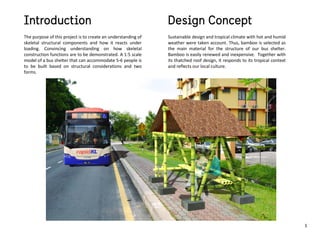
Sustainable design and tropical climate with hot and humid
weather were taken account. Thus, bamboo is selected as
the main material for the structure of our bus shelter.
Bamboo is easily renewed and inexpensive. Together with
its thatched roof design, it responds to its tropical context
and reflects our local culture.
1
2
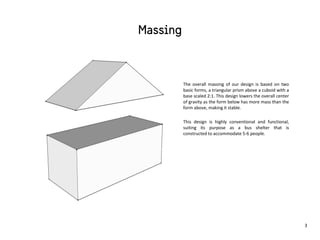
The overall massing of our design is based on two
basic forms, a triangular prism above a cuboid with a
base scaled 2:1. This design lowers the overall center
of gravity as the form below has more mass than the
form above, making it stable.
This design is highly conventional and functional,
suiting its purpose as a bus shelter that is
constructed to accommodate 5-6 people.
3
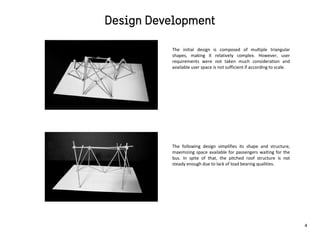
The initial design is composed of multiple triangular
shapes, making it relatively complex. However, user
requirements were not taken much consideration and
available user space is not sufficient if according to scale.
The following design simplifies its shape and structure,
maximizing space available for passengers waiting for the
bus. In spite of that, the pitched roof structure is not
steady enough due to lack of load bearing qualities.
4
This design makes the seating part of its structure. Still, this
design is disadvantageous due to lack of appropriate
bracings.
Next, the design is changed by converting the walls that
were initially merely screens to load-bearing structures.
Vertical columns are repeated to distribute the load from
the roof to the ground. Even so, the pitched roof is not well
supported and wobbly.
5
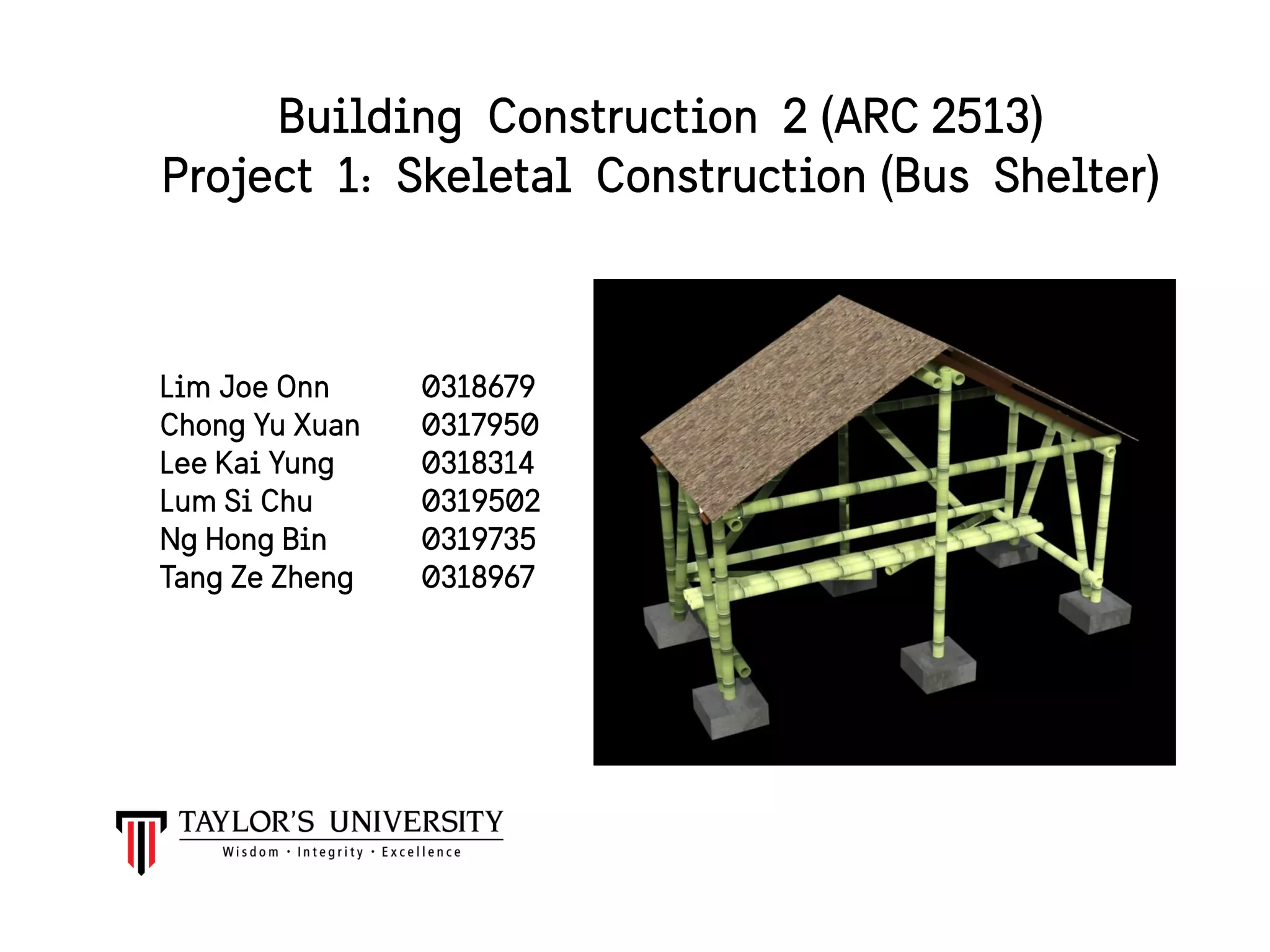
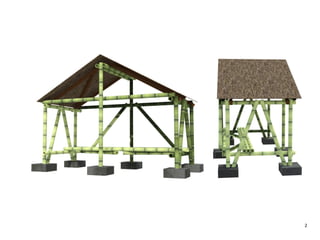
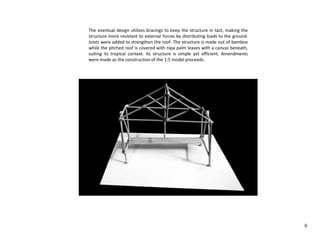
The eventual design utilizes bracings to keep the structure in tact, making the
structure more resistant to external forces by distributing loads to the ground.
Joists were added to strengthen the roof. The structure is made out of bamboo
while the pitched roof is covered with nipa palm leaves with a canvas beneath,
suiting its tropical context. Its structure is simple yet efficient. Amendments
were made as the construction of the 1:5 model proceeds.
6
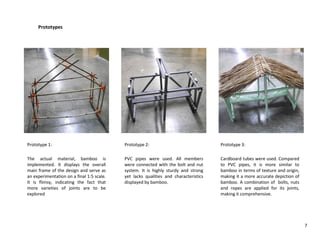
Prototypes
Prototype 1:
The actual material, bamboo is
implemented. It displays the overall
main frame of the design and serve as
an experimentation on a final 1:5 scale.
It is flimsy, indicating the fact that
more varieties of joints are to be
explored
Prototype 2:
PVC pipes were used. All members
were connected with the bolt and nut
system. It is highly sturdy and strong
yet lacks qualities and characteristics
displayed by bamboo.
Prototype 3:
Cardboard tubes were used. Compared
to PVC pipes, it is more similar to
bamboo in terms of texture and origin,
making it a more accurate depiction of
bamboo. A combination of bolts, nuts
and ropes are applied for its joints,
making it comprehensive.
7
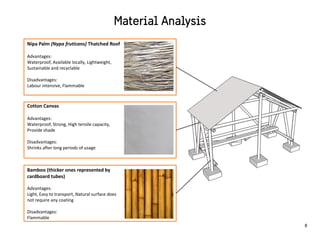
Bamboo (thicker ones represented by
cardboard tubes)
Advantages:
Light, Easy to transport, Natural surface does
not require any coating
Disadvantages:
Flammable
Cotton Canvas
Advantages:
Waterproof, Strong, High tensile capacity,
Provide shade
Disadvantages:
Shrinks after long periods of usage
Nipa Palm (Nypa fruticans) Thatched Roof
Advantages:
Waterproof, Available locally, Lightweight,
Sustainable and recyclable
Disadvantages:
Labour intensive, Flammable
8
Gypsum Plaster
Advantages:
Light, Durable, Low thermal conductivity, Good
fire resistance, Mouldable, Water resistant
Disadvantages:
Slightly soluble in water
Concrete (represented with cement)
Advantages:
High durability, Low maintenance cost, Least
likely to corrode, Non-combustible, Withstand
high temperatures
Disadvantages:
Less ductile, Low strength-to-weight ratio
9
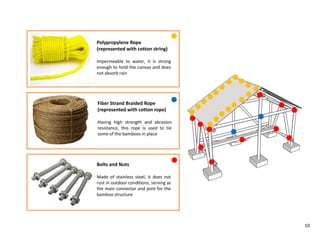
Bolts and Nuts
Made of stainless steel, it does not
rust in outdoor conditions, serving as
the main connector and joint for the
bamboo structure
Fiber Strand Braided Rope
(represented with cotton rope)
Having high strength and abrasion
resistance, this rope is used to tie
some of the bamboos in place
Polypropylene Rope
(represented with cotton string)
Impermeable to water, it is strong
enough to hold the canvas and does
not absorb rain
10
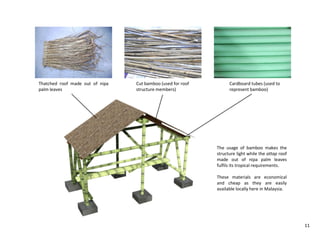
Cardboard tubes (used to
represent bamboo)
Thatched roof made out of nipa
palm leaves
Cut bamboo (used for roof
structure members)
The usage of bamboo makes the
structure light while the attap roof
made out of nipa palm leaves
fulfils its tropical requirements.
These materials are economical
and cheap as they are easily
available locally here in Malaysia.
11
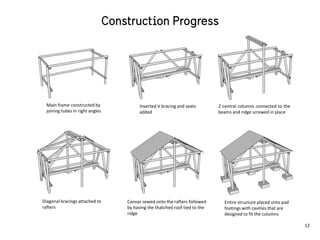
Main frame constructed by
joining tubes in right angles
Inverted V bracing and seats
added
2 central columns connected to the
beams and ridge screwed in place
Diagonal bracings attached to
rafters
Canvas sewed onto the rafters followed
by having the thatched roof tied to the
ridge
Entire structure placed onto pad
footings with cavities that are
designed to fit the columns
12
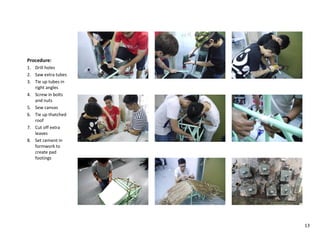
Procedure:
1. Drill holes
2. Saw extra tubes
3. Tie up tubes in
right angles
4. Screw in bolts
and nuts
5. Sew canvas
6. Tie up thatched
roof
7. Cut off extra
leaves
8. Set cement in
formwork to
create pad
footings
13
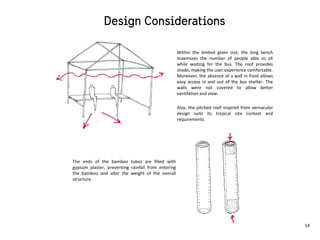
The ends of the bamboo tubes are filled with
gypsum plaster, preventing rainfall from entering
the bamboo and alter the weight of the overall
structure.
Within the limited given size, the long bench
maximizes the number of people able to sit
while waiting for the bus. The roof provides
shade, making the user experience comfortable.
Moreover, the absence of a wall in front allows
easy access in and out of the bus shelter. The
walls were not covered to allow better
ventilation and view.
Also, the pitched roof inspired from vernacular
design suits its tropical site context and
requirements.
14
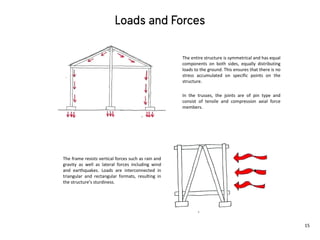
The entire structure is symmetrical and has equal
components on both sides, equally distributing
loads to the ground. This ensures that there is no
stress accumulated on specific points on the
structure.
In the trusses, the joints are of pin type and
consist of tensile and compression axial force
members.
The frame resists vertical forces such as rain and
gravity as well as lateral forces including wind
and earthquakes. Loads are interconnected in
triangular and rectangular formats, resulting in
the structure’s sturdiness.
15
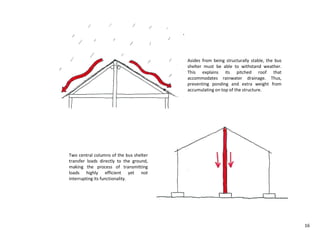
Asides from being structurally stable, the bus
shelter must be able to withstand weather.
This explains its pitched roof that
accommodates rainwater drainage. Thus,
preventing ponding and extra weight from
accumulating on top of the structure.
Two central columns of the bus shelter
transfer loads directly to the ground,
making the process of transmitting
loads highly efficient yet not
interrupting its functionality.
16
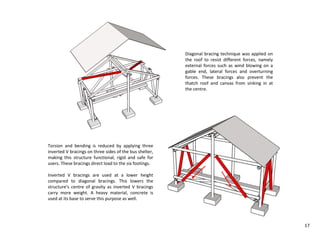
Diagonal bracing technique was applied on
the roof to resist different forces, namely
external forces such as wind blowing on a
gable end, lateral forces and overturning
forces. These bracings also prevent the
thatch roof and canvas from sinking in at
the centre.
Torsion and bending is reduced by applying three
inverted V bracings on three sides of the bus shelter,
making this structure functional, rigid and safe for
users. These bracings direct load to the six footings.
Inverted V bracings are used at a lower height
compared to diagonal bracings. This lowers the
structure’s centre of gravity as inverted V bracings
carry more weight. A heavy material, concrete is
used at its base to serve this purpose as well.
17
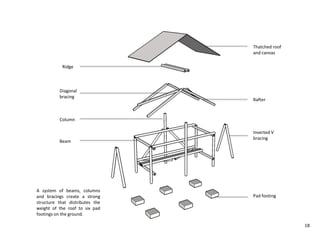
Thatched roof
and canvas
Diagonal
bracing
Inverted V
bracing
Pad footing
Beam
Column
Rafter
Ridge
A system of beams, columns
and bracings create a strong
structure that distributes the
weight of the roof to six pad
footings on the ground.
18
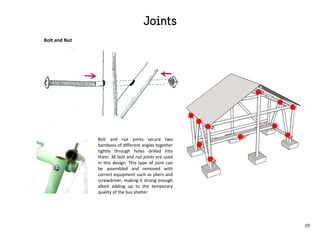
Bolt and nut joints secure two
bamboos of different angles together
tightly through holes drilled into
them. 36 bolt and nut joints are used
in this design. This type of joint can
be assembled and removed with
correct equipment such as pliers and
screwdriver, making it strong enough
albeit adding up to the temporary
quality of the bus shelter.
Bolt and Nut
19
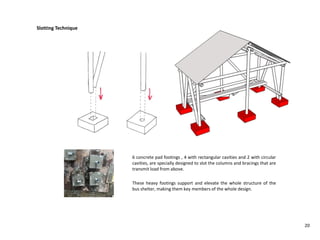
6 concrete pad footings , 4 with rectangular cavities and 2 with circular
cavities, are specially designed to slot the columns and bracings that are
transmit load from above.
These heavy footings support and elevate the whole structure of the
bus shelter, making them key members of the whole design.
Slotting Technique
20
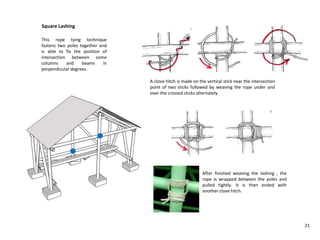
Square Lashing
This rope tying technique
fastens two poles together and
is able to fix the position of
intersection between some
columns and beams in
perpendicular degrees.
A clove hitch is made on the vertical stick near the intersection
point of two sticks followed by weaving the rope under and
over the crossed sticks alternately.
After finished weaving the lashing , the
rope is wrapped between the poles and
pulled tightly. It is then ended with
another clove hitch.
21
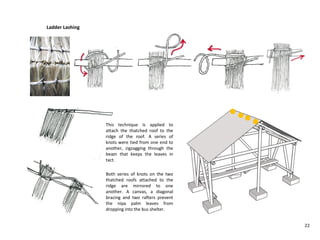
Ladder Lashing
This technique is applied to
attach the thatched roof to the
ridge of the roof. A series of
knots were tied from one end to
another, zigzagging through the
beam that keeps the leaves in
tact.
Both series of knots on the two
thatched roofs attached to the
ridge are mirrored to one
another. A canvas, a diagonal
bracing and two rafters prevent
the nipa palm leaves from
dropping into the bus shelter.
22
23
E-Rigging.com (n.d.). 3-Strand Twisted Manila Rope. Retrieved 9 May 2016 from http://www.e-rigging.com/rope
Geffre, J. (2001, August 20) The Six Boy Scout Knots. Retrieved May 9 2016 from
http://www.t53.info/uploads/Knots_and_Lashings_Primer.pdf
Hong Kong Scouts Organization. (n.d.) Knots. Retrieved 9 May 2016 from
http://www2.hkedcity.net/sch_files/a/mkm/mkm-boyscout/public_html/new_page_3.2.3.1.htm
Lokesh, M. (2012, August 2). Civil Engineering: Difference Between Frame and Truss. Retrieved 9 May 2016 from
http://www.geekinterview.com/talk/20452-difference-between-frame-truss-civil-engineering.html
Menards Shop Department (2016, September 5). Polypropylene Rope. Retrieved 9 May 2016 from
http://www.menards.com/main/tools-hardware/material-handling/ropes-rope-handling/3-8-x-50-hollow-braid-
polypropylene-rope/p-1444439543028.htm
Bcon report   bus shelter

Bcon report bus shelter

  • 3.
    Introduction 1 Design Concept1 Massing 3 Design Development 4 Material Analysis 8 Construction Progress 12 Design Considerations 14 Loads and Forces 15 Joints 19 References 23
  • 4.
    The purpose ofthis project is to create an understanding of skeletal structural components and how it reacts under loading. Convincing understanding on how skeletal construction functions are to be demonstrated. A 1:5 scale model of a bus shelter that can accommodate 5-6 people is to be built based on structural considerations and two forms. Sustainable design and tropical climate with hot and humid weather were taken account. Thus, bamboo is selected as the main material for the structure of our bus shelter. Bamboo is easily renewed and inexpensive. Together with its thatched roof design, it responds to its tropical context and reflects our local culture. 1
  • 5.
  • 6.
    The overall massingof our design is based on two basic forms, a triangular prism above a cuboid with a base scaled 2:1. This design lowers the overall center of gravity as the form below has more mass than the form above, making it stable. This design is highly conventional and functional, suiting its purpose as a bus shelter that is constructed to accommodate 5-6 people. 3
  • 7.
    The initial designis composed of multiple triangular shapes, making it relatively complex. However, user requirements were not taken much consideration and available user space is not sufficient if according to scale. The following design simplifies its shape and structure, maximizing space available for passengers waiting for the bus. In spite of that, the pitched roof structure is not steady enough due to lack of load bearing qualities. 4
  • 8.
    This design makesthe seating part of its structure. Still, this design is disadvantageous due to lack of appropriate bracings. Next, the design is changed by converting the walls that were initially merely screens to load-bearing structures. Vertical columns are repeated to distribute the load from the roof to the ground. Even so, the pitched roof is not well supported and wobbly. 5
  • 9.
    The eventual designutilizes bracings to keep the structure in tact, making the structure more resistant to external forces by distributing loads to the ground. Joists were added to strengthen the roof. The structure is made out of bamboo while the pitched roof is covered with nipa palm leaves with a canvas beneath, suiting its tropical context. Its structure is simple yet efficient. Amendments were made as the construction of the 1:5 model proceeds. 6
  • 10.
    Prototypes Prototype 1: The actualmaterial, bamboo is implemented. It displays the overall main frame of the design and serve as an experimentation on a final 1:5 scale. It is flimsy, indicating the fact that more varieties of joints are to be explored Prototype 2: PVC pipes were used. All members were connected with the bolt and nut system. It is highly sturdy and strong yet lacks qualities and characteristics displayed by bamboo. Prototype 3: Cardboard tubes were used. Compared to PVC pipes, it is more similar to bamboo in terms of texture and origin, making it a more accurate depiction of bamboo. A combination of bolts, nuts and ropes are applied for its joints, making it comprehensive. 7
  • 11.
    Bamboo (thicker onesrepresented by cardboard tubes) Advantages: Light, Easy to transport, Natural surface does not require any coating Disadvantages: Flammable Cotton Canvas Advantages: Waterproof, Strong, High tensile capacity, Provide shade Disadvantages: Shrinks after long periods of usage Nipa Palm (Nypa fruticans) Thatched Roof Advantages: Waterproof, Available locally, Lightweight, Sustainable and recyclable Disadvantages: Labour intensive, Flammable 8
  • 12.
    Gypsum Plaster Advantages: Light, Durable,Low thermal conductivity, Good fire resistance, Mouldable, Water resistant Disadvantages: Slightly soluble in water Concrete (represented with cement) Advantages: High durability, Low maintenance cost, Least likely to corrode, Non-combustible, Withstand high temperatures Disadvantages: Less ductile, Low strength-to-weight ratio 9
  • 13.
    Bolts and Nuts Madeof stainless steel, it does not rust in outdoor conditions, serving as the main connector and joint for the bamboo structure Fiber Strand Braided Rope (represented with cotton rope) Having high strength and abrasion resistance, this rope is used to tie some of the bamboos in place Polypropylene Rope (represented with cotton string) Impermeable to water, it is strong enough to hold the canvas and does not absorb rain 10
  • 14.
    Cardboard tubes (usedto represent bamboo) Thatched roof made out of nipa palm leaves Cut bamboo (used for roof structure members) The usage of bamboo makes the structure light while the attap roof made out of nipa palm leaves fulfils its tropical requirements. These materials are economical and cheap as they are easily available locally here in Malaysia. 11
  • 15.
    Main frame constructedby joining tubes in right angles Inverted V bracing and seats added 2 central columns connected to the beams and ridge screwed in place Diagonal bracings attached to rafters Canvas sewed onto the rafters followed by having the thatched roof tied to the ridge Entire structure placed onto pad footings with cavities that are designed to fit the columns 12
  • 16.
    Procedure: 1. Drill holes 2.Saw extra tubes 3. Tie up tubes in right angles 4. Screw in bolts and nuts 5. Sew canvas 6. Tie up thatched roof 7. Cut off extra leaves 8. Set cement in formwork to create pad footings 13
  • 17.
    The ends ofthe bamboo tubes are filled with gypsum plaster, preventing rainfall from entering the bamboo and alter the weight of the overall structure. Within the limited given size, the long bench maximizes the number of people able to sit while waiting for the bus. The roof provides shade, making the user experience comfortable. Moreover, the absence of a wall in front allows easy access in and out of the bus shelter. The walls were not covered to allow better ventilation and view. Also, the pitched roof inspired from vernacular design suits its tropical site context and requirements. 14
  • 18.
    The entire structureis symmetrical and has equal components on both sides, equally distributing loads to the ground. This ensures that there is no stress accumulated on specific points on the structure. In the trusses, the joints are of pin type and consist of tensile and compression axial force members. The frame resists vertical forces such as rain and gravity as well as lateral forces including wind and earthquakes. Loads are interconnected in triangular and rectangular formats, resulting in the structure’s sturdiness. 15
  • 19.
    Asides from beingstructurally stable, the bus shelter must be able to withstand weather. This explains its pitched roof that accommodates rainwater drainage. Thus, preventing ponding and extra weight from accumulating on top of the structure. Two central columns of the bus shelter transfer loads directly to the ground, making the process of transmitting loads highly efficient yet not interrupting its functionality. 16
  • 20.
    Diagonal bracing techniquewas applied on the roof to resist different forces, namely external forces such as wind blowing on a gable end, lateral forces and overturning forces. These bracings also prevent the thatch roof and canvas from sinking in at the centre. Torsion and bending is reduced by applying three inverted V bracings on three sides of the bus shelter, making this structure functional, rigid and safe for users. These bracings direct load to the six footings. Inverted V bracings are used at a lower height compared to diagonal bracings. This lowers the structure’s centre of gravity as inverted V bracings carry more weight. A heavy material, concrete is used at its base to serve this purpose as well. 17
  • 21.
    Thatched roof and canvas Diagonal bracing InvertedV bracing Pad footing Beam Column Rafter Ridge A system of beams, columns and bracings create a strong structure that distributes the weight of the roof to six pad footings on the ground. 18
  • 22.
    Bolt and nutjoints secure two bamboos of different angles together tightly through holes drilled into them. 36 bolt and nut joints are used in this design. This type of joint can be assembled and removed with correct equipment such as pliers and screwdriver, making it strong enough albeit adding up to the temporary quality of the bus shelter. Bolt and Nut 19
  • 23.
    6 concrete padfootings , 4 with rectangular cavities and 2 with circular cavities, are specially designed to slot the columns and bracings that are transmit load from above. These heavy footings support and elevate the whole structure of the bus shelter, making them key members of the whole design. Slotting Technique 20
  • 24.
    Square Lashing This ropetying technique fastens two poles together and is able to fix the position of intersection between some columns and beams in perpendicular degrees. A clove hitch is made on the vertical stick near the intersection point of two sticks followed by weaving the rope under and over the crossed sticks alternately. After finished weaving the lashing , the rope is wrapped between the poles and pulled tightly. It is then ended with another clove hitch. 21
  • 25.
    Ladder Lashing This techniqueis applied to attach the thatched roof to the ridge of the roof. A series of knots were tied from one end to another, zigzagging through the beam that keeps the leaves in tact. Both series of knots on the two thatched roofs attached to the ridge are mirrored to one another. A canvas, a diagonal bracing and two rafters prevent the nipa palm leaves from dropping into the bus shelter. 22
  • 26.
    23 E-Rigging.com (n.d.). 3-StrandTwisted Manila Rope. Retrieved 9 May 2016 from http://www.e-rigging.com/rope Geffre, J. (2001, August 20) The Six Boy Scout Knots. Retrieved May 9 2016 from http://www.t53.info/uploads/Knots_and_Lashings_Primer.pdf Hong Kong Scouts Organization. (n.d.) Knots. Retrieved 9 May 2016 from http://www2.hkedcity.net/sch_files/a/mkm/mkm-boyscout/public_html/new_page_3.2.3.1.htm Lokesh, M. (2012, August 2). Civil Engineering: Difference Between Frame and Truss. Retrieved 9 May 2016 from http://www.geekinterview.com/talk/20452-difference-between-frame-truss-civil-engineering.html Menards Shop Department (2016, September 5). Polypropylene Rope. Retrieved 9 May 2016 from http://www.menards.com/main/tools-hardware/material-handling/ropes-rope-handling/3-8-x-50-hollow-braid- polypropylene-rope/p-1444439543028.htm