BUILDING CONSTRUCTION 2 (BLD 60703/ARC 2513)
PROJECT 1: SKELETAL CONSTRUCTION - TEMPORARY BUS SHELTER
GROUP MEMBERS:
CHOO ZI ZHAO 0320498
MUHAMMAD ASHROFF 0325736
RAJAN KULANDAYA 0317164
WONG WAN JIUAN 0327173
MUHAMMAD ZAIM 0325930
TUTOR
MS SUJATAVANI GUNASAGARAN
TABLE OF CONTENTS
1.0 INTRODUCTION
2.0 DESIGN ANALYSIS
3.0 PRECEDENT STUDIES
4.0 DESIGN DEVELOPMENT
5.0 DESIGN CONSIDERATION
6.0 JOINTS AND CONNECTIONS
7.0 LOAD AND FORCE
8.0 CONSTRUCTION PROCESS
9.0 CONCLUSION
REFERENCE
APPENDIX
1.0 Introduction
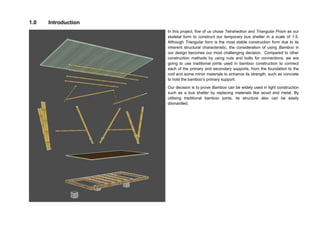
In this project, five of us chose Tetrahedron and Triangular Prism as our
skeletal form to construct our temporary bus shelter in a scale of 1:5.
Although Triangular form is the most stable construction form due to its
inherent structural characteristic, the consideration of using Bamboo in
our design becomes our most challenging decision. Compared to other
construction methods by using nuts and bolts for connections, we are
going to use traditional joints used in bamboo construction to connect
each of the primary and secondary supports, from the foundation to the
roof and some minor materials to enhance its strength, such as concrete
to hold the bamboo’s primary support.
Our decision is to prove Bamboo can be widely used in light construction
such as a bus shelter by replacing materials like wood and metal. By
utilising traditional bamboo joints, its structure also can be easily
dismantled.
2.0 Design Analysis
There are two aspects our group looked into before constructing our temporary bus shelter:
1. Form of the bus shelter
2. Material (Focus on Bamboo)
2.1 Form
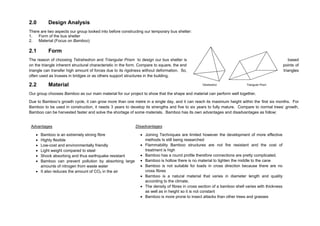
The reason of choosing Tetrahedron and Triangular Prism to design our bus shelter is based
on the triangle inherent structural characteristic in the form. Compare to square, the end points of
triangle can transfer high amount of forces due to its rigidness without deformation. So, triangles
often used as trusses in bridges or as others support structures in the building.
2.2 Material
Our group chooses Bamboo as our main material for our project to show that the shape and material can perform well together.
Due to Bamboo’s growth cycle, it can grow more than one metre in a single day, and it can reach its maximum height within the first six months. For
Bamboo to be used in construction, it needs 3 years to develop its strengths and five to six years to fully mature. Compare to normal trees’ growth,
Bamboo can be harvested faster and solve the shortage of some materials. Bamboo has its own advantages and disadvantages as follow:
Tetrahedron Triangular Prism
Advantages
 Bamboo is an extremely strong fibre
 Highly flexible
 Low-cost and environmentally friendly
 Light weight compared to steel
 Shock absorbing and thus earthquake resistant
 Bamboo can prevent pollution by absorbing large
amounts of nitrogen from waste water
 It also reduces the amount of CO2 in the air
Disadvantages
 Joining Techniques are limited however the development of more effective
methods Is still being researched
 Flammability Bamboo structures are not fire resistant and the cost of
treatment is high
 Bamboo has a round profile therefore connections are pretty complicated.
 Bamboo is hollow there is no material to tighten the middle to the cane
 Bamboo is not suitable for loads in cross direction because there are no
cross fibres
 Bamboo is a natural material that varies in diameter length and quality
according to the climate.
 The density of fibres in cross section of a bamboo shell varies with thickness
as well as in height so it is not constant
 Bamboo is more prone to insect attacks than other trees and grasses
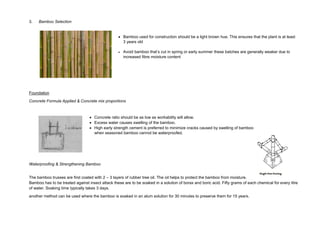
Correct bamboo to use due
to brownish hue
3.0 Precedent Studies
We got some inspiration from a series of precedents
Bamboo Structure
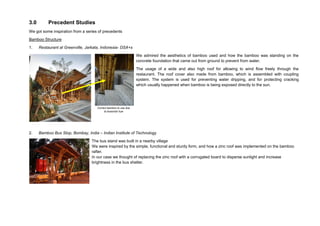
1. Restaurant at Greenville, Jarkata, Indonesia- DSA+s
We admired the aesthetics of bamboo used and how the bamboo was standing on the
concrete foundation that came out from ground to prevent from water.
The usage of a wide and also high roof for allowing to wind flow freely through the
restaurant. The roof cover also made from bamboo, which is assembled with coupling
system. The system is used for preventing water dripping, and for protecting cracking
which usually happened when bamboo is being exposed directly to the sun.
2. Bamboo Bus Stop, Bombay, India – Indian Institute of Technology
The bus stand was built in a nearby village
We were inspired by the simple, functional and sturdy form, and how a zinc roof was implemented on the bamboo
rafter.
In our case we thought of replacing the zinc roof with a corrugated board to disperse sunlight and increase
brightness in the bus shelter.
3. Bamboo Selection
 Bamboo used for construction should be a light brown hue. This ensures that the plant is at least
3 years old
 Avoid bamboo that’s cut in spring or early summer these batches are generally weaker due to
increased fibre moisture content
Foundation
Concrete Formula Applied & Concrete mix proportions
 Concrete ratio should be as low as workability will allow.
 Excess water causes swelling of the bamboo.
 High early strength cement is preferred to minimize cracks caused by swelling of bamboo
when seasoned bamboo cannot be waterproofed.
Waterproofing & Strengthening Bamboo
The bamboo trusses are first coated with 2 – 3 layers of rubber tree oil. The oil helps to protect the bamboo from moisture.
Bamboo has to be treated against insect attack these are to be soaked in a solution of borax and boric acid. Fifty grams of each chemical for every litre
of water. Soaking time typically takes 3 days.
another method can be used where the bamboo is soaked in an alum solution for 30 minutes to preserve them for 15 years.
Roof
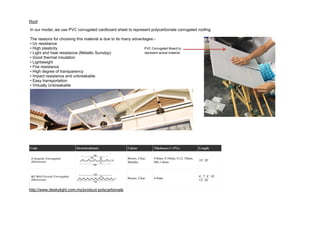
In our model, we use PVC corrugated cardboard sheet to represent polycarbonate corrugated roofing.
The reasons for choosing this material is due to its many advantages:-
• Uv resistance
• High plasticity
• Light and heat resistance (Metallic Sunstop)
• Good thermal insulation
• Lightweight
• Fire resistance
• High degree of transparency
• Impact resistance and unbreakable
• Easy transportation
• Virtually Unbreakable
Code Structural(mm) Colour Thickness (+/-5%) Length
A Angular Corrugated
(5Grooves)
Brown, Clear,
Metallic
0.8mm, 0.10mm, 0.12, 18mm,
MS-1.0mm
18', 20'
MC Mid-Circular Corrugated
(9Grooves)
Brown, Clear 0.9mm
6', 7', 8', 10',
12', 20'
http://www.deskylight.com.my/product-polycarbonate
PVC Corrugated Board to
represent actual material
4.0 Design Development
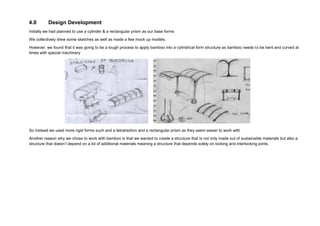
Initially we had planned to use a cylinder & a rectangular prism as our base forms
We collectively drew some sketches as well as made a few mock up models.
However, we found that it was going to be a tough process to apply bamboo into a cylindrical form structure as bamboo needs to be bent and curved at
times with special machinery
So instead we used more rigid forms such and a tetrahedron and a rectangular prism as they seem easier to work with
Another reason why we chose to work with bamboo is that we wanted to create a structure that is not only made out of sustainable materials but also a
structure that doesn’t depend on a lot of additional materials meaning a structure that depends solely on locking and interlocking joints.
Mock-up
model refined
Initial
scheme
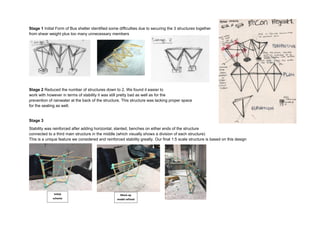
Stage 1 Initial Form of Bus shelter identified some difficulties due to securing the 3 structures together
from shear weight plus too many unnecessary members
Stage 2 Reduced the number of structures down to 2. We found it easier to
work with however in terms of stability it was still pretty bad as well as for the
prevention of rainwater at the back of the structure. This structure was lacking proper space
for the seating as well.
Stage 3
Stability was reinforced after adding horizontal, slanted, benches on either ends of the structure
connected to a third main structure in the middle (which visually shows a division of each structure)
This is a unique feature we considered and reinforced stability greatly. Our final 1:5 scale structure is based on this design
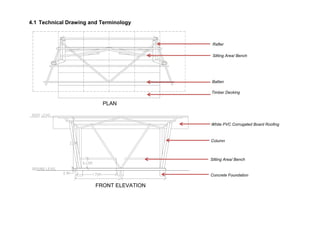
4.1 Technical Drawing and Terminology
Rafter
Sitting Area/ Bench
Batten
Timber Decking
PLAN
FRONT ELEVATION
White PVC Corrugated Board Roofing
Column
Concrete Foundation
Sitting Area/ Bench
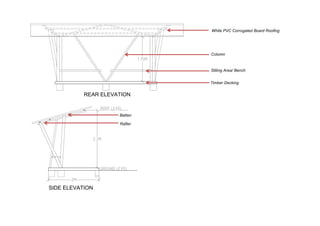
White PVC Corrugated Board Roofing
Sitting Area/ Bench
Timber Decking
REAR ELEVATION
Batten
Column
Rafter
SIDE ELEVATION
5.0 Design Consideration
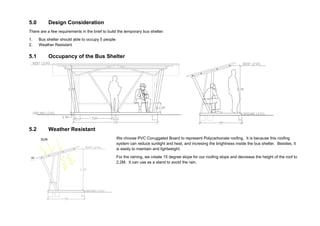
There are a few requirements in the brief to build the temporary bus shelter:
1. Bus shelter should able to occupy 5 people
2. Weather Resistant
5.1 Occupancy of the Bus Shelter
5.2 Weather Resistant
We choose PVC Coruggated Board to represent Polycarbonate roofing. It is because this roofing
system can reduce sunlight and heat, and incresing the brightness inside the bus shelter. Besides, it
is easily to maintain and lightweight.
For the raining, we create 15 degree slope for our roofing slope and decrease the height of the roof to
2.2M. It can use as a stand to avoid the rain.
SUN
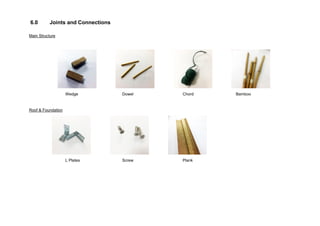
6.0 Joints and Connections
Main Structure
Wedge Dowel Chord Bamboo
Roof & Foundation
L Plates Screw Plank
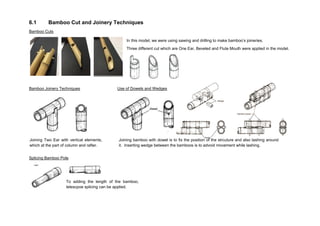
6.1 Bamboo Cut and Joinery Techniques
Bamboo Cuts
Bamboo Joinery Techniques Use of Dowels and Wedges
Splicing Bamboo Pole
In this model, we were using sawing and drilling to make bamboo’s joineries.
Three different cut which are One Ear, Beveled and Flute Mouth were applied in the model.
Joining Two Ear with vertical elements,
which at the part of column and rafter.
Joining bamboo with dowel is to fix the position of the strcuture and also lashing around
it. Inserting wedge between the bamboos is to advoid movement while lashing.
To adding the length of the bamboo,
telescpoe splicing can be applied.
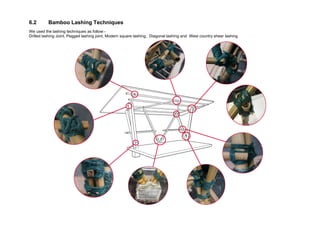
6.2 Bamboo Lashing Techniques
We used the lashing techniques as follow:-
Drilled lashing Joint, Pegged lashing joint, Modern square lashing, Diagonal lashing and West country shear lashing
7.0 Load and Force
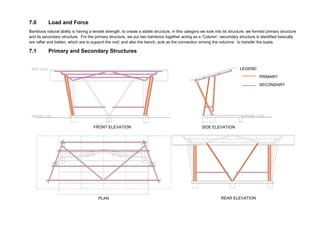
Bamboos natural ability is having a tensile strength, to create a stable structure, in this category we look into its structure, we formed primary structure
and its secondary structure. For the primary structure, we put two bamboos together acting as a ‘Column’; secondary structure is identified basically
are rafter and batten, which are to support the roof; and also the bench, acts as the connection among the columns’ to transfer the loads.
7.1 Primary and Secondary Structures
PLAN REAR ELEVATION
FRONT ELEVATION SIDE ELEVATION
LEGEND
PRIMARY
SECONDARY
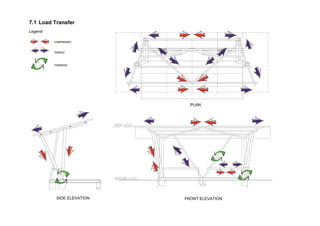
7.2 Load Transfer
Legend
PLAN
SIDE ELEVATION FRONT ELEVATION
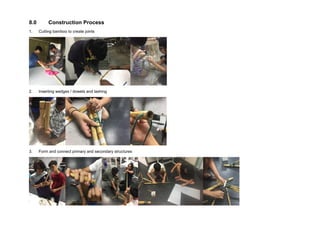
8.0 Construction Process
1. Cutting bamboo to create joints
2. Inserting wedges / dowels and lashing
3. Form and connect primary and secondary structures
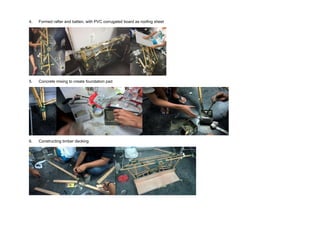
4. Formed rafter and batten, with PVC corrugated board as roofing sheet
5. Concrete mixing to create foundation pad
6. Constructing timber decking
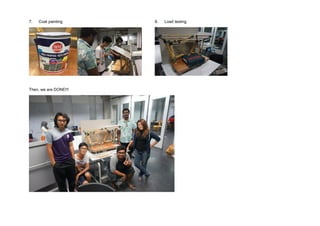
7. Coat painting 8. Load testing
Then, we are DONE!!!
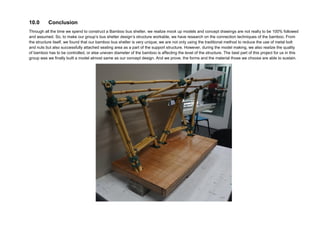
9.0 Conclusion
Through all the time we spend to construct a Bamboo bus shelter, we realize mock up models and concept drawings are not really to be 100% followed
and assumed. So, to make our group’s bus shelter design’s structure workable, we have research on the connection techniques of the bamboo. From
the structure itself, we found that our bamboo bus shelter is very unique; we are not only using the traditional method to reduce the use of metal bolt
and nuts but also successfully attached seating area as a part of the support structure. However, during the model making, we also realize the quality
of bamboo has to be controlled, or else uneven diameter of the bamboo is affecting the level of the structure. The best part of this project for us in this
group was we finally built a model almost same as our concept design. And we prove, the forms and the material those we choose are able to sustain.
References
1. Appropriate Building Materials: a Catalogue of Potential Solutions, Third Revised Edition (1988). Retrieved on Sept, 2016, from
http://www.nzdl.org/gsdlmod?e=d-00000-00---off-0hdl--00-0----0-10-0---0---0direct-10---4-------0-1l--11-en-50---20-about---00-0-1-00-0--4----0-0-
11-10-0utfZz-8-00&a=d&c=hdl&cl=CL1.1&d=HASH70c81f6386a2600bdfdd3f.3.13
2. http://inhabitat.com/indian-students-make-bamboo-bus-stop/
3. Green, L. (2013, February 23). SCOUT PIONEERING. Retrieved October 02, 2016,
from https://scoutpioneering.com/tag/what-kind-of-rope-for-lashing/
3. Stéphane Schröder. 2009. Bamboo Joints and Joinery Techniques. Retrieved September 30, 2016,
from http://www.guaduabamboo.com/working-with-bamboo/joining-bamboo.
4. Schröder, S. (2016, May 04). Bamboo Lashing Techniques. Retrieved September 30, 2016,
from https://www.bambooimport.com/en/blog/bamboo-lashing-techniques
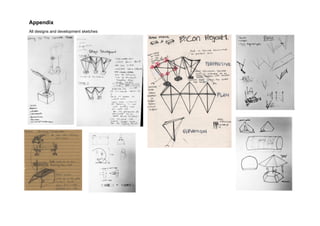
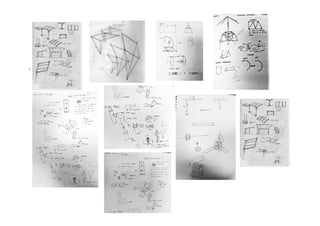
Appendix
All designs and development sketches
f

Building Construction 2 - Project 1 - Temporary Bus Shelter

  • 1.
    BUILDING CONSTRUCTION 2(BLD 60703/ARC 2513) PROJECT 1: SKELETAL CONSTRUCTION - TEMPORARY BUS SHELTER GROUP MEMBERS: CHOO ZI ZHAO 0320498 MUHAMMAD ASHROFF 0325736 RAJAN KULANDAYA 0317164 WONG WAN JIUAN 0327173 MUHAMMAD ZAIM 0325930 TUTOR MS SUJATAVANI GUNASAGARAN
  • 2.
    TABLE OF CONTENTS 1.0INTRODUCTION 2.0 DESIGN ANALYSIS 3.0 PRECEDENT STUDIES 4.0 DESIGN DEVELOPMENT 5.0 DESIGN CONSIDERATION 6.0 JOINTS AND CONNECTIONS 7.0 LOAD AND FORCE 8.0 CONSTRUCTION PROCESS 9.0 CONCLUSION REFERENCE APPENDIX
  • 3.
    1.0 Introduction In thisproject, five of us chose Tetrahedron and Triangular Prism as our skeletal form to construct our temporary bus shelter in a scale of 1:5. Although Triangular form is the most stable construction form due to its inherent structural characteristic, the consideration of using Bamboo in our design becomes our most challenging decision. Compared to other construction methods by using nuts and bolts for connections, we are going to use traditional joints used in bamboo construction to connect each of the primary and secondary supports, from the foundation to the roof and some minor materials to enhance its strength, such as concrete to hold the bamboo’s primary support. Our decision is to prove Bamboo can be widely used in light construction such as a bus shelter by replacing materials like wood and metal. By utilising traditional bamboo joints, its structure also can be easily dismantled.
  • 4.
    2.0 Design Analysis Thereare two aspects our group looked into before constructing our temporary bus shelter: 1. Form of the bus shelter 2. Material (Focus on Bamboo) 2.1 Form The reason of choosing Tetrahedron and Triangular Prism to design our bus shelter is based on the triangle inherent structural characteristic in the form. Compare to square, the end points of triangle can transfer high amount of forces due to its rigidness without deformation. So, triangles often used as trusses in bridges or as others support structures in the building. 2.2 Material Our group chooses Bamboo as our main material for our project to show that the shape and material can perform well together. Due to Bamboo’s growth cycle, it can grow more than one metre in a single day, and it can reach its maximum height within the first six months. For Bamboo to be used in construction, it needs 3 years to develop its strengths and five to six years to fully mature. Compare to normal trees’ growth, Bamboo can be harvested faster and solve the shortage of some materials. Bamboo has its own advantages and disadvantages as follow: Tetrahedron Triangular Prism Advantages  Bamboo is an extremely strong fibre  Highly flexible  Low-cost and environmentally friendly  Light weight compared to steel  Shock absorbing and thus earthquake resistant  Bamboo can prevent pollution by absorbing large amounts of nitrogen from waste water  It also reduces the amount of CO2 in the air Disadvantages  Joining Techniques are limited however the development of more effective methods Is still being researched  Flammability Bamboo structures are not fire resistant and the cost of treatment is high  Bamboo has a round profile therefore connections are pretty complicated.  Bamboo is hollow there is no material to tighten the middle to the cane  Bamboo is not suitable for loads in cross direction because there are no cross fibres  Bamboo is a natural material that varies in diameter length and quality according to the climate.  The density of fibres in cross section of a bamboo shell varies with thickness as well as in height so it is not constant  Bamboo is more prone to insect attacks than other trees and grasses
  • 5.
    Correct bamboo touse due to brownish hue 3.0 Precedent Studies We got some inspiration from a series of precedents Bamboo Structure 1. Restaurant at Greenville, Jarkata, Indonesia- DSA+s We admired the aesthetics of bamboo used and how the bamboo was standing on the concrete foundation that came out from ground to prevent from water. The usage of a wide and also high roof for allowing to wind flow freely through the restaurant. The roof cover also made from bamboo, which is assembled with coupling system. The system is used for preventing water dripping, and for protecting cracking which usually happened when bamboo is being exposed directly to the sun. 2. Bamboo Bus Stop, Bombay, India – Indian Institute of Technology The bus stand was built in a nearby village We were inspired by the simple, functional and sturdy form, and how a zinc roof was implemented on the bamboo rafter. In our case we thought of replacing the zinc roof with a corrugated board to disperse sunlight and increase brightness in the bus shelter.
  • 6.
    3. Bamboo Selection Bamboo used for construction should be a light brown hue. This ensures that the plant is at least 3 years old  Avoid bamboo that’s cut in spring or early summer these batches are generally weaker due to increased fibre moisture content Foundation Concrete Formula Applied & Concrete mix proportions  Concrete ratio should be as low as workability will allow.  Excess water causes swelling of the bamboo.  High early strength cement is preferred to minimize cracks caused by swelling of bamboo when seasoned bamboo cannot be waterproofed. Waterproofing & Strengthening Bamboo The bamboo trusses are first coated with 2 – 3 layers of rubber tree oil. The oil helps to protect the bamboo from moisture. Bamboo has to be treated against insect attack these are to be soaked in a solution of borax and boric acid. Fifty grams of each chemical for every litre of water. Soaking time typically takes 3 days. another method can be used where the bamboo is soaked in an alum solution for 30 minutes to preserve them for 15 years.
  • 7.
    Roof In our model,we use PVC corrugated cardboard sheet to represent polycarbonate corrugated roofing. The reasons for choosing this material is due to its many advantages:- • Uv resistance • High plasticity • Light and heat resistance (Metallic Sunstop) • Good thermal insulation • Lightweight • Fire resistance • High degree of transparency • Impact resistance and unbreakable • Easy transportation • Virtually Unbreakable Code Structural(mm) Colour Thickness (+/-5%) Length A Angular Corrugated (5Grooves) Brown, Clear, Metallic 0.8mm, 0.10mm, 0.12, 18mm, MS-1.0mm 18', 20' MC Mid-Circular Corrugated (9Grooves) Brown, Clear 0.9mm 6', 7', 8', 10', 12', 20' http://www.deskylight.com.my/product-polycarbonate PVC Corrugated Board to represent actual material
  • 8.
    4.0 Design Development Initiallywe had planned to use a cylinder & a rectangular prism as our base forms We collectively drew some sketches as well as made a few mock up models. However, we found that it was going to be a tough process to apply bamboo into a cylindrical form structure as bamboo needs to be bent and curved at times with special machinery So instead we used more rigid forms such and a tetrahedron and a rectangular prism as they seem easier to work with Another reason why we chose to work with bamboo is that we wanted to create a structure that is not only made out of sustainable materials but also a structure that doesn’t depend on a lot of additional materials meaning a structure that depends solely on locking and interlocking joints.
  • 9.
    Mock-up model refined Initial scheme Stage 1Initial Form of Bus shelter identified some difficulties due to securing the 3 structures together from shear weight plus too many unnecessary members Stage 2 Reduced the number of structures down to 2. We found it easier to work with however in terms of stability it was still pretty bad as well as for the prevention of rainwater at the back of the structure. This structure was lacking proper space for the seating as well. Stage 3 Stability was reinforced after adding horizontal, slanted, benches on either ends of the structure connected to a third main structure in the middle (which visually shows a division of each structure) This is a unique feature we considered and reinforced stability greatly. Our final 1:5 scale structure is based on this design
  • 10.
    4.1 Technical Drawingand Terminology Rafter Sitting Area/ Bench Batten Timber Decking PLAN FRONT ELEVATION White PVC Corrugated Board Roofing Column Concrete Foundation Sitting Area/ Bench
  • 11.
    White PVC CorrugatedBoard Roofing Sitting Area/ Bench Timber Decking REAR ELEVATION Batten Column Rafter SIDE ELEVATION
  • 12.
    5.0 Design Consideration Thereare a few requirements in the brief to build the temporary bus shelter: 1. Bus shelter should able to occupy 5 people 2. Weather Resistant 5.1 Occupancy of the Bus Shelter 5.2 Weather Resistant We choose PVC Coruggated Board to represent Polycarbonate roofing. It is because this roofing system can reduce sunlight and heat, and incresing the brightness inside the bus shelter. Besides, it is easily to maintain and lightweight. For the raining, we create 15 degree slope for our roofing slope and decrease the height of the roof to 2.2M. It can use as a stand to avoid the rain. SUN
  • 13.
    6.0 Joints andConnections Main Structure Wedge Dowel Chord Bamboo Roof & Foundation L Plates Screw Plank
  • 14.
    6.1 Bamboo Cutand Joinery Techniques Bamboo Cuts Bamboo Joinery Techniques Use of Dowels and Wedges Splicing Bamboo Pole In this model, we were using sawing and drilling to make bamboo’s joineries. Three different cut which are One Ear, Beveled and Flute Mouth were applied in the model. Joining Two Ear with vertical elements, which at the part of column and rafter. Joining bamboo with dowel is to fix the position of the strcuture and also lashing around it. Inserting wedge between the bamboos is to advoid movement while lashing. To adding the length of the bamboo, telescpoe splicing can be applied.
  • 15.
    6.2 Bamboo LashingTechniques We used the lashing techniques as follow:- Drilled lashing Joint, Pegged lashing joint, Modern square lashing, Diagonal lashing and West country shear lashing
  • 16.
    7.0 Load andForce Bamboos natural ability is having a tensile strength, to create a stable structure, in this category we look into its structure, we formed primary structure and its secondary structure. For the primary structure, we put two bamboos together acting as a ‘Column’; secondary structure is identified basically are rafter and batten, which are to support the roof; and also the bench, acts as the connection among the columns’ to transfer the loads. 7.1 Primary and Secondary Structures PLAN REAR ELEVATION FRONT ELEVATION SIDE ELEVATION LEGEND PRIMARY SECONDARY
  • 17.
    7.2 Load Transfer Legend PLAN SIDEELEVATION FRONT ELEVATION
  • 18.
    8.0 Construction Process 1.Cutting bamboo to create joints 2. Inserting wedges / dowels and lashing 3. Form and connect primary and secondary structures
  • 19.
    4. Formed rafterand batten, with PVC corrugated board as roofing sheet 5. Concrete mixing to create foundation pad 6. Constructing timber decking
  • 20.
    7. Coat painting8. Load testing Then, we are DONE!!!
  • 21.
    9.0 Conclusion Through allthe time we spend to construct a Bamboo bus shelter, we realize mock up models and concept drawings are not really to be 100% followed and assumed. So, to make our group’s bus shelter design’s structure workable, we have research on the connection techniques of the bamboo. From the structure itself, we found that our bamboo bus shelter is very unique; we are not only using the traditional method to reduce the use of metal bolt and nuts but also successfully attached seating area as a part of the support structure. However, during the model making, we also realize the quality of bamboo has to be controlled, or else uneven diameter of the bamboo is affecting the level of the structure. The best part of this project for us in this group was we finally built a model almost same as our concept design. And we prove, the forms and the material those we choose are able to sustain.
  • 22.
    References 1. Appropriate BuildingMaterials: a Catalogue of Potential Solutions, Third Revised Edition (1988). Retrieved on Sept, 2016, from http://www.nzdl.org/gsdlmod?e=d-00000-00---off-0hdl--00-0----0-10-0---0---0direct-10---4-------0-1l--11-en-50---20-about---00-0-1-00-0--4----0-0- 11-10-0utfZz-8-00&a=d&c=hdl&cl=CL1.1&d=HASH70c81f6386a2600bdfdd3f.3.13 2. http://inhabitat.com/indian-students-make-bamboo-bus-stop/ 3. Green, L. (2013, February 23). SCOUT PIONEERING. Retrieved October 02, 2016, from https://scoutpioneering.com/tag/what-kind-of-rope-for-lashing/ 3. Stéphane Schröder. 2009. Bamboo Joints and Joinery Techniques. Retrieved September 30, 2016, from http://www.guaduabamboo.com/working-with-bamboo/joining-bamboo. 4. Schröder, S. (2016, May 04). Bamboo Lashing Techniques. Retrieved September 30, 2016, from https://www.bambooimport.com/en/blog/bamboo-lashing-techniques
  • 23.
    Appendix All designs anddevelopment sketches
  • 24.