1 | P a g e 1 0 M a r c h 2 0 1 6
SCHOOL OF ARCHITECTURE, BUILDING & DESIGN
Modern Architecture Studies in Southeast Asia (MASSA) Research Unit
Bachelor of Science (Honours) (Architecture)
ARCHITECTURE DESIGN STUDIO 5 [ARC 60306 / ARC3117 / ARC 3118]
______________________________________________________________________________________
Project 1: Preliminary Studies
Project 1 Group & Peer Assessment
LO 1 -
3
30% of
total mark*
Pin Up & Verbal
presentation
Refer below
Introduction
The Preliminary Studies is a preparatory assignment that focuses on investigating basic notions of
the city, and learning from examples of community library around the world. This assignment aims to
firstly introduce students to the basics in urban design and its relation to architecture, and secondly,
studying and determining the programmatic function, societal role and spatial layout of a community
library and architectural responses for urban infills.
The Preliminary Studies comprises of three components: Site Documentation, Site Analysis, and
Precedent Studies of Urban Infills and Community Library. The Site Documentation and Site Analysis
will equip students with a firm understanding of the site they will be working with this semester, while
the Precedent Studies will provide an insight into architectural responses for designing an urban infill
community library.
The outcome of the Preliminary Studies will include the production of site documentation materials
(drawings and models in both digital and physical copy for further use), a comprehensive analysis of
the site, and a detailed case study of a relevant urban infill and community library.
Objectives of Project
The objectives of this assignment are as follows:
1. To have an overview of the formation of cities and introduce basic concepts of urban design in relation
to architectural design
2. To introduce and implement basic methodologies of urban studies
3. To investigate the role of community libraries in traditional and contemporary urban societies
4. To examine various examples and architectural responses for urban infills
2 | P a g e 1 0 M a r c h 2 0 1 6
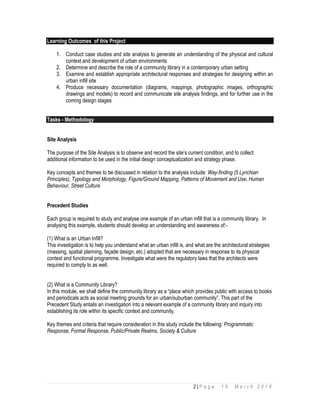
Learning Outcomes of this Project
1. Conduct case studies and site analysis to generate an understanding of the physical and cultural
context and development of urban environments
2. Determine and describe the role of a community library in a contemporary urban setting
3. Examine and establish appropriate architectural responses and strategies for designing within an
urban infill site
4. Produce necessary documentation (diagrams, mappings, photographic images, orthographic
drawings and models) to record and communicate site analysis findings, and for further use in the
coming design stages
Tasks - Methodology
Site Analysis
The purpose of the Site Analysis is to observe and record the site’s current condition, and to collect
additional information to be used in the initial design conceptualization and strategy phase.
Key concepts and themes to be discussed in relation to the analysis include: Way-finding (5 Lynchian
Principles), Typology and Morphology, Figure/Ground Mapping, Patterns of Movement and Use, Human
Behaviour, Street Culture
Precedent Studies
Each group is required to study and analyse one example of an urban infill that is a community library. In
analysing this example, students should develop an understanding and awareness of:-
(1) What is an Urban Infill?
This investigation is to help you understand what an urban infill is, and what are the architectural strategies
(massing, spatial planning, façade design, etc.) adopted that are necessary in response to its physical
context and functional programme. Investigate what were the regulatory laws that the architects were
required to comply to as well.
(2) What is a Community Library?
In this module, we shall define the community library as a “place which provides public with access to books
and periodicals acts as social meeting grounds for an urban/suburban community”. This part of the
Precedent Study entails an investigation into a relevant example of a community library and inquiry into
establishing its role within its specific context and community.
Key themes and criteria that require consideration in this study include the following: Programmatic
Response, Formal Response, Public/Private Realms, Society & Culture
3 | P a g e 1 0 M a r c h 2 0 1 6
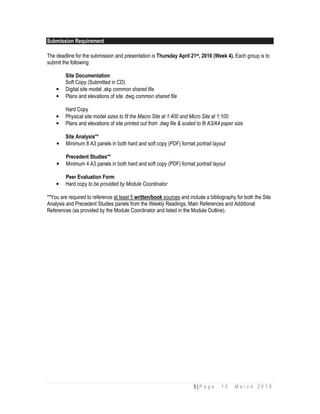
Submission Requirement
The deadline for the submission and presentation is Thursday April 21st, 2016 (Week 4). Each group is to
submit the following:
Site Documentation
Soft Copy (Submitted in CD)
• Digital site model .skp common shared file
• Plans and elevations of site .dwg common shared file
Hard Copy
• Physical site model sizes to fit the Macro Site at 1:400 and Micro Site at 1:100
• Plans and elevations of site printed out from .dwg file & scaled to fit A3/A4 paper size
Site Analysis**
• Minimum 8 A3 panels in both hard and soft copy (PDF) format portrait layout
Precedent Studies**
• Minimum 4 A3 panels in both hard and soft copy (PDF) format portrait layout
Peer Evaluation Form
• Hard copy to be provided by Module Coordinator
**You are required to reference at least 5 written/book sources and include a bibliography for both the Site
Analysis and Precedent Studies panels from the Weekly Readings, Main References and Additional
References (as provided by the Module Coordinator and listed in the Module Outline).
4 | P a g e 1 0 M a r c h 2 0 1 6
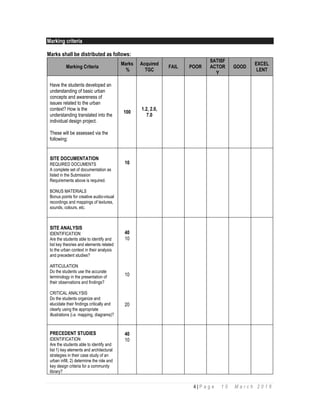
Marking criteria
Marks shall be distributed as follows:
Marking Criteria
Marks
%
Acquired
TGC
FAIL POOR
SATISF
ACTOR
Y
GOOD
EXCEL
LENT
Have the students developed an
understanding of basic urban
concepts and awareness of
issues related to the urban
context? How is the
understanding translated into the
individual design project.
These will be assessed via the
following:
100
1.2, 2.0,
7.0
SITE DOCUMENTATION
REQUIRED DOCUMENTS
A complete set of documentation as
listed in the Submission
Requirements above is required.
BONUS MATERIALS
Bonus points for creative audio-visual
recordings and mappings of textures,
sounds, colours, etc.
10
SITE ANALYSIS
IDENTIFICATION
Are the students able to identify and
list key theories and elements related
to the urban context in their analysis
and precedent studies?
ARTICULATION
Do the students use the accurate
terminology in the presentation of
their observations and findings?
CRITICAL ANALYSIS
Do the students organize and
elucidate their findings critically and
clearly using the appropriate
illustrations (i.e. mapping, diagrams)?
40
10
10
20
PRECEDENT STUDIES
IDENTIFICATION
Are the students able to identify and
list 1) key elements and architectural
strategies in their case study of an
urban infill, 2) determine the role and
key design criteria for a community
library?
40
10
5 | P a g e 1 0 M a r c h 2 0 1 6
ARTICULATION
Do the students use the accurate
terminology in the presentation of
their observations and findings?
CHOICE OF CASE STUDY
How appropriate was the building
selected by the students for the
purpose of this study?
CRITICAL ANALYSIS
Do the students organize and
elucidate their findings critically and
clearly using the appropriate
illustrations (i.e. mapping, diagrams)?
10
10
10
PEER EVALUATION
This individual assessment will be
grade each student’s team
contribution
10
Suggested References
Main References:
1. Lynch, K. 1979. The Image Of The City. Cambridge, Massachusetts: The MIT Press.
2. Gehl, J. 2010. Cities for People. Washington: Island Press
3. Gehl, J. (2011). Life between buildings : using public space. Washington, DC: Island Press.
4. Bryan Lawson. (2001). The language of space [electronic resource]. Oxford: Architectural.
5. Baker, G. 1989. Design Strategies In Architecture (2nd Ed.). New York: Van Nostrand Reinhold.
6. Hertzberger, H. 1991. Lessons For Students In Architecture. Rotterdam: 010 Publishers.
7. Gifford, R. (2014). Environmental Psychology Matters. Annual Review of Psychology, 65(1), 541–
579. http://doi.org/10.1146/annurev-psych-010213-115048
8. Porteous, J. D. (1977). Environment & behavior : planning and everyday urban life. Reading, Mass;
London etc: Addison-Wesley.
Additional References:
1. Norberg-schulz. (1966). Intentions in Architecture (New edition). MIT Press.
2. Franck, K. A., & Stevens, Q. (2007). Loose space: possibility and diversity in urban life. London;
New York: Routledge.
3. Jacobs, J. 1961. The Death and Life of Great American Cities. (1st Ed.). New York: Random House
4. Jean Hillier, Emma Rooksby, and Habitus 2000 (Conference) (2000 : Perth). (2005). Habitus : a
sense of place (2nd ed.). Aldershot: Ashgate.
5. Whyte, W.H. 1980. The Social Life of Small Urban Spaces (1st Ed.). New York: Project for Public
Spaces Inc
6. Larice, M., Macdonald, E. (ed.) 2012. The Urban Design Reader. (2nd Ed.).
For Weekly Readings, please refer to the handouts to be provided by the Module Coordinator.
*Note: Students are required to obtain a minimum C grade in this assessment to pass the module.

Studio brief

  • 1.
    1 | Pa g e 1 0 M a r c h 2 0 1 6 SCHOOL OF ARCHITECTURE, BUILDING & DESIGN Modern Architecture Studies in Southeast Asia (MASSA) Research Unit Bachelor of Science (Honours) (Architecture) ARCHITECTURE DESIGN STUDIO 5 [ARC 60306 / ARC3117 / ARC 3118] ______________________________________________________________________________________ Project 1: Preliminary Studies Project 1 Group & Peer Assessment LO 1 - 3 30% of total mark* Pin Up & Verbal presentation Refer below Introduction The Preliminary Studies is a preparatory assignment that focuses on investigating basic notions of the city, and learning from examples of community library around the world. This assignment aims to firstly introduce students to the basics in urban design and its relation to architecture, and secondly, studying and determining the programmatic function, societal role and spatial layout of a community library and architectural responses for urban infills. The Preliminary Studies comprises of three components: Site Documentation, Site Analysis, and Precedent Studies of Urban Infills and Community Library. The Site Documentation and Site Analysis will equip students with a firm understanding of the site they will be working with this semester, while the Precedent Studies will provide an insight into architectural responses for designing an urban infill community library. The outcome of the Preliminary Studies will include the production of site documentation materials (drawings and models in both digital and physical copy for further use), a comprehensive analysis of the site, and a detailed case study of a relevant urban infill and community library. Objectives of Project The objectives of this assignment are as follows: 1. To have an overview of the formation of cities and introduce basic concepts of urban design in relation to architectural design 2. To introduce and implement basic methodologies of urban studies 3. To investigate the role of community libraries in traditional and contemporary urban societies 4. To examine various examples and architectural responses for urban infills
  • 2.
    2 | Pa g e 1 0 M a r c h 2 0 1 6 Learning Outcomes of this Project 1. Conduct case studies and site analysis to generate an understanding of the physical and cultural context and development of urban environments 2. Determine and describe the role of a community library in a contemporary urban setting 3. Examine and establish appropriate architectural responses and strategies for designing within an urban infill site 4. Produce necessary documentation (diagrams, mappings, photographic images, orthographic drawings and models) to record and communicate site analysis findings, and for further use in the coming design stages Tasks - Methodology Site Analysis The purpose of the Site Analysis is to observe and record the site’s current condition, and to collect additional information to be used in the initial design conceptualization and strategy phase. Key concepts and themes to be discussed in relation to the analysis include: Way-finding (5 Lynchian Principles), Typology and Morphology, Figure/Ground Mapping, Patterns of Movement and Use, Human Behaviour, Street Culture Precedent Studies Each group is required to study and analyse one example of an urban infill that is a community library. In analysing this example, students should develop an understanding and awareness of:- (1) What is an Urban Infill? This investigation is to help you understand what an urban infill is, and what are the architectural strategies (massing, spatial planning, façade design, etc.) adopted that are necessary in response to its physical context and functional programme. Investigate what were the regulatory laws that the architects were required to comply to as well. (2) What is a Community Library? In this module, we shall define the community library as a “place which provides public with access to books and periodicals acts as social meeting grounds for an urban/suburban community”. This part of the Precedent Study entails an investigation into a relevant example of a community library and inquiry into establishing its role within its specific context and community. Key themes and criteria that require consideration in this study include the following: Programmatic Response, Formal Response, Public/Private Realms, Society & Culture
  • 3.
    3 | Pa g e 1 0 M a r c h 2 0 1 6 Submission Requirement The deadline for the submission and presentation is Thursday April 21st, 2016 (Week 4). Each group is to submit the following: Site Documentation Soft Copy (Submitted in CD) • Digital site model .skp common shared file • Plans and elevations of site .dwg common shared file Hard Copy • Physical site model sizes to fit the Macro Site at 1:400 and Micro Site at 1:100 • Plans and elevations of site printed out from .dwg file & scaled to fit A3/A4 paper size Site Analysis** • Minimum 8 A3 panels in both hard and soft copy (PDF) format portrait layout Precedent Studies** • Minimum 4 A3 panels in both hard and soft copy (PDF) format portrait layout Peer Evaluation Form • Hard copy to be provided by Module Coordinator **You are required to reference at least 5 written/book sources and include a bibliography for both the Site Analysis and Precedent Studies panels from the Weekly Readings, Main References and Additional References (as provided by the Module Coordinator and listed in the Module Outline).
  • 4.
    4 | Pa g e 1 0 M a r c h 2 0 1 6 Marking criteria Marks shall be distributed as follows: Marking Criteria Marks % Acquired TGC FAIL POOR SATISF ACTOR Y GOOD EXCEL LENT Have the students developed an understanding of basic urban concepts and awareness of issues related to the urban context? How is the understanding translated into the individual design project. These will be assessed via the following: 100 1.2, 2.0, 7.0 SITE DOCUMENTATION REQUIRED DOCUMENTS A complete set of documentation as listed in the Submission Requirements above is required. BONUS MATERIALS Bonus points for creative audio-visual recordings and mappings of textures, sounds, colours, etc. 10 SITE ANALYSIS IDENTIFICATION Are the students able to identify and list key theories and elements related to the urban context in their analysis and precedent studies? ARTICULATION Do the students use the accurate terminology in the presentation of their observations and findings? CRITICAL ANALYSIS Do the students organize and elucidate their findings critically and clearly using the appropriate illustrations (i.e. mapping, diagrams)? 40 10 10 20 PRECEDENT STUDIES IDENTIFICATION Are the students able to identify and list 1) key elements and architectural strategies in their case study of an urban infill, 2) determine the role and key design criteria for a community library? 40 10
  • 5.
    5 | Pa g e 1 0 M a r c h 2 0 1 6 ARTICULATION Do the students use the accurate terminology in the presentation of their observations and findings? CHOICE OF CASE STUDY How appropriate was the building selected by the students for the purpose of this study? CRITICAL ANALYSIS Do the students organize and elucidate their findings critically and clearly using the appropriate illustrations (i.e. mapping, diagrams)? 10 10 10 PEER EVALUATION This individual assessment will be grade each student’s team contribution 10 Suggested References Main References: 1. Lynch, K. 1979. The Image Of The City. Cambridge, Massachusetts: The MIT Press. 2. Gehl, J. 2010. Cities for People. Washington: Island Press 3. Gehl, J. (2011). Life between buildings : using public space. Washington, DC: Island Press. 4. Bryan Lawson. (2001). The language of space [electronic resource]. Oxford: Architectural. 5. Baker, G. 1989. Design Strategies In Architecture (2nd Ed.). New York: Van Nostrand Reinhold. 6. Hertzberger, H. 1991. Lessons For Students In Architecture. Rotterdam: 010 Publishers. 7. Gifford, R. (2014). Environmental Psychology Matters. Annual Review of Psychology, 65(1), 541– 579. http://doi.org/10.1146/annurev-psych-010213-115048 8. Porteous, J. D. (1977). Environment & behavior : planning and everyday urban life. Reading, Mass; London etc: Addison-Wesley. Additional References: 1. Norberg-schulz. (1966). Intentions in Architecture (New edition). MIT Press. 2. Franck, K. A., & Stevens, Q. (2007). Loose space: possibility and diversity in urban life. London; New York: Routledge. 3. Jacobs, J. 1961. The Death and Life of Great American Cities. (1st Ed.). New York: Random House 4. Jean Hillier, Emma Rooksby, and Habitus 2000 (Conference) (2000 : Perth). (2005). Habitus : a sense of place (2nd ed.). Aldershot: Ashgate. 5. Whyte, W.H. 1980. The Social Life of Small Urban Spaces (1st Ed.). New York: Project for Public Spaces Inc 6. Larice, M., Macdonald, E. (ed.) 2012. The Urban Design Reader. (2nd Ed.). For Weekly Readings, please refer to the handouts to be provided by the Module Coordinator. *Note: Students are required to obtain a minimum C grade in this assessment to pass the module.