UNIT - 3
STRATEGIC ANALYSIS AND CHOICE
Corporate Level Strategic Choice
BCG Matrix
GE Nine Cell Matrix
SWOT Analysis
 Business Level Strategic Analysis- Experience Curve
Analysis
 Industry Analysis-porter Five Force Model
Mr. Ashesh Anand
Assistant Professor
Vinoba Bhave University
Hazaribagh
BCG MATRIX
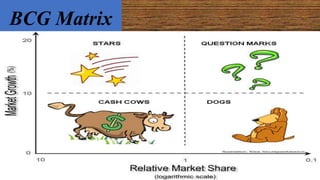
The BCG growth-share matrix is the simplest way to portray a
corporation’s portfolio of investments.
Growth share matrix also known for its cow and dog metaphors
is popularly used for resource allocation in a diversified company.
Using the BCG approach, a company classifies its different
businesses on a two-dimensional GROWTH-SHARE matrix
The vertical axis represents market growth rate and provides a
measure of market attractiveness.
The horizontal axis represents relative market share and serves
as a measure of company strength in the market.
BCG Matrix
STARS- are products or SBUs that are growing rapidly. They also
need heavy investment to maintain their position and finance
their rapid growth potential. They represent best opportunities
for expansion
STARS- are products or SBUs that are growing rapidly. They also need heavy investment to
maintain their position and finance their rapid growth potential. They represent best
expansion
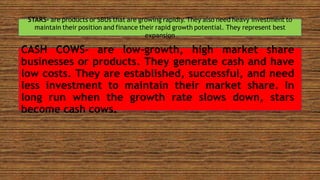
CASH COWS- are low-growth, high market share
businesses or products. They generate cash and have
low costs. They are established, successful, and need
less investment to maintain their market share. In
long run when the growth rate slows down, stars
become cash cows.
STARS- are products or SBUs that are growing rapidly. They also need heavy investment to
maintain their position and finance their rapid growth potential. They represent best
expansion
CASH COWS- are low-growth, high market share businesses or products. They generate
cash and have low costs. They are established, successful, and need less investment to
maintain their market share. In long run when the growth rate slows down, stars become
cash cows.
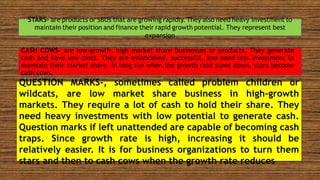
QUESTION MARKS-, sometimes called problem children or
wildcats, are low market share business in high-growth
markets. They require a lot of cash to hold their share. They
need heavy investments with low potential to generate cash.
Question marks if left unattended are capable of becoming cash
traps. Since growth rate is high, increasing it should be
relatively easier. It is for business organizations to turn them
stars and then to cash cows when the growth rate reduces
STARS- are products or SBUs that are growing rapidly. They also need heavy investment to
maintain their position and finance their rapid growth potential. They represent best
expansion
CASH COWS- are low-growth, high market share businesses or products. They generate
cash and have low costs. They are established, successful, and need less investment to
maintain their market share. In long run when the growth rate slows down, stars become
cash cows.
QUESTION MARKS-, sometimes called problem children or wildcats, are low market share
business in high-growth markets. They require a lot of cash to hold their share. They need
heavy investments with low potential to generate cash. Question marks if left unattended are
capable of becoming cash traps. Since growth rate is high, increasing it should be relatively
easier. It is for business organizations to turn them stars and then to cash cows when the
growth rate reduces
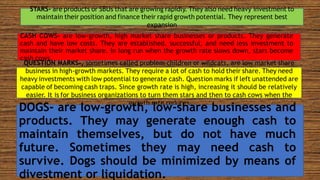
DOGS- are low-growth, low-share businesses and
products. They may generate enough cash to
maintain themselves, but do not have much
future. Sometimes they may need cash to
survive. Dogs should be minimized by means of
divestment or liquidation.
BCG Matrix : Post Identification Strategies
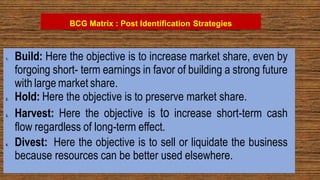
1. Build: Here the objective is to increase market share, even by
forgoing short- term earnings in favor of building a strong future
with large market share.
2. Hold: Here the objective is to preserve market share.
3. Harvest: Here the objective is to increase short-term cash
flow regardless of long-term effect.
4. Divest: Here the objective is to sell or liquidate the business
because resources can be better used elsewhere.
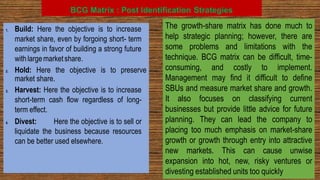
BCG Matrix : Post Identification Strategies
1. Build: Here the objective is to increase
market share, even by forgoing short- term
earnings in favor of building a strong future
with largemarketshare.
2. Hold: Here the objective is to preserve
market share.
3. Harvest: Here the objective is to increase
short-term cash flow regardless of long-
term effect.
4. Divest: Here the objective is to sell or
liquidate the business because resources
can be better used elsewhere.
The growth-share matrix has done much to
help strategic planning; however, there are
some problems and limitations with the
technique. BCG matrix can be difficult, time-
consuming, and costly to implement.
Management may find it difficult to define
SBUs and measure market share and growth.
It also focuses on classifying current
businesses but provide little advice for future
planning. They can lead the company to
placing too much emphasis on market-share
growth or growth through entry into attractive
new markets. This can cause unwise
expansion into hot, new, risky ventures or
divesting established units too quickly
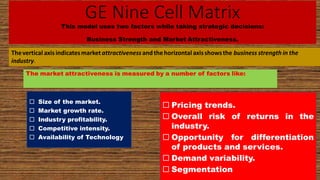
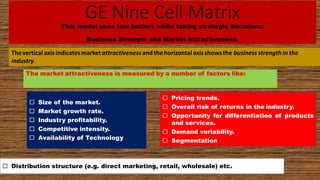
GE Nine Cell Matrix
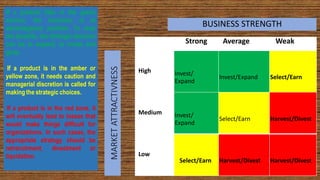
This model uses two factors while taking strategic decisions:
Business Strength and Market Attractiveness.
The market attractiveness is measured by a number of factors like:
Thevertical axisindicatesmarketattractivenessandthehorizontal axisshowsthe business strength in the
industry.
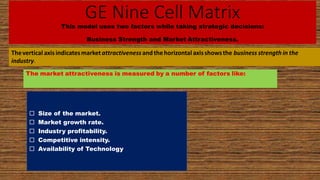
GE Nine Cell Matrix
This model uses two factors while taking strategic decisions:
Business Strength and Market Attractiveness.
The market attractiveness is measured by a number of factors like:
Thevertical axisindicatesmarketattractivenessandthehorizontal axisshowsthe business strength in the
industry.
 Size of the market.
 Market growth rate.
 Industry profitability.
 Competitive intensity.
 Availability of Technology
GE Nine Cell Matrix
This model uses two factors while taking strategic decisions:
Business Strength and Market Attractiveness.
The market attractiveness is measured by a number of factors like:
Thevertical axisindicatesmarketattractivenessandthehorizontal axisshowsthe business strength in the
industry.
 Size of the market.
 Market growth rate.
 Industry profitability.
 Competitive intensity.
 Availability of Technology
 Pricing trends.
 Overall risk of returns in the
industry.
 Opportunity for differentiation
of products and services.
 Demand variability.
 Segmentation
GE Nine Cell Matrix
This model uses two factors while taking strategic decisions:
Business Strength and Market Attractiveness.
The market attractiveness is measured by a number of factors like:
Thevertical axisindicatesmarketattractivenessandthehorizontal axisshowsthe business strength in the
industry.
 Size of the market.
 Market growth rate.
 Industry profitability.
 Competitive intensity.
 Availability of Technology
 Pricing trends.
 Overall risk of returns in the industry.
 Opportunity for differentiation of products
and services.
 Demand variability.
 Segmentation
 Distribution structure (e.g. direct marketing, retail, wholesale) etc.
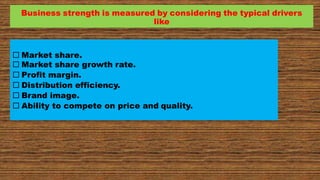
Business strength is measured by considering the typical drivers
like
 Market share.
 Market share growth rate.
 Profit margin.
 Distribution efficiency.
 Brand image.
 Ability to compete on price and quality.
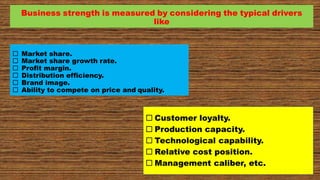
Business strength is measured by considering the typical drivers
like
 Market share.
 Market share growth rate.
 Profit margin.
 Distribution efficiency.
 Brand image.
 Ability to compete on price and quality.
 Customer loyalty.
 Production capacity.
 Technological capability.
 Relative cost position.
 Management caliber, etc.
MARKET
ATTRACTIVNESS
BUSINESS STRENGTH
Strong Average Weak
High Invest/
Expand
Invest/Expand Select/Earn
Medium Invest/
Expand
Select/Earn Harvest/Divest
Low
Select/Earn Harvest/Divest Harvest/Divest
If a product falls in the green
section, the business is at
advantageous position. To reap
the benefits, the strategic decision
can be to expand, to invest and
grow.
If a product is in the amber or
yellow zone, it needs caution and
managerial discretion is called for
making the strategic choices.
If a product is in the red zone, it
will eventually lead to losses that
would make things difficult for
organizations. In such cases, the
appropriate strategy should be
retrenchment, divestment or
liquidation.
EXPERIENCE CURVE
Experience curve is an important concept used for applying a
portfolio approach. The concept is akin to a learning curve
which explains the efficiency increase gained by workers
through REPETITIVE PRODUCTIVE WORK.
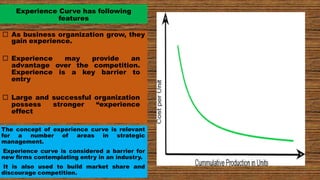
Experience curve is based on the commonly observed
phenomenon that unit costs decline as a firm accumulates
experience in terms of a cumulative volume of production. It is
based on the concept, “we learn as we grow”.
The implication is that larger firms in an industry would tend to
have lower unit costs as compared to those for smaller
companies, thereby gaining a competitive cost advantage
EXPERIENCE CURVE
Experience curve is an important concept used for applying a portfolio
approach. The concept is akin to a learning curve which explains the
efficiency increase gained by workers through REPETITIVE PRODUCTIVE
WORK.
Experience curve is based on the commonly observed phenomenon that unit
costs decline as a firm accumulates experience in terms of a cumulative
volume of production. It is based on the concept, “we learn as we grow”.
The implication is that larger firms in an industry would tend to have lower
unit costs as compared to those for smaller companies, thereby gaining a
competitive cost advantage
Experience curve results from a variety of factors such as
learning effects, economies of scale, product redesign and
technological improvements in production.
Experience Curve has following
features
 As business organization grow, they
gain experience.
 Experience may provide an
advantage over the competition.
Experience is a key barrier to
entry
 Large and successful organization
possess stronger “experience
effect
The concept of experience curve is relevant
for a number of areas in strategic
management.
Experience curve is considered a barrier for
new firms contemplating entry in an industry.
It is also used to build market share and
discourage competition.
BCG, GE NINE CELL, EXPERIENCE CURVE

BCG, GE NINE CELL, EXPERIENCE CURVE

  • 1.
    UNIT - 3 STRATEGICANALYSIS AND CHOICE Corporate Level Strategic Choice BCG Matrix GE Nine Cell Matrix SWOT Analysis  Business Level Strategic Analysis- Experience Curve Analysis  Industry Analysis-porter Five Force Model Mr. Ashesh Anand Assistant Professor Vinoba Bhave University Hazaribagh
  • 2.
    BCG MATRIX The BCGgrowth-share matrix is the simplest way to portray a corporation’s portfolio of investments. Growth share matrix also known for its cow and dog metaphors is popularly used for resource allocation in a diversified company. Using the BCG approach, a company classifies its different businesses on a two-dimensional GROWTH-SHARE matrix
  • 3.
    The vertical axisrepresents market growth rate and provides a measure of market attractiveness. The horizontal axis represents relative market share and serves as a measure of company strength in the market.
  • 4.
  • 5.
    STARS- are productsor SBUs that are growing rapidly. They also need heavy investment to maintain their position and finance their rapid growth potential. They represent best opportunities for expansion
  • 6.
    STARS- are productsor SBUs that are growing rapidly. They also need heavy investment to maintain their position and finance their rapid growth potential. They represent best expansion CASH COWS- are low-growth, high market share businesses or products. They generate cash and have low costs. They are established, successful, and need less investment to maintain their market share. In long run when the growth rate slows down, stars become cash cows.
  • 7.
    STARS- are productsor SBUs that are growing rapidly. They also need heavy investment to maintain their position and finance their rapid growth potential. They represent best expansion CASH COWS- are low-growth, high market share businesses or products. They generate cash and have low costs. They are established, successful, and need less investment to maintain their market share. In long run when the growth rate slows down, stars become cash cows. QUESTION MARKS-, sometimes called problem children or wildcats, are low market share business in high-growth markets. They require a lot of cash to hold their share. They need heavy investments with low potential to generate cash. Question marks if left unattended are capable of becoming cash traps. Since growth rate is high, increasing it should be relatively easier. It is for business organizations to turn them stars and then to cash cows when the growth rate reduces
  • 8.
    STARS- are productsor SBUs that are growing rapidly. They also need heavy investment to maintain their position and finance their rapid growth potential. They represent best expansion CASH COWS- are low-growth, high market share businesses or products. They generate cash and have low costs. They are established, successful, and need less investment to maintain their market share. In long run when the growth rate slows down, stars become cash cows. QUESTION MARKS-, sometimes called problem children or wildcats, are low market share business in high-growth markets. They require a lot of cash to hold their share. They need heavy investments with low potential to generate cash. Question marks if left unattended are capable of becoming cash traps. Since growth rate is high, increasing it should be relatively easier. It is for business organizations to turn them stars and then to cash cows when the growth rate reduces DOGS- are low-growth, low-share businesses and products. They may generate enough cash to maintain themselves, but do not have much future. Sometimes they may need cash to survive. Dogs should be minimized by means of divestment or liquidation.
  • 9.
    BCG Matrix :Post Identification Strategies 1. Build: Here the objective is to increase market share, even by forgoing short- term earnings in favor of building a strong future with large market share. 2. Hold: Here the objective is to preserve market share. 3. Harvest: Here the objective is to increase short-term cash flow regardless of long-term effect. 4. Divest: Here the objective is to sell or liquidate the business because resources can be better used elsewhere.
  • 10.
    BCG Matrix :Post Identification Strategies 1. Build: Here the objective is to increase market share, even by forgoing short- term earnings in favor of building a strong future with largemarketshare. 2. Hold: Here the objective is to preserve market share. 3. Harvest: Here the objective is to increase short-term cash flow regardless of long- term effect. 4. Divest: Here the objective is to sell or liquidate the business because resources can be better used elsewhere. The growth-share matrix has done much to help strategic planning; however, there are some problems and limitations with the technique. BCG matrix can be difficult, time- consuming, and costly to implement. Management may find it difficult to define SBUs and measure market share and growth. It also focuses on classifying current businesses but provide little advice for future planning. They can lead the company to placing too much emphasis on market-share growth or growth through entry into attractive new markets. This can cause unwise expansion into hot, new, risky ventures or divesting established units too quickly
  • 11.
    GE Nine CellMatrix This model uses two factors while taking strategic decisions: Business Strength and Market Attractiveness. The market attractiveness is measured by a number of factors like: Thevertical axisindicatesmarketattractivenessandthehorizontal axisshowsthe business strength in the industry.
  • 12.
    GE Nine CellMatrix This model uses two factors while taking strategic decisions: Business Strength and Market Attractiveness. The market attractiveness is measured by a number of factors like: Thevertical axisindicatesmarketattractivenessandthehorizontal axisshowsthe business strength in the industry.  Size of the market.  Market growth rate.  Industry profitability.  Competitive intensity.  Availability of Technology
  • 13.
    GE Nine CellMatrix This model uses two factors while taking strategic decisions: Business Strength and Market Attractiveness. The market attractiveness is measured by a number of factors like: Thevertical axisindicatesmarketattractivenessandthehorizontal axisshowsthe business strength in the industry.  Size of the market.  Market growth rate.  Industry profitability.  Competitive intensity.  Availability of Technology  Pricing trends.  Overall risk of returns in the industry.  Opportunity for differentiation of products and services.  Demand variability.  Segmentation
  • 14.
    GE Nine CellMatrix This model uses two factors while taking strategic decisions: Business Strength and Market Attractiveness. The market attractiveness is measured by a number of factors like: Thevertical axisindicatesmarketattractivenessandthehorizontal axisshowsthe business strength in the industry.  Size of the market.  Market growth rate.  Industry profitability.  Competitive intensity.  Availability of Technology  Pricing trends.  Overall risk of returns in the industry.  Opportunity for differentiation of products and services.  Demand variability.  Segmentation  Distribution structure (e.g. direct marketing, retail, wholesale) etc.
  • 15.
    Business strength ismeasured by considering the typical drivers like  Market share.  Market share growth rate.  Profit margin.  Distribution efficiency.  Brand image.  Ability to compete on price and quality.
  • 16.
    Business strength ismeasured by considering the typical drivers like  Market share.  Market share growth rate.  Profit margin.  Distribution efficiency.  Brand image.  Ability to compete on price and quality.  Customer loyalty.  Production capacity.  Technological capability.  Relative cost position.  Management caliber, etc.
  • 17.
    MARKET ATTRACTIVNESS BUSINESS STRENGTH Strong AverageWeak High Invest/ Expand Invest/Expand Select/Earn Medium Invest/ Expand Select/Earn Harvest/Divest Low Select/Earn Harvest/Divest Harvest/Divest If a product falls in the green section, the business is at advantageous position. To reap the benefits, the strategic decision can be to expand, to invest and grow. If a product is in the amber or yellow zone, it needs caution and managerial discretion is called for making the strategic choices. If a product is in the red zone, it will eventually lead to losses that would make things difficult for organizations. In such cases, the appropriate strategy should be retrenchment, divestment or liquidation.
  • 18.
    EXPERIENCE CURVE Experience curveis an important concept used for applying a portfolio approach. The concept is akin to a learning curve which explains the efficiency increase gained by workers through REPETITIVE PRODUCTIVE WORK. Experience curve is based on the commonly observed phenomenon that unit costs decline as a firm accumulates experience in terms of a cumulative volume of production. It is based on the concept, “we learn as we grow”. The implication is that larger firms in an industry would tend to have lower unit costs as compared to those for smaller companies, thereby gaining a competitive cost advantage
  • 19.
    EXPERIENCE CURVE Experience curveis an important concept used for applying a portfolio approach. The concept is akin to a learning curve which explains the efficiency increase gained by workers through REPETITIVE PRODUCTIVE WORK. Experience curve is based on the commonly observed phenomenon that unit costs decline as a firm accumulates experience in terms of a cumulative volume of production. It is based on the concept, “we learn as we grow”. The implication is that larger firms in an industry would tend to have lower unit costs as compared to those for smaller companies, thereby gaining a competitive cost advantage Experience curve results from a variety of factors such as learning effects, economies of scale, product redesign and technological improvements in production.
  • 20.
    Experience Curve hasfollowing features  As business organization grow, they gain experience.  Experience may provide an advantage over the competition. Experience is a key barrier to entry  Large and successful organization possess stronger “experience effect The concept of experience curve is relevant for a number of areas in strategic management. Experience curve is considered a barrier for new firms contemplating entry in an industry. It is also used to build market share and discourage competition.