Organizational
Capabilities
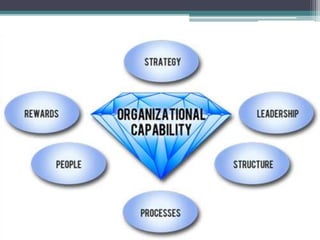
Organizational Capability
The firm’s ability to manage people
to gain competitive advantage.
• focuses on internal processes and systems for
meeting customer needs
• creates organization-specific competencies that
provide competitive advantage since they are
unique
• ensures that employee skills and efforts are
directed toward achieving organizational goals
and strategies
Importance
• Competitive Advantage :-
Organizational capabilities provide a company with an
advantage in the marketplace. When an organization
continues to create new capabilities and develops
existing ones, it will maintain the advantage over its
competitors.
• Improved Customer Relationships :-
Good customer relationships ensure the continued
growth and competitiveness in the market.
• Flexibility and Responsiveness :-
The responsiveness of an organization is its ability to
change in response to customer demand
• Knowledgeable Workforce :-
The skills and knowledge of a company's workforce
allow the organization to direct those skills to achieve the
business's goals
Four elements of capabilities
• Shared mindset
• Management practices
• capacity for change through understanding and
managing organizational systems
• Leadership at all levels in the organization
SHARED MINDSET
• Common understanding and goals of ends
(strategies) and means (processes, work
systems, activities)
• Congruence between customer and employee
expectations
MANAGEMENT PRACTICES
• Policies, programs, operating procedures, and
traditions that guide work
• Transform individual behavior to create
customer satisfaction and consistency in how
customer is treated
• Complement and integrate with one another to
create common expectations, behaviors, and
goals
CAPACITY FOR CHANGE
• Ability to reduce cycle time of all activities
LEADERSHIP
• Owns passionately a vision which is promoted
both within and outside the organization
• Translates external conditions into vision for
organization and how employee must act to
attain vision
• Empowers individuals at all levels within the
organization to act within his or her domain
Internal Environment
• The internal environment of an organization
deals with the management of resources like
human resources, physical resources,
technology, monetary resources and others that
constitute the organization in order to
implement or execute a strategy.
Kinds of capabilities
• Financial Capability Profile
• (a) Sources of funds
• (b) Usage of funds
• (c) Management of funds
• Marketing Capability Profile
• (a) Product related
• (b) Price related
• (c) Promotion related
• (d) Integrative & Systematic
• Operations Capability Factor
• (a) Production system
• (b) Operation & Control system
• (c) R&D system
• Personnel Capability Factor
• (a) Personnel system
• (b) Organization & employee characteristics
• (c) Industrial Relations
• General Management Capability
• (a) General Management Systems
• (b) External Relations (c) Organization climate
SWOT ANALYSIS
• Identify & classify firm’s resources-S&W
• Combine firm’s strength into specific capabilities –
Corporate capability- may be distinctive competence
• Strategy that best exploits the firms resources
• Identify resource gaps & Invest in upgrading
Organizational capability

Organizational capability

  • 1.
  • 2.
    Organizational Capability The firm’sability to manage people to gain competitive advantage. • focuses on internal processes and systems for meeting customer needs • creates organization-specific competencies that provide competitive advantage since they are unique • ensures that employee skills and efforts are directed toward achieving organizational goals and strategies
  • 4.
    Importance • Competitive Advantage:- Organizational capabilities provide a company with an advantage in the marketplace. When an organization continues to create new capabilities and develops existing ones, it will maintain the advantage over its competitors. • Improved Customer Relationships :- Good customer relationships ensure the continued growth and competitiveness in the market.
  • 5.
    • Flexibility andResponsiveness :- The responsiveness of an organization is its ability to change in response to customer demand • Knowledgeable Workforce :- The skills and knowledge of a company's workforce allow the organization to direct those skills to achieve the business's goals
  • 6.
    Four elements ofcapabilities • Shared mindset • Management practices • capacity for change through understanding and managing organizational systems • Leadership at all levels in the organization
  • 7.
    SHARED MINDSET • Commonunderstanding and goals of ends (strategies) and means (processes, work systems, activities) • Congruence between customer and employee expectations
  • 8.
    MANAGEMENT PRACTICES • Policies,programs, operating procedures, and traditions that guide work • Transform individual behavior to create customer satisfaction and consistency in how customer is treated • Complement and integrate with one another to create common expectations, behaviors, and goals
  • 9.
    CAPACITY FOR CHANGE •Ability to reduce cycle time of all activities
  • 10.
    LEADERSHIP • Owns passionatelya vision which is promoted both within and outside the organization • Translates external conditions into vision for organization and how employee must act to attain vision • Empowers individuals at all levels within the organization to act within his or her domain
  • 11.
    Internal Environment • Theinternal environment of an organization deals with the management of resources like human resources, physical resources, technology, monetary resources and others that constitute the organization in order to implement or execute a strategy.
  • 12.
    Kinds of capabilities •Financial Capability Profile • (a) Sources of funds • (b) Usage of funds • (c) Management of funds • Marketing Capability Profile • (a) Product related • (b) Price related • (c) Promotion related • (d) Integrative & Systematic
  • 13.
    • Operations CapabilityFactor • (a) Production system • (b) Operation & Control system • (c) R&D system • Personnel Capability Factor • (a) Personnel system • (b) Organization & employee characteristics • (c) Industrial Relations • General Management Capability • (a) General Management Systems • (b) External Relations (c) Organization climate
  • 14.
    SWOT ANALYSIS • Identify& classify firm’s resources-S&W • Combine firm’s strength into specific capabilities – Corporate capability- may be distinctive competence • Strategy that best exploits the firms resources • Identify resource gaps & Invest in upgrading