
STRATEGY IMPLEMENTATION,
TOOLS AND TECHNIQUES OF
STRATEGIC ANALYSIS
Dr.ParveenKaurNagpal
STRATEGY IMPLEMENTATION
 Strategic implementation is the sum total of all the
activities and choices required for the execution of a
strategic plan.
 It is the process by which strategies and policies are put
into action through the development of programs,
budgets and procedures.
 Strategy implementation is the process of allocating
resources to support the chosen strategies.
 This process includes the various management activities
that are necessary to put strategy in motion, institute
strategic controls that monitor progress, and ultimately
achieve organizational goals.
Dr.ParveenKaurNagpal
STRATEGIC ANALYSIS
 Strategic Analysis is the objective study of the
environmental factors, both internal and external, which
are considered in process of strategic choice.
 Strategic Analysis is the process of conducting research on
the business environment within which an organization
operates and on the organization itself, in order to
formulate strategy.
 Two types of Strategic Analysis can be done by different
organizations for future planning. They are:
i. Internal Analysis (SWOT)
ii. External Analysis (PESTLE)
Dr.ParveenKaurNagpal
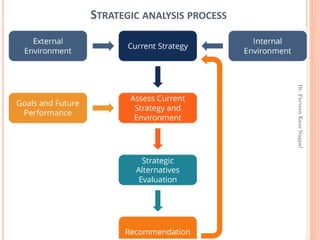
STRATEGIC ANALYSIS PROCESS
Dr.ParveenKaurNagpal
STRATEGIC CHOICE
 Strategic choice is a part of the strategic process and
involves elements like the identification and evaluation of
alternatives which then leads to choice of a particular
strategy.
 In the words of William Glueck and Lawrence Jauch,
“Strategic Choice is the decision, which selects a strategy
from among the alternative grand strategies, which will
best meet the objectives of enterprise”
Dr.ParveenKaurNagpal
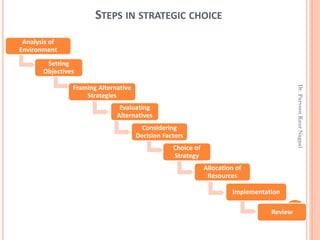
STEPS IN STRATEGIC CHOICE
Analysis of
Environment
Setting
Objectives
Framing Alternative
Strategies
Evaluating
Alternatives
Considering
Decision Factors
Choice of
Strategy
Allocation of
Resources
Implementation
Review
Dr.ParveenKaurNagpal
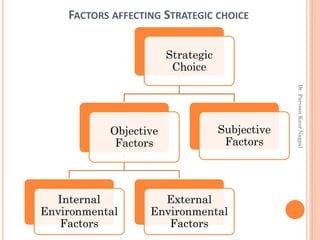
FACTORS AFFECTING STRATEGIC CHOICE
Strategic
Choice
Objective
Factors
Internal
Environmental
Factors
External
Environmental
Factors
Subjective
Factors
Dr.ParveenKaurNagpal
FACTORS AFFECTING STRATEGIC CHOICE
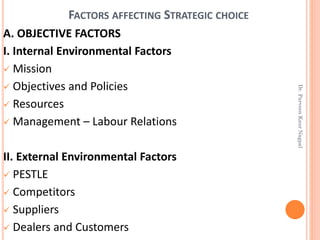
A. OBJECTIVE FACTORS
I. Internal Environmental Factors
✓ Mission
✓ Objectives and Policies
✓ Resources
✓ Management – Labour Relations
II. External Environmental Factors
✓ PESTLE
✓ Competitors
✓ Suppliers
✓ Dealers and Customers
Dr.ParveenKaurNagpal
FACTORS AFFECTING STRATEGIC CHOICE
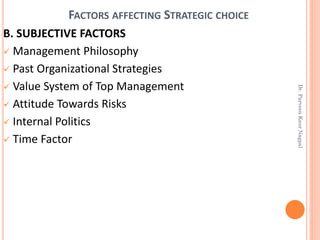
B. SUBJECTIVE FACTORS
✓ Management Philosophy
✓ Past Organizational Strategies
✓ Value System of Top Management
✓ Attitude Towards Risks
✓ Internal Politics
✓ Time Factor
Dr.ParveenKaurNagpal
Tools and Techniques of Strategic Analysis
Dr.ParveenKaurNagpal
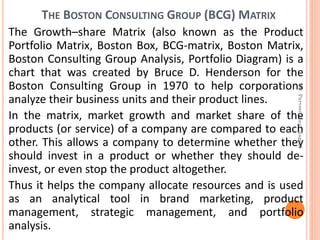
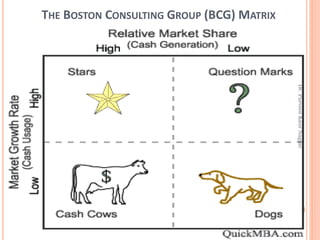
THE BOSTON CONSULTING GROUP (BCG) MATRIX
The Growth–share Matrix (also known as the Product
Portfolio Matrix, Boston Box, BCG-matrix, Boston Matrix,
Boston Consulting Group Analysis, Portfolio Diagram) is a
chart that was created by Bruce D. Henderson for the
Boston Consulting Group in 1970 to help corporations
analyze their business units and their product lines.
In the matrix, market growth and market share of the
products (or service) of a company are compared to each
other. This allows a company to determine whether they
should invest in a product or whether they should de-
invest, or even stop the product altogether.
Thus it helps the company allocate resources and is used
as an analytical tool in brand marketing, product
management, strategic management, and portfolio
analysis.
Dr.ParveenKaurNagpal
THE BOSTON CONSULTING GROUP (BCG) MATRIX
Dr.ParveenKaurNagpal
THE BOSTON CONSULTING GROUP (BCG) MATRIX
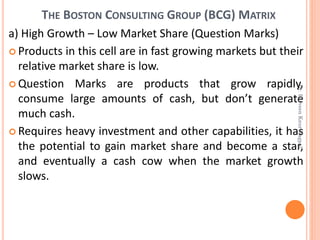
a) High Growth – Low Market Share (Question Marks)
 Products in this cell are in fast growing markets but their
relative market share is low.
 Question Marks are products that grow rapidly,
consume large amounts of cash, but don’t generate
much cash.
 Requires heavy investment and other capabilities, it has
the potential to gain market share and become a star,
and eventually a cash cow when the market growth
slows.
Dr.ParveenKaurNagpal
THE BOSTON CONSULTING GROUP (BCG) MATRIX
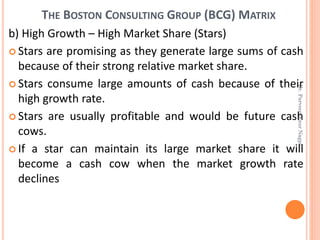
b) High Growth – High Market Share (Stars)
 Stars are promising as they generate large sums of cash
because of their strong relative market share.
 Stars consume large amounts of cash because of their
high growth rate.
 Stars are usually profitable and would be future cash
cows.
 If a star can maintain its large market share it will
become a cash cow when the market growth rate
declines
Dr.ParveenKaurNagpal
THE BOSTON CONSULTING GROUP (BCG) MATRIX
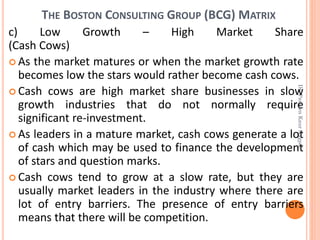
c) Low Growth – High Market Share
(Cash Cows)
 As the market matures or when the market growth rate
becomes low the stars would rather become cash cows.
 Cash cows are high market share businesses in slow
growth industries that do not normally require
significant re-investment.
 As leaders in a mature market, cash cows generate a lot
of cash which may be used to finance the development
of stars and question marks.
 Cash cows tend to grow at a slow rate, but they are
usually market leaders in the industry where there are
lot of entry barriers. The presence of entry barriers
means that there will be competition.
Dr.ParveenKaurNagpal
THE BOSTON CONSULTING GROUP (BCG) MATRIX
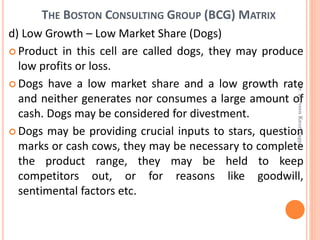
d) Low Growth – Low Market Share (Dogs)
 Product in this cell are called dogs, they may produce
low profits or loss.
 Dogs have a low market share and a low growth rate
and neither generates nor consumes a large amount of
cash. Dogs may be considered for divestment.
 Dogs may be providing crucial inputs to stars, question
marks or cash cows, they may be necessary to complete
the product range, they may be held to keep
competitors out, or for reasons like goodwill,
sentimental factors etc.
Dr.ParveenKaurNagpal
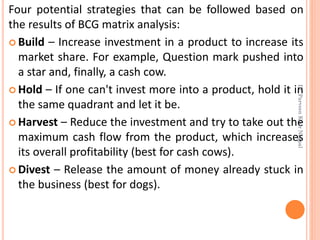
Four potential strategies that can be followed based on
the results of BCG matrix analysis:
 Build – Increase investment in a product to increase its
market share. For example, Question mark pushed into
a star and, finally, a cash cow.
 Hold – If one can't invest more into a product, hold it in
the same quadrant and let it be.
 Harvest – Reduce the investment and try to take out the
maximum cash flow from the product, which increases
its overall profitability (best for cash cows).
 Divest – Release the amount of money already stuck in
the business (best for dogs).
Dr.ParveenKaurNagpal
BCG MATRIX AND PRODUCT LIFE - CYCLE
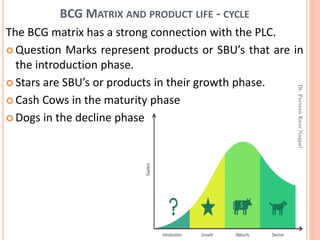
The BCG matrix has a strong connection with the PLC.
 Question Marks represent products or SBU’s that are in
the introduction phase.
 Stars are SBU’s or products in their growth phase.
 Cash Cows in the maturity phase
 Dogs in the decline phase
Dr.ParveenKaurNagpal
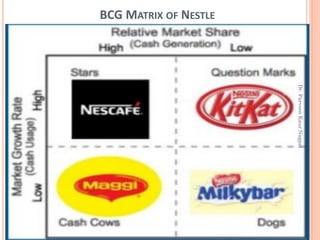
BCG MATRIX OF NESTLE
Dr.ParveenKaurNagpal
• The BCG-Matrix is helpful for managers to evaluate
balance in the company’s current portfolio of Stars,
Cash Cows, Question Marks and Dogs.
• BCG-Matrix is applicable to large companies
• The model is simple and easy to understand.
• It provides a base for management to decide and
prepare for future actions.
• It is an important tool in strategic management
BENEFITS OF THE BCG-MATRIX
Dr.ParveenKaurNagpal
• The BCG-Matrix neglects the effects of synergies
between business units.
• High market share is not the only success factor.
• Market growth is not the only indicator for
attractiveness of a market.
• Sometimes Dogs can earn even more cash as Cash
Cows.
• There can be problems of getting data on the market
share and market growth.
• There is no clear definition of what constitutes a
“market”.
LIMITATIONS OF THE BCG-MATRIX
Dr.ParveenKaurNagpal
 A high market share does not necessarily lead to
profitability all the time.
 The model uses only two dimensions – market share
and growth rate. This may tempt management to
emphasize a particular product, or to divest
prematurely.
 A business with a low market share can be profitable
too.
 The model neglects small competitors that have fast
growing market shares.
Though BCG matrix has its limitation it is one of the most
famous & simple portfolio planning matrix, used by large
companies having multi-products
Dr.ParveenKaurNagpal
THE GE PLANNING GRID/ GE 9 CELL
 The General Electronic (GE) Matrix was developed by
Mckinsey and Company Consultancy Group in the
1970s.
 Whereas BCG is limited to products, business units can
be products, whole product lines, a service or even a
brand.
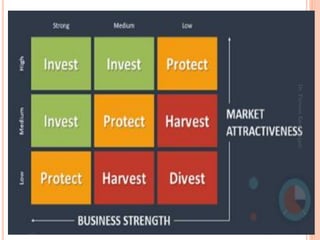
 The GE matrix is plotted in a 3 x 3 grid i.e. it includes
nine cells based on:
• long term industry attractiveness and
• business strength and competitive position.
 So each business is appraised in terms of two major
dimensions – Market Attractiveness and Business
Strength.
Dr.ParveenKaurNagpal
THE GE PLANNING GRID/ GE 9 CELL
 If one of these factors is missing, then the business will
not produce desired results.
 Neither a strong company operating in an unattractive
market, nor a weak company operating in an attractive
market will do very well
Dr.ParveenKaurNagpal
 Green Zone
Suggests to ‘go ahead’, to grow and build, pushing
through expansion strategies.
Businesses in the green zone attract major investment.
 Yellow Zone
Cautions to ‘wait and see’ indicating hold and maintain
type of strategies aimed at stability.
 Red Zone
Indicates that you have to adopt turnover strategies of
divestment and liquidation or rebuilding approach.
THE GE PLANNING GRID/ GE 9 CELL
Dr.ParveenKaurNagpal
 Market/ Industry Attractiveness indicates how hard or
easy it will be for a company to compete in the market
and earn profits. The more profitable the industry is the
more attractive it becomes.
 It includes factors such as:
• Long run growth rate
• Industry size
• Industry profitability: entry barriers, exit barriers,
supplier power, buyer power, threat of substitutes etc.
• Product life cycle changes
• Changes in demand
• Trend of prices
• Macro environment factors (PESTLE)
MARKET ATTRACTIVENESS
Dr.ParveenKaurNagpal
Example: Reliance Group, led by Dhirubhai Ambani, started back in
1966 and was mainly functioning in the infrastructure, power and
communications sector. In 2006, the company took a turn when they
started Reliance Fresh.
Now, why is it that from selling electricity and gadgets Reliance
directly came down to selling potatoes and tomatoes?
Are these decision taken by marketers just out of the blue?
 A study of 33 markets across the country has analysed that the
retailers of the vegetables and dairy items are selling at a profit of
48.8% than the wholesale prices.
 India is one of the top 5 retail markets in the world and retail trade
holds about 10% of our GDP.
 Reliance Fresh, which now has about 700 outlets in the 93 cities,
has been tapping the potential retail market of the country.
 It even plans to invest 3.5 billion dollars in the coming years to
optimize their operations
MARKET ATTRACTIVENESS
Dr.ParveenKaurNagpal
 Along the X axis, the matrix measures how strong, in
terms of competition, a particular business unit is
against its rivals.
 Competitive Strength focuses on internal factors and
the ability of the SBU to overcome specific issues with
the market and competitors. It includes:
• Total market share
• Market share growth compared to rivals
• Brand strength
• Profitability of the company
• Customer loyalty
• Level of product differentiation
• Production flexibility
COMPETITIVE STRENGTH
Dr.ParveenKaurNagpal
Example – How many of us remember Foodle?
For the many who may not remember, it was a brand
extension of Horlicks, back in 2010.
The company launched the product with an idea of making
a healthy alternative to Maggi noodles.
But despite aggressive marketing and promotions, the
brand still couldn’t gather a considerable market share.
It faced a tough competition from the already existing
brand – Maggi, more specifically from Maggi Atta noodles.
How often would companies be able to survive when the
market is dominated by certain brands already.
As it turned out, It was not only an unsuccessful brand
extension but it also hampered the profitability of Horlicks.
COMPETITIVE STRENGTH
Dr.ParveenKaurNagpal
1. INVEST - On the basis of existing market attractiveness
in terms of growth. Also it is affected by the respective
market share of the organization.
2. PROTECT - Protect Condition refers to the situation
where a business does not want fresh investment rather it
is willing to have the security of the given investment so
that it does not result in losses.
3. HARVEST - Situation where the business wants to
generate cash out of the given investment.
4. DIVEST - Condition where a business organization has
finally decided to sell an undertaking or a part of
STRATEGIC DECISIONS
Dr.ParveenKaurNagpal
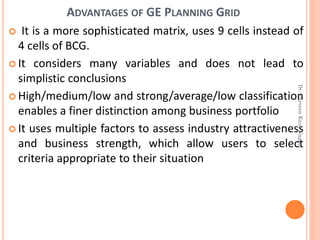
 It is a more sophisticated matrix, uses 9 cells instead of
4 cells of BCG.
 It considers many variables and does not lead to
simplistic conclusions
 High/medium/low and strong/average/low classification
enables a finer distinction among business portfolio
 It uses multiple factors to assess industry attractiveness
and business strength, which allow users to select
criteria appropriate to their situation
ADVANTAGES OF GE PLANNING GRID
Dr.ParveenKaurNagpal
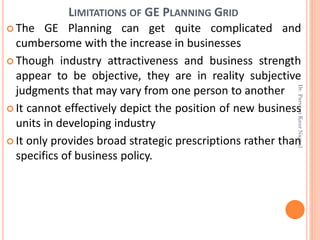
 The GE Planning can get quite complicated and
cumbersome with the increase in businesses
 Though industry attractiveness and business strength
appear to be objective, they are in reality subjective
judgments that may vary from one person to another
 It cannot effectively depict the position of new business
units in developing industry
 It only provides broad strategic prescriptions rather than
specifics of business policy.
LIMITATIONS OF GE PLANNING GRID
Dr.ParveenKaurNagpal
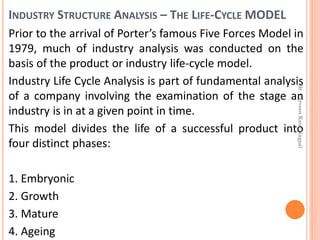
INDUSTRY STRUCTURE ANALYSIS – THE LIFE-CYCLE MODEL
Prior to the arrival of Porter’s famous Five Forces Model in
1979, much of industry analysis was conducted on the
basis of the product or industry life-cycle model.
Industry Life Cycle Analysis is part of fundamental analysis
of a company involving the examination of the stage an
industry is in at a given point in time.
This model divides the life of a successful product into
four distinct phases:
1. Embryonic
2. Growth
3. Mature
4. Ageing
Dr.ParveenKaurNagpal
INDUSTRY STRUCTURE ANALYSIS – THE LIFE-CYCLE MODEL
Dr.ParveenKaurNagpal
INDUSTRY STRUCTURE ANALYSIS – THE LIFE-CYCLE MODEL
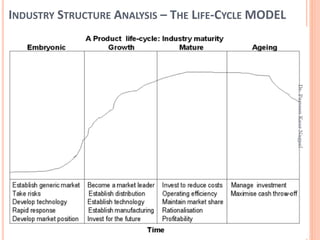
1. Embryonic
In the embryonic phase, mostly new companies were
concerned with establishing a generic market for the
product, to develop their technology, to be
entrepreneurial and to establish the market as a stable
one.
2. Growth
In this stage, the product bears fruit in terms of rapidly
growing sales. Even then, profits would be small and the
firm would need to reinvest to build capacity in order to
meet the growing demand.
In this phase, successful company would be concerned to
establish regular distribution, become the market leader
and invest for the future.
Dr.ParveenKaurNagpal
INDUSTRY STRUCTURE ANALYSIS – THE LIFE-CYCLE MODEL
3. Mature
As the industry approaches maturity, the industry life
cycle curve becomes noticeably flatter, indicating slowing
growth.
The same level of new investment would no longer be
required, and the main aim would be not so much
innovation as an increase in operating efficiency and
productivity. This phase could be linked to the ‘cash cow’
phase of the Boston Box.
Some competition from late entrants will be apparent,
and these new entrants will try to steal market share from
existing products. Thus, the marketing effort must remain
strong and must stress the unique features of the product
or the firm to continue to differentiate a firm's offerings
from industry competitors.
Dr.ParveenKaurNagpal
INDUSTRY STRUCTURE ANALYSIS – THE LIFE-CYCLE MODEL
4. Ageing
Ultimately, the ageing phase overtakes the market and the
firm struggles to maximise cash.
If product innovation has not kept pace with other
competing products and/or service, or if new innovations
or technological changes have caused the industry to
become obsolete, sales suffer and the life cycle
experiences a decline.
In this phase, sales are decreasing at an accelerating rate.
Mergers and consolidations will also be the norm as firms
try other strategies to continue to be competitive or grow
through acquisition and/or diversification.
Dr.ParveenKaurNagpal
PORTERS 5 FORCE MODEL
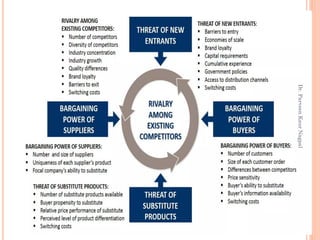
 Porter's Five Forces of Competitive Position Analysis
were developed in 1979 by Michael E Porter of Harvard
Business School.
 It is a simple framework for assessing and evaluating the
competitive strength and position of a business
organization.
 Porter recognized that organizations keep a close watch
on their rivals, but he encouraged them to look beyond
the actions of their competitors and examine what
other factors could impact the business environment.
 This is a broadly used model in business that refers to
the five important factors that drive a firm's competitive
position within an industry.
Dr.ParveenKaurNagpal
PORTERS 5 FORCE MODEL
Porter offers his Five Forces model of competition as a
means of understanding industry environments and
suggests that “competitive generic strategies” are
adopted in the light of an environmental analysis to
achieve a competitive industry position.
Dr.ParveenKaurNagpal
PORTERS 5 FORCE MODEL
The Five Forces analysis helps the firm to stay competitive
by:
 Knowing the strength of these five forces, one can
develop strategies that help their businesses be more
competitive and profitable.
 Looking at opportunities, one can strengthen their
organization's position compared to the other players
for reducing the competitive pressure as well as
generate competitive advantage.
Dr.ParveenKaurNagpal
1. Supplier Power: It represents the extent to which the
suppliers can influence the prices. When there are a lot of
suppliers, buyers can easily switch to competitors
because no supplier can, actually, influence the prices
and exercise control in the industry.
Supplier bargaining power is high when:
 The market is conquered by a few big suppliers.
 Uniqueness of their product or service
 The supplier customer base is fragmented, making their
bargaining power low.
 High switching costs from one to another supplier.
Dr.ParveenKaurNagpal
2. Buyer Power: The bargaining power of customers looks
at customers' ability to affect the pricing and quality of
products and services. When the number of consumers
of a particular product or service is low, they have much
more power to affect pricing and quality. The same holds
true when a large proportion of buyers can easily switch
to a different product or service
Customer bargaining power is high when:
 Customers procure large volumes.
 The supplying industry consists of several small
operators.
 The product has substitutes.
 Switching products is easy, simple and does not incur
high costs.
Dr.ParveenKaurNagpal
3. Competitive Rivalry: In highly competitive industries,
firms can exercise little or no control on the prices of the
goods and services. However, when the industry enjoys
monopoly, businesses can fully control the prices of goods
and services.
Rivalry between existing players is likely to be high when:
 Players are the same size.
 Players have comparable strategies.
 Little or no differentiation between players and their
products leading to price competition.
 Low market growth rates.
Dr.ParveenKaurNagpal
4. Threat of Substitution: Where close substitute products
exist in a market, it increases the likelihood of customers
switching to alternatives in response to price increases.
However, when a business follows a product differentiation
strategy, it can determine the ability of buyers to switch to
the competition.
This threat is determined by things such as:
 Brand dependability of customers.
 Secure customer relationships.
 Switching costs for customers.
 The relative price for performance of substitutes.
Dr.ParveenKaurNagpal
5. Threat of New Entry: When the barriers to entry into an
industry are high, new businesses can hardly enter the
market due to high costs and strong competition. Some
Industries can claim a competitive advantage because their
products are not homogeneous, and they can sustain a
favorable position.
Possible barriers to entry could include:
 Cost advantage of existing players.
 Brand loyalty.
 Intellectual property like patents, licenses, etc.
 Shortage of important resources.
 Access to raw materials is controlled by existing players.
 Legislation and Government Acts.
Dr.ParveenKaurNagpal
COMPETITIVE ADVANTAGE
Why do you buy Apple over Samsung?
The answer may be “competitive advantage”.
Competitive advantage is a set of unique features of a
company and its products that are perceived by the target
market as significant and superior to the competition.
It is the reason behind brand loyalty, and why you prefer
one product or service over another.
There are three different types of competitive advantages
that companies can actually use - price, product
differentiation, and cost.
Dr.ParveenKaurNagpal
COMPETITIVE ADVANTAGE
Price - is one of the most influential factors that can affect the
company's profit. Companies can take advantage by reducing
and increasing the price of the product, but it is generally
taken to have short term benefits.
Product Differentiation - "When a product or service has a
valuable, unique offering for their customer"
In order to gain an advantage, a company may differentiate its
product from that of the competitor.
Cost - If the cost of the product is higher than the competitor's
product, then the profit earned by the company will be less. To
take an advantage, firms may try to reduce the cost and
employ effective techniques of production, so that the firm's
profit will increase.
Dr.ParveenKaurNagpal
PESTLE AND PORTER’S FIVE FORCES ANALYSIS
Using the PESTLE and Five Forces Technique together
helps to provide a detailed picture of the situation facing
an organization.
Just using one technique may leave gaps in knowledge
and understanding.
The PESTLE Analysis enables to create a list of the
potential issues within the macro-environment that could
have implications for an organization. However, whilst
understanding the macro-environment is essential for
developing strategy it only gives half of the picture.
One also needs to have a thorough understanding of their
competitors and the impact they can have on the
organization.
To gain this knowledge one needs to conduct Porter’s Five
Forces Analysis.
Dr.ParveenKaurNagpal
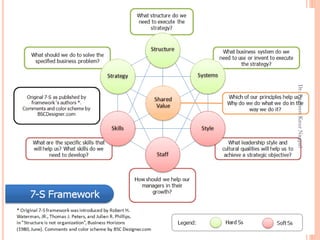
THE MCKINSEY 7 – S FRAMEWORK
 The model was developed by McKinsey & Company in
the 1980s. Specifically, it was developed by Robert H.
Waterman, Jr. and Tom Peters.
 Their research has shown that the success of an
organization depends on a number of mutually
supporting variables, besides strategy and structure.
 According to the 7-S framework, effective organizational
change is driven by 7-Ss. There are “Hard Ss” and “Soft
Ss.”
Dr.ParveenKaurNagpal
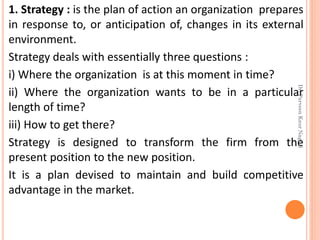
1. Strategy : is the plan of action an organization prepares
in response to, or anticipation of, changes in its external
environment.
Strategy deals with essentially three questions :
i) Where the organization is at this moment in time?
ii) Where the organization wants to be in a particular
length of time?
iii) How to get there?
Strategy is designed to transform the firm from the
present position to the new position.
It is a plan devised to maintain and build competitive
advantage in the market.
Dr.ParveenKaurNagpal
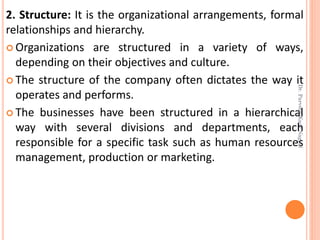
2. Structure: It is the organizational arrangements, formal
relationships and hierarchy.
 Organizations are structured in a variety of ways,
depending on their objectives and culture.
 The structure of the company often dictates the way it
operates and performs.
 The businesses have been structured in a hierarchical
way with several divisions and departments, each
responsible for a specific task such as human resources
management, production or marketing.
Dr.ParveenKaurNagpal
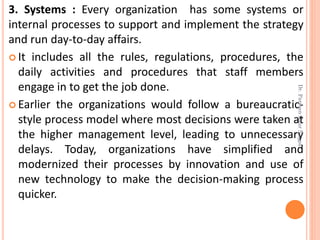
3. Systems : Every organization has some systems or
internal processes to support and implement the strategy
and run day-to-day affairs.
 It includes all the rules, regulations, procedures, the
daily activities and procedures that staff members
engage in to get the job done.
 Earlier the organizations would follow a bureaucratic-
style process model where most decisions were taken at
the higher management level, leading to unnecessary
delays. Today, organizations have simplified and
modernized their processes by innovation and use of
new technology to make the decision-making process
quicker.
Dr.ParveenKaurNagpal
4. Shared Values: All members of the organization share
some common fundamental ideas or guiding concepts
around which the business is built.
 These values and common goals keep the employees
working towards a common goal and are important to
keep the team spirit alive.
 The core values of the company are seen in the
corporate culture and the general work ethics.
5. Style: All organizations have their own distinct culture
and management style.
 It includes the dominant values, beliefs and norms
which develop over time and become relatively
enduring features of the organizational life.
 It also entails the way managers interact with the
employees and the way they spend their time.
Dr.ParveenKaurNagpal
6. Staff: Organizations are made up of humans and it's
the people who make the real difference to the success of
the organization in the increasingly knowledge-based
society.
 The importance of human resources has thus got the
central position in the strategy of the organization,
away from the traditional model of capital and land.
 All leading organizations put extraordinary emphasis on
hiring the best staff, providing them with rigorous
training and motivating them to achieve professional
excellence.
 This forms the basis of these organizations' strategy and
competitive advantage.
Dr.ParveenKaurNagpal
7. Skills: This variable refers to the capabilities of the staff
within the organization as a whole.
 It includes the actual skills and competencies of the
employees working for the company.
The hard components are the strategy, structure and
systems which are normally feasible and easy to identify
in an organization as they are normally well documented
and seen in the form of tangible objects or reports such
as strategy statements, corporate plans, organizational
charts and other documents.
The remaining four S’s, however, are more difficult to
comprehend.
Dr.ParveenKaurNagpal
 It ignores the importance of the external environment and
depicts only the most crucial elements in this model for
explaining the interdependence of the key processes and
factors within the organization.
 The model does not explain the concept of organizational
effectiveness or performance explicitly.
 The model has been criticized for lacking enough empirical
evidences to support their explanation.
 The model is considered to be more of a static kind of model.
 It is rather difficult to assess the degree of fit with accuracy
successfully.
 It is criticized for missing out the finer areas in which the
actual gaps in conceptualization and execution of strategy
may arise.
LIMITATIONS OF MCKINSEY 7 – S FRAMEWORK
Dr.ParveenKaurNagpal
The VRIO Analysis was developed by Jay B. Barney as a
way of evaluating the resources of an organization
(company’s micro-environment) which are as follows:
 Financial resources
 Human resources
 Material resources
 Non-material resources (information, knowledge)
VRIO analysis is a complement to a PESTLE analysis and is
used to assess the situation inside the organization - its
resources, their competitive implication and possible
potential for improvement in the given area or for a given
resource.
VRIO ANALYSIS
Dr.ParveenKaurNagpal
Organizations should look inside the company to find the
sources of competitive advantage instead of looking at the
competitive environment.
The key concepts within this view are therefore Firm
Resources and Sustainable Competitive Advantage.
Firm resources can be defined as ‘all assets, capabilities,
organizational processes, firm attributes, information and
knowledge controlled by a firm that enables it to improve
its efficiency and effectiveness’.
Resources are often classified into categories such as
tangible (e.g. equipment, machinery, land, buildings and
cash) and intangible (e.g. trademarks, brand reputation,
patents and licenses) or physical, human and
organizational resources.
VRIO ANALYSIS
Dr.ParveenKaurNagpal
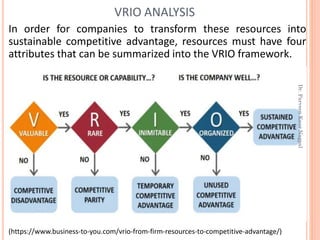
In order for companies to transform these resources into
sustainable competitive advantage, resources must have four
attributes that can be summarized into the VRIO framework.
(https://www.business-to-you.com/vrio-from-firm-resources-to-competitive-advantage/)
VRIO ANALYSIS
Dr.ParveenKaurNagpal
1. Valuable
Resources must be valuable such that they enable a firm
to implement strategies that improve a firm’s efficiency. If
none of the resources possessed by a firm are considered
valuable, the firm is likely to have a competitive
disadvantage.
2. Rare
Resources must be rare such that they may only be
acquired by one or few companies. If a certain valuable
resource is possessed by a large amount of players in the
industry, each of the players has a capability to exploit the
resource in the same way, thereby implementing a
common strategy that gives none of the players a
competitive advantage. Such a situation is indicated as
competitive parity or competitive equality.
VRIO ANALYSIS
Dr.ParveenKaurNagpal
3. Inimitable
Although valuable and rare resources may help companies
to engage in strategies that other firms cannot pursue
since the other firms lack the relevant resources, it is no
guarantee for long-term competitive advantage.
It may give the company a first-mover advantage but
competitors will probably try to imitate these resources.
Another criteria that resources should meet is therefore
that they should be hard and costly to imitate or
substitute.
VRIO ANALYSIS
Dr.ParveenKaurNagpal
4. Organization-wide supported
The resources themselves do not create any advantage for a
company if the company is not organized in a way to
adequately exploit these resources and capture the value from
them.
The company therefore needs the capability to assemble and
coordinate resources effectively.
Without the correct organization to acquire, use and monitor
the resources involved, even companies with valuable, rare and
imperfectly imitable resources will not be able to create a
sustainable competitive advantage.
When all four resource attributes are present, the company has
a distinctive competence that can be used as source of
sustainable competitive advantage.
VRIO ANALYSIS
Dr.ParveenKaurNagpal
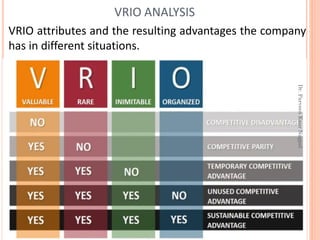
VRIO attributes and the resulting advantages the company
has in different situations.
VRIO ANALYSIS
Dr.ParveenKaurNagpal
Hennes & Mauritz (H&M) founded by Erling Persson in 1947 in
Sweden from a single store to now over 3700 stores in 61
countries and more than 1, 32, 000 employees.
Since inception H&M was into much slow progress averaging to
12 countries in 13 years until Karl-John Persson took over and
started a massive fast paced expansion.
In 2014, the CEO signaled further growth opening 400 new
stores and 5 online markets, expanding in Australia and
Philippines.
H&M believed more in a ‘Decentralised Structure of
Organisation’ and believes in optimum utilisation of resources
and capital. But the central functions like Design, Buying,
Technology and Logistics were much centralised.
H & M CASE
Dr.ParveenKaurNagpal
H&M has incurred huge profit margin in realising from
location economies by outsourcing bulk production in
order to achieve economies of scale.
Decentralised structure also reduce burden from the
Management providing flexibility in decision making.
H&M mainly has wholly owned subsidiaries as they
generally opt for renting store rather than buying
properties. Thus they chose the way for Direct Investments
in emerging markets like Europe, Asia and North America.
However, it shifted to franchising as entry mode
particularly to Middle East with legal restrictions in place.
H & M CASE
Dr.ParveenKaurNagpal
One of the major challenges faced by H&M is that it is
lagging behind its main competitor in key emerging markets
in Asia and South America, which contributed to H&M falling
behind Zara in terms of market capitalisation.
Thanks to its long-term advertising campaigns with high-
profile celebrities, H&M enjoys a clear brand recognition and
reputation advantage over its major rivals like Zara and Gap.
It is been claimed that 70% of production happens in Asia,
while 30% in Europe. Still they are much Europe dependent,
which happens to effect their lead time as well as product
cost to some extent.
Distribution is the main nervous system of the company
which provides a control over supply and demand shifts.
H & M CASE
Dr.ParveenKaurNagpal
Areas of Advantage:
Store operations and management
Marketing
Social media presence
Design
CSR
Logistics and distribution
HRM
Internationalisation and Expansion
H & M CASE
Dr.ParveenKaurNagpal
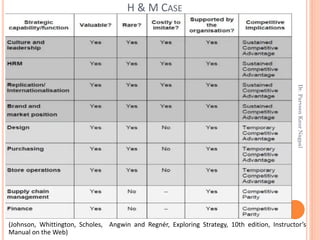
VRIO Analysis of H&M
‘V’ - Value - The design of the product on the price factor
brings a value,
'R’ - Rarity - The design of clothing within today's fashion
industry is not at all rare,
‘I’ - Imitate - From the product standpoint design is not at
all costly to imitate but with on time's standpoint due to
intensive change in fashion trends it often becomes costly
to do so
'O’ - Organization – To be exploited as it can be said that
H&M's designs, technology, HR Management and logistics
are organizationally embedded which can be exploited to
compete in the world market while on the other hand the
production is mainly outsourced to suppliers, who perform
under strict scrutiny and CSR guidelines.
H & M CASE
Dr.ParveenKaurNagpal
(Johnson, Whittington, Scholes, Angwin and Regnér, Exploring Strategy, 10th edition, Instructor’s
Manual on the Web)
H & M CASE
Dr.ParveenKaurNagpal
Do you think that H & M can maintain an
advantage going forward over its
competitors?
H & M CASE
Dr.ParveenKaurNagpal
Understanding how the company creates value, and
looking for ways to add more value, are critical elements in
developing a competitive strategy.
Michael Porter discussed this in his influential 1985 book
"Competitive Advantage," in which he first introduced the
concept of the value chain.
A value chain is a set of activities that an organization
carries out to create value for its customers.
Porter proposed a general-purpose value chain that
companies can use to examine all of their activities, and
see how they are connected.
The way in which value chain activities are performed
determines costs and affects profits, so this tool can help
in understanding the sources of value for the organization.
VALUE CHAIN
Dr.ParveenKaurNagpal
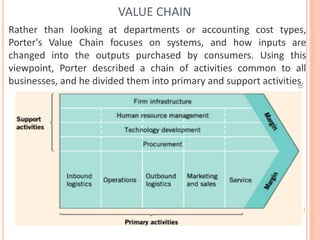
Rather than looking at departments or accounting cost types,
Porter's Value Chain focuses on systems, and how inputs are
changed into the outputs purchased by consumers. Using this
viewpoint, Porter described a chain of activities common to all
businesses, and he divided them into primary and support activities.
VALUE CHAIN
Dr.ParveenKaurNagpal
Benchmarking is a strategy tool used to compare the
performance of the business processes and products with
the best performances of other companies inside and
outside the industry.
Benchmarking is used as a way to understand how an
organization compares with others.
According to Camp, benchmarking is simply “Finding and
implementing the best business practices”. Managers use
the tool to identify the best practices in other companies
and apply those practices to their own processes in order
to improve the company’s performance.
Xerox has popularized benchmarking and was one of the
first companies to introduce the process of doing it.
BENCHMARKING
Dr.ParveenKaurNagpal
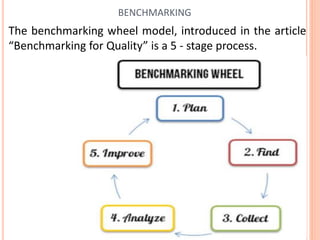
The benchmarking wheel model, introduced in the article
“Benchmarking for Quality” is a 5 - stage process.
BENCHMARKING
Dr.ParveenKaurNagpal
1. Plan - Assemble a team. Clearly define what is to be
compared and assign metrics to it.
2. Find - Identify benchmarking partners or sources of
information from where information is to be collected.
3. Collect - Choose the methods to collect information
and gather data for the metrics defined.
4. Analyze - Compare the metrics and identify the gap in
performance between ones company and the
organization observed. Provide the results and
recommendations on how to improve the
performance.
5. Improve - Implement the changes to ones products,
services, processes or strategy.
BENCHMARKING
Dr.ParveenKaurNagpal
Mergers and Acquisitions are often treated together in the
literature, legally they are transactions of a different kind.
 An acquisition is an outright purchase of one company
by another. It occurs when one company acquires
enough of another company’s shares to gain control or
ownership.
Examples:
✓ Zomato Acquired UberEats
✓ Tata Steel Acquired Bhushan Steel
✓ Hindustan Unilever Limited (HUL) Acquired GSK
Consumer Healthcare of GlaxoSmithKline (GSK)
MERGERS AND ACQUISITIONS (M&A)
Dr.ParveenKaurNagpal
 A merger is in theory a collaborative agreement by two
companies to combine their interests, ownership and
company structures into one company.
Examples:
✓ Vodafone India and Idea Cellular
✓ Flipkart and Ebay India
MERGERS AND ACQUISITIONS (M&A)
Dr.ParveenKaurNagpal
M&As are generally presented to shareholders as highly
rational strategies with clearly defined goals and
objectives. Typically these are of a financial or strategic
nature.
 Financial goals include increasing shareholder wealth
and financial synergy through economies of scale,
transfer of knowledge and increased control.
 Strategic reasons include increasing market share, the
reduction of uncertainty and the restoration of market
confidence.
Mergers and acquisitions can also be sought by companies
seeking to ward off hostile take-over bids.
Due to economic globalisation, cross-border mergers and
acquisitions have emerged as the business growth area.
MERGERS AND ACQUISITIONS
Dr.ParveenKaurNagpal
PriceWaterhouseCoopers have identified several actions that
need to be carried out if M&A success is to be achieved:
1. Clarify the deal objectives and business case
The proposed deal price, expected implementation costs,
value of inevitable losses as a result of the combination (e.g.
staff), and the value of synergies, should all be made clear at
the outset.
2. Monitor implementation against contribution to
shareholder value
Effective progress in mergers requires an understanding of
not just what tasks have been completed but also what
benefits have been realised. Flexibility is also required, to
accommodate change along the way.
MERGERS AND ACQUISITIONS
Dr.ParveenKaurNagpal
3. Integrate quickly
A major contributor to risk in merger situations is
uncertainty and the impact it can have on motivation and
staff performance. This means that merging entities should
quickly identify those activities and functions that are
essential to the immediate bringing together of the
companies and other improvement projects that can be
undertaken subsequently.
4. Focus on retaining existing business
Mergers can cause a shift in focus from external to internal
at the very time when the merging enterprises are under
greatest scrutiny from both clients and investment
consultants. As a result, opportunities to win new business
are limited and the importance of retaining existing business
MERGERS AND ACQUISITIONS
Dr.ParveenKaurNagpal
5. Focus on retaining key people
During a merger, senior management must also focus on
retaining key staff, especially in sectors such as investment
banking where the value of the business is heavily linked to
key people. A significant proportion of the value of the deal
could be lost if key individuals are lost early in the merger
process.
MERGERS AND ACQUISITIONS
Dr.ParveenKaurNagpal
1. Strategic Management - Fred R. David, Published by
Prentice Hall International.
2. Business Policy and Strategic Management - Dr. Azhar
Kazmi, published by Tata McGraw Hill Publications
3. Nagpal, Sharma: Strategic Management, SYBMS (Sem.
3), Sheth Publishers
4. Nagpal, Shelankar, Sharma: Strategic Management,
M.Com (Sem. 3), Sheth Publishers
REFERENCES
Dr.ParveenKaurNagpal
THANK YOU
Dr. Parveen Nagpal
www.linkedin.com/in/dr-parveen-kaur-nagpal-82965b15
Dr.ParveenKaurNagpal

Strategy Implementation, Tools and Techniques of Strategic Analysis

  • 1.
    STRATEGY IMPLEMENTATION, TOOLS ANDTECHNIQUES OF STRATEGIC ANALYSIS Dr.ParveenKaurNagpal
  • 2.
    STRATEGY IMPLEMENTATION  Strategicimplementation is the sum total of all the activities and choices required for the execution of a strategic plan.  It is the process by which strategies and policies are put into action through the development of programs, budgets and procedures.  Strategy implementation is the process of allocating resources to support the chosen strategies.  This process includes the various management activities that are necessary to put strategy in motion, institute strategic controls that monitor progress, and ultimately achieve organizational goals. Dr.ParveenKaurNagpal
  • 3.
    STRATEGIC ANALYSIS  StrategicAnalysis is the objective study of the environmental factors, both internal and external, which are considered in process of strategic choice.  Strategic Analysis is the process of conducting research on the business environment within which an organization operates and on the organization itself, in order to formulate strategy.  Two types of Strategic Analysis can be done by different organizations for future planning. They are: i. Internal Analysis (SWOT) ii. External Analysis (PESTLE) Dr.ParveenKaurNagpal
  • 4.
  • 5.
    STRATEGIC CHOICE  Strategicchoice is a part of the strategic process and involves elements like the identification and evaluation of alternatives which then leads to choice of a particular strategy.  In the words of William Glueck and Lawrence Jauch, “Strategic Choice is the decision, which selects a strategy from among the alternative grand strategies, which will best meet the objectives of enterprise” Dr.ParveenKaurNagpal
  • 6.
    STEPS IN STRATEGICCHOICE Analysis of Environment Setting Objectives Framing Alternative Strategies Evaluating Alternatives Considering Decision Factors Choice of Strategy Allocation of Resources Implementation Review Dr.ParveenKaurNagpal
  • 7.
    FACTORS AFFECTING STRATEGICCHOICE Strategic Choice Objective Factors Internal Environmental Factors External Environmental Factors Subjective Factors Dr.ParveenKaurNagpal
  • 8.
    FACTORS AFFECTING STRATEGICCHOICE A. OBJECTIVE FACTORS I. Internal Environmental Factors ✓ Mission ✓ Objectives and Policies ✓ Resources ✓ Management – Labour Relations II. External Environmental Factors ✓ PESTLE ✓ Competitors ✓ Suppliers ✓ Dealers and Customers Dr.ParveenKaurNagpal
  • 9.
    FACTORS AFFECTING STRATEGICCHOICE B. SUBJECTIVE FACTORS ✓ Management Philosophy ✓ Past Organizational Strategies ✓ Value System of Top Management ✓ Attitude Towards Risks ✓ Internal Politics ✓ Time Factor Dr.ParveenKaurNagpal
  • 10.
    Tools and Techniquesof Strategic Analysis Dr.ParveenKaurNagpal
  • 11.
    THE BOSTON CONSULTINGGROUP (BCG) MATRIX The Growth–share Matrix (also known as the Product Portfolio Matrix, Boston Box, BCG-matrix, Boston Matrix, Boston Consulting Group Analysis, Portfolio Diagram) is a chart that was created by Bruce D. Henderson for the Boston Consulting Group in 1970 to help corporations analyze their business units and their product lines. In the matrix, market growth and market share of the products (or service) of a company are compared to each other. This allows a company to determine whether they should invest in a product or whether they should de- invest, or even stop the product altogether. Thus it helps the company allocate resources and is used as an analytical tool in brand marketing, product management, strategic management, and portfolio analysis. Dr.ParveenKaurNagpal
  • 12.
    THE BOSTON CONSULTINGGROUP (BCG) MATRIX Dr.ParveenKaurNagpal
  • 13.
    THE BOSTON CONSULTINGGROUP (BCG) MATRIX a) High Growth – Low Market Share (Question Marks)  Products in this cell are in fast growing markets but their relative market share is low.  Question Marks are products that grow rapidly, consume large amounts of cash, but don’t generate much cash.  Requires heavy investment and other capabilities, it has the potential to gain market share and become a star, and eventually a cash cow when the market growth slows. Dr.ParveenKaurNagpal
  • 14.
    THE BOSTON CONSULTINGGROUP (BCG) MATRIX b) High Growth – High Market Share (Stars)  Stars are promising as they generate large sums of cash because of their strong relative market share.  Stars consume large amounts of cash because of their high growth rate.  Stars are usually profitable and would be future cash cows.  If a star can maintain its large market share it will become a cash cow when the market growth rate declines Dr.ParveenKaurNagpal
  • 15.
    THE BOSTON CONSULTINGGROUP (BCG) MATRIX c) Low Growth – High Market Share (Cash Cows)  As the market matures or when the market growth rate becomes low the stars would rather become cash cows.  Cash cows are high market share businesses in slow growth industries that do not normally require significant re-investment.  As leaders in a mature market, cash cows generate a lot of cash which may be used to finance the development of stars and question marks.  Cash cows tend to grow at a slow rate, but they are usually market leaders in the industry where there are lot of entry barriers. The presence of entry barriers means that there will be competition. Dr.ParveenKaurNagpal
  • 16.
    THE BOSTON CONSULTINGGROUP (BCG) MATRIX d) Low Growth – Low Market Share (Dogs)  Product in this cell are called dogs, they may produce low profits or loss.  Dogs have a low market share and a low growth rate and neither generates nor consumes a large amount of cash. Dogs may be considered for divestment.  Dogs may be providing crucial inputs to stars, question marks or cash cows, they may be necessary to complete the product range, they may be held to keep competitors out, or for reasons like goodwill, sentimental factors etc. Dr.ParveenKaurNagpal
  • 17.
    Four potential strategiesthat can be followed based on the results of BCG matrix analysis:  Build – Increase investment in a product to increase its market share. For example, Question mark pushed into a star and, finally, a cash cow.  Hold – If one can't invest more into a product, hold it in the same quadrant and let it be.  Harvest – Reduce the investment and try to take out the maximum cash flow from the product, which increases its overall profitability (best for cash cows).  Divest – Release the amount of money already stuck in the business (best for dogs). Dr.ParveenKaurNagpal
  • 18.
    BCG MATRIX ANDPRODUCT LIFE - CYCLE The BCG matrix has a strong connection with the PLC.  Question Marks represent products or SBU’s that are in the introduction phase.  Stars are SBU’s or products in their growth phase.  Cash Cows in the maturity phase  Dogs in the decline phase Dr.ParveenKaurNagpal
  • 19.
    BCG MATRIX OFNESTLE Dr.ParveenKaurNagpal
  • 20.
    • The BCG-Matrixis helpful for managers to evaluate balance in the company’s current portfolio of Stars, Cash Cows, Question Marks and Dogs. • BCG-Matrix is applicable to large companies • The model is simple and easy to understand. • It provides a base for management to decide and prepare for future actions. • It is an important tool in strategic management BENEFITS OF THE BCG-MATRIX Dr.ParveenKaurNagpal
  • 21.
    • The BCG-Matrixneglects the effects of synergies between business units. • High market share is not the only success factor. • Market growth is not the only indicator for attractiveness of a market. • Sometimes Dogs can earn even more cash as Cash Cows. • There can be problems of getting data on the market share and market growth. • There is no clear definition of what constitutes a “market”. LIMITATIONS OF THE BCG-MATRIX Dr.ParveenKaurNagpal
  • 22.
     A highmarket share does not necessarily lead to profitability all the time.  The model uses only two dimensions – market share and growth rate. This may tempt management to emphasize a particular product, or to divest prematurely.  A business with a low market share can be profitable too.  The model neglects small competitors that have fast growing market shares. Though BCG matrix has its limitation it is one of the most famous & simple portfolio planning matrix, used by large companies having multi-products Dr.ParveenKaurNagpal
  • 23.
    THE GE PLANNINGGRID/ GE 9 CELL  The General Electronic (GE) Matrix was developed by Mckinsey and Company Consultancy Group in the 1970s.  Whereas BCG is limited to products, business units can be products, whole product lines, a service or even a brand.  The GE matrix is plotted in a 3 x 3 grid i.e. it includes nine cells based on: • long term industry attractiveness and • business strength and competitive position.  So each business is appraised in terms of two major dimensions – Market Attractiveness and Business Strength. Dr.ParveenKaurNagpal
  • 24.
    THE GE PLANNINGGRID/ GE 9 CELL  If one of these factors is missing, then the business will not produce desired results.  Neither a strong company operating in an unattractive market, nor a weak company operating in an attractive market will do very well Dr.ParveenKaurNagpal
  • 25.
  • 26.
     Green Zone Suggeststo ‘go ahead’, to grow and build, pushing through expansion strategies. Businesses in the green zone attract major investment.  Yellow Zone Cautions to ‘wait and see’ indicating hold and maintain type of strategies aimed at stability.  Red Zone Indicates that you have to adopt turnover strategies of divestment and liquidation or rebuilding approach. THE GE PLANNING GRID/ GE 9 CELL Dr.ParveenKaurNagpal
  • 27.
     Market/ IndustryAttractiveness indicates how hard or easy it will be for a company to compete in the market and earn profits. The more profitable the industry is the more attractive it becomes.  It includes factors such as: • Long run growth rate • Industry size • Industry profitability: entry barriers, exit barriers, supplier power, buyer power, threat of substitutes etc. • Product life cycle changes • Changes in demand • Trend of prices • Macro environment factors (PESTLE) MARKET ATTRACTIVENESS Dr.ParveenKaurNagpal
  • 28.
    Example: Reliance Group,led by Dhirubhai Ambani, started back in 1966 and was mainly functioning in the infrastructure, power and communications sector. In 2006, the company took a turn when they started Reliance Fresh. Now, why is it that from selling electricity and gadgets Reliance directly came down to selling potatoes and tomatoes? Are these decision taken by marketers just out of the blue?  A study of 33 markets across the country has analysed that the retailers of the vegetables and dairy items are selling at a profit of 48.8% than the wholesale prices.  India is one of the top 5 retail markets in the world and retail trade holds about 10% of our GDP.  Reliance Fresh, which now has about 700 outlets in the 93 cities, has been tapping the potential retail market of the country.  It even plans to invest 3.5 billion dollars in the coming years to optimize their operations MARKET ATTRACTIVENESS Dr.ParveenKaurNagpal
  • 29.
     Along theX axis, the matrix measures how strong, in terms of competition, a particular business unit is against its rivals.  Competitive Strength focuses on internal factors and the ability of the SBU to overcome specific issues with the market and competitors. It includes: • Total market share • Market share growth compared to rivals • Brand strength • Profitability of the company • Customer loyalty • Level of product differentiation • Production flexibility COMPETITIVE STRENGTH Dr.ParveenKaurNagpal
  • 30.
    Example – Howmany of us remember Foodle? For the many who may not remember, it was a brand extension of Horlicks, back in 2010. The company launched the product with an idea of making a healthy alternative to Maggi noodles. But despite aggressive marketing and promotions, the brand still couldn’t gather a considerable market share. It faced a tough competition from the already existing brand – Maggi, more specifically from Maggi Atta noodles. How often would companies be able to survive when the market is dominated by certain brands already. As it turned out, It was not only an unsuccessful brand extension but it also hampered the profitability of Horlicks. COMPETITIVE STRENGTH Dr.ParveenKaurNagpal
  • 31.
    1. INVEST -On the basis of existing market attractiveness in terms of growth. Also it is affected by the respective market share of the organization. 2. PROTECT - Protect Condition refers to the situation where a business does not want fresh investment rather it is willing to have the security of the given investment so that it does not result in losses. 3. HARVEST - Situation where the business wants to generate cash out of the given investment. 4. DIVEST - Condition where a business organization has finally decided to sell an undertaking or a part of STRATEGIC DECISIONS Dr.ParveenKaurNagpal
  • 32.
     It isa more sophisticated matrix, uses 9 cells instead of 4 cells of BCG.  It considers many variables and does not lead to simplistic conclusions  High/medium/low and strong/average/low classification enables a finer distinction among business portfolio  It uses multiple factors to assess industry attractiveness and business strength, which allow users to select criteria appropriate to their situation ADVANTAGES OF GE PLANNING GRID Dr.ParveenKaurNagpal
  • 33.
     The GEPlanning can get quite complicated and cumbersome with the increase in businesses  Though industry attractiveness and business strength appear to be objective, they are in reality subjective judgments that may vary from one person to another  It cannot effectively depict the position of new business units in developing industry  It only provides broad strategic prescriptions rather than specifics of business policy. LIMITATIONS OF GE PLANNING GRID Dr.ParveenKaurNagpal
  • 34.
    INDUSTRY STRUCTURE ANALYSIS– THE LIFE-CYCLE MODEL Prior to the arrival of Porter’s famous Five Forces Model in 1979, much of industry analysis was conducted on the basis of the product or industry life-cycle model. Industry Life Cycle Analysis is part of fundamental analysis of a company involving the examination of the stage an industry is in at a given point in time. This model divides the life of a successful product into four distinct phases: 1. Embryonic 2. Growth 3. Mature 4. Ageing Dr.ParveenKaurNagpal
  • 35.
    INDUSTRY STRUCTURE ANALYSIS– THE LIFE-CYCLE MODEL Dr.ParveenKaurNagpal
  • 36.
    INDUSTRY STRUCTURE ANALYSIS– THE LIFE-CYCLE MODEL 1. Embryonic In the embryonic phase, mostly new companies were concerned with establishing a generic market for the product, to develop their technology, to be entrepreneurial and to establish the market as a stable one. 2. Growth In this stage, the product bears fruit in terms of rapidly growing sales. Even then, profits would be small and the firm would need to reinvest to build capacity in order to meet the growing demand. In this phase, successful company would be concerned to establish regular distribution, become the market leader and invest for the future. Dr.ParveenKaurNagpal
  • 37.
    INDUSTRY STRUCTURE ANALYSIS– THE LIFE-CYCLE MODEL 3. Mature As the industry approaches maturity, the industry life cycle curve becomes noticeably flatter, indicating slowing growth. The same level of new investment would no longer be required, and the main aim would be not so much innovation as an increase in operating efficiency and productivity. This phase could be linked to the ‘cash cow’ phase of the Boston Box. Some competition from late entrants will be apparent, and these new entrants will try to steal market share from existing products. Thus, the marketing effort must remain strong and must stress the unique features of the product or the firm to continue to differentiate a firm's offerings from industry competitors. Dr.ParveenKaurNagpal
  • 38.
    INDUSTRY STRUCTURE ANALYSIS– THE LIFE-CYCLE MODEL 4. Ageing Ultimately, the ageing phase overtakes the market and the firm struggles to maximise cash. If product innovation has not kept pace with other competing products and/or service, or if new innovations or technological changes have caused the industry to become obsolete, sales suffer and the life cycle experiences a decline. In this phase, sales are decreasing at an accelerating rate. Mergers and consolidations will also be the norm as firms try other strategies to continue to be competitive or grow through acquisition and/or diversification. Dr.ParveenKaurNagpal
  • 39.
    PORTERS 5 FORCEMODEL  Porter's Five Forces of Competitive Position Analysis were developed in 1979 by Michael E Porter of Harvard Business School.  It is a simple framework for assessing and evaluating the competitive strength and position of a business organization.  Porter recognized that organizations keep a close watch on their rivals, but he encouraged them to look beyond the actions of their competitors and examine what other factors could impact the business environment.  This is a broadly used model in business that refers to the five important factors that drive a firm's competitive position within an industry. Dr.ParveenKaurNagpal
  • 40.
    PORTERS 5 FORCEMODEL Porter offers his Five Forces model of competition as a means of understanding industry environments and suggests that “competitive generic strategies” are adopted in the light of an environmental analysis to achieve a competitive industry position. Dr.ParveenKaurNagpal
  • 41.
    PORTERS 5 FORCEMODEL The Five Forces analysis helps the firm to stay competitive by:  Knowing the strength of these five forces, one can develop strategies that help their businesses be more competitive and profitable.  Looking at opportunities, one can strengthen their organization's position compared to the other players for reducing the competitive pressure as well as generate competitive advantage. Dr.ParveenKaurNagpal
  • 42.
  • 43.
    1. Supplier Power:It represents the extent to which the suppliers can influence the prices. When there are a lot of suppliers, buyers can easily switch to competitors because no supplier can, actually, influence the prices and exercise control in the industry. Supplier bargaining power is high when:  The market is conquered by a few big suppliers.  Uniqueness of their product or service  The supplier customer base is fragmented, making their bargaining power low.  High switching costs from one to another supplier. Dr.ParveenKaurNagpal
  • 44.
    2. Buyer Power:The bargaining power of customers looks at customers' ability to affect the pricing and quality of products and services. When the number of consumers of a particular product or service is low, they have much more power to affect pricing and quality. The same holds true when a large proportion of buyers can easily switch to a different product or service Customer bargaining power is high when:  Customers procure large volumes.  The supplying industry consists of several small operators.  The product has substitutes.  Switching products is easy, simple and does not incur high costs. Dr.ParveenKaurNagpal
  • 45.
    3. Competitive Rivalry:In highly competitive industries, firms can exercise little or no control on the prices of the goods and services. However, when the industry enjoys monopoly, businesses can fully control the prices of goods and services. Rivalry between existing players is likely to be high when:  Players are the same size.  Players have comparable strategies.  Little or no differentiation between players and their products leading to price competition.  Low market growth rates. Dr.ParveenKaurNagpal
  • 46.
    4. Threat ofSubstitution: Where close substitute products exist in a market, it increases the likelihood of customers switching to alternatives in response to price increases. However, when a business follows a product differentiation strategy, it can determine the ability of buyers to switch to the competition. This threat is determined by things such as:  Brand dependability of customers.  Secure customer relationships.  Switching costs for customers.  The relative price for performance of substitutes. Dr.ParveenKaurNagpal
  • 47.
    5. Threat ofNew Entry: When the barriers to entry into an industry are high, new businesses can hardly enter the market due to high costs and strong competition. Some Industries can claim a competitive advantage because their products are not homogeneous, and they can sustain a favorable position. Possible barriers to entry could include:  Cost advantage of existing players.  Brand loyalty.  Intellectual property like patents, licenses, etc.  Shortage of important resources.  Access to raw materials is controlled by existing players.  Legislation and Government Acts. Dr.ParveenKaurNagpal
  • 48.
    COMPETITIVE ADVANTAGE Why doyou buy Apple over Samsung? The answer may be “competitive advantage”. Competitive advantage is a set of unique features of a company and its products that are perceived by the target market as significant and superior to the competition. It is the reason behind brand loyalty, and why you prefer one product or service over another. There are three different types of competitive advantages that companies can actually use - price, product differentiation, and cost. Dr.ParveenKaurNagpal
  • 49.
    COMPETITIVE ADVANTAGE Price -is one of the most influential factors that can affect the company's profit. Companies can take advantage by reducing and increasing the price of the product, but it is generally taken to have short term benefits. Product Differentiation - "When a product or service has a valuable, unique offering for their customer" In order to gain an advantage, a company may differentiate its product from that of the competitor. Cost - If the cost of the product is higher than the competitor's product, then the profit earned by the company will be less. To take an advantage, firms may try to reduce the cost and employ effective techniques of production, so that the firm's profit will increase. Dr.ParveenKaurNagpal
  • 50.
    PESTLE AND PORTER’SFIVE FORCES ANALYSIS Using the PESTLE and Five Forces Technique together helps to provide a detailed picture of the situation facing an organization. Just using one technique may leave gaps in knowledge and understanding. The PESTLE Analysis enables to create a list of the potential issues within the macro-environment that could have implications for an organization. However, whilst understanding the macro-environment is essential for developing strategy it only gives half of the picture. One also needs to have a thorough understanding of their competitors and the impact they can have on the organization. To gain this knowledge one needs to conduct Porter’s Five Forces Analysis. Dr.ParveenKaurNagpal
  • 51.
    THE MCKINSEY 7– S FRAMEWORK  The model was developed by McKinsey & Company in the 1980s. Specifically, it was developed by Robert H. Waterman, Jr. and Tom Peters.  Their research has shown that the success of an organization depends on a number of mutually supporting variables, besides strategy and structure.  According to the 7-S framework, effective organizational change is driven by 7-Ss. There are “Hard Ss” and “Soft Ss.” Dr.ParveenKaurNagpal
  • 52.
  • 53.
    1. Strategy :is the plan of action an organization prepares in response to, or anticipation of, changes in its external environment. Strategy deals with essentially three questions : i) Where the organization is at this moment in time? ii) Where the organization wants to be in a particular length of time? iii) How to get there? Strategy is designed to transform the firm from the present position to the new position. It is a plan devised to maintain and build competitive advantage in the market. Dr.ParveenKaurNagpal
  • 54.
    2. Structure: Itis the organizational arrangements, formal relationships and hierarchy.  Organizations are structured in a variety of ways, depending on their objectives and culture.  The structure of the company often dictates the way it operates and performs.  The businesses have been structured in a hierarchical way with several divisions and departments, each responsible for a specific task such as human resources management, production or marketing. Dr.ParveenKaurNagpal
  • 55.
    3. Systems :Every organization has some systems or internal processes to support and implement the strategy and run day-to-day affairs.  It includes all the rules, regulations, procedures, the daily activities and procedures that staff members engage in to get the job done.  Earlier the organizations would follow a bureaucratic- style process model where most decisions were taken at the higher management level, leading to unnecessary delays. Today, organizations have simplified and modernized their processes by innovation and use of new technology to make the decision-making process quicker. Dr.ParveenKaurNagpal
  • 56.
    4. Shared Values:All members of the organization share some common fundamental ideas or guiding concepts around which the business is built.  These values and common goals keep the employees working towards a common goal and are important to keep the team spirit alive.  The core values of the company are seen in the corporate culture and the general work ethics. 5. Style: All organizations have their own distinct culture and management style.  It includes the dominant values, beliefs and norms which develop over time and become relatively enduring features of the organizational life.  It also entails the way managers interact with the employees and the way they spend their time. Dr.ParveenKaurNagpal
  • 57.
    6. Staff: Organizationsare made up of humans and it's the people who make the real difference to the success of the organization in the increasingly knowledge-based society.  The importance of human resources has thus got the central position in the strategy of the organization, away from the traditional model of capital and land.  All leading organizations put extraordinary emphasis on hiring the best staff, providing them with rigorous training and motivating them to achieve professional excellence.  This forms the basis of these organizations' strategy and competitive advantage. Dr.ParveenKaurNagpal
  • 58.
    7. Skills: Thisvariable refers to the capabilities of the staff within the organization as a whole.  It includes the actual skills and competencies of the employees working for the company. The hard components are the strategy, structure and systems which are normally feasible and easy to identify in an organization as they are normally well documented and seen in the form of tangible objects or reports such as strategy statements, corporate plans, organizational charts and other documents. The remaining four S’s, however, are more difficult to comprehend. Dr.ParveenKaurNagpal
  • 59.
     It ignoresthe importance of the external environment and depicts only the most crucial elements in this model for explaining the interdependence of the key processes and factors within the organization.  The model does not explain the concept of organizational effectiveness or performance explicitly.  The model has been criticized for lacking enough empirical evidences to support their explanation.  The model is considered to be more of a static kind of model.  It is rather difficult to assess the degree of fit with accuracy successfully.  It is criticized for missing out the finer areas in which the actual gaps in conceptualization and execution of strategy may arise. LIMITATIONS OF MCKINSEY 7 – S FRAMEWORK Dr.ParveenKaurNagpal
  • 60.
    The VRIO Analysiswas developed by Jay B. Barney as a way of evaluating the resources of an organization (company’s micro-environment) which are as follows:  Financial resources  Human resources  Material resources  Non-material resources (information, knowledge) VRIO analysis is a complement to a PESTLE analysis and is used to assess the situation inside the organization - its resources, their competitive implication and possible potential for improvement in the given area or for a given resource. VRIO ANALYSIS Dr.ParveenKaurNagpal
  • 61.
    Organizations should lookinside the company to find the sources of competitive advantage instead of looking at the competitive environment. The key concepts within this view are therefore Firm Resources and Sustainable Competitive Advantage. Firm resources can be defined as ‘all assets, capabilities, organizational processes, firm attributes, information and knowledge controlled by a firm that enables it to improve its efficiency and effectiveness’. Resources are often classified into categories such as tangible (e.g. equipment, machinery, land, buildings and cash) and intangible (e.g. trademarks, brand reputation, patents and licenses) or physical, human and organizational resources. VRIO ANALYSIS Dr.ParveenKaurNagpal
  • 62.
    In order forcompanies to transform these resources into sustainable competitive advantage, resources must have four attributes that can be summarized into the VRIO framework. (https://www.business-to-you.com/vrio-from-firm-resources-to-competitive-advantage/) VRIO ANALYSIS Dr.ParveenKaurNagpal
  • 63.
    1. Valuable Resources mustbe valuable such that they enable a firm to implement strategies that improve a firm’s efficiency. If none of the resources possessed by a firm are considered valuable, the firm is likely to have a competitive disadvantage. 2. Rare Resources must be rare such that they may only be acquired by one or few companies. If a certain valuable resource is possessed by a large amount of players in the industry, each of the players has a capability to exploit the resource in the same way, thereby implementing a common strategy that gives none of the players a competitive advantage. Such a situation is indicated as competitive parity or competitive equality. VRIO ANALYSIS Dr.ParveenKaurNagpal
  • 64.
    3. Inimitable Although valuableand rare resources may help companies to engage in strategies that other firms cannot pursue since the other firms lack the relevant resources, it is no guarantee for long-term competitive advantage. It may give the company a first-mover advantage but competitors will probably try to imitate these resources. Another criteria that resources should meet is therefore that they should be hard and costly to imitate or substitute. VRIO ANALYSIS Dr.ParveenKaurNagpal
  • 65.
    4. Organization-wide supported Theresources themselves do not create any advantage for a company if the company is not organized in a way to adequately exploit these resources and capture the value from them. The company therefore needs the capability to assemble and coordinate resources effectively. Without the correct organization to acquire, use and monitor the resources involved, even companies with valuable, rare and imperfectly imitable resources will not be able to create a sustainable competitive advantage. When all four resource attributes are present, the company has a distinctive competence that can be used as source of sustainable competitive advantage. VRIO ANALYSIS Dr.ParveenKaurNagpal
  • 66.
    VRIO attributes andthe resulting advantages the company has in different situations. VRIO ANALYSIS Dr.ParveenKaurNagpal
  • 67.
    Hennes & Mauritz(H&M) founded by Erling Persson in 1947 in Sweden from a single store to now over 3700 stores in 61 countries and more than 1, 32, 000 employees. Since inception H&M was into much slow progress averaging to 12 countries in 13 years until Karl-John Persson took over and started a massive fast paced expansion. In 2014, the CEO signaled further growth opening 400 new stores and 5 online markets, expanding in Australia and Philippines. H&M believed more in a ‘Decentralised Structure of Organisation’ and believes in optimum utilisation of resources and capital. But the central functions like Design, Buying, Technology and Logistics were much centralised. H & M CASE Dr.ParveenKaurNagpal
  • 68.
    H&M has incurredhuge profit margin in realising from location economies by outsourcing bulk production in order to achieve economies of scale. Decentralised structure also reduce burden from the Management providing flexibility in decision making. H&M mainly has wholly owned subsidiaries as they generally opt for renting store rather than buying properties. Thus they chose the way for Direct Investments in emerging markets like Europe, Asia and North America. However, it shifted to franchising as entry mode particularly to Middle East with legal restrictions in place. H & M CASE Dr.ParveenKaurNagpal
  • 69.
    One of themajor challenges faced by H&M is that it is lagging behind its main competitor in key emerging markets in Asia and South America, which contributed to H&M falling behind Zara in terms of market capitalisation. Thanks to its long-term advertising campaigns with high- profile celebrities, H&M enjoys a clear brand recognition and reputation advantage over its major rivals like Zara and Gap. It is been claimed that 70% of production happens in Asia, while 30% in Europe. Still they are much Europe dependent, which happens to effect their lead time as well as product cost to some extent. Distribution is the main nervous system of the company which provides a control over supply and demand shifts. H & M CASE Dr.ParveenKaurNagpal
  • 70.
    Areas of Advantage: Storeoperations and management Marketing Social media presence Design CSR Logistics and distribution HRM Internationalisation and Expansion H & M CASE Dr.ParveenKaurNagpal
  • 71.
    VRIO Analysis ofH&M ‘V’ - Value - The design of the product on the price factor brings a value, 'R’ - Rarity - The design of clothing within today's fashion industry is not at all rare, ‘I’ - Imitate - From the product standpoint design is not at all costly to imitate but with on time's standpoint due to intensive change in fashion trends it often becomes costly to do so 'O’ - Organization – To be exploited as it can be said that H&M's designs, technology, HR Management and logistics are organizationally embedded which can be exploited to compete in the world market while on the other hand the production is mainly outsourced to suppliers, who perform under strict scrutiny and CSR guidelines. H & M CASE Dr.ParveenKaurNagpal
  • 72.
    (Johnson, Whittington, Scholes,Angwin and Regnér, Exploring Strategy, 10th edition, Instructor’s Manual on the Web) H & M CASE Dr.ParveenKaurNagpal
  • 73.
    Do you thinkthat H & M can maintain an advantage going forward over its competitors? H & M CASE Dr.ParveenKaurNagpal
  • 74.
    Understanding how thecompany creates value, and looking for ways to add more value, are critical elements in developing a competitive strategy. Michael Porter discussed this in his influential 1985 book "Competitive Advantage," in which he first introduced the concept of the value chain. A value chain is a set of activities that an organization carries out to create value for its customers. Porter proposed a general-purpose value chain that companies can use to examine all of their activities, and see how they are connected. The way in which value chain activities are performed determines costs and affects profits, so this tool can help in understanding the sources of value for the organization. VALUE CHAIN Dr.ParveenKaurNagpal
  • 75.
    Rather than lookingat departments or accounting cost types, Porter's Value Chain focuses on systems, and how inputs are changed into the outputs purchased by consumers. Using this viewpoint, Porter described a chain of activities common to all businesses, and he divided them into primary and support activities. VALUE CHAIN Dr.ParveenKaurNagpal
  • 76.
    Benchmarking is astrategy tool used to compare the performance of the business processes and products with the best performances of other companies inside and outside the industry. Benchmarking is used as a way to understand how an organization compares with others. According to Camp, benchmarking is simply “Finding and implementing the best business practices”. Managers use the tool to identify the best practices in other companies and apply those practices to their own processes in order to improve the company’s performance. Xerox has popularized benchmarking and was one of the first companies to introduce the process of doing it. BENCHMARKING Dr.ParveenKaurNagpal
  • 77.
    The benchmarking wheelmodel, introduced in the article “Benchmarking for Quality” is a 5 - stage process. BENCHMARKING Dr.ParveenKaurNagpal
  • 78.
    1. Plan -Assemble a team. Clearly define what is to be compared and assign metrics to it. 2. Find - Identify benchmarking partners or sources of information from where information is to be collected. 3. Collect - Choose the methods to collect information and gather data for the metrics defined. 4. Analyze - Compare the metrics and identify the gap in performance between ones company and the organization observed. Provide the results and recommendations on how to improve the performance. 5. Improve - Implement the changes to ones products, services, processes or strategy. BENCHMARKING Dr.ParveenKaurNagpal
  • 79.
    Mergers and Acquisitionsare often treated together in the literature, legally they are transactions of a different kind.  An acquisition is an outright purchase of one company by another. It occurs when one company acquires enough of another company’s shares to gain control or ownership. Examples: ✓ Zomato Acquired UberEats ✓ Tata Steel Acquired Bhushan Steel ✓ Hindustan Unilever Limited (HUL) Acquired GSK Consumer Healthcare of GlaxoSmithKline (GSK) MERGERS AND ACQUISITIONS (M&A) Dr.ParveenKaurNagpal
  • 80.
     A mergeris in theory a collaborative agreement by two companies to combine their interests, ownership and company structures into one company. Examples: ✓ Vodafone India and Idea Cellular ✓ Flipkart and Ebay India MERGERS AND ACQUISITIONS (M&A) Dr.ParveenKaurNagpal
  • 81.
    M&As are generallypresented to shareholders as highly rational strategies with clearly defined goals and objectives. Typically these are of a financial or strategic nature.  Financial goals include increasing shareholder wealth and financial synergy through economies of scale, transfer of knowledge and increased control.  Strategic reasons include increasing market share, the reduction of uncertainty and the restoration of market confidence. Mergers and acquisitions can also be sought by companies seeking to ward off hostile take-over bids. Due to economic globalisation, cross-border mergers and acquisitions have emerged as the business growth area. MERGERS AND ACQUISITIONS Dr.ParveenKaurNagpal
  • 82.
    PriceWaterhouseCoopers have identifiedseveral actions that need to be carried out if M&A success is to be achieved: 1. Clarify the deal objectives and business case The proposed deal price, expected implementation costs, value of inevitable losses as a result of the combination (e.g. staff), and the value of synergies, should all be made clear at the outset. 2. Monitor implementation against contribution to shareholder value Effective progress in mergers requires an understanding of not just what tasks have been completed but also what benefits have been realised. Flexibility is also required, to accommodate change along the way. MERGERS AND ACQUISITIONS Dr.ParveenKaurNagpal
  • 83.
    3. Integrate quickly Amajor contributor to risk in merger situations is uncertainty and the impact it can have on motivation and staff performance. This means that merging entities should quickly identify those activities and functions that are essential to the immediate bringing together of the companies and other improvement projects that can be undertaken subsequently. 4. Focus on retaining existing business Mergers can cause a shift in focus from external to internal at the very time when the merging enterprises are under greatest scrutiny from both clients and investment consultants. As a result, opportunities to win new business are limited and the importance of retaining existing business MERGERS AND ACQUISITIONS Dr.ParveenKaurNagpal
  • 84.
    5. Focus onretaining key people During a merger, senior management must also focus on retaining key staff, especially in sectors such as investment banking where the value of the business is heavily linked to key people. A significant proportion of the value of the deal could be lost if key individuals are lost early in the merger process. MERGERS AND ACQUISITIONS Dr.ParveenKaurNagpal
  • 85.
    1. Strategic Management- Fred R. David, Published by Prentice Hall International. 2. Business Policy and Strategic Management - Dr. Azhar Kazmi, published by Tata McGraw Hill Publications 3. Nagpal, Sharma: Strategic Management, SYBMS (Sem. 3), Sheth Publishers 4. Nagpal, Shelankar, Sharma: Strategic Management, M.Com (Sem. 3), Sheth Publishers REFERENCES Dr.ParveenKaurNagpal
  • 86.
    THANK YOU Dr. ParveenNagpal www.linkedin.com/in/dr-parveen-kaur-nagpal-82965b15 Dr.ParveenKaurNagpal