SANTA FE COLLEGE
Rules and Procedures
Of the Student Senate
Revised by Senate President Pro-Tempore Matthew Pearson and the Senate Rules
Committee
Adapted by the Senate Rules Committee and its Chair from the following works consulted:
Speaker Cannon, Dean -2010-2012 House Rules Ed 1. Florida House of Representatives 2010-2012.
November 16, 2010
Speaker Cannon, Dean. – 2010-2012 House Rules Ed 2. Florida House of Representatives 2010-2012.
November 16, 2010
Inspired by the Florida Model Legislature Organization
Revised January 26, 2016
1
2
Rules and Procedures of the Student Senate
Rule I Rules and Procedures
1. All rules, regulations, and procedures of the Student Senate of permanent effect and
general interest, or of legal significance, shall be compiled in a collation known as the
Rules and Procedures of the Student Senate.
2. The Student Body Constitution and the Student Body Statutes shall hold legal precedence
over this content.
3. Each rule shall be subdivided by means of an alpha-numerical arrangement.
4. Senate shall further classify procedures according to number two (2) to provide a logical,
orderly, and comprehensive arrangement of the procedures of Senate by subject matter.
5. The Senate President has the authority to make corrections only to spelling, numbering
and non-punctuation typographical errors. Such corrections shall not require ratification
by senate, only announcement of all changes.
6. The Senate President or their appointee will maintain these Rules.
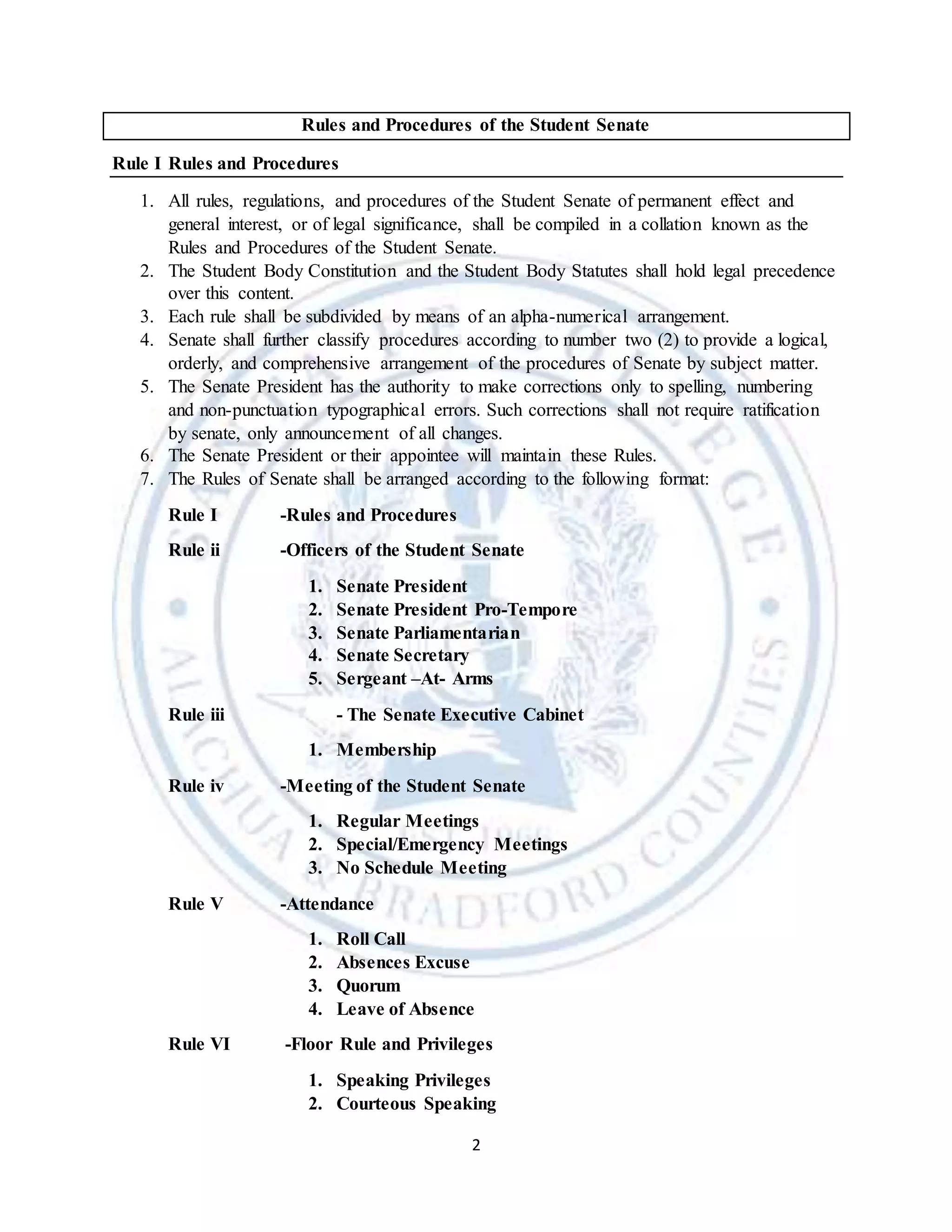
7. The Rules of Senate shall be arranged according to the following format:
Rule I -Rules and Procedures
Rule ii -Officers of the Student Senate
1. Senate President
2. Senate President Pro-Tempore
3. Senate Parliamentarian
4. Senate Secretary
5. Sergeant –At- Arms
Rule iii - The Senate Executive Cabinet
1. Membership
Rule iv -Meeting of the Student Senate
1. Regular Meetings
2. Special/Emergency Meetings
3. No Schedule Meeting
Rule V -Attendance
1. Roll Call
2. Absences Excuse
3. Quorum
4. Leave of Absence
Rule VI -Floor Rule and Privileges
1. Speaking Privileges
2. Courteous Speaking
3
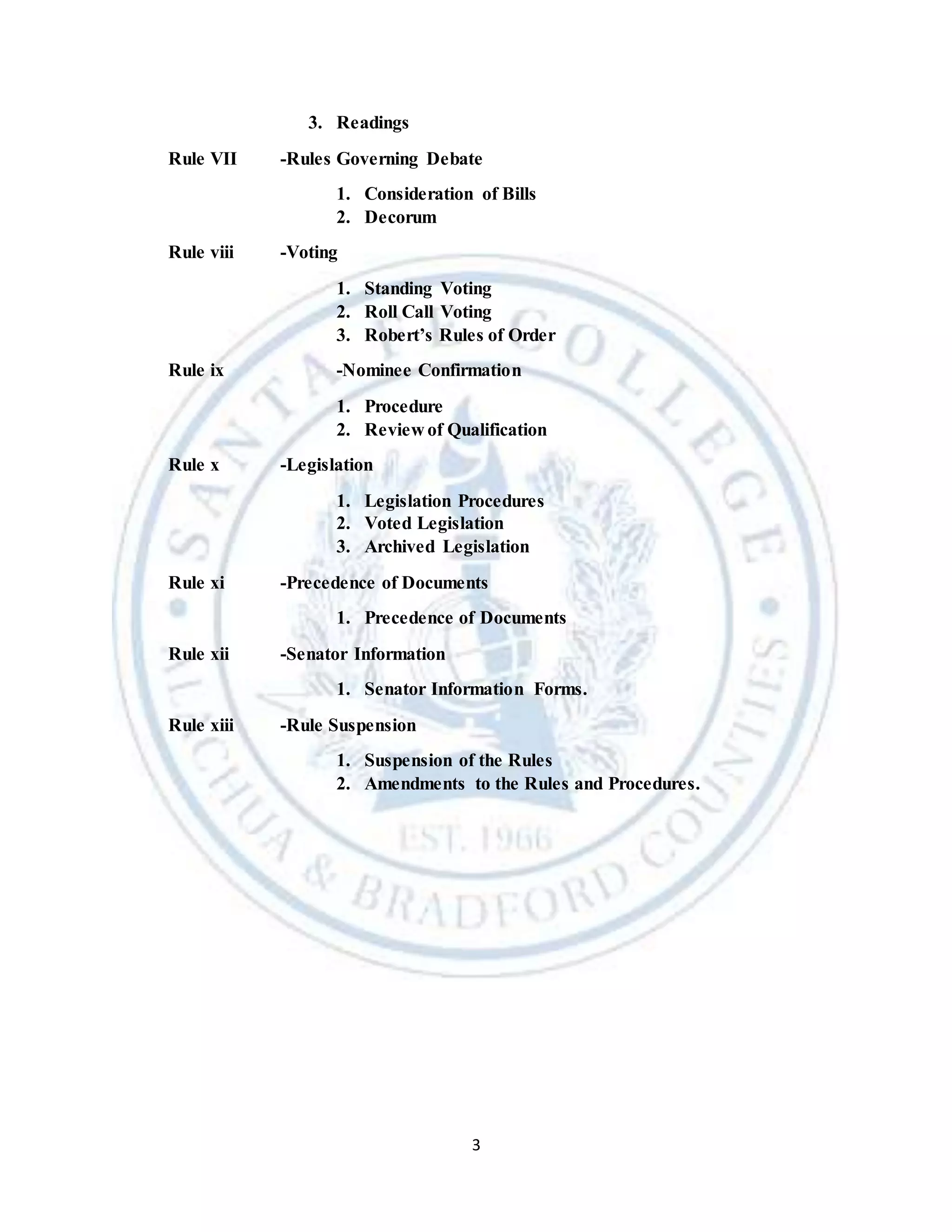
3. Readings
Rule VII -Rules Governing Debate
1. Consideration of Bills
2. Decorum
Rule viii -Voting
1. Standing Voting
2. Roll Call Voting
3. Robert’s Rules of Order
Rule ix -Nominee Confirmation
1. Procedure
2. Review of Qualification
Rule x -Legislation
1. Legislation Procedures
2. Voted Legislation
3. Archived Legislation
Rule xi -Precedence of Documents
1. Precedence of Documents
Rule xii -Senator Information
1. Senator Information Forms.
Rule xiii -Rule Suspension
1. Suspension of the Rules
2. Amendments to the Rules and Procedures.
4
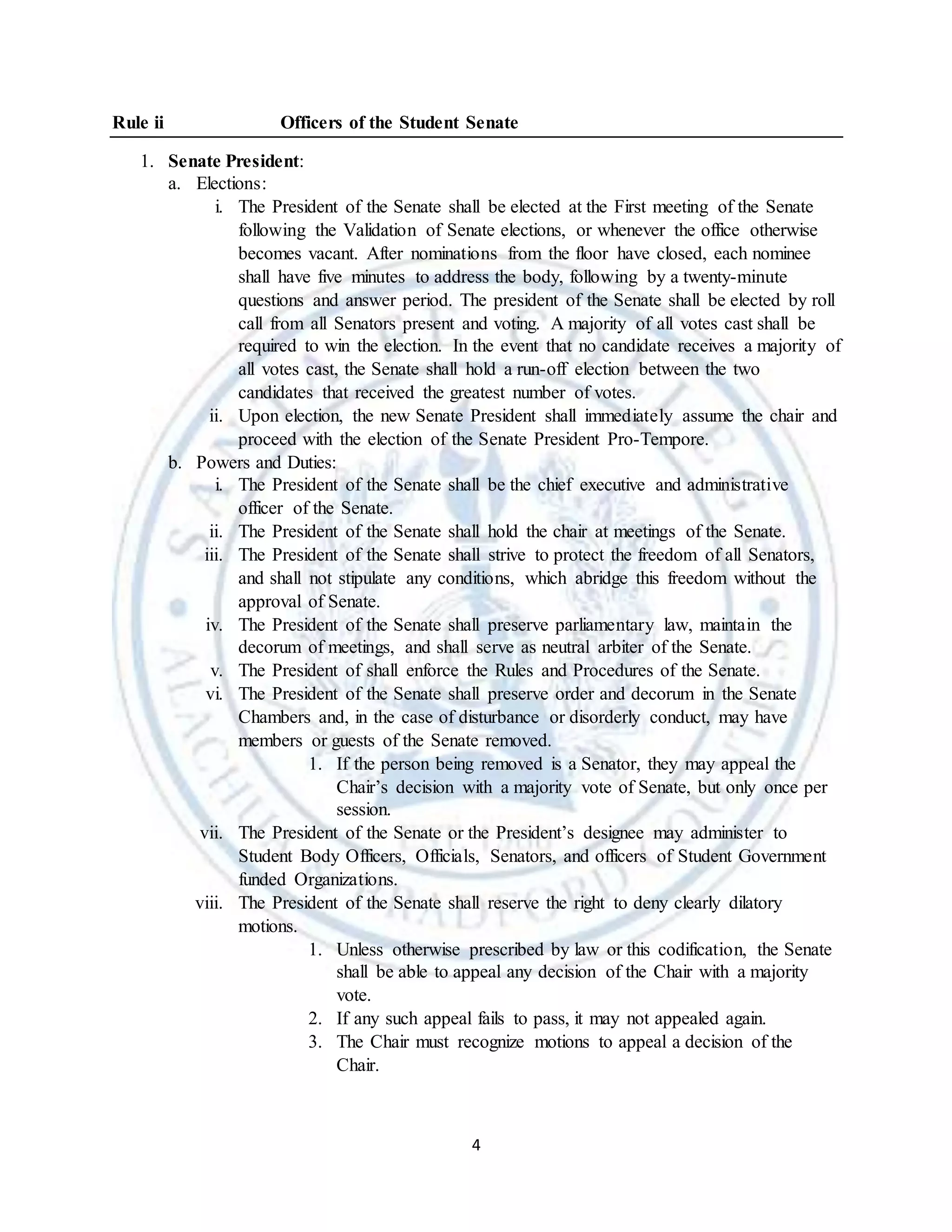
Rule ii Officers of the Student Senate
1. Senate President:
a. Elections:
i. The President of the Senate shall be elected at the First meeting of the Senate
following the Validation of Senate elections, or whenever the office otherwise
becomes vacant. After nominations from the floor have closed, each nominee
shall have five minutes to address the body, following by a twenty-minute
questions and answer period. The president of the Senate shall be elected by roll
call from all Senators present and voting. A majority of all votes cast shall be
required to win the election. In the event that no candidate receives a majority of
all votes cast, the Senate shall hold a run-off election between the two
candidates that received the greatest number of votes.
ii. Upon election, the new Senate President shall immediately assume the chair and
proceed with the election of the Senate President Pro-Tempore.
b. Powers and Duties:
i. The President of the Senate shall be the chief executive and administrative
officer of the Senate.
ii. The President of the Senate shall hold the chair at meetings of the Senate.
iii. The President of the Senate shall strive to protect the freedom of all Senators,
and shall not stipulate any conditions, which abridge this freedom without the
approval of Senate.
iv. The President of the Senate shall preserve parliamentary law, maintain the
decorum of meetings, and shall serve as neutral arbiter of the Senate.
v. The President of shall enforce the Rules and Procedures of the Senate.
vi. The President of the Senate shall preserve order and decorum in the Senate
Chambers and, in the case of disturbance or disorderly conduct, may have
members or guests of the Senate removed.
1. If the person being removed is a Senator, they may appeal the
Chair’s decision with a majority vote of Senate, but only once per
session.
vii. The President of the Senate or the President’s designee may administer to
Student Body Officers, Officials, Senators, and officers of Student Government
funded Organizations.
viii. The President of the Senate shall reserve the right to deny clearly dilatory
motions.
1. Unless otherwise prescribed by law or this codification, the Senate
shall be able to appeal any decision of the Chair with a majority
vote.
2. If any such appeal fails to pass, it may not appealed again.
3. The Chair must recognize motions to appeal a decision of the
Chair.
5
ix. The President of the Senate reserves the right to administratively change a
Senator’s designation upon direct formal request
x. The President of the Senate shall submit a session report to the Student Body
President and deliver the State of the Student Senate Address, not exceeding
five minutes at the end of each Fall and Spring session.
xi. The President of the Senate shall have all other powers as prescribed by law.
2. Senate President Pro-Tempore:
a. Elections
i. The President Pro-Tempore of the Senate shall be elected in the same manner
and at the same time as the President of the Senate, or whenever the office
otherwise becomes vacant.
b. Powers and Duties
i. The President Pro-Tempore of the Senate shall serve as the Chair of the Senate
whenever the elected Senate President is absent from the chair or whenever that
office becomes vacant, until such time as a successor may be chosen.
ii. The President Pro-Tempore of the Senate shall assist the President of the Senate
in fulfilling the duties of said office.
iii. The President of Pro-Tempore of the Senate shall serve as Chair of the Rules
Committee.
iv. The President Pro-Tempore of the Senate shall serve as the Recording Officer
of Senate and is responsible for the recording, filing and archiving of the
meeting agenda, minutes, and legislation, conflict of interest disclosures, and
absence excuses
v. The President Pro-Tempore of the Senate shall be responsible for submitting
approved legislation to the Student Body President.
vi. Once the legislation becomes law or is vetoed, the President Pro-Tempore of the
Senate shall inform the Senate President of said action of announcement at the
next Senate meeting.
3. Senate Parliamentarian:
a. Appointment:
i. The Senate Parliamentarian shall be nominated from the floor of Senate at time
prescribed by the President of the Senate or upon vacancy of the position. After
nominations from the floor have closed, each nominee shall receive two minutes
to address the body, followed by a question and answer period. A majority of all
votes cast must be required to win the nomination. In the event that no candidate
receives the majority of votes cast, the Senate shall hold a run-off election for
the two nominees that received the greatest number of votes.
b. Powers and Duties:
i. The Parliamentarian shall uphold the Student Body Constitution.
ii. The Parliamentarian shall upon request, instruct the Senate President, President
Pro-Tempore, and Committee Chairs on the proper methods of parliamentary
law.
6
iii. The Parliamentarian shall work to better the Senate’s general understanding of
parliamentary law, and shall help any Senator with issues of parliamentary law.
iv. The Parliamentarian shall refer all inquiries relating to the Student Body
Constitution to the Student Government Judicial Branch for proper
interpretation.
4. Senate Secretary:
a. Appointment:
i. The Senate Secretary shall be nominated from the floor of the Senate at a time
prescribed by the President of the Senate or upon the vacancy of the position.
After nominations from the floor have closed, each nominee shall receive two
minutes to address the body, followed by a question and answer period. A
majority of all votes cast must be required to win the nomination. In the event
that no candidate receives the majority of votes cast, the Senate shall hold a run-
off election for the two nominees that received the greatest number of votes.
b. Powers and Duties:
i. The Senate Secretary shall uphold the Student Body Constitution.
ii. The Senate Secretary shall take minutes of all Student Senate meetings, both
regular and special.
iii. The Senate Secretary shall publicize all records, to be defined as minutes, bills,
resolutions, and other documents of importance of the Student Senate on the
Student Government webpage in the timeframe specified by the Senate
President.
5. Sergeant-At-Arms:
a. Appointment:
i. The Sergeant-At-Arms shall be nominated from the floor of Senate at a time
prescribed by the President of the Senate or upon vacancy of the positon. After
nominations from the floor have closed, each nominee shall receive two minutes
to address the body, followed by question and answer period. A majority off all
votes cast must be required to win the nomination. In the event that no candidate
receives the majority of votes cast, the Senate shall hold a run-off election for
the two nominees that received the greatest number of votes.
b. Powers and Duties:
i. The Sergeant-At-Arms shall uphold the Student Body Constitution.
ii. The Sergeant-At-Arms shall prepare the facilities for meetings of the meetings
of the Student Senate.
iii. The Sergeant-At-Arms shall, at the discretion of the Senate President, escort
individuals from the Senate Chambers.
iv. The Sergeant-At-Arms shall assist and maintaining decorum.
v. The Sergeant-At-Arms shall administer the Oath of Office.
vi. The Sergeant-At-Arms may hold other offices in Student Government including
a Senate seat.
7
Rule III Senate Executive Cabinet
1. Memberships:
a. The following members shall serve as the Senate Executive Cabinet
i. The Senate President, as Chair
ii. The Senate Pro-Tempore
iii. Recruitment and Training Director
iv. Student Organization Coordinator
v. Senate Parliamentarian
vi. Senate Secretary
vii. Sergeant-At-Arms
Rule IV Meetings of the Student Senate
1. Regular Meeting:
a. Regular meetings shall be conducted on campus at a consistent time and location.
b. The Senate President, Senate President Pro-Tempore, and Student Government
Advisor shall set the time and location for regular meetings, but this decision can
be overturned by a majority vote of the Senate.
c. The Senate President with the assistance of the Senate President Pro-Tempore
shall prepare the agenda for regular meetings.
i. The agenda must be adopted and approved by a majority vote of Senate.
ii. Any Senator may motion to amend the agenda from the floor of Senate.
Any motion to amend the agenda shall require a majority vote of Senate.
iii. The agenda shall include sections for Roll Call, Adoption of Agenda,
Approval of Minutes, Approval of New Senators, Officer Reports,
Presentations, New and Old Business, Open Forum, Questions and
Answers, and Final Roll Call.
iv. The agenda shall be made public by 4:00pm on the day before the meeting
of Student Senate. All requests and documents for the consideration must
be received by the Student Senate President or Senate President Pro-
Tempore within forty-eight hours of the agenda being made public not to
include weekends and/or holidays.
v. The Senate President shall reserve the right to deny the inclusion of any
piece of legislation or presentation from the agenda.
1. The Senate President decision to deny may be overturned by a
two-thirds (2/3) vote of the Senate
2. Special/Emergency Meetings:
a. The Student Body President and/or a two-thirds (2/3) vote of Senate may call for
a Special/Emergency Meeting Student Senate.
b. Any Senator motioning for a Special Meeting shall be given five (5) minutes to
present his/her intended purpose for the special meeting.
8
c. The President of Student Senate shall notify each member of the Student Senate
forty-eight (48) hours prior to the Special meeting. Exceptions shall apply to
Emergency meetings
i. Notice may be given at a prior meeting of the Senate, so long as that
meeting occurs more than forty-eight (48) hours prior to the special
meeting.
ii. Notification may be given be email or telephone, so long as a log is kept.
If a Senator cannot be contacted via telephone due to a disconnection of
that Senator’s phone service or due to incorrect information being
provided to the Senate Office, indication of such must be placed indicated
and regular attendance rules should apply.
iii. All members being contacted shall be informed of the meetings purpose.
3. No Scheduled Meetings
a. The Student Senate or Committees and Student Organizations approved by the
Student Senate shall not meet on official College holidays.
b. During periods of final full-term examinations, the Student Senate or Senate
approved Committees and student organizations shall not meet.
Rule V Attendance
1. Roll Call:
a. The President Pro-Tempore shall call the roll of Senate whenever needed. In the
absence of the Senate President Pro-Tempore, the Senate President or his his/her
designee shall conduct roll call.
b. Each Senate, the President Pro-Tempore will administer one roll call at call-to-order
and one roll call at adjournment for a total of two (2) roll calls per meeting.
c. Any Senator that fails to answer a roll call or quorum shall receive one-half (1/2)
absences and be considered absent for quorum purposes. All other attendance rules
shall apply according to the attendance rules outlined by the President Pro-Tempore,
the Senate Rules and Procedures, and Student Body Constitution.
d. All Senators are required to maintain seventy-five percent (75%).
2. Absences Excuses:
a. An absence, late arrival, or early departure may be excused if a Senator submits
reasoning to the President Pro-Tempore. The Senate Office may reject the Senator’s
reasoning and not excuse them. Requests for excusal must be submitted a minimum
of twenty-four (24) hours prior to the Senate in question.
i. A Senator may appeal the decision to reject an absence excuse with a two-thirds
(2/3) vote of Senate.
3. Quorum:
a. A quorum to conduct business shall be the simply majority (50% plus one) of the
active roster of Senate.
9
b. Any Senator may raise a point of order regarding the presence of a quorum and with
a one-fifth (1/5) vote of Senate the President Pro-Tempore shall call the roll or
perform a roll call vote.
c. The Sergeant-at-Arms shall prevent any Senators entering the chambers during the
roll call from being recorded as present.
d. If Student Senate fails to establish quorum this section shall suspend any rule
regarding attendance and record keeping shall omitted.
4. Leave of Absence:
a. Any Student Organization Senator can request a Leave of Absence (LOA). Leave
of Absences shall be placed on the agenda and Senate must question and debate
this inquiry.
i. Upon Senate approval, the President Pro-Tempore shall remove the
Organization Senator from the active roster of Senate and readjust quorum
accordingly.
b. All Student Organizations on a LOA may not use any Student Government
allocated funds or participate and/or host events.
c. Academic and At-Large Senators are not permitted to take a Leave of Absence.
The Senator must formally resign from his/her position by submitting a formal
resignation to the Senate President Pro-Tempore
i. The President Pro-Tempore shall remove the Senator from the active
roster of Senate and readjust quorum accordingly.
10
Rule VI Floor Rule and Privileges
1. Privilege of the Floor:
a. MEMBERS' ACCESS. Members of the Senate or House, respectively, shall have the
exclusive right to enter the Chamber during sessions, and no other person shall be
admitted unless granted privilege of the floor as provided below.
b. PRIVILEGED GUESTS. The Student Body President, Student Body Vice President,
Student Body Treasurer, Chief Justice, shall be provided adequate time to give their
report to Senate. Any Senator wishing to ask a question of a Leadership Team Member
shall request permission from the Chair of Senate.
c.. OTHER GUESTS. Other guests may be granted the privilege of the Floor at the
discretion of the Presiding Officer. At the discretion of the Chair, time may be allotted
to Leadership Team members for director reports.
d. RESTRICTIONS ON NON-MEMBERS. Persons granted the privilege of the floor
may not lobby the members while the Senate is in session, unless granted leave to address
the Chambers.
e. Any committee of the Senate shall be allowed as much time before the Senate as is
necessary to report on the activities of the committee and to make recommendations to
the Senate germane to the purview of the committee.
f. Any and all persons present may be time restricted at the discretion of the Chair, as
announced prior to ceding the floor to any speakers for the allotted time(s). Speaking
times may be changed via a motion on the floor.
g. Any person speaking on the floor of the Senate pertaining to a measure that concerns a
Student Organization or special interest group shall state any affiliations that the person
speaking may have with said organization or special interest group prior to speaking.
h. If a Senator feels that they have made an inappropriate motion, they may move to
withdraw their motion, which requires removal also of a second. In the case of the failure
of the second to concur, the withdrawal may proceed through acclamation by Senate.
2. Courteous Speaking:
a. When a member desires to speak or deliver any matter to the Senate, the member shall
rise and respectfully address the presiding officer as “―Mr. (or Madam) President" and
shall confine all remarks to the question under debate, avoiding personal reference.
Failure to do so will result in the presiding officer calling the legislative member out of
order and the member loses his/her right to speak. Once recognized, a member may speak
from the member's desk or may, with the Chair’s permission, speak from the well.
b. When two or more members rise at once, the Presiding Officer shall name the one who
is to speak first. This decision shall be final and not open to debate or appeal.
c. There shall be no appeal of the Presiding Officer’s recognition, but the Presiding
Officer shall be governed by the rules and usage in priority of entertaining motions from
the floor. When a member seeks recognition, the Presiding Officer may ask, "For what
purpose does the member rise?" Alternatively, "For what purpose does the member seek
recognition?"
3. Readings:
11
a. Senators may call for the reading of any section of a Student Government Legal
Document as it pertains to any motion, parliamentary inquiry, or point of order being
heard.
b. If a Senator objects tot eh reading, the question of entertain the reading shall be put to a
vote without debate, requiring a majority for the reading to be entertained.
c. The Parliamentarian of the Senate, or the Senate President Pro-Tempore in their
absence, shall perform all readings to the Senate body.
d. In the absence of a Leadership Team member, their report shall be submitted to the
Senate Office for reading in Senate.
Rule VII Rule Governing Debate
1. Consideration of Bills:
a. Any bill, appropriation, resolution, authorization, confirmation or special requests
shall be debated pursuant to this section.
b. Readings shall be by title only, except when otherwise called for by two-fifths of
those present and voting, in which case the Senate Parliamentarian shall read the bill
in its entirety.
c. The authors and sponsors of the bill shall be afforded five minutes to present the
bill to the Senate.
d. Should time remain within the five minutes afforded to present the bill, the
remaining time shall be allowed for non-debatable technical questions of the bill’s
authors and sponsors.
i. A non-debatable technical question shall be any question that can be answered
with “yes,” “no,” of a known fact.
ii. The bill’s authors and sponsors may not be compelled to answer a question.
iii. The question period may be extended by motion at the discretion of the Chair.
iv. If there are no questions to be asked, the Senate shall move into debate after
the second reading of said bill.
v. At any time on the floor of Senate, a Senator may motion to amend a bill being
presented for adoption.
e. The Chair in accordance to Rule V of these Rules and Procedures shall recognize all
persons wishing to speak with eligible voting Senators receiving priority.
f. A member may not speak more than once nor occupy more than five (5) minutes in
debate on any question. Once the Chair has set the time for debate on any question the
member speaking must indicate that they-yield their time by saying “I yield my time to
a like speaker” or the member may designate a specific speaker to which to yield their
12
time. If time is not yielded, the Chair states- Time was not yielded and the debate is
ended or reverts to the opposing view.
g. Another member may not interrupt a member who has the floor for any purpose, save
the privilege of the Chambers, unless the member consents to yield to the other member.
A member desiring to interrupt another in debate should first address the Chair for the
permission of the member speaking. The Chair shall then ask the member who has the
floor if they wish to yield and shall then announce the decision of that member. Whether
to yield shall be entirely within the speaking member’s discretion. This subsection shall
no, however, deprive the first-named sponsor or mover the right to close when the effect
of an amendment or motion would be to foreclose favorable action on the bill,
amendment, or motion.
h. Following the debate period, the authors and sponsors of the bill shall be afforded three
minutes of final privilege, to which at the end, they shall move that the bill be put on final
passage to vote.
i. Following final privilege, the Chair shall put the question and the Senate shall vote on
the adoption of the bill.
2. Decorum:
The members shall attend to the debates unless necessarily prevented, and no member
shall stand between the Chair and a member recognized to speak.
Rule VIII Voting
13
1. Standard Voting Procedures:
a. All votes must be conducted by electronic voting, or by hand, or by roll-call with the
consent of one-fifth (1/5) of Senate, or by acclamation with the unanimous consent of
Senate.
b. The Chair or their designee shall announce the vote totals and results immediately
following a vote.
c. In cases of division votes shall be counted by rising.
d. A Senator may not cast a vote for another Senator or on behalf of a Senate Seat.
e. No Senator may abstain from a vote except in cases wherein voting would present a
conflict of interest. A conflict of interest exists whenever a Senator stands to gain an
individual benefit from the matter being considered.
2. Roll Call Voting:
a. When not otherwise called for, a roll call vote may be ordered by one-fifth (1/5) of the
Senators present and voting at any time before the next question is spoken on.
b. When not otherwise called for, a roll call ballot may be ordered at the discretion of the
Chair.
c. The roll call shall be conducted in accordance with the Rule IV of these Rules and
Procedures
d. Senators may abstain from voting in the roll call vote in cases of conflicted of interest
as described above.
e. Roll call votes and ballots shall be recorded in the minutes of the meeting, indicating
how each Senator present voted.
3. Roberts Rules of Order:
a. Where not otherwise prescribed by Law or addressed in this document, the latest
version of Robert’s Rules of Order Newly Revised shall be followed in all procedures of
Student Senate.
14
Rule IX Nominee Confirmation
1. Procedure
a. Once the senate President has been notified of a nomination, the confirmation of
the nominee shall be placed on the Agenda of the following meeting.
b. The nominee shall have (2) minutes to address the Senate.
c. After the initial presentation, the Senate may ask questions of the nominee.
d. Senate shall deliberate and vote while the nominee(s) wait outside the Chamber.
i. The nominee shall not have any physical or electronic communication
with members in the Chamber during debate.
e. If confirmed by a majority vote, the Chair or their designee shall inaugurate the
nominee with the Oath of the Santa Fe College Student Government, as
prescribed by law.
2. Review of Qualifications:
a. According the Student Body Constitution, Santa Fe College Rules and Procedures
and these rules and procedures all Senators present and voting are prohibited from
discrimination on the basis of race, creed, color, religion, age, disability, sex,
sexual orientation, gender identity and expression, marital status, national origin,
political affiliation and opinions, veteran status or any other classification and
there shall be no toleration of discrimination thereof.
Rule X Legislation
2. Legislation Procedures
a. Any legislation presented to the Senate for the purpose of a vote must first have at
least one (1) Senator as author or sponsor in order to be brought before the Senate
as new business.
b. All legislation shall include the title, date of submission, author(s), and sponsoring
Senator(s).
c. All legislation being brought before the Senate must be submitted to the Senate
President and the Senate President Pro-Tempore electronically at least twenty-
four hours in advance, to be made electronically available.
d. When receiving legislation, the Senate President Pro-Tempore will assign an
identifier to the piece, commencing with the Senate Bill(SB) to be followed by the
year and the legislation number (YY##) starting at (01). At the start of a new year,
the legislation number will reset to (YY01).
e. Legislation authors may use established templates as guidelines.
3. Vetoed Legislation
a. Any vetoed legislation shall be added to the agenda during the next session of
Senate, to be debated.
b. The President shall have five (5) minutes to explain the reasoning behind the veto
to the Senate.
c. Alternatively, the Senate President shall read a statement from the President, not
to exceed five (5) minutes.
15
d. Afterwards, the legislation’s author or their designee shall present the bill and
respond to the veto.
4. Archived Legislation
a. All acts of legislation presented for consideration by the Senate and its
committees shall be archived by the Senate President Pro-Tempore.
b. A copy of all acts of legislation passed or failed, shall be kept in paper and digital
copy in the Student Government offices and website accessible to all Student
Government members and the student body.
Rule XI Precedence of Documents
1. Precedence of Documents:
a. The Student Senate shall be governed by, in order of precedence, the Constitution
of the Student Body, the Statutes of the Student Body, these Rules and Procedures
of the Student Senate, and the latest version of Robert’s Rules of Order Newly
Revised.
b. The Student Senate shall abide by all applicable state and federal laws.
c. If there is a question of procedure not discussed in any of these documents, the
chair shall apply principles of justice and general parliamentary law to determine
the correct course of action.
i. The Senate President may put this question before the Senate.
ii. Any decision made by the chair in this manner may be appealed in the
same manner as any other decision of the chair.
Rule XII Senator Information
1. Senator Information Forms:
a. All Senators shall be required to keep in the Senate office files an accurate record
of their contact information.
b. Included on the information form shall be the following information
i. The Senator’s full legal name
ii. Senator Seat held
iii. Phone Number and E-mail address
c. Senators shall submit updates to their information forms whenever the above
listed information changes.
Rule XIII Rule Suspension
1. Suspension of Rules:
a. The provisions within these Rules and Procedures and Robert’s Rules of
Order Newly Revised as a parliamentary author may be suspended at any time
by a two-thirds vote.
16
b. Rules may only be suspended in order to allow a particular course of action
which shall be stated in the motion to suspend the rules.
c. The provisions within the following Rules may not be suspended by any
means:
i. Rule I
ii. Rule II
iii. Rule X
iv. Rule XI
v. Rule XII
vi. This Rule
2. Amendments to the Rules and Procedures:
a. Amendments to these Rules and Procedures shall be submitted to the Rules
Committee as a resolution, and shall require a two-thirds (2/3) vote in the
Senate for adoption and cannot be moved from the floor.
b. Amendments shall not take effect until the following meeting of the Senate.
c. These Rules shall be voted on the reapproved at the beginning of the Fall and
Spring session.
17
APPENDIX I: PROCEDURE OF SENATE SESSIONS
A1.1- Meaning of Gavel Raps
1 rap – The chamber will come to order.
2 raps – Members will rise.
3 raps – Members stand and applaud until a single rap returns order.
A1.2- Procedure and Language of Call to Order and Session Opening
(1) Presiding Officer: The Senate will be in order.
(2) Sergeant of Arms: Senators and Guest, all rise, please remove all hats for the Pledge of
Allegiance
(3) All in Chambers: Observe the Pledge of Allegiance, by reciting if so inclined.
(4) Sergeant of Arms: Attention to the roll!
The Senate President Pro-Tempore, or acting member, no calls the roll, Senators will reply when
name is called or will be marked absent and will not be able to vote.
(5) Presiding officer, after referring to results of roll call and Pro-Tempore: With X present,
and X need for Quorum, we now may (or may not) conduct business.
(6) President: Is there now a motion to adopt the agenda?
(7) Senator: After gaining recognition: Mr./Madam President, I move that the agenda be
adopted as is/amended with the addition of X.
(8) (a) President: It has been moved that the agenda be adopted as is. Is there an objection?
Hearing none, the agenda is adopted
(b) President: It has been moved that the agenda be amended with the addition of X. Is
there a second?
(c)Senator: Seconded
(d) President: All those in favor? All those against? The agenda is amended/This motion
fails, the
Agenda remains as is.
(If the Agenda is amended, or the motion fails, return to subsection 7 to adopt agenda.)
(9) President: We will now revert to the approval of the minutes. Are there any amendments
to the minutes? Hearing none, the minutes are approved as written.
(a) A Senator may move to amend any amendments to the minutes, this motion must be
seconded and voted on, discussion not required, but may take place.
18
A1.3- Procedure and Language of Nomination Confirmation
(1)Presiding Officer: We will now revert to the task of Approval, will X rise and approach the
dias.
(2)Candidate: (Rises and is presented to the Chambers)
(3) President: X is up before this body for approval and appointment into the position of X. The
nominee shall have two (2) minutes to address the Senate, followed by a period of X minutes for
questions from the members of this body and our guests. X, the chair recognizes you and grants
you the privilege of the floor for two (2) minutes.
(4) Candidate: Thank you, Mr./Madam President, (Proceeds with presentation.)
(5) President: Thank you, X. Yielding their time back to the chair, we are now in order for
questions from the chambers for X minutes.
(6) Senator: Mr./Madam President, I rise to ask a question of X/the panel.
(7)President: Will the candidate(s) yield to a question?
(8)Candidate(s): Yes, I yield (Candidate may yield to all questions or one at a time.)
(9)President: The Candidate has yielded; you may ask your question.
(10)Senator: (asks question) — Candidate answers (Other Senators may be recognized to ask
questions until time expires.
(11)President: As our time for questions has expired, The Chair now requests that the Sergeant of
Arms escort our candidates out of the chambers so the Senate may deliberate and vote. The Chair
would like to remind members that during these debate and voting procedures, electronic and
physical communication with the nominee is prohibited as according to Rule IX, section one,
subsection D of Senate Rules and Procedure.
(12)President: (After the candidates have vacated the Chambers) We are now in order for open
debate on the floor, are there any motions?
It shall be at the discretion of the Presiding Officer to accept a motion from the floor for the
following forms of debate, provided that they:
a) Rounds of Pro/Con Debate set individually at a specified time. I move for X rounds
of Pro/Con debate set at X minutes each
b) Convene as a Whole for a specified time. I move to Convene as a Whole for X
minutes
c) Unmoderated Caucus set at a specified time. I move to entertain an unmoderated
caucus for a period of X minutes
(13) Senator: (gains recognition from the chair and makes motion)
(14) President: We are now in order for X minutes of X debate.
(15) Senator: (gains recognition from the chair) I rise to speak (pro/con) on the approval of X.
Debate by members shall continue by Senators based on the type of debate that has been selected
until the time allotted has expired.
a) In Pro/Con, a member may yield his/her time to a like speaker or to a specific senator.
If time is not yielded, time is called and the debate reverts to the opposing side, if a
member yields time to the chair and NOT a like-minded speaker, the time is expired and
the debate reverts to the opposing side. Senators must gain permission from the presiding
officer to speak.
19
b) If Convened as a Whole, the entire chamber may enter into informal discussion
without formality other than recognition by the chair.1
c) If in Unmoderated Caucus, members may debate informally on the floor for the
allotted time provided that debate remains professional.
(16) Presiding Officer: As time for debate has expired, we will now move on into voting
procedure. The Chair would like to remind members that during these debate and voting
procedures, electronic and physical communication with the nominee is prohibited as according
to Rule IX, section one, subsection D of Senate Rules and Procedure. Nominees will be
confirmed by a simple majority vote, the vote will commence as (Roll Call/Vote by hand).
(a) Members will vote by method selected by the Presiding Officer. The Sergeant of
Arms will count the votes.
(17) Will the Sergeant of Arms announce the vote?
(18) Sergeant of Arms: Mr. /Madam President there are X yeas and X nays.
(19) President: By your vote you have confirmed Candidate X for the position of X.
(20)President: Sergeant of Arms, will you please allow the nominees back in these chambers for
the reading of the results.
Once the nominees are have returned to the chambers and the results announced, the Chair or
their designee shall inaugurate the nominee with the Oath of Santa Fe College Student
Government, as prescribed by law.
1 At any time during a Convene as a Whole debate, a member may move for a “Call to question” or motion that the
nominee be adopted by acclamation. If the question has been called without objection, debate expires and the Chair
then guides the body into voting procedures.
20
A1.4- Procedure and Language of Bill Passage
(1) Presiding Officer: We will now revert to the order of passage of bills.
(2) Sponsor of Bill Current on Agenda: After gaining recognition: Mr. /Madam President, I
move that the rules be waived and Senate Bill No. be read for a first time by the title only.
(3) Presiding Officer: It has been moved that Bill No. be read for a first time by title noting
changes made in committee. Is there an objection to the motion? Hearing none, will the
Parliamentarian now read Bill No. _ for the first time by title noting changes made in the
committee.
(4) Parliamentarian: (Reads the bill by title only, noting changes made in committee) Senate Bill,
a bill to be entitled...
(5) President: The sponsor has ten (10) minutes to present the bill.
(6) Sponsor: Goes to the front of the chamber and presents the bill.
(7) President: We are now in order for non-debatable technical questions. 2
(8) (Senator rises) President: For what purpose does the member rise?
(9) Senator: After stating name/ organization name/Academic/At-Large, “I rise to ask a
non-debatable, technical question of the sponsor.”
(10) President: Will the sponsor yield to a non-debatable, technical question? 3
(11) Sponsor: Yes, I yield. (Sponsor may yield to all questions or one at a time)
(12) President: The Sponsor has yielded; you may ask your question.
(13) Senator: (asks question) — Sponsor answers (Other Senators may be recognized to ask
non-debatable, technical questions until time expires).
(14) President: We are now in order for open debate on the floor, are there any motions?
It shall be at the discretion of the Presiding Officer to accept a motion from the floor for the
following forms of debate, provided that they:
a) Rounds of Pro/Con Debate set individually at a specified time. I move for X rounds
of Pro/Con debate set at X minutes each.
b) Convene as a Whole for a specified time. I move to Convene as a Whole for X
minutes.
c) Unmoderated Caucus set at a specified time. I move to entertain an unmoderated
caucus for a period of X minutes.
(15) Senator: (gains recognition from the chair and makes motion).
(16) President: We are now in order for X minutes of X debate.
(17) Senator: (gains recognition from the chair) I rise to speak (pro/con) on this bill.
2 Non-Debatable technical questions may be asked if time remains during initial 10 minute presentation,if time
expires before questions are asked, a motion may be made to extend the time for questions.If no motion for
extension is made, the Presiding officer guides us into debate.
3 A Non-Debatable Technical Question shall be any question that can be answered with “yes,” “no”, or a known
fact.
21
Debate by members shall continue by Senators based on the type of debate that has been selected
until the time allotted has expired.
a) In Pro/Con, a member may yield his/her time to a like speaker or to a specific senator.
If time is not yielded, time is called and the debate reverts to the opposing side, if a
member yields time to the chair and NOT a like-minded speaker, the time is expired and
the debate reverts to the opposing side. Senators must gain permission from the presiding
officer to speak.
b) If Convened as a Whole, the entire chamber may enter into informal discussion
without formality other than recognition by the chair.4
c) If in Unmoderated Caucus, members may debate informally on the floor for the
allotted time provided that debate remains professional.
(18) President: The bill sponsor has five (5) minutes to close.
(19) Sponsor: Returns to the front of the chamber and presents his closing arguments. When
finished, he/she then says: Mr. /Madam President, I move the rules be further waived and
that Bill No. be read for a second time by title only and placed on final passage.
(20) President: It has been moved that Bill No. be read for a second and final time by title only.
Is there an objection to the motion? Hearing none, Will the Parliamentarian now read Senate Bill
No. for the second and final time by title only?
(21) Parliamentarian: (Reads the bill by title only, noting changes made in committee) Senate
Bill , a bill to be entitled...
(22) President: ―Are there any amendments on the desk? (If so, they are read by the
Parliamentarian).
Amendments are considered in the order in which they are submitted. The amendment sponsor
has two (2) minutes to present the amendment, and the amendment sponsor may waive his/her
time to like speakers until the time has expired. An opposition speaker is then given two (2)
minutes, and may also waive time to like speakers. The amendment sponsor then has one minute
to summarize. The members may then vote on the amendment. This process shall continue until
the amendment list has exhausted.
(23) Sponsor: Mr. /Madam President, I move that Senate Bill No. does now pass.
(24) President: It has been moved that Senate Bill No. does now pass. This vote is on the final
passage of Bill No. . Voting will commence by X.
(a) Members will vote by method selected by the Presiding Officer. The Sergeant of
Arms will count the votes.
(25) President: Will the Sergeant of Arms announce the vote?
(26) Sergeant of Arms: Mr. /Madam President there are X yeas and X nays
(27) President: By your vote you have passed (failed to pass) Bill No. _
(28) President: The chair will now recognize the sponsor of the next bill.
4 At any time during a Convene as a Whole debate, a member may move for a “Call to question” or motion that the
legislation be adopted by acclamation. If the question has been called without objection, debate expires and the
Chair then guides the body into voting procedures.
22
A1.5- Procedure and Language of Resolution Passage
(1) Presiding Officer: We will now revert to the order of passage of Resolutions.
(2) Sponsor/Author of Resolution Current on Agenda: After gaining recognition: Mr. /Madam
President, I move that the rules be waived and the Resolution be read for a first time by the
title only.
(3) Presiding Officer: It has been moved that the Resolution be read for a first time by title noting
changes made in committee. Is there an objection to the motion? Hearing none, will the
Parliamentarian now read the Resolution for the first time by title noting changes made in the
committee?
(4) Parliamentarian: (Reads the Resolution by title only, noting changes made in committee) the
Resolution to be entitled.
(5) President: The sponsor has ten (10) minutes to present the Resolution.
(6) Sponsor/Author: Goes to the front of the chamber and presents the Resolution.
(7) President: We are now in order for non-debatable technical questions. 5
(8) (Senator rises) President: For what purpose does the member rise?
(9) Senator: After stating name/ organization name/Academic/At-Large, “I rise to ask a
non-debatable, technical question of the sponsor.”
(10) President: Will the sponsor yield to a non-debatable, technical question?
(11) Sponsor: Yes, I yield. (Sponsor may yield to all questions or one at a time).
(12) President: The Sponsor has yielded; you may ask your question.
(13) Senator: (asks question) — Sponsor answers (Other Senators may be recognized to ask
non-debatable, technical questions until time expires).
(14) President: We are now in order for open debate on the floor, are there any motions?
It shall be at the discretion of the Presiding Officer to accept a motion from the floor for the
following forms of debate, provided that they:
a) Rounds of Pro/Con Debate set individually at a specified time. I move for X rounds of
Pro/Con debate set at X minutes each.
b) Convene as a Whole for a specified time. I move to Convene as a Whole for X minutes.
c) Unmoderated Caucus set at a specified time. I move to entertain an unmoderated caucus
for a period of X minutes.
(15) Senator: (gains recognition from the chair and makes motion) .
(16) President: We are now in order for X minutes of X debate.
5 Non-Debatable technical questions may be asked if time remains during initial 10 minute presentation,if time
expires before questions are asked, a motion may be made to extend the time for questions.If no motion for
extension is made, the Presiding officer guides us into debate.
23
(17) Senator: (gains recognition from the chair) I rise to speak (pro/con) on this bill.
Debate by members shall continue by Senators based on the type of debate that has been selected
until the time allotted has expired.
a) In Pro/Con, a member may yield his/her time to a like speaker or to a specific senator. If time
is not yielded, time is called and the debate reverts to the opposing side, if a member yields time
to the chair and NOT a like-minded speaker, the time is expired and the debate reverts to the
opposing side. Senators must gain permission from the presiding officer to speak.
b) If Convened as a Whole, the entire chamber may enter into informal discussion without
formality other than recognition by the chair.6
c) If in Unmoderated Caucus, members may debate informally on the floor for the allotted time
provided that debate remains professional.
(18) President: The Resolution sponsor has five (5) minutes to close.
(19) Sponsor/Author: Returns to the front of the chamber and presents his closing arguments.
When finished, he/she then says: Mr. /Madam President, I move the Resolution does now
pass.
(20) President: It has been moved that the Resolution does now pass. Is there an objection to the
motion? Hearing none this vote is on the final passage of the Resolution. Voting will commence
by X.
(a) Members will vote by method selected by the Presiding Officer. The Sergeant of Arms will
count the votes.
(21) President:Will the Sergeant of Arms announce the vote?
(22) Sergeant of Arms: Mr. /Madam President there are X yeas and X nays
(23) President: By your vote you have passed (failed to pass) this Resolution.
(24) President: We will now move on to the next item agenda.
6 At any time during a Convene as a Whole debate, a member may move for a “Call to question” or motion that the
legislation be adopted by acclamation. If the question has been called without objection, debate expires and the
Chair then guides the body into voting procedures.

Rules and Procedures of the Student Senate

  • 1.
    SANTA FE COLLEGE Rulesand Procedures Of the Student Senate Revised by Senate President Pro-Tempore Matthew Pearson and the Senate Rules Committee Adapted by the Senate Rules Committee and its Chair from the following works consulted: Speaker Cannon, Dean -2010-2012 House Rules Ed 1. Florida House of Representatives 2010-2012. November 16, 2010 Speaker Cannon, Dean. – 2010-2012 House Rules Ed 2. Florida House of Representatives 2010-2012. November 16, 2010 Inspired by the Florida Model Legislature Organization Revised January 26, 2016
  • 2.
  • 3.
    2 Rules and Proceduresof the Student Senate Rule I Rules and Procedures 1. All rules, regulations, and procedures of the Student Senate of permanent effect and general interest, or of legal significance, shall be compiled in a collation known as the Rules and Procedures of the Student Senate. 2. The Student Body Constitution and the Student Body Statutes shall hold legal precedence over this content. 3. Each rule shall be subdivided by means of an alpha-numerical arrangement. 4. Senate shall further classify procedures according to number two (2) to provide a logical, orderly, and comprehensive arrangement of the procedures of Senate by subject matter. 5. The Senate President has the authority to make corrections only to spelling, numbering and non-punctuation typographical errors. Such corrections shall not require ratification by senate, only announcement of all changes. 6. The Senate President or their appointee will maintain these Rules. 7. The Rules of Senate shall be arranged according to the following format: Rule I -Rules and Procedures Rule ii -Officers of the Student Senate 1. Senate President 2. Senate President Pro-Tempore 3. Senate Parliamentarian 4. Senate Secretary 5. Sergeant –At- Arms Rule iii - The Senate Executive Cabinet 1. Membership Rule iv -Meeting of the Student Senate 1. Regular Meetings 2. Special/Emergency Meetings 3. No Schedule Meeting Rule V -Attendance 1. Roll Call 2. Absences Excuse 3. Quorum 4. Leave of Absence Rule VI -Floor Rule and Privileges 1. Speaking Privileges 2. Courteous Speaking
  • 4.
    3 3. Readings Rule VII-Rules Governing Debate 1. Consideration of Bills 2. Decorum Rule viii -Voting 1. Standing Voting 2. Roll Call Voting 3. Robert’s Rules of Order Rule ix -Nominee Confirmation 1. Procedure 2. Review of Qualification Rule x -Legislation 1. Legislation Procedures 2. Voted Legislation 3. Archived Legislation Rule xi -Precedence of Documents 1. Precedence of Documents Rule xii -Senator Information 1. Senator Information Forms. Rule xiii -Rule Suspension 1. Suspension of the Rules 2. Amendments to the Rules and Procedures.
  • 5.
    4 Rule ii Officersof the Student Senate 1. Senate President: a. Elections: i. The President of the Senate shall be elected at the First meeting of the Senate following the Validation of Senate elections, or whenever the office otherwise becomes vacant. After nominations from the floor have closed, each nominee shall have five minutes to address the body, following by a twenty-minute questions and answer period. The president of the Senate shall be elected by roll call from all Senators present and voting. A majority of all votes cast shall be required to win the election. In the event that no candidate receives a majority of all votes cast, the Senate shall hold a run-off election between the two candidates that received the greatest number of votes. ii. Upon election, the new Senate President shall immediately assume the chair and proceed with the election of the Senate President Pro-Tempore. b. Powers and Duties: i. The President of the Senate shall be the chief executive and administrative officer of the Senate. ii. The President of the Senate shall hold the chair at meetings of the Senate. iii. The President of the Senate shall strive to protect the freedom of all Senators, and shall not stipulate any conditions, which abridge this freedom without the approval of Senate. iv. The President of the Senate shall preserve parliamentary law, maintain the decorum of meetings, and shall serve as neutral arbiter of the Senate. v. The President of shall enforce the Rules and Procedures of the Senate. vi. The President of the Senate shall preserve order and decorum in the Senate Chambers and, in the case of disturbance or disorderly conduct, may have members or guests of the Senate removed. 1. If the person being removed is a Senator, they may appeal the Chair’s decision with a majority vote of Senate, but only once per session. vii. The President of the Senate or the President’s designee may administer to Student Body Officers, Officials, Senators, and officers of Student Government funded Organizations. viii. The President of the Senate shall reserve the right to deny clearly dilatory motions. 1. Unless otherwise prescribed by law or this codification, the Senate shall be able to appeal any decision of the Chair with a majority vote. 2. If any such appeal fails to pass, it may not appealed again. 3. The Chair must recognize motions to appeal a decision of the Chair.
  • 6.
    5 ix. The Presidentof the Senate reserves the right to administratively change a Senator’s designation upon direct formal request x. The President of the Senate shall submit a session report to the Student Body President and deliver the State of the Student Senate Address, not exceeding five minutes at the end of each Fall and Spring session. xi. The President of the Senate shall have all other powers as prescribed by law. 2. Senate President Pro-Tempore: a. Elections i. The President Pro-Tempore of the Senate shall be elected in the same manner and at the same time as the President of the Senate, or whenever the office otherwise becomes vacant. b. Powers and Duties i. The President Pro-Tempore of the Senate shall serve as the Chair of the Senate whenever the elected Senate President is absent from the chair or whenever that office becomes vacant, until such time as a successor may be chosen. ii. The President Pro-Tempore of the Senate shall assist the President of the Senate in fulfilling the duties of said office. iii. The President of Pro-Tempore of the Senate shall serve as Chair of the Rules Committee. iv. The President Pro-Tempore of the Senate shall serve as the Recording Officer of Senate and is responsible for the recording, filing and archiving of the meeting agenda, minutes, and legislation, conflict of interest disclosures, and absence excuses v. The President Pro-Tempore of the Senate shall be responsible for submitting approved legislation to the Student Body President. vi. Once the legislation becomes law or is vetoed, the President Pro-Tempore of the Senate shall inform the Senate President of said action of announcement at the next Senate meeting. 3. Senate Parliamentarian: a. Appointment: i. The Senate Parliamentarian shall be nominated from the floor of Senate at time prescribed by the President of the Senate or upon vacancy of the position. After nominations from the floor have closed, each nominee shall receive two minutes to address the body, followed by a question and answer period. A majority of all votes cast must be required to win the nomination. In the event that no candidate receives the majority of votes cast, the Senate shall hold a run-off election for the two nominees that received the greatest number of votes. b. Powers and Duties: i. The Parliamentarian shall uphold the Student Body Constitution. ii. The Parliamentarian shall upon request, instruct the Senate President, President Pro-Tempore, and Committee Chairs on the proper methods of parliamentary law.
  • 7.
    6 iii. The Parliamentarianshall work to better the Senate’s general understanding of parliamentary law, and shall help any Senator with issues of parliamentary law. iv. The Parliamentarian shall refer all inquiries relating to the Student Body Constitution to the Student Government Judicial Branch for proper interpretation. 4. Senate Secretary: a. Appointment: i. The Senate Secretary shall be nominated from the floor of the Senate at a time prescribed by the President of the Senate or upon the vacancy of the position. After nominations from the floor have closed, each nominee shall receive two minutes to address the body, followed by a question and answer period. A majority of all votes cast must be required to win the nomination. In the event that no candidate receives the majority of votes cast, the Senate shall hold a run- off election for the two nominees that received the greatest number of votes. b. Powers and Duties: i. The Senate Secretary shall uphold the Student Body Constitution. ii. The Senate Secretary shall take minutes of all Student Senate meetings, both regular and special. iii. The Senate Secretary shall publicize all records, to be defined as minutes, bills, resolutions, and other documents of importance of the Student Senate on the Student Government webpage in the timeframe specified by the Senate President. 5. Sergeant-At-Arms: a. Appointment: i. The Sergeant-At-Arms shall be nominated from the floor of Senate at a time prescribed by the President of the Senate or upon vacancy of the positon. After nominations from the floor have closed, each nominee shall receive two minutes to address the body, followed by question and answer period. A majority off all votes cast must be required to win the nomination. In the event that no candidate receives the majority of votes cast, the Senate shall hold a run-off election for the two nominees that received the greatest number of votes. b. Powers and Duties: i. The Sergeant-At-Arms shall uphold the Student Body Constitution. ii. The Sergeant-At-Arms shall prepare the facilities for meetings of the meetings of the Student Senate. iii. The Sergeant-At-Arms shall, at the discretion of the Senate President, escort individuals from the Senate Chambers. iv. The Sergeant-At-Arms shall assist and maintaining decorum. v. The Sergeant-At-Arms shall administer the Oath of Office. vi. The Sergeant-At-Arms may hold other offices in Student Government including a Senate seat.
  • 8.
    7 Rule III SenateExecutive Cabinet 1. Memberships: a. The following members shall serve as the Senate Executive Cabinet i. The Senate President, as Chair ii. The Senate Pro-Tempore iii. Recruitment and Training Director iv. Student Organization Coordinator v. Senate Parliamentarian vi. Senate Secretary vii. Sergeant-At-Arms Rule IV Meetings of the Student Senate 1. Regular Meeting: a. Regular meetings shall be conducted on campus at a consistent time and location. b. The Senate President, Senate President Pro-Tempore, and Student Government Advisor shall set the time and location for regular meetings, but this decision can be overturned by a majority vote of the Senate. c. The Senate President with the assistance of the Senate President Pro-Tempore shall prepare the agenda for regular meetings. i. The agenda must be adopted and approved by a majority vote of Senate. ii. Any Senator may motion to amend the agenda from the floor of Senate. Any motion to amend the agenda shall require a majority vote of Senate. iii. The agenda shall include sections for Roll Call, Adoption of Agenda, Approval of Minutes, Approval of New Senators, Officer Reports, Presentations, New and Old Business, Open Forum, Questions and Answers, and Final Roll Call. iv. The agenda shall be made public by 4:00pm on the day before the meeting of Student Senate. All requests and documents for the consideration must be received by the Student Senate President or Senate President Pro- Tempore within forty-eight hours of the agenda being made public not to include weekends and/or holidays. v. The Senate President shall reserve the right to deny the inclusion of any piece of legislation or presentation from the agenda. 1. The Senate President decision to deny may be overturned by a two-thirds (2/3) vote of the Senate 2. Special/Emergency Meetings: a. The Student Body President and/or a two-thirds (2/3) vote of Senate may call for a Special/Emergency Meeting Student Senate. b. Any Senator motioning for a Special Meeting shall be given five (5) minutes to present his/her intended purpose for the special meeting.
  • 9.
    8 c. The Presidentof Student Senate shall notify each member of the Student Senate forty-eight (48) hours prior to the Special meeting. Exceptions shall apply to Emergency meetings i. Notice may be given at a prior meeting of the Senate, so long as that meeting occurs more than forty-eight (48) hours prior to the special meeting. ii. Notification may be given be email or telephone, so long as a log is kept. If a Senator cannot be contacted via telephone due to a disconnection of that Senator’s phone service or due to incorrect information being provided to the Senate Office, indication of such must be placed indicated and regular attendance rules should apply. iii. All members being contacted shall be informed of the meetings purpose. 3. No Scheduled Meetings a. The Student Senate or Committees and Student Organizations approved by the Student Senate shall not meet on official College holidays. b. During periods of final full-term examinations, the Student Senate or Senate approved Committees and student organizations shall not meet. Rule V Attendance 1. Roll Call: a. The President Pro-Tempore shall call the roll of Senate whenever needed. In the absence of the Senate President Pro-Tempore, the Senate President or his his/her designee shall conduct roll call. b. Each Senate, the President Pro-Tempore will administer one roll call at call-to-order and one roll call at adjournment for a total of two (2) roll calls per meeting. c. Any Senator that fails to answer a roll call or quorum shall receive one-half (1/2) absences and be considered absent for quorum purposes. All other attendance rules shall apply according to the attendance rules outlined by the President Pro-Tempore, the Senate Rules and Procedures, and Student Body Constitution. d. All Senators are required to maintain seventy-five percent (75%). 2. Absences Excuses: a. An absence, late arrival, or early departure may be excused if a Senator submits reasoning to the President Pro-Tempore. The Senate Office may reject the Senator’s reasoning and not excuse them. Requests for excusal must be submitted a minimum of twenty-four (24) hours prior to the Senate in question. i. A Senator may appeal the decision to reject an absence excuse with a two-thirds (2/3) vote of Senate. 3. Quorum: a. A quorum to conduct business shall be the simply majority (50% plus one) of the active roster of Senate.
  • 10.
    9 b. Any Senatormay raise a point of order regarding the presence of a quorum and with a one-fifth (1/5) vote of Senate the President Pro-Tempore shall call the roll or perform a roll call vote. c. The Sergeant-at-Arms shall prevent any Senators entering the chambers during the roll call from being recorded as present. d. If Student Senate fails to establish quorum this section shall suspend any rule regarding attendance and record keeping shall omitted. 4. Leave of Absence: a. Any Student Organization Senator can request a Leave of Absence (LOA). Leave of Absences shall be placed on the agenda and Senate must question and debate this inquiry. i. Upon Senate approval, the President Pro-Tempore shall remove the Organization Senator from the active roster of Senate and readjust quorum accordingly. b. All Student Organizations on a LOA may not use any Student Government allocated funds or participate and/or host events. c. Academic and At-Large Senators are not permitted to take a Leave of Absence. The Senator must formally resign from his/her position by submitting a formal resignation to the Senate President Pro-Tempore i. The President Pro-Tempore shall remove the Senator from the active roster of Senate and readjust quorum accordingly.
  • 11.
    10 Rule VI FloorRule and Privileges 1. Privilege of the Floor: a. MEMBERS' ACCESS. Members of the Senate or House, respectively, shall have the exclusive right to enter the Chamber during sessions, and no other person shall be admitted unless granted privilege of the floor as provided below. b. PRIVILEGED GUESTS. The Student Body President, Student Body Vice President, Student Body Treasurer, Chief Justice, shall be provided adequate time to give their report to Senate. Any Senator wishing to ask a question of a Leadership Team Member shall request permission from the Chair of Senate. c.. OTHER GUESTS. Other guests may be granted the privilege of the Floor at the discretion of the Presiding Officer. At the discretion of the Chair, time may be allotted to Leadership Team members for director reports. d. RESTRICTIONS ON NON-MEMBERS. Persons granted the privilege of the floor may not lobby the members while the Senate is in session, unless granted leave to address the Chambers. e. Any committee of the Senate shall be allowed as much time before the Senate as is necessary to report on the activities of the committee and to make recommendations to the Senate germane to the purview of the committee. f. Any and all persons present may be time restricted at the discretion of the Chair, as announced prior to ceding the floor to any speakers for the allotted time(s). Speaking times may be changed via a motion on the floor. g. Any person speaking on the floor of the Senate pertaining to a measure that concerns a Student Organization or special interest group shall state any affiliations that the person speaking may have with said organization or special interest group prior to speaking. h. If a Senator feels that they have made an inappropriate motion, they may move to withdraw their motion, which requires removal also of a second. In the case of the failure of the second to concur, the withdrawal may proceed through acclamation by Senate. 2. Courteous Speaking: a. When a member desires to speak or deliver any matter to the Senate, the member shall rise and respectfully address the presiding officer as “―Mr. (or Madam) President" and shall confine all remarks to the question under debate, avoiding personal reference. Failure to do so will result in the presiding officer calling the legislative member out of order and the member loses his/her right to speak. Once recognized, a member may speak from the member's desk or may, with the Chair’s permission, speak from the well. b. When two or more members rise at once, the Presiding Officer shall name the one who is to speak first. This decision shall be final and not open to debate or appeal. c. There shall be no appeal of the Presiding Officer’s recognition, but the Presiding Officer shall be governed by the rules and usage in priority of entertaining motions from the floor. When a member seeks recognition, the Presiding Officer may ask, "For what purpose does the member rise?" Alternatively, "For what purpose does the member seek recognition?" 3. Readings:
  • 12.
    11 a. Senators maycall for the reading of any section of a Student Government Legal Document as it pertains to any motion, parliamentary inquiry, or point of order being heard. b. If a Senator objects tot eh reading, the question of entertain the reading shall be put to a vote without debate, requiring a majority for the reading to be entertained. c. The Parliamentarian of the Senate, or the Senate President Pro-Tempore in their absence, shall perform all readings to the Senate body. d. In the absence of a Leadership Team member, their report shall be submitted to the Senate Office for reading in Senate. Rule VII Rule Governing Debate 1. Consideration of Bills: a. Any bill, appropriation, resolution, authorization, confirmation or special requests shall be debated pursuant to this section. b. Readings shall be by title only, except when otherwise called for by two-fifths of those present and voting, in which case the Senate Parliamentarian shall read the bill in its entirety. c. The authors and sponsors of the bill shall be afforded five minutes to present the bill to the Senate. d. Should time remain within the five minutes afforded to present the bill, the remaining time shall be allowed for non-debatable technical questions of the bill’s authors and sponsors. i. A non-debatable technical question shall be any question that can be answered with “yes,” “no,” of a known fact. ii. The bill’s authors and sponsors may not be compelled to answer a question. iii. The question period may be extended by motion at the discretion of the Chair. iv. If there are no questions to be asked, the Senate shall move into debate after the second reading of said bill. v. At any time on the floor of Senate, a Senator may motion to amend a bill being presented for adoption. e. The Chair in accordance to Rule V of these Rules and Procedures shall recognize all persons wishing to speak with eligible voting Senators receiving priority. f. A member may not speak more than once nor occupy more than five (5) minutes in debate on any question. Once the Chair has set the time for debate on any question the member speaking must indicate that they-yield their time by saying “I yield my time to a like speaker” or the member may designate a specific speaker to which to yield their
  • 13.
    12 time. If timeis not yielded, the Chair states- Time was not yielded and the debate is ended or reverts to the opposing view. g. Another member may not interrupt a member who has the floor for any purpose, save the privilege of the Chambers, unless the member consents to yield to the other member. A member desiring to interrupt another in debate should first address the Chair for the permission of the member speaking. The Chair shall then ask the member who has the floor if they wish to yield and shall then announce the decision of that member. Whether to yield shall be entirely within the speaking member’s discretion. This subsection shall no, however, deprive the first-named sponsor or mover the right to close when the effect of an amendment or motion would be to foreclose favorable action on the bill, amendment, or motion. h. Following the debate period, the authors and sponsors of the bill shall be afforded three minutes of final privilege, to which at the end, they shall move that the bill be put on final passage to vote. i. Following final privilege, the Chair shall put the question and the Senate shall vote on the adoption of the bill. 2. Decorum: The members shall attend to the debates unless necessarily prevented, and no member shall stand between the Chair and a member recognized to speak. Rule VIII Voting
  • 14.
    13 1. Standard VotingProcedures: a. All votes must be conducted by electronic voting, or by hand, or by roll-call with the consent of one-fifth (1/5) of Senate, or by acclamation with the unanimous consent of Senate. b. The Chair or their designee shall announce the vote totals and results immediately following a vote. c. In cases of division votes shall be counted by rising. d. A Senator may not cast a vote for another Senator or on behalf of a Senate Seat. e. No Senator may abstain from a vote except in cases wherein voting would present a conflict of interest. A conflict of interest exists whenever a Senator stands to gain an individual benefit from the matter being considered. 2. Roll Call Voting: a. When not otherwise called for, a roll call vote may be ordered by one-fifth (1/5) of the Senators present and voting at any time before the next question is spoken on. b. When not otherwise called for, a roll call ballot may be ordered at the discretion of the Chair. c. The roll call shall be conducted in accordance with the Rule IV of these Rules and Procedures d. Senators may abstain from voting in the roll call vote in cases of conflicted of interest as described above. e. Roll call votes and ballots shall be recorded in the minutes of the meeting, indicating how each Senator present voted. 3. Roberts Rules of Order: a. Where not otherwise prescribed by Law or addressed in this document, the latest version of Robert’s Rules of Order Newly Revised shall be followed in all procedures of Student Senate.
  • 15.
    14 Rule IX NomineeConfirmation 1. Procedure a. Once the senate President has been notified of a nomination, the confirmation of the nominee shall be placed on the Agenda of the following meeting. b. The nominee shall have (2) minutes to address the Senate. c. After the initial presentation, the Senate may ask questions of the nominee. d. Senate shall deliberate and vote while the nominee(s) wait outside the Chamber. i. The nominee shall not have any physical or electronic communication with members in the Chamber during debate. e. If confirmed by a majority vote, the Chair or their designee shall inaugurate the nominee with the Oath of the Santa Fe College Student Government, as prescribed by law. 2. Review of Qualifications: a. According the Student Body Constitution, Santa Fe College Rules and Procedures and these rules and procedures all Senators present and voting are prohibited from discrimination on the basis of race, creed, color, religion, age, disability, sex, sexual orientation, gender identity and expression, marital status, national origin, political affiliation and opinions, veteran status or any other classification and there shall be no toleration of discrimination thereof. Rule X Legislation 2. Legislation Procedures a. Any legislation presented to the Senate for the purpose of a vote must first have at least one (1) Senator as author or sponsor in order to be brought before the Senate as new business. b. All legislation shall include the title, date of submission, author(s), and sponsoring Senator(s). c. All legislation being brought before the Senate must be submitted to the Senate President and the Senate President Pro-Tempore electronically at least twenty- four hours in advance, to be made electronically available. d. When receiving legislation, the Senate President Pro-Tempore will assign an identifier to the piece, commencing with the Senate Bill(SB) to be followed by the year and the legislation number (YY##) starting at (01). At the start of a new year, the legislation number will reset to (YY01). e. Legislation authors may use established templates as guidelines. 3. Vetoed Legislation a. Any vetoed legislation shall be added to the agenda during the next session of Senate, to be debated. b. The President shall have five (5) minutes to explain the reasoning behind the veto to the Senate. c. Alternatively, the Senate President shall read a statement from the President, not to exceed five (5) minutes.
  • 16.
    15 d. Afterwards, thelegislation’s author or their designee shall present the bill and respond to the veto. 4. Archived Legislation a. All acts of legislation presented for consideration by the Senate and its committees shall be archived by the Senate President Pro-Tempore. b. A copy of all acts of legislation passed or failed, shall be kept in paper and digital copy in the Student Government offices and website accessible to all Student Government members and the student body. Rule XI Precedence of Documents 1. Precedence of Documents: a. The Student Senate shall be governed by, in order of precedence, the Constitution of the Student Body, the Statutes of the Student Body, these Rules and Procedures of the Student Senate, and the latest version of Robert’s Rules of Order Newly Revised. b. The Student Senate shall abide by all applicable state and federal laws. c. If there is a question of procedure not discussed in any of these documents, the chair shall apply principles of justice and general parliamentary law to determine the correct course of action. i. The Senate President may put this question before the Senate. ii. Any decision made by the chair in this manner may be appealed in the same manner as any other decision of the chair. Rule XII Senator Information 1. Senator Information Forms: a. All Senators shall be required to keep in the Senate office files an accurate record of their contact information. b. Included on the information form shall be the following information i. The Senator’s full legal name ii. Senator Seat held iii. Phone Number and E-mail address c. Senators shall submit updates to their information forms whenever the above listed information changes. Rule XIII Rule Suspension 1. Suspension of Rules: a. The provisions within these Rules and Procedures and Robert’s Rules of Order Newly Revised as a parliamentary author may be suspended at any time by a two-thirds vote.
  • 17.
    16 b. Rules mayonly be suspended in order to allow a particular course of action which shall be stated in the motion to suspend the rules. c. The provisions within the following Rules may not be suspended by any means: i. Rule I ii. Rule II iii. Rule X iv. Rule XI v. Rule XII vi. This Rule 2. Amendments to the Rules and Procedures: a. Amendments to these Rules and Procedures shall be submitted to the Rules Committee as a resolution, and shall require a two-thirds (2/3) vote in the Senate for adoption and cannot be moved from the floor. b. Amendments shall not take effect until the following meeting of the Senate. c. These Rules shall be voted on the reapproved at the beginning of the Fall and Spring session.
  • 18.
    17 APPENDIX I: PROCEDUREOF SENATE SESSIONS A1.1- Meaning of Gavel Raps 1 rap – The chamber will come to order. 2 raps – Members will rise. 3 raps – Members stand and applaud until a single rap returns order. A1.2- Procedure and Language of Call to Order and Session Opening (1) Presiding Officer: The Senate will be in order. (2) Sergeant of Arms: Senators and Guest, all rise, please remove all hats for the Pledge of Allegiance (3) All in Chambers: Observe the Pledge of Allegiance, by reciting if so inclined. (4) Sergeant of Arms: Attention to the roll! The Senate President Pro-Tempore, or acting member, no calls the roll, Senators will reply when name is called or will be marked absent and will not be able to vote. (5) Presiding officer, after referring to results of roll call and Pro-Tempore: With X present, and X need for Quorum, we now may (or may not) conduct business. (6) President: Is there now a motion to adopt the agenda? (7) Senator: After gaining recognition: Mr./Madam President, I move that the agenda be adopted as is/amended with the addition of X. (8) (a) President: It has been moved that the agenda be adopted as is. Is there an objection? Hearing none, the agenda is adopted (b) President: It has been moved that the agenda be amended with the addition of X. Is there a second? (c)Senator: Seconded (d) President: All those in favor? All those against? The agenda is amended/This motion fails, the Agenda remains as is. (If the Agenda is amended, or the motion fails, return to subsection 7 to adopt agenda.) (9) President: We will now revert to the approval of the minutes. Are there any amendments to the minutes? Hearing none, the minutes are approved as written. (a) A Senator may move to amend any amendments to the minutes, this motion must be seconded and voted on, discussion not required, but may take place.
  • 19.
    18 A1.3- Procedure andLanguage of Nomination Confirmation (1)Presiding Officer: We will now revert to the task of Approval, will X rise and approach the dias. (2)Candidate: (Rises and is presented to the Chambers) (3) President: X is up before this body for approval and appointment into the position of X. The nominee shall have two (2) minutes to address the Senate, followed by a period of X minutes for questions from the members of this body and our guests. X, the chair recognizes you and grants you the privilege of the floor for two (2) minutes. (4) Candidate: Thank you, Mr./Madam President, (Proceeds with presentation.) (5) President: Thank you, X. Yielding their time back to the chair, we are now in order for questions from the chambers for X minutes. (6) Senator: Mr./Madam President, I rise to ask a question of X/the panel. (7)President: Will the candidate(s) yield to a question? (8)Candidate(s): Yes, I yield (Candidate may yield to all questions or one at a time.) (9)President: The Candidate has yielded; you may ask your question. (10)Senator: (asks question) — Candidate answers (Other Senators may be recognized to ask questions until time expires. (11)President: As our time for questions has expired, The Chair now requests that the Sergeant of Arms escort our candidates out of the chambers so the Senate may deliberate and vote. The Chair would like to remind members that during these debate and voting procedures, electronic and physical communication with the nominee is prohibited as according to Rule IX, section one, subsection D of Senate Rules and Procedure. (12)President: (After the candidates have vacated the Chambers) We are now in order for open debate on the floor, are there any motions? It shall be at the discretion of the Presiding Officer to accept a motion from the floor for the following forms of debate, provided that they: a) Rounds of Pro/Con Debate set individually at a specified time. I move for X rounds of Pro/Con debate set at X minutes each b) Convene as a Whole for a specified time. I move to Convene as a Whole for X minutes c) Unmoderated Caucus set at a specified time. I move to entertain an unmoderated caucus for a period of X minutes (13) Senator: (gains recognition from the chair and makes motion) (14) President: We are now in order for X minutes of X debate. (15) Senator: (gains recognition from the chair) I rise to speak (pro/con) on the approval of X. Debate by members shall continue by Senators based on the type of debate that has been selected until the time allotted has expired. a) In Pro/Con, a member may yield his/her time to a like speaker or to a specific senator. If time is not yielded, time is called and the debate reverts to the opposing side, if a member yields time to the chair and NOT a like-minded speaker, the time is expired and the debate reverts to the opposing side. Senators must gain permission from the presiding officer to speak.
  • 20.
    19 b) If Convenedas a Whole, the entire chamber may enter into informal discussion without formality other than recognition by the chair.1 c) If in Unmoderated Caucus, members may debate informally on the floor for the allotted time provided that debate remains professional. (16) Presiding Officer: As time for debate has expired, we will now move on into voting procedure. The Chair would like to remind members that during these debate and voting procedures, electronic and physical communication with the nominee is prohibited as according to Rule IX, section one, subsection D of Senate Rules and Procedure. Nominees will be confirmed by a simple majority vote, the vote will commence as (Roll Call/Vote by hand). (a) Members will vote by method selected by the Presiding Officer. The Sergeant of Arms will count the votes. (17) Will the Sergeant of Arms announce the vote? (18) Sergeant of Arms: Mr. /Madam President there are X yeas and X nays. (19) President: By your vote you have confirmed Candidate X for the position of X. (20)President: Sergeant of Arms, will you please allow the nominees back in these chambers for the reading of the results. Once the nominees are have returned to the chambers and the results announced, the Chair or their designee shall inaugurate the nominee with the Oath of Santa Fe College Student Government, as prescribed by law. 1 At any time during a Convene as a Whole debate, a member may move for a “Call to question” or motion that the nominee be adopted by acclamation. If the question has been called without objection, debate expires and the Chair then guides the body into voting procedures.
  • 21.
    20 A1.4- Procedure andLanguage of Bill Passage (1) Presiding Officer: We will now revert to the order of passage of bills. (2) Sponsor of Bill Current on Agenda: After gaining recognition: Mr. /Madam President, I move that the rules be waived and Senate Bill No. be read for a first time by the title only. (3) Presiding Officer: It has been moved that Bill No. be read for a first time by title noting changes made in committee. Is there an objection to the motion? Hearing none, will the Parliamentarian now read Bill No. _ for the first time by title noting changes made in the committee. (4) Parliamentarian: (Reads the bill by title only, noting changes made in committee) Senate Bill, a bill to be entitled... (5) President: The sponsor has ten (10) minutes to present the bill. (6) Sponsor: Goes to the front of the chamber and presents the bill. (7) President: We are now in order for non-debatable technical questions. 2 (8) (Senator rises) President: For what purpose does the member rise? (9) Senator: After stating name/ organization name/Academic/At-Large, “I rise to ask a non-debatable, technical question of the sponsor.” (10) President: Will the sponsor yield to a non-debatable, technical question? 3 (11) Sponsor: Yes, I yield. (Sponsor may yield to all questions or one at a time) (12) President: The Sponsor has yielded; you may ask your question. (13) Senator: (asks question) — Sponsor answers (Other Senators may be recognized to ask non-debatable, technical questions until time expires). (14) President: We are now in order for open debate on the floor, are there any motions? It shall be at the discretion of the Presiding Officer to accept a motion from the floor for the following forms of debate, provided that they: a) Rounds of Pro/Con Debate set individually at a specified time. I move for X rounds of Pro/Con debate set at X minutes each. b) Convene as a Whole for a specified time. I move to Convene as a Whole for X minutes. c) Unmoderated Caucus set at a specified time. I move to entertain an unmoderated caucus for a period of X minutes. (15) Senator: (gains recognition from the chair and makes motion). (16) President: We are now in order for X minutes of X debate. (17) Senator: (gains recognition from the chair) I rise to speak (pro/con) on this bill. 2 Non-Debatable technical questions may be asked if time remains during initial 10 minute presentation,if time expires before questions are asked, a motion may be made to extend the time for questions.If no motion for extension is made, the Presiding officer guides us into debate. 3 A Non-Debatable Technical Question shall be any question that can be answered with “yes,” “no”, or a known fact.
  • 22.
    21 Debate by membersshall continue by Senators based on the type of debate that has been selected until the time allotted has expired. a) In Pro/Con, a member may yield his/her time to a like speaker or to a specific senator. If time is not yielded, time is called and the debate reverts to the opposing side, if a member yields time to the chair and NOT a like-minded speaker, the time is expired and the debate reverts to the opposing side. Senators must gain permission from the presiding officer to speak. b) If Convened as a Whole, the entire chamber may enter into informal discussion without formality other than recognition by the chair.4 c) If in Unmoderated Caucus, members may debate informally on the floor for the allotted time provided that debate remains professional. (18) President: The bill sponsor has five (5) minutes to close. (19) Sponsor: Returns to the front of the chamber and presents his closing arguments. When finished, he/she then says: Mr. /Madam President, I move the rules be further waived and that Bill No. be read for a second time by title only and placed on final passage. (20) President: It has been moved that Bill No. be read for a second and final time by title only. Is there an objection to the motion? Hearing none, Will the Parliamentarian now read Senate Bill No. for the second and final time by title only? (21) Parliamentarian: (Reads the bill by title only, noting changes made in committee) Senate Bill , a bill to be entitled... (22) President: ―Are there any amendments on the desk? (If so, they are read by the Parliamentarian). Amendments are considered in the order in which they are submitted. The amendment sponsor has two (2) minutes to present the amendment, and the amendment sponsor may waive his/her time to like speakers until the time has expired. An opposition speaker is then given two (2) minutes, and may also waive time to like speakers. The amendment sponsor then has one minute to summarize. The members may then vote on the amendment. This process shall continue until the amendment list has exhausted. (23) Sponsor: Mr. /Madam President, I move that Senate Bill No. does now pass. (24) President: It has been moved that Senate Bill No. does now pass. This vote is on the final passage of Bill No. . Voting will commence by X. (a) Members will vote by method selected by the Presiding Officer. The Sergeant of Arms will count the votes. (25) President: Will the Sergeant of Arms announce the vote? (26) Sergeant of Arms: Mr. /Madam President there are X yeas and X nays (27) President: By your vote you have passed (failed to pass) Bill No. _ (28) President: The chair will now recognize the sponsor of the next bill. 4 At any time during a Convene as a Whole debate, a member may move for a “Call to question” or motion that the legislation be adopted by acclamation. If the question has been called without objection, debate expires and the Chair then guides the body into voting procedures.
  • 23.
    22 A1.5- Procedure andLanguage of Resolution Passage (1) Presiding Officer: We will now revert to the order of passage of Resolutions. (2) Sponsor/Author of Resolution Current on Agenda: After gaining recognition: Mr. /Madam President, I move that the rules be waived and the Resolution be read for a first time by the title only. (3) Presiding Officer: It has been moved that the Resolution be read for a first time by title noting changes made in committee. Is there an objection to the motion? Hearing none, will the Parliamentarian now read the Resolution for the first time by title noting changes made in the committee? (4) Parliamentarian: (Reads the Resolution by title only, noting changes made in committee) the Resolution to be entitled. (5) President: The sponsor has ten (10) minutes to present the Resolution. (6) Sponsor/Author: Goes to the front of the chamber and presents the Resolution. (7) President: We are now in order for non-debatable technical questions. 5 (8) (Senator rises) President: For what purpose does the member rise? (9) Senator: After stating name/ organization name/Academic/At-Large, “I rise to ask a non-debatable, technical question of the sponsor.” (10) President: Will the sponsor yield to a non-debatable, technical question? (11) Sponsor: Yes, I yield. (Sponsor may yield to all questions or one at a time). (12) President: The Sponsor has yielded; you may ask your question. (13) Senator: (asks question) — Sponsor answers (Other Senators may be recognized to ask non-debatable, technical questions until time expires). (14) President: We are now in order for open debate on the floor, are there any motions? It shall be at the discretion of the Presiding Officer to accept a motion from the floor for the following forms of debate, provided that they: a) Rounds of Pro/Con Debate set individually at a specified time. I move for X rounds of Pro/Con debate set at X minutes each. b) Convene as a Whole for a specified time. I move to Convene as a Whole for X minutes. c) Unmoderated Caucus set at a specified time. I move to entertain an unmoderated caucus for a period of X minutes. (15) Senator: (gains recognition from the chair and makes motion) . (16) President: We are now in order for X minutes of X debate. 5 Non-Debatable technical questions may be asked if time remains during initial 10 minute presentation,if time expires before questions are asked, a motion may be made to extend the time for questions.If no motion for extension is made, the Presiding officer guides us into debate.
  • 24.
    23 (17) Senator: (gainsrecognition from the chair) I rise to speak (pro/con) on this bill. Debate by members shall continue by Senators based on the type of debate that has been selected until the time allotted has expired. a) In Pro/Con, a member may yield his/her time to a like speaker or to a specific senator. If time is not yielded, time is called and the debate reverts to the opposing side, if a member yields time to the chair and NOT a like-minded speaker, the time is expired and the debate reverts to the opposing side. Senators must gain permission from the presiding officer to speak. b) If Convened as a Whole, the entire chamber may enter into informal discussion without formality other than recognition by the chair.6 c) If in Unmoderated Caucus, members may debate informally on the floor for the allotted time provided that debate remains professional. (18) President: The Resolution sponsor has five (5) minutes to close. (19) Sponsor/Author: Returns to the front of the chamber and presents his closing arguments. When finished, he/she then says: Mr. /Madam President, I move the Resolution does now pass. (20) President: It has been moved that the Resolution does now pass. Is there an objection to the motion? Hearing none this vote is on the final passage of the Resolution. Voting will commence by X. (a) Members will vote by method selected by the Presiding Officer. The Sergeant of Arms will count the votes. (21) President:Will the Sergeant of Arms announce the vote? (22) Sergeant of Arms: Mr. /Madam President there are X yeas and X nays (23) President: By your vote you have passed (failed to pass) this Resolution. (24) President: We will now move on to the next item agenda. 6 At any time during a Convene as a Whole debate, a member may move for a “Call to question” or motion that the legislation be adopted by acclamation. If the question has been called without objection, debate expires and the Chair then guides the body into voting procedures.