By:
Hassan Samoon
MBA from University of Sindh
 INTRODUCTIN TO MANAGERIAL COMMUNICATION
 PLANNING THE COMMUNICATION
 BUSINESS WRITING PRINCIPLES ( SEVEN Cs)
 LEGAL ASPECTS OF COMMUNICATION
 APPEARANCE OF BUSINESS LETTER
 SALES AND SALES PROMOTION LETTER
 INQUIRY AND ORDER LETTER
 COMPLAINT/CLAIM AND ADJUSTMENT LETTER
 JOB LETTER
 COLLECTION LETTER
 BUSINESS REPORTS
 ORAL PRESEENTATIN/COMMUNICATION
 SPEAKING
 LISTENING
 LEADING
 PARTICIPATING
 INTERVIEWING
 DISCTATING
 TEXT BOOK: MANAGERAIL COMMUNICATION BY HARTA A. MURPHY &
HILDBRANDT
 What is Communication?
 As the term communication is derived from Latin
word “Communis” means “Common” i.e. common
background to understand. It is two way process of
exchanging the ideas.
 Communication is the FUNDAMENTAL TRUTH OF
THIS UNIVERSE.
Importance of communication can be seen
from the two aspects:
i. It is the life blood of every
organization.
As the blood circulates within human body, so the
communication circulates within an organization.
ii. It helps in career and personal life.
* It helps in seeking the job
* It helps in seeking the promotion
* Professor John felden’s book “what do you mean I
can’t write”, in the year 1964.
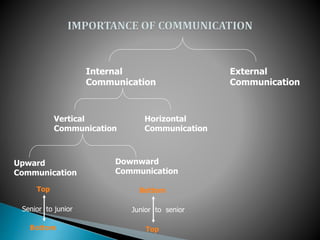
Internal
Communication
External
Communication
Vertical
Communication
Horizontal
Communication
Upward
Communication
Downward
Communication
Top
Bottom
Senior to junior
Bottom
Top
Junior to senior
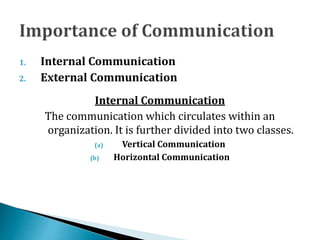
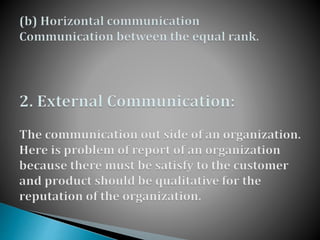
1. Internal Communication
2. External Communication
Internal Communication
The communication which circulates within an
organization. It is further divided into two classes.
(a) Vertical Communication
(b) Horizontal Communication
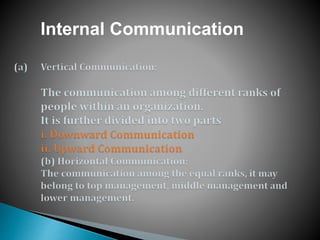
Internal Communication
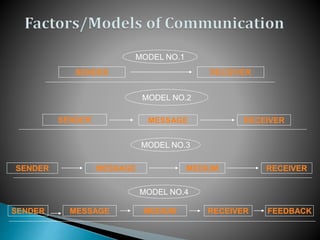
MODEL NO.1
SENDER RECEIVER
MODEL NO.2
SENDER MESSAGE RECEIVER
MODEL NO.3
SENDER MESSAGE MEDIUM RECEIVER
MODEL NO.4
SENDER MESSAGE MEDIUM RECEIVER FEEDBACK
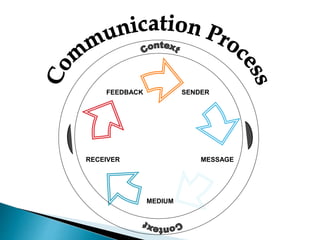
SENDER
RECEIVER
FEEDBACK
MESSAGE
MEDIUM
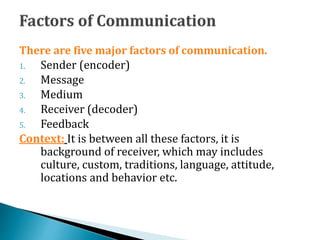
There are five major factors of communication.
1. Sender (encoder)
2. Message
3. Medium
4. Receiver (decoder)
5. Feedback
Context: It is between all these factors, it is
background of receiver, which may includes
culture, custom, traditions, language, attitude,
locations and behavior etc.
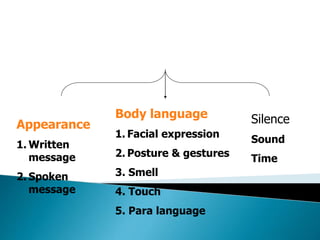
Appearance
1. Written
message
2. Spoken
message
Body language
1. Facial expression
2. Posture & gestures
3. Smell
4. Touch
5. Para language
Silence
Sound
Time
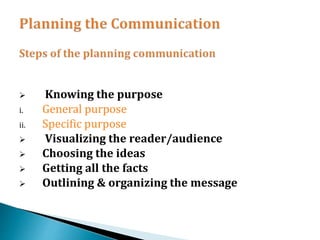
 Knowing the purpose
i. General purpose
ii. Specific purpose
 Visualizing the reader/audience
 Choosing the ideas
 Getting all the facts
 Outlining & organizing the message
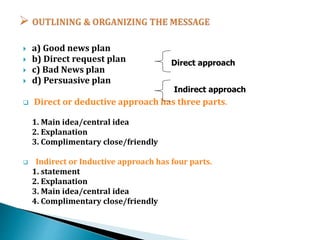
 a) Good news plan
 b) Direct request plan
 c) Bad News plan
 d) Persuasive plan
 Direct or deductive approach has three parts.
1. Main idea/central idea
2. Explanation
3. Complimentary close/friendly
 Indirect or Inductive approach has four parts.
1. statement
2. Explanation
3. Main idea/central idea
4. Complimentary close/friendly
Direct approach
Indirect approach
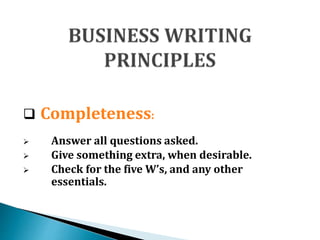
 Completeness:
 Answer all questions asked.
 Give something extra, when desirable.
 Check for the five W’s, and any other
essentials.
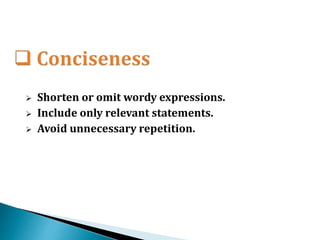
 Shorten or omit wordy expressions.
 Include only relevant statements.
 Avoid unnecessary repetition.
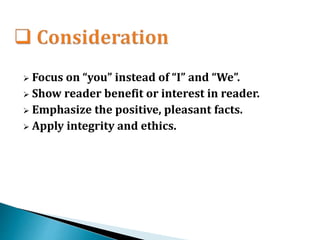
 Focus on “you” instead of “I” and “We”.
 Show reader benefit or interest in reader.
 Emphasize the positive, pleasant facts.
 Apply integrity and ethics.
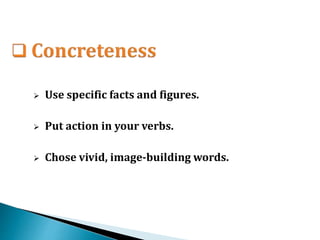
 Use specific facts and figures.
 Put action in your verbs.
 Chose vivid, image-building words.
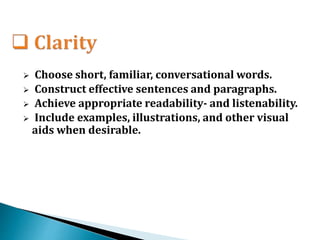
 Choose short, familiar, conversational words.
 Construct effective sentences and paragraphs.
 Achieve appropriate readability- and listenability.
 Include examples, illustrations, and other visual
aids when desirable.
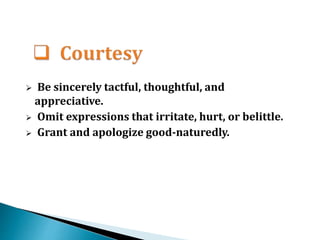
 Be sincerely tactful, thoughtful, and
appreciative.
 Omit expressions that irritate, hurt, or belittle.
 Grant and apologize good-naturedly.
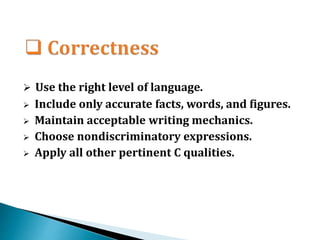
 Use the right level of language.
 Include only accurate facts, words, and figures.
 Maintain acceptable writing mechanics.
 Choose nondiscriminatory expressions.
 Apply all other pertinent C qualities.
1. DEFAMATION (injuring one’s reputation)
2. INVASION OF PRIVACY (unreasonable intervene in the private
life of an individual).
3. FRAUD (intentional misrepresentation)
4. LAWS REGARDING EMPLOYMENT, CREDIT AND COLLECTION
5. OTHER AREAS OF CAUTION
(A) UNMAILABLE MATERIAL (illegal business)
(B) COPIED DOCUMENTS (e,g currency notes, postage stamps)
C) COPY RIGHT MATERIAL (without permission of owner)
 Most of the important transactions in a business enterprise either
initially or ultimately take the form of letters.
 A business letter aims at performing one or more of the following
functions for an enterprise
 Creating goodwill
 Improving revenues and profits
 Resolving claims and disputes
 Promoting mutual understanding
 Recording transactions with other parties
 Informing others about organizational set-up.
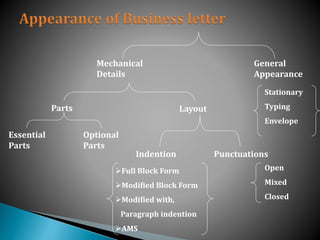
Mechanical
Details
General
Appearance
Parts Layout
Essential
Parts
Optional
Parts
Stationary
Typing
Envelope
Indention Punctuations
Full Block Form
Modified Block Form
Modified with,
Paragraph indention
AMS
Open
Mixed
Closed
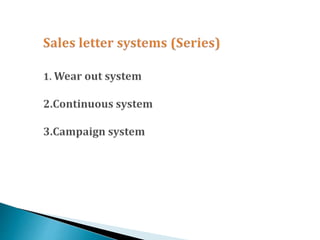
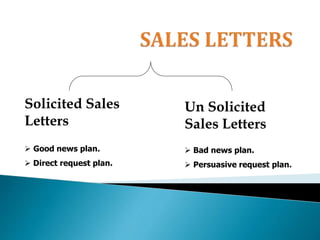
Solicited Sales
Letters
 Good news plan.
 Direct request plan.
Un Solicited
Sales Letters
 Bad news plan.
 Persuasive request plan.
 Uses of Sales letters
1. Selling by mail
2. Producing sales inquiries
3. Following up the sales inquiries
4. Inducing people to buy
5. Building up, goodwill
 Functions of Sales letter (AIDA)
1. Attracting attentions
2. Creating interest
3. Arising desire
4. Convincing the reader
5. Stimulating the action
 Characteristics of sales promotion letters.
1. Timeliness
2. Goodwill
3. Informal style
1. Maintaining Contacts
2. Awakening inactive accounts
3. Welcoming new customers
4. Inviting business from new sources
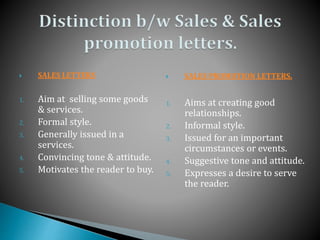
 SALES LETTERS
1. Aim at selling some goods
& services.
2. Formal style.
3. Generally issued in a
services.
4. Convincing tone & attitude.
5. Motivates the reader to buy.
 SALES PROMOTION LETTERS.
1. Aims at creating good
relationships.
2. Informal style.
3. Issued for an important
circumstances or events.
4. Suggestive tone and attitude.
5. Expresses a desire to serve
the reader.
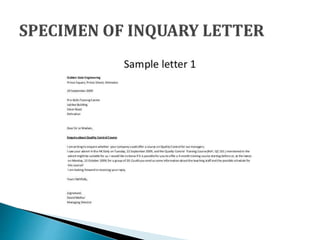
 letters seeking information fall in TWO broad
categories:
 General inquiries (regarding private or business
research, inquiries from students,
teachers or executives from other organization
asking for various data
 Sales related inquiries (regarding the product or
service purchased or being purchased
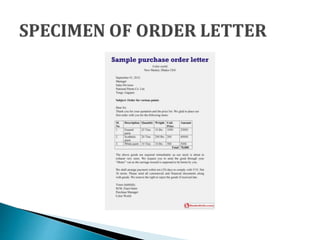
 Order letters refers to the description of
merchandise, amount of money , credit terms,
delivery dates etc.
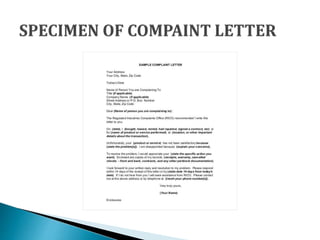
 A dissatisfied party may either discontinue business
contact or may complain through a claim letter.
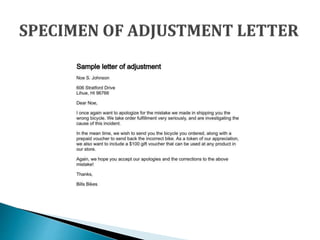
 An adjustment letter is a reply to complaint (claim)
letter.
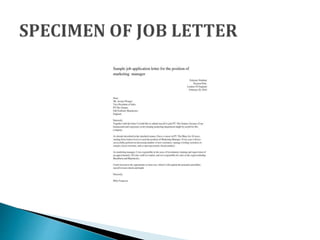
 Job letter is organized like sales letter
 It intends to sell the writer’s servies to the reader.
 The immediate purpose of a job letter is to secure an
interview and the final goal is to get employment.
 Curriculum vitae is an organized summary of the
applicant’s particulars.
 For example: Personal, educational, experienced
record, ect.
 It is not a substitute of job letter, but a supplement
to job letter.
1. Name, address and telephone number of the
applicant
2. Job applied for
3. Qualifications
4. Experience
5. Interest and hobbies
6. Personal data
7. Names of references
A systematic/organized
presentation/way of Business
facts and figures is called
Business Report.
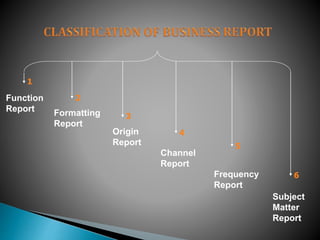
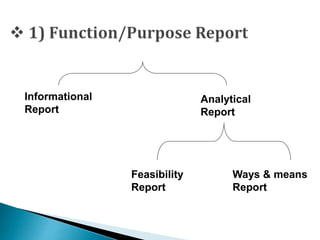
Function
Report Formatting
Report
Origin
Report
Channel
Report
Frequency
Report
Subject
Matter
Report
1
2
3
4
5
6
Informational
Report
Analytical
Report
Feasibility
Report
Ways & means
Report
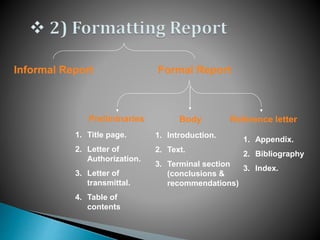
Informal Report Formal Report
Preliminaries Body Reference letter
1. Title page.
2. Letter of
Authorization.
3. Letter of
transmittal.
4. Table of
contents
1. Introduction.
2. Text.
3. Terminal section
(conclusions &
recommendations)
1. Appendix.
2. Bibliography
3. Index.
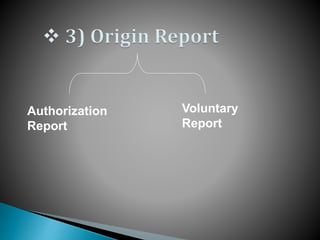
Authorization
Report
Voluntary
Report
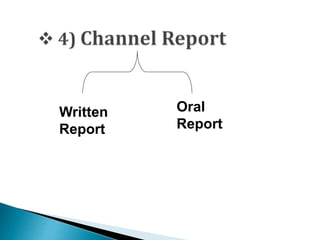
Written
Report
Oral
Report
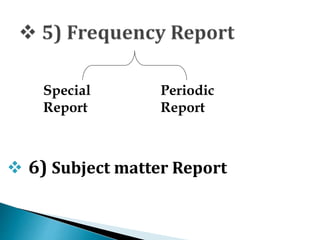
 6) Subject matter Report
Special
Report
Periodic
Report
 Tools of oral presentation
1. Speaking
2. Listening
3. Leading
4. Participating
5. Interviewing
6. Dictating
 PLANNING EFFECTIVE TALKS & SPEACHES
1. Determine the purpose.
2. Analysing the audience and situation.
3. Choosing the ideas to be included.
4. Researching the topic thoroughly.
5. Organizing the data and writing the draft.
6. Planning visual aids, if desirable.
7. Rehearsing the talk and revising where necessary.
 Each speech has a general purpose and the specific
purpose
 To instruct
 To persuade
 To entertain and so on.
 A message must be adapted to the audience---- their
occupation
their educational level
their approx: age
their interest
 Situation refers to:
Planning the visual aids
Speech in a small room is planned differently than
that in a large auditorium.
 This depends upon the nature of the message and
the nature of the audience
 Simply means choose the ideas which must match
with the nature of the message and the nature of the
audience
 E.g Congratulation letter and colleague
Condolence letter and the customer.
 PRIMARY RESEARCH
 SECONDARY RESEARCH
 SUMMARY
 INTRODUCTION OF THE PROBLEM
 BODY
 SUMMARY
 CONCLUSIONS
 RECOMMENDATIONS
 MARKER & WHITE-BOARD
 FLIP-SHEETS
 CARDS OR POSTERS
 PROJECTORS
 VIDEO FILMS
 COPIES
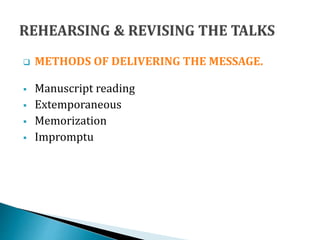
 METHODS OF DELIVERING THE MESSAGE.
 Manuscript reading
 Extemporaneous
 Memorization
 Impromptu
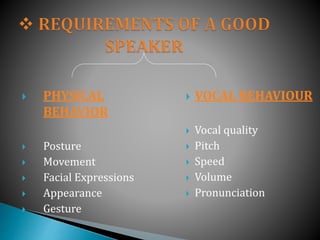
 PHYSICAL
BEHAVIOR
 Posture
 Movement
 Facial Expressions
 Appearance
 Gesture
 VOCAL BEHAVIOUR
 Vocal quality
 Pitch
 Speed
 Volume
 Pronunciation
1. Leads to a positive attitude with the speaker.
2. Permits the speaker and the listener improve
communication.
3. Listener’s interest induces the speaker to give a
better presentation.
4. Helps the listener gain useful information.
1. Prejudice against the speaker.
2. External distraction.
3. Thinking speed.
4. Premature evaluation.
5. Semantic stereotypes.
6. Delivery.
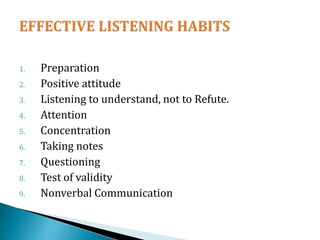
1. Preparation
2. Positive attitude
3. Listening to understand, not to Refute.
4. Attention
5. Concentration
6. Taking notes
7. Questioning
8. Test of validity
9. Nonverbal Communication
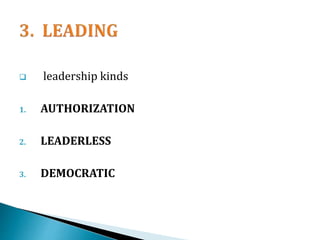
 leadership kinds
1. AUTHORIZATION
2. LEADERLESS
3. DEMOCRATIC
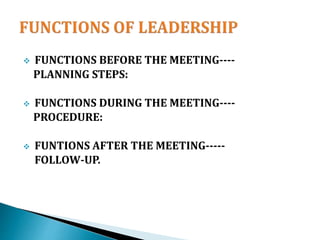
 FUNCTIONS BEFORE THE MEETING----
PLANNING STEPS:
 FUNCTIONS DURING THE MEETING----
PROCEDURE:
 FUNTIONS AFTER THE MEETING-----
FOLLOW-UP.
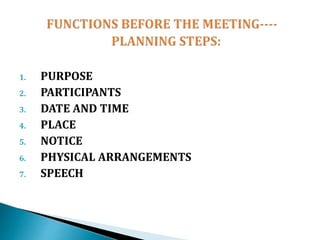
1. PURPOSE
2. PARTICIPANTS
3. DATE AND TIME
4. PLACE
5. NOTICE
6. PHYSICAL ARRANGEMENTS
7. SPEECH
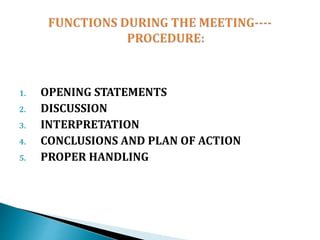
1. OPENING STATEMENTS
2. DISCUSSION
3. INTERPRETATION
4. CONCLUSIONS AND PLAN OF ACTION
5. PROPER HANDLING
1. MINUTES
1. IMPLEMENTATION
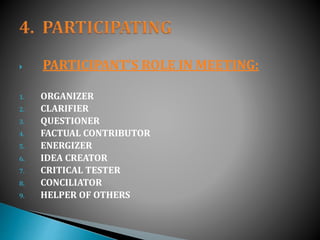
 PARTICIPANT’S ROLE IN MEETING:
1. ORGANIZER
2. CLARIFIER
3. QUESTIONER
4. FACTUAL CONTRIBUTOR
5. ENERGIZER
6. IDEA CREATOR
7. CRITICAL TESTER
8. CONCILIATOR
9. HELPER OF OTHERS
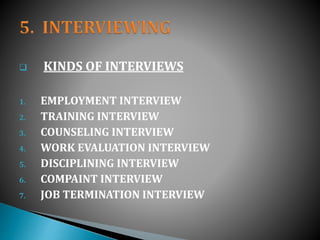
 KINDS OF INTERVIEWS
1. EMPLOYMENT INTERVIEW
2. TRAINING INTERVIEW
3. COUNSELING INTERVIEW
4. WORK EVALUATION INTERVIEW
5. DISCIPLINING INTERVIEW
6. COMPAINT INTERVIEW
7. JOB TERMINATION INTERVIEW
1. Evaluating job qualifications.
2. Giving necessary facts about job and company to
the applicant.
3. Creating and promoting goodwill.
1. Know his/her company’s organizational
structure.
2. Know the requirements and work environment
of the job for which interviewee has applied.
3. Decide what information is needed from the
applicant about educational and technical
qualifications training experience, interest etc.
4. Know the current government regulations
regarding employment practices.
5. Plan the questions carefully keeping in mind the
legal aspects of business communication.
6. Chose the appropriate place for interview, with
proper facilities.
7. Arrange the schedule so that candidates may not
have to wait long.
8. Arrange comfortable waiting room for candidates
who will be waiting for there turn.
1. Welcoming the Candidate.
2. Stating the Purpose and Contents of Interview
3. Asking Appropriate Questions
a. Impress the interview favorably
b. Ask tactful and appropriate Question
c. Listen to the interviewee attentively
d. Notice the nonverbal action
e. Respect the views the views and feelings of
interview
f. Give the interviewee an opportunity for maximum
taking.
g. Control the discussion within the limits of
relevance.
h. Give the interviewee an opportunity for asking
questions.
i. Answer the interviewee’s questions honestly.
j. Be Courteous.
a. Forming overall opinion based on a single aspect.
b. Judging applicant’s Character and ability by his/her
hand writing outward features , caste, religion.
c. Being discourteous and rude.
d. Arriving at Pre-mature Conclusions.
Evaluation requires the following steps:
Significant points of interview be noted
 On the basis of notes, a short report should be
prepared: Interviewee’s name, topic covered, date,
educational and technical qualifications, training,
experience, interests and overall summary.
 Conclusion shows candidates score and interviewer’s
opinion
 After careful judgment and consideration, the
interviewer should choose, or recommend to be
chosen, the right candidate (s).
 Suggestions for better Dictation
i. Know The Purpose
ii. Visualize The reader
iii. Consider the secretary.
iv. Collect all facts needed for the contents of the Massage.
WISH YOU ALL THE BEST

Business Communication Complete Topics

  • 2.
    By: Hassan Samoon MBA fromUniversity of Sindh
  • 3.
     INTRODUCTIN TOMANAGERIAL COMMUNICATION  PLANNING THE COMMUNICATION  BUSINESS WRITING PRINCIPLES ( SEVEN Cs)  LEGAL ASPECTS OF COMMUNICATION  APPEARANCE OF BUSINESS LETTER  SALES AND SALES PROMOTION LETTER  INQUIRY AND ORDER LETTER  COMPLAINT/CLAIM AND ADJUSTMENT LETTER  JOB LETTER  COLLECTION LETTER  BUSINESS REPORTS  ORAL PRESEENTATIN/COMMUNICATION  SPEAKING  LISTENING  LEADING  PARTICIPATING  INTERVIEWING  DISCTATING  TEXT BOOK: MANAGERAIL COMMUNICATION BY HARTA A. MURPHY & HILDBRANDT
  • 4.
     What isCommunication?  As the term communication is derived from Latin word “Communis” means “Common” i.e. common background to understand. It is two way process of exchanging the ideas.  Communication is the FUNDAMENTAL TRUTH OF THIS UNIVERSE.
  • 5.
    Importance of communicationcan be seen from the two aspects: i. It is the life blood of every organization. As the blood circulates within human body, so the communication circulates within an organization.
  • 6.
    ii. It helpsin career and personal life. * It helps in seeking the job * It helps in seeking the promotion * Professor John felden’s book “what do you mean I can’t write”, in the year 1964.
  • 7.
  • 8.
    1. Internal Communication 2.External Communication Internal Communication The communication which circulates within an organization. It is further divided into two classes. (a) Vertical Communication (b) Horizontal Communication
  • 9.
  • 11.
    MODEL NO.1 SENDER RECEIVER MODELNO.2 SENDER MESSAGE RECEIVER MODEL NO.3 SENDER MESSAGE MEDIUM RECEIVER MODEL NO.4 SENDER MESSAGE MEDIUM RECEIVER FEEDBACK
  • 12.
  • 13.
    There are fivemajor factors of communication. 1. Sender (encoder) 2. Message 3. Medium 4. Receiver (decoder) 5. Feedback Context: It is between all these factors, it is background of receiver, which may includes culture, custom, traditions, language, attitude, locations and behavior etc.
  • 14.
    Appearance 1. Written message 2. Spoken message Bodylanguage 1. Facial expression 2. Posture & gestures 3. Smell 4. Touch 5. Para language Silence Sound Time
  • 15.
     Knowing thepurpose i. General purpose ii. Specific purpose  Visualizing the reader/audience  Choosing the ideas  Getting all the facts  Outlining & organizing the message
  • 16.
     a) Goodnews plan  b) Direct request plan  c) Bad News plan  d) Persuasive plan  Direct or deductive approach has three parts. 1. Main idea/central idea 2. Explanation 3. Complimentary close/friendly  Indirect or Inductive approach has four parts. 1. statement 2. Explanation 3. Main idea/central idea 4. Complimentary close/friendly Direct approach Indirect approach
  • 17.
     Completeness:  Answerall questions asked.  Give something extra, when desirable.  Check for the five W’s, and any other essentials.
  • 18.
     Shorten oromit wordy expressions.  Include only relevant statements.  Avoid unnecessary repetition.
  • 19.
     Focus on“you” instead of “I” and “We”.  Show reader benefit or interest in reader.  Emphasize the positive, pleasant facts.  Apply integrity and ethics.
  • 20.
     Use specificfacts and figures.  Put action in your verbs.  Chose vivid, image-building words.
  • 21.
     Choose short,familiar, conversational words.  Construct effective sentences and paragraphs.  Achieve appropriate readability- and listenability.  Include examples, illustrations, and other visual aids when desirable.
  • 22.
     Be sincerelytactful, thoughtful, and appreciative.  Omit expressions that irritate, hurt, or belittle.  Grant and apologize good-naturedly.
  • 23.
     Use theright level of language.  Include only accurate facts, words, and figures.  Maintain acceptable writing mechanics.  Choose nondiscriminatory expressions.  Apply all other pertinent C qualities.
  • 24.
    1. DEFAMATION (injuringone’s reputation) 2. INVASION OF PRIVACY (unreasonable intervene in the private life of an individual). 3. FRAUD (intentional misrepresentation) 4. LAWS REGARDING EMPLOYMENT, CREDIT AND COLLECTION 5. OTHER AREAS OF CAUTION (A) UNMAILABLE MATERIAL (illegal business) (B) COPIED DOCUMENTS (e,g currency notes, postage stamps) C) COPY RIGHT MATERIAL (without permission of owner)
  • 25.
     Most ofthe important transactions in a business enterprise either initially or ultimately take the form of letters.  A business letter aims at performing one or more of the following functions for an enterprise  Creating goodwill  Improving revenues and profits  Resolving claims and disputes  Promoting mutual understanding  Recording transactions with other parties  Informing others about organizational set-up.
  • 26.
    Mechanical Details General Appearance Parts Layout Essential Parts Optional Parts Stationary Typing Envelope Indention Punctuations FullBlock Form Modified Block Form Modified with, Paragraph indention AMS Open Mixed Closed
  • 27.
    Solicited Sales Letters  Goodnews plan.  Direct request plan. Un Solicited Sales Letters  Bad news plan.  Persuasive request plan.
  • 28.
     Uses ofSales letters 1. Selling by mail 2. Producing sales inquiries 3. Following up the sales inquiries 4. Inducing people to buy 5. Building up, goodwill
  • 29.
     Functions ofSales letter (AIDA) 1. Attracting attentions 2. Creating interest 3. Arising desire 4. Convincing the reader 5. Stimulating the action
  • 32.
     Characteristics ofsales promotion letters. 1. Timeliness 2. Goodwill 3. Informal style
  • 33.
    1. Maintaining Contacts 2.Awakening inactive accounts 3. Welcoming new customers 4. Inviting business from new sources
  • 34.
     SALES LETTERS 1.Aim at selling some goods & services. 2. Formal style. 3. Generally issued in a services. 4. Convincing tone & attitude. 5. Motivates the reader to buy.  SALES PROMOTION LETTERS. 1. Aims at creating good relationships. 2. Informal style. 3. Issued for an important circumstances or events. 4. Suggestive tone and attitude. 5. Expresses a desire to serve the reader.
  • 36.
     letters seekinginformation fall in TWO broad categories:  General inquiries (regarding private or business research, inquiries from students, teachers or executives from other organization asking for various data  Sales related inquiries (regarding the product or service purchased or being purchased
  • 38.
     Order lettersrefers to the description of merchandise, amount of money , credit terms, delivery dates etc.
  • 40.
     A dissatisfiedparty may either discontinue business contact or may complain through a claim letter.
  • 42.
     An adjustmentletter is a reply to complaint (claim) letter.
  • 44.
     Job letteris organized like sales letter  It intends to sell the writer’s servies to the reader.  The immediate purpose of a job letter is to secure an interview and the final goal is to get employment.
  • 46.
     Curriculum vitaeis an organized summary of the applicant’s particulars.  For example: Personal, educational, experienced record, ect.  It is not a substitute of job letter, but a supplement to job letter.
  • 47.
    1. Name, addressand telephone number of the applicant 2. Job applied for 3. Qualifications 4. Experience 5. Interest and hobbies 6. Personal data 7. Names of references
  • 48.
    A systematic/organized presentation/way ofBusiness facts and figures is called Business Report.
  • 49.
  • 50.
  • 51.
    Informal Report FormalReport Preliminaries Body Reference letter 1. Title page. 2. Letter of Authorization. 3. Letter of transmittal. 4. Table of contents 1. Introduction. 2. Text. 3. Terminal section (conclusions & recommendations) 1. Appendix. 2. Bibliography 3. Index.
  • 52.
  • 53.
  • 54.
     6) Subjectmatter Report Special Report Periodic Report
  • 55.
     Tools oforal presentation 1. Speaking 2. Listening 3. Leading 4. Participating 5. Interviewing 6. Dictating
  • 56.
     PLANNING EFFECTIVETALKS & SPEACHES 1. Determine the purpose. 2. Analysing the audience and situation. 3. Choosing the ideas to be included. 4. Researching the topic thoroughly. 5. Organizing the data and writing the draft. 6. Planning visual aids, if desirable. 7. Rehearsing the talk and revising where necessary.
  • 57.
     Each speechhas a general purpose and the specific purpose  To instruct  To persuade  To entertain and so on.
  • 58.
     A messagemust be adapted to the audience---- their occupation their educational level their approx: age their interest  Situation refers to: Planning the visual aids Speech in a small room is planned differently than that in a large auditorium.
  • 59.
     This dependsupon the nature of the message and the nature of the audience  Simply means choose the ideas which must match with the nature of the message and the nature of the audience  E.g Congratulation letter and colleague Condolence letter and the customer.
  • 60.
     PRIMARY RESEARCH SECONDARY RESEARCH  SUMMARY
  • 61.
     INTRODUCTION OFTHE PROBLEM  BODY  SUMMARY  CONCLUSIONS  RECOMMENDATIONS
  • 62.
     MARKER &WHITE-BOARD  FLIP-SHEETS  CARDS OR POSTERS  PROJECTORS  VIDEO FILMS  COPIES
  • 63.
     METHODS OFDELIVERING THE MESSAGE.  Manuscript reading  Extemporaneous  Memorization  Impromptu
  • 64.
     PHYSICAL BEHAVIOR  Posture Movement  Facial Expressions  Appearance  Gesture  VOCAL BEHAVIOUR  Vocal quality  Pitch  Speed  Volume  Pronunciation
  • 65.
    1. Leads toa positive attitude with the speaker. 2. Permits the speaker and the listener improve communication. 3. Listener’s interest induces the speaker to give a better presentation. 4. Helps the listener gain useful information.
  • 66.
    1. Prejudice againstthe speaker. 2. External distraction. 3. Thinking speed. 4. Premature evaluation. 5. Semantic stereotypes. 6. Delivery.
  • 67.
    1. Preparation 2. Positiveattitude 3. Listening to understand, not to Refute. 4. Attention 5. Concentration 6. Taking notes 7. Questioning 8. Test of validity 9. Nonverbal Communication
  • 68.
     leadership kinds 1.AUTHORIZATION 2. LEADERLESS 3. DEMOCRATIC
  • 69.
     FUNCTIONS BEFORETHE MEETING---- PLANNING STEPS:  FUNCTIONS DURING THE MEETING---- PROCEDURE:  FUNTIONS AFTER THE MEETING----- FOLLOW-UP.
  • 70.
    1. PURPOSE 2. PARTICIPANTS 3.DATE AND TIME 4. PLACE 5. NOTICE 6. PHYSICAL ARRANGEMENTS 7. SPEECH
  • 71.
    1. OPENING STATEMENTS 2.DISCUSSION 3. INTERPRETATION 4. CONCLUSIONS AND PLAN OF ACTION 5. PROPER HANDLING
  • 72.
  • 73.
     PARTICIPANT’S ROLEIN MEETING: 1. ORGANIZER 2. CLARIFIER 3. QUESTIONER 4. FACTUAL CONTRIBUTOR 5. ENERGIZER 6. IDEA CREATOR 7. CRITICAL TESTER 8. CONCILIATOR 9. HELPER OF OTHERS
  • 74.
     KINDS OFINTERVIEWS 1. EMPLOYMENT INTERVIEW 2. TRAINING INTERVIEW 3. COUNSELING INTERVIEW 4. WORK EVALUATION INTERVIEW 5. DISCIPLINING INTERVIEW 6. COMPAINT INTERVIEW 7. JOB TERMINATION INTERVIEW
  • 75.
    1. Evaluating jobqualifications. 2. Giving necessary facts about job and company to the applicant. 3. Creating and promoting goodwill.
  • 76.
    1. Know his/hercompany’s organizational structure. 2. Know the requirements and work environment of the job for which interviewee has applied. 3. Decide what information is needed from the applicant about educational and technical qualifications training experience, interest etc.
  • 77.
    4. Know thecurrent government regulations regarding employment practices. 5. Plan the questions carefully keeping in mind the legal aspects of business communication. 6. Chose the appropriate place for interview, with proper facilities.
  • 78.
    7. Arrange theschedule so that candidates may not have to wait long. 8. Arrange comfortable waiting room for candidates who will be waiting for there turn.
  • 79.
    1. Welcoming theCandidate. 2. Stating the Purpose and Contents of Interview 3. Asking Appropriate Questions
  • 80.
    a. Impress theinterview favorably b. Ask tactful and appropriate Question c. Listen to the interviewee attentively d. Notice the nonverbal action
  • 81.
    e. Respect theviews the views and feelings of interview f. Give the interviewee an opportunity for maximum taking. g. Control the discussion within the limits of relevance.
  • 82.
    h. Give theinterviewee an opportunity for asking questions. i. Answer the interviewee’s questions honestly. j. Be Courteous.
  • 83.
    a. Forming overallopinion based on a single aspect. b. Judging applicant’s Character and ability by his/her hand writing outward features , caste, religion. c. Being discourteous and rude. d. Arriving at Pre-mature Conclusions.

  • 84.
    Evaluation requires thefollowing steps: Significant points of interview be noted  On the basis of notes, a short report should be prepared: Interviewee’s name, topic covered, date, educational and technical qualifications, training, experience, interests and overall summary.  Conclusion shows candidates score and interviewer’s opinion  After careful judgment and consideration, the interviewer should choose, or recommend to be chosen, the right candidate (s).
  • 85.
     Suggestions forbetter Dictation i. Know The Purpose ii. Visualize The reader iii. Consider the secretary. iv. Collect all facts needed for the contents of the Massage.
  • 86.
    WISH YOU ALLTHE BEST