The Battery
The Battery
• Main Entry: storage battery
• Function: noun
• Date: 1881
• : a cell or connected group of cells that converts
chemical energy into electrical energy by
reversible chemical reactions and that may be
recharged by passing a current through it in the
direction opposite to that of its discharge -- called
also storage cell.
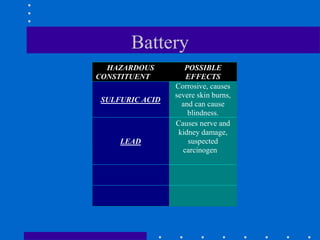
Battery
HAZARDOUS
CONSTITUENT
POSSIBLE
EFFECTS
SULFURIC ACID
Corrosive, causes
severe skin burns,
and can cause
blindness.
LEAD
Causes nerve and
kidney damage,
suspected
carcinogen
Types of Batteries
The primary battery converts chemical energy
to electrical energy directly, using the chemical
materials within the cell to start the action.
The secondary battery must first be charged
with electrical energy before it can convert
chemical energy to electrical energy.
The secondary battery is frequently called a
storage battery, since it stores the energy that is
supplied to it.
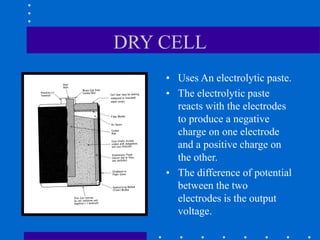
DRY CELL
• Uses An electrolytic paste.
• The electrolytic paste
reacts with the electrodes
to produce a negative
charge on one electrode
and a positive charge on
the other.
• The difference of potential
between the two
electrodes is the output
voltage.
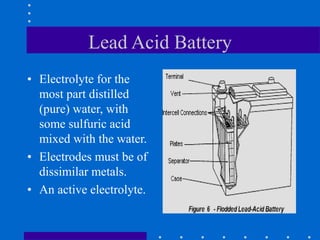
Lead Acid Battery
• Electrolyte for the
most part distilled
(pure) water, with
some sulfuric acid
mixed with the water.
• Electrodes must be of
dissimilar metals.
• An active electrolyte.
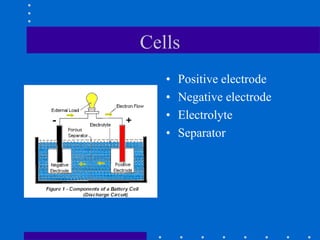
Cells
• Positive electrode
• Negative electrode
• Electrolyte
• Separator
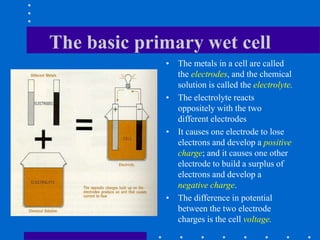
The basic primary wet cell
• The metals in a cell are called
the electrodes, and the chemical
solution is called the electrolyte.
• The electrolyte reacts
oppositely with the two
different electrodes
• It causes one electrode to lose
electrons and develop a positive
charge; and it causes one other
electrode to build a surplus of
electrons and develop a
negative charge.
• The difference in potential
between the two electrode
charges is the cell voltage.
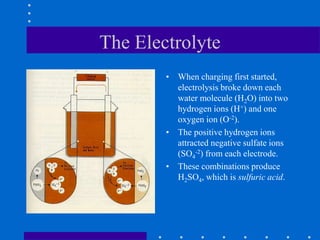
The Electrolyte
• When charging first started,
electrolysis broke down each
water molecule (H2O) into two
hydrogen ions (H+) and one
oxygen ion (O-2).
• The positive hydrogen ions
attracted negative sulfate ions
(SO4
-2) from each electrode.
• These combinations produce
H2SO4, which is sulfuric acid.
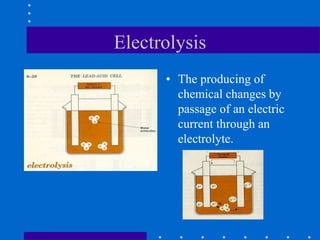
Electrolysis
• The producing of
chemical changes by
passage of an electric
current through an
electrolyte.
Specific Gravity
• Ratio of the weight of
a given volume of a
substance to the
weight of an equal
volume of some
reference substance,
or, equivalently, the
ratio of the masses of
equal volumes of the
two substances.
• Example: It is the
weight of the sulfuric
acid - water mixture
compared to an equal
volume of water. Pure
water has a specific
gravity of 1,000.
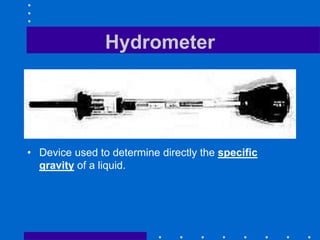
Hydrometer
• Device used to determine directly the specific

gravity of a liquid.
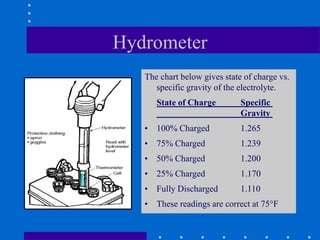
Hydrometer
The chart below gives state of charge vs.
specific gravity of the electrolyte.
State of Charge Specific
Gravity
• 100% Charged 1.265
• 75% Charged 1.239
• 50% Charged 1.200
• 25% Charged 1.170
• Fully Discharged 1.110
• These readings are correct at 75°F
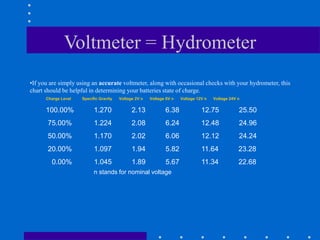
•If you are simply using an accurate voltmeter, along with occasional checks with your hydrometer, this
chart should be helpful in determining your batteries state of charge.
Charge Level Specific Gravity Voltage 2V n Voltage 6V n Voltage 12V n Voltage 24V n
100.00% 1.270 2.13 6.38 12.75 25.50
75.00% 1.224 2.08 6.24 12.48 24.96
50.00% 1.170 2.02 6.06 12.12 24.24
20.00% 1.097 1.94 5.82 11.64 23.28
0.00% 1.045 1.89 5.67 11.34 22.68
n stands for nominal voltage
Voltmeter = Hydrometer
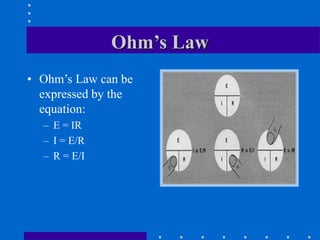
Ohm’s Law
• Ohm’s Law can be
expressed by the
equation:
– E = IR
– I = E/R
– R = E/I
Ohm’s Law
• Series circuits, the total voltage is equal to
the sum of the individual voltages. The
current is constant.
• Parallel circuits, the voltage is constant.
The current is equal to the sum of the
individual currents.
Currents
• If one volt of potential difference across a
device causes on ampere of current to flow,
then the device has a resistance of
1 ohm = 1 = 1V/A
• Most of your electrical resistance is in your
skin and varies from 500 ohms (clean) to
several million ohms (dirty).
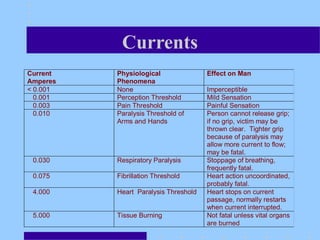
Currents
Current
Amperes
Physiological
Phenomena
Effect on Man
< 0.001 None Imperceptible
0.001 Perception Threshold Mild Sensation
0.003 Pain Threshold Painful Sensation
0.010 Paralysis Threshold of
Arms and Hands
Person cannot release grip;
if no grip, victim may be
thrown clear. Tighter grip
because of paralysis may
allow more current to flow;
may be fatal.
0.030 Respiratory Paralysis Stoppage of breathing,
frequently fatal.
0.075 Fibrillation Threshold Heart action uncoordinated,
probably fatal.
4.000 Heart Paralysis Threshold Heart stops on current
passage, normally restarts
when current interrupted.
5.000 Tissue Burning Not fatal unless vital organs
are burned
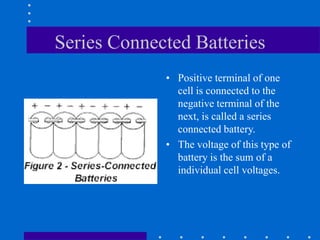
Series Connected Batteries
• Positive terminal of one
cell is connected to the
negative terminal of the
next, is called a series
connected battery.
• The voltage of this type of
battery is the sum of a
individual cell voltages.
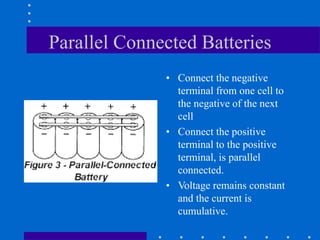
Parallel Connected Batteries
• Connect the negative
terminal from one cell to
the negative of the next
cell
• Connect the positive
terminal to the positive
terminal, is parallel
connected.
• Voltage remains constant
and the current is
cumulative.
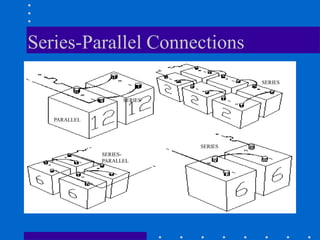
Series-Parallel Connections
PARALLEL
SERIES
SERIES-
PARALLEL
SERIES
SERIES
Capacity Rating System
• The Society of Automotive Engineers
(SAE) has established two ratings for
domestic made batteries:
– Reserve Capacity (RC)
– Cold Cranking Amps (CCA)
Reserve Capacity
• Reserve capacity is the time required (in
minutes) for a fully charged battery at 80°F
under a constant 25 amp draw to reach a
voltage of 10.5 volts.
Cold Cranking Amps (CCA)
• CCA is an important measurement of
battery capacity.
• This rating measures the discharge lead (in
amps) that a battery can supply for 30
seconds at 0°F (-17°C), while maintaining a
voltage of 1.2 volts per cell (7.2 volts per
battery or higher).
Preventive Maintenance
• When the top of a battery is “dirty or looks
damp.
• Give a battery a general cleaning, use hot
water (130° F to 170° F) with a neutralizer /
detergent solution.
Charging
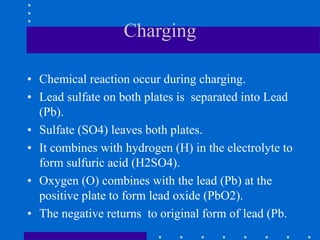
• Chemical reaction occur during charging.
• Lead sulfate on both plates is separated into Lead
(Pb).
• Sulfate (SO4) leaves both plates.
• It combines with hydrogen (H) in the electrolyte to
form sulfuric acid (H2SO4).
• Oxygen (O) combines with the lead (Pb) at the
positive plate to form lead oxide (PbO2).
• The negative returns to original form of lead (Pb.
Charging
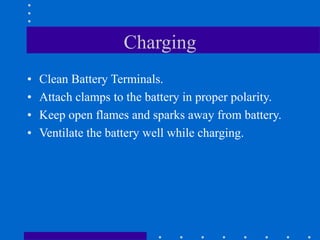
• Clean Battery Terminals.
• Attach clamps to the battery in proper polarity.
• Keep open flames and sparks away from battery.
• Ventilate the battery well while charging.
Charging
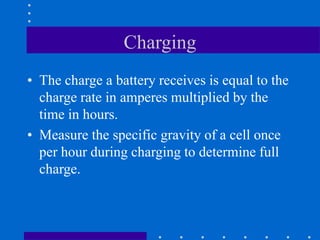
• The charge a battery receives is equal to the
charge rate in amperes multiplied by the
time in hours.
• Measure the specific gravity of a cell once
per hour during charging to determine full
charge.
Overcharging
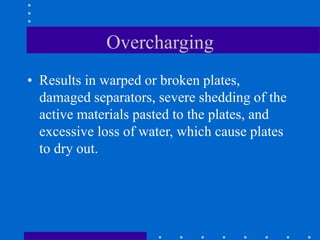
• Results in warped or broken plates,
damaged separators, severe shedding of the
active materials pasted to the plates, and
excessive loss of water, which cause plates
to dry out.
Ventilation Requirements
• The oxygen and hydrogen gases released during
the gassing phase of a typical flooded lead-acid
battery recharge can be dangerous if allowed to
exceed 0.8 % (by volume) or 20 percent of the
lower explosive range. Concentrations of
hydrogen between 4 % and 74% are considered
explosive (40,000 ppm and 740,000 ppm).
HYDROGEN
• Chemical Formula: H2
• Specific Gravity: 0.0695
• Color: None Odor: None
• Taste: None
• Origin: Applying water to super hot mine fires, explosions electrolysis of
battery acid.
• Explosive Range: 4.1% - 74%
• Ignition Temp: 1030o - 1130o F
• % Oxygen Needed To Burn or Explode: 5%
• TLV: None
• STEL: None
• Effect on Body:Asphxysiant Due to Displacement of Oxygen.
• How Detected: Electronic Detectors, Squeeze Tube Detectors, Chemical
Analysis.
• NOTE: Hydrogen is the reason a flame safety lamp is not permitted in a battery
Ventilation
• All lead acid power batteries give off gases
when recharging and also for a period after
the charge is completed.
– A Concentration of hydrogen in excess of 4%
(by volume). It is suggested that the
concentration be controlled to a maximum of
2% (by volume).
Ventilation (cont.)
• A typical lead acid motive power cell will, evolve
approximately .016 cubic feet of hydrogen gas over A.H.
overcharge.
• Since this gas is given off at the maximum rate at the end
of the charging period, the following calculation assumes a
charging current of 5% of the 6 hour A.H. capacity (C6)
during this over charge period. (This charging current is
excessive but has been used to take account of the worst
case.)
• Gas given off per hour per cell = 0.16 x .05 = .0008 C6
cu / ft. / cell / hr.
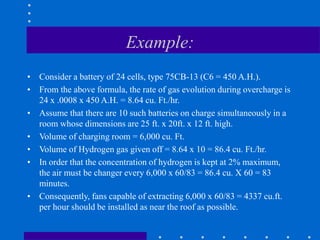
Example:
• Consider a battery of 24 cells, type 75CB-13 (C6 = 450 A.H.).
• From the above formula, the rate of gas evolution during overcharge is
24 x .0008 x 450 A.H. = 8.64 cu. Ft./hr.
• Assume that there are 10 such batteries on charge simultaneously in a
room whose dimensions are 25 ft. x 20ft. x 12 ft. high.
• Volume of charging room = 6,000 cu. Ft.
• Volume of Hydrogen gas given off = 8.64 x 10 = 86.4 cu. Ft./hr.
• In order that the concentration of hydrogen is kept at 2% maximum,
the air must be changer every 6,000 x 60/83 = 86.4 cu. X 60 = 83
minutes.
• Consequently, fans capable of extracting 6,000 x 60/83 = 4337 cu.ft.
per hour should be installed as near the roof as possible.
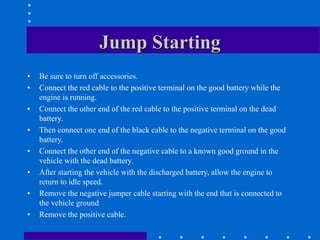
Jump Starting
• Be sure to turn off accessories.
• Connect the red cable to the positive terminal on the good battery while the
engine is running.
• Connect the other end of the red cable to the positive terminal on the dead
battery.
• Then connect one end of the black cable to the negative terminal on the good
battery.
• Connect the other end of the negative cable to a known good ground in the
vehicle with the dead battery.
• After starting the vehicle with the discharged battery, allow the engine to
return to idle speed.
• Remove the negative jumper cable starting with the end that is connected to
the vehicle ground
• Remove the positive cable.
Contacts
• Crown Battery Company
– Jack Enos 724-444-6444
– Ron Bauer 724-925-7266
battery.ppt

battery.ppt

  • 1.
  • 2.
    The Battery • MainEntry: storage battery • Function: noun • Date: 1881 • : a cell or connected group of cells that converts chemical energy into electrical energy by reversible chemical reactions and that may be recharged by passing a current through it in the direction opposite to that of its discharge -- called also storage cell.
  • 3.
    Battery HAZARDOUS CONSTITUENT POSSIBLE EFFECTS SULFURIC ACID Corrosive, causes severeskin burns, and can cause blindness. LEAD Causes nerve and kidney damage, suspected carcinogen
  • 4.
    Types of Batteries Theprimary battery converts chemical energy to electrical energy directly, using the chemical materials within the cell to start the action. The secondary battery must first be charged with electrical energy before it can convert chemical energy to electrical energy. The secondary battery is frequently called a storage battery, since it stores the energy that is supplied to it.
  • 5.
    DRY CELL • UsesAn electrolytic paste. • The electrolytic paste reacts with the electrodes to produce a negative charge on one electrode and a positive charge on the other. • The difference of potential between the two electrodes is the output voltage.
  • 6.
    Lead Acid Battery •Electrolyte for the most part distilled (pure) water, with some sulfuric acid mixed with the water. • Electrodes must be of dissimilar metals. • An active electrolyte.
  • 7.
    Cells • Positive electrode •Negative electrode • Electrolyte • Separator
  • 8.
    The basic primarywet cell • The metals in a cell are called the electrodes, and the chemical solution is called the electrolyte. • The electrolyte reacts oppositely with the two different electrodes • It causes one electrode to lose electrons and develop a positive charge; and it causes one other electrode to build a surplus of electrons and develop a negative charge. • The difference in potential between the two electrode charges is the cell voltage.
  • 9.
    The Electrolyte • Whencharging first started, electrolysis broke down each water molecule (H2O) into two hydrogen ions (H+) and one oxygen ion (O-2). • The positive hydrogen ions attracted negative sulfate ions (SO4 -2) from each electrode. • These combinations produce H2SO4, which is sulfuric acid.
  • 10.
    Electrolysis • The producingof chemical changes by passage of an electric current through an electrolyte.
  • 11.
    Specific Gravity • Ratioof the weight of a given volume of a substance to the weight of an equal volume of some reference substance, or, equivalently, the ratio of the masses of equal volumes of the two substances. • Example: It is the weight of the sulfuric acid - water mixture compared to an equal volume of water. Pure water has a specific gravity of 1,000.
  • 12.
    Hydrometer • Device usedto determine directly the specific gravity of a liquid.
  • 13.
    Hydrometer The chart belowgives state of charge vs. specific gravity of the electrolyte. State of Charge Specific Gravity • 100% Charged 1.265 • 75% Charged 1.239 • 50% Charged 1.200 • 25% Charged 1.170 • Fully Discharged 1.110 • These readings are correct at 75°F
  • 14.
    •If you aresimply using an accurate voltmeter, along with occasional checks with your hydrometer, this chart should be helpful in determining your batteries state of charge. Charge Level Specific Gravity Voltage 2V n Voltage 6V n Voltage 12V n Voltage 24V n 100.00% 1.270 2.13 6.38 12.75 25.50 75.00% 1.224 2.08 6.24 12.48 24.96 50.00% 1.170 2.02 6.06 12.12 24.24 20.00% 1.097 1.94 5.82 11.64 23.28 0.00% 1.045 1.89 5.67 11.34 22.68 n stands for nominal voltage Voltmeter = Hydrometer
  • 15.
    Ohm’s Law • Ohm’sLaw can be expressed by the equation: – E = IR – I = E/R – R = E/I
  • 16.
    Ohm’s Law • Seriescircuits, the total voltage is equal to the sum of the individual voltages. The current is constant. • Parallel circuits, the voltage is constant. The current is equal to the sum of the individual currents.
  • 17.
    Currents • If onevolt of potential difference across a device causes on ampere of current to flow, then the device has a resistance of 1 ohm = 1 = 1V/A • Most of your electrical resistance is in your skin and varies from 500 ohms (clean) to several million ohms (dirty).
  • 18.
    Currents Current Amperes Physiological Phenomena Effect on Man <0.001 None Imperceptible 0.001 Perception Threshold Mild Sensation 0.003 Pain Threshold Painful Sensation 0.010 Paralysis Threshold of Arms and Hands Person cannot release grip; if no grip, victim may be thrown clear. Tighter grip because of paralysis may allow more current to flow; may be fatal. 0.030 Respiratory Paralysis Stoppage of breathing, frequently fatal. 0.075 Fibrillation Threshold Heart action uncoordinated, probably fatal. 4.000 Heart Paralysis Threshold Heart stops on current passage, normally restarts when current interrupted. 5.000 Tissue Burning Not fatal unless vital organs are burned
  • 19.
    Series Connected Batteries •Positive terminal of one cell is connected to the negative terminal of the next, is called a series connected battery. • The voltage of this type of battery is the sum of a individual cell voltages.
  • 20.
    Parallel Connected Batteries •Connect the negative terminal from one cell to the negative of the next cell • Connect the positive terminal to the positive terminal, is parallel connected. • Voltage remains constant and the current is cumulative.
  • 21.
  • 22.
    Capacity Rating System •The Society of Automotive Engineers (SAE) has established two ratings for domestic made batteries: – Reserve Capacity (RC) – Cold Cranking Amps (CCA)
  • 23.
    Reserve Capacity • Reservecapacity is the time required (in minutes) for a fully charged battery at 80°F under a constant 25 amp draw to reach a voltage of 10.5 volts.
  • 24.
    Cold Cranking Amps(CCA) • CCA is an important measurement of battery capacity. • This rating measures the discharge lead (in amps) that a battery can supply for 30 seconds at 0°F (-17°C), while maintaining a voltage of 1.2 volts per cell (7.2 volts per battery or higher).
  • 25.
    Preventive Maintenance • Whenthe top of a battery is “dirty or looks damp. • Give a battery a general cleaning, use hot water (130° F to 170° F) with a neutralizer / detergent solution.
  • 26.
    Charging • Chemical reactionoccur during charging. • Lead sulfate on both plates is separated into Lead (Pb). • Sulfate (SO4) leaves both plates. • It combines with hydrogen (H) in the electrolyte to form sulfuric acid (H2SO4). • Oxygen (O) combines with the lead (Pb) at the positive plate to form lead oxide (PbO2). • The negative returns to original form of lead (Pb.
  • 27.
    Charging • Clean BatteryTerminals. • Attach clamps to the battery in proper polarity. • Keep open flames and sparks away from battery. • Ventilate the battery well while charging.
  • 28.
    Charging • The chargea battery receives is equal to the charge rate in amperes multiplied by the time in hours. • Measure the specific gravity of a cell once per hour during charging to determine full charge.
  • 29.
    Overcharging • Results inwarped or broken plates, damaged separators, severe shedding of the active materials pasted to the plates, and excessive loss of water, which cause plates to dry out.
  • 30.
    Ventilation Requirements • Theoxygen and hydrogen gases released during the gassing phase of a typical flooded lead-acid battery recharge can be dangerous if allowed to exceed 0.8 % (by volume) or 20 percent of the lower explosive range. Concentrations of hydrogen between 4 % and 74% are considered explosive (40,000 ppm and 740,000 ppm).
  • 31.
    HYDROGEN • Chemical Formula:H2 • Specific Gravity: 0.0695 • Color: None Odor: None • Taste: None • Origin: Applying water to super hot mine fires, explosions electrolysis of battery acid. • Explosive Range: 4.1% - 74% • Ignition Temp: 1030o - 1130o F • % Oxygen Needed To Burn or Explode: 5% • TLV: None • STEL: None • Effect on Body:Asphxysiant Due to Displacement of Oxygen. • How Detected: Electronic Detectors, Squeeze Tube Detectors, Chemical Analysis. • NOTE: Hydrogen is the reason a flame safety lamp is not permitted in a battery
  • 32.
    Ventilation • All leadacid power batteries give off gases when recharging and also for a period after the charge is completed. – A Concentration of hydrogen in excess of 4% (by volume). It is suggested that the concentration be controlled to a maximum of 2% (by volume).
  • 33.
    Ventilation (cont.) • Atypical lead acid motive power cell will, evolve approximately .016 cubic feet of hydrogen gas over A.H. overcharge. • Since this gas is given off at the maximum rate at the end of the charging period, the following calculation assumes a charging current of 5% of the 6 hour A.H. capacity (C6) during this over charge period. (This charging current is excessive but has been used to take account of the worst case.) • Gas given off per hour per cell = 0.16 x .05 = .0008 C6 cu / ft. / cell / hr.
  • 34.
    Example: • Consider abattery of 24 cells, type 75CB-13 (C6 = 450 A.H.). • From the above formula, the rate of gas evolution during overcharge is 24 x .0008 x 450 A.H. = 8.64 cu. Ft./hr. • Assume that there are 10 such batteries on charge simultaneously in a room whose dimensions are 25 ft. x 20ft. x 12 ft. high. • Volume of charging room = 6,000 cu. Ft. • Volume of Hydrogen gas given off = 8.64 x 10 = 86.4 cu. Ft./hr. • In order that the concentration of hydrogen is kept at 2% maximum, the air must be changer every 6,000 x 60/83 = 86.4 cu. X 60 = 83 minutes. • Consequently, fans capable of extracting 6,000 x 60/83 = 4337 cu.ft. per hour should be installed as near the roof as possible.
  • 35.
    Jump Starting • Besure to turn off accessories. • Connect the red cable to the positive terminal on the good battery while the engine is running. • Connect the other end of the red cable to the positive terminal on the dead battery. • Then connect one end of the black cable to the negative terminal on the good battery. • Connect the other end of the negative cable to a known good ground in the vehicle with the dead battery. • After starting the vehicle with the discharged battery, allow the engine to return to idle speed. • Remove the negative jumper cable starting with the end that is connected to the vehicle ground • Remove the positive cable.
  • 36.
    Contacts • Crown BatteryCompany – Jack Enos 724-444-6444 – Ron Bauer 724-925-7266