Directorate of Online Education
SESSION JUL/AUG 2021
PROGRAM MASTER OF BUSINESS ADMINISTRATION (MBA)
SEMESTER I
COURSE CODE &
NAME
DMBA104–FINANCIAL AND MANAGEMENT ACCOUNTING
NAME
ROLL NO
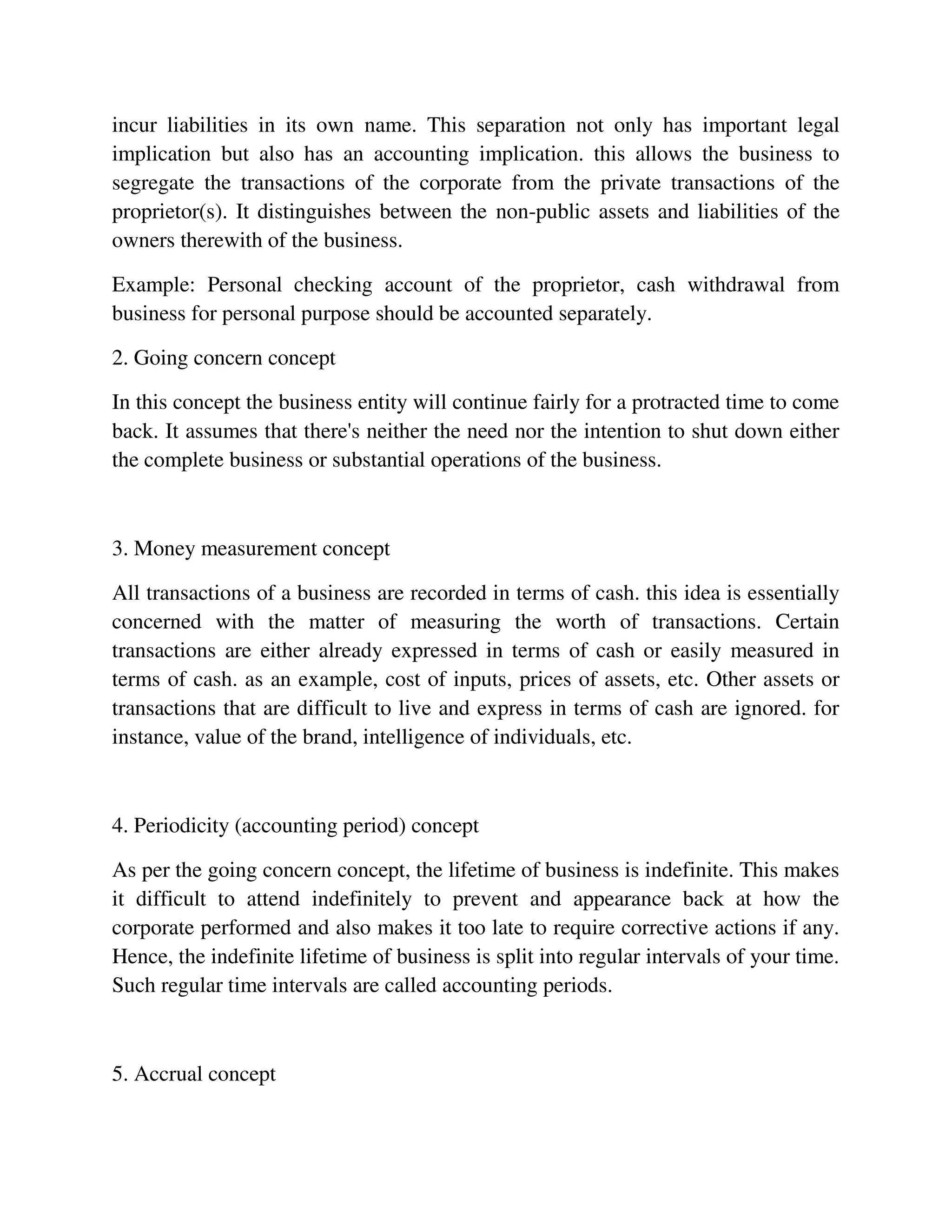
1. Discuss 5 accounting concepts with suitable example of each concept.
Ans.
1. Business separate entity concept
This concept states that business may be a separate entity and it's different from the
proprietor or the owner. during this concept an organization can own assets and
incur liabilities in its own name. This separation not only has important legal
implication but also has an accounting implication. this allows the business to
segregate the transactions of the corporate from the private transactions of the
proprietor(s). It distinguishes between the non-public assets and liabilities of the
owners therewith of the business.
Example: Personal checking account of the proprietor, cash withdrawal from
business for personal purpose should be accounted separately.
2. Going concern concept
In this concept the business entity will continue fairly for a protracted time to come
back. It assumes that there's neither the need nor the intention to shut down either
the complete business or substantial operations of the business.
3. Money measurement concept
All transactions of a business are recorded in terms of cash. this idea is essentially
concerned with the matter of measuring the worth of transactions. Certain
transactions are either already expressed in terms of cash or easily measured in
terms of cash. as an example, cost of inputs, prices of assets, etc. Other assets or
transactions that are difficult to live and express in terms of cash are ignored. for
instance, value of the brand, intelligence of individuals, etc.
4. Periodicity (accounting period) concept
As per the going concern concept, the lifetime of business is indefinite. This makes
it difficult to attend indefinitely to prevent and appearance back at how the
corporate performed and also makes it too late to require corrective actions if any.
Hence, the indefinite lifetime of business is split into regular intervals of your time.
Such regular time intervals are called accounting periods.
5. Accrual concept
The following are the features of this concept:
• Expenses incurred for an accounting period must be recorded therein accounting
period irrespective of whether it's actually paid therein accounting period or not.
• Income earned for an accounting period must be recorded therein accounting
period no matter whether it's actually received in this accounting period or not
Example: On 31st December, 2006, interest receivable on fixed deposit was Rs.
12000. The interest amount was credited to a checking account in February 2007
(two months later). per accrual concept, the income from interest is Rs.12000
though it's received after 31stDecember, 2006.
2. Prepare trading account of XYZ for the year ending 31 March 2019 from
the following information:
Purchases 13,00,000
Sales 15,00,000
Stock (April 1, 2018) 40,000
Wages 30,000
Carriage inwards 14,000
Returns outwards 3,000
Returns inwards 2,500
Freight 15,000
Additional information: Stock on 31 March 2019 was Rs. 1,70,000
Answer:
Trading Account
Particulars Rs Particulars Rs
To Opening Stock
To Purchases
13,00,000
Returns
(3000)
To Wages
To Carriage Inwards
To Freight
To Gross profit
40,000
12,97,000
30,000
14,000
15,000
2,71,500
By Sales
15,00,000
Returns (2500)
By closing stock
14,97,500
1,70,000
16,67,500 16,67,500
3. Distinguish between management accounting and financial accounting.
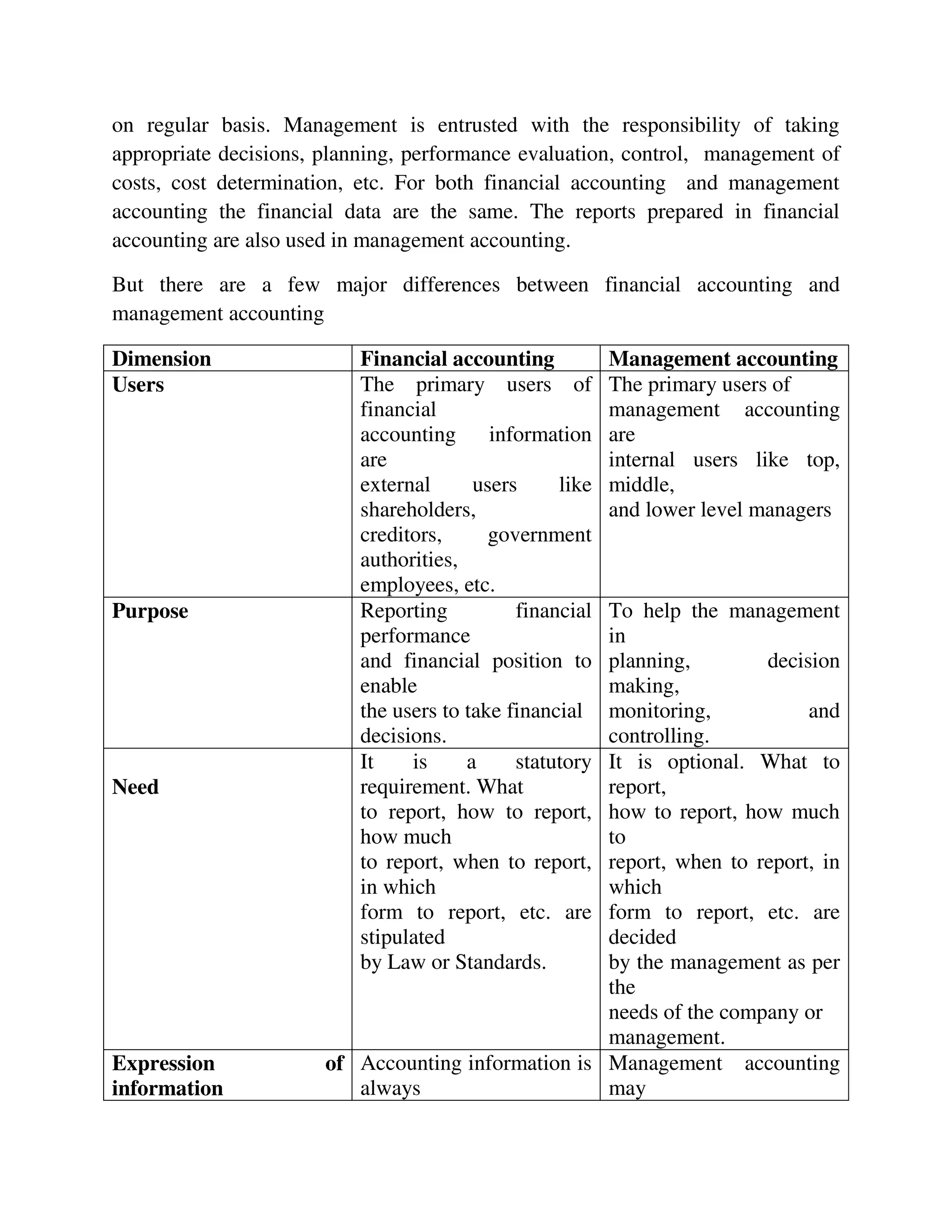
Answer. Financial accounting is the preparation and communication of financial
information to outsiders such as creditors, bankers, government, customers, etc.
Another objective of financial accounting is to give complete picture of the
enterprise to shareholders. Management accounting on the other hand, aims at
preparing and reporting the financial data to the management
on regular basis. Management is entrusted with the responsibility of taking
appropriate decisions, planning, performance evaluation, control, management of
costs, cost determination, etc. For both financial accounting and management
accounting the financial data are the same. The reports prepared in financial
accounting are also used in management accounting.
But there are a few major differences between financial accounting and
management accounting
Dimension Financial accounting Management accounting
Users The primary users of
financial
accounting information
are
external users like
shareholders,
creditors, government
authorities,
employees, etc.
The primary users of
management accounting
are
internal users like top,
middle,
and lower level managers
Purpose Reporting financial
performance
and financial position to
enable
the users to take financial
decisions.
To help the management
in
planning, decision
making,
monitoring, and
controlling.
Need
It is a statutory
requirement. What
to report, how to report,
how much
to report, when to report,
in which
form to report, etc. are
stipulated
by Law or Standards.
It is optional. What to
report,
how to report, how much
to
report, when to report, in
which
form to report, etc. are
decided
by the management as per
the
needs of the company or
management.
Expression of
information
Accounting information is
always
Management accounting
may
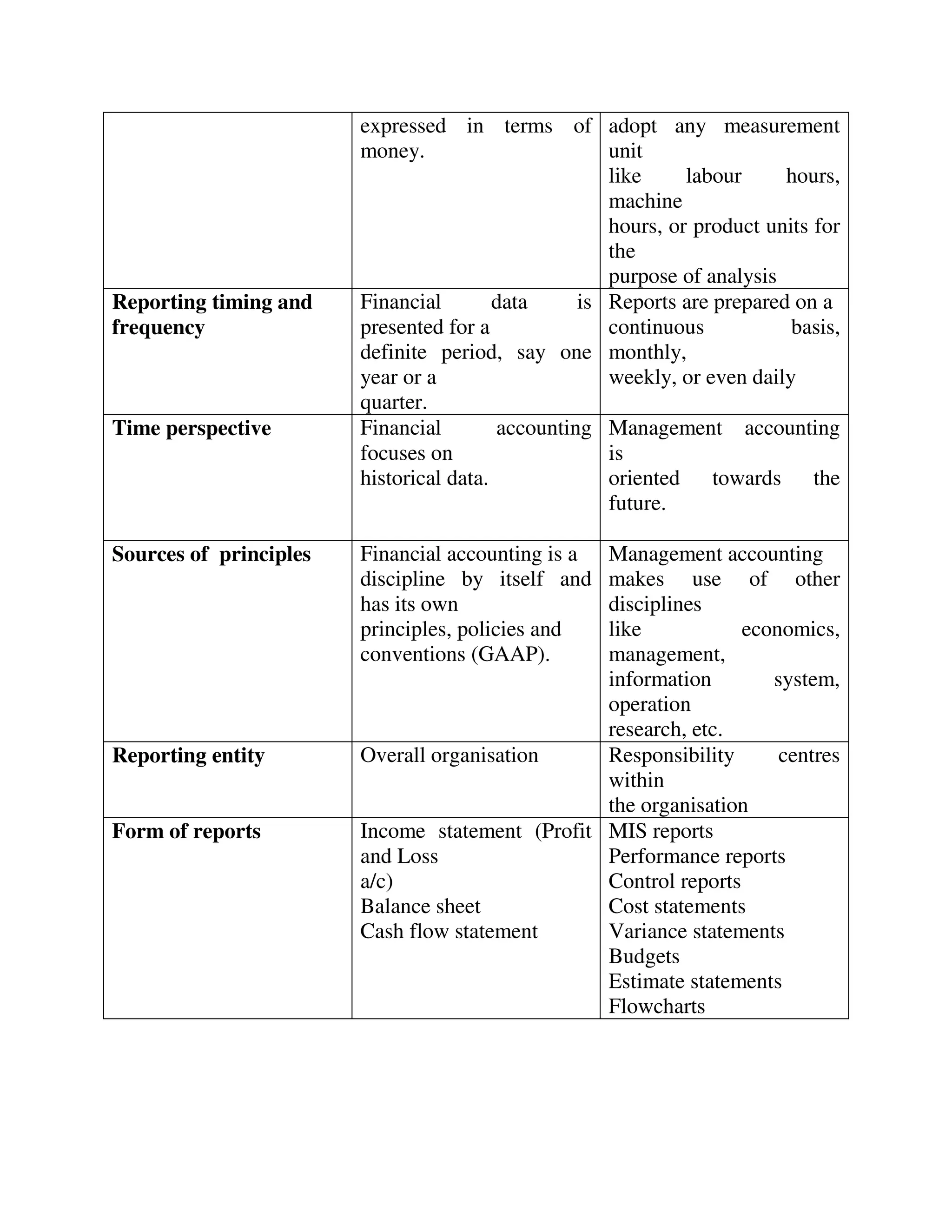
expressed in terms of
money.
adopt any measurement
unit
like labour hours,
machine
hours, or product units for
the
purpose of analysis
Reporting timing and
frequency
Financial data is
presented for a
definite period, say one
year or a
quarter.
Reports are prepared on a
continuous basis,
monthly,
weekly, or even daily
Time perspective Financial accounting
focuses on
historical data.
Management accounting
is
oriented towards the
future.
Sources of principles Financial accounting is a
discipline by itself and
has its own
principles, policies and
conventions (GAAP).
Management accounting
makes use of other
disciplines
like economics,
management,
information system,
operation
research, etc.
Reporting entity Overall organisation Responsibility centres
within
the organisation
Form of reports Income statement (Profit
and Loss
a/c)
Balance sheet
Cash flow statement
MIS reports
Performance reports
Control reports
Cost statements
Variance statements
Budgets
Estimate statements
Flowcharts
SET 2
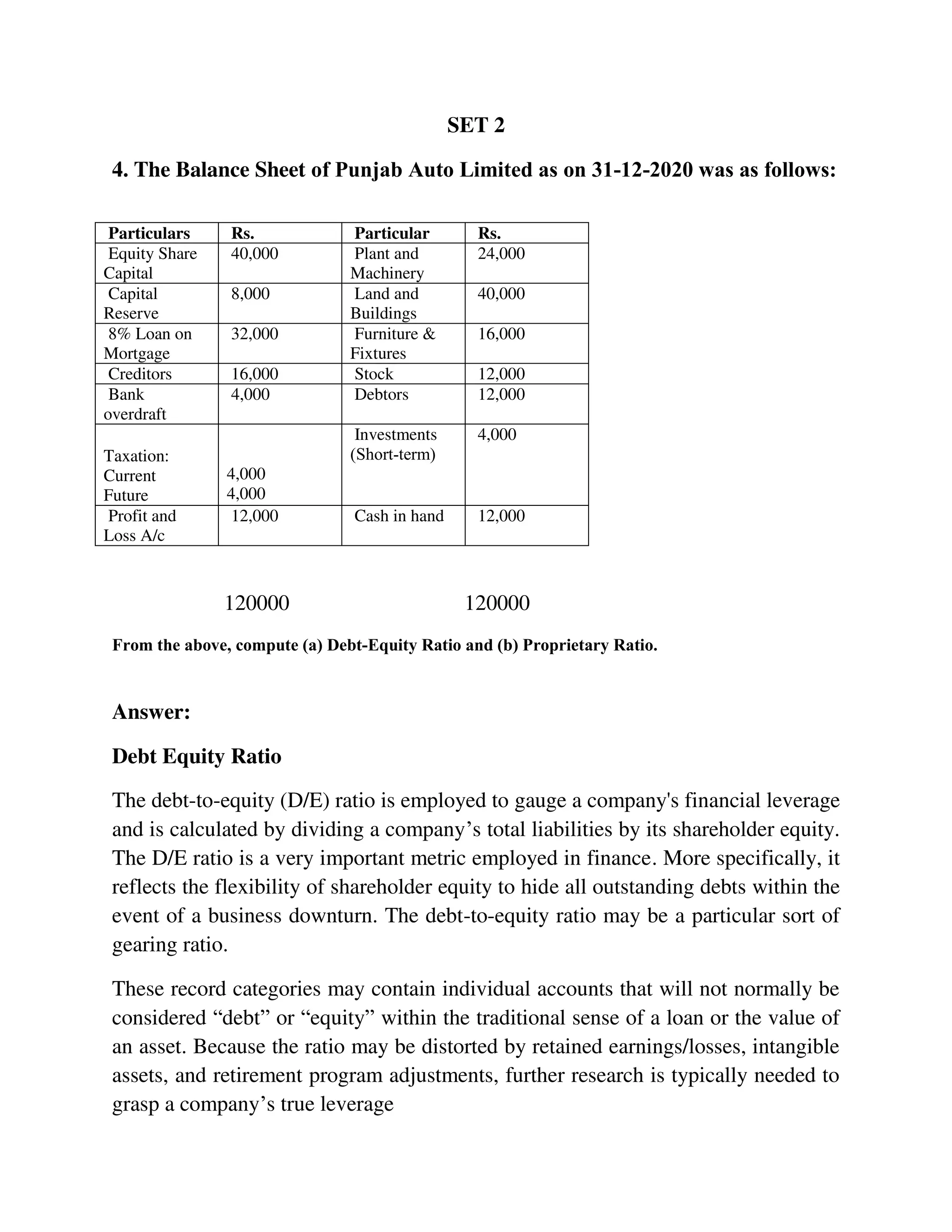
4. The Balance Sheet of Punjab Auto Limited as on 31‐12‐2020 was as follows:
Particulars Rs. Particular Rs.
Equity Share
Capital
40,000 Plant and
Machinery
24,000
Capital
Reserve
8,000 Land and
Buildings
40,000
8% Loan on
Mortgage
32,000 Furniture &
Fixtures
16,000
Creditors 16,000 Stock 12,000
Bank
overdraft
4,000 Debtors 12,000
Taxation:
Current
Future
4,000
4,000
Investments
(Short‐term)
4,000
Profit and
Loss A/c
12,000 Cash in hand 12,000
120000 120000
From the above, compute (a) Debt‐Equity Ratio and (b) Proprietary Ratio.
Answer:
Debt Equity Ratio
The debt-to-equity (D/E) ratio is employed to gauge a company's financial leverage
and is calculated by dividing a company’s total liabilities by its shareholder equity.
The D/E ratio is a very important metric employed in finance. More specifically, it
reflects the flexibility of shareholder equity to hide all outstanding debts within the
event of a business downturn. The debt-to-equity ratio may be a particular sort of
gearing ratio.
These record categories may contain individual accounts that will not normally be
considered “debt” or “equity” within the traditional sense of a loan or the value of
an asset. Because the ratio may be distorted by retained earnings/losses, intangible
assets, and retirement program adjustments, further research is typically needed to
grasp a company’s true leverage
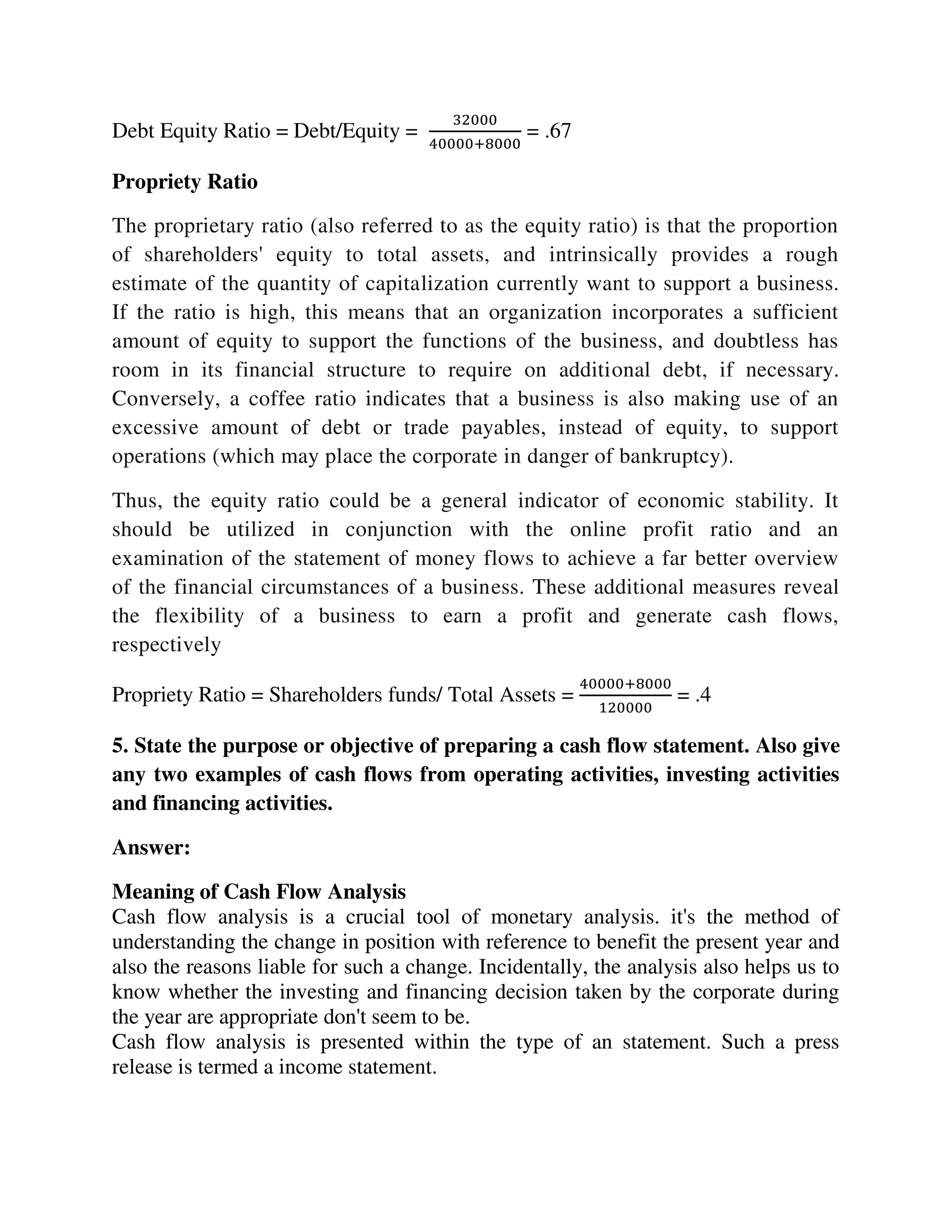
Debt Equity Ratio = Debt/Equity =
32000
40000+8000
= .67
Propriety Ratio
The proprietary ratio (also referred to as the equity ratio) is that the proportion
of shareholders' equity to total assets, and intrinsically provides a rough
estimate of the quantity of capitalization currently want to support a business.
If the ratio is high, this means that an organization incorporates a sufficient
amount of equity to support the functions of the business, and doubtless has
room in its financial structure to require on additional debt, if necessary.
Conversely, a coffee ratio indicates that a business is also making use of an
excessive amount of debt or trade payables, instead of equity, to support
operations (which may place the corporate in danger of bankruptcy).
Thus, the equity ratio could be a general indicator of economic stability. It
should be utilized in conjunction with the online profit ratio and an
examination of the statement of money flows to achieve a far better overview
of the financial circumstances of a business. These additional measures reveal
the flexibility of a business to earn a profit and generate cash flows,
respectively
Propriety Ratio = Shareholders funds/ Total Assets =
40000+8000
120000
= .4
5. State the purpose or objective of preparing a cash flow statement. Also give
any two examples of cash flows from operating activities, investing activities
and financing activities.
Answer:
Meaning of Cash Flow Analysis
Cash flow analysis is a crucial tool of monetary analysis. it's the method of
understanding the change in position with reference to benefit the present year and
also the reasons liable for such a change. Incidentally, the analysis also helps us to
know whether the investing and financing decision taken by the corporate during
the year are appropriate don't seem to be.
Cash flow analysis is presented within the type of an statement. Such a press
release is termed a income statement.
Objectives of Cash Flow Analysis
• What is the change in the cash position of the firm for the current year as
compared to the previous year?
• How good was the liquidity position of the firm?
• What were the sources of cash during the current year?
• How much cash was generated from operations?
• What were the applications of cash during the current year?
The preparation of cash flow statement is similar to the preparation of fund flow
statement. It requires the identification of the sources of cash and the uses of cash.
An application of cash is a transaction which leads to an outflow of cash.
Following is the list of transactions that results in a source of cash or application of
cash.
Sources of cash:
 Cash from operations
 Proceeds of issue of
 Equity shares
 Preference shares
 Proceeds of issue of
 Debentures
 Bonds
 Raising mortgage loans (long-term)
 Sale of assets
 Intangible assets like patent rights, copyrights, brand names, goodwill,
licences, etc.
 Sale of investments like shares, bonds, debentures, etc.
Applications or uses of cash:
 Cash lost in operations (adjusted net loss)
 Buy back of equity shares
 Redemption of redeemable preference shares
 Redemption of redeemable bonds or debentures
 Repaying of long-term debts from banks and financial institutions
 Repaying of mortgage loans (long-term)
 Purchasing of assets
 Purchasing of investments like shares, bonds, debentures, etc.
 It may be noted that the sources of cash increase the cash balance and
applications of cash decrease the cash balance.
Examples of cash flows from Operating activities are:
a) cash receipts from the sale of goods and the rendering of services;
b) cash receipts from royalties, fees, commissions and other revenue;
c) cash payments to suppliers for goods and services;
d) cash payments to and on behalf of employees;
e) cash receipts and cash payments of an insurance enterprise for premiums and
claims, annuities and other policy benefits;
f) cash payments or refunds of income taxes unless they can be specifically
identified with financing and investing activities; and g) cash receipts and
payments relating to futures contracts, forward contracts, option contracts and
swap contracts when the contracts are held for dealing or trading purposes.
Examples of cash flows arising from Investing activities are:
a) cash payments to acquire fixed assets : These payments include those relating to
capitalised research and development costs and self-constructed fixed assets;
b) cash receipts from disposal of fixed assets (including intangibles);
c) cash payments to acquire shares, warrants or debt instruments of other
enterprises and interests in joint ventures (other than payments for those
instruments considered to be cash equivalents and those held for dealing or trading
purposes);
d) cash receipts from disposal of shares, warrants or debt instruments of other
enterprises and interests in joint ventures (other than receipts from those
instruments considered to be cash equivalents and those held for dealing or trading
purposes);
e) cash advances and loans made to third parties (other than advances and loans
made by a financial enterprise);
f) cash receipts from the repayment of advances and loans made to third parties
(other than advances and loans of a financial enterprise);
6. Discuss the steps involved in standard costing. Also state the Differences
between Standard Costing and Budgetary Control.
Answer. Following are the steps involved in standard costing...
1. Establishment of standards
It is the primary step within the standard costing process. Standards need to be set
separately for every item of cost. It must be done very meticulously.
2. Comparison of actual costs with the predetermined standards.
It is the subsequent step in standard costing. It has to be ensured that an accurate
comparison is formed. the particular costs must be compared with the quality cost
for actual output.
3. Analyzing the variances (deviations) of actual costs from the quality costs.
The difference between the quality cost and also the actual cost is named the
variance. The variances are to be analyzed for every item of cost separately.
4. Reporting
The variance is also favorable or unfavorable. In either case, it should be reported
to the management for taking corrective actions wherever necessary.
Differences between Standard Costing and Budgetary Control
1. The scope of budgetary control is wider. It is an integrated plan of action and a
coordinated plan with respect to all functions of an enterprise. On the other hand,
the scope of standard costing is limited to the operating level.
2. Budgetary control targets are based on past actual data adjusted to future trends.
In standard costing, standards are based on technical assessment.
3. Budgeted targets work as the maximum limit of expenses which should not
exceed the actual expenditure. Standards are attainable level of performance.
4. Budgetary control emphasises the forecasting aspect of future operations.
Standard costing scope and utility is limited to only operating level of the concern.
5. Variance analysis is not compulsory in budgetary control though companies
normally do it. Even when it is done, no accounting entry is passed in the books for
the variance. But variance analysis is an essential part of standard costing.
Variances are analysed and journal entries are passed and posted to the ledger
accounts in the costing books.
6. Budgetary control can be operated in parts. That is, as per the needs of the
management, only functional budgets may be prepared. A standard costing system
cannot be operated in parts. All items of expenditure included in the cost units are
to be accounted for.

Assignment accounts

  • 1.
    Directorate of OnlineEducation SESSION JUL/AUG 2021 PROGRAM MASTER OF BUSINESS ADMINISTRATION (MBA) SEMESTER I COURSE CODE & NAME DMBA104–FINANCIAL AND MANAGEMENT ACCOUNTING NAME ROLL NO 1. Discuss 5 accounting concepts with suitable example of each concept. Ans. 1. Business separate entity concept This concept states that business may be a separate entity and it's different from the proprietor or the owner. during this concept an organization can own assets and
  • 2.
    incur liabilities inits own name. This separation not only has important legal implication but also has an accounting implication. this allows the business to segregate the transactions of the corporate from the private transactions of the proprietor(s). It distinguishes between the non-public assets and liabilities of the owners therewith of the business. Example: Personal checking account of the proprietor, cash withdrawal from business for personal purpose should be accounted separately. 2. Going concern concept In this concept the business entity will continue fairly for a protracted time to come back. It assumes that there's neither the need nor the intention to shut down either the complete business or substantial operations of the business. 3. Money measurement concept All transactions of a business are recorded in terms of cash. this idea is essentially concerned with the matter of measuring the worth of transactions. Certain transactions are either already expressed in terms of cash or easily measured in terms of cash. as an example, cost of inputs, prices of assets, etc. Other assets or transactions that are difficult to live and express in terms of cash are ignored. for instance, value of the brand, intelligence of individuals, etc. 4. Periodicity (accounting period) concept As per the going concern concept, the lifetime of business is indefinite. This makes it difficult to attend indefinitely to prevent and appearance back at how the corporate performed and also makes it too late to require corrective actions if any. Hence, the indefinite lifetime of business is split into regular intervals of your time. Such regular time intervals are called accounting periods. 5. Accrual concept
  • 3.
    The following arethe features of this concept: • Expenses incurred for an accounting period must be recorded therein accounting period irrespective of whether it's actually paid therein accounting period or not. • Income earned for an accounting period must be recorded therein accounting period no matter whether it's actually received in this accounting period or not Example: On 31st December, 2006, interest receivable on fixed deposit was Rs. 12000. The interest amount was credited to a checking account in February 2007 (two months later). per accrual concept, the income from interest is Rs.12000 though it's received after 31stDecember, 2006. 2. Prepare trading account of XYZ for the year ending 31 March 2019 from the following information: Purchases 13,00,000 Sales 15,00,000 Stock (April 1, 2018) 40,000 Wages 30,000 Carriage inwards 14,000 Returns outwards 3,000 Returns inwards 2,500 Freight 15,000 Additional information: Stock on 31 March 2019 was Rs. 1,70,000
  • 4.
    Answer: Trading Account Particulars RsParticulars Rs To Opening Stock To Purchases 13,00,000 Returns (3000) To Wages To Carriage Inwards To Freight To Gross profit 40,000 12,97,000 30,000 14,000 15,000 2,71,500 By Sales 15,00,000 Returns (2500) By closing stock 14,97,500 1,70,000 16,67,500 16,67,500 3. Distinguish between management accounting and financial accounting. Answer. Financial accounting is the preparation and communication of financial information to outsiders such as creditors, bankers, government, customers, etc. Another objective of financial accounting is to give complete picture of the enterprise to shareholders. Management accounting on the other hand, aims at preparing and reporting the financial data to the management
  • 5.
    on regular basis.Management is entrusted with the responsibility of taking appropriate decisions, planning, performance evaluation, control, management of costs, cost determination, etc. For both financial accounting and management accounting the financial data are the same. The reports prepared in financial accounting are also used in management accounting. But there are a few major differences between financial accounting and management accounting Dimension Financial accounting Management accounting Users The primary users of financial accounting information are external users like shareholders, creditors, government authorities, employees, etc. The primary users of management accounting are internal users like top, middle, and lower level managers Purpose Reporting financial performance and financial position to enable the users to take financial decisions. To help the management in planning, decision making, monitoring, and controlling. Need It is a statutory requirement. What to report, how to report, how much to report, when to report, in which form to report, etc. are stipulated by Law or Standards. It is optional. What to report, how to report, how much to report, when to report, in which form to report, etc. are decided by the management as per the needs of the company or management. Expression of information Accounting information is always Management accounting may
  • 6.
    expressed in termsof money. adopt any measurement unit like labour hours, machine hours, or product units for the purpose of analysis Reporting timing and frequency Financial data is presented for a definite period, say one year or a quarter. Reports are prepared on a continuous basis, monthly, weekly, or even daily Time perspective Financial accounting focuses on historical data. Management accounting is oriented towards the future. Sources of principles Financial accounting is a discipline by itself and has its own principles, policies and conventions (GAAP). Management accounting makes use of other disciplines like economics, management, information system, operation research, etc. Reporting entity Overall organisation Responsibility centres within the organisation Form of reports Income statement (Profit and Loss a/c) Balance sheet Cash flow statement MIS reports Performance reports Control reports Cost statements Variance statements Budgets Estimate statements Flowcharts
  • 7.
    SET 2 4. TheBalance Sheet of Punjab Auto Limited as on 31‐12‐2020 was as follows: Particulars Rs. Particular Rs. Equity Share Capital 40,000 Plant and Machinery 24,000 Capital Reserve 8,000 Land and Buildings 40,000 8% Loan on Mortgage 32,000 Furniture & Fixtures 16,000 Creditors 16,000 Stock 12,000 Bank overdraft 4,000 Debtors 12,000 Taxation: Current Future 4,000 4,000 Investments (Short‐term) 4,000 Profit and Loss A/c 12,000 Cash in hand 12,000 120000 120000 From the above, compute (a) Debt‐Equity Ratio and (b) Proprietary Ratio. Answer: Debt Equity Ratio The debt-to-equity (D/E) ratio is employed to gauge a company's financial leverage and is calculated by dividing a company’s total liabilities by its shareholder equity. The D/E ratio is a very important metric employed in finance. More specifically, it reflects the flexibility of shareholder equity to hide all outstanding debts within the event of a business downturn. The debt-to-equity ratio may be a particular sort of gearing ratio. These record categories may contain individual accounts that will not normally be considered “debt” or “equity” within the traditional sense of a loan or the value of an asset. Because the ratio may be distorted by retained earnings/losses, intangible assets, and retirement program adjustments, further research is typically needed to grasp a company’s true leverage
  • 8.
    Debt Equity Ratio= Debt/Equity = 32000 40000+8000 = .67 Propriety Ratio The proprietary ratio (also referred to as the equity ratio) is that the proportion of shareholders' equity to total assets, and intrinsically provides a rough estimate of the quantity of capitalization currently want to support a business. If the ratio is high, this means that an organization incorporates a sufficient amount of equity to support the functions of the business, and doubtless has room in its financial structure to require on additional debt, if necessary. Conversely, a coffee ratio indicates that a business is also making use of an excessive amount of debt or trade payables, instead of equity, to support operations (which may place the corporate in danger of bankruptcy). Thus, the equity ratio could be a general indicator of economic stability. It should be utilized in conjunction with the online profit ratio and an examination of the statement of money flows to achieve a far better overview of the financial circumstances of a business. These additional measures reveal the flexibility of a business to earn a profit and generate cash flows, respectively Propriety Ratio = Shareholders funds/ Total Assets = 40000+8000 120000 = .4 5. State the purpose or objective of preparing a cash flow statement. Also give any two examples of cash flows from operating activities, investing activities and financing activities. Answer: Meaning of Cash Flow Analysis Cash flow analysis is a crucial tool of monetary analysis. it's the method of understanding the change in position with reference to benefit the present year and also the reasons liable for such a change. Incidentally, the analysis also helps us to know whether the investing and financing decision taken by the corporate during the year are appropriate don't seem to be. Cash flow analysis is presented within the type of an statement. Such a press release is termed a income statement.
  • 9.
    Objectives of CashFlow Analysis • What is the change in the cash position of the firm for the current year as compared to the previous year? • How good was the liquidity position of the firm? • What were the sources of cash during the current year? • How much cash was generated from operations? • What were the applications of cash during the current year? The preparation of cash flow statement is similar to the preparation of fund flow statement. It requires the identification of the sources of cash and the uses of cash. An application of cash is a transaction which leads to an outflow of cash. Following is the list of transactions that results in a source of cash or application of cash. Sources of cash:  Cash from operations  Proceeds of issue of  Equity shares  Preference shares  Proceeds of issue of  Debentures  Bonds  Raising mortgage loans (long-term)  Sale of assets  Intangible assets like patent rights, copyrights, brand names, goodwill, licences, etc.  Sale of investments like shares, bonds, debentures, etc. Applications or uses of cash:  Cash lost in operations (adjusted net loss)  Buy back of equity shares  Redemption of redeemable preference shares  Redemption of redeemable bonds or debentures  Repaying of long-term debts from banks and financial institutions  Repaying of mortgage loans (long-term)  Purchasing of assets  Purchasing of investments like shares, bonds, debentures, etc.  It may be noted that the sources of cash increase the cash balance and applications of cash decrease the cash balance. Examples of cash flows from Operating activities are: a) cash receipts from the sale of goods and the rendering of services; b) cash receipts from royalties, fees, commissions and other revenue;
  • 10.
    c) cash paymentsto suppliers for goods and services; d) cash payments to and on behalf of employees; e) cash receipts and cash payments of an insurance enterprise for premiums and claims, annuities and other policy benefits; f) cash payments or refunds of income taxes unless they can be specifically identified with financing and investing activities; and g) cash receipts and payments relating to futures contracts, forward contracts, option contracts and swap contracts when the contracts are held for dealing or trading purposes. Examples of cash flows arising from Investing activities are: a) cash payments to acquire fixed assets : These payments include those relating to capitalised research and development costs and self-constructed fixed assets; b) cash receipts from disposal of fixed assets (including intangibles); c) cash payments to acquire shares, warrants or debt instruments of other enterprises and interests in joint ventures (other than payments for those instruments considered to be cash equivalents and those held for dealing or trading purposes); d) cash receipts from disposal of shares, warrants or debt instruments of other enterprises and interests in joint ventures (other than receipts from those instruments considered to be cash equivalents and those held for dealing or trading purposes); e) cash advances and loans made to third parties (other than advances and loans made by a financial enterprise); f) cash receipts from the repayment of advances and loans made to third parties (other than advances and loans of a financial enterprise); 6. Discuss the steps involved in standard costing. Also state the Differences between Standard Costing and Budgetary Control. Answer. Following are the steps involved in standard costing... 1. Establishment of standards It is the primary step within the standard costing process. Standards need to be set separately for every item of cost. It must be done very meticulously. 2. Comparison of actual costs with the predetermined standards.
  • 11.
    It is thesubsequent step in standard costing. It has to be ensured that an accurate comparison is formed. the particular costs must be compared with the quality cost for actual output. 3. Analyzing the variances (deviations) of actual costs from the quality costs. The difference between the quality cost and also the actual cost is named the variance. The variances are to be analyzed for every item of cost separately. 4. Reporting The variance is also favorable or unfavorable. In either case, it should be reported to the management for taking corrective actions wherever necessary. Differences between Standard Costing and Budgetary Control 1. The scope of budgetary control is wider. It is an integrated plan of action and a coordinated plan with respect to all functions of an enterprise. On the other hand, the scope of standard costing is limited to the operating level. 2. Budgetary control targets are based on past actual data adjusted to future trends. In standard costing, standards are based on technical assessment. 3. Budgeted targets work as the maximum limit of expenses which should not exceed the actual expenditure. Standards are attainable level of performance. 4. Budgetary control emphasises the forecasting aspect of future operations. Standard costing scope and utility is limited to only operating level of the concern. 5. Variance analysis is not compulsory in budgetary control though companies normally do it. Even when it is done, no accounting entry is passed in the books for the variance. But variance analysis is an essential part of standard costing. Variances are analysed and journal entries are passed and posted to the ledger accounts in the costing books. 6. Budgetary control can be operated in parts. That is, as per the needs of the management, only functional budgets may be prepared. A standard costing system cannot be operated in parts. All items of expenditure included in the cost units are to be accounted for.