BATTERIES
BATTERY
A cell or connected group of cells that converts chemical energy into electrical energy
by reversible chemical reactions and that may be recharged by passing a current
through it in the direction opposite to that of its discharge -- called also storage cell.
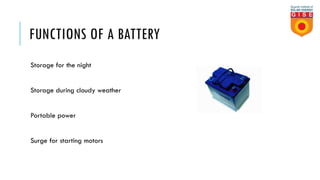
FUNCTIONS OF A BATTERY
Storage for the night
Storage during cloudy weather
Portable power
Surge for starting motors
TYPES OF CELLS
The primary battery converts chemical energy to electrical energy directly, using the
chemical materials within the cell to start the action.
It can not be recharged e.g. Dry cell, Alkline cell etc.
The secondary battery must first be charged with electrical energy before it can
convert chemical energy to electrical energy.
It can be recharged. e.g. Lead Acid, NiCd, NiFe, Lithium Ion.
The secondary battery is frequently called a storage battery, since it stores the
energy that is supplied to it.
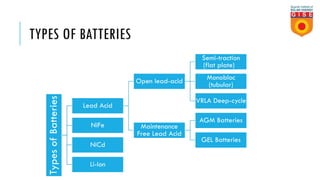
TYPES OF BATTERIES
TypesofBatteries
Lead Acid
Open lead-acid
Semi-traction
(flat plate)
Monobloc
(tubular)
VRLA Deep-cycle
Maintenance
Free Lead Acid
AGM Batteries
GEL Batteries
NiFe
NiCd
Li-Ion
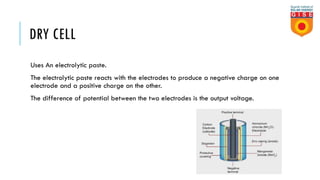
DRY CELL
Uses An electrolytic paste.
The electrolytic paste reacts with the electrodes to produce a negative charge on one
electrode and a positive charge on the other.
The difference of potential between the two electrodes is the output voltage.
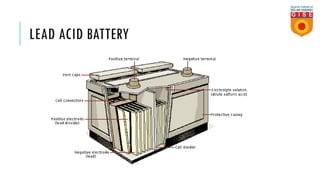
LEAD ACID BATTERY
LEAD-ACID BATTERY: CONSTRUCTION
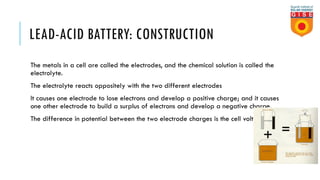
The metals in a cell are called the electrodes, and the chemical solution is called the
electrolyte.
The electrolyte reacts oppositely with the two different electrodes
It causes one electrode to lose electrons and develop a positive charge; and it causes
one other electrode to build a surplus of electrons and develop a negative charge.
The difference in potential between the two electrode charges is the cell voltage.
THE ELECTROLYTE & ELECTROLYSIS
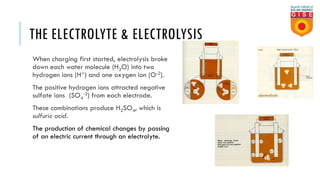
When charging first started, electrolysis broke
down each water molecule (H2O) into two
hydrogen ions (H+) and one oxygen ion (O-2).
The positive hydrogen ions attracted negative
sulfate ions (SO4
-2) from each electrode.
These combinations produce H2SO4, which is
sulfuric acid.
The production of chemical changes by passing
of an electric current through an electrolyte.
FLOODED LEAD ACID BATTERIES
Flooded lead acid batteries are used in majority of stand alone and grid connected
photovoltaic systems because they have the longest life and least cost per amp-hour
of any of the choices.
However, their main disadvantage is that they require regular (every 3 months)
maintenance (topping the water level, equalizing charges, keeping top and terminals
clean etc.).
Two volt cells were mainly used for large systems.
BATTERY CAPACITY
Capacity: Amps x Hours =Amp-hours (Ah) and V
100Ah = 100 amps for 1 hour or 1 amp for 100 hours or 20 amps for 5 hours
AUTOMOTIVE BATTERIES VS SOLAR BATTERIES
All batteries share same chemistry but the difference is in their designs.
Solar Batteries are deep cycle batteries.
Automotive batteries are designed to provide large current and hence they last for
short period.
Solar batteries provide small current for longer time. Their charging and discharging
rates are slower than automotive batteries.
Automotive batteries consist thin electrode while solar batteries are made of thick
electrode in order to make them release small current.
BASIC TERMS
Capacity
 Amount of electrical energy the battery will contain
State of Charge (SOC)
 Available battery capacity
Depth of Discharge (DOD)
 Energy taken out of the battery
Efficiency
 Energy out/Energy in (typically 80-85%)
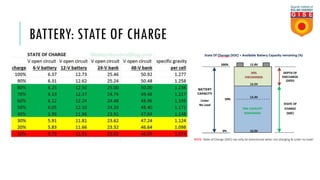
SOC + DOD = 100%
Energy (watt-hour) = Capacity (Ah) x Voltage (V)
BATTERY: STATE OF CHARGE
DEPTH OF DISCHARGE
Usually D.O.D. of Automotive batteries are allowed up to 20% while of solar
batteries it might vary from 50% to 80%
SELF-DISCHARGE (IN %)
TOPIC : BATTERY 16
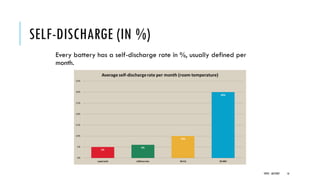
Every battery has a self-discharge rate in %, usually defined per
month.
SELF-DISCHARGE (IN %)
TOPIC : BATTERY 17
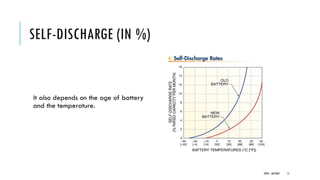
It also depends on the age of battery
and the temperature.
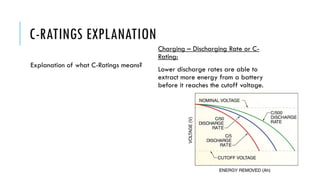
C-RATINGS EXPLANATION
Explanation of what C-Ratings means?
Charging – Discharging Rate or C-
Rating:
Lower discharge rates are able to
extract more energy from a battery
before it reaches the cutoff voltage.
SPECIFIC GRAVITY
Ratio of the weight of a given volume of a substance to the weight of an equal
volume of some reference substance, or, equivalently, the ratio of the masses of equal
volumes of the two substances.
Example: It is the weight of the sulfuric acid - water mixture compared to an equal
volume of water. Pure water has a specific gravity of 1,000.
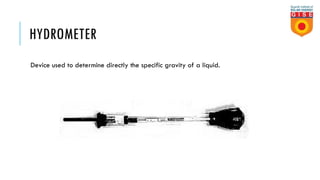
HYDROMETER
Device used to determine directly the specific gravity of a liquid.
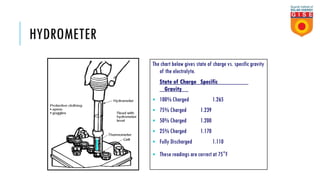
HYDROMETER
The chart below gives state of charge vs. specific gravity
of the electrolyte.
State of Charge Specific
Gravity
 100% Charged 1.265
 75% Charged 1.239
 50% Charged 1.200
 25% Charged 1.170
 Fully Discharged 1.110
 These readings are correct at 75°F
RELATION OF VOLTAGE AND HYDROMETER
READINGS
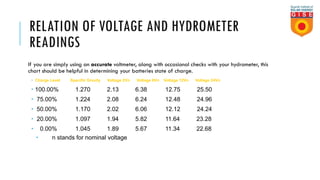
If you are simply using an accurate voltmeter, along with occasional checks with your hydrometer, this
chart should be helpful in determining your batteries state of charge.
 Charge Level Specific Gravity Voltage 2Vn Voltage 6Vn Voltage 12Vn Voltage 24Vn
 100.00% 1.270 2.13 6.38 12.75 25.50
 75.00% 1.224 2.08 6.24 12.48 24.96
 50.00% 1.170 2.02 6.06 12.12 24.24
 20.00% 1.097 1.94 5.82 11.64 23.28
 0.00% 1.045 1.89 5.67 11.34 22.68
 n stands for nominal voltage
SULPHATION
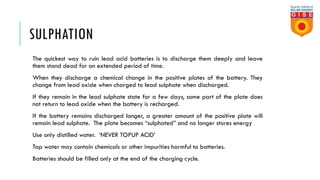
The quickest way to ruin lead acid batteries is to discharge them deeply and leave
them stand dead for an extended period of time.
When they discharge a chemical change in the positive plates of the battery. They
change from lead oxide when charged to lead sulphate when discharged.
If they remain in the lead sulphate state for a few days, some part of the plate does
not return to lead oxide when the battery is recharged.
If the battery remains discharged longer, a greater amount of the positive plate will
remain lead sulphate. The plate becomes “sulphated” and no longer stores energy
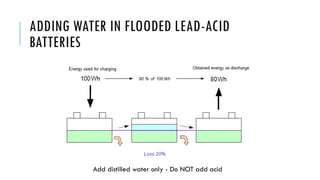
Use only distilled water. ‘NEVER TOPUP ACID’
Tap water may contain chemicals or other impurities harmful to batteries.
Batteries should be filled only at the end of the charging cycle.
ADDING WATER IN FLOODED LEAD-ACID
BATTERIES
Add distilled water only - Do NOT add acid
SERIES CONNECTED BATTERIES
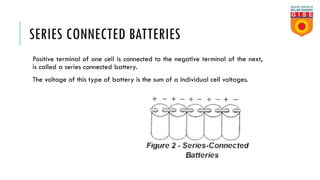
Positive terminal of one cell is connected to the negative terminal of the next,
is called a series connected battery.
The voltage of this type of battery is the sum of a individual cell voltages.
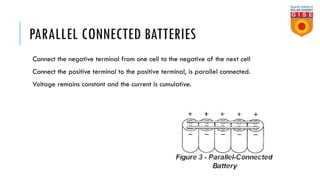
PARALLEL CONNECTED BATTERIES
Connect the negative terminal from one cell to the negative of the next cell
Connect the positive terminal to the positive terminal, is parallel connected.
Voltage remains constant and the current is cumulative.
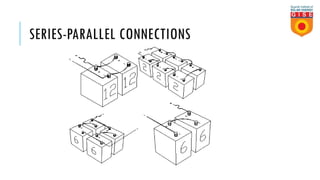
SERIES-PARALLEL CONNECTIONS
PREVENTIVE MAINTENANCE
When the top of a battery is having “dirty or looks damp. Give a battery a general
cleaning, use hot water (130° F to 170° F) with a neutralizer / detergent solution.
Clean Battery Terminals.
Attach clamps to the battery in proper polarity.
Keep open flames and sparks away from battery.
Ventilate the battery well while charging.
Battery voltage should be at or above 50% of S.O.C.
Prevent sulphation. Do not over discharge or over charge the batteries.
Do not mix make, type, models or age of batteries.
Corrosion (the sulphuric acid corrodes the lead plates).
Stratification (This is where heavier acid falls to the bottom section of the battery. This over
a long period results in accelerated corrosion and non-uniform cell operation).
VENTILATION REQUIREMENTS
The oxygen and hydrogen gases released during the gassing phase of a
typical flooded lead-acid battery recharge can be dangerous if allowed to
exceed 0.8 % (by volume) or 20 percent of the lower explosive range.
Concentrations of hydrogen between 4 % and 74% are considered explosive
(40,000 ppm and 740,000 ppm).
All lead acid power batteries give off gases when recharging and also for a
period after the charge is completed.
A Concentration of hydrogen in excess of 4% (by volume). It is suggested that
the concentration be controlled to a maximum of 2% (by volume).
VENTILATION REQUIREMENTS
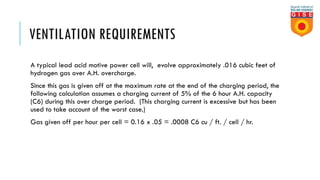
A typical lead acid motive power cell will, evolve approximately .016 cubic feet of
hydrogen gas over A.H. overcharge.
Since this gas is given off at the maximum rate at the end of the charging period, the
following calculation assumes a charging current of 5% of the 6 hour A.H. capacity
(C6) during this over charge period. (This charging current is excessive but has been
used to take account of the worst case.)
Gas given off per hour per cell = 0.16 x .05 = .0008 C6 cu / ft. / cell / hr.
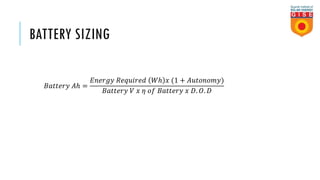
BATTERY SIZING
𝐵𝑎𝑡𝑡𝑒𝑟𝑦 𝐴ℎ =
𝐸𝑛𝑒𝑟𝑔𝑦 𝑅𝑒𝑞𝑢𝑖𝑟𝑒𝑑 𝑊ℎ 𝑥 (1 + 𝐴𝑢𝑡𝑜𝑛𝑜𝑚𝑦)
𝐵𝑎𝑡𝑡𝑒𝑟𝑦 𝑉 𝑥 𝜂 𝑜𝑓 𝐵𝑎𝑡𝑡𝑒𝑟𝑦 𝑥 𝐷. 𝑂. 𝐷
BATTERY SELECTION CRITERIA
Allowable D.O.D.
Charging and Discharging patterns and characteristics
Life Cycle
Sulphation Vulnerability
Self-Discharge Rate
Maintenance Requirement
Size and Weight
Cost and Warranty
Manufacturer’s reputation
Autonomy
Temperature range

Batteries

  • 1.
  • 2.
    BATTERY A cell orconnected group of cells that converts chemical energy into electrical energy by reversible chemical reactions and that may be recharged by passing a current through it in the direction opposite to that of its discharge -- called also storage cell.
  • 3.
    FUNCTIONS OF ABATTERY Storage for the night Storage during cloudy weather Portable power Surge for starting motors
  • 4.
    TYPES OF CELLS Theprimary battery converts chemical energy to electrical energy directly, using the chemical materials within the cell to start the action. It can not be recharged e.g. Dry cell, Alkline cell etc. The secondary battery must first be charged with electrical energy before it can convert chemical energy to electrical energy. It can be recharged. e.g. Lead Acid, NiCd, NiFe, Lithium Ion. The secondary battery is frequently called a storage battery, since it stores the energy that is supplied to it.
  • 5.
    TYPES OF BATTERIES TypesofBatteries LeadAcid Open lead-acid Semi-traction (flat plate) Monobloc (tubular) VRLA Deep-cycle Maintenance Free Lead Acid AGM Batteries GEL Batteries NiFe NiCd Li-Ion
  • 6.
    DRY CELL Uses Anelectrolytic paste. The electrolytic paste reacts with the electrodes to produce a negative charge on one electrode and a positive charge on the other. The difference of potential between the two electrodes is the output voltage.
  • 7.
  • 8.
    LEAD-ACID BATTERY: CONSTRUCTION Themetals in a cell are called the electrodes, and the chemical solution is called the electrolyte. The electrolyte reacts oppositely with the two different electrodes It causes one electrode to lose electrons and develop a positive charge; and it causes one other electrode to build a surplus of electrons and develop a negative charge. The difference in potential between the two electrode charges is the cell voltage.
  • 9.
    THE ELECTROLYTE &ELECTROLYSIS When charging first started, electrolysis broke down each water molecule (H2O) into two hydrogen ions (H+) and one oxygen ion (O-2). The positive hydrogen ions attracted negative sulfate ions (SO4 -2) from each electrode. These combinations produce H2SO4, which is sulfuric acid. The production of chemical changes by passing of an electric current through an electrolyte.
  • 10.
    FLOODED LEAD ACIDBATTERIES Flooded lead acid batteries are used in majority of stand alone and grid connected photovoltaic systems because they have the longest life and least cost per amp-hour of any of the choices. However, their main disadvantage is that they require regular (every 3 months) maintenance (topping the water level, equalizing charges, keeping top and terminals clean etc.). Two volt cells were mainly used for large systems.
  • 11.
    BATTERY CAPACITY Capacity: Ampsx Hours =Amp-hours (Ah) and V 100Ah = 100 amps for 1 hour or 1 amp for 100 hours or 20 amps for 5 hours
  • 12.
    AUTOMOTIVE BATTERIES VSSOLAR BATTERIES All batteries share same chemistry but the difference is in their designs. Solar Batteries are deep cycle batteries. Automotive batteries are designed to provide large current and hence they last for short period. Solar batteries provide small current for longer time. Their charging and discharging rates are slower than automotive batteries. Automotive batteries consist thin electrode while solar batteries are made of thick electrode in order to make them release small current.
  • 13.
    BASIC TERMS Capacity  Amountof electrical energy the battery will contain State of Charge (SOC)  Available battery capacity Depth of Discharge (DOD)  Energy taken out of the battery Efficiency  Energy out/Energy in (typically 80-85%) SOC + DOD = 100% Energy (watt-hour) = Capacity (Ah) x Voltage (V)
  • 14.
  • 15.
    DEPTH OF DISCHARGE UsuallyD.O.D. of Automotive batteries are allowed up to 20% while of solar batteries it might vary from 50% to 80%
  • 16.
    SELF-DISCHARGE (IN %) TOPIC: BATTERY 16 Every battery has a self-discharge rate in %, usually defined per month.
  • 17.
    SELF-DISCHARGE (IN %) TOPIC: BATTERY 17 It also depends on the age of battery and the temperature.
  • 18.
    C-RATINGS EXPLANATION Explanation ofwhat C-Ratings means? Charging – Discharging Rate or C- Rating: Lower discharge rates are able to extract more energy from a battery before it reaches the cutoff voltage.
  • 19.
    SPECIFIC GRAVITY Ratio ofthe weight of a given volume of a substance to the weight of an equal volume of some reference substance, or, equivalently, the ratio of the masses of equal volumes of the two substances. Example: It is the weight of the sulfuric acid - water mixture compared to an equal volume of water. Pure water has a specific gravity of 1,000.
  • 20.
    HYDROMETER Device used todetermine directly the specific gravity of a liquid.
  • 21.
    HYDROMETER The chart belowgives state of charge vs. specific gravity of the electrolyte. State of Charge Specific Gravity  100% Charged 1.265  75% Charged 1.239  50% Charged 1.200  25% Charged 1.170  Fully Discharged 1.110  These readings are correct at 75°F
  • 22.
    RELATION OF VOLTAGEAND HYDROMETER READINGS If you are simply using an accurate voltmeter, along with occasional checks with your hydrometer, this chart should be helpful in determining your batteries state of charge.  Charge Level Specific Gravity Voltage 2Vn Voltage 6Vn Voltage 12Vn Voltage 24Vn  100.00% 1.270 2.13 6.38 12.75 25.50  75.00% 1.224 2.08 6.24 12.48 24.96  50.00% 1.170 2.02 6.06 12.12 24.24  20.00% 1.097 1.94 5.82 11.64 23.28  0.00% 1.045 1.89 5.67 11.34 22.68  n stands for nominal voltage
  • 23.
    SULPHATION The quickest wayto ruin lead acid batteries is to discharge them deeply and leave them stand dead for an extended period of time. When they discharge a chemical change in the positive plates of the battery. They change from lead oxide when charged to lead sulphate when discharged. If they remain in the lead sulphate state for a few days, some part of the plate does not return to lead oxide when the battery is recharged. If the battery remains discharged longer, a greater amount of the positive plate will remain lead sulphate. The plate becomes “sulphated” and no longer stores energy Use only distilled water. ‘NEVER TOPUP ACID’ Tap water may contain chemicals or other impurities harmful to batteries. Batteries should be filled only at the end of the charging cycle.
  • 24.
    ADDING WATER INFLOODED LEAD-ACID BATTERIES Add distilled water only - Do NOT add acid
  • 25.
    SERIES CONNECTED BATTERIES Positiveterminal of one cell is connected to the negative terminal of the next, is called a series connected battery. The voltage of this type of battery is the sum of a individual cell voltages.
  • 26.
    PARALLEL CONNECTED BATTERIES Connectthe negative terminal from one cell to the negative of the next cell Connect the positive terminal to the positive terminal, is parallel connected. Voltage remains constant and the current is cumulative.
  • 27.
  • 28.
    PREVENTIVE MAINTENANCE When thetop of a battery is having “dirty or looks damp. Give a battery a general cleaning, use hot water (130° F to 170° F) with a neutralizer / detergent solution. Clean Battery Terminals. Attach clamps to the battery in proper polarity. Keep open flames and sparks away from battery. Ventilate the battery well while charging. Battery voltage should be at or above 50% of S.O.C. Prevent sulphation. Do not over discharge or over charge the batteries. Do not mix make, type, models or age of batteries. Corrosion (the sulphuric acid corrodes the lead plates). Stratification (This is where heavier acid falls to the bottom section of the battery. This over a long period results in accelerated corrosion and non-uniform cell operation).
  • 29.
    VENTILATION REQUIREMENTS The oxygenand hydrogen gases released during the gassing phase of a typical flooded lead-acid battery recharge can be dangerous if allowed to exceed 0.8 % (by volume) or 20 percent of the lower explosive range. Concentrations of hydrogen between 4 % and 74% are considered explosive (40,000 ppm and 740,000 ppm). All lead acid power batteries give off gases when recharging and also for a period after the charge is completed. A Concentration of hydrogen in excess of 4% (by volume). It is suggested that the concentration be controlled to a maximum of 2% (by volume).
  • 30.
    VENTILATION REQUIREMENTS A typicallead acid motive power cell will, evolve approximately .016 cubic feet of hydrogen gas over A.H. overcharge. Since this gas is given off at the maximum rate at the end of the charging period, the following calculation assumes a charging current of 5% of the 6 hour A.H. capacity (C6) during this over charge period. (This charging current is excessive but has been used to take account of the worst case.) Gas given off per hour per cell = 0.16 x .05 = .0008 C6 cu / ft. / cell / hr.
  • 31.
    BATTERY SIZING 𝐵𝑎𝑡𝑡𝑒𝑟𝑦 𝐴ℎ= 𝐸𝑛𝑒𝑟𝑔𝑦 𝑅𝑒𝑞𝑢𝑖𝑟𝑒𝑑 𝑊ℎ 𝑥 (1 + 𝐴𝑢𝑡𝑜𝑛𝑜𝑚𝑦) 𝐵𝑎𝑡𝑡𝑒𝑟𝑦 𝑉 𝑥 𝜂 𝑜𝑓 𝐵𝑎𝑡𝑡𝑒𝑟𝑦 𝑥 𝐷. 𝑂. 𝐷
  • 32.
    BATTERY SELECTION CRITERIA AllowableD.O.D. Charging and Discharging patterns and characteristics Life Cycle Sulphation Vulnerability Self-Discharge Rate Maintenance Requirement Size and Weight Cost and Warranty Manufacturer’s reputation Autonomy Temperature range