AUTOMOTIVE BATTERY

                      By
               A. Jayanth joseph
                S.Stalin wilfred
                   S.Yuvaraja
Battery :
   An electrical battery is one or more electrochemical cells
    that convert stored chemical energy into electrical energy
   There are two types of batteries: primary batteries
    (disposable batteries), which are designed to be used once
    and discarded, and secondary batteries (rechargeable
    batteries), which are designed to be recharged and used
    multiple times. Batteries come in many sizes, from
    miniature cells used to power hearing aids and
    wristwatches to battery banks the size of rooms that
    provide standby power for telephone exchanges and
    computer data centers
AUTOMOTIVE BATTERY
   An automotive battery is a type of rechargeable battery
    that supplies electric energy to an automobile. Usually
    this refers to an SLI battery (starting, lighting,
    ignition) to power the starter motor, the lights, and the
    ignition system of a vehicle’s engine.
   Automotive SLI batteries are usually lead-acid type, and
    are made of six galvanic cells in series to provide a 12
    volt system. Each cell provides 2.1 volts for a total of
    12.6 volt at full charge. Heavy vehicles such as highway
    trucks or tractors, often equipped with diesel engines,
    may have two batteries in series for a 24 volt system, or
    may have parallel strings of batteries.
LEAD ACID BATTERY
   Lead-acid batteries store energy using a reversible
    chemical reaction between lead plates and dilute
    sulphuric acid (electrolyte). There are three basic types
    of lead acid battery - starter batteries: used to start
    engines in cars etc, deep-cycle batteries: used in
    renewable energy applications and camping etc, and
    marine batteries: used both for starting and for deep
    cycle applications
   The deep cycle battery has less instant energy but
    greater long-term energy delivery. Deep cycle batteries
    have thicker plates and can survive a number of
    discharge cycles.
CONSTRUCTION
 In the battery, several similar plates are properly spaced and
  welded, or lead-burned, to a strap. This forms a plate group.
 Plates of two types are used, one for the positive plate group, the
  other for the negative plate group. A positive plate group is nested
  with a negative plate group.
 Separators are placed between the plates to form an element The
  separators hold the plates apart so that they do not touch. At the
  same time the separators are porous enough to permit liquid in
  circulate between the plates. Wooden sheets, spun glass matted
  into sheets and porous sponge rubber sheets have been used as
  separators. Late model batteries have separators made of acid-
  resistant polyvinyl chloride on polyethylene saturated cellulose.
   An effective separator must possess a number of
    mechanical properties; such as permeability, porosity,
    pore size distribution, specific surface area, mechanical
    design and strength, electrical resistance, ionic
    conductivity, and chemical compatibility with the
    electrolyte. In service, the separator must have good
    resistance to acid and oxidation. The area of the
    separator must be a little larger than the area of the
    plates to prevent material shorting between the plates.
    The separators must remain stable over the battery's
    operating temperature range.
   In many batteries, the cover has openings through which
    liquid can be added water; the filler plug or vent caps are
    removed. After the liquid is added and the battery is
    given an initial charge. It is ready for operation.
    Maintenance-free batteries have no vent caps
Various components in a battery
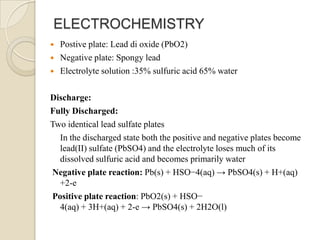
ELECTROCHEMISTRY
   Postive plate: Lead di oxide (PbO2)
   Negative plate: Spongy lead
   Electrolyte solution :35% sulfuric acid 65% water

Discharge:
Fully Discharged:
Two identical lead sulfate plates
  In the discharged state both the positive and negative plates become
  lead(II) sulfate (PbSO4) and the electrolyte loses much of its
  dissolved sulfuric acid and becomes primarily water
Negative plate reaction: Pb(s) + HSO−4(aq) → PbSO4(s) + H+(aq)
  +2-e
Positive plate reaction: PbO2(s) + HSO−
  4(aq) + 3H+(aq) + 2-e → PbSO4(s) + 2H2O(l)
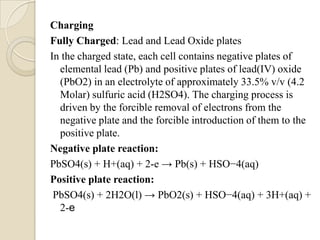
Charging
Fully Charged: Lead and Lead Oxide plates
In the charged state, each cell contains negative plates of
  elemental lead (Pb) and positive plates of lead(IV) oxide
  (PbO2) in an electrolyte of approximately 33.5% v/v (4.2
  Molar) sulfuric acid (H2SO4). The charging process is
  driven by the forcible removal of electrons from the
  negative plate and the forcible introduction of them to the
  positive plate.
Negative plate reaction:
PbSO4(s) + H+(aq) + 2-e → Pb(s) + HSO−4(aq)
Positive plate reaction:
 PbSO4(s) + 2H2O(l) → PbO2(s) + HSO−4(aq) + 3H+(aq) +
  2-e
Adding up of battery voltages
   A battery is a cluster of cells connected together for greater voltage
    and/or current capacity. Cells connected together in series (polarities
    aiding) results in greater total voltage. Physical cell size impacts cell
    resistance, which in turn impacts the ability for the cell to supply
    current to a circuit. Generally, the larger the cell, the less its internal
    resistance. Cells connected together in parallel results in less total
    resistance, and potentially greater total current.
   The total voltage of a battery is the sum of all cell voltages. A typical
    automotive lead-acid battery has six cells, for a nominal voltage
    output of 6 x 2.0 or 12.0 volts:
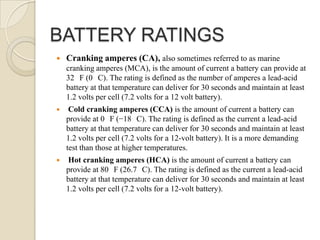
BATTERY RATINGS
   Cranking amperes (CA), also sometimes referred to as marine
    cranking amperes (MCA), is the amount of current a battery can provide at
    32 F (0 C). The rating is defined as the number of amperes a lead-acid
    battery at that temperature can deliver for 30 seconds and maintain at least
    1.2 volts per cell (7.2 volts for a 12 volt battery).
    Cold cranking amperes (CCA) is the amount of current a battery can
    provide at 0 F (−18 C). The rating is defined as the current a lead-acid
    battery at that temperature can deliver for 30 seconds and maintain at least
    1.2 volts per cell (7.2 volts for a 12-volt battery). It is a more demanding
    test than those at higher temperatures.
   Hot cranking amperes (HCA) is the amount of current a battery can
    provide at 80 F (26.7 C). The rating is defined as the current a lead-acid
    battery at that temperature can deliver for 30 seconds and maintain at least
    1.2 volts per cell (7.2 volts for a 12-volt battery).
   Reserve capacity minutes (RCM), also referred to as reserve
    capacity (RC), is a battery's ability to sustain a minimum stated
    electrical load; it is defined as the time (in minutes) that a lead-acid
    battery at 80 F (27 C) will continuously deliver 25 amperes
    before its voltage drops below 10.5 volts.
   Battery Council International group size (BCI) specifies a battery's
    physical dimensions, such as length, width, and height. These
    groups are determined by the Battery Council International
    organization.
   Ampere-hours (A·h) is a measure of electrical charge that a
    battery can deliver. This quantity is one indicator of the total
    amount of charge that a battery is able to store and deliver at its
    rated voltage. Its value is the product of the discharge-current (in
    amperes), multiplied by the duration (in hours) for which this
    discharge-current can be sustained by the battery
MAINTENANCE
    Fluid level
   Car batteries using lead-antimony plates would
    require regular watering to replace water lost due to
    electrolysis on each charging cycle. Modern car
    batteries have reduced maintenance requirements,
    and may not provide caps for addition of water to
    the cells.. Prolonged overcharging or charging at
    excessively high voltage causes some of the water in
    the electrolyte to be broken up into hydrogen and
    oxygen gases, which escape from the cells. If the
    electrolyte liquid level drops too low, the plates are
    exposed to air, lose capacity, and are damaged. The
    sulfuric acid in the battery normally does not require
    replacement since it is not consumed even on
    overcharging. Impurities or additives in the water
    will reduce the life and performance of the battery.
    Manufacturers usually recommend use of
    demineralized or distilled water, since even potable
    tap water can contain high levels of minerals.
CHARGING
   In normal automotive service the vehicle's charging system powers
    the vehicle's electrical systems and restores charge used from the
    battery during engine cranking. When installing a new battery or
    recharging a battery that has been accidentally discharged
    completely, one of several different methods can be used to charge
    it. The most gentle of these is called trickle charging. Other methods
    include slow-charging and quick-charging
   The voltage regulator of the charge system does not measure the
    relative currents charging the battery and for powering the car's
    loads. The charge system essentially provides a fixed voltage of
    typically 13.8 to 14.4 V (Volt), A discharged battery draws a high
    charge current of typically 20 to 40 A (Ampere). As the battery gets
    charged the charge current typically decreases to 2—5 A. A high
    load results when multiple high-power systems such as ignition,
    radiator fan, heater blowers, lights and entertainment system are
    running. In this case, the battery voltage will begin to decrease
    unless the engine is running at a higher rpm and the
    alternator/generator is delivering at least enough current to power the
    load.
   In emergencies a vehicle can be jump started by the battery of
    another vehicle or by a portable battery booster.
   Whenever the car's charge system is inadequate to fully charge the
    battery, a battery charger can be used. Simple chargers do not
    regulate the charge current, and the user needs to stop the process or
    lower the charge current to prevent excessive gassing of the battery.
    More elaborate chargers, in particular those implementing the 3-step
    charge profile, also referred to as IUoU, charge the battery fully and
    safely in a short time without requiring user intervention.
    Desulfating chargers are also commercially available for charging
    all types of lead-acid batteries.
BATTERY BEING JUMP
STARTED
Storage
 Batteries last longer when stored in a charged state. Leaving an
 automotive battery discharged will shorten its life, or make it
 unusable if left for a long time (usually several years); sulfation
 eventually becomes irreversible by normal charging. Batteries in
 storage may be monitored and periodically charged, or attached to a
 "float" charger to retain their capacity. Batteries are prepared for
 storage by charging and cleaning deposits from the posts. Batteries
 are stored in a cool, dry environment for best results since high
 temperatures increase the self discharge rate and plate corrosion.
MEASUREMENT OF CHARGE
   Because the electrolyte takes part in
    the charge-discharge reaction, this
    battery has one major advantage
    over other chemistries. It is
    relatively simple to determine the
    state of charge by merely measuring
    the specific gravity (S.G.) of the
    electrolyte, It is the weight of the
    sulfuric acid-water mixture
    compared to an equal volume of
    water. the S.G. falling as the battery
    discharges. Some battery designs
    include a simple hydrometer using
    colored floating balls of differing
    density. When used in diesel-
    electric submarines, the S.G. was
    regularly measured and written on a
    blackboard in the control room to
    indicate how much longer the boat
    could remain submerged
Open circuite voltage for various
charges
The open circuit voltage , is measured when the engine is off and no
loads are connected. It can be approximately related to the charge of the
battery
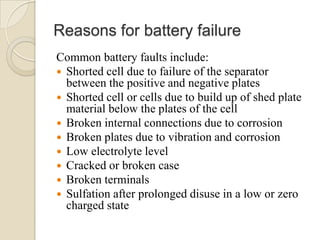
Reasons for battery failure
Common battery faults include:
 Shorted cell due to failure of the separator
  between the positive and negative plates
 Shorted cell or cells due to build up of shed plate
  material below the plates of the cell
 Broken internal connections due to corrosion
 Broken plates due to vibration and corrosion
 Low electrolyte level
 Cracked or broken case
 Broken terminals
 Sulfation after prolonged disuse in a low or zero
  charged state
Casestudy
delco
IDNS40 BATTERY USED IN MARUTI 800 AND OMNI
Delco IDN150 BATTERY USED IN TATA HCVS
ELECTRIC VEHICLE BATTERY
   An electric vehicle battery (EVB) or traction battery is a
    rechargeable battery used for propulsion of battery electric vehicles
    (BEVs). Traction batteries are used in forklifts, electric Golf carts,,
    and other electric vehicles.
   They are designed to give power over sustained periods of time
   Batteries for electric vehicles are characterized by their relatively
    high power-to-weight ratio, energy to weight ratio and energy
    density; smaller, lighter batteries reduce the weight of the vehicle
    and improve its performance. Compared to liquid fuels, all current
    battery technologies have much lower specific energy; and this
    often impacts the maximum all-electric range of the vehicles over
    sustained periods of time
Types of batterys used in electric vehicles

  Lead-acid
 Nickel metal hydride
 Zebra
 Lithium ion
 Lead-acid batteries are the most available and inexpensive.
 Such conversions generally have a range of 30 to 80 km
 Production EVs with lead-acid batteries are capable of up to
 130 km (80 mi) per charge.
 NiMH batteries have higher energy density than lead-acid;
 prototype EVs deliver up to 200 km (120 mi) of range.
 New lithium-ion battery-equipped EVs provide 320–480 km
 (200–300 mi) of range per charge.
  Lithium is also less expensive than nickel.
 Nickel-zinc battery are cheaper and lighter than Nickel-
 cadmium batteries. They are also cheaper but heavier than
 Lithium-Ion batteries
high power Ni-MH Battery of Toyota
NHW20 Prius, Japan
Nissan Leaf's lithium-ion battery
pack.
Automotive battery

Automotive battery

  • 1.
    AUTOMOTIVE BATTERY By A. Jayanth joseph S.Stalin wilfred S.Yuvaraja
  • 2.
    Battery :  An electrical battery is one or more electrochemical cells that convert stored chemical energy into electrical energy  There are two types of batteries: primary batteries (disposable batteries), which are designed to be used once and discarded, and secondary batteries (rechargeable batteries), which are designed to be recharged and used multiple times. Batteries come in many sizes, from miniature cells used to power hearing aids and wristwatches to battery banks the size of rooms that provide standby power for telephone exchanges and computer data centers
  • 3.
    AUTOMOTIVE BATTERY  An automotive battery is a type of rechargeable battery that supplies electric energy to an automobile. Usually this refers to an SLI battery (starting, lighting, ignition) to power the starter motor, the lights, and the ignition system of a vehicle’s engine.  Automotive SLI batteries are usually lead-acid type, and are made of six galvanic cells in series to provide a 12 volt system. Each cell provides 2.1 volts for a total of 12.6 volt at full charge. Heavy vehicles such as highway trucks or tractors, often equipped with diesel engines, may have two batteries in series for a 24 volt system, or may have parallel strings of batteries.
  • 4.
  • 5.
    Lead-acid batteries store energy using a reversible chemical reaction between lead plates and dilute sulphuric acid (electrolyte). There are three basic types of lead acid battery - starter batteries: used to start engines in cars etc, deep-cycle batteries: used in renewable energy applications and camping etc, and marine batteries: used both for starting and for deep cycle applications  The deep cycle battery has less instant energy but greater long-term energy delivery. Deep cycle batteries have thicker plates and can survive a number of discharge cycles.
  • 6.
    CONSTRUCTION  In thebattery, several similar plates are properly spaced and welded, or lead-burned, to a strap. This forms a plate group.  Plates of two types are used, one for the positive plate group, the other for the negative plate group. A positive plate group is nested with a negative plate group.  Separators are placed between the plates to form an element The separators hold the plates apart so that they do not touch. At the same time the separators are porous enough to permit liquid in circulate between the plates. Wooden sheets, spun glass matted into sheets and porous sponge rubber sheets have been used as separators. Late model batteries have separators made of acid- resistant polyvinyl chloride on polyethylene saturated cellulose.
  • 7.
    An effective separator must possess a number of mechanical properties; such as permeability, porosity, pore size distribution, specific surface area, mechanical design and strength, electrical resistance, ionic conductivity, and chemical compatibility with the electrolyte. In service, the separator must have good resistance to acid and oxidation. The area of the separator must be a little larger than the area of the plates to prevent material shorting between the plates. The separators must remain stable over the battery's operating temperature range.  In many batteries, the cover has openings through which liquid can be added water; the filler plug or vent caps are removed. After the liquid is added and the battery is given an initial charge. It is ready for operation. Maintenance-free batteries have no vent caps
  • 8.
  • 9.
    ELECTROCHEMISTRY  Postive plate: Lead di oxide (PbO2)  Negative plate: Spongy lead  Electrolyte solution :35% sulfuric acid 65% water Discharge: Fully Discharged: Two identical lead sulfate plates In the discharged state both the positive and negative plates become lead(II) sulfate (PbSO4) and the electrolyte loses much of its dissolved sulfuric acid and becomes primarily water Negative plate reaction: Pb(s) + HSO−4(aq) → PbSO4(s) + H+(aq) +2-e Positive plate reaction: PbO2(s) + HSO− 4(aq) + 3H+(aq) + 2-e → PbSO4(s) + 2H2O(l)
  • 10.
    Charging Fully Charged: Leadand Lead Oxide plates In the charged state, each cell contains negative plates of elemental lead (Pb) and positive plates of lead(IV) oxide (PbO2) in an electrolyte of approximately 33.5% v/v (4.2 Molar) sulfuric acid (H2SO4). The charging process is driven by the forcible removal of electrons from the negative plate and the forcible introduction of them to the positive plate. Negative plate reaction: PbSO4(s) + H+(aq) + 2-e → Pb(s) + HSO−4(aq) Positive plate reaction: PbSO4(s) + 2H2O(l) → PbO2(s) + HSO−4(aq) + 3H+(aq) + 2-e
  • 11.
    Adding up ofbattery voltages  A battery is a cluster of cells connected together for greater voltage and/or current capacity. Cells connected together in series (polarities aiding) results in greater total voltage. Physical cell size impacts cell resistance, which in turn impacts the ability for the cell to supply current to a circuit. Generally, the larger the cell, the less its internal resistance. Cells connected together in parallel results in less total resistance, and potentially greater total current.  The total voltage of a battery is the sum of all cell voltages. A typical automotive lead-acid battery has six cells, for a nominal voltage output of 6 x 2.0 or 12.0 volts:
  • 12.
    BATTERY RATINGS  Cranking amperes (CA), also sometimes referred to as marine cranking amperes (MCA), is the amount of current a battery can provide at 32 F (0 C). The rating is defined as the number of amperes a lead-acid battery at that temperature can deliver for 30 seconds and maintain at least 1.2 volts per cell (7.2 volts for a 12 volt battery).  Cold cranking amperes (CCA) is the amount of current a battery can provide at 0 F (−18 C). The rating is defined as the current a lead-acid battery at that temperature can deliver for 30 seconds and maintain at least 1.2 volts per cell (7.2 volts for a 12-volt battery). It is a more demanding test than those at higher temperatures.  Hot cranking amperes (HCA) is the amount of current a battery can provide at 80 F (26.7 C). The rating is defined as the current a lead-acid battery at that temperature can deliver for 30 seconds and maintain at least 1.2 volts per cell (7.2 volts for a 12-volt battery).
  • 13.
    Reserve capacity minutes (RCM), also referred to as reserve capacity (RC), is a battery's ability to sustain a minimum stated electrical load; it is defined as the time (in minutes) that a lead-acid battery at 80 F (27 C) will continuously deliver 25 amperes before its voltage drops below 10.5 volts.  Battery Council International group size (BCI) specifies a battery's physical dimensions, such as length, width, and height. These groups are determined by the Battery Council International organization.  Ampere-hours (A·h) is a measure of electrical charge that a battery can deliver. This quantity is one indicator of the total amount of charge that a battery is able to store and deliver at its rated voltage. Its value is the product of the discharge-current (in amperes), multiplied by the duration (in hours) for which this discharge-current can be sustained by the battery
  • 14.
    MAINTENANCE Fluid level  Car batteries using lead-antimony plates would require regular watering to replace water lost due to electrolysis on each charging cycle. Modern car batteries have reduced maintenance requirements, and may not provide caps for addition of water to the cells.. Prolonged overcharging or charging at excessively high voltage causes some of the water in the electrolyte to be broken up into hydrogen and oxygen gases, which escape from the cells. If the electrolyte liquid level drops too low, the plates are exposed to air, lose capacity, and are damaged. The sulfuric acid in the battery normally does not require replacement since it is not consumed even on overcharging. Impurities or additives in the water will reduce the life and performance of the battery. Manufacturers usually recommend use of demineralized or distilled water, since even potable tap water can contain high levels of minerals.
  • 15.
    CHARGING  In normal automotive service the vehicle's charging system powers the vehicle's electrical systems and restores charge used from the battery during engine cranking. When installing a new battery or recharging a battery that has been accidentally discharged completely, one of several different methods can be used to charge it. The most gentle of these is called trickle charging. Other methods include slow-charging and quick-charging  The voltage regulator of the charge system does not measure the relative currents charging the battery and for powering the car's loads. The charge system essentially provides a fixed voltage of typically 13.8 to 14.4 V (Volt), A discharged battery draws a high charge current of typically 20 to 40 A (Ampere). As the battery gets charged the charge current typically decreases to 2—5 A. A high load results when multiple high-power systems such as ignition, radiator fan, heater blowers, lights and entertainment system are running. In this case, the battery voltage will begin to decrease unless the engine is running at a higher rpm and the alternator/generator is delivering at least enough current to power the load.
  • 16.
    In emergencies a vehicle can be jump started by the battery of another vehicle or by a portable battery booster.  Whenever the car's charge system is inadequate to fully charge the battery, a battery charger can be used. Simple chargers do not regulate the charge current, and the user needs to stop the process or lower the charge current to prevent excessive gassing of the battery. More elaborate chargers, in particular those implementing the 3-step charge profile, also referred to as IUoU, charge the battery fully and safely in a short time without requiring user intervention. Desulfating chargers are also commercially available for charging all types of lead-acid batteries.
  • 17.
  • 18.
    Storage Batteries lastlonger when stored in a charged state. Leaving an automotive battery discharged will shorten its life, or make it unusable if left for a long time (usually several years); sulfation eventually becomes irreversible by normal charging. Batteries in storage may be monitored and periodically charged, or attached to a "float" charger to retain their capacity. Batteries are prepared for storage by charging and cleaning deposits from the posts. Batteries are stored in a cool, dry environment for best results since high temperatures increase the self discharge rate and plate corrosion.
  • 19.
    MEASUREMENT OF CHARGE  Because the electrolyte takes part in the charge-discharge reaction, this battery has one major advantage over other chemistries. It is relatively simple to determine the state of charge by merely measuring the specific gravity (S.G.) of the electrolyte, It is the weight of the sulfuric acid-water mixture compared to an equal volume of water. the S.G. falling as the battery discharges. Some battery designs include a simple hydrometer using colored floating balls of differing density. When used in diesel- electric submarines, the S.G. was regularly measured and written on a blackboard in the control room to indicate how much longer the boat could remain submerged
  • 20.
    Open circuite voltagefor various charges The open circuit voltage , is measured when the engine is off and no loads are connected. It can be approximately related to the charge of the battery
  • 21.
    Reasons for batteryfailure Common battery faults include:  Shorted cell due to failure of the separator between the positive and negative plates  Shorted cell or cells due to build up of shed plate material below the plates of the cell  Broken internal connections due to corrosion  Broken plates due to vibration and corrosion  Low electrolyte level  Cracked or broken case  Broken terminals  Sulfation after prolonged disuse in a low or zero charged state
  • 22.
  • 23.
    Delco IDN150 BATTERYUSED IN TATA HCVS
  • 24.
    ELECTRIC VEHICLE BATTERY  An electric vehicle battery (EVB) or traction battery is a rechargeable battery used for propulsion of battery electric vehicles (BEVs). Traction batteries are used in forklifts, electric Golf carts,, and other electric vehicles.  They are designed to give power over sustained periods of time  Batteries for electric vehicles are characterized by their relatively high power-to-weight ratio, energy to weight ratio and energy density; smaller, lighter batteries reduce the weight of the vehicle and improve its performance. Compared to liquid fuels, all current battery technologies have much lower specific energy; and this often impacts the maximum all-electric range of the vehicles over sustained periods of time
  • 25.
    Types of batterysused in electric vehicles  Lead-acid  Nickel metal hydride  Zebra  Lithium ion Lead-acid batteries are the most available and inexpensive. Such conversions generally have a range of 30 to 80 km Production EVs with lead-acid batteries are capable of up to 130 km (80 mi) per charge. NiMH batteries have higher energy density than lead-acid; prototype EVs deliver up to 200 km (120 mi) of range. New lithium-ion battery-equipped EVs provide 320–480 km (200–300 mi) of range per charge. Lithium is also less expensive than nickel. Nickel-zinc battery are cheaper and lighter than Nickel- cadmium batteries. They are also cheaper but heavier than Lithium-Ion batteries
  • 26.
    high power Ni-MHBattery of Toyota NHW20 Prius, Japan
  • 27.