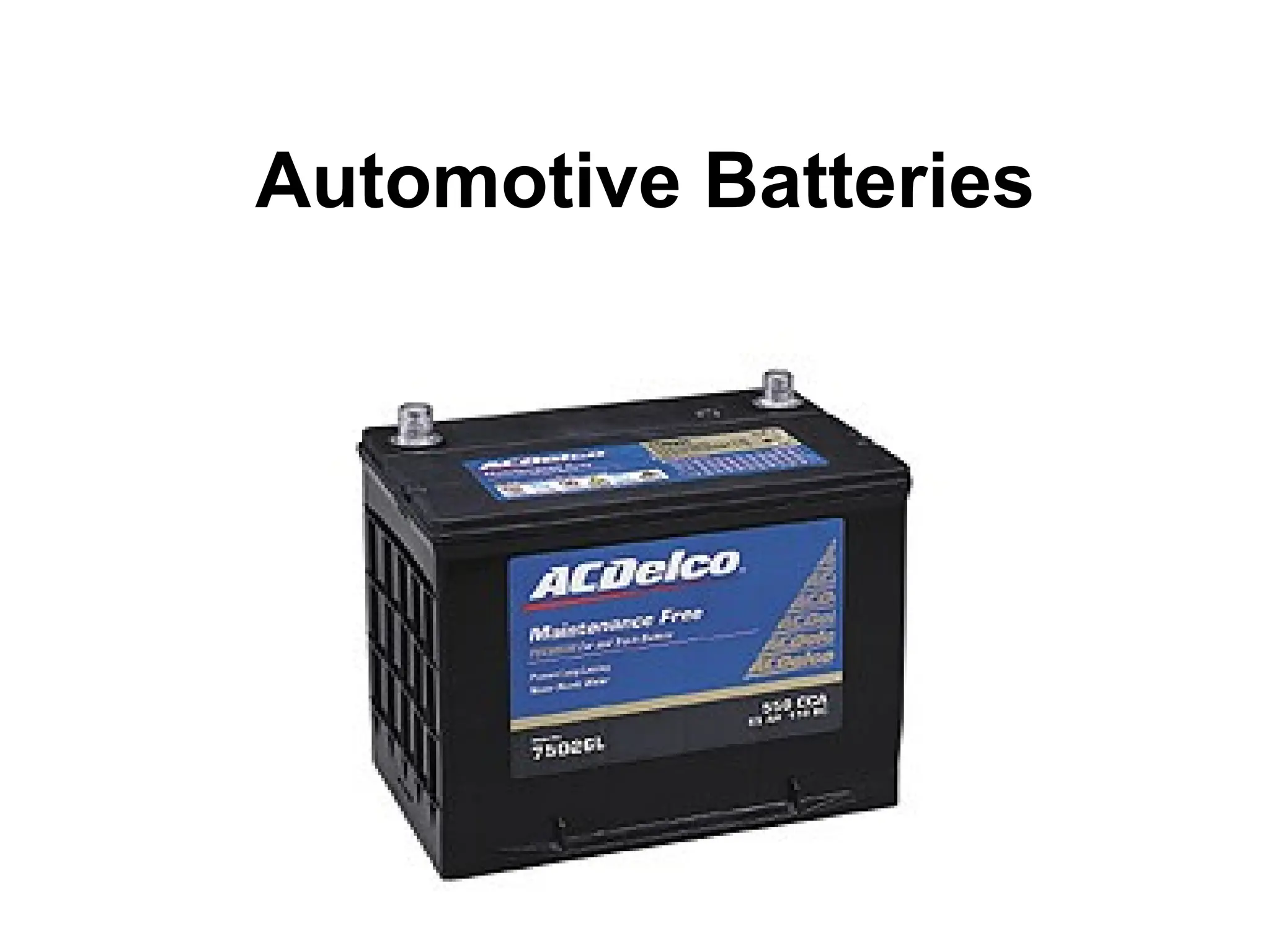
Battery Purpose
• Suppliesall electrical power when the charging system is
not operating
• Acts as a voltage stabilizer for the charging system
• Provides extra current for short periods of time while the
charging system is catching up to a new load
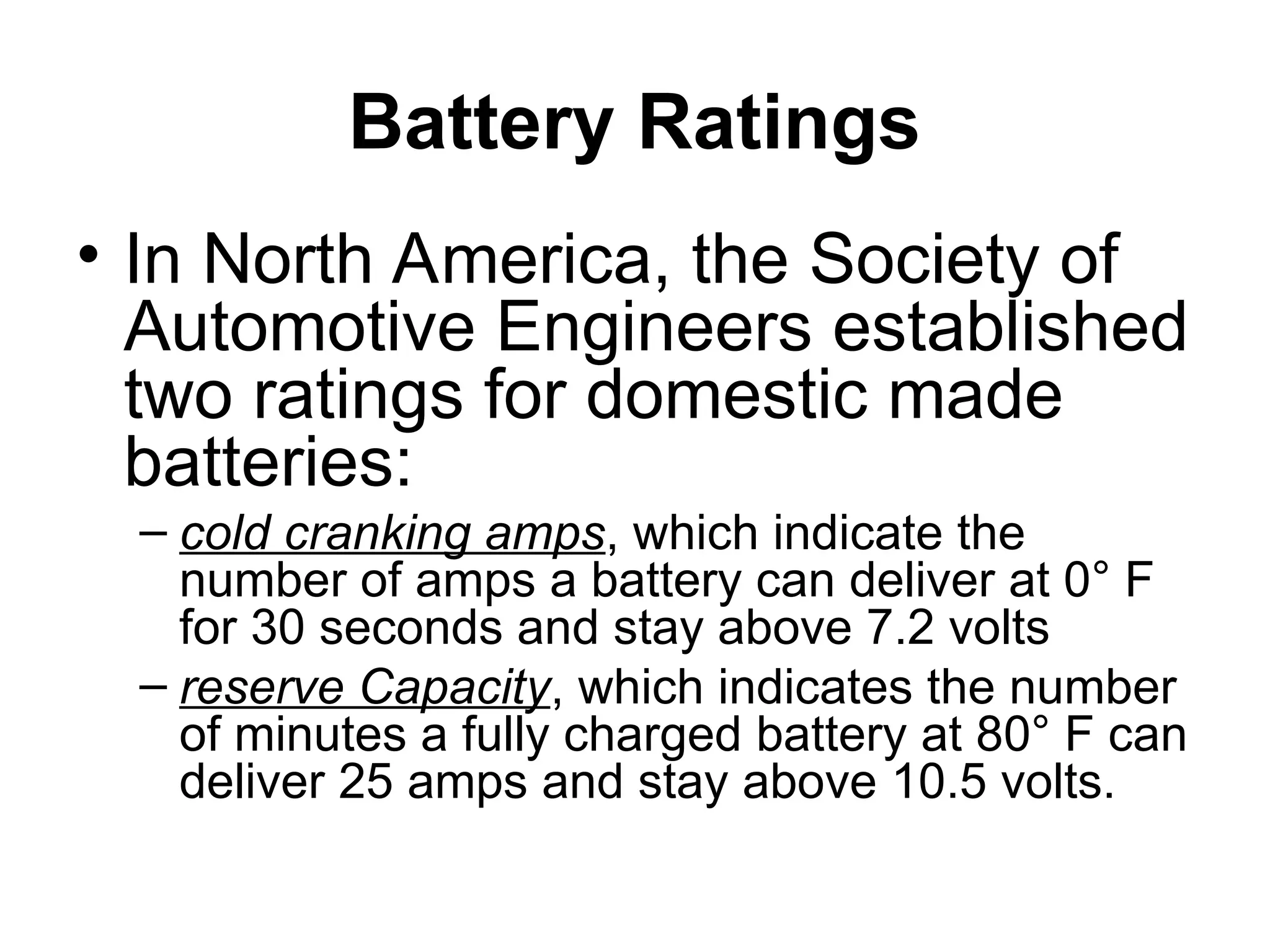
Battery Ratings
• InNorth America, the Society of
Automotive Engineers established
two ratings for domestic made
batteries:
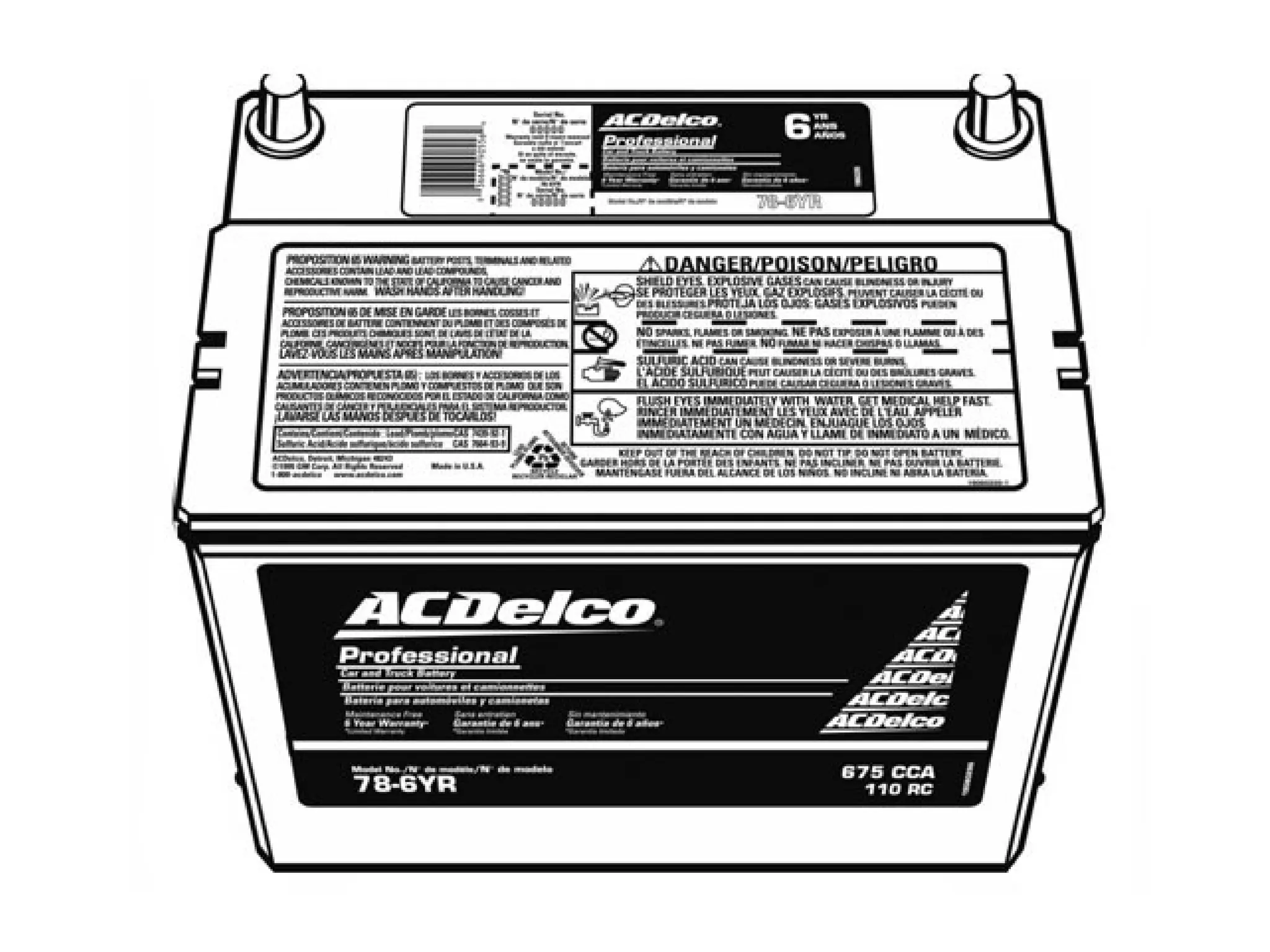
– cold cranking amps, which indicate the
number of amps a battery can deliver at 0° F
for 30 seconds and stay above 7.2 volts
– reserve Capacity, which indicates the number
of minutes a fully charged battery at 80° F can
deliver 25 amps and stay above 10.5 volts.
13.
Voltage
• A typicalbattery has six
cells.
• The cells are connected
in a series configuration.
• Each cell generates
approximately 2.1 volts
• This equates to each
battery having an actual
voltage of 12.6 volts.
14.
Battery Construction
• Eachcell contains
a series of lead
plates.
• Some lead plates
are positive (lead
dioxide) in charge
and some are
negative (lead).
• The plates are kept
from touching by a
porous separator
material, usually
plastic or fiberglass.
15.
Battery Construction
• Abattery produces
electricity during the
chemical reaction
between the lead
plates and the
electrolyte.
• The electrolyte is 36%
water (H2O) and 64%
sulfuric acid (H2SO4)
when the battery is
fully charged.
16.
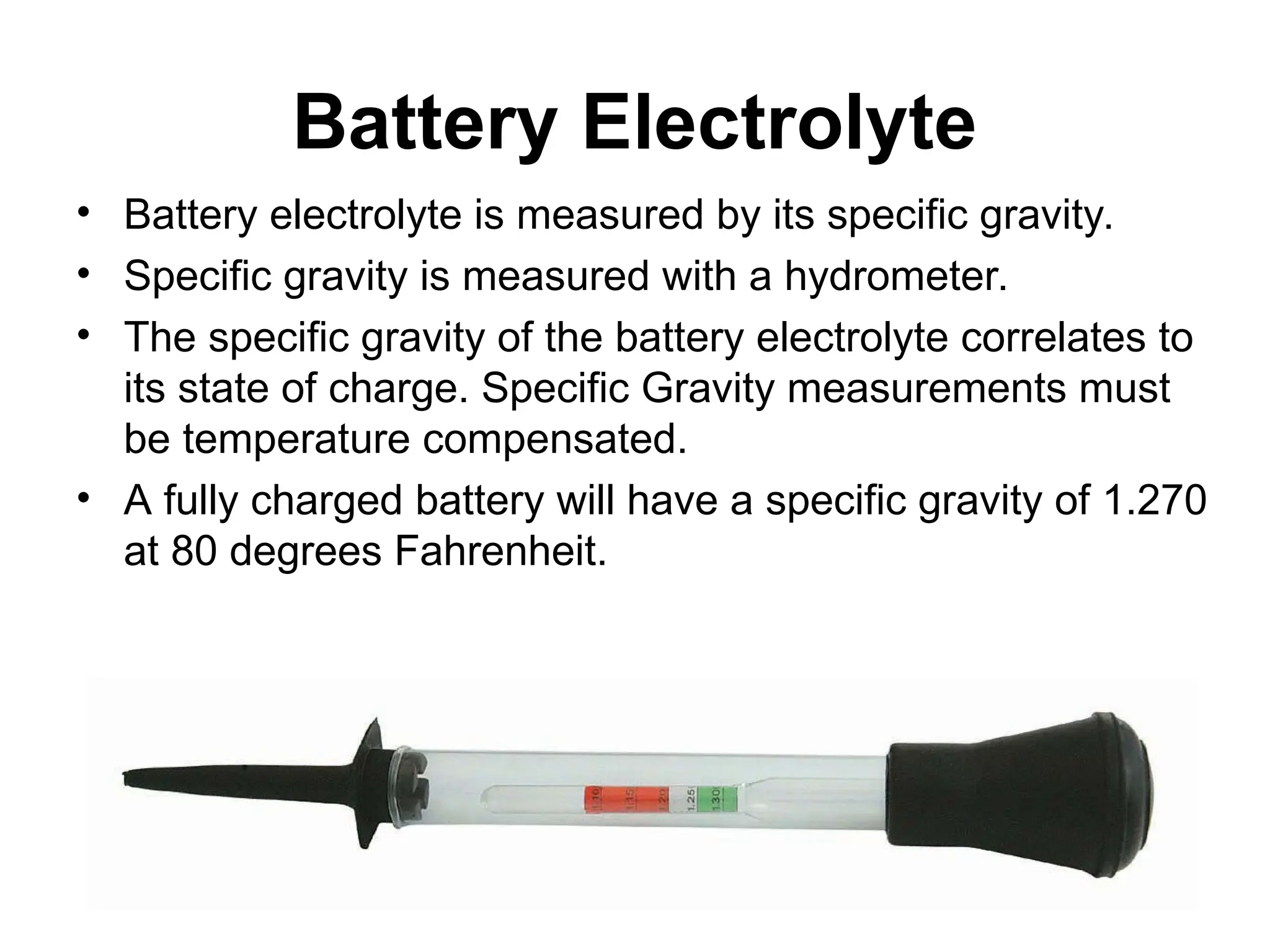
Battery Electrolyte
• Batteryelectrolyte is measured by its specific gravity.
• Specific gravity is measured with a hydrometer.
• The specific gravity of the battery electrolyte correlates to
its state of charge. Specific Gravity measurements must
be temperature compensated.
• A fully charged battery will have a specific gravity of 1.270
at 80 degrees Fahrenheit.
• Batteries todaycan have a built in
hydrometer to measure the specific gravity
or state of charge in the battery. Built in
hydrometers show colored dots that are
either:
• Green – 65% or better charged
• Black – must charged before testing
• Clear – low electrolyte level, discard
battery
19.
Maintenance Free Batteries
•Most batteries today
are said to be
maintenance free
• These batteries do
NOT have removable
caps on the top.
• These batteries have
an open chamber
under the lid
– Called a liquid/gas
separator
There are manynew types of
batteries on the market today
• One of these is the
absorbent glass mat
battery or AGM battery.
• This battery contains
absorbent mat separators
that prevent the
electrolyte from leaking
• This reduces the effects
of vibration, which
extends battery life.
22.
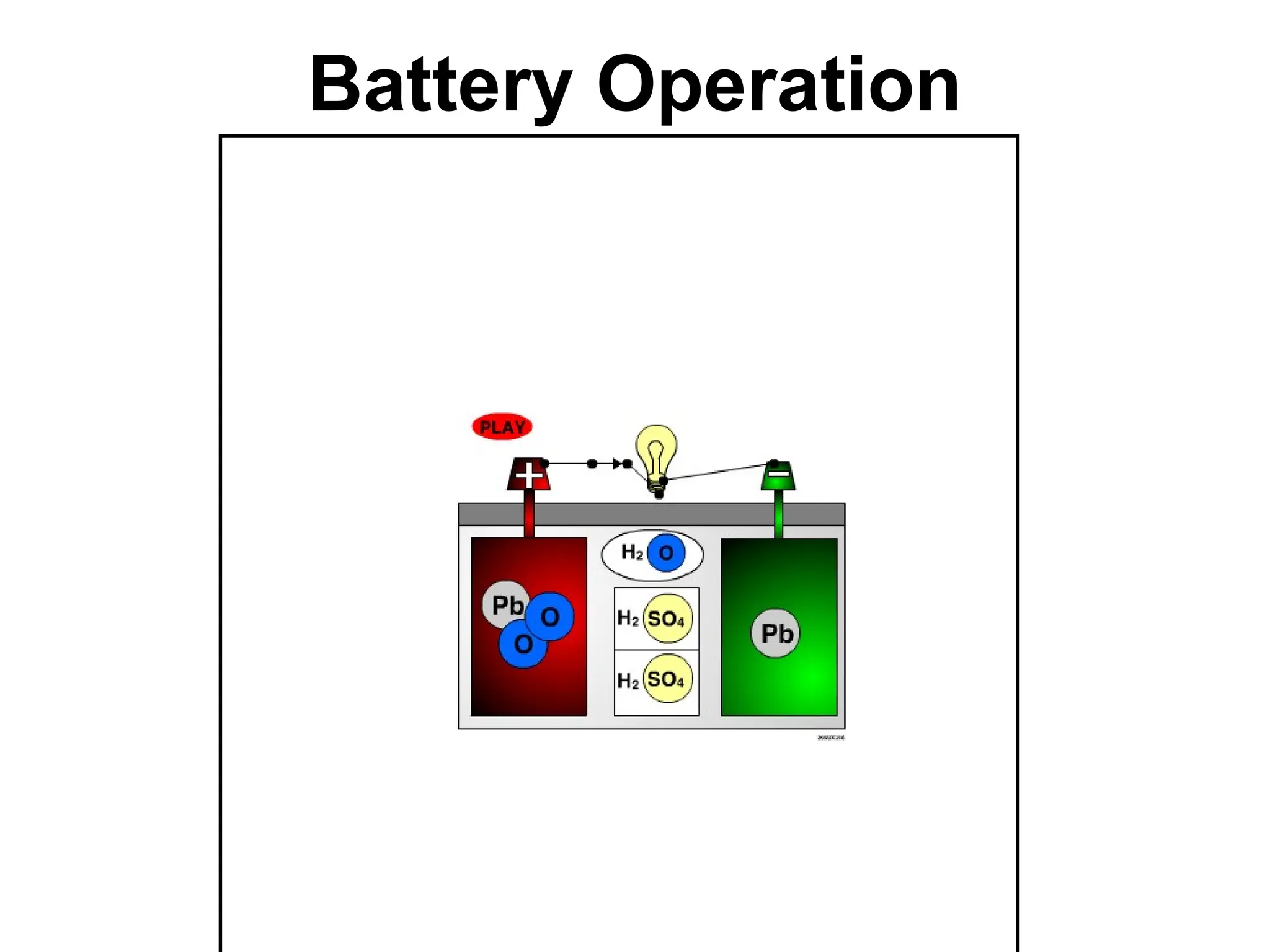
Battery Operation
• Duringthe generation of electricity the
battery discharges.
• During discharge the positive and negative
plate surfaces become sulfated causing the
battery to lose voltage.
23.
As the batterydischarges, a chemical
reaction occurs
• The oxygen molecules from the positive plate’s
lead dioxide (PbO2) are released into the
electrolyte
• The electrolyte absorbs the oxygen molecules
and releases it’s sulfate molecules
• This causes the positive and negative plates lead
(Pb) to gain sulfate molecules (SO4 )
– both of the plates are changing to lead sulfate (PbSO4)
– the electrolyte’s acid is changing to water (H2O).
• As the battery is recharged the reaction is
reversed.
Battery Discharge Conditions
•Starting a vehicle
• When the demand of the electrical system
exceeds the output of the generator
(usually at idle)
• Using powered accessories while the
vehicle is not running.
• Battery or vehicle storage
• Normal battery drain (parasitic draw)
– Clocks
– Radio station presets
– Computer memory
28.
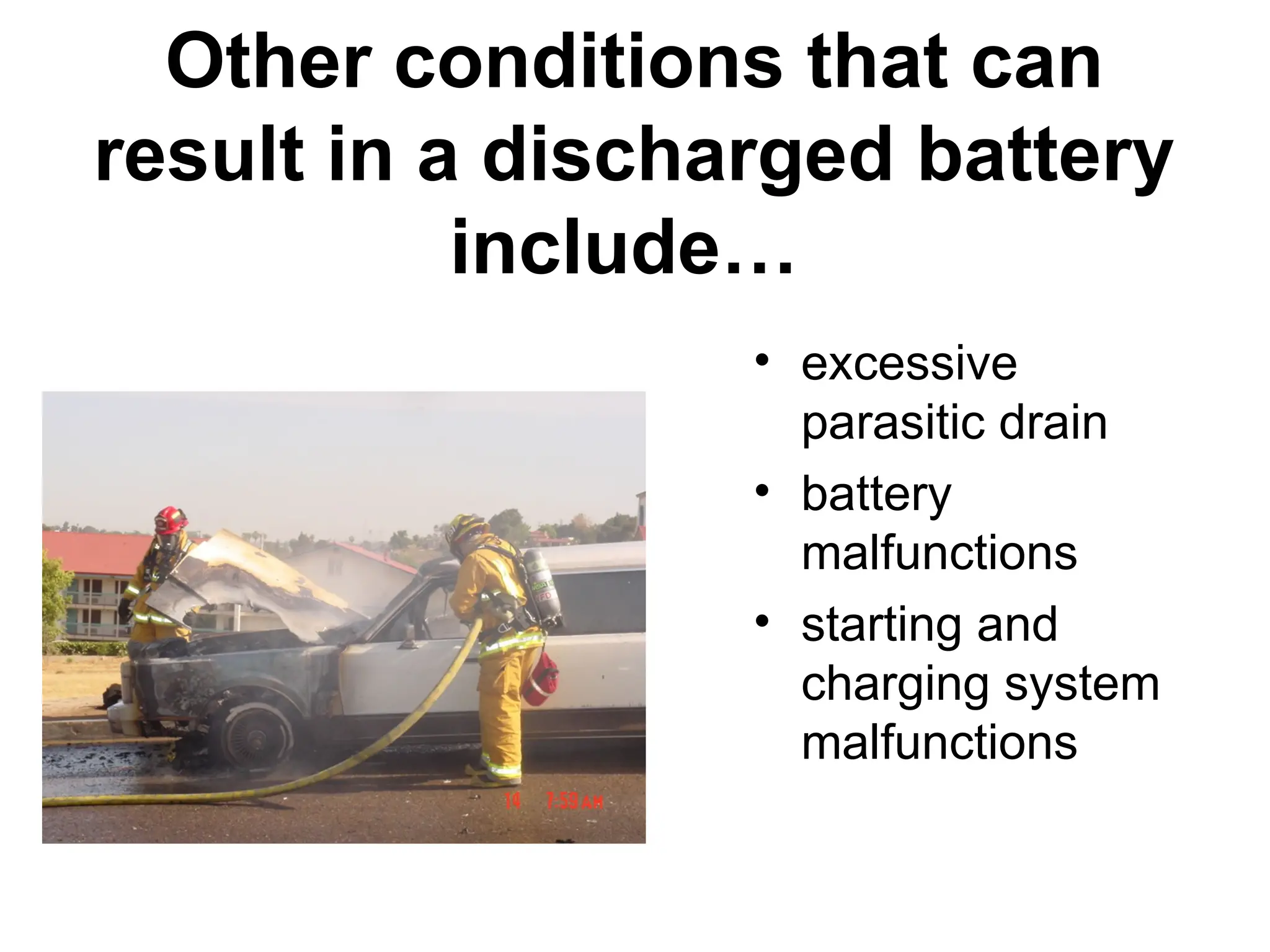
Other conditions thatcan
result in a discharged battery
include…
• excessive
parasitic drain
• battery
malfunctions
• starting and
charging system
malfunctions
29.
Battery Charging
• Whenthe engine is
running at sufficient
speed, the generator
in the charging
system supplies
current to the battery.
In this condition, the
battery is said to be
charging.
30.
Battery Charging
• Whena battery is
nearly or
completely
discharged,
recharging is
required for the
battery to provide
proper service.
Battery Charging
• Whena charger is first
connected to a completely
discharged battery, the battery
accepts only a small amount
of current.
• As the battery becomes more
charged, electrolytes begin to
return to sulfuric acid,
therefore increasing the
charge rate. The charge time
for a completely discharged
battery may be more than
twice as long as that for a half-
charged battery.
33.
Battery Charging
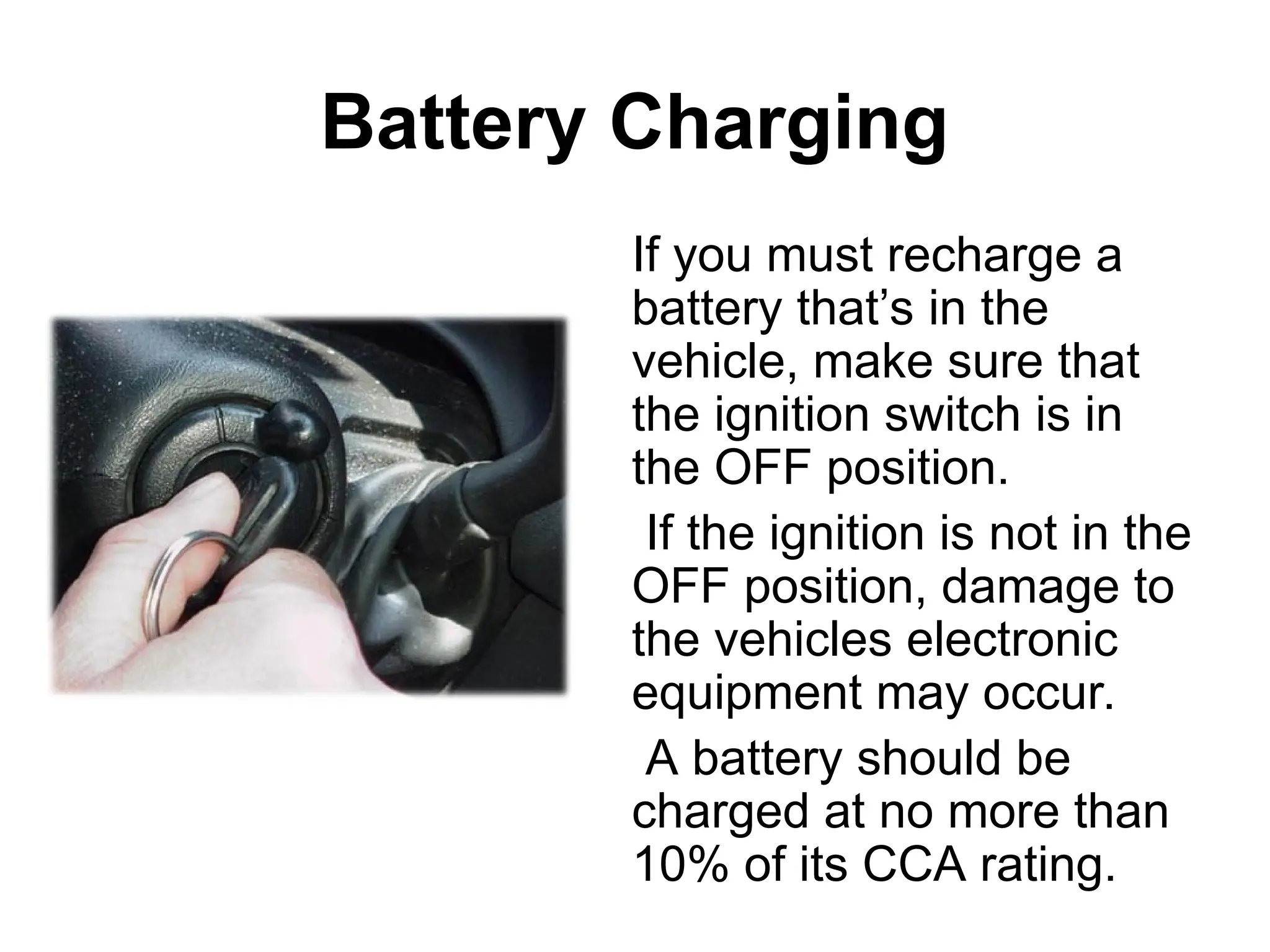
• Ifyou must recharge a
battery that’s in the
vehicle, make sure that
the ignition switch is in
the OFF position.
• If the ignition is not in the
OFF position, damage to
the vehicles electronic
equipment may occur.
• A battery should be
charged at no more than
10% of its CCA rating.
Storing Batteries
1. Whena battery is new the lead and acid will begin to react
and it will slowly discharge.
2. Any battery that sits unused for several months will slowly
go dead and begin to sulfate.
3. This will ruin the battery..
4. All batteries should be periodically recharged.
5. New batteries, awaiting sale, are given a “trickle charge” (2
- 4A) on a regular schedule
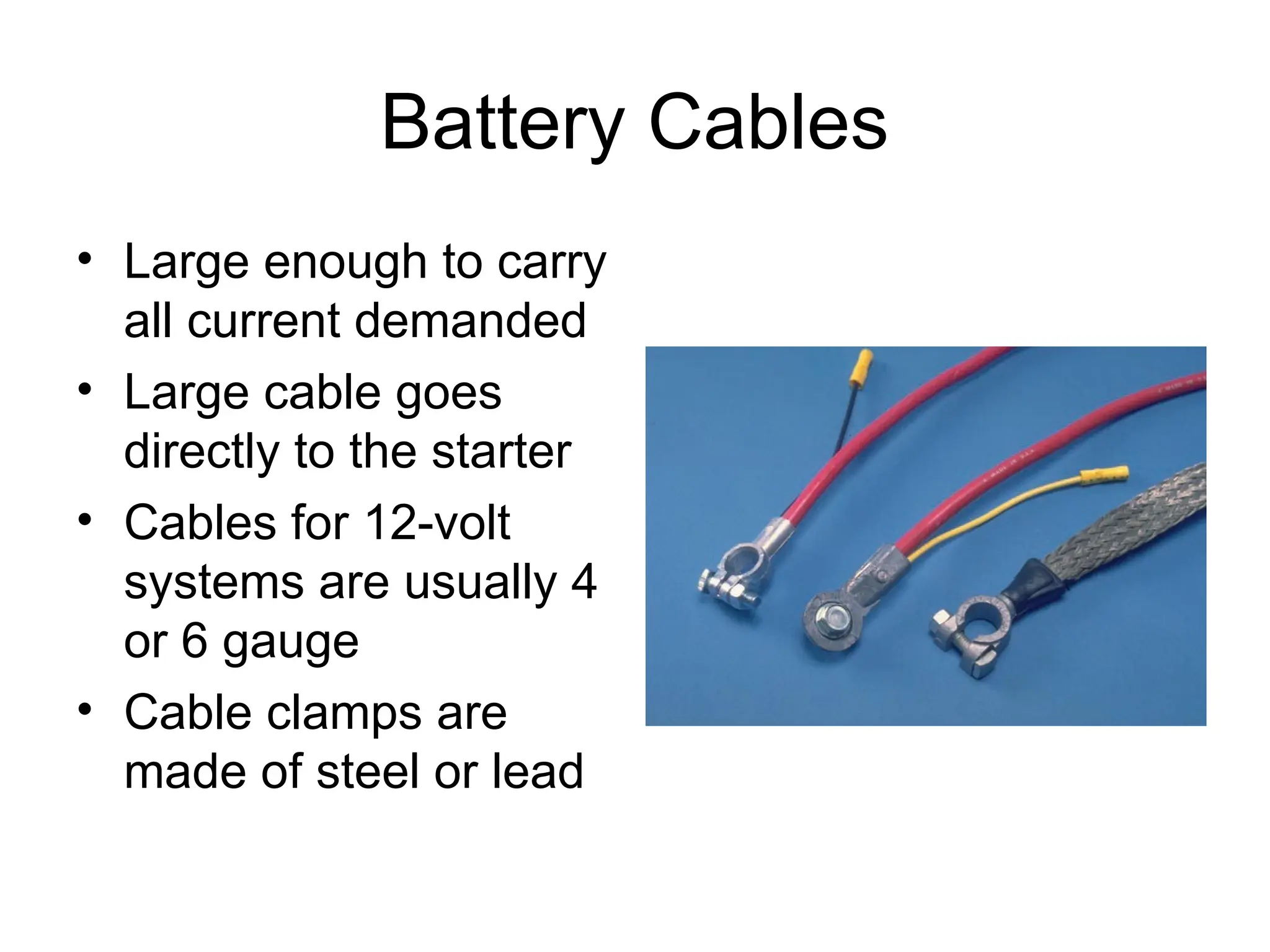
Battery Cables
• Largeenough to carry
all current demanded
• Large cable goes
directly to the starter
• Cables for 12-volt
systems are usually 4
or 6 gauge
• Cable clamps are
made of steel or lead
38.
Battery Hold-downs
• Batterymust be held
in its tray
• Excessive vibration
can harm the battery
• Holddowns are made
of steel or plastic
39.
Reasons for BatteryFailure
• Damaged battery case can leak electrolyte
• Undercharging can cause sulfation
• Overcharging can cause buckled/warped plates
• Vibration can cause more material to be shed
from plates
• Short between the plates can cause a dead cell
• Age (batteries are good for three to six years)
40.
Hybrid and OtherBattery Types
• Other types of batteries
include:
– Nickel metal hydride
batteries
– Lithium-ion batteries
• Hybrid battery voltages
range 200 – 500 volts
– This can kill you!
– Be careful!
– Do not work on a hybrid
until you have been
schooled!