KEYPOINTS-
BATTERY RATING
BATTERY EFFICIENCY
BATTERY CHARGING AND IT’S METHODS
CONCEPT OF DEPTH DISCHARGING
PARTICIPANTS NAME - RITESH PATIL , GAURI RAYKAR , UTKARSH
BARGE
UNDER GUIDANCE OF MRS KRANTI RAHANE
BATTERY
BATTERY RATING
• The battery rating is specified in ampere-hours (Ah).
• It indicates the amount of electricity which a battery can supply at the
specified discharge rate, till its voltage falls to a specified value.
• For a lead acid battery, the discharge rate is specified as 10 hours or 8
hours while the value of voltage to which it should fall is specified as 1.8 V.
• Mathematically the product of discharge current in amperes and the time for
discharge in hours till voltage falls to a specified value is the rating of a
battery.
• Battery rating = ID x TD (Ah)
• Where
ID = Discharge current in amperes TD = Time of discharge in hours till
voltage falls to a specified value.
Sometimes it is specified as watt-hours (Wh). It is the product of the
average voltage during discharge and the ampere hour rating of a battery.
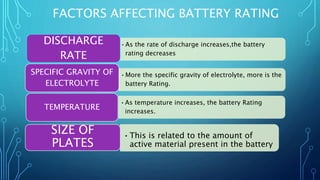
FACTORS AFFECTING BATTERY RATING
•As the rate of discharge increases,the battery
rating decreases
DISCHARGE
RATE
•More the specific gravity of electrolyte, more is the
battery Rating.
SPECIFIC GRAVITY OF
ELECTROLYTE
•As temperature increases, the battery Rating
increases.
TEMPERATURE
SIZE OF
PLATES
•This is related to the amount of
active material present in the battery
GRAPH – BATTERY RATING VS
TEMPERATURE
Battery
Rating
BATTERY EFFICIENCY
•Mainly the battery efficiency is defined as
the ratio of output during discharging to
the input required during charging, to
regain the original state of the battery.
•It is define in two ways as,
•1] Ampere –hour efficiency or quantity
efficiency
•2]Watt – hour efficiency or energy
1] AMPERE – HOUR EFFICIENCY
• It is defined as ratio of output in ampere-hours
during discharging to the input in ampere-hours
during charging. It is denoted as MAh
•% MAh=[Current x Time on discharge]/[Current x
Time on charge] x 100
•• For lead acid battery, it ranges between 80 % to
90 %.
2] WATT – HOUR EFFICIENCY
• It is defined as the ratio of output in watt-hours during discharging to
the input in watt-hours during charging. It is denoted as MWh
• % mWh= [{Voltage during discharge (Avg)} x {Current x Time at
discharge}] x 100
• [ Voltage during charge (average)] x [Currentx Time at charge]
• % mWh= mAh x[ Avg voltage during discharge]
• [Avg voltage during charge ]
• For lead acid battery, watt-hour efficiency ranges between 70 % to 80
%.
BATTERY CHARGING
• During charging, the chemical action takes place which is exactly opposite to that of
discharging Thus current in opposite direction to that at the time of discharge, is
passed through the battery For this the voltage applied is in excess of the voltage of
the battery or cell. The battery voltage acts in opposite direction to that of the applied
voltage and hence called back e.m.f. The charging current can be obtained as
• Charging Current = [Ea – Eb] / [R + r]
• Ea = Applied voltage
• Eb = Back e.m.f i.e battery voltage
• R = Exteral resistance in the circuit
• r = Internal resistance of the battery
• The charging current must be adjusted such that the temperature of the electrolyte
will not increase beyond 100° to 110 °F.
BATTERY CHARGING CIRCUIT
METHOD OF BATTERY CHARGING
•1. Constant current method
•2 Constant voltage method
•3. Rectifier method
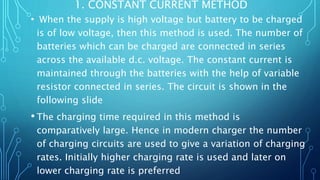
1. CONSTANT CURRENT METHOD
• When the supply is high voltage but battery to be charged
is of low voltage, then this method is used. The number of
batteries which can be charged are connected in series
across the available d.c. voltage. The constant current is
maintained through the batteries with the help of variable
resistor connected in series. The circuit is shown in the
following slide
• The charging time required in this method is
comparatively large. Hence in modern charger the number
of charging circuits are used to give a variation of charging
rates. Initially higher charging rate is used and later on
lower charging rate is preferred
CIRCUIT DIAGRAM
Constant current method circuit
diagram
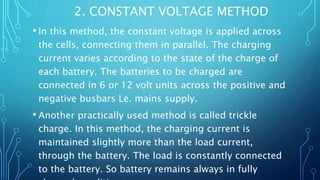
2. CONSTANT VOLTAGE METHOD
• In this method, the constant voltage is applied across
the cells, connecting them in parallel. The charging
current varies according to the state of the charge of
each battery. The batteries to be charged are
connected in 6 or 12 volt units across the positive and
negative busbars Le. mains supply.
• Another practically used method is called trickle
charge. In this method, the charging current is
maintained slightly more than the load current,
through the battery. The load is constantly connected
to the battery. So battery remains always in fully
CIRCUIT DIAGRAM
Parallel charging
circuit
Constant voltage method
circuit
3. RECTIFIER METHOD
•When battery is required to be charged from a.c.
supply, the rectifier method is used.
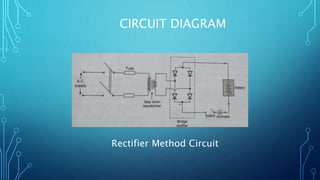
•The rectifier converts a.c. supply to d.c. Generally
bridge rectifier is used for this purpose.
•The step down transformer lowers the ac. supply
voltage as per the requirement.
•The bridge rectifier converts this low a.c voltage to d.c
this is used to charge the battery
CIRCUIT DIAGRAM
Rectifier Method Circuit
CONCEPT OF DEPTH OF DISCHARGING
• The depth of discharge is a key factor for any battery.
• It is denoted as DoD.. It indicates the degree to which the
battery can be discharged to certain minimum voltage from its
full state of charge.
• Though the battery capacity is mentioned by the manufacturer,
it is not possible to use its entire capacity. The depth of
discharge gives the indication that up to which level of
discharge, the battery capacity can be used safely.
• Depth of Discharge is defined as the capacity in Ampere Hours
(Ah) that is discharged from a fully charged battery, divided by
battery nominal capacity. DoD is normally represented in
percent (%).
• When the battery is discharged to its full energy capacity then its DoD
is 100%
• Lithium ion batteries can typically be discharged up to 80 % before
reaching a potentially harmful state of deep discharge. They have a
battery management system to prevent deep discharge.
• Most battery manufacturers indicate in the specification sheet the
maximum recommended DoD for peak performance of the battery. If
the manufacturer of a 20 kWh battery recommends a maximum DoD
of 60 %, it means that you should avoid discharging more than 12 kWh
without recharging.
THANK
YOU

battery ppt.pptx

  • 1.
    KEYPOINTS- BATTERY RATING BATTERY EFFICIENCY BATTERYCHARGING AND IT’S METHODS CONCEPT OF DEPTH DISCHARGING PARTICIPANTS NAME - RITESH PATIL , GAURI RAYKAR , UTKARSH BARGE UNDER GUIDANCE OF MRS KRANTI RAHANE BATTERY
  • 2.
    BATTERY RATING • Thebattery rating is specified in ampere-hours (Ah). • It indicates the amount of electricity which a battery can supply at the specified discharge rate, till its voltage falls to a specified value. • For a lead acid battery, the discharge rate is specified as 10 hours or 8 hours while the value of voltage to which it should fall is specified as 1.8 V. • Mathematically the product of discharge current in amperes and the time for discharge in hours till voltage falls to a specified value is the rating of a battery. • Battery rating = ID x TD (Ah) • Where ID = Discharge current in amperes TD = Time of discharge in hours till voltage falls to a specified value. Sometimes it is specified as watt-hours (Wh). It is the product of the average voltage during discharge and the ampere hour rating of a battery.
  • 3.
    FACTORS AFFECTING BATTERYRATING •As the rate of discharge increases,the battery rating decreases DISCHARGE RATE •More the specific gravity of electrolyte, more is the battery Rating. SPECIFIC GRAVITY OF ELECTROLYTE •As temperature increases, the battery Rating increases. TEMPERATURE SIZE OF PLATES •This is related to the amount of active material present in the battery
  • 4.
    GRAPH – BATTERYRATING VS TEMPERATURE Battery Rating
  • 5.
    BATTERY EFFICIENCY •Mainly thebattery efficiency is defined as the ratio of output during discharging to the input required during charging, to regain the original state of the battery. •It is define in two ways as, •1] Ampere –hour efficiency or quantity efficiency •2]Watt – hour efficiency or energy
  • 6.
    1] AMPERE –HOUR EFFICIENCY • It is defined as ratio of output in ampere-hours during discharging to the input in ampere-hours during charging. It is denoted as MAh •% MAh=[Current x Time on discharge]/[Current x Time on charge] x 100 •• For lead acid battery, it ranges between 80 % to 90 %.
  • 7.
    2] WATT –HOUR EFFICIENCY • It is defined as the ratio of output in watt-hours during discharging to the input in watt-hours during charging. It is denoted as MWh • % mWh= [{Voltage during discharge (Avg)} x {Current x Time at discharge}] x 100 • [ Voltage during charge (average)] x [Currentx Time at charge] • % mWh= mAh x[ Avg voltage during discharge] • [Avg voltage during charge ] • For lead acid battery, watt-hour efficiency ranges between 70 % to 80 %.
  • 8.
    BATTERY CHARGING • Duringcharging, the chemical action takes place which is exactly opposite to that of discharging Thus current in opposite direction to that at the time of discharge, is passed through the battery For this the voltage applied is in excess of the voltage of the battery or cell. The battery voltage acts in opposite direction to that of the applied voltage and hence called back e.m.f. The charging current can be obtained as • Charging Current = [Ea – Eb] / [R + r] • Ea = Applied voltage • Eb = Back e.m.f i.e battery voltage • R = Exteral resistance in the circuit • r = Internal resistance of the battery • The charging current must be adjusted such that the temperature of the electrolyte will not increase beyond 100° to 110 °F.
  • 9.
  • 10.
    METHOD OF BATTERYCHARGING •1. Constant current method •2 Constant voltage method •3. Rectifier method
  • 11.
    1. CONSTANT CURRENTMETHOD • When the supply is high voltage but battery to be charged is of low voltage, then this method is used. The number of batteries which can be charged are connected in series across the available d.c. voltage. The constant current is maintained through the batteries with the help of variable resistor connected in series. The circuit is shown in the following slide • The charging time required in this method is comparatively large. Hence in modern charger the number of charging circuits are used to give a variation of charging rates. Initially higher charging rate is used and later on lower charging rate is preferred
  • 12.
    CIRCUIT DIAGRAM Constant currentmethod circuit diagram
  • 13.
    2. CONSTANT VOLTAGEMETHOD • In this method, the constant voltage is applied across the cells, connecting them in parallel. The charging current varies according to the state of the charge of each battery. The batteries to be charged are connected in 6 or 12 volt units across the positive and negative busbars Le. mains supply. • Another practically used method is called trickle charge. In this method, the charging current is maintained slightly more than the load current, through the battery. The load is constantly connected to the battery. So battery remains always in fully
  • 14.
  • 15.
    3. RECTIFIER METHOD •Whenbattery is required to be charged from a.c. supply, the rectifier method is used. •The rectifier converts a.c. supply to d.c. Generally bridge rectifier is used for this purpose. •The step down transformer lowers the ac. supply voltage as per the requirement. •The bridge rectifier converts this low a.c voltage to d.c this is used to charge the battery
  • 16.
  • 17.
    CONCEPT OF DEPTHOF DISCHARGING • The depth of discharge is a key factor for any battery. • It is denoted as DoD.. It indicates the degree to which the battery can be discharged to certain minimum voltage from its full state of charge. • Though the battery capacity is mentioned by the manufacturer, it is not possible to use its entire capacity. The depth of discharge gives the indication that up to which level of discharge, the battery capacity can be used safely. • Depth of Discharge is defined as the capacity in Ampere Hours (Ah) that is discharged from a fully charged battery, divided by battery nominal capacity. DoD is normally represented in percent (%).
  • 18.
    • When thebattery is discharged to its full energy capacity then its DoD is 100% • Lithium ion batteries can typically be discharged up to 80 % before reaching a potentially harmful state of deep discharge. They have a battery management system to prevent deep discharge. • Most battery manufacturers indicate in the specification sheet the maximum recommended DoD for peak performance of the battery. If the manufacturer of a 20 kWh battery recommends a maximum DoD of 60 %, it means that you should avoid discharging more than 12 kWh without recharging.
  • 19.