Turbulent Scales
Khusro Kamaluddin
Introduction
“Big whirls have little whirls that feed on their velocity, and little
whirls have lesser whirls and so on to viscosity”- Richardson(1922)
Fully developed turbulent flow is considered.
The largest eddies are created by instabilities in mean flow
These are further subjected to inertia instabilities leading to breakup
into progressively smaller eddies.
Dissipation (↑) → Instantaneous velocity gradient (↑)
Introduction
“Big whirls have little whirls that feed on their velocity, and little
whirls have lesser whirls and so on to viscosity”- Richardson(1922)
Fully developed turbulent flow is considered.
The largest eddies are created by instabilities in mean flow
These are further subjected to inertia instabilities leading to breakup
into progressively smaller eddies.
Dissipation (↑) →
𝜕𝑢
𝜕𝑦
(↑)
Introduction
“Big whirls have little whirls that feed on their velocity, and little
whirls have lesser whirls and so on to viscosity”- Richardson(1922)
Fully developed turbulent flow is considered.
The largest eddies are created by instabilities in mean flow
These are further subjected to inertia instabilities leading to breakup
into progressively smaller eddies.
Dissipation (↑) → ∇ത
𝑉(↑)
Introduction
“Big whirls have little whirls that feed on their velocity, and little
whirls have lesser whirls and so on to viscosity”- Richardson(1922)
Fully developed turbulent flow is considered.
The largest eddies are created by instabilities in mean flow
These are further subjected to inertia instabilities leading to breakup
into progressively smaller eddies.
Dissipation (↑) → ∇ത
𝑉(↑) → Shear Stress ↑
We already know that the viscous effect are most pronounced at the
smaller scales.
Thus dissipation of mechanical energy within a turbulent flow is
concentrated in the smallest eddy sizes.
Velocity and key length scales in
laminar and turbulent boundary
layers
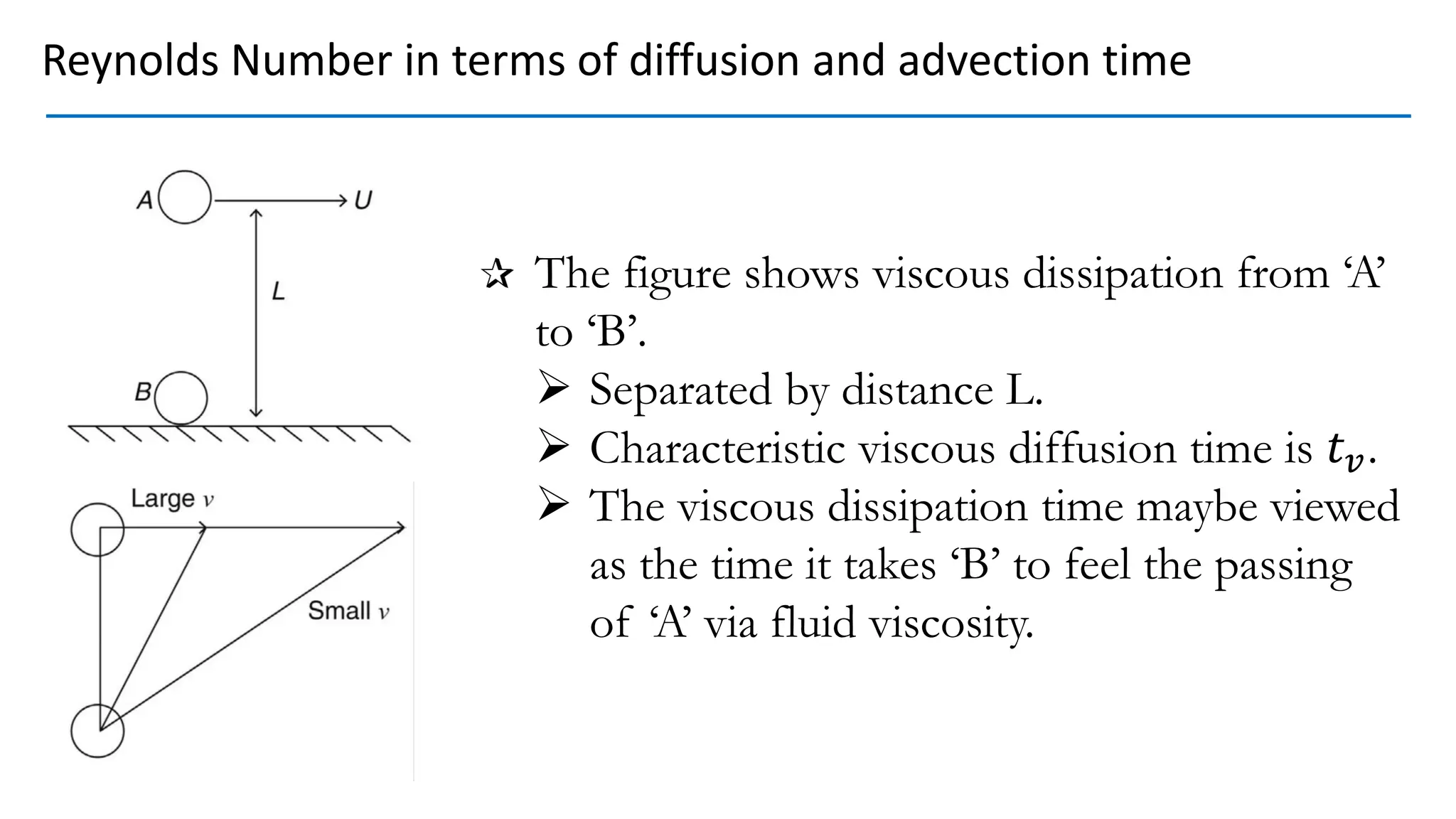
The figure shows viscous dissipation from ‘A’
to ‘B’.
➢ Separated by distance L.
➢ Characteristic viscous diffusion time is 𝑡𝑣.
➢ The viscous dissipation time maybe viewed
as the time it takes ‘B’ to feel the passing
of ‘A’ via fluid viscosity.
Reynolds Number in terms of diffusion and advection time
The viscous diffusion time is:
➢ Proportional to distance(𝑡𝑣 ~ 𝐿)
➢ The farther away they are the longer it
takes for ‘B’ to feel ‘A’.
➢ Inversely proportional to the fluid
viscosity (𝑡𝑣 ~
1
𝜈
)
➢ The larger the viscosity the shorter
time it takes for ‘B’ to feel ‘A’.
Reynolds Number in terms of diffusion and advection time
Hence dimensionally the characteristic viscous diffusion time
which is required for momentum to diffuse a distance ‘𝐿’ due to
viscosity is
𝑡𝑣 =
𝐿2
𝜈
; [ Τ
𝑚2 Τ
𝑚2
𝑠 = 𝑠]
For a body of length ‘𝐿’ in a flow field with a mean velocity ‘𝑈’.
A characteristic(overall) advection time scale 𝑡𝑎 signifies the
duration over which the fluid element is of significance to the
body and vice-versa.
𝐴𝑑𝑣𝑒𝑐𝑡𝑖𝑜𝑛 𝑇𝑖𝑚𝑒 𝑡𝑎 =
𝐿
𝑈
Advection time is the time that is required by a fluid element to
pass a body of length ‘𝐿’.
Reynolds Number in terms of diffusion and advection time
Reynolds Number signifies the strength of inertia force with
respect to the underlying viscous force of a moving fluid.
𝑅𝑒 =
𝐼𝑛𝑒𝑟𝑡𝑖𝑎 𝐹𝑜𝑟𝑐𝑒
𝑉𝑖𝑠𝑐𝑜𝑢𝑠 𝐹𝑜𝑟𝑐𝑒
=
𝐴𝑑𝑣𝑒𝑐𝑡𝑖𝑜𝑛 𝐸𝑓𝑓𝑒𝑐𝑡
𝑉𝑖𝑠𝑐𝑜𝑢𝑠 𝐸𝑓𝑓𝑒𝑐𝑡
=
1
𝑡𝑎
1
𝑡𝑣
The shorter the fluid(element) takes to pass(advect) a distance
‘𝐿’, the larger the inertia force.
𝑡𝑎 ↓ → 𝐹𝑖𝑛𝑒𝑟𝑡𝑖𝑎(↑)
The shorter the time it take to communicate the presence of a
fluid particle, the higher the viscous effect.
𝑡𝑣 ↓ → 𝐹𝑣𝑖𝑠𝑐𝑜𝑢𝑠(↑)
Rearranging yields
𝑅𝑒 =
𝑡𝑣
𝑡𝑎
=
( Τ
𝐿2 𝜈)
(𝐿/𝑈)
=
𝑈𝐿
𝜈
Reynolds Number in terms of diffusion and advection time
Derivation via Newton’s second Law
𝑅𝑒 =
𝐼𝑛𝑒𝑟𝑡𝑖𝑎 𝐹𝑜𝑟𝑐𝑒
𝑉𝑖𝑠𝑐𝑜𝑢𝑠 𝐹𝑜𝑟𝑐𝑒
=
𝐴𝑑𝑣𝑒𝑐𝑡𝑖𝑜𝑛 𝐸𝑓𝑓𝑒𝑐𝑡
𝑉𝑖𝑠𝑐𝑜𝑢𝑠 𝐸𝑓𝑓𝑒𝑐𝑡
=
1
𝑡𝑎
1
𝑡𝑣
From Newton’s Second Law:
𝐹𝑖 = 𝑚𝑎
Acceleration of fluid particle in 𝑥 direction is given by
𝑎𝑥 =
𝜕𝑢
𝜕𝑡
+ 𝑢
𝜕𝑢
𝜕𝑥
+ v
𝜕𝑢
𝜕𝑦
+ w
𝜕𝑢
𝜕𝑧
Thus force becomes
𝐹𝑖 = 𝑚 𝑢
𝜕𝑢
𝜕𝑥
~ 𝜌∀
𝑈2
𝐿
Reynolds Number in terms of diffusion and advection time
Dividing force by volume(∀) yields
𝐹𝑖
∀
=
𝑚𝑎
∀
=
𝜌∀
𝑈2
𝐿
∀
=
𝜌𝑈2
𝐿
(Inertia Force per unit mass)
Shear Force from Newton’s Law of Viscosity is given by
𝜏 = 𝜇
𝑑𝑢
𝑑𝑦
~𝜇
𝑈
𝐿
Thus, Shear Force is given by
𝐹𝑣 = 𝜏𝐴 = 𝜇
𝑈
𝐿
𝐿2 = 𝜇𝑈𝐿
Dividing force by volume(∀) yields
𝐹𝑣
∀
=
𝜇𝑈𝐿
𝐿3 =
𝜇𝑈
𝐿2 (Viscous Force per unit mass)
Taking ratio of both forces yields Reynolds Number
𝑅𝑒 =
𝐹𝑖
∀
𝐹𝑣
∀
=
𝜌𝑈2
𝐿
𝜇𝑈
𝐿2
=
𝜌𝑈𝐿
𝜇
=
𝑈𝐿
𝜈
Reynolds Number in terms of diffusion and advection time
When 𝑅𝑒 ↓ :
There is enough viscous force to take care of the agitative inertia
force.
Hence Turbulence is under control.
When 𝑅𝑒 ↑ :
The inertia force increases until the viscous force becomes
incapable of keeping the fluctuations under control
Thus flow becomes Turbulent
Reynolds Number in terms of diffusion and advection time
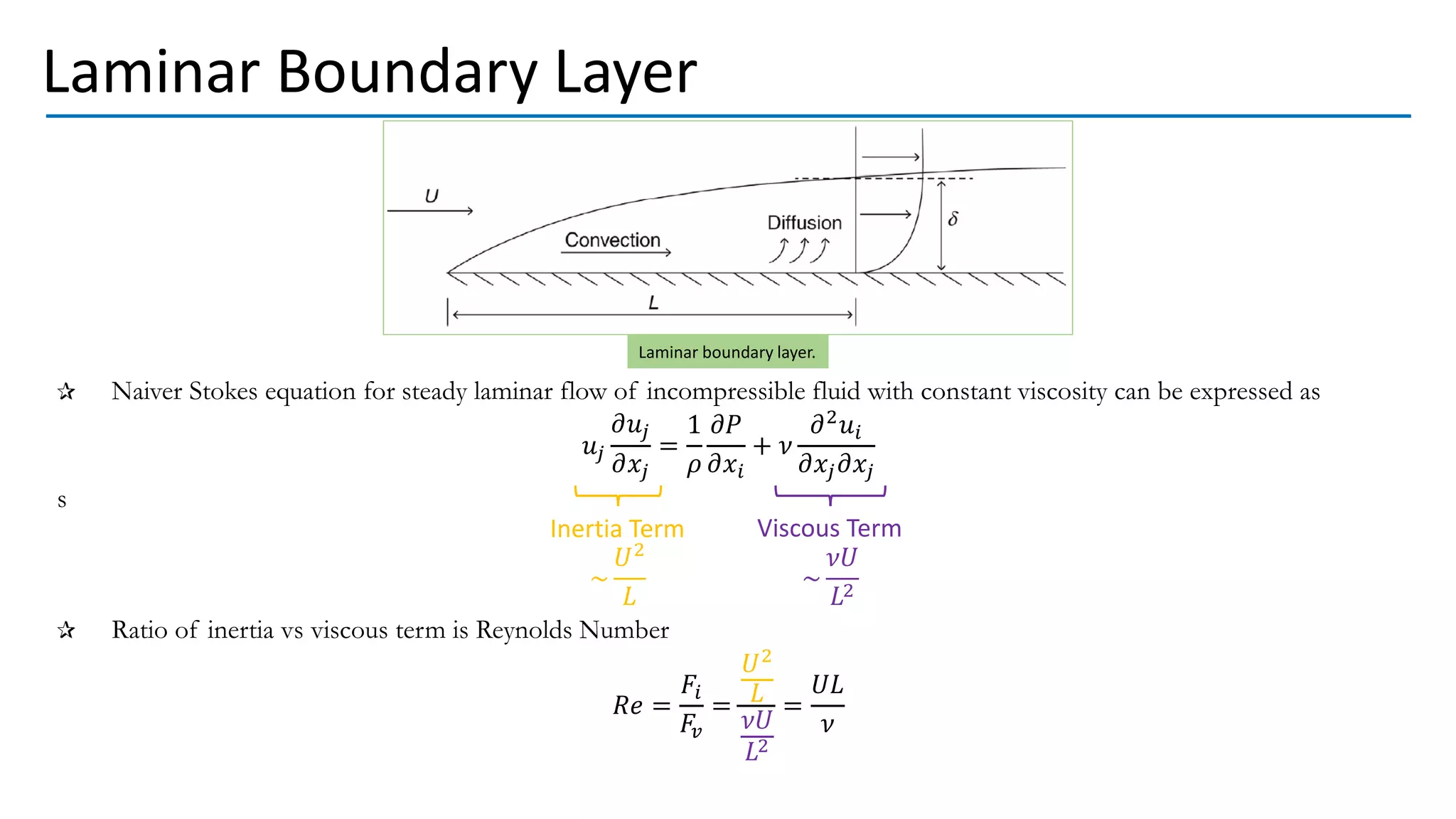
Naiver Stokes equation for steady laminar flow of incompressible fluid with constant viscosity can be expressed as
𝑢𝑗
𝜕𝑢𝑗
𝜕𝑥𝑗
=
1
𝜌
𝜕𝑃
𝜕𝑥𝑖
+ 𝜈
𝜕2𝑢𝑖
𝜕𝑥𝑗𝜕𝑥𝑗
s
Ratio of inertia vs viscous term is Reynolds Number
𝑅𝑒 =
𝐹𝑖
𝐹𝑣
=
𝑈2
𝐿
𝜈𝑈
𝐿2
=
𝑈𝐿
𝜈
Laminar Boundary Layer
Laminar boundary layer.
Inertia Term Viscous Term
~
𝑈2
𝐿
~
𝜈𝑈
𝐿2
We see that viscous term becomes negligible and must be dropped at high Reynolds Number.
But the boundary conditions make it impossible to neglect the viscous terms everywhere in the flow field.
E.g. Viscous terms cannot be neglected in the velocity boundary layer.
When considering length scale , we tend to associate viscous effects with small length scales
In other terms the viscous term can survive at high Re values only by choosing a length scale(𝛿)(𝑆𝑚𝑎𝑙𝑙) which
represents the thickness of the boundary layer.
At such length scale the inertia and viscous forces become of the same order
i.e. for diffusive(viscous) length scale(𝛿)
Laminar Boundary Layer
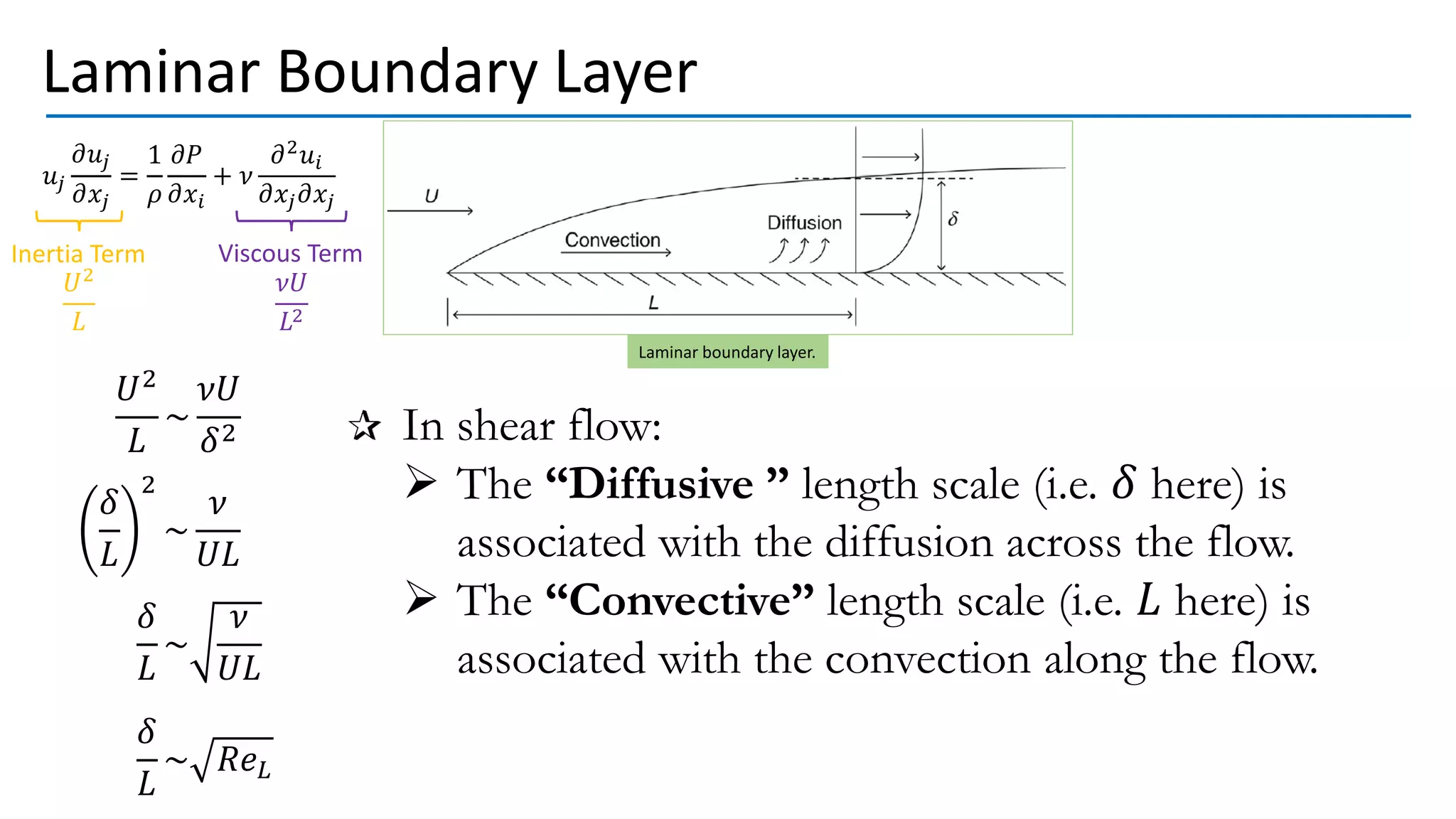
Laminar boundary layer.
Inertia Term Viscous Term
𝑈2
𝐿
𝜈𝑈
𝐿2
𝑢𝑗
𝜕𝑢𝑗
𝜕𝑥𝑗
=
1
𝜌
𝜕𝑃
𝜕𝑥𝑖
+ 𝜈
𝜕2
𝑢𝑖
𝜕𝑥𝑗𝜕𝑥𝑗
𝑈2
𝐿
𝜈𝑈
𝐿2
~
𝑈2
𝐿
𝜈𝑈
𝛿2
~
In shear flow:
➢ The “Diffusive ” length scale (i.e. 𝛿 here) is
associated with the diffusion across the flow.
➢ The “Convective” length scale (i.e. 𝐿 here) is
associated with the convection along the flow.
Laminar Boundary Layer
Laminar boundary layer.
Inertia Term Viscous Term
𝑈2
𝐿
𝜈𝑈
𝐿2
𝑢𝑗
𝜕𝑢𝑗
𝜕𝑥𝑗
=
1
𝜌
𝜕𝑃
𝜕𝑥𝑖
+ 𝜈
𝜕2
𝑢𝑖
𝜕𝑥𝑗𝜕𝑥𝑗
𝑈2
𝐿
~
𝜈𝑈
𝛿2
𝛿
𝐿
2
~
𝜈
𝑈𝐿
𝛿
𝐿
~
𝜈
𝑈𝐿
𝛿
𝐿
~ 𝑅𝑒𝐿
Considering boundary layer for the case where the boundary layer is turbulent.
Considerable inertia is associated with large Reynolds Number.
➢ This produces lots of eddy motion.
These eddies transfer momentum deficit(Relatively less amount of momentum) away from
the solid surface.
➢ Giving rise to “Cross stream diffusion turbulence”.
The boundary layer thickness ‘𝛿’ presumably increase roughly as
𝜕𝛿
𝜕𝑡
~𝑢′ or
𝜕𝛿
𝜕𝑥
~𝑢′
Turbulent Boundary Layer
Turbulent boundary layer.
In other words,
The higher the turbulence level, the faster the boundary layer increases w.r.t time or
position in downstream direction.
The time interval that has elapsed for a fluid particle moving from 𝑥 = 0 to 𝐿 is of the
order Τ
𝐿 𝑈.
Convective time scale~
𝐿
𝑈
For Diffusion:
Diffusion Time Scale 𝑡 ~
𝛿
𝑢′
Turbulent Boundary Layer
Turbulent boundary layer.
‘
Substituting convective time scale to diffusion time scale.
The above analysis implies that with imposed external flow.
Turbulent Timescale ∝ Flow Timescale.
In other words, Flow turbulence is a function of mean flow,
Consequently turbulence is apart of flow.
And not the part of fluid as molecular diffusivity and
viscosity.
Not all of turbulence has such small time scale.
Turbulent Boundary Layer
Turbulent boundary layer.
‘
Convective time scale~
𝐿
𝑈
Diffusion Time Scale 𝑡 ~
𝛿
𝑢′
𝐿
𝑈
~
𝛿
𝑢′
𝑢′
𝑈
~
𝛿
𝐿
Shortest eddies in turbulence has small time scale
Which make them statistical independent.
Thus more than one eddy size is required to describe
turbulent flow.
At minimum we need to describe one large scale and one
small scale to describe turbulent low.
In the turbulent flow, the fluid motion creates a multitude of
eddies that are responsible for transport properties
Turbulent Boundary Layer
Turbulent boundary layer.
‘
Convective time scale~
𝐿
𝑈
Diffusion Time Scale 𝑡 ~
𝛿
𝑢′
𝐿
𝑈
~
𝛿
𝑢′
𝑢′
𝑈
~
𝛿
𝐿
The molecular effects in turbulent flow provides a sink for
dissipation of small scale eddying motion.
Transport heat, mass and momentum over distance less thatn
the smallest turbulent eddies.
A wide range of length scale exists in a turbulent flow
Bounded by the dimension of the flow field
Dimension of the flow field
Dimension of the body generating the flow disturbance
The diffusion action of molecular viscosity(mfp)
Turbulent Boundary Layer
Turbulent boundary layer.
‘
Convective time scale~
𝐿
𝑈
Diffusion Time Scale 𝑡 ~
𝛿
𝑢′
𝐿
𝑈
~
𝛿
𝑢′
𝑢′
𝑈
~
𝛿
𝐿
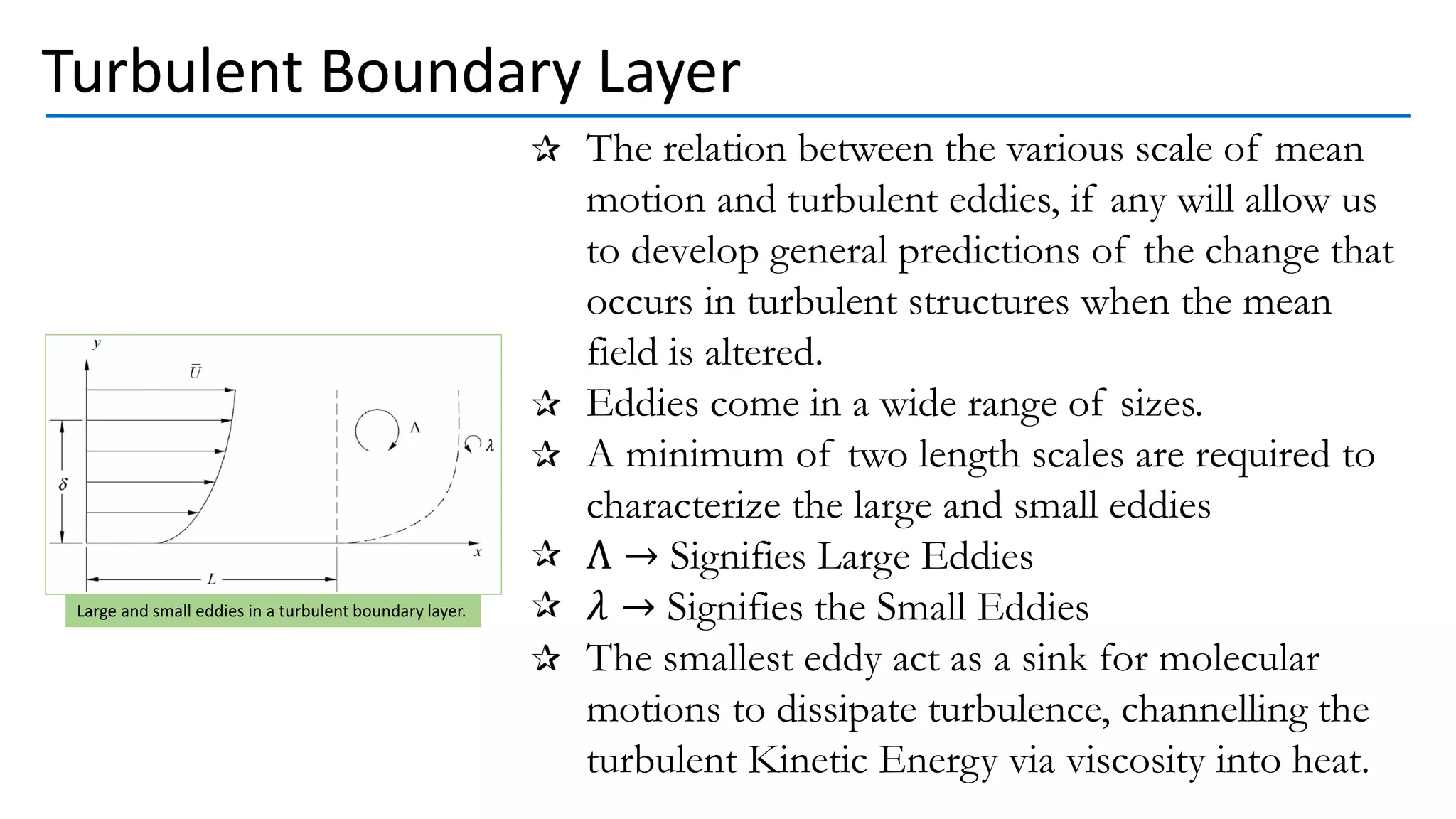
The relation between the various scale of mean
motion and turbulent eddies, if any will allow us
to develop general predictions of the change that
occurs in turbulent structures when the mean
field is altered.
Eddies come in a wide range of sizes.
A minimum of two length scales are required to
characterize the large and small eddies
Λ → Signifies Large Eddies
𝜆 → Signifies the Small Eddies
The smallest eddy act as a sink for molecular
motions to dissipate turbulence, channelling the
turbulent Kinetic Energy via viscosity into heat.
Turbulent Boundary Layer
Large and small eddies in a turbulent boundary layer.
For Laminar Flow(Boundary layer)
𝑈 → Velocity Scale
𝛿 → Cross-stream length scale
𝐿 → Stream-wise length scale
For Turbulent Flow(Boundary Layer)
ഥ
𝑈 → Mean(time averaged)Velocity Scale
𝛿&𝐿 → Length Scales
Time scale for mean flow ~
𝐿
𝑈
Time scale for large scale turbulence ~
Λ
𝑢′
Turbulent Boundary Layer
Large and small eddies in a turbulent boundary layer.
𝑢′
𝜆&Λ
Corresponding
Fluctuating
Components
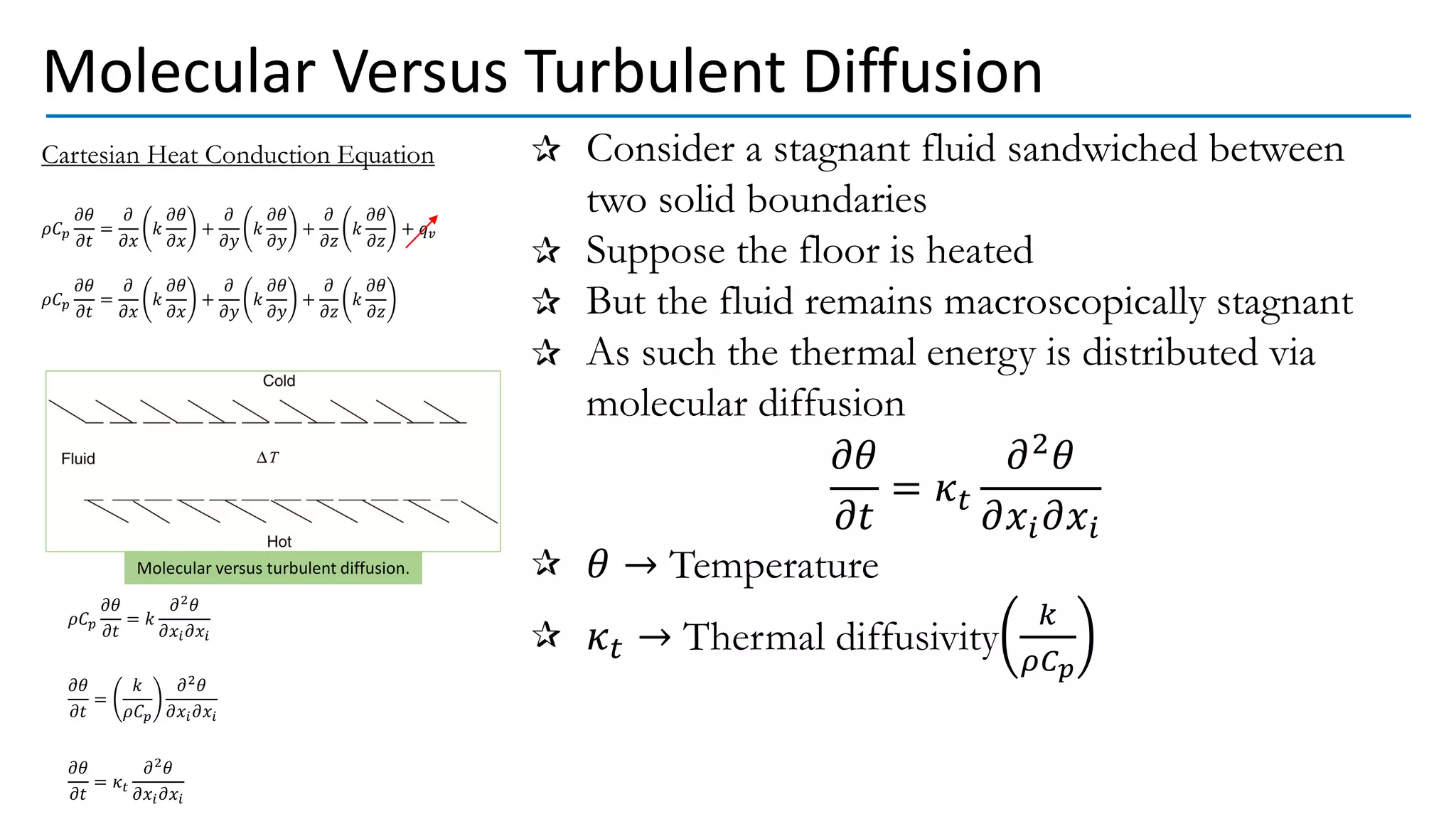
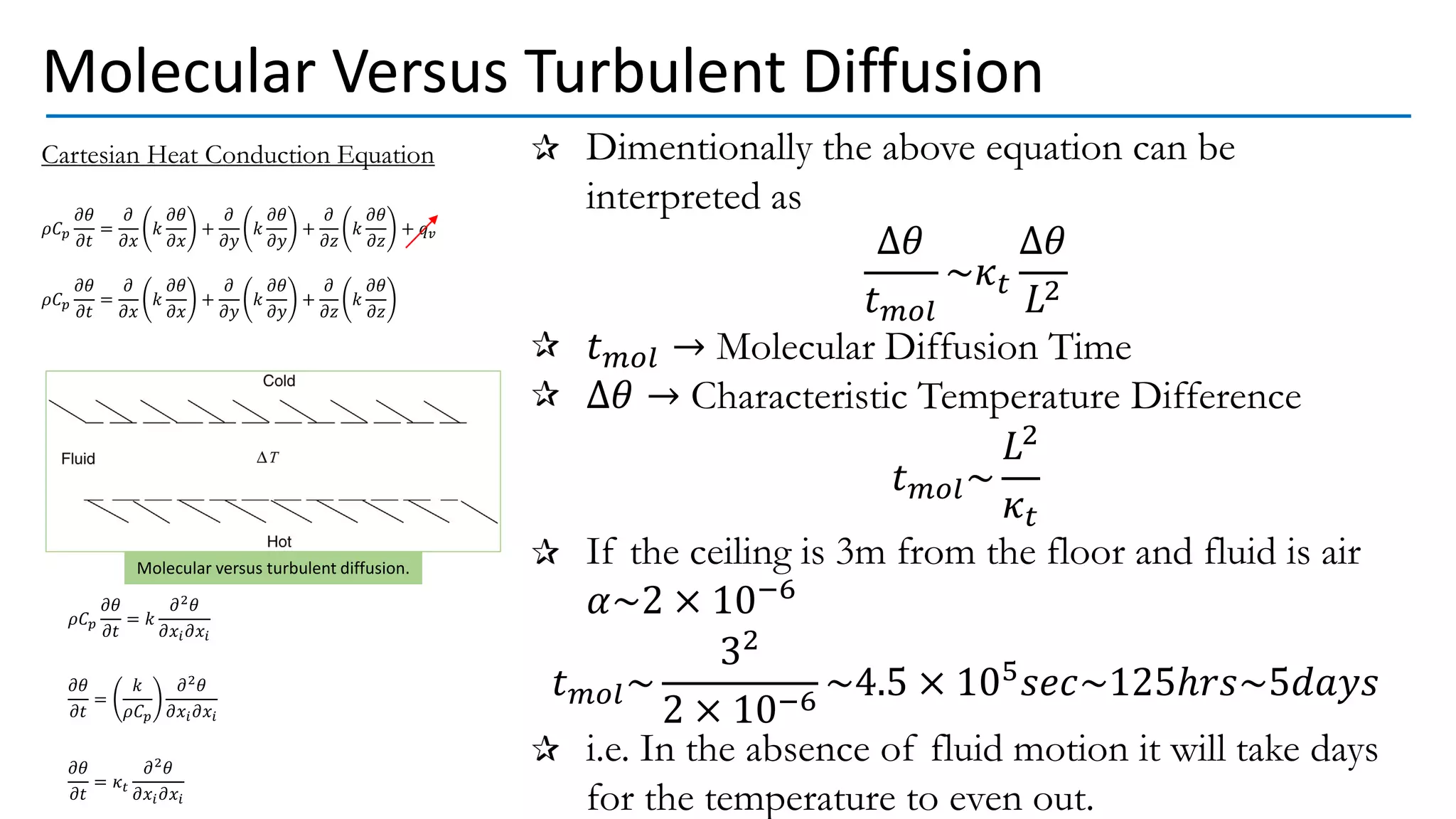
Consider a stagnant fluid sandwiched between
two solid boundaries
Suppose the floor is heated
But the fluid remains macroscopically stagnant
As such the thermal energy is distributed via
molecular diffusion
𝜕𝜃
𝜕𝑡
= 𝜅𝑡
𝜕2
𝜃
𝜕𝑥𝑖𝜕𝑥𝑖
𝜃 → Temperature
𝜅𝑡 → Thermal diffusivity
𝑘
𝜌𝐶𝑝
Molecular Versus Turbulent Diffusion
Molecular versus turbulent diffusion.
Cartesian Heat Conduction Equation
𝜌𝐶𝑝
𝜕𝜃
𝜕𝑡
=
𝜕
𝜕𝑥
𝑘
𝜕𝜃
𝜕𝑥
+
𝜕
𝜕𝑦
𝑘
𝜕𝜃
𝜕𝑦
+
𝜕
𝜕𝑧
𝑘
𝜕𝜃
𝜕𝑧
+ 𝑞𝑣
𝜌𝐶𝑝
𝜕𝜃
𝜕𝑡
=
𝜕
𝜕𝑥
𝑘
𝜕𝜃
𝜕𝑥
+
𝜕
𝜕𝑦
𝑘
𝜕𝜃
𝜕𝑦
+
𝜕
𝜕𝑧
𝑘
𝜕𝜃
𝜕𝑧
𝜌𝐶𝑝
𝜕𝜃
𝜕𝑡
= 𝑘
𝜕2
𝜃
𝜕𝑥𝑖𝜕𝑥𝑖
𝜕𝜃
𝜕𝑡
=
𝑘
𝜌𝐶𝑝
𝜕2
𝜃
𝜕𝑥𝑖𝜕𝑥𝑖
𝜕𝜃
𝜕𝑡
= 𝜅𝑡
𝜕2
𝜃
𝜕𝑥𝑖𝜕𝑥𝑖
Dimentionally the above equation can be
interpreted as
Δ𝜃
𝑡𝑚𝑜𝑙
~𝜅𝑡
Δ𝜃
𝐿2
𝑡𝑚𝑜𝑙 → Molecular Diffusion Time
Δ𝜃 → Characteristic Temperature Difference
𝑡𝑚𝑜𝑙~
𝐿2
𝜅𝑡
If the ceiling is 3m from the floor and fluid is air
𝛼~2 × 10⁻⁶
𝑡𝑚𝑜𝑙~
32
2 × 10⁻⁶
~4.5 × 10⁵𝑠𝑒𝑐~125ℎ𝑟𝑠~5𝑑𝑎𝑦𝑠
i.e. In the absence of fluid motion it will take days
for the temperature to even out.
Molecular Versus Turbulent Diffusion
Molecular versus turbulent diffusion.
Cartesian Heat Conduction Equation
𝜌𝐶𝑝
𝜕𝜃
𝜕𝑡
=
𝜕
𝜕𝑥
𝑘
𝜕𝜃
𝜕𝑥
+
𝜕
𝜕𝑦
𝑘
𝜕𝜃
𝜕𝑦
+
𝜕
𝜕𝑧
𝑘
𝜕𝜃
𝜕𝑧
+ 𝑞𝑣
𝜌𝐶𝑝
𝜕𝜃
𝜕𝑡
=
𝜕
𝜕𝑥
𝑘
𝜕𝜃
𝜕𝑥
+
𝜕
𝜕𝑦
𝑘
𝜕𝜃
𝜕𝑦
+
𝜕
𝜕𝑧
𝑘
𝜕𝜃
𝜕𝑧
𝜌𝐶𝑝
𝜕𝜃
𝜕𝑡
= 𝑘
𝜕2
𝜃
𝜕𝑥𝑖𝜕𝑥𝑖
𝜕𝜃
𝜕𝑡
=
𝑘
𝜌𝐶𝑝
𝜕2
𝜃
𝜕𝑥𝑖𝜕𝑥𝑖
𝜕𝜃
𝜕𝑡
= 𝜅𝑡
𝜕2
𝜃
𝜕𝑥𝑖𝜕𝑥𝑖
In reality when the fluid in the vicinity of the hot floor
is heated
Buoyancy driven instabilities will emerge.
Assuming that the length scale of the resulting
turbulent motion is ‘𝐿’ and velocity scale is of the
order ‘𝑢′
’.
𝑡𝑡𝑢𝑟𝑏~
𝐿
𝑢′
Further assuming that
𝑢′
~ Τ
𝑐𝑚 𝑠
𝑡𝑡𝑢𝑟𝑏~
3
0.01
~300𝑠𝑒𝑐~5𝑚𝑖𝑛
i.e. The resulting turbulence characteristic time for the
thermal energy to be distributed throughout the
compartment is of the order of a few minutes
Molecular Versus Turbulent Diffusion
Molecular versus turbulent diffusion.
Cartesian Heat Conduction Equation
𝜌𝐶𝑝
𝜕𝜃
𝜕𝑡
=
𝜕
𝜕𝑥
𝑘
𝜕𝜃
𝜕𝑥
+
𝜕
𝜕𝑦
𝑘
𝜕𝜃
𝜕𝑦
+
𝜕
𝜕𝑧
𝑘
𝜕𝜃
𝜕𝑧
+ 𝑞𝑣
𝜌𝐶𝑝
𝜕𝜃
𝜕𝑡
=
𝜕
𝜕𝑥
𝑘
𝜕𝜃
𝜕𝑥
+
𝜕
𝜕𝑦
𝑘
𝜕𝜃
𝜕𝑦
+
𝜕
𝜕𝑧
𝑘
𝜕𝜃
𝜕𝑧
𝜌𝐶𝑝
𝜕𝜃
𝜕𝑡
= 𝑘
𝜕2
𝜃
𝜕𝑥𝑖𝜕𝑥𝑖
𝜕𝜃
𝜕𝑡
=
𝑘
𝜌𝐶𝑝
𝜕2
𝜃
𝜕𝑥𝑖𝜕𝑥𝑖
𝜕𝜃
𝜕𝑡
= 𝜅𝑡
𝜕2
𝜃
𝜕𝑥𝑖𝜕𝑥𝑖
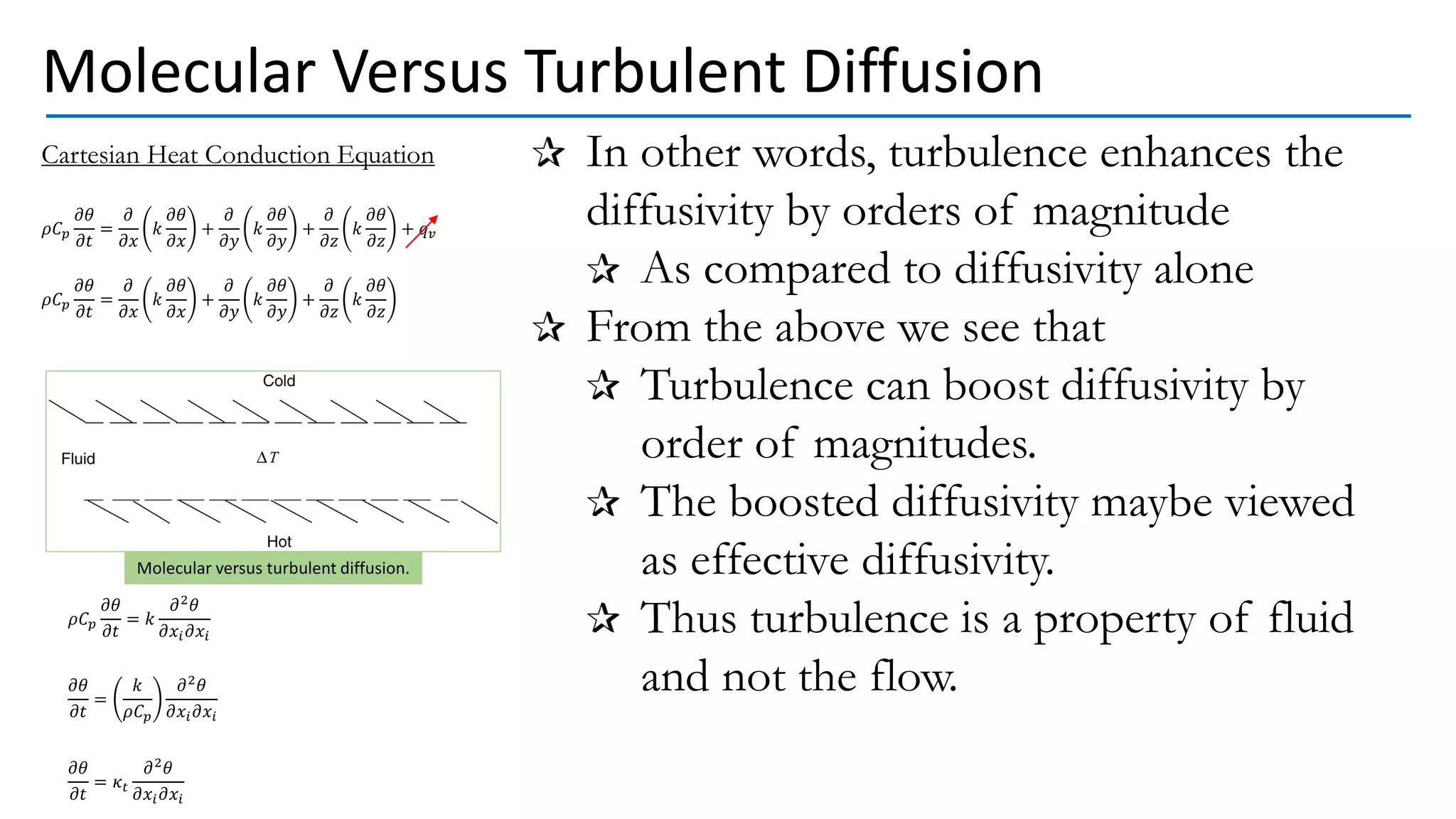
In other words, turbulence enhances the
diffusivity by orders of magnitude
As compared to diffusivity alone
From the above we see that
Turbulence can boost diffusivity by
order of magnitudes.
The boosted diffusivity maybe viewed
as effective diffusivity.
Thus turbulence is a property of fluid
and not the flow.
Molecular Versus Turbulent Diffusion
Molecular versus turbulent diffusion.
Cartesian Heat Conduction Equation
𝜌𝐶𝑝
𝜕𝜃
𝜕𝑡
=
𝜕
𝜕𝑥
𝑘
𝜕𝜃
𝜕𝑥
+
𝜕
𝜕𝑦
𝑘
𝜕𝜃
𝜕𝑦
+
𝜕
𝜕𝑧
𝑘
𝜕𝜃
𝜕𝑧
+ 𝑞𝑣
𝜌𝐶𝑝
𝜕𝜃
𝜕𝑡
=
𝜕
𝜕𝑥
𝑘
𝜕𝜃
𝜕𝑥
+
𝜕
𝜕𝑦
𝑘
𝜕𝜃
𝜕𝑦
+
𝜕
𝜕𝑧
𝑘
𝜕𝜃
𝜕𝑧
𝜌𝐶𝑝
𝜕𝜃
𝜕𝑡
= 𝑘
𝜕2
𝜃
𝜕𝑥𝑖𝜕𝑥𝑖
𝜕𝜃
𝜕𝑡
=
𝑘
𝜌𝐶𝑝
𝜕2
𝜃
𝜕𝑥𝑖𝜕𝑥𝑖
𝜕𝜃
𝜕𝑡
= 𝜅𝑡
𝜕2
𝜃
𝜕𝑥𝑖𝜕𝑥𝑖
We can express diffusion of heat by turbulent motion as
𝜕𝜃
𝜕𝑡
= 𝐾
𝜕2
𝜃
𝜕𝑥𝑖𝜕𝑥𝑖
Here,
𝐾 → “Eddy Diffusivity” or “Exchange Coefficient” for
heat(Thermal Energy)
From the above equation,
Timescale 𝑡 ~
𝐿2
𝐾
But we also have
𝑡𝑡𝑢𝑟𝑏~
𝐿
𝑢′
Equating both time scales yields
𝑡~
𝐿2
𝐾
~
𝐿
𝑢′
𝑡~
𝐿2
𝐾
~
𝐿2
𝑢′𝐿
Molecular Versus Turbulent Diffusion
Molecular versus turbulent diffusion.
Cartesian Heat Conduction Equation
𝜌𝐶𝑝
𝜕𝜃
𝜕𝑡
=
𝜕
𝜕𝑥
𝑘
𝜕𝜃
𝜕𝑥
+
𝜕
𝜕𝑦
𝑘
𝜕𝜃
𝜕𝑦
+
𝜕
𝜕𝑧
𝑘
𝜕𝜃
𝜕𝑧
+ 𝑞𝑣
𝜌𝐶𝑝
𝜕𝜃
𝜕𝑡
=
𝜕
𝜕𝑥
𝑘
𝜕𝜃
𝜕𝑥
+
𝜕
𝜕𝑦
𝑘
𝜕𝜃
𝜕𝑦
+
𝜕
𝜕𝑧
𝑘
𝜕𝜃
𝜕𝑧
𝐾~𝐿𝑢′
𝜌𝐶𝑝
𝜕𝜃
𝜕𝑡
= 𝑘
𝜕2
𝜃
𝜕𝑥𝑖𝜕𝑥𝑖
𝜕𝜃
𝜕𝑡
=
𝑘
𝜌𝐶𝑝
𝜕2
𝜃
𝜕𝑥𝑖𝜕𝑥𝑖
𝜕𝜃
𝜕𝑡
= 𝜅𝑡
𝜕2
𝜃
𝜕𝑥𝑖𝜕𝑥𝑖
𝐾~𝐿𝑢′
In other words “Eddy Diffusivity” 𝐾 is of the order of
product of fluctuating velocity and characteristic length
associated with the mean flow or the physical dimension
of the confinement.
This Eddy Diffusivity or Viscosity maybe compared to
the Kinematic Viscosity(𝜈) and thermal diffusivity(𝜅𝑡).
𝐾
𝜅𝑡
≅
𝐾
𝜈
~
𝑢′𝐿
𝜈
= 𝑅𝑒
The above expression conveys Reynolds Number as ratio
of apparent/turbulent viscosity(𝜈) and thermal
diffusivity(𝜅𝑡).
𝑅𝑒~
Τ
𝐴𝑝𝑝𝑎𝑟𝑒𝑛𝑡 𝑇𝑢𝑟𝑏𝑢𝑙𝑒𝑛𝑡 𝑉𝑖𝑠𝑐𝑜𝑠𝑖𝑡𝑦(𝐾)
𝑀𝑜𝑙𝑒𝑐𝑢𝑙𝑎𝑟 𝑉𝑖𝑠𝑐𝑜𝑠𝑖𝑡𝑦(𝜈)
Molecular Versus Turbulent Diffusion
Molecular versus turbulent diffusion.
Cartesian Heat Conduction Equation
𝜌𝐶𝑝
𝜕𝜃
𝜕𝑡
=
𝜕
𝜕𝑥
𝑘
𝜕𝜃
𝜕𝑥
+
𝜕
𝜕𝑦
𝑘
𝜕𝜃
𝜕𝑦
+
𝜕
𝜕𝑧
𝑘
𝜕𝜃
𝜕𝑧
+ 𝑞𝑣
𝜌𝐶𝑝
𝜕𝜃
𝜕𝑡
=
𝜕
𝜕𝑥
𝑘
𝜕𝜃
𝜕𝑥
+
𝜕
𝜕𝑦
𝑘
𝜕𝜃
𝜕𝑦
+
𝜕
𝜕𝑧
𝑘
𝜕𝜃
𝜕𝑧
𝜌𝐶𝑝
𝜕𝜃
𝜕𝑡
= 𝑘
𝜕2
𝜃
𝜕𝑥𝑖𝜕𝑥𝑖
𝜕𝜃
𝜕𝑡
=
𝑘
𝜌𝐶𝑝
𝜕2
𝜃
𝜕𝑥𝑖𝜕𝑥𝑖
𝜕𝜃
𝜕𝑡
= 𝜅𝑡
𝜕2
𝜃
𝜕𝑥𝑖𝜕𝑥𝑖
So far we have discussed only large scales Λ , along with a brief mention of some small
scales(𝜆).
Now introducing Kolmogorov microscales of dissipation to put a “Lower limit at the
smallest eddy end”
Large eddies do most of the transportation of momentum and contaminants.
Large eddies are generally the relevant length scales in analysis of the interaction of
turbulence with the mean flow.
The generation of small-scale fluctuations from the larger ones is due to nonlinear terms
in the equation of motion.
i.e. The viscous term prevents the generation of infinitely small scale of motion by
dissipating small scale energy into heat.
𝑅𝑒 ↑ → 𝐹𝑖𝑛𝑒𝑟𝑡𝑖𝑎 ≫ 𝐹𝑣𝑖𝑠𝑐𝑜𝑢𝑠 → 𝑉𝑖𝑠𝑐𝑜𝑢𝑠 𝐸𝑓𝑓𝑒𝑐𝑡𝑠 ≈ 0
But the non-linear term in the governing equation counteract this threat by generating
motions at scales small enough to be effected by viscosity.
i.e. The smallest scale of motion automatically adjusts itself to the value of
viscosity.
Kolmogorov Microscales of Dissipation
Large scale eddies have the following properties:
Direction dependent
Low frequency
Large timescale
Small scale eddies have the following properties:
Statistically direction independent
High Frequency
Small Timescales
Small scale eddies are formed due handling down of energy from large eddies
The rale of energy supplied(from mean flow to large eddies) is thus approximately equal to
the rate of dissipation(𝜀).(Particularly true for Stationary Turbulence)
For typically large Reynolds number the rate of dissipation adjusts itself the amount of
energy funnelling down the energy cascade.
Thus this quasi-equilibrium condition is valid, provided change is not too rapid.
i.e. The net rate of change is significantly less than the dissipation rate.
Kolmogorov Microscales of Dissipation
Kolmogorov’s universal equilibrium theory
One important outcome of Kolmogorov's universal equilibrium theory is that
the dissipation rate per unit mass𝜀( Τ
𝑚2 𝑠3) and the kinematic viscosity
ν( Τ
𝑚2 𝑠) govern the small scale motion.
Kolmogorov(1941) developed a set of dissipation length and velocity length
scales the were independent of large eddy turbulence properties.
His observations were:
1. Because the smallest eddies are dissipated by viscosity, the size of scale(𝜂)
necessary to carry out a fixed rate of dissipation should be a function of only
viscosity (𝜈).
2. Because the rate of dissipation is related to the size 𝜂 of eddies for a fixed
viscosity, the size 𝜂 should be a function of only the dissipation rate(𝜀).
Kolmogorov Microscales of Dissipation
Combining these ideas Kolmogorov proposed that length, velocity and time-
scales of dissipation must be function of dissipation rate and viscosity only.
𝜂 = 𝑓 𝜀, 𝜈
𝑢𝜂 = 𝑓 𝜀, 𝜈
𝑡𝜂 = 𝑓(𝜀, 𝜈)
Note that is hypothesis is only valid when:
𝑆𝑖𝑧𝑒 𝑜𝑓 𝑑𝑖𝑠𝑠𝑖𝑝𝑎𝑡𝑖𝑜𝑛 𝐸𝑑𝑑𝑦 ≪ [𝑆𝑖𝑧𝑒 𝑜𝑓 𝑃𝑟𝑜𝑑𝑢𝑐𝑡𝑖𝑜𝑛 𝐸𝑑𝑑𝑦]
If the above is not the case, then eddies maybe simultaneously involved in both
production and dissipation.
Further, the length-scale of the eddies(i.e. dissipating and producing) will be
influenced by mean shear in addition to dissipation rate(𝜀) and viscosity (𝜈).
The above case will not be further explored as we are dealing with fully
developed turbulent flows, where Kolmogorov's hypothesis is valid.
Kolmogorov Microscales of Dissipation
From dimensional analysis:
𝜂 𝑚 ~𝜀𝑎[ Τ
𝑚2 𝑠3]𝜈𝑏[ Τ
𝑚2 𝑠]
Where,
𝑎 = − Τ
1
4 & 𝑏 = Τ
3
4
Further, the dimensional analysis yields
𝑆𝑚𝑎𝑙𝑙 𝑒𝑑𝑑𝑦 𝑙𝑒𝑛𝑔𝑡ℎ − 𝑠𝑐𝑎𝑙𝑒 𝜂 =
𝜈3
𝜀
ൗ
1
4
𝑆𝑚𝑎𝑙𝑙 𝑒𝑑𝑑𝑦 𝑣𝑒𝑙𝑜𝑐𝑖𝑡𝑦 − 𝑠𝑐𝑎𝑙𝑒 𝑢𝜂 = 𝜀𝜈 ൗ
1
4
𝑆𝑚𝑎𝑙𝑙 𝑒𝑑𝑑𝑦 𝑡𝑖𝑚𝑒 − 𝑠𝑐𝑎𝑙𝑒 𝑡𝜂 =
𝜈
𝜀
ൗ
1
2
Kolmogorov Microscales of Dissipation
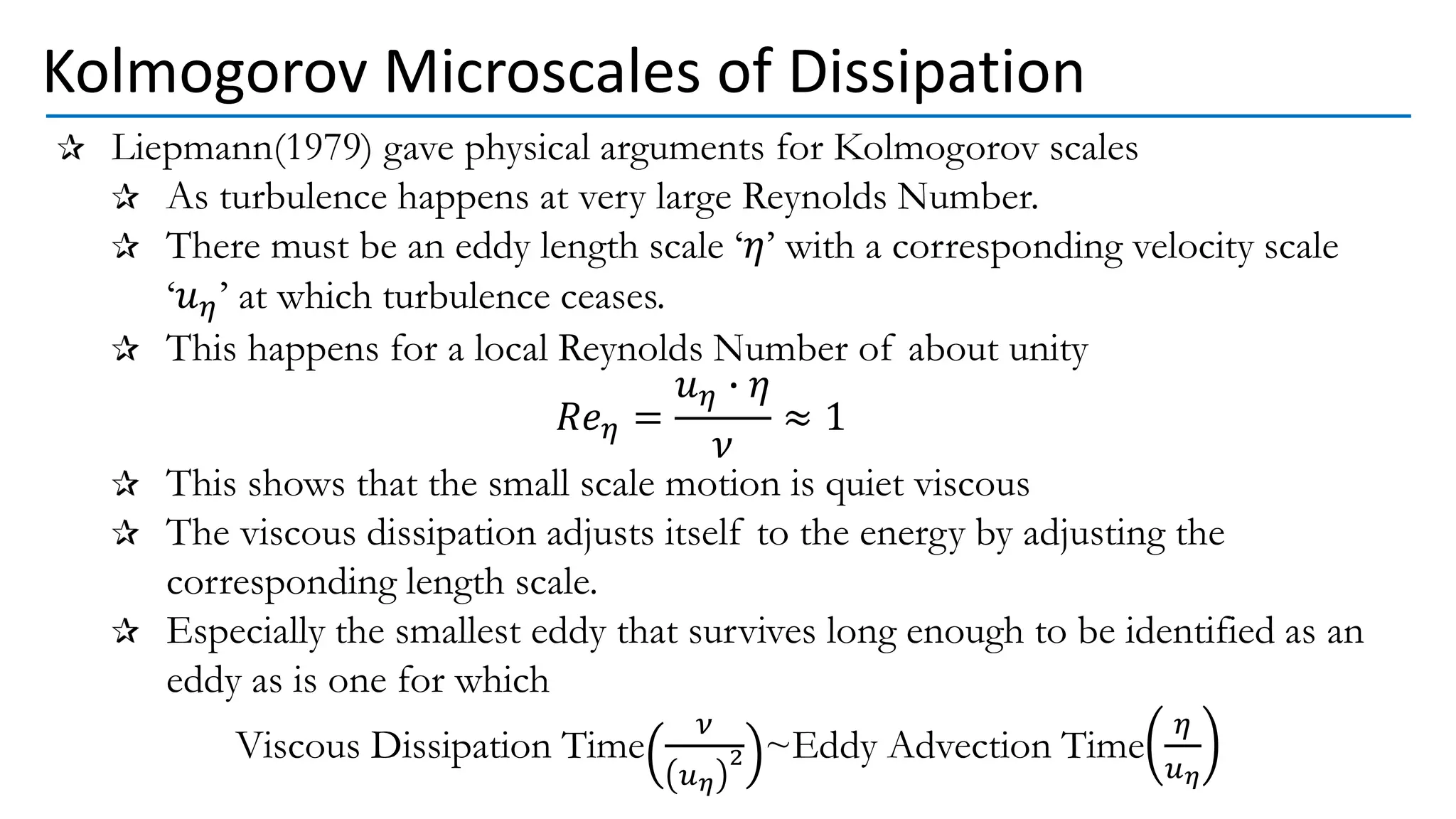
Liepmann(1979) gave physical arguments for Kolmogorov scales
As turbulence happens at very large Reynolds Number.
There must be an eddy length scale ‘𝜂’ with a corresponding velocity scale
‘𝑢𝜂’ at which turbulence ceases.
This happens for a local Reynolds Number of about unity
𝑅𝑒𝜂 =
𝑢𝜂 ∙ 𝜂
𝜈
≈ 1
This shows that the small scale motion is quiet viscous
The viscous dissipation adjusts itself to the energy by adjusting the
corresponding length scale.
Especially the smallest eddy that survives long enough to be identified as an
eddy as is one for which
Viscous Dissipation Time
𝜈
𝑢𝜂
2 ~Eddy Advection Time
𝜂
𝑢𝜂
Kolmogorov Microscales of Dissipation
The above suggest that:
“The eddying fluid motion dissipates completely, transforming all it’s Kinetic Energy via viscosity
into heat within one rotation”
Thus,
Energy dissipation is completely viscous.
All the energy produced from the mean flow is dissipated by small scales.
The overall dissipation rate(𝜀) is equal to the small scale rate
𝜀 =
𝜈 𝑢𝜂
2
𝜂2
Τ
𝑚2
𝑠3
~[ Τ
𝑊 𝑘𝑔]
Solving the previous two equation yields the Kolmogorov length scales 𝜂 and 𝑢𝜂.
𝜈 ↑ → 𝜀 ↑
𝑢𝜂(↑) → 𝑆ℎ𝑒𝑎𝑟(↑) → 𝜀(↑)
𝜂 ↑ → 𝑉𝑒𝑙𝑜𝑐𝑖𝑡𝑦 𝐺𝑟𝑎𝑑𝑖𝑒𝑛𝑡(↓) → 𝜀(↓)
Kolmogorov Microscales of Dissipation
Considering a mixing process where the fluid
involved has the following properties:
Kinematic Viscosity 𝜈 = 10−3 Τ
𝑚 𝑠
Density 𝜌 = 1000 Τ
𝑘𝑔 𝑚3
Suppose a 20 𝑊att electric mixer is used to mix a
1L mixture.
At equilibrium condition
𝐷𝑖𝑠𝑠𝑖𝑝𝑎𝑡𝑖𝑛𝑔 𝑝𝑜𝑤𝑒𝑟 𝜀 = 𝑃𝑜𝑤𝑒𝑟 𝐼𝑛𝑝𝑢𝑡 𝑃𝑖𝑛
𝜀 =
20[𝑊]
1000[ Τ
𝑘𝑔 𝑚3] × 0.001[𝑚3]
= 20 Τ
𝑊 𝑘𝑔
Kolmogorov Microscales of Dissipation
Kolmogorov and larger scales in a mixing process.
The corresponding Kolmogorov length-scale is
given by
𝜂 =
𝜈3
𝜀
Τ
1 4
=
10−3 3
20
Τ
1 4
= 2.7mm
𝜂′ =
𝜂
2
→ 𝑃𝑖𝑛
′
→ 16
This is due to the Τ
1 4 exponent involved.
Hence there is a lot of room to dissipate an
enormous amount of energy before the eddies
approach the molecular mean free path
𝜂′
~𝑚𝑓𝑝 → 𝑃′
≫ 𝑃
Thus making continuum hypothesis valid.
Kolmogorov Microscales of Dissipation
Kolmogorov and larger scales in a mixing process.
A relation between dissipation rate (𝜀) with the length and velocity scales can
give a good impression between large and small scale aspects of turbulence.
Invoking the following assumption:
𝑅𝑎𝑡𝑒 𝑎𝑡 𝑤ℎ𝑖𝑐ℎ 𝑙𝑎𝑟𝑔𝑒 𝑒𝑑𝑑𝑖𝑒𝑠
𝑠𝑢𝑝𝑝𝑙𝑦 𝑒𝑛𝑒𝑟𝑔𝑦 𝑡𝑜 𝑠𝑚𝑎𝑙𝑙 𝑒𝑑𝑑𝑖𝑒𝑠
∝
𝑇𝑖𝑚𝑒 − 𝑠𝑐𝑎𝑙𝑒
𝑜𝑓 𝑙𝑎𝑟𝑔𝑒 𝐸𝑑𝑑𝑖𝑒𝑠
−1
This means that the large eddy passes all it’s Kinetic Energy to the smaller
eddies within its life span(Turnover Time).
According to Richardson’s energy cascade proposition:
These smaller eddies subsequently pass all their energy to smaller eddies
while making their revolution.
Pessimistic Family Comparison.
An Inviscid Estimate for Dissipation Rate
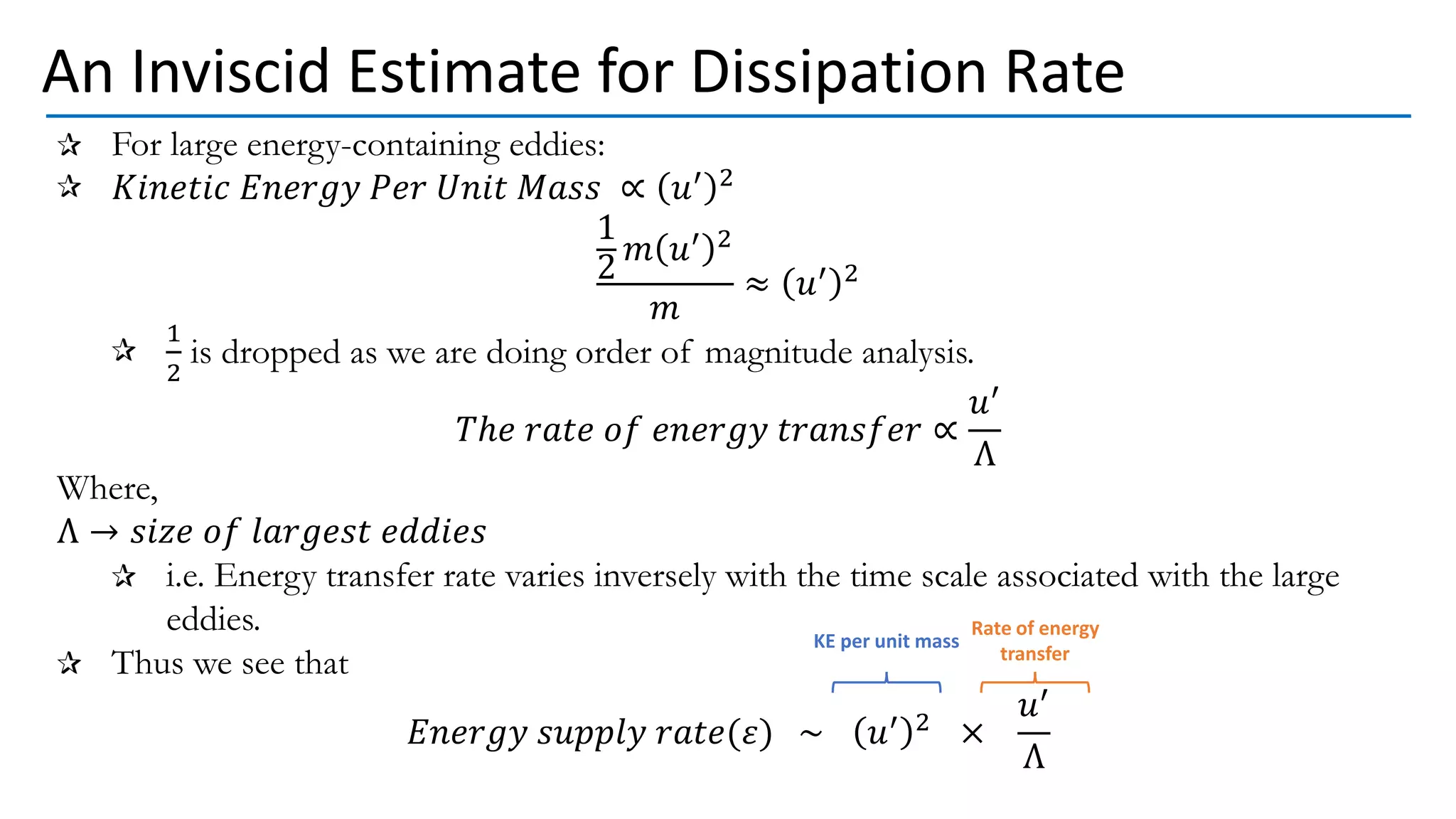
For large energy-containing eddies:
𝐾𝑖𝑛𝑒𝑡𝑖𝑐 𝐸𝑛𝑒𝑟𝑔𝑦 𝑃𝑒𝑟 𝑈𝑛𝑖𝑡 𝑀𝑎𝑠𝑠 ∝ 𝑢′ 2
1
2
𝑚 𝑢′ 2
𝑚
≈ 𝑢′ 2
1
2
is dropped as we are doing order of magnitude analysis.
𝑇ℎ𝑒 𝑟𝑎𝑡𝑒 𝑜𝑓 𝑒𝑛𝑒𝑟𝑔𝑦 𝑡𝑟𝑎𝑛𝑠𝑓𝑒𝑟 ∝
𝑢′
Λ
Where,
Λ → 𝑠𝑖𝑧𝑒 𝑜𝑓 𝑙𝑎𝑟𝑔𝑒𝑠𝑡 𝑒𝑑𝑑𝑖𝑒𝑠
i.e. Energy transfer rate varies inversely with the time scale associated with the large
eddies.
Thus we see that
𝐸𝑛𝑒𝑟𝑔𝑦 𝑠𝑢𝑝𝑝𝑙𝑦 𝑟𝑎𝑡𝑒(𝜀) ~ 𝑢′ 2 ×
𝑢′
Λ
An Inviscid Estimate for Dissipation Rate
KE per unit mass
Rate of energy
transfer
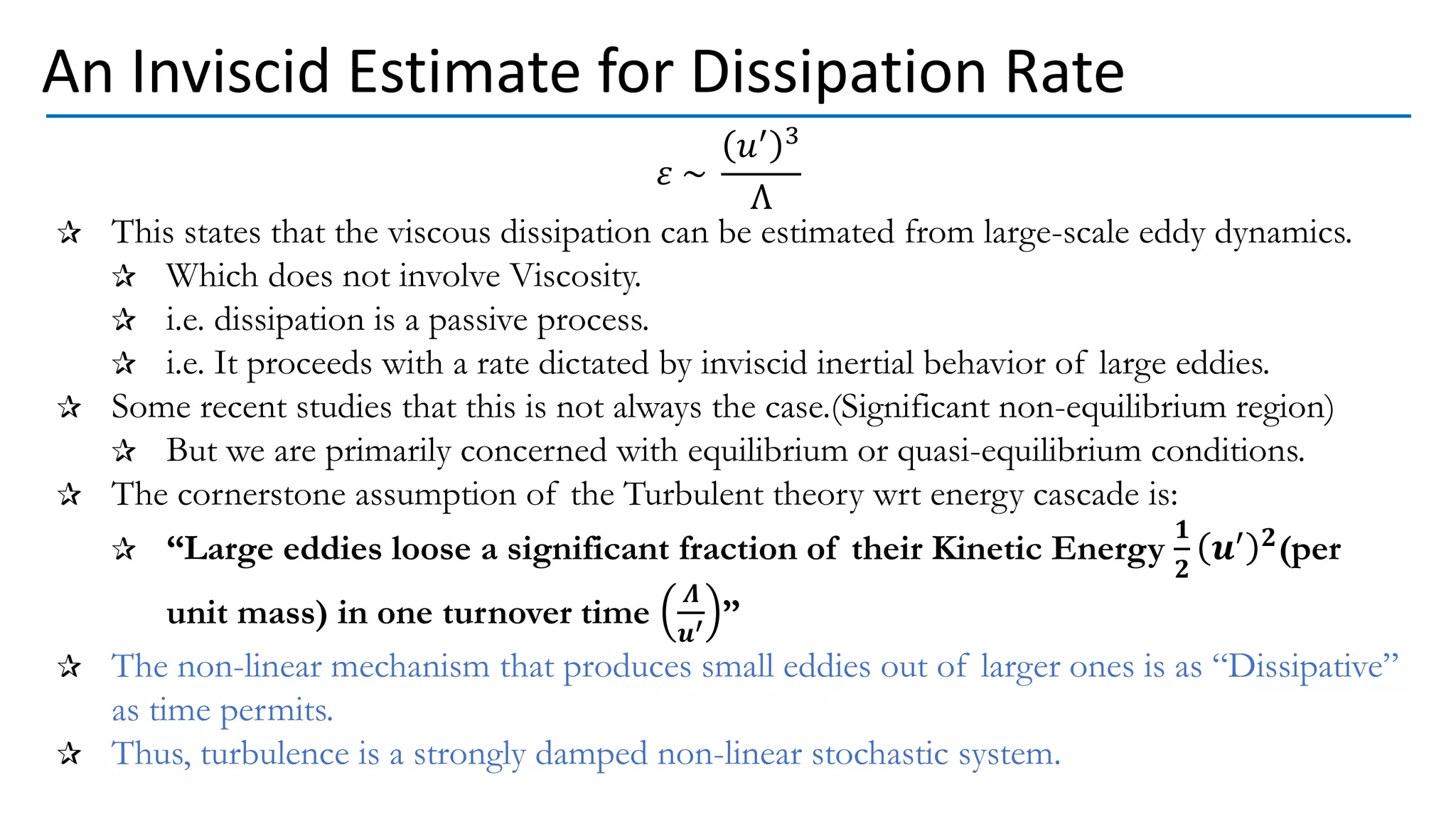
𝜀 ~
𝑢′ 3
Λ
This states that the viscous dissipation can be estimated from large-scale eddy dynamics.
Which does not involve Viscosity.
i.e. dissipation is a passive process.
i.e. It proceeds with a rate dictated by inviscid inertial behavior of large eddies.
Some recent studies that this is not always the case.(Significant non-equilibrium region)
But we are primarily concerned with equilibrium or quasi-equilibrium conditions.
The cornerstone assumption of the Turbulent theory wrt energy cascade is:
“Large eddies loose a significant fraction of their Kinetic Energy
𝟏
𝟐
𝒖′ 𝟐(per
unit mass) in one turnover time
𝜦
𝒖′ ”
The non-linear mechanism that produces small eddies out of larger ones is as “Dissipative”
as time permits.
Thus, turbulence is a strongly damped non-linear stochastic system.
An Inviscid Estimate for Dissipation Rate
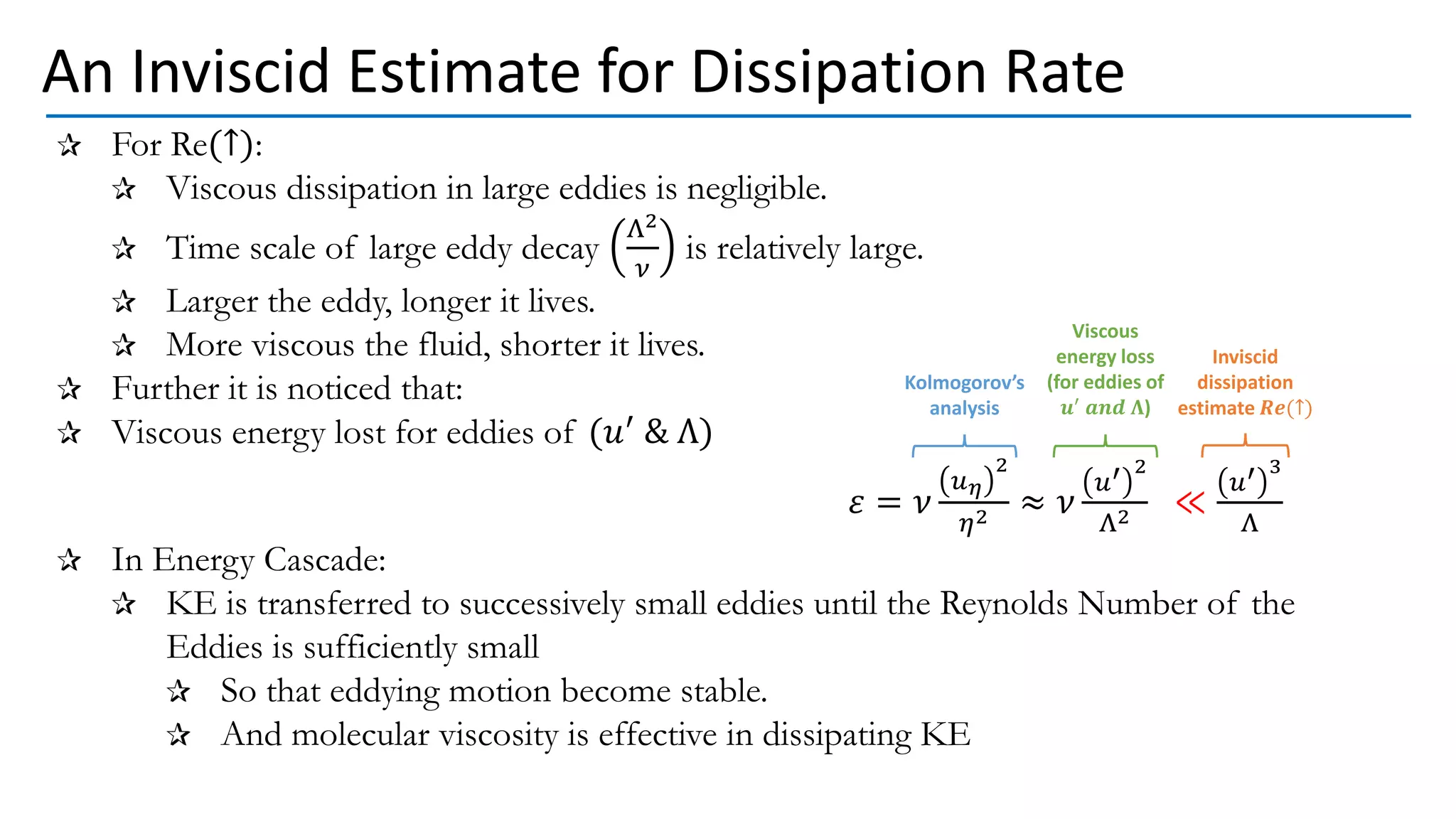
For Re(↑):
Viscous dissipation in large eddies is negligible.
Time scale of large eddy decay
Λ2
𝜈
is relatively large.
Larger the eddy, longer it lives.
More viscous the fluid, shorter it lives.
Further it is noticed that:
Viscous energy lost for eddies of (𝑢′ & Λ)
𝜀 = 𝜈
𝑢𝜂
2
𝜂2 ≈ 𝜈
𝑢′ 2
Λ2 ≪
𝑢′ 3
Λ
In Energy Cascade:
KE is transferred to successively small eddies until the Reynolds Number of the
Eddies is sufficiently small
So that eddying motion become stable.
And molecular viscosity is effective in dissipating KE
An Inviscid Estimate for Dissipation Rate
Inviscid
dissipation
estimate 𝑹𝒆(↑)
Kolmogorov’s
analysis
Viscous
energy loss
(for eddies of
𝒖′
𝒂𝒏𝒅 𝚲)
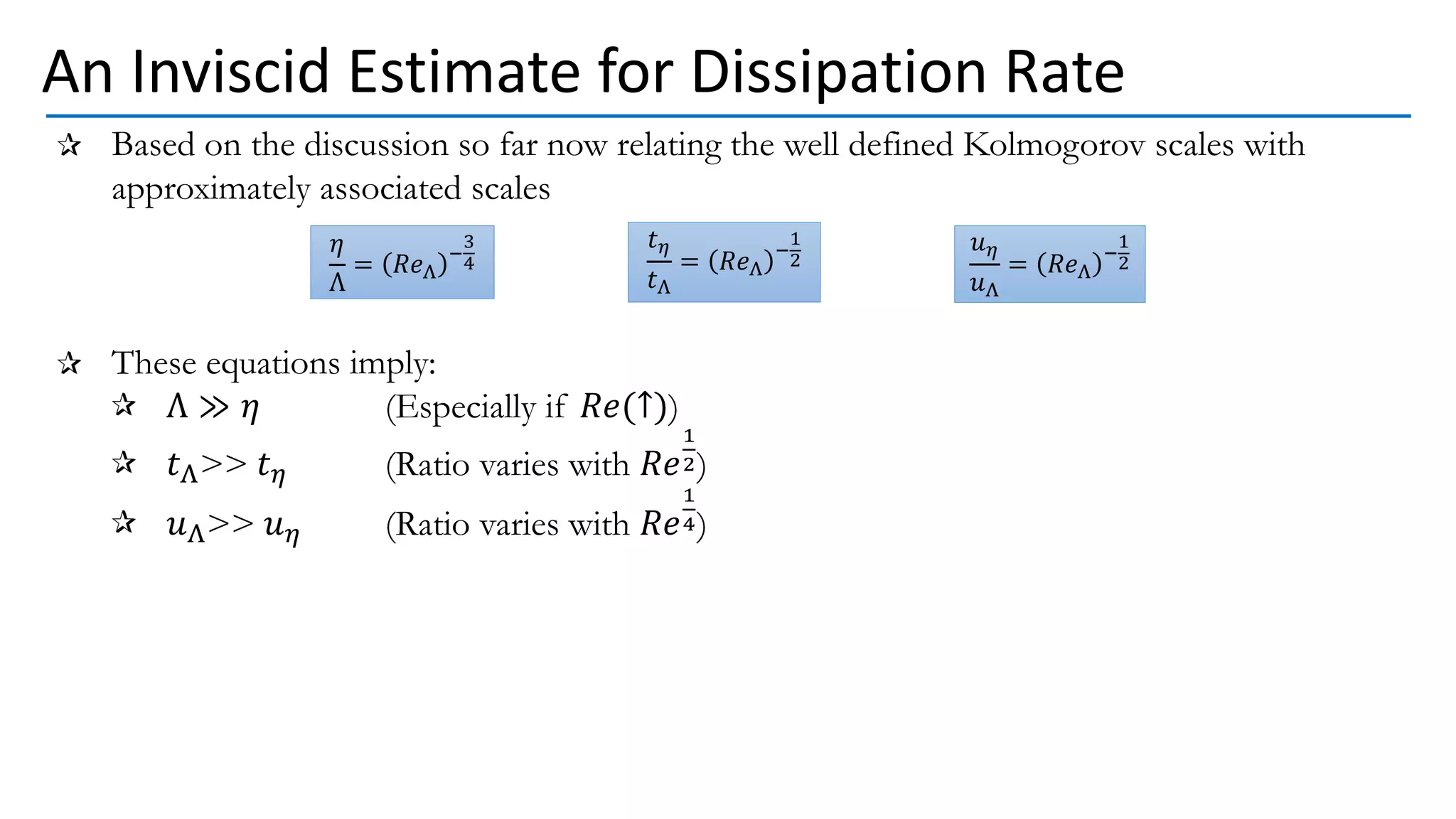
Based on the discussion so far now relating the well defined Kolmogorov scales with
approximately associated scales
An Inviscid Estimate for Dissipation Rate
Based on the discussion so far now relating the well defined Kolmogorov scales with
approximately associated scales
These equations imply:
Λ ≫ 𝜂 (Especially if 𝑅𝑒(↑))
𝑡Λ>> 𝑡𝜂 (Ratio varies with 𝑅𝑒
1
2)
𝑢Λ>> 𝑢𝜂 (Ratio varies with 𝑅𝑒
1
4)
An Inviscid Estimate for Dissipation Rate
𝜂
Λ
= 𝑅𝑒Λ
−
3
4
𝑡𝜂
𝑡Λ
= 𝑅𝑒Λ
−
1
2
𝑢𝜂
𝑢Λ
= 𝑅𝑒Λ
−
1
2
Above illustrates how these small-large scale ratios vary with respect to Reynolds Number.
As 𝑅𝑒 ↑ → 𝑆𝑐𝑎𝑙𝑒 𝑆𝑒𝑝𝑎𝑟𝑎𝑡𝑖𝑜𝑛(↑)
As 𝑅𝑒 ↑ → 𝜂, 𝑡𝜂, 𝑢𝜂(↓)
Only the small scale decreases as the large scale is bounder by the physical confinement
or the buff body involved.
Large-scales don't change noticeably with Reynolds Number in the absence of changes to
the physical dimension.
An Inviscid Estimate for Dissipation Rate
Variations of small/large scales with Re
Under these invariant conditions
Essentially only the passive, smaller-length scales are adjusted by variation of 𝑅𝑒.
Smaller length-scale drastically decreases(Power of Τ
3 4) with increase in 𝑅𝑒.
Smaller time-scale is significantly reduced(Power of Τ
1 2) with increase in 𝑅𝑒.
Smaller velocity-scale is lowered(Power of Τ
1 4) with increase in 𝑅𝑒.
Doubling Reynolds Number causes:
40% decrease in
𝜂
Λ
.
30% reduction in
𝑡𝜂
𝑡Λ
.
20% attenuation in
𝑢𝜂
𝑢Λ
.
An Inviscid Estimate for Dissipation Rate
Variations of small/large scales with Re
Now taking look at vorticity [𝑠−1].
The small-large scale vorticity ratio is
𝑓𝜂
𝑓Λ
~
𝑡Λ
𝑡𝜂
~
𝜈
𝑢′Λ
1
2
= 𝑅𝑒
1
2
This shows that vorticity of smaller-scale eddies is much greater than, that associated with
large-scale eddies.
Thus, small-scale eddies rather than large scale eddies are used for modelling turbulence via
vorticity dynamics.
On the other hand, if we look at the corresponding distribution in the Turbulent Kinetic
Energy.
Mass of Kolmogorov eddy → 𝑚𝜂 ≈ 𝜌𝜂3
Mass of large eddy → 𝑚Λ ≈ 𝜌Λ3
𝑚Λ ≫ 𝑚𝜂
An Inviscid Estimate for Dissipation Rate
On the other hand, if we look at the corresponding distribution in the Turbulent Kinetic
Energy.
Mass of Kolmogorov eddy → 𝑚𝜂 ≈ 𝜌𝜂3
Mass of large eddy → 𝑚Λ ≈ 𝜌Λ3
𝑚Λ ≫ 𝑚𝜂
Thus,
1
2
𝑚Λ 𝑢Λ
′ 2 ≫
1
2
𝑚𝜂 𝑢𝜂
′ 2
The kinetic energy of smaller eddies is substantially less than that of largest eddy.
Most of the fluctuating energy is associated with large eddy.
Most of the vorticity is associated with small scale motion.
An Inviscid Estimate for Dissipation Rate
The Energy Cascade-scales from
production-dissipation balance
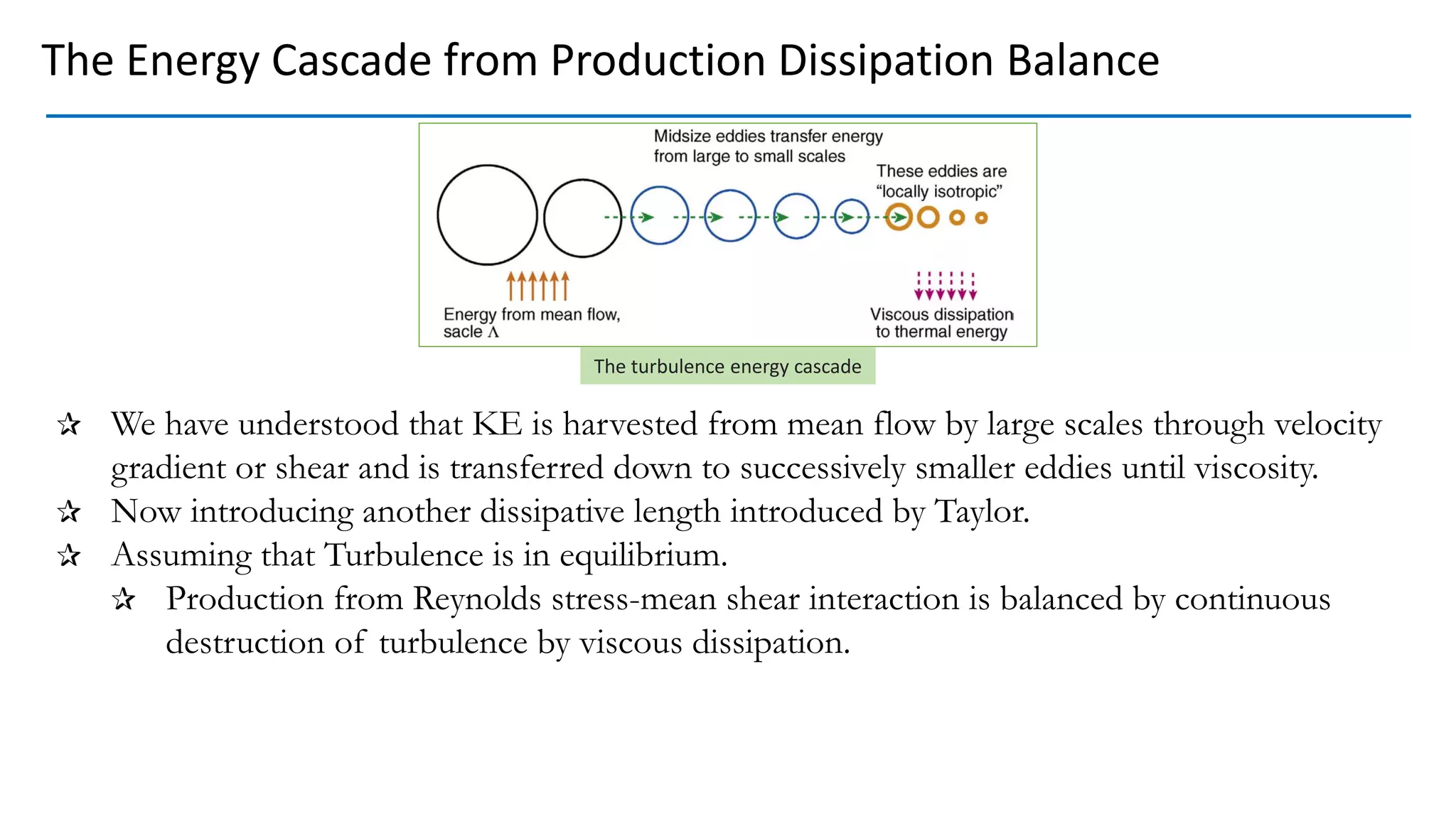
We have understood that KE is harvested from mean flow by large scales through velocity
gradient or shear and is transferred down to successively smaller eddies until viscosity.
Now introducing another dissipative length introduced by Taylor.
Assuming that Turbulence is in equilibrium.
Production from Reynolds stress-mean shear interaction is balanced by continuous
destruction of turbulence by viscous dissipation.
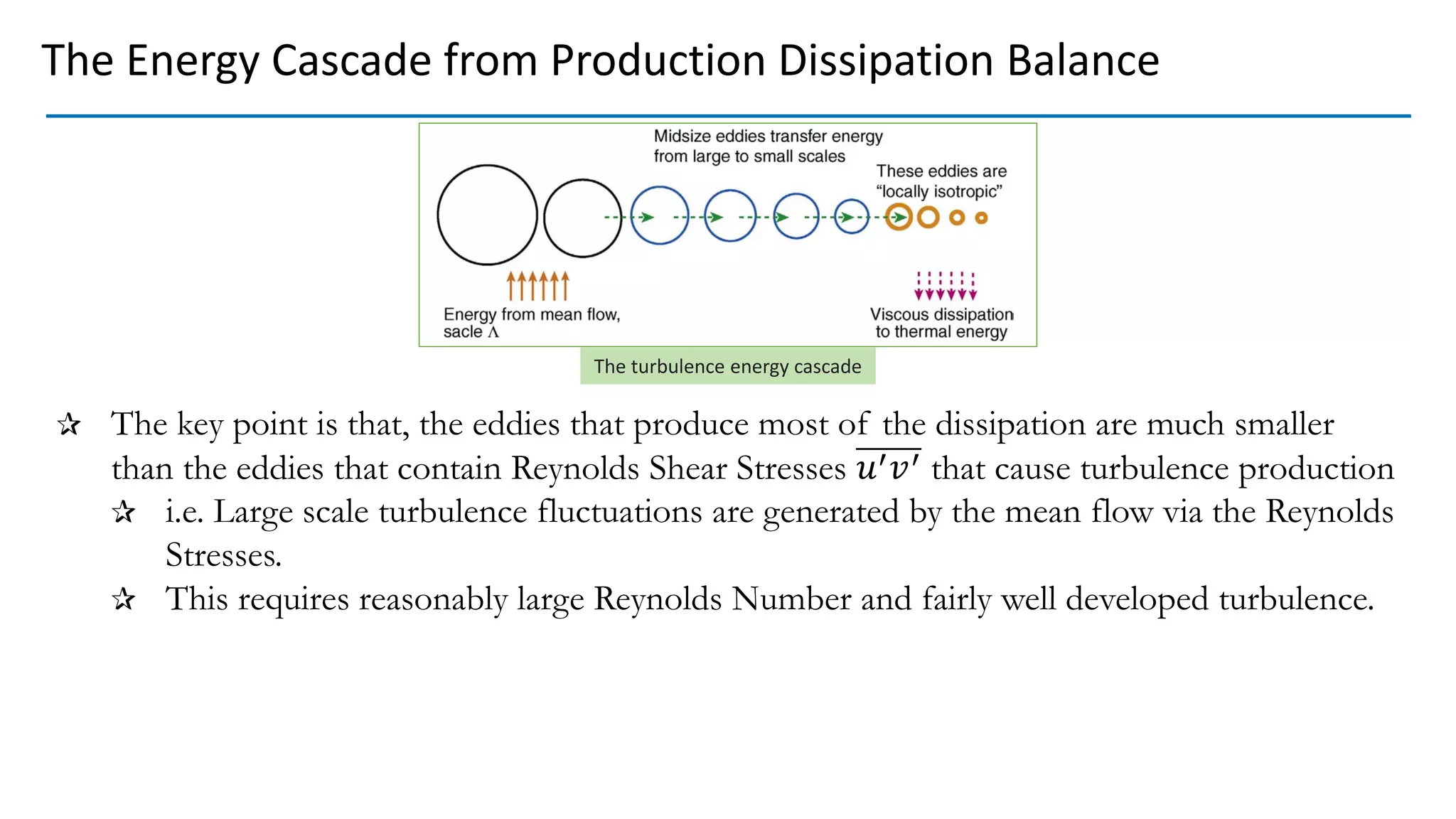
The Energy Cascade from Production Dissipation Balance
The turbulence energy cascade
The key point is that, the eddies that produce most of the dissipation are much smaller
than the eddies that contain Reynolds Shear Stresses 𝑢′𝑣′ that cause turbulence production
i.e. Large scale turbulence fluctuations are generated by the mean flow via the Reynolds
Stresses.
This requires reasonably large Reynolds Number and fairly well developed turbulence.
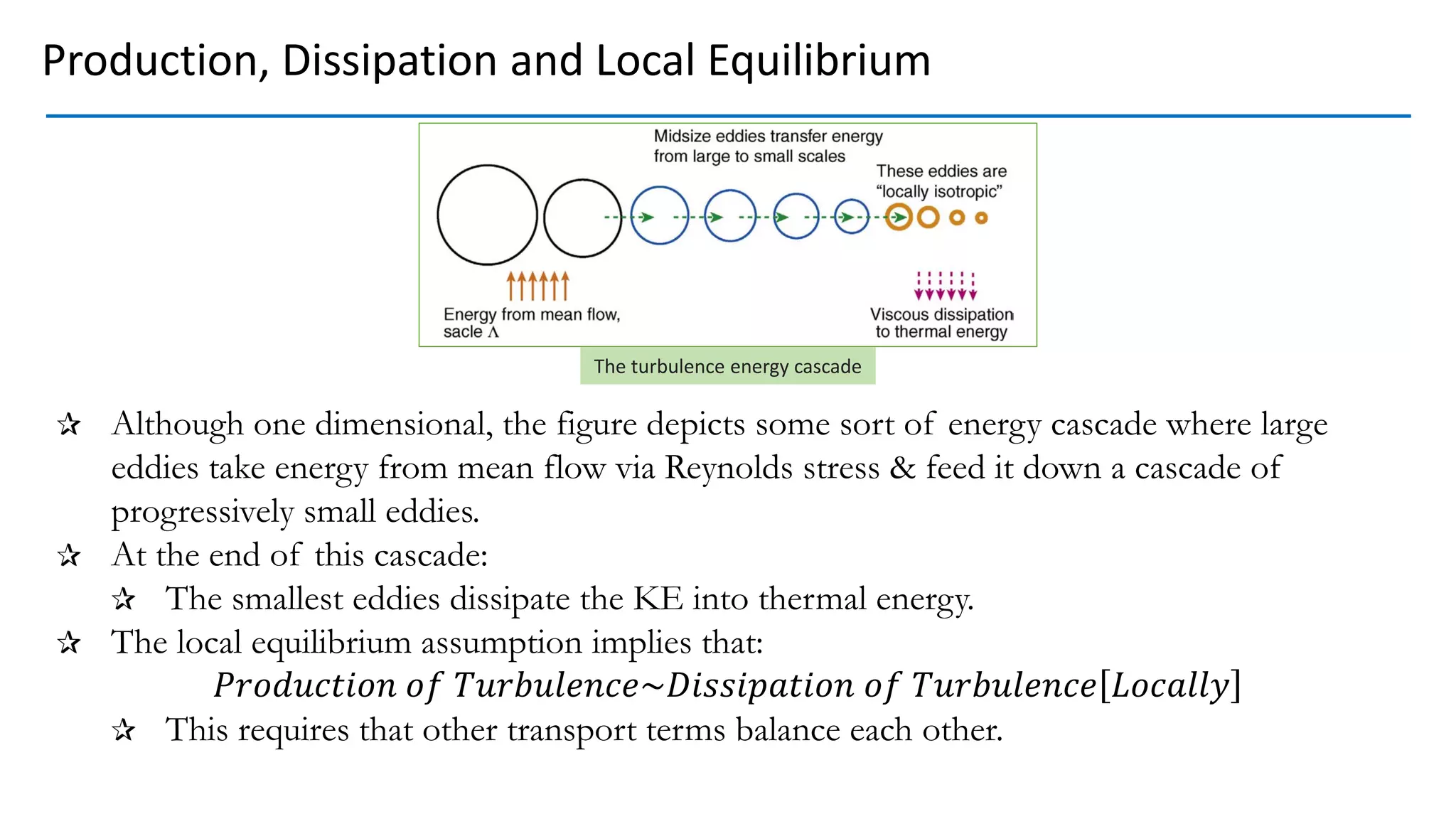
The Energy Cascade from Production Dissipation Balance
The turbulence energy cascade
Although one dimensional, the figure depicts some sort of energy cascade where large
eddies take energy from mean flow via Reynolds stress & feed it down a cascade of
progressively small eddies.
At the end of this cascade:
The smallest eddies dissipate the KE into thermal energy.
The local equilibrium assumption implies that:
𝑃𝑟𝑜𝑑𝑢𝑐𝑡𝑖𝑜𝑛 𝑜𝑓 𝑇𝑢𝑟𝑏𝑢𝑙𝑒𝑛𝑐𝑒~𝐷𝑖𝑠𝑠𝑖𝑝𝑎𝑡𝑖𝑜𝑛 𝑜𝑓 𝑇𝑢𝑟𝑏𝑢𝑙𝑒𝑛𝑐𝑒 𝐿𝑜𝑐𝑎𝑙𝑙𝑦
This requires that other transport terms balance each other.
Production, Dissipation and Local Equilibrium
The turbulence energy cascade
Total turbulence fluctuation from the three orthogonal contribution in Cartesian system is
given by:
𝑞′ 2 = 𝑢′ 2 + 𝑣′ 2 + 𝑤′ 2
Where 𝑢′, 𝑣′ & 𝑤′ are fluctuating velocity components in the 𝑥, 𝑦, & 𝑧 direction.
The total change in Turbulent Kinetic Energy per unit mass of fluid is given by:
𝐷
𝐷𝑡
𝑞′ 2
2
=
𝑃𝑟𝑒𝑠𝑠𝑢𝑟𝑒 𝑎𝑛𝑑
𝑇𝑢𝑟𝑏𝑢𝑙𝑒𝑛𝑡 𝐷𝑖𝑓𝑓𝑢𝑠𝑖𝑜𝑛
+
𝑉𝑖𝑠𝑐𝑜𝑢𝑠
𝑊𝑜𝑟𝑘
+ 𝑃𝑟𝑜𝑑𝑢𝑐𝑡𝑖𝑜𝑛 −
𝑉𝑖𝑠𝑐𝑜𝑢𝑠
𝐷𝑖𝑠𝑠𝑖𝑝𝑎𝑡𝑖𝑜𝑛
Production, Dissipation and Local Equilibrium
The turbulence energy cascade
In absence of [Pressure and Turbulent Diffusion] & [Viscous Work] we are
left with
𝐷
𝐷𝑡
𝑞′ 2
2
= 𝑃𝑟𝑜𝑑𝑢𝑐𝑡𝑖𝑜𝑛 −
𝑉𝑖𝑠𝑐𝑜𝑢𝑠
𝐷𝑖𝑠𝑠𝑖𝑝𝑎𝑡𝑖𝑜𝑛
The production TKE production rate (𝑃𝑡𝑢𝑟𝑏) & TKE dissipation rate 𝜀 .
𝑃𝑡𝑢𝑟𝑏 = −𝑢𝑖𝑢𝑗
𝜕𝑢𝑖
𝜕𝑥𝑗
[m2/s3] 𝜀 = 2𝜈𝑆𝑖𝑗
𝜕𝑢𝑖
𝜕𝑥𝑗
[m2/s3]
𝜀 = 2𝜈
1
2
𝜕𝑢𝑖
𝜕𝑥𝑗
+
𝜕𝑢𝑗
𝜕𝑥𝑖
𝜕𝑢𝑖
𝜕𝑥𝑗
; 𝑆𝑖𝑗 =
1
2
𝜕𝑢𝑖
𝜕𝑥𝑗
+
𝜕𝑢𝑗
𝜕𝑥𝑖
Production, Dissipation and Local Equilibrium
The turbulence energy cascade
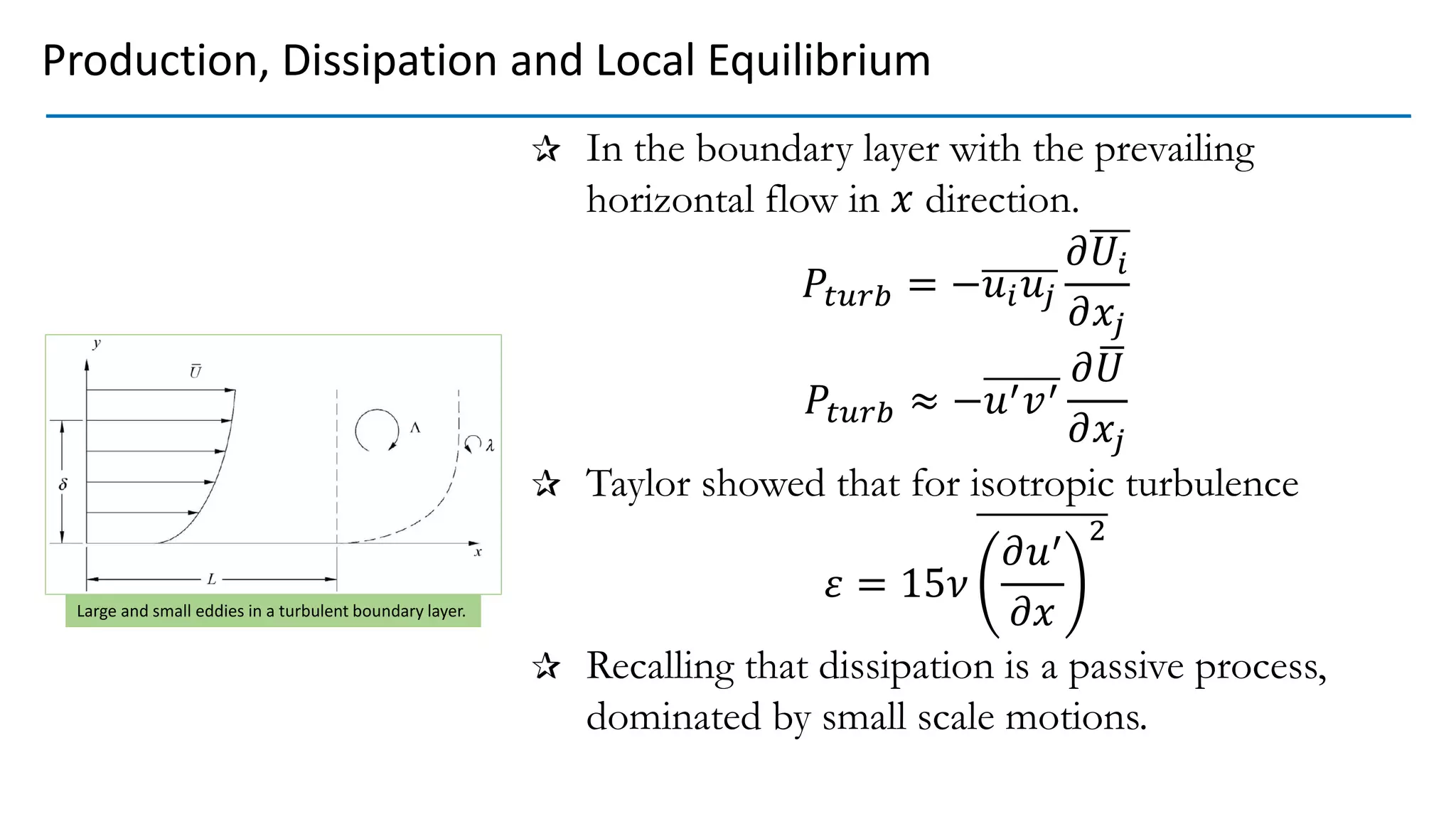
In the boundary layer with the prevailing
horizontal flow in 𝑥 direction.
𝑃𝑡𝑢𝑟𝑏 = −𝑢𝑖𝑢𝑗
𝜕𝑈𝑖
𝜕𝑥𝑗
𝑃𝑡𝑢𝑟𝑏 ≈ −𝑢′𝑣′
𝜕ഥ
𝑈
𝜕𝑥𝑗
Taylor showed that for isotropic turbulence
𝜀 = 15𝜈
𝜕𝑢′
𝜕𝑥
2
Recalling that dissipation is a passive process,
dominated by small scale motions.
Large and small eddies in a turbulent boundary layer.
Production, Dissipation and Local Equilibrium
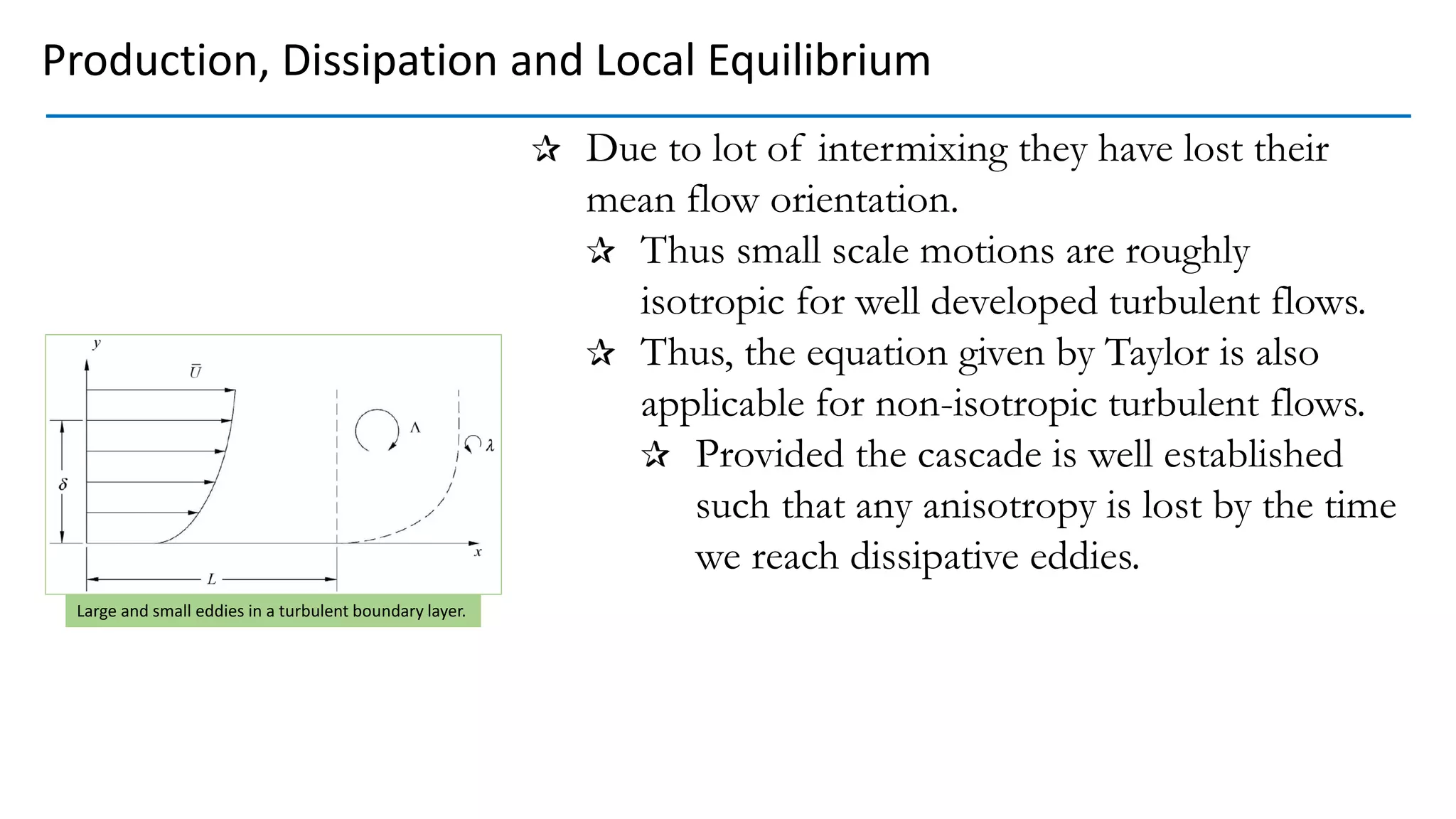
Due to lot of intermixing they have lost their
mean flow orientation.
Thus small scale motions are roughly
isotropic for well developed turbulent flows.
Thus, the equation given by Taylor is also
applicable for non-isotropic turbulent flows.
Provided the cascade is well established
such that any anisotropy is lost by the time
we reach dissipative eddies.
Large and small eddies in a turbulent boundary layer.
Production, Dissipation and Local Equilibrium
Large and small eddies in a turbulent boundary layer.
Approximate Scaling of Production and Dissipation
Relating Production and Dissipation Scales
Refined Estimates for Turbulence
Dissipation and Integral Scales
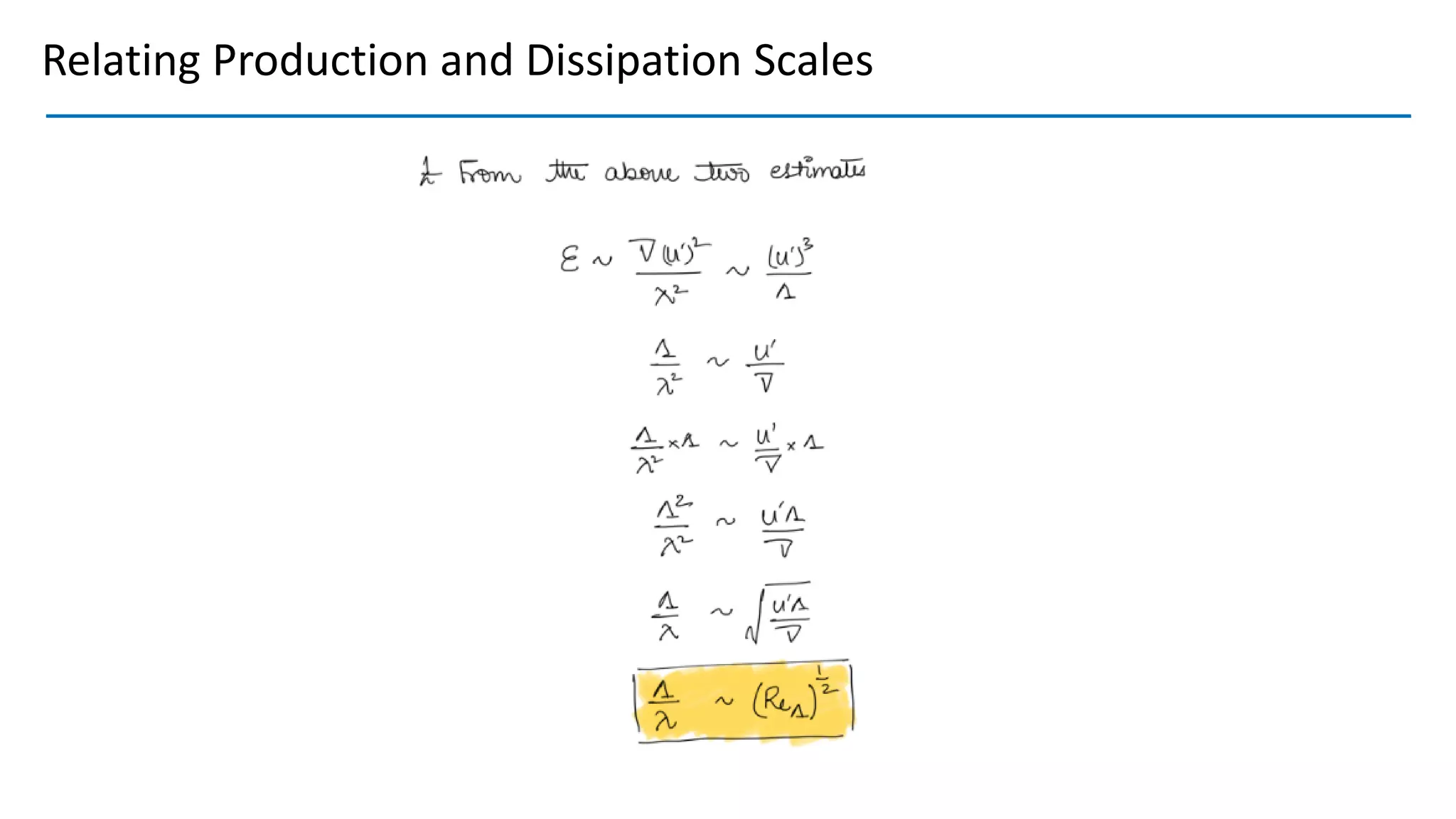
Dissipative Microscales in Isotropic Turbulence
Up until now 𝜆 has been used to approximate some typical scale that represents
the range of eddy sizes that participates strongly in dissipation.
Thus, a more precise definition of the turbulence dissipation scale 𝜆 is required.
A more rigorous definition of eddy size is Taylor Microscale formulated by
Taylor(1935).
Taylor defined a cross-stream scale 𝜆𝑔 and an along-stream scale 𝜆𝑓.
(𝜆𝑔)2
≡
2𝑢′2
𝜕𝑢′
𝜕𝑦
2 ; (𝜆𝑓)2
≡
2𝑢′2
𝜕𝑢′
𝜕𝑥
2
For isotropic turbulence, Taylor related the 𝑥 and 𝑦 velocity derivative to give
Λ𝑔
Λ𝑓
=
1
2
Dissipative Microscales in Isotropic Turbulence
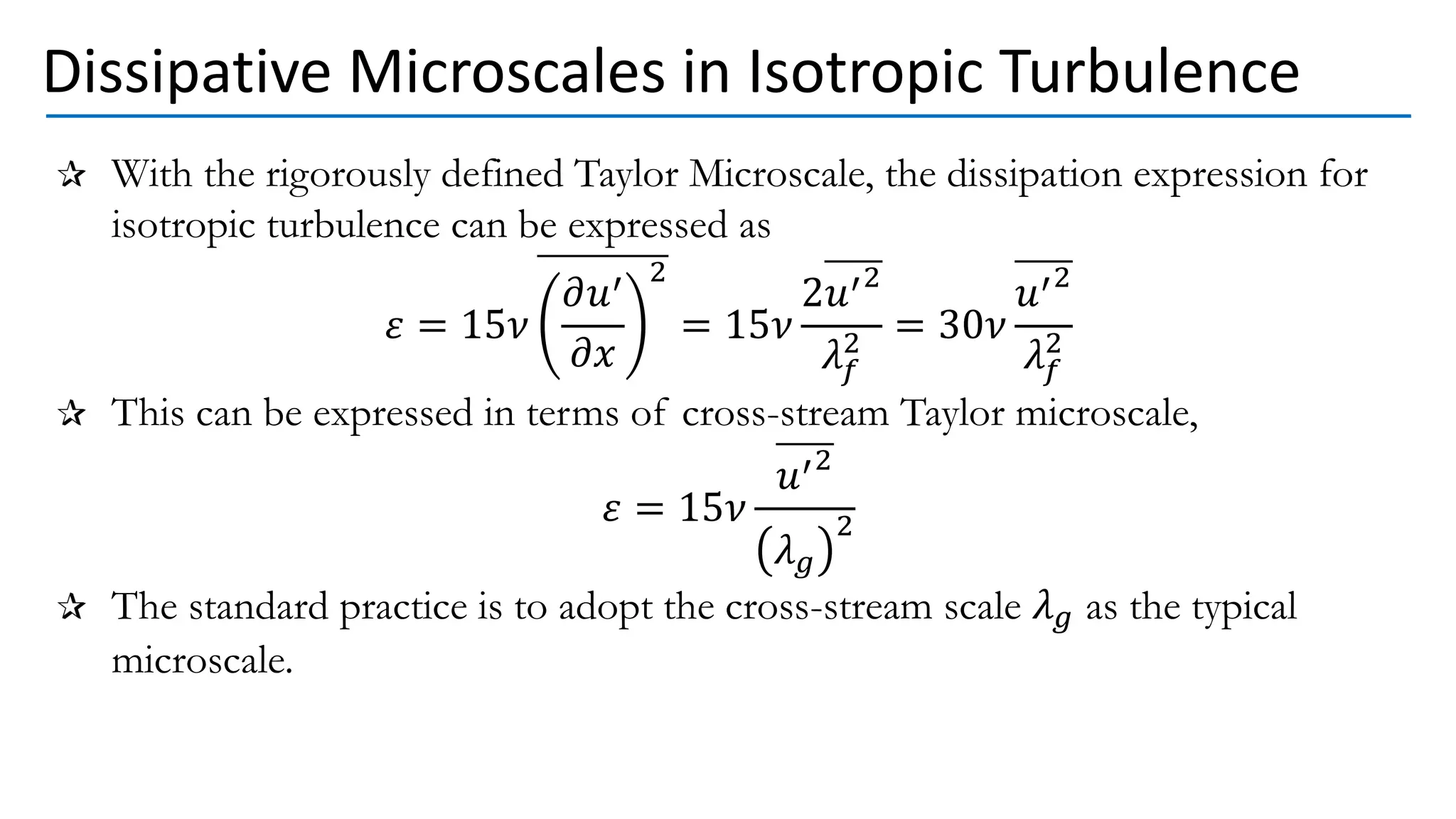
With the rigorously defined Taylor Microscale, the dissipation expression for
isotropic turbulence can be expressed as
𝜀 = 15𝜈
𝜕𝑢′
𝜕𝑥
2
= 15𝜈
2𝑢′2
𝜆𝑓
2 = 30𝜈
𝑢′2
𝜆𝑓
2
This can be expressed in terms of cross-stream Taylor microscale,
𝜀 = 15𝜈
𝑢′2
𝜆𝑔
2
The standard practice is to adopt the cross-stream scale 𝜆𝑔 as the typical
microscale.
Dissipative Microscales in Isotropic Turbulence
𝜀 = 15𝜈
𝑢′2
𝜆𝑔
2
Lets compare the above result with previously obtained estimate of 𝜀 from
scaling analysis.
𝜀~
𝜈𝑢′2
𝜆2
For isotropic turbulence 𝑢′2
= 𝑢′2
, hence
𝜆𝑔 = 15𝜆
Neither 𝜆 nor 𝜆𝑔 are true dissipation scales because they are both derived by
assuming that the velocity scale of dissipating eddies are same a the large
eddies.
Dissipative Microscales in Isotropic Turbulence
In a more general form, the dissipation scale relation maybe expressed as
𝜀 =
𝜈 𝑢𝑑
2
𝜆𝑑
2
Where 𝑢𝑑 and 𝜆𝑑 are activity scales specific to the range of dissipating eddies.
Hinze(1975) showed via spectral analysis of dissipation that the typical size of
the most dissipating eddies is normally
𝜆𝑑~0.3𝜆𝑔
Combining last 3 equations yields
𝑢𝑑 ≈ 1.2 𝑢2
This shows that 𝑢𝑑 = 𝑢 is a fairly good assumption.
Dissipative Microscales in Isotropic Turbulence
Thus, the size of dissipating eddies are typically more than a couple of orders
of magnitude smaller than that of energy-containing eddies.
But, the corresponding velocity scales are similar in magnitude.
The above table also exhibits that 𝑢𝜂 is within an order of magnitude of 𝑢Λ.
Variations of small/large scales with Re
Dissipative Microscales in Isotropic Turbulence
Dissipation expression for isotropic turbulence is given by
𝜀 = 15𝜈
𝑢2
𝜆𝑔
2
Relaxing the expression to include non-isotropic turbulence yields
𝜀 ≈ 15𝜈
𝑞2
𝜆𝑔
2
Where the total velocity variance
𝑞2 = 𝑢2 = 𝑣2 + 𝑤2
The approximate inequality arises because isotropic dissipation assumption
for non-isotropic turbulent flows.
The equation becomes exact when 𝑞2 = 3𝑢2.
Integral Scales
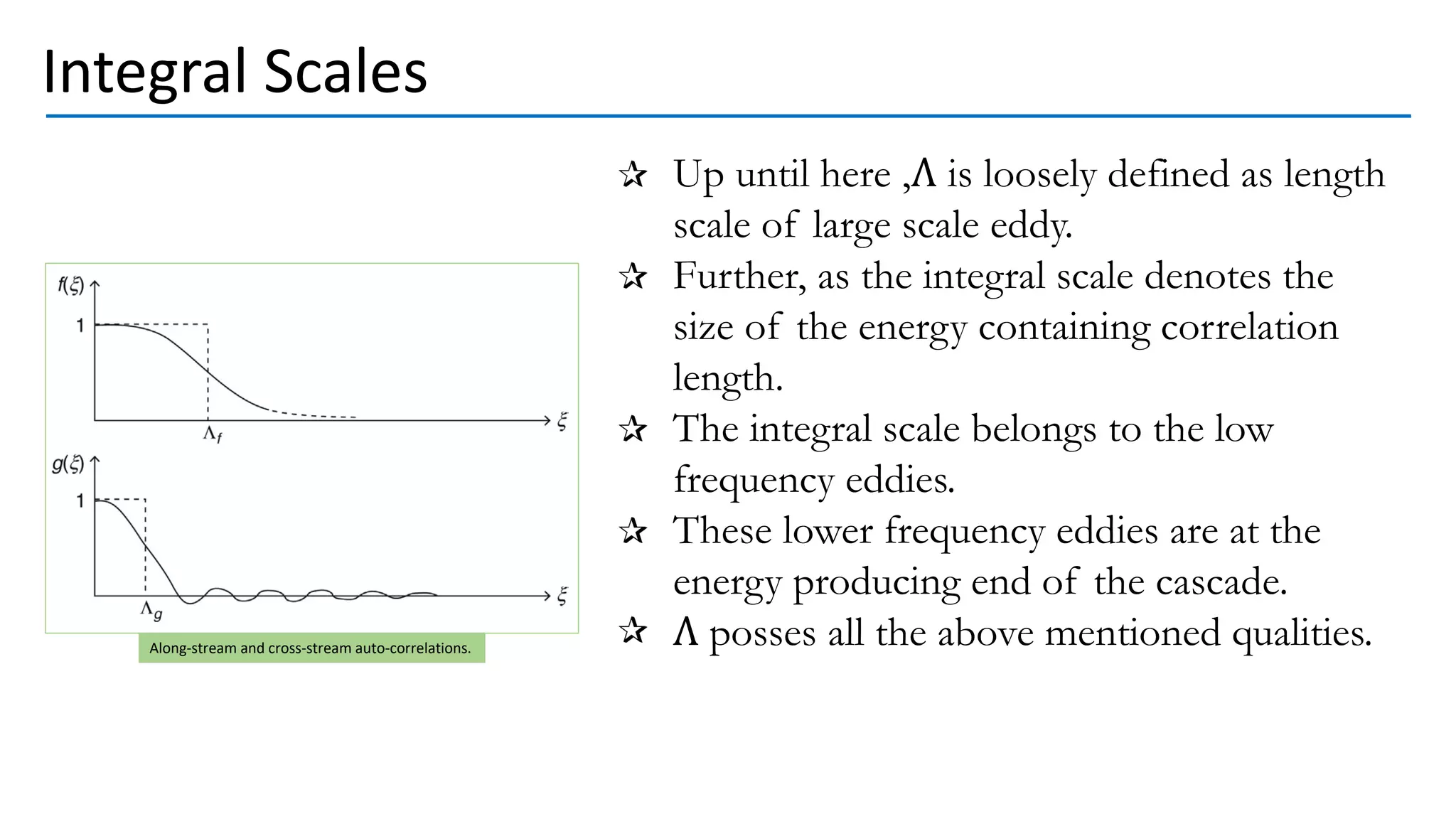
Up until now, Λ has been used to denote the size of some typical
large eddy,
Taylor(1935) defined the large length scales in terms of cross-
stream and along-stream correlations.
Along-stream correlation is given by:
𝑓 𝜉 =
𝑢′ 𝑥, 𝑦 𝑢′(𝑥 + 𝜉, 𝑦)
𝑢′2
Cross-stream correlation is given by:
𝑔 𝜉 =
𝑢′ 𝑥, 𝑦 𝑢′(𝑥, 𝑦 + 𝜉)
𝑢′2
Integral Scales
Here, 𝑢′
is the fluctuating component
in 𝑥 direction and 𝜉 denotes a small
displacement.
The cross stream correlation tends to
oscillate around zero before it
acquires zero value with increasing
separation 𝜉.
The negative correlation happens
when two eddies rotate in opposite
directions.
Cross-stream auto-correlations.
Integral Scales
This negative correlation is usually not
observed in the streamwise
correlation
Probably due to the prevailing
convection of the mean velocity.
This mean velocity overshadows any
small negative correlations
Along-stream auto-correlations.
Integral Scales
The integral scales are defined in terms of
area under the correlations
Λ𝑓 ≡ න
0
∞
𝑓 𝜉 𝑑𝜉
And
Λ𝑔 ≡ න
0
∞
𝑔 𝜉 𝑑𝜉
For any function 𝑓 and 𝑔 that behave like
𝑒𝑥𝑝−𝜉 as 𝜉 → ∞, it can be shown that
Λ𝑔
Λ𝑓
=
1
2
Along-stream and cross-stream auto-correlations.
Integral Scales
Up until here ,Λ is loosely defined as length
scale of large scale eddy.
Further, as the integral scale denotes the
size of the energy containing correlation
length.
The integral scale belongs to the low
frequency eddies.
These lower frequency eddies are at the
energy producing end of the cascade.
Λ posses all the above mentioned qualities.
Along-stream and cross-stream auto-correlations.
Integral Scales
Thus the two length scales are expected to
be linearly related, i.e.
Λ = 𝐶Λ𝑔
Where, 𝐶 is constant
According to Hinze(1975)
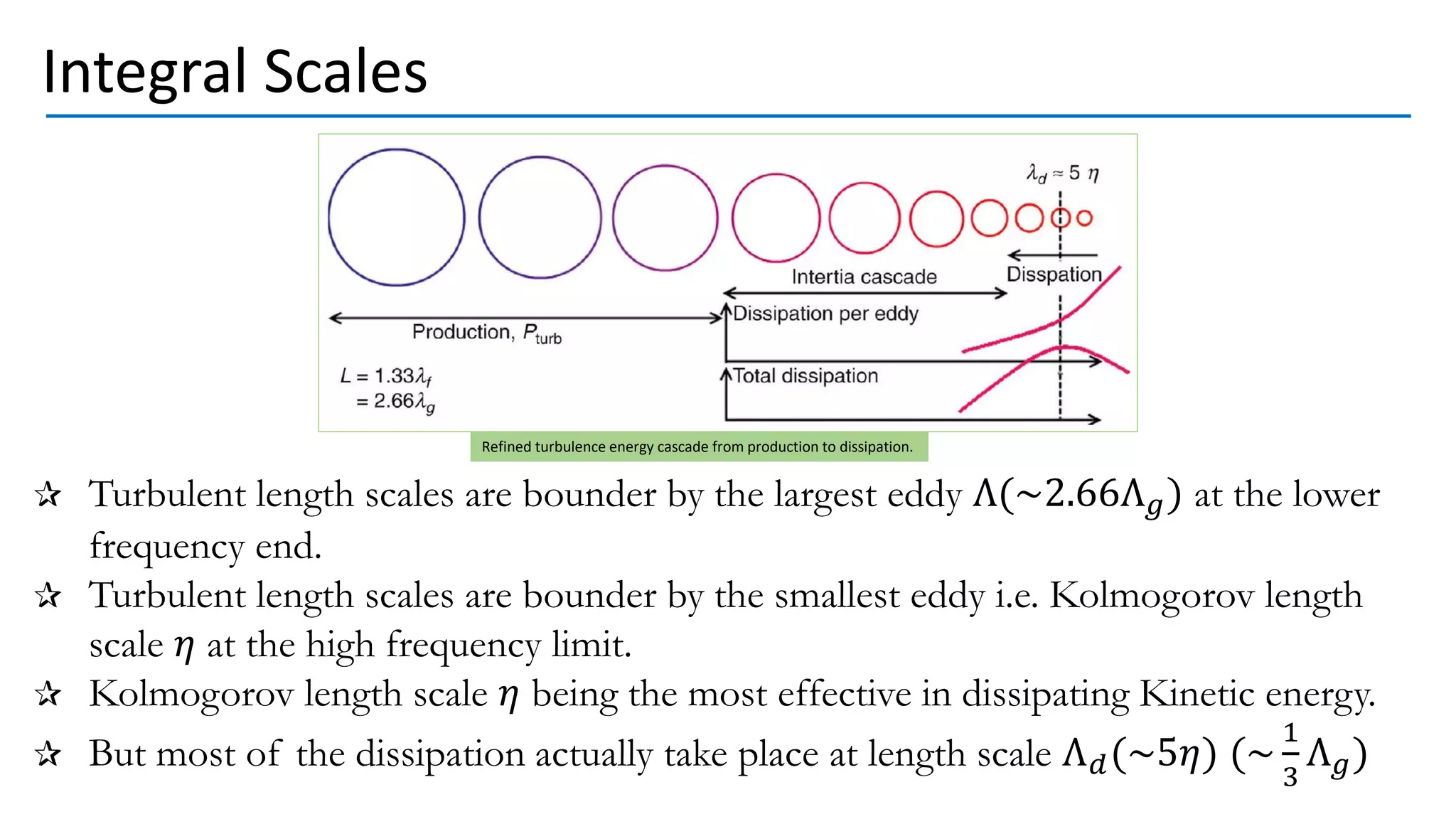
Λ = 2.66Λ𝑔 = 1.33Λ𝑓, (Λ > Λ𝑓 > Λ𝑔)
Thus concluding that Λ denotes the largest
eddies.
This further points out that the turbulent
length scales are bounder by the largest
eddy Λ(~2.66Λ𝑔) at the lower frequency
end.
Along-stream and cross-stream auto-correlations.
Integral Scales
Turbulent length scales are bounder by the largest eddy Λ(~2.66Λ𝑔) at the lower
frequency end.
Turbulent length scales are bounder by the smallest eddy i.e. Kolmogorov length
scale 𝜂 at the high frequency limit.
Kolmogorov length scale 𝜂 being the most effective in dissipating Kinetic energy.
But most of the dissipation actually take place at length scale Λ𝑑(~5𝜂) (~
1
3
Λ𝑔)
Refined turbulence energy cascade from production to dissipation.
Turbulent Kinetic Energy
Spectrum
Turbulent Kinetic Energy Spectrum
The turbulent kinetic energy associated with the cascade of the
large to small spectrum of eddies can be viewed in terms of the
spectral distribution of energy.
The Fourier decomposition can be expressed in terms of number
of cycles per unit length( i.e., wavenumber(𝜅𝑤), or its inverse,
wavelength(𝜆𝑤))
Wavelength is similar to length scale(size of the eddy).
Wavenumber is similar to frequency.
Larger length scale have longer wavelengths and lower frequencies.
Smaller length scales have shorter wavelength and higher
frequencies
Turbulent Kinetic Energy Spectrum
The turbulence kinetic energy per unit mass is thus
𝑘𝑒 = න
0
∞
𝐸 𝜅𝑤 𝑑𝜅𝑤
Where 𝐸 𝜅𝑤 𝑑𝜅𝑤 is the amount of kinetic energy possessed by the
eddies with wavenumbers between 𝜅𝑤 and 𝜅𝑤 + 𝑑𝜅𝑤.
The energy spectral density or energy spectrum function 𝐸 𝜅𝑤 is a
function of the energy containing large eddy(Λ) and the mean strain rate
which transfers the energy from mean flow to the large eddies.
The amount of 𝐸 𝜅𝑤 is also dependent on the rate of dissipation (i.e. 𝜀
and 𝜈)
Turbulent Kinetic Energy Spectrum
For well developed turbulence where Λ ≫ 𝜆,
we have
𝜀~
(𝑘𝑒)
3
2
Λ
[Taylor(1935)]
Which means
𝑘𝑒~(𝜀Λ)
2
3
As shown in the figure, for well developed
turbulence, there is a range of wavenumbers
over which neither production nor dissipation
is dominant.
i.e. inertial transfer of kinetic Energy is the
premiant player.
Orificed, perforated plate-generated streamwise
turbulence velocity spectra at U = 10.8 m/s.
Turbulent Kinetic Energy Spectrum
Over this inertial subrange, 𝐸 𝜅𝑤 depends
only on 𝜀 and 𝜅𝑤.
Based on dimensional analysis, Kolmogorov
concluded
𝐸 𝜅𝑤 = 𝐶𝜅𝜀2/3𝜅𝑤
−5/3
Where,
1
Λ
≪ 𝜅𝑤 ≪
1
𝜂
𝐶𝜅 is Kolmogorov constant
Orificed, perforated plate-generated streamwise
turbulence velocity spectra at U = 10.8 m/s.

Scales in Turbulent Flow

  • 1.
  • 2.
    Introduction “Big whirls havelittle whirls that feed on their velocity, and little whirls have lesser whirls and so on to viscosity”- Richardson(1922) Fully developed turbulent flow is considered. The largest eddies are created by instabilities in mean flow These are further subjected to inertia instabilities leading to breakup into progressively smaller eddies. Dissipation (↑) → Instantaneous velocity gradient (↑)
  • 3.
    Introduction “Big whirls havelittle whirls that feed on their velocity, and little whirls have lesser whirls and so on to viscosity”- Richardson(1922) Fully developed turbulent flow is considered. The largest eddies are created by instabilities in mean flow These are further subjected to inertia instabilities leading to breakup into progressively smaller eddies. Dissipation (↑) → 𝜕𝑢 𝜕𝑦 (↑)
  • 4.
    Introduction “Big whirls havelittle whirls that feed on their velocity, and little whirls have lesser whirls and so on to viscosity”- Richardson(1922) Fully developed turbulent flow is considered. The largest eddies are created by instabilities in mean flow These are further subjected to inertia instabilities leading to breakup into progressively smaller eddies. Dissipation (↑) → ∇ത 𝑉(↑)
  • 5.
    Introduction “Big whirls havelittle whirls that feed on their velocity, and little whirls have lesser whirls and so on to viscosity”- Richardson(1922) Fully developed turbulent flow is considered. The largest eddies are created by instabilities in mean flow These are further subjected to inertia instabilities leading to breakup into progressively smaller eddies. Dissipation (↑) → ∇ത 𝑉(↑) → Shear Stress ↑ We already know that the viscous effect are most pronounced at the smaller scales. Thus dissipation of mechanical energy within a turbulent flow is concentrated in the smallest eddy sizes.
  • 6.
    Velocity and keylength scales in laminar and turbulent boundary layers
  • 7.
    The figure showsviscous dissipation from ‘A’ to ‘B’. ➢ Separated by distance L. ➢ Characteristic viscous diffusion time is 𝑡𝑣. ➢ The viscous dissipation time maybe viewed as the time it takes ‘B’ to feel the passing of ‘A’ via fluid viscosity. Reynolds Number in terms of diffusion and advection time
  • 8.
    The viscous diffusiontime is: ➢ Proportional to distance(𝑡𝑣 ~ 𝐿) ➢ The farther away they are the longer it takes for ‘B’ to feel ‘A’. ➢ Inversely proportional to the fluid viscosity (𝑡𝑣 ~ 1 𝜈 ) ➢ The larger the viscosity the shorter time it takes for ‘B’ to feel ‘A’. Reynolds Number in terms of diffusion and advection time
  • 9.
    Hence dimensionally thecharacteristic viscous diffusion time which is required for momentum to diffuse a distance ‘𝐿’ due to viscosity is 𝑡𝑣 = 𝐿2 𝜈 ; [ Τ 𝑚2 Τ 𝑚2 𝑠 = 𝑠] For a body of length ‘𝐿’ in a flow field with a mean velocity ‘𝑈’. A characteristic(overall) advection time scale 𝑡𝑎 signifies the duration over which the fluid element is of significance to the body and vice-versa. 𝐴𝑑𝑣𝑒𝑐𝑡𝑖𝑜𝑛 𝑇𝑖𝑚𝑒 𝑡𝑎 = 𝐿 𝑈 Advection time is the time that is required by a fluid element to pass a body of length ‘𝐿’. Reynolds Number in terms of diffusion and advection time
  • 10.
    Reynolds Number signifiesthe strength of inertia force with respect to the underlying viscous force of a moving fluid. 𝑅𝑒 = 𝐼𝑛𝑒𝑟𝑡𝑖𝑎 𝐹𝑜𝑟𝑐𝑒 𝑉𝑖𝑠𝑐𝑜𝑢𝑠 𝐹𝑜𝑟𝑐𝑒 = 𝐴𝑑𝑣𝑒𝑐𝑡𝑖𝑜𝑛 𝐸𝑓𝑓𝑒𝑐𝑡 𝑉𝑖𝑠𝑐𝑜𝑢𝑠 𝐸𝑓𝑓𝑒𝑐𝑡 = 1 𝑡𝑎 1 𝑡𝑣 The shorter the fluid(element) takes to pass(advect) a distance ‘𝐿’, the larger the inertia force. 𝑡𝑎 ↓ → 𝐹𝑖𝑛𝑒𝑟𝑡𝑖𝑎(↑) The shorter the time it take to communicate the presence of a fluid particle, the higher the viscous effect. 𝑡𝑣 ↓ → 𝐹𝑣𝑖𝑠𝑐𝑜𝑢𝑠(↑) Rearranging yields 𝑅𝑒 = 𝑡𝑣 𝑡𝑎 = ( Τ 𝐿2 𝜈) (𝐿/𝑈) = 𝑈𝐿 𝜈 Reynolds Number in terms of diffusion and advection time
  • 11.
    Derivation via Newton’ssecond Law 𝑅𝑒 = 𝐼𝑛𝑒𝑟𝑡𝑖𝑎 𝐹𝑜𝑟𝑐𝑒 𝑉𝑖𝑠𝑐𝑜𝑢𝑠 𝐹𝑜𝑟𝑐𝑒 = 𝐴𝑑𝑣𝑒𝑐𝑡𝑖𝑜𝑛 𝐸𝑓𝑓𝑒𝑐𝑡 𝑉𝑖𝑠𝑐𝑜𝑢𝑠 𝐸𝑓𝑓𝑒𝑐𝑡 = 1 𝑡𝑎 1 𝑡𝑣 From Newton’s Second Law: 𝐹𝑖 = 𝑚𝑎 Acceleration of fluid particle in 𝑥 direction is given by 𝑎𝑥 = 𝜕𝑢 𝜕𝑡 + 𝑢 𝜕𝑢 𝜕𝑥 + v 𝜕𝑢 𝜕𝑦 + w 𝜕𝑢 𝜕𝑧 Thus force becomes 𝐹𝑖 = 𝑚 𝑢 𝜕𝑢 𝜕𝑥 ~ 𝜌∀ 𝑈2 𝐿 Reynolds Number in terms of diffusion and advection time
  • 12.
    Dividing force byvolume(∀) yields 𝐹𝑖 ∀ = 𝑚𝑎 ∀ = 𝜌∀ 𝑈2 𝐿 ∀ = 𝜌𝑈2 𝐿 (Inertia Force per unit mass) Shear Force from Newton’s Law of Viscosity is given by 𝜏 = 𝜇 𝑑𝑢 𝑑𝑦 ~𝜇 𝑈 𝐿 Thus, Shear Force is given by 𝐹𝑣 = 𝜏𝐴 = 𝜇 𝑈 𝐿 𝐿2 = 𝜇𝑈𝐿 Dividing force by volume(∀) yields 𝐹𝑣 ∀ = 𝜇𝑈𝐿 𝐿3 = 𝜇𝑈 𝐿2 (Viscous Force per unit mass) Taking ratio of both forces yields Reynolds Number 𝑅𝑒 = 𝐹𝑖 ∀ 𝐹𝑣 ∀ = 𝜌𝑈2 𝐿 𝜇𝑈 𝐿2 = 𝜌𝑈𝐿 𝜇 = 𝑈𝐿 𝜈 Reynolds Number in terms of diffusion and advection time
  • 13.
    When 𝑅𝑒 ↓: There is enough viscous force to take care of the agitative inertia force. Hence Turbulence is under control. When 𝑅𝑒 ↑ : The inertia force increases until the viscous force becomes incapable of keeping the fluctuations under control Thus flow becomes Turbulent Reynolds Number in terms of diffusion and advection time
  • 14.
    Naiver Stokes equationfor steady laminar flow of incompressible fluid with constant viscosity can be expressed as 𝑢𝑗 𝜕𝑢𝑗 𝜕𝑥𝑗 = 1 𝜌 𝜕𝑃 𝜕𝑥𝑖 + 𝜈 𝜕2𝑢𝑖 𝜕𝑥𝑗𝜕𝑥𝑗 s Ratio of inertia vs viscous term is Reynolds Number 𝑅𝑒 = 𝐹𝑖 𝐹𝑣 = 𝑈2 𝐿 𝜈𝑈 𝐿2 = 𝑈𝐿 𝜈 Laminar Boundary Layer Laminar boundary layer. Inertia Term Viscous Term ~ 𝑈2 𝐿 ~ 𝜈𝑈 𝐿2
  • 15.
    We see thatviscous term becomes negligible and must be dropped at high Reynolds Number. But the boundary conditions make it impossible to neglect the viscous terms everywhere in the flow field. E.g. Viscous terms cannot be neglected in the velocity boundary layer. When considering length scale , we tend to associate viscous effects with small length scales In other terms the viscous term can survive at high Re values only by choosing a length scale(𝛿)(𝑆𝑚𝑎𝑙𝑙) which represents the thickness of the boundary layer. At such length scale the inertia and viscous forces become of the same order i.e. for diffusive(viscous) length scale(𝛿) Laminar Boundary Layer Laminar boundary layer. Inertia Term Viscous Term 𝑈2 𝐿 𝜈𝑈 𝐿2 𝑢𝑗 𝜕𝑢𝑗 𝜕𝑥𝑗 = 1 𝜌 𝜕𝑃 𝜕𝑥𝑖 + 𝜈 𝜕2 𝑢𝑖 𝜕𝑥𝑗𝜕𝑥𝑗 𝑈2 𝐿 𝜈𝑈 𝐿2 ~ 𝑈2 𝐿 𝜈𝑈 𝛿2 ~
  • 16.
    In shear flow: ➢The “Diffusive ” length scale (i.e. 𝛿 here) is associated with the diffusion across the flow. ➢ The “Convective” length scale (i.e. 𝐿 here) is associated with the convection along the flow. Laminar Boundary Layer Laminar boundary layer. Inertia Term Viscous Term 𝑈2 𝐿 𝜈𝑈 𝐿2 𝑢𝑗 𝜕𝑢𝑗 𝜕𝑥𝑗 = 1 𝜌 𝜕𝑃 𝜕𝑥𝑖 + 𝜈 𝜕2 𝑢𝑖 𝜕𝑥𝑗𝜕𝑥𝑗 𝑈2 𝐿 ~ 𝜈𝑈 𝛿2 𝛿 𝐿 2 ~ 𝜈 𝑈𝐿 𝛿 𝐿 ~ 𝜈 𝑈𝐿 𝛿 𝐿 ~ 𝑅𝑒𝐿
  • 17.
    Considering boundary layerfor the case where the boundary layer is turbulent. Considerable inertia is associated with large Reynolds Number. ➢ This produces lots of eddy motion. These eddies transfer momentum deficit(Relatively less amount of momentum) away from the solid surface. ➢ Giving rise to “Cross stream diffusion turbulence”. The boundary layer thickness ‘𝛿’ presumably increase roughly as 𝜕𝛿 𝜕𝑡 ~𝑢′ or 𝜕𝛿 𝜕𝑥 ~𝑢′ Turbulent Boundary Layer Turbulent boundary layer.
  • 18.
    In other words, Thehigher the turbulence level, the faster the boundary layer increases w.r.t time or position in downstream direction. The time interval that has elapsed for a fluid particle moving from 𝑥 = 0 to 𝐿 is of the order Τ 𝐿 𝑈. Convective time scale~ 𝐿 𝑈 For Diffusion: Diffusion Time Scale 𝑡 ~ 𝛿 𝑢′ Turbulent Boundary Layer Turbulent boundary layer. ‘
  • 19.
    Substituting convective timescale to diffusion time scale. The above analysis implies that with imposed external flow. Turbulent Timescale ∝ Flow Timescale. In other words, Flow turbulence is a function of mean flow, Consequently turbulence is apart of flow. And not the part of fluid as molecular diffusivity and viscosity. Not all of turbulence has such small time scale. Turbulent Boundary Layer Turbulent boundary layer. ‘ Convective time scale~ 𝐿 𝑈 Diffusion Time Scale 𝑡 ~ 𝛿 𝑢′ 𝐿 𝑈 ~ 𝛿 𝑢′ 𝑢′ 𝑈 ~ 𝛿 𝐿
  • 20.
    Shortest eddies inturbulence has small time scale Which make them statistical independent. Thus more than one eddy size is required to describe turbulent flow. At minimum we need to describe one large scale and one small scale to describe turbulent low. In the turbulent flow, the fluid motion creates a multitude of eddies that are responsible for transport properties Turbulent Boundary Layer Turbulent boundary layer. ‘ Convective time scale~ 𝐿 𝑈 Diffusion Time Scale 𝑡 ~ 𝛿 𝑢′ 𝐿 𝑈 ~ 𝛿 𝑢′ 𝑢′ 𝑈 ~ 𝛿 𝐿
  • 21.
    The molecular effectsin turbulent flow provides a sink for dissipation of small scale eddying motion. Transport heat, mass and momentum over distance less thatn the smallest turbulent eddies. A wide range of length scale exists in a turbulent flow Bounded by the dimension of the flow field Dimension of the flow field Dimension of the body generating the flow disturbance The diffusion action of molecular viscosity(mfp) Turbulent Boundary Layer Turbulent boundary layer. ‘ Convective time scale~ 𝐿 𝑈 Diffusion Time Scale 𝑡 ~ 𝛿 𝑢′ 𝐿 𝑈 ~ 𝛿 𝑢′ 𝑢′ 𝑈 ~ 𝛿 𝐿
  • 22.
    The relation betweenthe various scale of mean motion and turbulent eddies, if any will allow us to develop general predictions of the change that occurs in turbulent structures when the mean field is altered. Eddies come in a wide range of sizes. A minimum of two length scales are required to characterize the large and small eddies Λ → Signifies Large Eddies 𝜆 → Signifies the Small Eddies The smallest eddy act as a sink for molecular motions to dissipate turbulence, channelling the turbulent Kinetic Energy via viscosity into heat. Turbulent Boundary Layer Large and small eddies in a turbulent boundary layer.
  • 23.
    For Laminar Flow(Boundarylayer) 𝑈 → Velocity Scale 𝛿 → Cross-stream length scale 𝐿 → Stream-wise length scale For Turbulent Flow(Boundary Layer) ഥ 𝑈 → Mean(time averaged)Velocity Scale 𝛿&𝐿 → Length Scales Time scale for mean flow ~ 𝐿 𝑈 Time scale for large scale turbulence ~ Λ 𝑢′ Turbulent Boundary Layer Large and small eddies in a turbulent boundary layer. 𝑢′ 𝜆&Λ Corresponding Fluctuating Components
  • 24.
    Consider a stagnantfluid sandwiched between two solid boundaries Suppose the floor is heated But the fluid remains macroscopically stagnant As such the thermal energy is distributed via molecular diffusion 𝜕𝜃 𝜕𝑡 = 𝜅𝑡 𝜕2 𝜃 𝜕𝑥𝑖𝜕𝑥𝑖 𝜃 → Temperature 𝜅𝑡 → Thermal diffusivity 𝑘 𝜌𝐶𝑝 Molecular Versus Turbulent Diffusion Molecular versus turbulent diffusion. Cartesian Heat Conduction Equation 𝜌𝐶𝑝 𝜕𝜃 𝜕𝑡 = 𝜕 𝜕𝑥 𝑘 𝜕𝜃 𝜕𝑥 + 𝜕 𝜕𝑦 𝑘 𝜕𝜃 𝜕𝑦 + 𝜕 𝜕𝑧 𝑘 𝜕𝜃 𝜕𝑧 + 𝑞𝑣 𝜌𝐶𝑝 𝜕𝜃 𝜕𝑡 = 𝜕 𝜕𝑥 𝑘 𝜕𝜃 𝜕𝑥 + 𝜕 𝜕𝑦 𝑘 𝜕𝜃 𝜕𝑦 + 𝜕 𝜕𝑧 𝑘 𝜕𝜃 𝜕𝑧 𝜌𝐶𝑝 𝜕𝜃 𝜕𝑡 = 𝑘 𝜕2 𝜃 𝜕𝑥𝑖𝜕𝑥𝑖 𝜕𝜃 𝜕𝑡 = 𝑘 𝜌𝐶𝑝 𝜕2 𝜃 𝜕𝑥𝑖𝜕𝑥𝑖 𝜕𝜃 𝜕𝑡 = 𝜅𝑡 𝜕2 𝜃 𝜕𝑥𝑖𝜕𝑥𝑖
  • 25.
    Dimentionally the aboveequation can be interpreted as Δ𝜃 𝑡𝑚𝑜𝑙 ~𝜅𝑡 Δ𝜃 𝐿2 𝑡𝑚𝑜𝑙 → Molecular Diffusion Time Δ𝜃 → Characteristic Temperature Difference 𝑡𝑚𝑜𝑙~ 𝐿2 𝜅𝑡 If the ceiling is 3m from the floor and fluid is air 𝛼~2 × 10⁻⁶ 𝑡𝑚𝑜𝑙~ 32 2 × 10⁻⁶ ~4.5 × 10⁵𝑠𝑒𝑐~125ℎ𝑟𝑠~5𝑑𝑎𝑦𝑠 i.e. In the absence of fluid motion it will take days for the temperature to even out. Molecular Versus Turbulent Diffusion Molecular versus turbulent diffusion. Cartesian Heat Conduction Equation 𝜌𝐶𝑝 𝜕𝜃 𝜕𝑡 = 𝜕 𝜕𝑥 𝑘 𝜕𝜃 𝜕𝑥 + 𝜕 𝜕𝑦 𝑘 𝜕𝜃 𝜕𝑦 + 𝜕 𝜕𝑧 𝑘 𝜕𝜃 𝜕𝑧 + 𝑞𝑣 𝜌𝐶𝑝 𝜕𝜃 𝜕𝑡 = 𝜕 𝜕𝑥 𝑘 𝜕𝜃 𝜕𝑥 + 𝜕 𝜕𝑦 𝑘 𝜕𝜃 𝜕𝑦 + 𝜕 𝜕𝑧 𝑘 𝜕𝜃 𝜕𝑧 𝜌𝐶𝑝 𝜕𝜃 𝜕𝑡 = 𝑘 𝜕2 𝜃 𝜕𝑥𝑖𝜕𝑥𝑖 𝜕𝜃 𝜕𝑡 = 𝑘 𝜌𝐶𝑝 𝜕2 𝜃 𝜕𝑥𝑖𝜕𝑥𝑖 𝜕𝜃 𝜕𝑡 = 𝜅𝑡 𝜕2 𝜃 𝜕𝑥𝑖𝜕𝑥𝑖
  • 26.
    In reality whenthe fluid in the vicinity of the hot floor is heated Buoyancy driven instabilities will emerge. Assuming that the length scale of the resulting turbulent motion is ‘𝐿’ and velocity scale is of the order ‘𝑢′ ’. 𝑡𝑡𝑢𝑟𝑏~ 𝐿 𝑢′ Further assuming that 𝑢′ ~ Τ 𝑐𝑚 𝑠 𝑡𝑡𝑢𝑟𝑏~ 3 0.01 ~300𝑠𝑒𝑐~5𝑚𝑖𝑛 i.e. The resulting turbulence characteristic time for the thermal energy to be distributed throughout the compartment is of the order of a few minutes Molecular Versus Turbulent Diffusion Molecular versus turbulent diffusion. Cartesian Heat Conduction Equation 𝜌𝐶𝑝 𝜕𝜃 𝜕𝑡 = 𝜕 𝜕𝑥 𝑘 𝜕𝜃 𝜕𝑥 + 𝜕 𝜕𝑦 𝑘 𝜕𝜃 𝜕𝑦 + 𝜕 𝜕𝑧 𝑘 𝜕𝜃 𝜕𝑧 + 𝑞𝑣 𝜌𝐶𝑝 𝜕𝜃 𝜕𝑡 = 𝜕 𝜕𝑥 𝑘 𝜕𝜃 𝜕𝑥 + 𝜕 𝜕𝑦 𝑘 𝜕𝜃 𝜕𝑦 + 𝜕 𝜕𝑧 𝑘 𝜕𝜃 𝜕𝑧 𝜌𝐶𝑝 𝜕𝜃 𝜕𝑡 = 𝑘 𝜕2 𝜃 𝜕𝑥𝑖𝜕𝑥𝑖 𝜕𝜃 𝜕𝑡 = 𝑘 𝜌𝐶𝑝 𝜕2 𝜃 𝜕𝑥𝑖𝜕𝑥𝑖 𝜕𝜃 𝜕𝑡 = 𝜅𝑡 𝜕2 𝜃 𝜕𝑥𝑖𝜕𝑥𝑖
  • 27.
    In other words,turbulence enhances the diffusivity by orders of magnitude As compared to diffusivity alone From the above we see that Turbulence can boost diffusivity by order of magnitudes. The boosted diffusivity maybe viewed as effective diffusivity. Thus turbulence is a property of fluid and not the flow. Molecular Versus Turbulent Diffusion Molecular versus turbulent diffusion. Cartesian Heat Conduction Equation 𝜌𝐶𝑝 𝜕𝜃 𝜕𝑡 = 𝜕 𝜕𝑥 𝑘 𝜕𝜃 𝜕𝑥 + 𝜕 𝜕𝑦 𝑘 𝜕𝜃 𝜕𝑦 + 𝜕 𝜕𝑧 𝑘 𝜕𝜃 𝜕𝑧 + 𝑞𝑣 𝜌𝐶𝑝 𝜕𝜃 𝜕𝑡 = 𝜕 𝜕𝑥 𝑘 𝜕𝜃 𝜕𝑥 + 𝜕 𝜕𝑦 𝑘 𝜕𝜃 𝜕𝑦 + 𝜕 𝜕𝑧 𝑘 𝜕𝜃 𝜕𝑧 𝜌𝐶𝑝 𝜕𝜃 𝜕𝑡 = 𝑘 𝜕2 𝜃 𝜕𝑥𝑖𝜕𝑥𝑖 𝜕𝜃 𝜕𝑡 = 𝑘 𝜌𝐶𝑝 𝜕2 𝜃 𝜕𝑥𝑖𝜕𝑥𝑖 𝜕𝜃 𝜕𝑡 = 𝜅𝑡 𝜕2 𝜃 𝜕𝑥𝑖𝜕𝑥𝑖
  • 28.
    We can expressdiffusion of heat by turbulent motion as 𝜕𝜃 𝜕𝑡 = 𝐾 𝜕2 𝜃 𝜕𝑥𝑖𝜕𝑥𝑖 Here, 𝐾 → “Eddy Diffusivity” or “Exchange Coefficient” for heat(Thermal Energy) From the above equation, Timescale 𝑡 ~ 𝐿2 𝐾 But we also have 𝑡𝑡𝑢𝑟𝑏~ 𝐿 𝑢′ Equating both time scales yields 𝑡~ 𝐿2 𝐾 ~ 𝐿 𝑢′ 𝑡~ 𝐿2 𝐾 ~ 𝐿2 𝑢′𝐿 Molecular Versus Turbulent Diffusion Molecular versus turbulent diffusion. Cartesian Heat Conduction Equation 𝜌𝐶𝑝 𝜕𝜃 𝜕𝑡 = 𝜕 𝜕𝑥 𝑘 𝜕𝜃 𝜕𝑥 + 𝜕 𝜕𝑦 𝑘 𝜕𝜃 𝜕𝑦 + 𝜕 𝜕𝑧 𝑘 𝜕𝜃 𝜕𝑧 + 𝑞𝑣 𝜌𝐶𝑝 𝜕𝜃 𝜕𝑡 = 𝜕 𝜕𝑥 𝑘 𝜕𝜃 𝜕𝑥 + 𝜕 𝜕𝑦 𝑘 𝜕𝜃 𝜕𝑦 + 𝜕 𝜕𝑧 𝑘 𝜕𝜃 𝜕𝑧 𝐾~𝐿𝑢′ 𝜌𝐶𝑝 𝜕𝜃 𝜕𝑡 = 𝑘 𝜕2 𝜃 𝜕𝑥𝑖𝜕𝑥𝑖 𝜕𝜃 𝜕𝑡 = 𝑘 𝜌𝐶𝑝 𝜕2 𝜃 𝜕𝑥𝑖𝜕𝑥𝑖 𝜕𝜃 𝜕𝑡 = 𝜅𝑡 𝜕2 𝜃 𝜕𝑥𝑖𝜕𝑥𝑖
  • 29.
    𝐾~𝐿𝑢′ In other words“Eddy Diffusivity” 𝐾 is of the order of product of fluctuating velocity and characteristic length associated with the mean flow or the physical dimension of the confinement. This Eddy Diffusivity or Viscosity maybe compared to the Kinematic Viscosity(𝜈) and thermal diffusivity(𝜅𝑡). 𝐾 𝜅𝑡 ≅ 𝐾 𝜈 ~ 𝑢′𝐿 𝜈 = 𝑅𝑒 The above expression conveys Reynolds Number as ratio of apparent/turbulent viscosity(𝜈) and thermal diffusivity(𝜅𝑡). 𝑅𝑒~ Τ 𝐴𝑝𝑝𝑎𝑟𝑒𝑛𝑡 𝑇𝑢𝑟𝑏𝑢𝑙𝑒𝑛𝑡 𝑉𝑖𝑠𝑐𝑜𝑠𝑖𝑡𝑦(𝐾) 𝑀𝑜𝑙𝑒𝑐𝑢𝑙𝑎𝑟 𝑉𝑖𝑠𝑐𝑜𝑠𝑖𝑡𝑦(𝜈) Molecular Versus Turbulent Diffusion Molecular versus turbulent diffusion. Cartesian Heat Conduction Equation 𝜌𝐶𝑝 𝜕𝜃 𝜕𝑡 = 𝜕 𝜕𝑥 𝑘 𝜕𝜃 𝜕𝑥 + 𝜕 𝜕𝑦 𝑘 𝜕𝜃 𝜕𝑦 + 𝜕 𝜕𝑧 𝑘 𝜕𝜃 𝜕𝑧 + 𝑞𝑣 𝜌𝐶𝑝 𝜕𝜃 𝜕𝑡 = 𝜕 𝜕𝑥 𝑘 𝜕𝜃 𝜕𝑥 + 𝜕 𝜕𝑦 𝑘 𝜕𝜃 𝜕𝑦 + 𝜕 𝜕𝑧 𝑘 𝜕𝜃 𝜕𝑧 𝜌𝐶𝑝 𝜕𝜃 𝜕𝑡 = 𝑘 𝜕2 𝜃 𝜕𝑥𝑖𝜕𝑥𝑖 𝜕𝜃 𝜕𝑡 = 𝑘 𝜌𝐶𝑝 𝜕2 𝜃 𝜕𝑥𝑖𝜕𝑥𝑖 𝜕𝜃 𝜕𝑡 = 𝜅𝑡 𝜕2 𝜃 𝜕𝑥𝑖𝜕𝑥𝑖
  • 30.
    So far wehave discussed only large scales Λ , along with a brief mention of some small scales(𝜆). Now introducing Kolmogorov microscales of dissipation to put a “Lower limit at the smallest eddy end” Large eddies do most of the transportation of momentum and contaminants. Large eddies are generally the relevant length scales in analysis of the interaction of turbulence with the mean flow. The generation of small-scale fluctuations from the larger ones is due to nonlinear terms in the equation of motion. i.e. The viscous term prevents the generation of infinitely small scale of motion by dissipating small scale energy into heat. 𝑅𝑒 ↑ → 𝐹𝑖𝑛𝑒𝑟𝑡𝑖𝑎 ≫ 𝐹𝑣𝑖𝑠𝑐𝑜𝑢𝑠 → 𝑉𝑖𝑠𝑐𝑜𝑢𝑠 𝐸𝑓𝑓𝑒𝑐𝑡𝑠 ≈ 0 But the non-linear term in the governing equation counteract this threat by generating motions at scales small enough to be effected by viscosity. i.e. The smallest scale of motion automatically adjusts itself to the value of viscosity. Kolmogorov Microscales of Dissipation
  • 31.
    Large scale eddieshave the following properties: Direction dependent Low frequency Large timescale Small scale eddies have the following properties: Statistically direction independent High Frequency Small Timescales Small scale eddies are formed due handling down of energy from large eddies The rale of energy supplied(from mean flow to large eddies) is thus approximately equal to the rate of dissipation(𝜀).(Particularly true for Stationary Turbulence) For typically large Reynolds number the rate of dissipation adjusts itself the amount of energy funnelling down the energy cascade. Thus this quasi-equilibrium condition is valid, provided change is not too rapid. i.e. The net rate of change is significantly less than the dissipation rate. Kolmogorov Microscales of Dissipation
  • 32.
    Kolmogorov’s universal equilibriumtheory One important outcome of Kolmogorov's universal equilibrium theory is that the dissipation rate per unit mass𝜀( Τ 𝑚2 𝑠3) and the kinematic viscosity ν( Τ 𝑚2 𝑠) govern the small scale motion. Kolmogorov(1941) developed a set of dissipation length and velocity length scales the were independent of large eddy turbulence properties. His observations were: 1. Because the smallest eddies are dissipated by viscosity, the size of scale(𝜂) necessary to carry out a fixed rate of dissipation should be a function of only viscosity (𝜈). 2. Because the rate of dissipation is related to the size 𝜂 of eddies for a fixed viscosity, the size 𝜂 should be a function of only the dissipation rate(𝜀). Kolmogorov Microscales of Dissipation
  • 33.
    Combining these ideasKolmogorov proposed that length, velocity and time- scales of dissipation must be function of dissipation rate and viscosity only. 𝜂 = 𝑓 𝜀, 𝜈 𝑢𝜂 = 𝑓 𝜀, 𝜈 𝑡𝜂 = 𝑓(𝜀, 𝜈) Note that is hypothesis is only valid when: 𝑆𝑖𝑧𝑒 𝑜𝑓 𝑑𝑖𝑠𝑠𝑖𝑝𝑎𝑡𝑖𝑜𝑛 𝐸𝑑𝑑𝑦 ≪ [𝑆𝑖𝑧𝑒 𝑜𝑓 𝑃𝑟𝑜𝑑𝑢𝑐𝑡𝑖𝑜𝑛 𝐸𝑑𝑑𝑦] If the above is not the case, then eddies maybe simultaneously involved in both production and dissipation. Further, the length-scale of the eddies(i.e. dissipating and producing) will be influenced by mean shear in addition to dissipation rate(𝜀) and viscosity (𝜈). The above case will not be further explored as we are dealing with fully developed turbulent flows, where Kolmogorov's hypothesis is valid. Kolmogorov Microscales of Dissipation
  • 34.
    From dimensional analysis: 𝜂𝑚 ~𝜀𝑎[ Τ 𝑚2 𝑠3]𝜈𝑏[ Τ 𝑚2 𝑠] Where, 𝑎 = − Τ 1 4 & 𝑏 = Τ 3 4 Further, the dimensional analysis yields 𝑆𝑚𝑎𝑙𝑙 𝑒𝑑𝑑𝑦 𝑙𝑒𝑛𝑔𝑡ℎ − 𝑠𝑐𝑎𝑙𝑒 𝜂 = 𝜈3 𝜀 ൗ 1 4 𝑆𝑚𝑎𝑙𝑙 𝑒𝑑𝑑𝑦 𝑣𝑒𝑙𝑜𝑐𝑖𝑡𝑦 − 𝑠𝑐𝑎𝑙𝑒 𝑢𝜂 = 𝜀𝜈 ൗ 1 4 𝑆𝑚𝑎𝑙𝑙 𝑒𝑑𝑑𝑦 𝑡𝑖𝑚𝑒 − 𝑠𝑐𝑎𝑙𝑒 𝑡𝜂 = 𝜈 𝜀 ൗ 1 2 Kolmogorov Microscales of Dissipation
  • 35.
    Liepmann(1979) gave physicalarguments for Kolmogorov scales As turbulence happens at very large Reynolds Number. There must be an eddy length scale ‘𝜂’ with a corresponding velocity scale ‘𝑢𝜂’ at which turbulence ceases. This happens for a local Reynolds Number of about unity 𝑅𝑒𝜂 = 𝑢𝜂 ∙ 𝜂 𝜈 ≈ 1 This shows that the small scale motion is quiet viscous The viscous dissipation adjusts itself to the energy by adjusting the corresponding length scale. Especially the smallest eddy that survives long enough to be identified as an eddy as is one for which Viscous Dissipation Time 𝜈 𝑢𝜂 2 ~Eddy Advection Time 𝜂 𝑢𝜂 Kolmogorov Microscales of Dissipation
  • 36.
    The above suggestthat: “The eddying fluid motion dissipates completely, transforming all it’s Kinetic Energy via viscosity into heat within one rotation” Thus, Energy dissipation is completely viscous. All the energy produced from the mean flow is dissipated by small scales. The overall dissipation rate(𝜀) is equal to the small scale rate 𝜀 = 𝜈 𝑢𝜂 2 𝜂2 Τ 𝑚2 𝑠3 ~[ Τ 𝑊 𝑘𝑔] Solving the previous two equation yields the Kolmogorov length scales 𝜂 and 𝑢𝜂. 𝜈 ↑ → 𝜀 ↑ 𝑢𝜂(↑) → 𝑆ℎ𝑒𝑎𝑟(↑) → 𝜀(↑) 𝜂 ↑ → 𝑉𝑒𝑙𝑜𝑐𝑖𝑡𝑦 𝐺𝑟𝑎𝑑𝑖𝑒𝑛𝑡(↓) → 𝜀(↓) Kolmogorov Microscales of Dissipation
  • 37.
    Considering a mixingprocess where the fluid involved has the following properties: Kinematic Viscosity 𝜈 = 10−3 Τ 𝑚 𝑠 Density 𝜌 = 1000 Τ 𝑘𝑔 𝑚3 Suppose a 20 𝑊att electric mixer is used to mix a 1L mixture. At equilibrium condition 𝐷𝑖𝑠𝑠𝑖𝑝𝑎𝑡𝑖𝑛𝑔 𝑝𝑜𝑤𝑒𝑟 𝜀 = 𝑃𝑜𝑤𝑒𝑟 𝐼𝑛𝑝𝑢𝑡 𝑃𝑖𝑛 𝜀 = 20[𝑊] 1000[ Τ 𝑘𝑔 𝑚3] × 0.001[𝑚3] = 20 Τ 𝑊 𝑘𝑔 Kolmogorov Microscales of Dissipation Kolmogorov and larger scales in a mixing process.
  • 38.
    The corresponding Kolmogorovlength-scale is given by 𝜂 = 𝜈3 𝜀 Τ 1 4 = 10−3 3 20 Τ 1 4 = 2.7mm 𝜂′ = 𝜂 2 → 𝑃𝑖𝑛 ′ → 16 This is due to the Τ 1 4 exponent involved. Hence there is a lot of room to dissipate an enormous amount of energy before the eddies approach the molecular mean free path 𝜂′ ~𝑚𝑓𝑝 → 𝑃′ ≫ 𝑃 Thus making continuum hypothesis valid. Kolmogorov Microscales of Dissipation Kolmogorov and larger scales in a mixing process.
  • 39.
    A relation betweendissipation rate (𝜀) with the length and velocity scales can give a good impression between large and small scale aspects of turbulence. Invoking the following assumption: 𝑅𝑎𝑡𝑒 𝑎𝑡 𝑤ℎ𝑖𝑐ℎ 𝑙𝑎𝑟𝑔𝑒 𝑒𝑑𝑑𝑖𝑒𝑠 𝑠𝑢𝑝𝑝𝑙𝑦 𝑒𝑛𝑒𝑟𝑔𝑦 𝑡𝑜 𝑠𝑚𝑎𝑙𝑙 𝑒𝑑𝑑𝑖𝑒𝑠 ∝ 𝑇𝑖𝑚𝑒 − 𝑠𝑐𝑎𝑙𝑒 𝑜𝑓 𝑙𝑎𝑟𝑔𝑒 𝐸𝑑𝑑𝑖𝑒𝑠 −1 This means that the large eddy passes all it’s Kinetic Energy to the smaller eddies within its life span(Turnover Time). According to Richardson’s energy cascade proposition: These smaller eddies subsequently pass all their energy to smaller eddies while making their revolution. Pessimistic Family Comparison. An Inviscid Estimate for Dissipation Rate
  • 40.
    For large energy-containingeddies: 𝐾𝑖𝑛𝑒𝑡𝑖𝑐 𝐸𝑛𝑒𝑟𝑔𝑦 𝑃𝑒𝑟 𝑈𝑛𝑖𝑡 𝑀𝑎𝑠𝑠 ∝ 𝑢′ 2 1 2 𝑚 𝑢′ 2 𝑚 ≈ 𝑢′ 2 1 2 is dropped as we are doing order of magnitude analysis. 𝑇ℎ𝑒 𝑟𝑎𝑡𝑒 𝑜𝑓 𝑒𝑛𝑒𝑟𝑔𝑦 𝑡𝑟𝑎𝑛𝑠𝑓𝑒𝑟 ∝ 𝑢′ Λ Where, Λ → 𝑠𝑖𝑧𝑒 𝑜𝑓 𝑙𝑎𝑟𝑔𝑒𝑠𝑡 𝑒𝑑𝑑𝑖𝑒𝑠 i.e. Energy transfer rate varies inversely with the time scale associated with the large eddies. Thus we see that 𝐸𝑛𝑒𝑟𝑔𝑦 𝑠𝑢𝑝𝑝𝑙𝑦 𝑟𝑎𝑡𝑒(𝜀) ~ 𝑢′ 2 × 𝑢′ Λ An Inviscid Estimate for Dissipation Rate KE per unit mass Rate of energy transfer
  • 41.
    𝜀 ~ 𝑢′ 3 Λ Thisstates that the viscous dissipation can be estimated from large-scale eddy dynamics. Which does not involve Viscosity. i.e. dissipation is a passive process. i.e. It proceeds with a rate dictated by inviscid inertial behavior of large eddies. Some recent studies that this is not always the case.(Significant non-equilibrium region) But we are primarily concerned with equilibrium or quasi-equilibrium conditions. The cornerstone assumption of the Turbulent theory wrt energy cascade is: “Large eddies loose a significant fraction of their Kinetic Energy 𝟏 𝟐 𝒖′ 𝟐(per unit mass) in one turnover time 𝜦 𝒖′ ” The non-linear mechanism that produces small eddies out of larger ones is as “Dissipative” as time permits. Thus, turbulence is a strongly damped non-linear stochastic system. An Inviscid Estimate for Dissipation Rate
  • 42.
    For Re(↑): Viscous dissipationin large eddies is negligible. Time scale of large eddy decay Λ2 𝜈 is relatively large. Larger the eddy, longer it lives. More viscous the fluid, shorter it lives. Further it is noticed that: Viscous energy lost for eddies of (𝑢′ & Λ) 𝜀 = 𝜈 𝑢𝜂 2 𝜂2 ≈ 𝜈 𝑢′ 2 Λ2 ≪ 𝑢′ 3 Λ In Energy Cascade: KE is transferred to successively small eddies until the Reynolds Number of the Eddies is sufficiently small So that eddying motion become stable. And molecular viscosity is effective in dissipating KE An Inviscid Estimate for Dissipation Rate Inviscid dissipation estimate 𝑹𝒆(↑) Kolmogorov’s analysis Viscous energy loss (for eddies of 𝒖′ 𝒂𝒏𝒅 𝚲)
  • 43.
    Based on thediscussion so far now relating the well defined Kolmogorov scales with approximately associated scales An Inviscid Estimate for Dissipation Rate
  • 44.
    Based on thediscussion so far now relating the well defined Kolmogorov scales with approximately associated scales These equations imply: Λ ≫ 𝜂 (Especially if 𝑅𝑒(↑)) 𝑡Λ>> 𝑡𝜂 (Ratio varies with 𝑅𝑒 1 2) 𝑢Λ>> 𝑢𝜂 (Ratio varies with 𝑅𝑒 1 4) An Inviscid Estimate for Dissipation Rate 𝜂 Λ = 𝑅𝑒Λ − 3 4 𝑡𝜂 𝑡Λ = 𝑅𝑒Λ − 1 2 𝑢𝜂 𝑢Λ = 𝑅𝑒Λ − 1 2
  • 45.
    Above illustrates howthese small-large scale ratios vary with respect to Reynolds Number. As 𝑅𝑒 ↑ → 𝑆𝑐𝑎𝑙𝑒 𝑆𝑒𝑝𝑎𝑟𝑎𝑡𝑖𝑜𝑛(↑) As 𝑅𝑒 ↑ → 𝜂, 𝑡𝜂, 𝑢𝜂(↓) Only the small scale decreases as the large scale is bounder by the physical confinement or the buff body involved. Large-scales don't change noticeably with Reynolds Number in the absence of changes to the physical dimension. An Inviscid Estimate for Dissipation Rate Variations of small/large scales with Re
  • 46.
    Under these invariantconditions Essentially only the passive, smaller-length scales are adjusted by variation of 𝑅𝑒. Smaller length-scale drastically decreases(Power of Τ 3 4) with increase in 𝑅𝑒. Smaller time-scale is significantly reduced(Power of Τ 1 2) with increase in 𝑅𝑒. Smaller velocity-scale is lowered(Power of Τ 1 4) with increase in 𝑅𝑒. Doubling Reynolds Number causes: 40% decrease in 𝜂 Λ . 30% reduction in 𝑡𝜂 𝑡Λ . 20% attenuation in 𝑢𝜂 𝑢Λ . An Inviscid Estimate for Dissipation Rate Variations of small/large scales with Re
  • 47.
    Now taking lookat vorticity [𝑠−1]. The small-large scale vorticity ratio is 𝑓𝜂 𝑓Λ ~ 𝑡Λ 𝑡𝜂 ~ 𝜈 𝑢′Λ 1 2 = 𝑅𝑒 1 2 This shows that vorticity of smaller-scale eddies is much greater than, that associated with large-scale eddies. Thus, small-scale eddies rather than large scale eddies are used for modelling turbulence via vorticity dynamics. On the other hand, if we look at the corresponding distribution in the Turbulent Kinetic Energy. Mass of Kolmogorov eddy → 𝑚𝜂 ≈ 𝜌𝜂3 Mass of large eddy → 𝑚Λ ≈ 𝜌Λ3 𝑚Λ ≫ 𝑚𝜂 An Inviscid Estimate for Dissipation Rate
  • 48.
    On the otherhand, if we look at the corresponding distribution in the Turbulent Kinetic Energy. Mass of Kolmogorov eddy → 𝑚𝜂 ≈ 𝜌𝜂3 Mass of large eddy → 𝑚Λ ≈ 𝜌Λ3 𝑚Λ ≫ 𝑚𝜂 Thus, 1 2 𝑚Λ 𝑢Λ ′ 2 ≫ 1 2 𝑚𝜂 𝑢𝜂 ′ 2 The kinetic energy of smaller eddies is substantially less than that of largest eddy. Most of the fluctuating energy is associated with large eddy. Most of the vorticity is associated with small scale motion. An Inviscid Estimate for Dissipation Rate
  • 49.
    The Energy Cascade-scalesfrom production-dissipation balance
  • 50.
    We have understoodthat KE is harvested from mean flow by large scales through velocity gradient or shear and is transferred down to successively smaller eddies until viscosity. Now introducing another dissipative length introduced by Taylor. Assuming that Turbulence is in equilibrium. Production from Reynolds stress-mean shear interaction is balanced by continuous destruction of turbulence by viscous dissipation. The Energy Cascade from Production Dissipation Balance The turbulence energy cascade
  • 51.
    The key pointis that, the eddies that produce most of the dissipation are much smaller than the eddies that contain Reynolds Shear Stresses 𝑢′𝑣′ that cause turbulence production i.e. Large scale turbulence fluctuations are generated by the mean flow via the Reynolds Stresses. This requires reasonably large Reynolds Number and fairly well developed turbulence. The Energy Cascade from Production Dissipation Balance The turbulence energy cascade
  • 52.
    Although one dimensional,the figure depicts some sort of energy cascade where large eddies take energy from mean flow via Reynolds stress & feed it down a cascade of progressively small eddies. At the end of this cascade: The smallest eddies dissipate the KE into thermal energy. The local equilibrium assumption implies that: 𝑃𝑟𝑜𝑑𝑢𝑐𝑡𝑖𝑜𝑛 𝑜𝑓 𝑇𝑢𝑟𝑏𝑢𝑙𝑒𝑛𝑐𝑒~𝐷𝑖𝑠𝑠𝑖𝑝𝑎𝑡𝑖𝑜𝑛 𝑜𝑓 𝑇𝑢𝑟𝑏𝑢𝑙𝑒𝑛𝑐𝑒 𝐿𝑜𝑐𝑎𝑙𝑙𝑦 This requires that other transport terms balance each other. Production, Dissipation and Local Equilibrium The turbulence energy cascade
  • 53.
    Total turbulence fluctuationfrom the three orthogonal contribution in Cartesian system is given by: 𝑞′ 2 = 𝑢′ 2 + 𝑣′ 2 + 𝑤′ 2 Where 𝑢′, 𝑣′ & 𝑤′ are fluctuating velocity components in the 𝑥, 𝑦, & 𝑧 direction. The total change in Turbulent Kinetic Energy per unit mass of fluid is given by: 𝐷 𝐷𝑡 𝑞′ 2 2 = 𝑃𝑟𝑒𝑠𝑠𝑢𝑟𝑒 𝑎𝑛𝑑 𝑇𝑢𝑟𝑏𝑢𝑙𝑒𝑛𝑡 𝐷𝑖𝑓𝑓𝑢𝑠𝑖𝑜𝑛 + 𝑉𝑖𝑠𝑐𝑜𝑢𝑠 𝑊𝑜𝑟𝑘 + 𝑃𝑟𝑜𝑑𝑢𝑐𝑡𝑖𝑜𝑛 − 𝑉𝑖𝑠𝑐𝑜𝑢𝑠 𝐷𝑖𝑠𝑠𝑖𝑝𝑎𝑡𝑖𝑜𝑛 Production, Dissipation and Local Equilibrium The turbulence energy cascade
  • 54.
    In absence of[Pressure and Turbulent Diffusion] & [Viscous Work] we are left with 𝐷 𝐷𝑡 𝑞′ 2 2 = 𝑃𝑟𝑜𝑑𝑢𝑐𝑡𝑖𝑜𝑛 − 𝑉𝑖𝑠𝑐𝑜𝑢𝑠 𝐷𝑖𝑠𝑠𝑖𝑝𝑎𝑡𝑖𝑜𝑛 The production TKE production rate (𝑃𝑡𝑢𝑟𝑏) & TKE dissipation rate 𝜀 . 𝑃𝑡𝑢𝑟𝑏 = −𝑢𝑖𝑢𝑗 𝜕𝑢𝑖 𝜕𝑥𝑗 [m2/s3] 𝜀 = 2𝜈𝑆𝑖𝑗 𝜕𝑢𝑖 𝜕𝑥𝑗 [m2/s3] 𝜀 = 2𝜈 1 2 𝜕𝑢𝑖 𝜕𝑥𝑗 + 𝜕𝑢𝑗 𝜕𝑥𝑖 𝜕𝑢𝑖 𝜕𝑥𝑗 ; 𝑆𝑖𝑗 = 1 2 𝜕𝑢𝑖 𝜕𝑥𝑗 + 𝜕𝑢𝑗 𝜕𝑥𝑖 Production, Dissipation and Local Equilibrium The turbulence energy cascade
  • 55.
    In the boundarylayer with the prevailing horizontal flow in 𝑥 direction. 𝑃𝑡𝑢𝑟𝑏 = −𝑢𝑖𝑢𝑗 𝜕𝑈𝑖 𝜕𝑥𝑗 𝑃𝑡𝑢𝑟𝑏 ≈ −𝑢′𝑣′ 𝜕ഥ 𝑈 𝜕𝑥𝑗 Taylor showed that for isotropic turbulence 𝜀 = 15𝜈 𝜕𝑢′ 𝜕𝑥 2 Recalling that dissipation is a passive process, dominated by small scale motions. Large and small eddies in a turbulent boundary layer. Production, Dissipation and Local Equilibrium
  • 56.
    Due to lotof intermixing they have lost their mean flow orientation. Thus small scale motions are roughly isotropic for well developed turbulent flows. Thus, the equation given by Taylor is also applicable for non-isotropic turbulent flows. Provided the cascade is well established such that any anisotropy is lost by the time we reach dissipative eddies. Large and small eddies in a turbulent boundary layer. Production, Dissipation and Local Equilibrium
  • 57.
    Large and smalleddies in a turbulent boundary layer. Approximate Scaling of Production and Dissipation
  • 58.
    Relating Production andDissipation Scales
  • 59.
    Relating Production andDissipation Scales
  • 60.
    Relating Production andDissipation Scales
  • 61.
    Relating Production andDissipation Scales
  • 62.
    Relating Production andDissipation Scales
  • 63.
    Refined Estimates forTurbulence Dissipation and Integral Scales
  • 64.
    Dissipative Microscales inIsotropic Turbulence Up until now 𝜆 has been used to approximate some typical scale that represents the range of eddy sizes that participates strongly in dissipation. Thus, a more precise definition of the turbulence dissipation scale 𝜆 is required. A more rigorous definition of eddy size is Taylor Microscale formulated by Taylor(1935). Taylor defined a cross-stream scale 𝜆𝑔 and an along-stream scale 𝜆𝑓. (𝜆𝑔)2 ≡ 2𝑢′2 𝜕𝑢′ 𝜕𝑦 2 ; (𝜆𝑓)2 ≡ 2𝑢′2 𝜕𝑢′ 𝜕𝑥 2 For isotropic turbulence, Taylor related the 𝑥 and 𝑦 velocity derivative to give Λ𝑔 Λ𝑓 = 1 2
  • 65.
    Dissipative Microscales inIsotropic Turbulence With the rigorously defined Taylor Microscale, the dissipation expression for isotropic turbulence can be expressed as 𝜀 = 15𝜈 𝜕𝑢′ 𝜕𝑥 2 = 15𝜈 2𝑢′2 𝜆𝑓 2 = 30𝜈 𝑢′2 𝜆𝑓 2 This can be expressed in terms of cross-stream Taylor microscale, 𝜀 = 15𝜈 𝑢′2 𝜆𝑔 2 The standard practice is to adopt the cross-stream scale 𝜆𝑔 as the typical microscale.
  • 66.
    Dissipative Microscales inIsotropic Turbulence 𝜀 = 15𝜈 𝑢′2 𝜆𝑔 2 Lets compare the above result with previously obtained estimate of 𝜀 from scaling analysis. 𝜀~ 𝜈𝑢′2 𝜆2 For isotropic turbulence 𝑢′2 = 𝑢′2 , hence 𝜆𝑔 = 15𝜆 Neither 𝜆 nor 𝜆𝑔 are true dissipation scales because they are both derived by assuming that the velocity scale of dissipating eddies are same a the large eddies.
  • 67.
    Dissipative Microscales inIsotropic Turbulence In a more general form, the dissipation scale relation maybe expressed as 𝜀 = 𝜈 𝑢𝑑 2 𝜆𝑑 2 Where 𝑢𝑑 and 𝜆𝑑 are activity scales specific to the range of dissipating eddies. Hinze(1975) showed via spectral analysis of dissipation that the typical size of the most dissipating eddies is normally 𝜆𝑑~0.3𝜆𝑔 Combining last 3 equations yields 𝑢𝑑 ≈ 1.2 𝑢2 This shows that 𝑢𝑑 = 𝑢 is a fairly good assumption.
  • 68.
    Dissipative Microscales inIsotropic Turbulence Thus, the size of dissipating eddies are typically more than a couple of orders of magnitude smaller than that of energy-containing eddies. But, the corresponding velocity scales are similar in magnitude. The above table also exhibits that 𝑢𝜂 is within an order of magnitude of 𝑢Λ. Variations of small/large scales with Re
  • 69.
    Dissipative Microscales inIsotropic Turbulence Dissipation expression for isotropic turbulence is given by 𝜀 = 15𝜈 𝑢2 𝜆𝑔 2 Relaxing the expression to include non-isotropic turbulence yields 𝜀 ≈ 15𝜈 𝑞2 𝜆𝑔 2 Where the total velocity variance 𝑞2 = 𝑢2 = 𝑣2 + 𝑤2 The approximate inequality arises because isotropic dissipation assumption for non-isotropic turbulent flows. The equation becomes exact when 𝑞2 = 3𝑢2.
  • 70.
    Integral Scales Up untilnow, Λ has been used to denote the size of some typical large eddy, Taylor(1935) defined the large length scales in terms of cross- stream and along-stream correlations. Along-stream correlation is given by: 𝑓 𝜉 = 𝑢′ 𝑥, 𝑦 𝑢′(𝑥 + 𝜉, 𝑦) 𝑢′2 Cross-stream correlation is given by: 𝑔 𝜉 = 𝑢′ 𝑥, 𝑦 𝑢′(𝑥, 𝑦 + 𝜉) 𝑢′2
  • 71.
    Integral Scales Here, 𝑢′ isthe fluctuating component in 𝑥 direction and 𝜉 denotes a small displacement. The cross stream correlation tends to oscillate around zero before it acquires zero value with increasing separation 𝜉. The negative correlation happens when two eddies rotate in opposite directions. Cross-stream auto-correlations.
  • 72.
    Integral Scales This negativecorrelation is usually not observed in the streamwise correlation Probably due to the prevailing convection of the mean velocity. This mean velocity overshadows any small negative correlations Along-stream auto-correlations.
  • 73.
    Integral Scales The integralscales are defined in terms of area under the correlations Λ𝑓 ≡ න 0 ∞ 𝑓 𝜉 𝑑𝜉 And Λ𝑔 ≡ න 0 ∞ 𝑔 𝜉 𝑑𝜉 For any function 𝑓 and 𝑔 that behave like 𝑒𝑥𝑝−𝜉 as 𝜉 → ∞, it can be shown that Λ𝑔 Λ𝑓 = 1 2 Along-stream and cross-stream auto-correlations.
  • 74.
    Integral Scales Up untilhere ,Λ is loosely defined as length scale of large scale eddy. Further, as the integral scale denotes the size of the energy containing correlation length. The integral scale belongs to the low frequency eddies. These lower frequency eddies are at the energy producing end of the cascade. Λ posses all the above mentioned qualities. Along-stream and cross-stream auto-correlations.
  • 75.
    Integral Scales Thus thetwo length scales are expected to be linearly related, i.e. Λ = 𝐶Λ𝑔 Where, 𝐶 is constant According to Hinze(1975) Λ = 2.66Λ𝑔 = 1.33Λ𝑓, (Λ > Λ𝑓 > Λ𝑔) Thus concluding that Λ denotes the largest eddies. This further points out that the turbulent length scales are bounder by the largest eddy Λ(~2.66Λ𝑔) at the lower frequency end. Along-stream and cross-stream auto-correlations.
  • 76.
    Integral Scales Turbulent lengthscales are bounder by the largest eddy Λ(~2.66Λ𝑔) at the lower frequency end. Turbulent length scales are bounder by the smallest eddy i.e. Kolmogorov length scale 𝜂 at the high frequency limit. Kolmogorov length scale 𝜂 being the most effective in dissipating Kinetic energy. But most of the dissipation actually take place at length scale Λ𝑑(~5𝜂) (~ 1 3 Λ𝑔) Refined turbulence energy cascade from production to dissipation.
  • 77.
  • 78.
    Turbulent Kinetic EnergySpectrum The turbulent kinetic energy associated with the cascade of the large to small spectrum of eddies can be viewed in terms of the spectral distribution of energy. The Fourier decomposition can be expressed in terms of number of cycles per unit length( i.e., wavenumber(𝜅𝑤), or its inverse, wavelength(𝜆𝑤)) Wavelength is similar to length scale(size of the eddy). Wavenumber is similar to frequency. Larger length scale have longer wavelengths and lower frequencies. Smaller length scales have shorter wavelength and higher frequencies
  • 79.
    Turbulent Kinetic EnergySpectrum The turbulence kinetic energy per unit mass is thus 𝑘𝑒 = න 0 ∞ 𝐸 𝜅𝑤 𝑑𝜅𝑤 Where 𝐸 𝜅𝑤 𝑑𝜅𝑤 is the amount of kinetic energy possessed by the eddies with wavenumbers between 𝜅𝑤 and 𝜅𝑤 + 𝑑𝜅𝑤. The energy spectral density or energy spectrum function 𝐸 𝜅𝑤 is a function of the energy containing large eddy(Λ) and the mean strain rate which transfers the energy from mean flow to the large eddies. The amount of 𝐸 𝜅𝑤 is also dependent on the rate of dissipation (i.e. 𝜀 and 𝜈)
  • 80.
    Turbulent Kinetic EnergySpectrum For well developed turbulence where Λ ≫ 𝜆, we have 𝜀~ (𝑘𝑒) 3 2 Λ [Taylor(1935)] Which means 𝑘𝑒~(𝜀Λ) 2 3 As shown in the figure, for well developed turbulence, there is a range of wavenumbers over which neither production nor dissipation is dominant. i.e. inertial transfer of kinetic Energy is the premiant player. Orificed, perforated plate-generated streamwise turbulence velocity spectra at U = 10.8 m/s.
  • 81.
    Turbulent Kinetic EnergySpectrum Over this inertial subrange, 𝐸 𝜅𝑤 depends only on 𝜀 and 𝜅𝑤. Based on dimensional analysis, Kolmogorov concluded 𝐸 𝜅𝑤 = 𝐶𝜅𝜀2/3𝜅𝑤 −5/3 Where, 1 Λ ≪ 𝜅𝑤 ≪ 1 𝜂 𝐶𝜅 is Kolmogorov constant Orificed, perforated plate-generated streamwise turbulence velocity spectra at U = 10.8 m/s.