BY:-Ramani Romil
Shoeb Ranger
 History
 How does it work?
 How is it used?
 Impact of the circuit
 Summary
 The Wheatstone Bridge was invented in 1833
by Samuel Hunter Christie
 Later named after Sir Charles Wheatstone for
his many applications of the circuit through
the 1840s
 The most common procedure for the bridge
remains the testing of unknown electrical
resistance
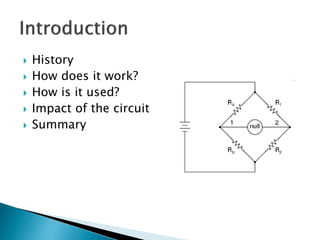
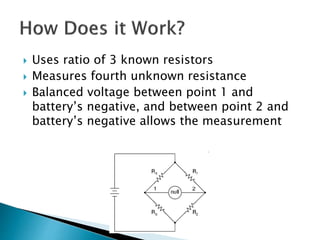
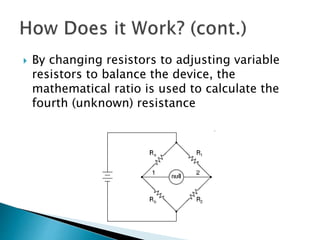
 Uses ratio of 3 known resistors
 Measures fourth unknown resistance
 Balanced voltage between point 1 and
battery’s negative, and between point 2 and
battery’s negative allows the measurement
 By changing resistors to adjusting variable
resistors to balance the device, the
mathematical ratio is used to calculate the
fourth (unknown) resistance
 Main focus of the Wheatstone Bridge =
applications using electricity
 The circuit monitors sensor devices like strain
gauges – it reads the level of the strain in the
system
 The galvanometer measures whether the
gauges are balanced or not
 Electrical power distributors use the
Wheatstone Bridge to locate breaks in the
power lines
 The Wheatstone Bridge is a very simple
design, although there are more complex
versions of achieving the same outcome
 Can be adjusted easily
 Fairly inexpensive to produce
 Also indirectly measures any variable that
would change the resistance of a material
◦ Ex: temperature, force, pressure
 Created in 1833, popularized in 1840s
 Wheatstone bridges are one of the best methods of
measuring resistance due to the basic mathematical
ratio involved.
 Accurate standards with sensitive enough voltmeter,
measurements of resistance within .05% can be reached.
 Many calibration laboratories still use this method
today.
 The Wheatstone Bridge are replaceable; however, for its
simplicity and versatility the circuit is an indispensible
piece of technology
on a wheston brige

on a wheston brige

  • 1.
  • 2.
     History  Howdoes it work?  How is it used?  Impact of the circuit  Summary
  • 3.
     The WheatstoneBridge was invented in 1833 by Samuel Hunter Christie  Later named after Sir Charles Wheatstone for his many applications of the circuit through the 1840s  The most common procedure for the bridge remains the testing of unknown electrical resistance
  • 4.
     Uses ratioof 3 known resistors  Measures fourth unknown resistance  Balanced voltage between point 1 and battery’s negative, and between point 2 and battery’s negative allows the measurement
  • 5.
     By changingresistors to adjusting variable resistors to balance the device, the mathematical ratio is used to calculate the fourth (unknown) resistance
  • 7.
     Main focusof the Wheatstone Bridge = applications using electricity  The circuit monitors sensor devices like strain gauges – it reads the level of the strain in the system  The galvanometer measures whether the gauges are balanced or not  Electrical power distributors use the Wheatstone Bridge to locate breaks in the power lines
  • 8.
     The WheatstoneBridge is a very simple design, although there are more complex versions of achieving the same outcome  Can be adjusted easily  Fairly inexpensive to produce  Also indirectly measures any variable that would change the resistance of a material ◦ Ex: temperature, force, pressure
  • 9.
     Created in1833, popularized in 1840s  Wheatstone bridges are one of the best methods of measuring resistance due to the basic mathematical ratio involved.  Accurate standards with sensitive enough voltmeter, measurements of resistance within .05% can be reached.  Many calibration laboratories still use this method today.  The Wheatstone Bridge are replaceable; however, for its simplicity and versatility the circuit is an indispensible piece of technology