SSooffttwwaarree TTeessttiinngg 
Preeti Mishra 
Course Incharge
Observations about Testing 
• “Testing is the process of executing 
a program with the intention of 
finding errors.” – Myers 
• “Testing can show the presence of 
bugs but never their absence.” - 
Dijkstra
Good Testing Practices 
• A good test case is one that has a 
high probability of detecting an 
undiscovered defect, not one that 
shows that the program works 
correctly 
• It is impossible to test your own 
program 
• A necessary part of every test case 
is a description of the expected 
result
Good Testing Practices 
(cont’d) 
• Avoid nonreproducible or on-the-fly 
testing 
• Write test cases for valid as well as 
invalid input conditions. 
• Thoroughly inspect the results of 
each test 
• As the number of detected defects 
in a piece of software increases, the 
probability of the existence of more 
undetected defects also increases
Good Testing Practices 
(cont’d) 
• Assign your best people to testing 
• Ensure that testability is a key 
objective in your software design 
• Never alter the program to make 
testing easier 
• Testing, like almost every other 
activity, must start with objectives
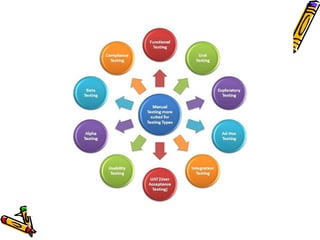
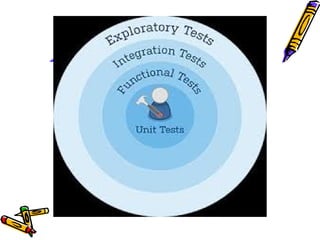
Levels of Testing 
• Unit Testing 
• Integration Testing 
• Validation Testing 
– Regression Testing 
– Alpha Testing 
– Beta Testing 
• Acceptance Testing
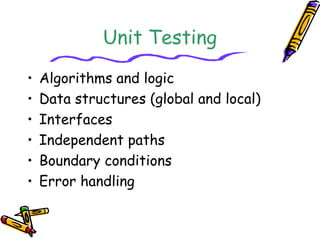
Unit Testing 
• Algorithms and logic 
• Data structures (global and local) 
• Interfaces 
• Independent paths 
• Boundary conditions 
• Error handling
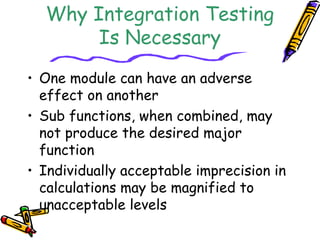
Why Integration Testing 
Is Necessary 
• One module can have an adverse 
effect on another 
• Sub functions, when combined, may 
not produce the desired major 
function 
• Individually acceptable imprecision in 
calculations may be magnified to 
unacceptable levels
Why Integration Testing 
Is Necessary (cont’d) 
• Interfacing errors not detected in 
unit testing may appear 
• Timing problems (in real-time 
systems) are not detectable by unit 
testing 
• Resource contention problems are 
not detectable by unit testing
Top-Down Integration 
• The main control module is used as a 
driver, and stubs are substituted for all 
modules directly subordinate to the main 
module. 
• Depending on the integration approach 
selected (depth or breadth first), 
subordinate stubs are replaced by 
modules one at a time.
Top-Down Integration 
(cont’d) 
• Tests are run as each individual module is 
integrated. 
• On the successful completion of a set of 
tests, another stub is replaced with a 
real module 
• Regression testing is performed to 
ensure that errors have not developed as 
result of integrating new modules
Problems with Top-Down 
Integration 
• Many times, calculations are performed in 
the modules at the bottom of the hierarchy 
• Stubs typically do not pass data up to the 
higher modules 
• Delaying testing until lower-level modules are 
ready usually results in integrating many 
modules at the same time rather than one at 
a time 
• Developing stubs that can pass data up is 
almost as much work as developing the actual 
module
Bottom-Up Integration 
• Integration begins with the lowest-level modules, 
which are combined into clusters, or builds, that 
perform a specific software subfunction 
• Drivers (control programs developed as stubs) are 
written to coordinate test case input and output 
• The cluster is tested 
• Drivers are removed and clusters are combined 
moving upward in the program structure
Problems with Bottom-Up 
Integration 
• The whole program does not exist 
until the last module is integrated 
• Timing and resource contention 
problems are not found until late 
in the process
Validation Testing 
• Determine if the software meets all of the 
requirements defined in the SRS 
• Having written requirements is essential 
• Regression testing is performed to determine if 
the software still meets all of its requirements in 
light of changes and modifications to the 
software 
• Regression testing involves selectively repeating 
existing validation tests, not developing new tests
Alpha and Beta Testing 
• It’s best to provide customers with an 
outline of the things that you would like 
them to focus on and specific test 
scenarios for them to execute. 
• Provide with customers who are actively 
involved with a commitment to fix defects 
that they discover.
Acceptance Testing 
• Similar to validation testing 
except that customers are 
present or directly involved. 
• Usually the tests are developed 
by the customer
Test Methods 
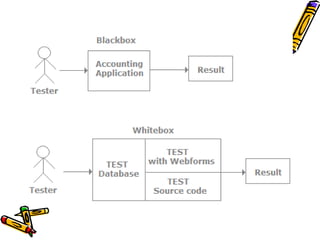
• White box or glass box testing 
• Black box testing 
• Top-down and bottom-up for 
performing incremental integration 
• ALAC (Act-like-a-customer)
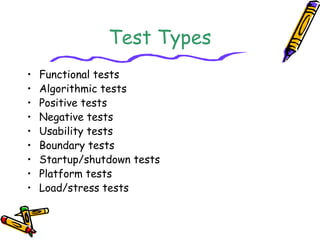
Test Types 
• Functional tests 
• Algorithmic tests 
• Positive tests 
• Negative tests 
• Usability tests 
• Boundary tests 
• Startup/shutdown tests 
• Platform tests 
• Load/stress tests
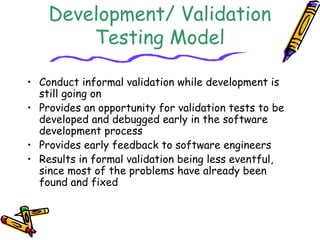
Concurrent 
Development/ Validation 
Testing Model 
• Conduct informal validation while development is 
still going on 
• Provides an opportunity for validation tests to be 
developed and debugged early in the software 
development process 
• Provides early feedback to software engineers 
• Results in formal validation being less eventful, 
since most of the problems have already been 
found and fixed
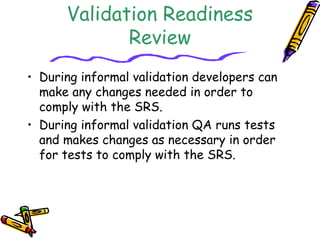
Validation Readiness 
Review 
• During informal validation developers can 
make any changes needed in order to 
comply with the SRS. 
• During informal validation QA runs tests 
and makes changes as necessary in order 
for tests to comply with the SRS.
Validation Readiness 
Review (cont’d) 
• During formal validation the only 
changes that can be made are bug 
fixes in response to bugs reported 
during formal validation testing. No 
new features can be added at this 
time. 
• During formal validation the same set 
of tests run during informal 
validation is run again. No new tests 
are added.
Entrance Criteria for 
Formal Validation Testing 
• Software development is completed (a 
precise definition of “completed” is 
required. 
• The test plan has been reviewed, approved 
and is under document control. 
• A requirements inspection has been 
performed on the SRS. 
• Design inspections have been performed on 
the SDDs (Software Design Descriptions).
Entrance Criteria for Formal 
Validation Testing (cont’d) 
• Code inspections have been performed on 
all “critical modules”. 
• All test scripts are completed and the 
software validation test procedure 
document has been reviewed, approved, and 
placed under document control. 
• Selected test scripts have been reviewed, 
approved and placed under document 
control.
Entrance Criteria for Formal 
Validation Testing (cont’d) 
• All test scripts have been executed 
at least once. 
• CM tools are in place and all source 
code is under configuration control. 
• Software problem reporting 
procedures are in place. 
• Validation testing completion criteria 
have been developed, reviewed, and 
approved.
Formal Validation 
• The same tests that were run during 
informal validation are executed again and 
the results recorded. 
• Software Problem Reports (SPRs) are 
submitted for each test that fails. 
• SPR tracking is performed and includes the 
status of all SPRs ( i.e., open, fixed, 
verified, deferred, not a bug)
Formal Validation (cont’d) 
• For each bug fixed, the SPR identifies the 
modules that were changed to fix the bug. 
• Baseline change assessment is used to ensure 
only modules that should have changed have 
changed and no new features have slipped in. 
• Informal code reviews are selectively 
conducted on changed modules to ensure that 
new bugs are not being introduced.
Formal Validation (cont’d) 
• Time required to find and fix bugs (find-fix 
cycle time) is tracked. 
• Regression testing is performed using the 
following guidelines: 
– Use complexity measures to help determine 
which modules may need additional testing 
– Use judgment to decide which tests to be rerun 
– Base decision on knowledge of software design 
and past history
Formal Validation (cont’d) 
• Track test status (i.e., passed, failed, 
or not run). 
• Record cumulative test time 
(cumulative hours of actual testing) 
for software reliability growth 
tracking.
Exit Criteria for Validation 
Testing 
• All test scripts have been executed. 
• All SPRs have been satisfactorily 
resolved. (Resolution could include 
bugs being fixed, deferred to a later 
release, determined not to be bugs, 
etc.) All parties must agree to the 
resolution. This criterion could be 
further defined to state that all 
high-priority bugs must be fixed 
while lower-priority bugs can be 
handled on a case-by-case basis.
Exit Criteria for Validation 
Testing (cont’d) 
• All changes made as a result of SPRs 
have been tested. 
• All documentation associated with the 
software (such as SRS, SDD, test 
documents) have been updated to 
reflect changes made during 
validation testing. 
• The test report has been reviewed 
and approved.
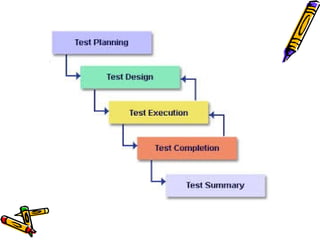
Test Planning 
• The Test Plan – defines the scope of the 
work to be performed 
• The Test Procedure – a container 
document that holds all of the individual 
tests (test scripts) that are to be 
executed 
• The Test Report – documents what 
occurred when the test scripts were run
Test Plan 
• Questions to be answered: 
– How many tests are needed? 
– How long will it take to develop those tests? 
– How long will it take to execute those tests? 
• Topics to be addressed: 
– Test estimation 
– Test development and informal validation 
– Validation readiness review and formal validation 
– Test completion criteria
Test Estimation 
• Number of test cases required is based on: 
– Testing all functions and features in the SRS 
– Including an appropriate number of ALAC (Act 
Like A Customer) tests including: 
• Do it wrong 
• Use wrong or illegal combination of inputs 
• Don’t do enough 
• Do nothing 
• Do too much 
– Achieving some test coverage goal 
– Achieving a software reliability goal
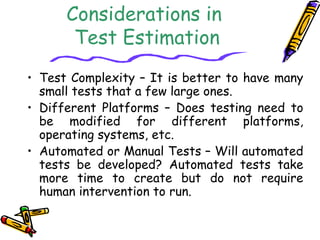
Considerations in 
Test Estimation 
• Test Complexity – It is better to have many 
small tests that a few large ones. 
• Different Platforms – Does testing need to 
be modified for different platforms, 
operating systems, etc. 
• Automated or Manual Tests – Will automated 
tests be developed? Automated tests take 
more time to create but do not require 
human intervention to run.
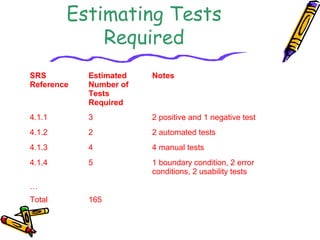
Estimating Tests 
Required 
SRS 
Reference 
Estimated 
Number of 
Tests 
Required 
Notes 
4.1.1 3 2 positive and 1 negative test 
4.1.2 2 2 automated tests 
4.1.3 4 4 manual tests 
4.1.4 5 1 boundary condition, 2 error 
conditions, 2 usability tests 
… 
Total 165
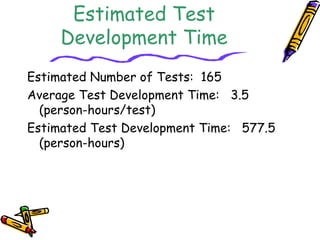
Estimated Test 
Development Time 
Estimated Number of Tests: 165 
Average Test Development Time: 3.5 
(person-hours/test) 
Estimated Test Development Time: 577.5 
(person-hours)
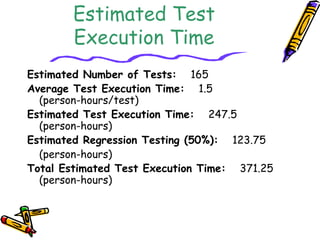
Estimated Test 
Execution Time 
Estimated Number of Tests: 165 
Average Test Execution Time: 1.5 
(person-hours/test) 
Estimated Test Execution Time: 247.5 
(person-hours) 
Estimated Regression Testing (50%): 123.75 
(person-hours) 
Total Estimated Test Execution Time: 371.25 
(person-hours)
Test Procedure 
• Collection of test scripts 
• An integral part of each test script 
is the expected results 
• The Test Procedure document should 
contain an unexecuted, clean copy of 
every test so that the tests may be 
more easily reused
Test Report 
• Completed copy of each test script with 
evidence that it was executed (i.e., 
dated with the signature of the person 
who ran the test) 
• Copy of each SPR showing resolution 
• List of open or unresolved SPRs 
• Identification of SPRs found in each 
baseline along with total number of SPRs 
in each baseline 
• Regression tests executed for each 
software baseline
Validation Test Plan 
IEEE – Standard 1012-1998 
1. Overview 
a. Organization 
b. Tasks and Schedules 
c. Responsibilities 
d. Tools, Techniques, Methods 
2. Processes 
a. Management 
b. Acquisition 
c. Supply 
d. Development 
e. Operation 
f. Maintenance
Validation Test Plan 
IEEE – Standard 1012-1998 (cont’d) 
3. Reporting Requirements 
4. Administrative Requirements 
5. Documentation Requirements 
6. Resource Requirements 
7. Completion Criteria

Software testing

  • 1.
  • 2.
    Observations about Testing • “Testing is the process of executing a program with the intention of finding errors.” – Myers • “Testing can show the presence of bugs but never their absence.” - Dijkstra
  • 3.
    Good Testing Practices • A good test case is one that has a high probability of detecting an undiscovered defect, not one that shows that the program works correctly • It is impossible to test your own program • A necessary part of every test case is a description of the expected result
  • 4.
    Good Testing Practices (cont’d) • Avoid nonreproducible or on-the-fly testing • Write test cases for valid as well as invalid input conditions. • Thoroughly inspect the results of each test • As the number of detected defects in a piece of software increases, the probability of the existence of more undetected defects also increases
  • 5.
    Good Testing Practices (cont’d) • Assign your best people to testing • Ensure that testability is a key objective in your software design • Never alter the program to make testing easier • Testing, like almost every other activity, must start with objectives
  • 7.
    Levels of Testing • Unit Testing • Integration Testing • Validation Testing – Regression Testing – Alpha Testing – Beta Testing • Acceptance Testing
  • 10.
    Unit Testing •Algorithms and logic • Data structures (global and local) • Interfaces • Independent paths • Boundary conditions • Error handling
  • 11.
    Why Integration Testing Is Necessary • One module can have an adverse effect on another • Sub functions, when combined, may not produce the desired major function • Individually acceptable imprecision in calculations may be magnified to unacceptable levels
  • 12.
    Why Integration Testing Is Necessary (cont’d) • Interfacing errors not detected in unit testing may appear • Timing problems (in real-time systems) are not detectable by unit testing • Resource contention problems are not detectable by unit testing
  • 13.
    Top-Down Integration •The main control module is used as a driver, and stubs are substituted for all modules directly subordinate to the main module. • Depending on the integration approach selected (depth or breadth first), subordinate stubs are replaced by modules one at a time.
  • 14.
    Top-Down Integration (cont’d) • Tests are run as each individual module is integrated. • On the successful completion of a set of tests, another stub is replaced with a real module • Regression testing is performed to ensure that errors have not developed as result of integrating new modules
  • 15.
    Problems with Top-Down Integration • Many times, calculations are performed in the modules at the bottom of the hierarchy • Stubs typically do not pass data up to the higher modules • Delaying testing until lower-level modules are ready usually results in integrating many modules at the same time rather than one at a time • Developing stubs that can pass data up is almost as much work as developing the actual module
  • 16.
    Bottom-Up Integration •Integration begins with the lowest-level modules, which are combined into clusters, or builds, that perform a specific software subfunction • Drivers (control programs developed as stubs) are written to coordinate test case input and output • The cluster is tested • Drivers are removed and clusters are combined moving upward in the program structure
  • 17.
    Problems with Bottom-Up Integration • The whole program does not exist until the last module is integrated • Timing and resource contention problems are not found until late in the process
  • 18.
    Validation Testing •Determine if the software meets all of the requirements defined in the SRS • Having written requirements is essential • Regression testing is performed to determine if the software still meets all of its requirements in light of changes and modifications to the software • Regression testing involves selectively repeating existing validation tests, not developing new tests
  • 19.
    Alpha and BetaTesting • It’s best to provide customers with an outline of the things that you would like them to focus on and specific test scenarios for them to execute. • Provide with customers who are actively involved with a commitment to fix defects that they discover.
  • 20.
    Acceptance Testing •Similar to validation testing except that customers are present or directly involved. • Usually the tests are developed by the customer
  • 21.
    Test Methods •White box or glass box testing • Black box testing • Top-down and bottom-up for performing incremental integration • ALAC (Act-like-a-customer)
  • 25.
    Test Types •Functional tests • Algorithmic tests • Positive tests • Negative tests • Usability tests • Boundary tests • Startup/shutdown tests • Platform tests • Load/stress tests
  • 26.
    Concurrent Development/ Validation Testing Model • Conduct informal validation while development is still going on • Provides an opportunity for validation tests to be developed and debugged early in the software development process • Provides early feedback to software engineers • Results in formal validation being less eventful, since most of the problems have already been found and fixed
  • 27.
    Validation Readiness Review • During informal validation developers can make any changes needed in order to comply with the SRS. • During informal validation QA runs tests and makes changes as necessary in order for tests to comply with the SRS.
  • 28.
    Validation Readiness Review(cont’d) • During formal validation the only changes that can be made are bug fixes in response to bugs reported during formal validation testing. No new features can be added at this time. • During formal validation the same set of tests run during informal validation is run again. No new tests are added.
  • 29.
    Entrance Criteria for Formal Validation Testing • Software development is completed (a precise definition of “completed” is required. • The test plan has been reviewed, approved and is under document control. • A requirements inspection has been performed on the SRS. • Design inspections have been performed on the SDDs (Software Design Descriptions).
  • 30.
    Entrance Criteria forFormal Validation Testing (cont’d) • Code inspections have been performed on all “critical modules”. • All test scripts are completed and the software validation test procedure document has been reviewed, approved, and placed under document control. • Selected test scripts have been reviewed, approved and placed under document control.
  • 31.
    Entrance Criteria forFormal Validation Testing (cont’d) • All test scripts have been executed at least once. • CM tools are in place and all source code is under configuration control. • Software problem reporting procedures are in place. • Validation testing completion criteria have been developed, reviewed, and approved.
  • 32.
    Formal Validation •The same tests that were run during informal validation are executed again and the results recorded. • Software Problem Reports (SPRs) are submitted for each test that fails. • SPR tracking is performed and includes the status of all SPRs ( i.e., open, fixed, verified, deferred, not a bug)
  • 33.
    Formal Validation (cont’d) • For each bug fixed, the SPR identifies the modules that were changed to fix the bug. • Baseline change assessment is used to ensure only modules that should have changed have changed and no new features have slipped in. • Informal code reviews are selectively conducted on changed modules to ensure that new bugs are not being introduced.
  • 34.
    Formal Validation (cont’d) • Time required to find and fix bugs (find-fix cycle time) is tracked. • Regression testing is performed using the following guidelines: – Use complexity measures to help determine which modules may need additional testing – Use judgment to decide which tests to be rerun – Base decision on knowledge of software design and past history
  • 35.
    Formal Validation (cont’d) • Track test status (i.e., passed, failed, or not run). • Record cumulative test time (cumulative hours of actual testing) for software reliability growth tracking.
  • 36.
    Exit Criteria forValidation Testing • All test scripts have been executed. • All SPRs have been satisfactorily resolved. (Resolution could include bugs being fixed, deferred to a later release, determined not to be bugs, etc.) All parties must agree to the resolution. This criterion could be further defined to state that all high-priority bugs must be fixed while lower-priority bugs can be handled on a case-by-case basis.
  • 37.
    Exit Criteria forValidation Testing (cont’d) • All changes made as a result of SPRs have been tested. • All documentation associated with the software (such as SRS, SDD, test documents) have been updated to reflect changes made during validation testing. • The test report has been reviewed and approved.
  • 38.
    Test Planning •The Test Plan – defines the scope of the work to be performed • The Test Procedure – a container document that holds all of the individual tests (test scripts) that are to be executed • The Test Report – documents what occurred when the test scripts were run
  • 39.
    Test Plan •Questions to be answered: – How many tests are needed? – How long will it take to develop those tests? – How long will it take to execute those tests? • Topics to be addressed: – Test estimation – Test development and informal validation – Validation readiness review and formal validation – Test completion criteria
  • 40.
    Test Estimation •Number of test cases required is based on: – Testing all functions and features in the SRS – Including an appropriate number of ALAC (Act Like A Customer) tests including: • Do it wrong • Use wrong or illegal combination of inputs • Don’t do enough • Do nothing • Do too much – Achieving some test coverage goal – Achieving a software reliability goal
  • 41.
    Considerations in TestEstimation • Test Complexity – It is better to have many small tests that a few large ones. • Different Platforms – Does testing need to be modified for different platforms, operating systems, etc. • Automated or Manual Tests – Will automated tests be developed? Automated tests take more time to create but do not require human intervention to run.
  • 42.
    Estimating Tests Required SRS Reference Estimated Number of Tests Required Notes 4.1.1 3 2 positive and 1 negative test 4.1.2 2 2 automated tests 4.1.3 4 4 manual tests 4.1.4 5 1 boundary condition, 2 error conditions, 2 usability tests … Total 165
  • 43.
    Estimated Test DevelopmentTime Estimated Number of Tests: 165 Average Test Development Time: 3.5 (person-hours/test) Estimated Test Development Time: 577.5 (person-hours)
  • 44.
    Estimated Test ExecutionTime Estimated Number of Tests: 165 Average Test Execution Time: 1.5 (person-hours/test) Estimated Test Execution Time: 247.5 (person-hours) Estimated Regression Testing (50%): 123.75 (person-hours) Total Estimated Test Execution Time: 371.25 (person-hours)
  • 45.
    Test Procedure •Collection of test scripts • An integral part of each test script is the expected results • The Test Procedure document should contain an unexecuted, clean copy of every test so that the tests may be more easily reused
  • 46.
    Test Report •Completed copy of each test script with evidence that it was executed (i.e., dated with the signature of the person who ran the test) • Copy of each SPR showing resolution • List of open or unresolved SPRs • Identification of SPRs found in each baseline along with total number of SPRs in each baseline • Regression tests executed for each software baseline
  • 47.
    Validation Test Plan IEEE – Standard 1012-1998 1. Overview a. Organization b. Tasks and Schedules c. Responsibilities d. Tools, Techniques, Methods 2. Processes a. Management b. Acquisition c. Supply d. Development e. Operation f. Maintenance
  • 48.
    Validation Test Plan IEEE – Standard 1012-1998 (cont’d) 3. Reporting Requirements 4. Administrative Requirements 5. Documentation Requirements 6. Resource Requirements 7. Completion Criteria