Immune Tolerance
By Pankaj Ombase
M.S. (Pharm) 2020-22
Department of Biotechnology
NIPER, Raebareli
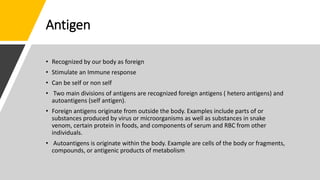
Antigen
• Recognized by our body as foreign
• Stimulate an Immune response
• Can be self or non self
• Two main divisions of antigens are recognized foreign antigens ( hetero antigens) and
autoantigens (self antigen).
• Foreign antigens originate from outside the body. Examples include parts of or
substances produced by virus or microorganisms as well as substances in snake
venom, certain protein in foods, and components of serum and RBC from other
individuals.
• Autoantigens is originate within the body. Example are cells of the body or fragments,
compounds, or antigenic products of metabolism
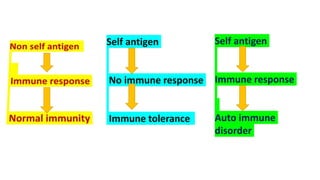
Self antigen
No immune response
Immune tolerance
Self antigen
Immune response
Auto immune
disorder
What is Tolerance in Immunology
• Immune tolerance or immunological tolerance or immunotolerance is a
state of unresponsiveness of the immune system to substances or tissue
that have the capacity to elicit an immune response in a given organism.
Definitions :
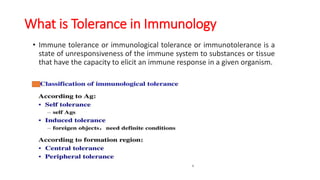
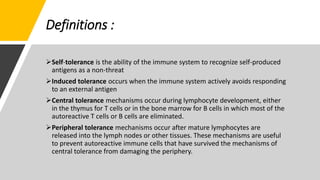
Self-tolerance is the ability of the immune system to recognize self-produced
antigens as a non-threat
Induced tolerance occurs when the immune system actively avoids responding
to an external antigen
Central tolerance mechanisms occur during lymphocyte development, either
in the thymus for T cells or in the bone marrow for B cells in which most of the
autoreactive T cells or B cells are eliminated.
Peripheral tolerance mechanisms occur after mature lymphocytes are
released into the lymph nodes or other tissues. These mechanisms are useful
to prevent autoreactive immune cells that have survived the mechanisms of
central tolerance from damaging the periphery.
Central T cell Tolerance :
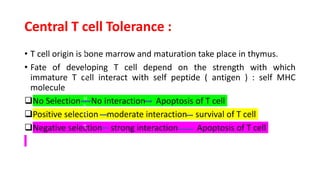
• T cell origin is bone marrow and maturation take place in thymus.
• Fate of developing T cell depend on the strength with which
immature T cell interact with self peptide ( antigen ) : self MHC
molecule
No Selection No interaction Apoptosis of T cell
Positive selection moderate interaction survival of T cell
Negative selection strong interaction Apoptosis of T cell
A
p
o
p
t
o
si
s
o
f
T
c
e
ll
Central B cell Tolerance :
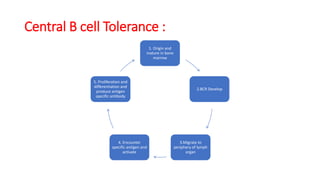
1. Origin and
mature in bone
marrow
2.BCR Develop
3.Migrate to
periphery of lymph
organ
4. Encounter
specific antigen and
activate
5. Proliferation and
differentiation and
produce antigen
specific antibody
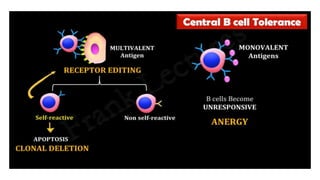
Central B cell Tolerance :
Recognition of auto reactive B cell depend upon strength of BCR and antigen binding in
Bone marrow.
Immature B cell having no or weak interaction with multivalent antigen will
leave the bone marrow and migrate to lymphoid organ.
Immature B cell having strong cross linking or interaction with multivalent antigen
then their further development is stop because they are potentially auto reactive B
cell
Mechanism of B cell Tolerance :
A) Receptor editing
B) Clonal deletion
C) Anergy
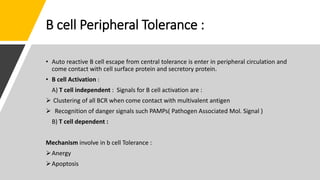
B cell Peripheral Tolerance :
• Auto reactive B cell escape from central tolerance is enter in peripheral circulation and
come contact with cell surface protein and secretory protein.
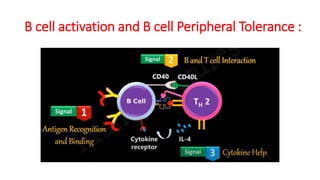
• B cell Activation :
A) T cell independent : Signals for B cell activation are :
 Clustering of all BCR when come contact with multivalent antigen
 Recognition of danger signals such PAMPs( Pathogen Associated Mol. Signal )
B) T cell dependent :
Mechanism involve in b cell Tolerance :
Anergy
Apoptosis
B cell activation and B cell Peripheral Tolerance :
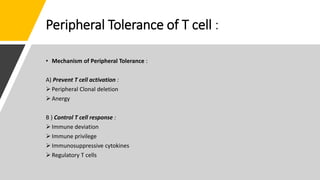
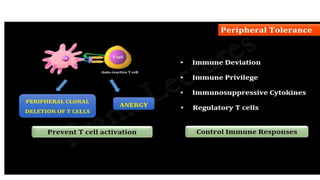
Peripheral Tolerance of T cell :
• Mechanism of Peripheral Tolerance :
A) Prevent T cell activation :
 Peripheral Clonal deletion
 Anergy
B ) Control T cell response :
 Immune deviation
 Immune privilege
 Immunosuppressive cytokines
 Regulatory T cells
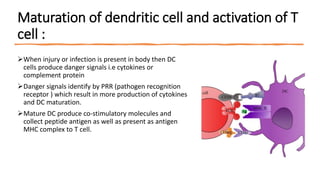
Maturation of dendritic cell and activation of T
cell :
When injury or infection is present in body then DC
cells produce danger signals i.e cytokines or
complement protein
Danger signals identify by PRR (pathogen recognition
receptor ) which result in more production of cytokines
and DC maturation.
Mature DC produce co-stimulatory molecules and
collect peptide antigen as well as present as antigen
MHC complex to T cell.
Control T cell response :
Immune Deviation : Potentially harmful response is converted into less
harmful immune response.
Immune Privilege : Anatomical regions that are less subject to immune
response. Ex. CNS
Immunosuppressive cytokines : They stop the macrophage activation,
decrees cytokines secretions and downregulation of intercellular signals.
Ex. IL 10, TGF beta.
Regulatory T cells : They control the response of activated T cell
regardless of antigen specificity. Block T cell proliferation .
Immune tolerance

Immune tolerance

  • 1.
    Immune Tolerance By PankajOmbase M.S. (Pharm) 2020-22 Department of Biotechnology NIPER, Raebareli
  • 2.
    Antigen • Recognized byour body as foreign • Stimulate an Immune response • Can be self or non self • Two main divisions of antigens are recognized foreign antigens ( hetero antigens) and autoantigens (self antigen). • Foreign antigens originate from outside the body. Examples include parts of or substances produced by virus or microorganisms as well as substances in snake venom, certain protein in foods, and components of serum and RBC from other individuals. • Autoantigens is originate within the body. Example are cells of the body or fragments, compounds, or antigenic products of metabolism
  • 3.
    Self antigen No immuneresponse Immune tolerance Self antigen Immune response Auto immune disorder
  • 4.
    What is Tolerancein Immunology • Immune tolerance or immunological tolerance or immunotolerance is a state of unresponsiveness of the immune system to substances or tissue that have the capacity to elicit an immune response in a given organism.
  • 5.
    Definitions : Self-tolerance isthe ability of the immune system to recognize self-produced antigens as a non-threat Induced tolerance occurs when the immune system actively avoids responding to an external antigen Central tolerance mechanisms occur during lymphocyte development, either in the thymus for T cells or in the bone marrow for B cells in which most of the autoreactive T cells or B cells are eliminated. Peripheral tolerance mechanisms occur after mature lymphocytes are released into the lymph nodes or other tissues. These mechanisms are useful to prevent autoreactive immune cells that have survived the mechanisms of central tolerance from damaging the periphery.
  • 6.
    Central T cellTolerance : • T cell origin is bone marrow and maturation take place in thymus. • Fate of developing T cell depend on the strength with which immature T cell interact with self peptide ( antigen ) : self MHC molecule No Selection No interaction Apoptosis of T cell Positive selection moderate interaction survival of T cell Negative selection strong interaction Apoptosis of T cell A p o p t o si s o f T c e ll
  • 7.
    Central B cellTolerance : 1. Origin and mature in bone marrow 2.BCR Develop 3.Migrate to periphery of lymph organ 4. Encounter specific antigen and activate 5. Proliferation and differentiation and produce antigen specific antibody
  • 8.
    Central B cellTolerance : Recognition of auto reactive B cell depend upon strength of BCR and antigen binding in Bone marrow. Immature B cell having no or weak interaction with multivalent antigen will leave the bone marrow and migrate to lymphoid organ. Immature B cell having strong cross linking or interaction with multivalent antigen then their further development is stop because they are potentially auto reactive B cell Mechanism of B cell Tolerance : A) Receptor editing B) Clonal deletion C) Anergy
  • 10.
    B cell PeripheralTolerance : • Auto reactive B cell escape from central tolerance is enter in peripheral circulation and come contact with cell surface protein and secretory protein. • B cell Activation : A) T cell independent : Signals for B cell activation are :  Clustering of all BCR when come contact with multivalent antigen  Recognition of danger signals such PAMPs( Pathogen Associated Mol. Signal ) B) T cell dependent : Mechanism involve in b cell Tolerance : Anergy Apoptosis
  • 11.
    B cell activationand B cell Peripheral Tolerance :
  • 12.
    Peripheral Tolerance ofT cell : • Mechanism of Peripheral Tolerance : A) Prevent T cell activation :  Peripheral Clonal deletion  Anergy B ) Control T cell response :  Immune deviation  Immune privilege  Immunosuppressive cytokines  Regulatory T cells
  • 13.
    Maturation of dendriticcell and activation of T cell : When injury or infection is present in body then DC cells produce danger signals i.e cytokines or complement protein Danger signals identify by PRR (pathogen recognition receptor ) which result in more production of cytokines and DC maturation. Mature DC produce co-stimulatory molecules and collect peptide antigen as well as present as antigen MHC complex to T cell.
  • 15.
    Control T cellresponse : Immune Deviation : Potentially harmful response is converted into less harmful immune response. Immune Privilege : Anatomical regions that are less subject to immune response. Ex. CNS Immunosuppressive cytokines : They stop the macrophage activation, decrees cytokines secretions and downregulation of intercellular signals. Ex. IL 10, TGF beta. Regulatory T cells : They control the response of activated T cell regardless of antigen specificity. Block T cell proliferation .