Bleeding time, clotting time ,PT and
aPTT,
by Dr Mohan Singh Dhakad
COAGULATION
PROFILE
WHAT IS COAGULATION?
●Coagulation is a complex process by which blood forms clots.
Blood must be remain fluid with in the vasculature and yet clot
quickly when expose to non endothelial surface at a site of
vascular injury.
●It is an important part of haemostasis (the cessation of blood
loss from a damaged vessel), where in a damaged blood vessel
wall is covered by a platelet and fibrin-containing clot to stop
bleeding and begin repair of the damaged vessel.
●Disorders of coagulation can lead to an increased risk of
bleeding (hemorrhage) or clotting (thrombosis).
Hemostasis is maintained in the body via three
mechanisms:
●Vascular spasm - Damaged blood vessels.
constrict
●Platelet plug formation - Platelats adhere to
damaged endothelium to form platelet plug
(primary hemostasis) and then degranulate.
●Blood Coagulation - Clots form upon the
conversion of fibrinogen to Fibrin, and its
addition to the platelet plug (secondary
hemostasis).
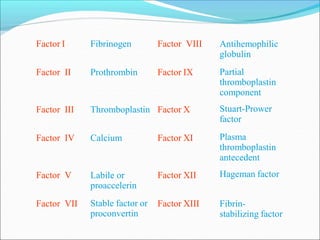
Factor I Fibrinogen Factor VIII
Factor II Prothrombin Factor IX
Factor III Thromboplastin Factor X
Factor IV Calcium Factor XI
Factor V Factor XII
Antihemophilic
globulin
Partial
thromboplastin
component
Stuart-Prower
factor
Plasma
thromboplastin
antecedent
Hageman factor
Factor VII
Labile or
proaccelerin
Stable factor or
proconvertin
Factor XIII Fibrin-
stabilizing factor
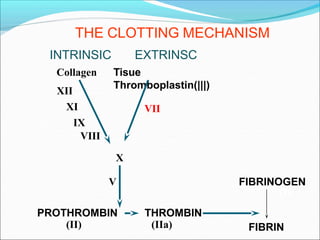
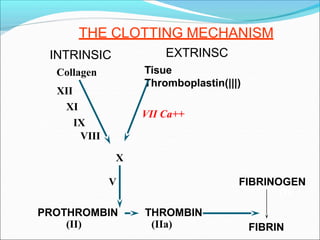
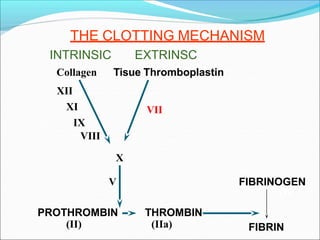
THE CLOTTING MECHANISM
FIBRINOGEN
FIBRIN
PROTHROMBIN
(II)
THROMBIN
(IIa)
(I)
V
X
EXTRINSC
Tisue
Thromboplastin(|||)
VII
INTRINSIC
Collagen
XII
XI
IX
VIII
FIBRINOLYTIC PHASE
●ANTICLOTTING MECHANISMS ARE
ACTIVATED TO ALLOW CLOT
DISINTEGRATION AND REPAIR OF THE
DAMAGED VESSEL.
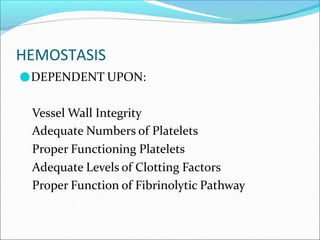
HEMOSTASIS
●DEPENDENT UPON:
Vessel Wall Integrity
Adequate Numbers of Platelets
Proper Functioning Platelets
Adequate Levels of Clotting Factors
Proper Function of Fibrinolytic Pathway
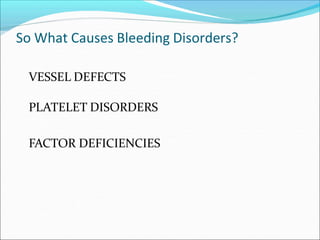
So What Causes Bleeding Disorders?
VESSEL DEFECTS
PLATELET DISORDERS
FACTOR DEFICIENCIES
V E S S E L DEFECTS
VITAMIN C DEFICIENCY
BACTERIAL & VIRAL INFECTIONS
ACQUIRED
PLATELET
DISOR DERS
(INADEQUATE
THROMBOCYTOPENIA
NUMBER OF PLATELETS)
Causes
DRUG INDUCED
BONE MARROW FAILURE
HYPERSPLENISM
OTHER CAUSES
THROMBOCYTOPATHY
) ADEQUATE NUMBER BUT ABNORMAL FUNCTION )
causes
UREMIA
INHERITED DISORDERS
MYELOPROLIFERATIVE DISORDERS
DRUG INDUCED(ASPIRIN, NSAIDS)
FACTOR DEFICIENCIES
● Inherited:
1. Hemophilia A
HEMHHHHOPHILIA A
2. HEMOPHILIA B
3. VON WILLEBRAND’S
DISEASE
● Acquired:
1. Anticoagulant therapy
2. Liver diseases
3. DIC
LABORATORY EVALUATION
●PLATELET COUNT
●BLEEDING TIME (BT)
●Clotting time (CT)
●PROTHROMBIN TIME (PT)
●Activated PARTIAL THROMBOPLASTIN TIME
(APTT)
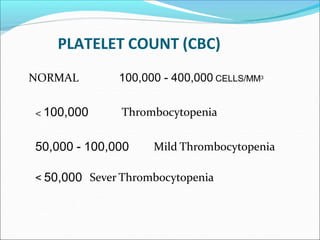
PLATELET COUNT (CBC)
NORMAL 100,000 - 400,000 CELLS/MM3
< 100,000 Thrombocytopenia
50,000 - 100,000 Mild Thrombocytopenia
< 50,000 Sever Thrombocytopenia
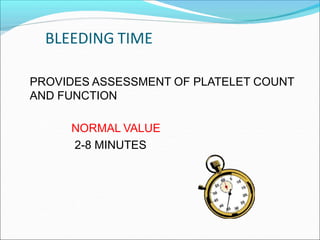
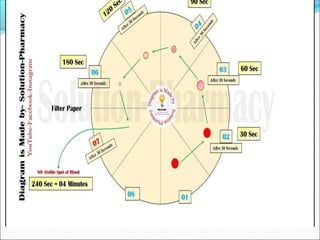
BLEEDING TIME
PROVIDES ASSESSMENT OF PLATELET COUNT
AND FUNCTION
NORMAL VALUE
2-8 MINUTES
➢
Clotting time - capillary method
Material
1. Sterile disposable pricking needle or lancet.
2. Stop watch
3. Dry glass capillary tube (narrow diameter 1 to 2 mm,
minimum 10 cm long.)
4. Cotton Swab of absorbent cotton.
5. Spirit wetted, cotton swab.
6. 70 % v/v ethyl alcohol
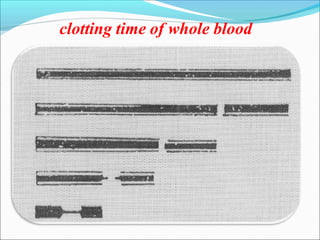
clotting time of whole blood
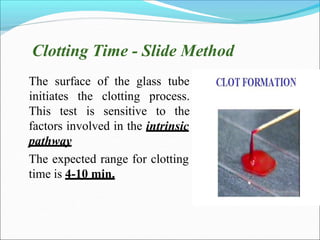
Clotting Time - Slide Method
• The surface of the glass tube
This test
initiates the clotting process.
is sensitive to the
•
factors involved in the intrinsic
pathway
The expected range for clotting
time is 4-10 min.
PROTHROMBIN TIME
Measures Effectiveness of the Extrinsic
Pathway
NORMAL VALUE
10-15 SECS
PT
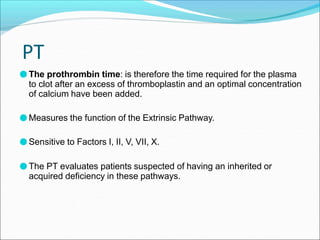
●The prothrombin time: is therefore the time required for the plasma
to clot after an excess of thromboplastin and an optimal concentration
of calcium have been added.
●Measures the function of the Extrinsic Pathway.
●Sensitive to Factors I, II, V, VII, X.
●The PT evaluates patients suspected of having an inherited or
acquired deficiency in these pathways.
THE CLOTTING MECHANISM
FIBRINOGEN
FIBRIN
PROTHROMBIN
(II)
THROMBIN
(IIa)
(I)
V
X
EXTRINSC
Tisue
Thromboplastin(|||)
VII Ca++
INTRINSIC
Collagen
XII
XI
IX
VIII
When is it ordered?
●Used to monitor oral anticoagulant therapy (Warfarin /
Coumadin).
●When a patient who is not taking anti-coagulant drugs
has signs or symptoms of a bleeding disorder.
●When a patient is to undergo an invasive medical
procedure, such as surgery, to ensure normal clotting
ability.
An elevated prothrombin time
may indicate the presence of:
Vitamin K deficiency
(Vitamin K is needed to make prothrombin and other clotting factors)
➢
➢
➢
DIC
liver disease
a deficiency in one or more of the following factors:
I, II, V, VII, X.
Anticoagulant (warfarin)
INR
●A PT test may also be called an INR test.
●INR (international normalized ratio) stands for a way of
standardizing the results of prothrombin time tests, no
matter the testing method.
●So your doctor can understand results in the same way
even when they come from different labs and different
test methods.
●Using the INR system, treatment with (anticoagulant
therapy) will be the same. In some labs, only the INR is
reported and the PT is not reported
●An INR of 1.0 means that the patient PT is normal.
●An INR greater than 1.0 means the clotting time is
elevated.
●INR of greater than 5 or 5.5 = unacceptable high risk of
bleeding,whereas if the INR=0.5 then there is a high
chance of having a clot.
●Normal range for a healthy person is 0.9–1.3, and for
people on warfarin therapy, 2.0–3.0, although the target
INR may be higher in particular situations, such as for
those with a mechanical heart valve.
PARTIAL THROMBOPLASTIN TIME
Measures Effectiveness of the Intrinsic
Pathway
NORMAL VALUE
25-40 SECS
PTT
●The partial thromboplastin time (PTT) or activated partial
thromboplastin time (aPTT or APTT( is a performance
indicator measuring the efficacy of both the "intrinsic" and
the common coagulation pathways.
●It is also used to monitor the treatment effects with
heparin a major anticoagulant.
●Kaolin cephalin clotting time (KccT) is a historic name for
the activated partial thromboplastin time
THE CLOTTING MECHANISM
FIBRINOGEN
FIBRIN
PROTHROMBIN
(II)
THROMBIN
(IIa)
(I)
V
X
EXTRINSC
Tisue Thromboplastin
VII
INTRINSIC
Collagen
XII
XI
IX
VIII
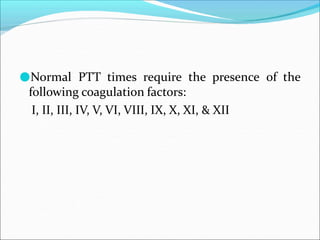
●Normal PTT times require the presence of the
following coagulation factors:
I, II, III, IV, V, VI, VIII, IX, X, XI, & XII
When is it ordered?
●When a patient presents with unexplained bleeding or
bruising,
●It may be ordered as part of a pre-surgical evaluation for
bleeding tendencies,
●When a patient is on intravenous (IV) or injection heparin
therapy, the APTT is ordered at regular intervals to
monitor the degree of anticoagulation.
Prolonged APTT may indicate:
●Use of heparin.
●antiphospholipid antibody:especially lupus anticoagulant,
which paradoxically increases propensity to thrombosis
●coagulation factor deficiency ,
e.g hemophilia
●DIC
●Liver disease
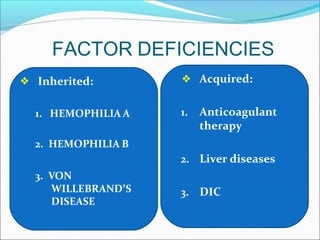
FACTOR DEFICIENCIES
❖ Inherited:
1. HEMOPHILIA A
2. HEMOPHILIA B
3. VON
WILLEBRAND’S
DISEASE
❖ Acquired:
1. Anticoagulant
therapy
2. Liver diseases
3. DIC
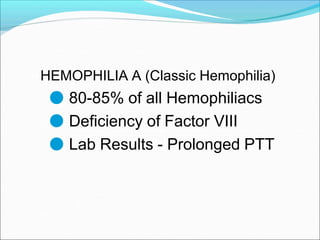
HEMOPHILIA A (Classic Hemophilia)
● 80-85% of all Hemophiliacs
● Deficiency of Factor VIII
● Lab Results - Prolonged PTT
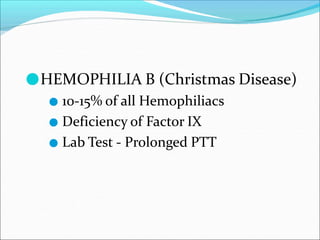
●HEMOPHILIA B (Christmas Disease)
● 10-15% of all Hemophiliacs
● Deficiency of Factor IX
● Lab Test - Prolonged PTT
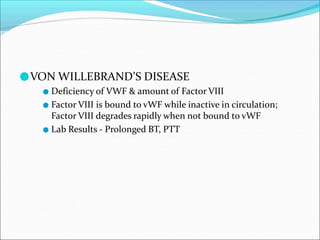
●VON WILLEBRAND’S DISEASE
● Deficiency of VWF & amount of Factor VIII
● Factor VIII is bound to vWF while inactive in circulation;
Factor VIII degrades rapidly when not bound to vWF
● Lab Results - Prolonged BT, PTT
ANTICOAGULANTS
● An anticoagulant is a substance that prevents
coagulation; that is, it stops blood from clotting
● This prevents deep vein thrombosis,
pulmonary embolism, myocardial infarction
and stroke.
ANTICOAGULANTS
1. Coumadins (Vitamin K antagonists)
2. Heparin
Coumadin's
●These oral anticoagulants that antagonize the effects of
vitamin K.
●Examples include warfarin. It takes at least 48 to 72 hours
for the anticoagulant effect to develop. Where an
immediate effect is required, heparin must be given
concomitantly.
●Monitored by PT times
●These anticoagulants are used to treat patients with deep-
vein thrombosis (DVT), pulmonary embolism (PE), atrial
fibrillation (AF), and mechanical prosthetic heart valves.
Heparin
●Heparin is a biological substance.
●It works by activating antithrombin III, which blocks
thrombin from clotting blood.
●Heparin Therapy is Monitored by PTT times
●Low molecular weight heparin is a more highly processed
product that is useful as it does not require monitoring of
the APTT coagulation parameter (it has more predictable
plasma levels) and has fewer side effects.
Liver Disease
●Liver Disease can Result in Reduced
Production of Coagulation Factors
(I,II,V,VII,IX,X).
DIC
●Disseminated intravascular coagulation (DIC is a
pathological activation of coagulation) blood clotting)
mechanisms that happens in response to a variety of
diseases
●DIC leads to the formation of small blood clots inside the
blood vessels throughout the body
●The small clots also disrupt normal blood flow to organs
(such as the kidneys), which may malfunction as a result
●As the small clots consume coagulation proteins and
platelets, normal coagulation is disrupted and abnormal
bleeding occurs from the skin the gastrointestinal tract,
the respiratory tract and surgical wounds.
●The PT and APTT are usually very prolonged and the
fibrinogen level markedly reduced
●High levels of fibrin degradation products, including D-
dimer, are found owing to the intense fibrinolytic activity
stimulated by the presence of fibrin in the circulation.
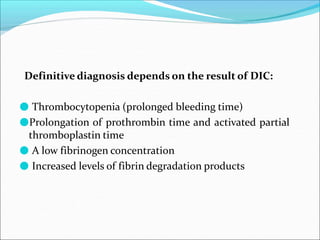
Definitive diagnosis depends on the result of DIC:
● Thrombocytopenia (prolonged bleeding time)
●Prolongation of prothrombin time and activated partial
thromboplastin time
● A low fibrinogen concentration
● Increased levels of fibrin degradation products
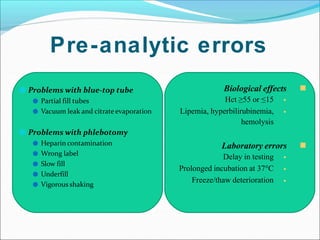
Pre-analytic errors
● Problems with blue-top tube
● Partial fill tubes
● Vacuum leak and citrate evaporation
● Problems with phlebotomy
● Heparin contamination
● Wrong label
● Slow fill
● Underfill
● Vigorous shaking
■
Biological effects
•
•
Hct ≥55 or ≤15
Lipemia, hyperbilirubinemia,
hemolysis
■
Laboratory errors
•
•
•
Delay in testing
Prolonged incubation at 37°C
Freeze/thaw deterioration
bleeding-timeclotting-time-pt-and-ptt-130504122408-phpapp01.pptx

bleeding-timeclotting-time-pt-and-ptt-130504122408-phpapp01.pptx

  • 1.
    Bleeding time, clottingtime ,PT and aPTT, by Dr Mohan Singh Dhakad COAGULATION PROFILE
  • 2.
    WHAT IS COAGULATION? ●Coagulationis a complex process by which blood forms clots. Blood must be remain fluid with in the vasculature and yet clot quickly when expose to non endothelial surface at a site of vascular injury. ●It is an important part of haemostasis (the cessation of blood loss from a damaged vessel), where in a damaged blood vessel wall is covered by a platelet and fibrin-containing clot to stop bleeding and begin repair of the damaged vessel. ●Disorders of coagulation can lead to an increased risk of bleeding (hemorrhage) or clotting (thrombosis).
  • 3.
    Hemostasis is maintainedin the body via three mechanisms: ●Vascular spasm - Damaged blood vessels. constrict ●Platelet plug formation - Platelats adhere to damaged endothelium to form platelet plug (primary hemostasis) and then degranulate. ●Blood Coagulation - Clots form upon the conversion of fibrinogen to Fibrin, and its addition to the platelet plug (secondary hemostasis).
  • 4.
    Factor I FibrinogenFactor VIII Factor II Prothrombin Factor IX Factor III Thromboplastin Factor X Factor IV Calcium Factor XI Factor V Factor XII Antihemophilic globulin Partial thromboplastin component Stuart-Prower factor Plasma thromboplastin antecedent Hageman factor Factor VII Labile or proaccelerin Stable factor or proconvertin Factor XIII Fibrin- stabilizing factor
  • 5.
  • 6.
    FIBRINOLYTIC PHASE ●ANTICLOTTING MECHANISMSARE ACTIVATED TO ALLOW CLOT DISINTEGRATION AND REPAIR OF THE DAMAGED VESSEL.
  • 7.
    HEMOSTASIS ●DEPENDENT UPON: Vessel WallIntegrity Adequate Numbers of Platelets Proper Functioning Platelets Adequate Levels of Clotting Factors Proper Function of Fibrinolytic Pathway
  • 8.
    So What CausesBleeding Disorders? VESSEL DEFECTS PLATELET DISORDERS FACTOR DEFICIENCIES
  • 9.
    V E SS E L DEFECTS VITAMIN C DEFICIENCY BACTERIAL & VIRAL INFECTIONS ACQUIRED
  • 10.
    PLATELET DISOR DERS (INADEQUATE THROMBOCYTOPENIA NUMBER OFPLATELETS) Causes DRUG INDUCED BONE MARROW FAILURE HYPERSPLENISM OTHER CAUSES
  • 11.
    THROMBOCYTOPATHY ) ADEQUATE NUMBERBUT ABNORMAL FUNCTION ) causes UREMIA INHERITED DISORDERS MYELOPROLIFERATIVE DISORDERS DRUG INDUCED(ASPIRIN, NSAIDS)
  • 12.
    FACTOR DEFICIENCIES ● Inherited: 1.Hemophilia A HEMHHHHOPHILIA A 2. HEMOPHILIA B 3. VON WILLEBRAND’S DISEASE ● Acquired: 1. Anticoagulant therapy 2. Liver diseases 3. DIC
  • 13.
    LABORATORY EVALUATION ●PLATELET COUNT ●BLEEDINGTIME (BT) ●Clotting time (CT) ●PROTHROMBIN TIME (PT) ●Activated PARTIAL THROMBOPLASTIN TIME (APTT)
  • 14.
    PLATELET COUNT (CBC) NORMAL100,000 - 400,000 CELLS/MM3 < 100,000 Thrombocytopenia 50,000 - 100,000 Mild Thrombocytopenia < 50,000 Sever Thrombocytopenia
  • 15.
    BLEEDING TIME PROVIDES ASSESSMENTOF PLATELET COUNT AND FUNCTION NORMAL VALUE 2-8 MINUTES
  • 17.
    ➢ Clotting time -capillary method Material 1. Sterile disposable pricking needle or lancet. 2. Stop watch 3. Dry glass capillary tube (narrow diameter 1 to 2 mm, minimum 10 cm long.) 4. Cotton Swab of absorbent cotton. 5. Spirit wetted, cotton swab. 6. 70 % v/v ethyl alcohol
  • 18.
    clotting time ofwhole blood
  • 19.
    Clotting Time -Slide Method • The surface of the glass tube This test initiates the clotting process. is sensitive to the • factors involved in the intrinsic pathway The expected range for clotting time is 4-10 min.
  • 20.
    PROTHROMBIN TIME Measures Effectivenessof the Extrinsic Pathway NORMAL VALUE 10-15 SECS
  • 21.
    PT ●The prothrombin time:is therefore the time required for the plasma to clot after an excess of thromboplastin and an optimal concentration of calcium have been added. ●Measures the function of the Extrinsic Pathway. ●Sensitive to Factors I, II, V, VII, X. ●The PT evaluates patients suspected of having an inherited or acquired deficiency in these pathways.
  • 22.
  • 23.
    When is itordered? ●Used to monitor oral anticoagulant therapy (Warfarin / Coumadin). ●When a patient who is not taking anti-coagulant drugs has signs or symptoms of a bleeding disorder. ●When a patient is to undergo an invasive medical procedure, such as surgery, to ensure normal clotting ability.
  • 24.
    An elevated prothrombintime may indicate the presence of: Vitamin K deficiency (Vitamin K is needed to make prothrombin and other clotting factors) ➢ ➢ ➢ DIC liver disease a deficiency in one or more of the following factors: I, II, V, VII, X. Anticoagulant (warfarin)
  • 25.
    INR ●A PT testmay also be called an INR test. ●INR (international normalized ratio) stands for a way of standardizing the results of prothrombin time tests, no matter the testing method. ●So your doctor can understand results in the same way even when they come from different labs and different test methods. ●Using the INR system, treatment with (anticoagulant therapy) will be the same. In some labs, only the INR is reported and the PT is not reported
  • 26.
    ●An INR of1.0 means that the patient PT is normal. ●An INR greater than 1.0 means the clotting time is elevated. ●INR of greater than 5 or 5.5 = unacceptable high risk of bleeding,whereas if the INR=0.5 then there is a high chance of having a clot. ●Normal range for a healthy person is 0.9–1.3, and for people on warfarin therapy, 2.0–3.0, although the target INR may be higher in particular situations, such as for those with a mechanical heart valve.
  • 27.
    PARTIAL THROMBOPLASTIN TIME MeasuresEffectiveness of the Intrinsic Pathway NORMAL VALUE 25-40 SECS
  • 28.
    PTT ●The partial thromboplastintime (PTT) or activated partial thromboplastin time (aPTT or APTT( is a performance indicator measuring the efficacy of both the "intrinsic" and the common coagulation pathways. ●It is also used to monitor the treatment effects with heparin a major anticoagulant. ●Kaolin cephalin clotting time (KccT) is a historic name for the activated partial thromboplastin time
  • 29.
  • 30.
    ●Normal PTT timesrequire the presence of the following coagulation factors: I, II, III, IV, V, VI, VIII, IX, X, XI, & XII
  • 31.
    When is itordered? ●When a patient presents with unexplained bleeding or bruising, ●It may be ordered as part of a pre-surgical evaluation for bleeding tendencies, ●When a patient is on intravenous (IV) or injection heparin therapy, the APTT is ordered at regular intervals to monitor the degree of anticoagulation.
  • 32.
    Prolonged APTT mayindicate: ●Use of heparin. ●antiphospholipid antibody:especially lupus anticoagulant, which paradoxically increases propensity to thrombosis ●coagulation factor deficiency , e.g hemophilia ●DIC ●Liver disease
  • 34.
    FACTOR DEFICIENCIES ❖ Inherited: 1.HEMOPHILIA A 2. HEMOPHILIA B 3. VON WILLEBRAND’S DISEASE ❖ Acquired: 1. Anticoagulant therapy 2. Liver diseases 3. DIC
  • 35.
    HEMOPHILIA A (ClassicHemophilia) ● 80-85% of all Hemophiliacs ● Deficiency of Factor VIII ● Lab Results - Prolonged PTT
  • 36.
    ●HEMOPHILIA B (ChristmasDisease) ● 10-15% of all Hemophiliacs ● Deficiency of Factor IX ● Lab Test - Prolonged PTT
  • 37.
    ●VON WILLEBRAND’S DISEASE ●Deficiency of VWF & amount of Factor VIII ● Factor VIII is bound to vWF while inactive in circulation; Factor VIII degrades rapidly when not bound to vWF ● Lab Results - Prolonged BT, PTT
  • 38.
    ANTICOAGULANTS ● An anticoagulantis a substance that prevents coagulation; that is, it stops blood from clotting ● This prevents deep vein thrombosis, pulmonary embolism, myocardial infarction and stroke. ANTICOAGULANTS 1. Coumadins (Vitamin K antagonists) 2. Heparin
  • 39.
    Coumadin's ●These oral anticoagulantsthat antagonize the effects of vitamin K. ●Examples include warfarin. It takes at least 48 to 72 hours for the anticoagulant effect to develop. Where an immediate effect is required, heparin must be given concomitantly. ●Monitored by PT times ●These anticoagulants are used to treat patients with deep- vein thrombosis (DVT), pulmonary embolism (PE), atrial fibrillation (AF), and mechanical prosthetic heart valves.
  • 40.
    Heparin ●Heparin is abiological substance. ●It works by activating antithrombin III, which blocks thrombin from clotting blood. ●Heparin Therapy is Monitored by PTT times ●Low molecular weight heparin is a more highly processed product that is useful as it does not require monitoring of the APTT coagulation parameter (it has more predictable plasma levels) and has fewer side effects.
  • 41.
    Liver Disease ●Liver Diseasecan Result in Reduced Production of Coagulation Factors (I,II,V,VII,IX,X).
  • 42.
    DIC ●Disseminated intravascular coagulation(DIC is a pathological activation of coagulation) blood clotting) mechanisms that happens in response to a variety of diseases ●DIC leads to the formation of small blood clots inside the blood vessels throughout the body ●The small clots also disrupt normal blood flow to organs (such as the kidneys), which may malfunction as a result
  • 43.
    ●As the smallclots consume coagulation proteins and platelets, normal coagulation is disrupted and abnormal bleeding occurs from the skin the gastrointestinal tract, the respiratory tract and surgical wounds. ●The PT and APTT are usually very prolonged and the fibrinogen level markedly reduced ●High levels of fibrin degradation products, including D- dimer, are found owing to the intense fibrinolytic activity stimulated by the presence of fibrin in the circulation.
  • 44.
    Definitive diagnosis dependson the result of DIC: ● Thrombocytopenia (prolonged bleeding time) ●Prolongation of prothrombin time and activated partial thromboplastin time ● A low fibrinogen concentration ● Increased levels of fibrin degradation products
  • 45.
    Pre-analytic errors ● Problemswith blue-top tube ● Partial fill tubes ● Vacuum leak and citrate evaporation ● Problems with phlebotomy ● Heparin contamination ● Wrong label ● Slow fill ● Underfill ● Vigorous shaking ■ Biological effects • • Hct ≥55 or ≤15 Lipemia, hyperbilirubinemia, hemolysis ■ Laboratory errors • • • Delay in testing Prolonged incubation at 37°C Freeze/thaw deterioration