Department of Electronics and Communication Engineering, MIT, Manipal 1
Chapter- 10
Introduction to Mobile Communication
Reference:
Raj Pandya, “Mobile And Personal
Communication Services And Systems”,
Wiley-IEEE Press,1999
Part - III
Principles of Electronic Communication
Department of Electronics and Communication Engineering, MIT, Manipal
Module-1:
Introduction to Mobile Communication
Objectives:
▪ To describe principle behind cellular mobile
communication
▪ To Explain the various multiple access techniques
used in cellular systems
▪ To discuss the GSM Architecture
2
Department of Electronics and Communication Engineering, MIT, Manipal
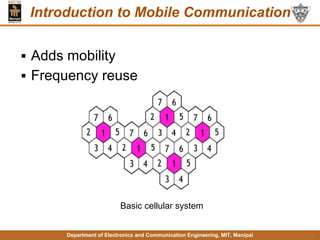
Introduction to Mobile Communication
▪ Adds mobility
▪ Frequency reuse
3
Basic cellular system
Department of Electronics and Communication Engineering, MIT, Manipal
Introduction to Mobile Communication
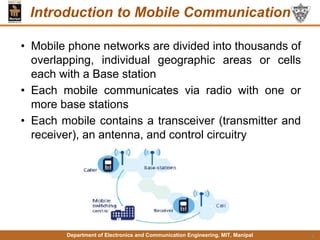
• Mobile phone networks are divided into thousands of
overlapping, individual geographic areas or cells
each with a Base station
• Each mobile communicates via radio with one or
more base stations
• Each mobile contains a transceiver (transmitter and
receiver), an antenna, and control circuitry
4
Department of Electronics and Communication Engineering, MIT, Manipal
Introduction to Mobile Communication
▪ Uplink channel
▪ Downlink channel
▪ Forward and reverse control channel
▪ Hand off
▪ Roaming
5
Department of Electronics and Communication Engineering, MIT, Manipal
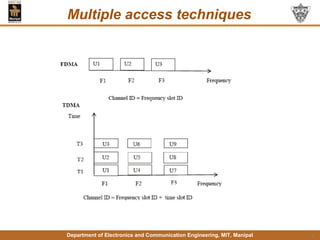
Multiple access techniques
6
Department of Electronics and Communication Engineering, MIT, Manipal
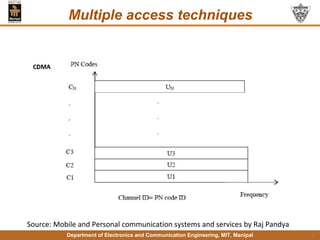
Multiple access techniques
7
Source: Mobile and Personal communication systems and services by Raj Pandya
Department of Electronics and Communication Engineering, MIT, Manipal
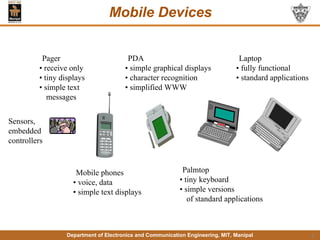
Mobile Devices
8
Pager
• receive only
• tiny displays
• simple text
messages
Mobile phones
• voice, data
• simple text displays
PDA
• simple graphical displays
• character recognition
• simplified WWW
Palmtop
• tiny keyboard
• simple versions
of standard applications
Laptop
• fully functional
• standard applications
Sensors,
embedded
controllers
Department of Electronics and Communication Engineering, MIT, Manipal
Global System for Mobile Communications
Features:
▪ Higher digital voice quality
▪ Low cost alternatives to making calls such
as SMS
▪ Ability to deploy equipment from different
vendors
▪ GSM allows network operators to offer
roaming services
9
Department of Electronics and Communication Engineering, MIT, Manipal
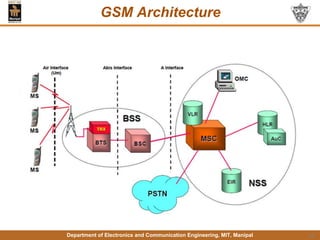
GSM Architecture
10
Department of Electronics and Communication Engineering, MIT, Manipal
GSM Architecture
11
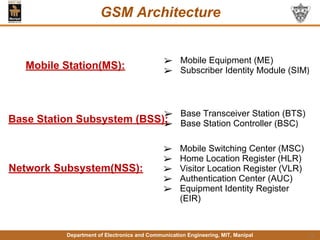
Mobile Station(MS):
➢ Mobile Equipment (ME)
➢ Subscriber Identity Module (SIM)
Base Station Subsystem (BSS):
➢ Base Transceiver Station (BTS)
➢ Base Station Controller (BSC)
Network Subsystem(NSS):
➢ Mobile Switching Center (MSC)
➢ Home Location Register (HLR)
➢ Visitor Location Register (VLR)
➢ Authentication Center (AUC)
➢ Equipment Identity Register
(EIR)
Department of Electronics and Communication Engineering, MIT, Manipal
Summary
In this module we have learnt:
▪ Basic concept of cellular mobile communication
▪ Commonly used multiple access techniques in
cellular systems such as frequency division multiple
access, time division multiple access and code
division multiple access
▪ Architecture of GSM system
▪ Importance of base station subsystem and network
subsystem
▪ The components of network subsystem such as HLR,
VLR, AuC and EIR
12
Department of Electronics and Communication Engineering, MIT, Manipal
Self test
▪ How call set up takes place between two mobile
subscribers?
▪ Explain the need for cellular concept in mobile
communication.
▪ Explain frequency reuse concept in cellular systems.
13
Department of Electronics and Communication Engineering, MIT, Manipal
Exercises
▪ Compare different generations of cellular mobile
communication in terms of underlying modulation
schemes, data rate, and applications offered etc.
▪ Compare CDMA with that of GSM system.
14

Basic Electronics - PPT Mobile Communication.pdf

  • 1.
    Department of Electronicsand Communication Engineering, MIT, Manipal 1 Chapter- 10 Introduction to Mobile Communication Reference: Raj Pandya, “Mobile And Personal Communication Services And Systems”, Wiley-IEEE Press,1999 Part - III Principles of Electronic Communication
  • 2.
    Department of Electronicsand Communication Engineering, MIT, Manipal Module-1: Introduction to Mobile Communication Objectives: ▪ To describe principle behind cellular mobile communication ▪ To Explain the various multiple access techniques used in cellular systems ▪ To discuss the GSM Architecture 2
  • 3.
    Department of Electronicsand Communication Engineering, MIT, Manipal Introduction to Mobile Communication ▪ Adds mobility ▪ Frequency reuse 3 Basic cellular system
  • 4.
    Department of Electronicsand Communication Engineering, MIT, Manipal Introduction to Mobile Communication • Mobile phone networks are divided into thousands of overlapping, individual geographic areas or cells each with a Base station • Each mobile communicates via radio with one or more base stations • Each mobile contains a transceiver (transmitter and receiver), an antenna, and control circuitry 4
  • 5.
    Department of Electronicsand Communication Engineering, MIT, Manipal Introduction to Mobile Communication ▪ Uplink channel ▪ Downlink channel ▪ Forward and reverse control channel ▪ Hand off ▪ Roaming 5
  • 6.
    Department of Electronicsand Communication Engineering, MIT, Manipal Multiple access techniques 6
  • 7.
    Department of Electronicsand Communication Engineering, MIT, Manipal Multiple access techniques 7 Source: Mobile and Personal communication systems and services by Raj Pandya
  • 8.
    Department of Electronicsand Communication Engineering, MIT, Manipal Mobile Devices 8 Pager • receive only • tiny displays • simple text messages Mobile phones • voice, data • simple text displays PDA • simple graphical displays • character recognition • simplified WWW Palmtop • tiny keyboard • simple versions of standard applications Laptop • fully functional • standard applications Sensors, embedded controllers
  • 9.
    Department of Electronicsand Communication Engineering, MIT, Manipal Global System for Mobile Communications Features: ▪ Higher digital voice quality ▪ Low cost alternatives to making calls such as SMS ▪ Ability to deploy equipment from different vendors ▪ GSM allows network operators to offer roaming services 9
  • 10.
    Department of Electronicsand Communication Engineering, MIT, Manipal GSM Architecture 10
  • 11.
    Department of Electronicsand Communication Engineering, MIT, Manipal GSM Architecture 11 Mobile Station(MS): ➢ Mobile Equipment (ME) ➢ Subscriber Identity Module (SIM) Base Station Subsystem (BSS): ➢ Base Transceiver Station (BTS) ➢ Base Station Controller (BSC) Network Subsystem(NSS): ➢ Mobile Switching Center (MSC) ➢ Home Location Register (HLR) ➢ Visitor Location Register (VLR) ➢ Authentication Center (AUC) ➢ Equipment Identity Register (EIR)
  • 12.
    Department of Electronicsand Communication Engineering, MIT, Manipal Summary In this module we have learnt: ▪ Basic concept of cellular mobile communication ▪ Commonly used multiple access techniques in cellular systems such as frequency division multiple access, time division multiple access and code division multiple access ▪ Architecture of GSM system ▪ Importance of base station subsystem and network subsystem ▪ The components of network subsystem such as HLR, VLR, AuC and EIR 12
  • 13.
    Department of Electronicsand Communication Engineering, MIT, Manipal Self test ▪ How call set up takes place between two mobile subscribers? ▪ Explain the need for cellular concept in mobile communication. ▪ Explain frequency reuse concept in cellular systems. 13
  • 14.
    Department of Electronicsand Communication Engineering, MIT, Manipal Exercises ▪ Compare different generations of cellular mobile communication in terms of underlying modulation schemes, data rate, and applications offered etc. ▪ Compare CDMA with that of GSM system. 14