1
MOBILE COMPUTING
Unit III
https://play.google.com/store/apps/details?id=com.sss.edubuzz360
www.edubuzz360.com
2
UNIT II
MOBILE TELECOMMUNICATION
SYSTEM
Introduction to cellular system- GSM – Services & Architecture –Protocol –
Connection Establishment –Frequency Allocation – Routing –Mobile Management
–Security - GPRS –UMTS –Architecture – Handover - Security
https://play.google.com/store/apps/details?id=com.sss.edubuzz360
www.edubuzz360.com
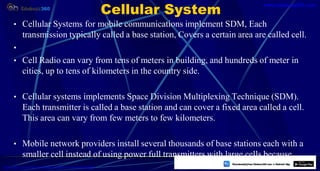
Cellular System
• Cellular Systems for mobile communications implement SDM, Each
transmission typically called a base station, Covers a certain area are called cell.
•
• Cell Radio can vary from tens of meters in building, and hundreds of meter in
cities, up to tens of kilometers in the country side.
• Cellular systems implements Space Division Multiplexing Technique (SDM).
Each transmitter is called a base station and can cover a fixed area called a cell.
This area can vary from few meters to few kilometers.
• Mobile network providers install several thousands of base stations each with a
smaller cell instead of using power full transmitters with large cells because
3
https://play.google.com/store/apps/details?id=com.sss.edubuzz360
www.edubuzz360.com
Advantages of cellular systems
Higher capacity
• Smaller the size of the cell more the number of concurrent users i.e. huge cells do
not allow for more concurrent users.
Less transmission power
• Huge cells require a greater transmission power than small cells.
Local interference only
• For huge cells there are a number of interfering signals, while for small cells there
is limited interference only.
Robustness
• As cellular systems are decentralized, they are more robust against the failure of
single components.
4
https://play.google.com/store/apps/details?id=com.sss.edubuzz360
www.edubuzz360.com
Disadvantage cellular systems
Infrastructure needed
• Small cells require a complex infrastructure to connect all base station. The
infrastructure required includes switches for call forwarding, location registers
etc.
Handover needed
• The mobile station has to perform a handover when changing from one cell to
another very frequently.
Frequency planning
• To avoid interference, frequency spectrum should be distributed properly with a
very less range of frequency spectrum.
5
https://play.google.com/store/apps/details?id=com.sss.edubuzz360
www.edubuzz360.com
Cellular System Infrastructure
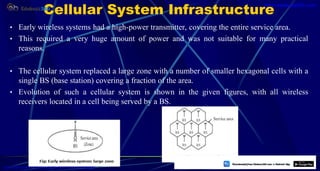
• Early wireless systems had a high-power transmitter, covering the entire service area.
• This required a very huge amount of power and was not suitable for many practical
reasons.
• The cellular system replaced a large zone with a number of smaller hexagonal cells with a
single BS (base station) covering a fraction of the area.
• Evolution of such a cellular system is shown in the given figures, with all wireless
receivers located in a cell being served by a BS.
6
https://play.google.com/store/apps/details?id=com.sss.edubuzz360
www.edubuzz360.com
• Wireless devices need to be supported for different types of services, the wireless
device could be a wireless telephone laptop with wireless card, personal digital
assistant (PDA), or web enabled phone. For simplicity, it could be called an MS.
• In a cellular structure, a MS (mobile station) needs to communicate with the BS of
the cell where the MS is currently located and the BS acts as a gateway to the rest
of the world.
• Therefore, to provide a link, the MS needs to be in the area of one of the cells (and
hence a BS) so that mobility of the MS can be supported.
7
https://play.google.com/store/apps/details?id=com.sss.edubuzz360
www.edubuzz360.com
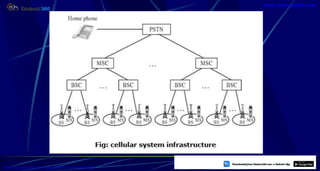
• Several base stations are connected through hard-wires and are
controlled by a BS controller (BSC), which in turn is connected to a
mobile switching center (MSC).
• Several mobile switching centers are interconnected to a PSTN (public
switched telephone network) and the ATM (asynchronous transfer
mode) backbone.
• To provide a better perspective of wireless communication technology,
simplified system infrastructure for cellular system is shown in the
figure:
8
https://play.google.com/store/apps/details?id=com.sss.edubuzz360
www.edubuzz360.com
9
https://play.google.com/store/apps/details?id=com.sss.edubuzz360
www.edubuzz360.com
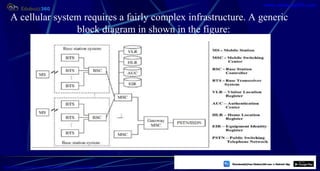
A cellular system requires a fairly complex infrastructure. A generic
block diagram in shown in the figure:
10
https://play.google.com/store/apps/details?id=com.sss.edubuzz360
www.edubuzz360.com
• A BS consists of a base transceiver system (BTS) and a BSC. Both
tower and antenna are a part of the BTS, while all associated
electronics are contained in the BSC.
• The HLR (home location register) and VLR (visitor location register)
are two sets of pointers that support mobility and enable the use of
the same telephone numbers worldwide.
• The AUC (authentication center) unit provides authentication and
encryption parameters that verify the user's identity and ensure the
confidentiality of each cell.
11
https://play.google.com/store/apps/details?id=com.sss.edubuzz360
www.edubuzz360.com
• The EIR (equipment identity register) is a database that information
about identity of mobile equipment. Both AUC and EIR can be
implemented as individual stand-alone units or as a combined
AUC/EIR unit.
• The HLR is located at the MSC where MS is initially registered and is
the initial home location for billing and access information.
• In simple words, any incoming call, based on the calling number, is
directed to the HLR of the home MS where the MS is registered. The
HLR then points to the VLR of the MSC where the MS is currently
located.
12
https://play.google.com/store/apps/details?id=com.sss.edubuzz360
www.edubuzz360.com
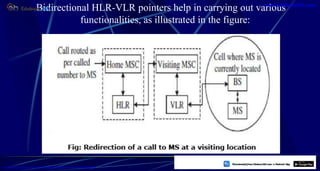
Bidirectional HLR-VLR pointers help in carrying out various
functionalities, as illustrated in the figure:
13
https://play.google.com/store/apps/details?id=com.sss.edubuzz360
www.edubuzz360.com
• The VLR contains information about all MS visiting that particular
MSC and hence points to the HLR of the visiting MSs for exchanging
related information about the MS.
• Such a pointer allows calls to be routed or rerouted to the MS,
wherever it is located.
• In cellular systems, a reverse direction pointer is needed that allows
traversal of many control signals back and forth between the HLR and
VLR such bidirectional HLR-VLR pointers help in carrying out
various functionalities.
14
https://play.google.com/store/apps/details?id=com.sss.edubuzz360
www.edubuzz360.com
GSM – GLOBAL SYSTEM FOR MOBILE
COMMUNICATION
15
https://play.google.com/store/apps/details?id=com.sss.edubuzz360
www.edubuzz360.com
GSM SERVICE
GSM provides three categories of services.
I. Bearer service
II. Teleservices
III. Supplementary services
16
https://play.google.com/store/apps/details?id=com.sss.edubuzz360
www.edubuzz360.com
Bearer Services
• Bearer Services or Data services are used through a GSM phone to receive and
send data is the essential building block leading to widespread mobile Internet
access and mobile data transfer.
• GSM currently has a data transfer rate of 9.6k.
• New developments that will push up data transfer rates for GSM users are
HSCSD (high speed circuit switched data) and GPRS (general packet radio
service) are now available.
17
https://play.google.com/store/apps/details?id=com.sss.edubuzz360
www.edubuzz360.com
Teleservices
The abilities of a Bearer Service are used by a teleservice to transport data.
These services are further transited in the following ways:
•Voice Calls
The most basic Teleservice supported by GSM is telephony. This includes
full-rate speech at 13 kbps
•Emergency calls
where the nearest emergency-service provider is notified by dialing three
digits.
18
https://play.google.com/store/apps/details?id=com.sss.edubuzz360
www.edubuzz360.com
•Short Text Messages
SMS service is a text messaging service that allows sending and
receiving text messages on your GSM mobile phone.
In addition to simple text messages, other text data including news,
sports, financial, language, and location-based data can also be
transmitted.
•Facsimile or Fax: Using modem fax data is transmitted as digital data
over the analog telephone network.
19
https://play.google.com/store/apps/details?id=com.sss.edubuzz360
www.edubuzz360.com
Supplementary services
• Supplementary services are additional services that are provided in
addition to teleservices and bearer services.
• These services include caller identification, call forwarding, call waiting,
multi-party conversations, and barring of outgoing (international) calls
20
https://play.google.com/store/apps/details?id=com.sss.edubuzz360
www.edubuzz360.com
Building Blocks
AMPS – Advanced Mobile Phone System
TACS – Total Access Communication System
NMT – Nordic Mobile Telephone System
21
https://play.google.com/store/apps/details?id=com.sss.edubuzz360
www.edubuzz360.com
Building Blocks
contd.
AMPS – Advanced Mobile Phone System
analog technology
used in North and South America and approximately 35 other
countries
operates in the 800 MHz band using FDMA technology
https://play.google.com/store/apps/details?id=com.sss.edubuzz360
www.edubuzz360.com
Building Blocks
contd.
TACS – Total Access Communication System
variant of AMPS
deployed in a number of countries
primarily in the UK
https://play.google.com/store/apps/details?id=com.sss.edubuzz360
www.edubuzz360.com
Building Blocks
contd.
NMT – Nordic Mobile Telephone System
analog technology
deployed in the Benelux countries and Russia
operates in the 450 and 900 MHz band
first technology to offer international roaming – only within the Nordic countries
24
https://play.google.com/store/apps/details?id=com.sss.edubuzz360
www.edubuzz360.com
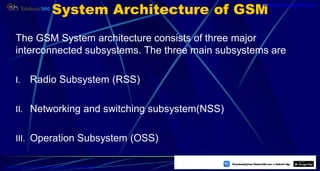
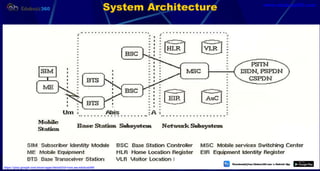
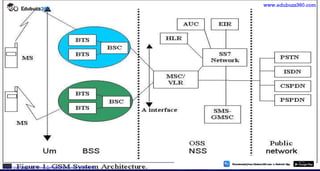
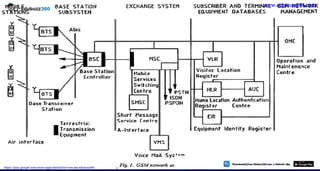
System Architecture of GSM
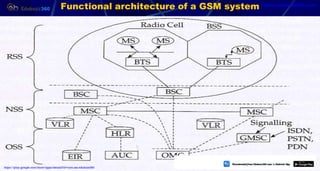
The GSM System architecture consists of three major
interconnected subsystems. The three main subsystems are
I. Radio Subsystem (RSS)
II. Networking and switching subsystem(NSS)
III. Operation Subsystem (OSS)
25
https://play.google.com/store/apps/details?id=com.sss.edubuzz360
www.edubuzz360.com
Functional architecture of a GSM system
26
https://play.google.com/store/apps/details?id=com.sss.edubuzz360
www.edubuzz360.com
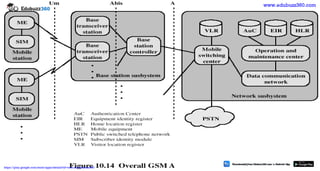
GSM Network Architecture
https://play.google.com/store/apps/details?id=com.sss.edubuzz360
www.edubuzz360.com
System Architecture
28
https://play.google.com/store/apps/details?id=com.sss.edubuzz360
www.edubuzz360.com
6/27/2020 Department of Information Technology 29
https://play.google.com/store/apps/details?id=com.sss.edubuzz360
www.edubuzz360.com
6/27/2020 Department of Information Technology
https://play.google.com/store/apps/details?id=com.sss.edubuzz360
www.edubuzz360.com
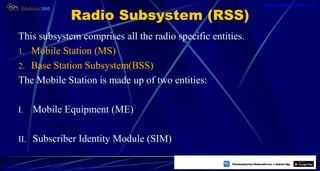
Radio Subsystem (RSS)
This subsystem comprises all the radio specific entities.
1. Mobile Station (MS)
2. Base Station Subsystem(BSS)
The Mobile Station is made up of two entities:
I. Mobile Equipment (ME)
II. Subscriber Identity Module (SIM)
31
https://play.google.com/store/apps/details?id=com.sss.edubuzz360
www.edubuzz360.com
Mobile Equipment
Produced by many different manufacturers
Must obtain approval from the standardization body
Uniquely identified by an IMEI (International Mobile
Equipment Identity)
32
https://play.google.com/store/apps/details?id=com.sss.edubuzz360
www.edubuzz360.com
Subscriber Identity Module (SIM)
Smart card containing the International Mobile Subscriber
Identity (IMSI)
Allows user to send and receive calls and receive other
subscribed services
Encoded network identification details
Protected by a password or PIN
Can be moved from phone to phone – contains key information
to activate the phone
33
https://play.google.com/store/apps/details?id=com.sss.edubuzz360
www.edubuzz360.com
Base Station Subsystem (BSS)
Base Station Subsystem is composed of two parts that
communicate across the standardized Abis interface allowing
operation between components made by different suppliers
1. Base Transceiver Station (BTS)
2. Base Station Controller (BSC)
https://play.google.com/store/apps/details?id=com.sss.edubuzz360
www.edubuzz360.com
Base Transceiver Station (BTS)
A BTS comprises all radio equipment such as antenna, signal
processors and amplifiers that are necessary for radio transmission.
It encodes the received signal, modulates it on a carrier wave and feeds
the RF signals to the antenna.
It communicates with both the mobile station and the BSC
35
https://play.google.com/store/apps/details?id=com.sss.edubuzz360
www.edubuzz360.com
Base Station Controller (BSC)
Manages Resources for BTS
It assigns frequency and time slot for and MS for call set up
It manages the handoff from one BTS to another within the
BSS.
BSC multiplexes the radio channel onto the fixed network
connection to the Mobile Switching Centre.
36
https://play.google.com/store/apps/details?id=com.sss.edubuzz360
www.edubuzz360.com
Network and Switching Subsystem(NSS)
It is the heart of the GSM system. It connects the wireless networks to the standard public
networks. It carries out usage based charging, accounting and also handles roaming.
Mobile Switching Center (MSC)
Heart of the network
Switch speech and data connections between:
Base Station Controllers
Mobile Switching Centers
GSM-networks
Other external networks
Three main jobs:
1) connects calls from sender to receiver
2) collects details of the calls made and received
3) supervises operation of the rest of the network components
37
https://play.google.com/store/apps/details?id=com.sss.edubuzz360
www.edubuzz360.com
Home Location Registers (HLR)
- contains administrative information of each subscriber
- IMSI and current location of the mobile
Visitor Location Registers (VLR)
- A temporary database that is updated whenever a new MS enters its area
by reaming.
- contains selected administrative information from the HLR
- authenticates the user
- tracks which customers have the phone on and ready to receive a call
- periodically updates the database on which phones are turned on and ready to
receive calls
38
https://play.google.com/store/apps/details?id=com.sss.edubuzz360
www.edubuzz360.com
The operation subsystem contains all the function necessary for network operation and
maintenance.
Authentication Center (AUC)
- mainly used for security
- data storage location and functional part of the network
- Ki is the primary element
Equipment Identity Register (EIR)
- Database that is used to track handsets using the IMEI (International Mobile Equipment
Identity)
- Made up of three sub-classes: The White List, The Black List and the Gray List
- Optional database
39
Operation subsystem (OSS)
https://play.google.com/store/apps/details?id=com.sss.edubuzz360
www.edubuzz360.com
GSM Security
Security in GSM is broadly supported at three levels: Operator level, Customer's level and
System level. These three levels help oversee aspects such as correct billing, avoiding fraud,
protecting services and ensuring anonymity.
Authentication
Protect the network against unauthorized use.
Denying the possibility for intruders to impersonate authorized users.
GSM network operator verify the identity , making it highly improbable to clone someone's
mobile phone identity.
Authentication can be achiced in a simple way by using a password such as PIN.
40
https://play.google.com/store/apps/details?id=com.sss.edubuzz360
www.edubuzz360.com
Confidentiality
GSM network protects voice, data and sensitive information against eavesdropping
on the radio path.
It is achieved by using encryption techniques by GSM designers.
Data on the radio path is encrypted between the ME and BTS against eavesdropping.
Anonymity
GSM protects against someone tracking the location of a user or identifying calls
made to the user by eavesdropping on the radio path.
It is achieved by allocating Temporary Mobile Subscriber Identity (TMSIs) instead
of permanent indentities.
41
https://play.google.com/store/apps/details?id=com.sss.edubuzz360
www.edubuzz360.com
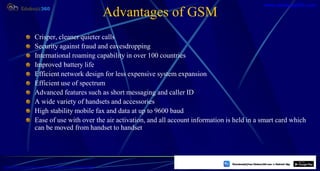
Advantages of GSM
Crisper, cleaner quieter calls
Security against fraud and eavesdropping
International roaming capability in over 100 countries
Improved battery life
Efficient network design for less expensive system expansion
Efficient use of spectrum
Advanced features such as short messaging and caller ID
A wide variety of handsets and accessories
High stability mobile fax and data at up to 9600 baud
Ease of use with over the air activation, and all account information is held in a smart card which
can be moved from handset to handset
42
https://play.google.com/store/apps/details?id=com.sss.edubuzz360
www.edubuzz360.com
General Packet Radio Service GPRS
6/27/2020 43
https://play.google.com/store/apps/details?id=com.sss.edubuzz360
www.edubuzz360.com
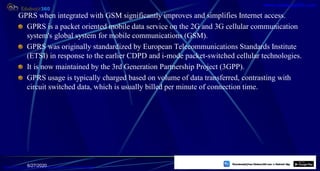
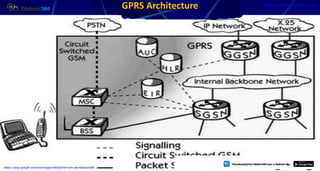
GPRS when integrated with GSM significantly improves and simplifies Internet access.
GPRS is a packet oriented mobile data service on the 2G and 3G cellular communication
system's global system for mobile communications (GSM).
GPRS was originally standardized by European Telecommunications Standards Institute
(ETSI) in response to the earlier CDPD and i-mode packet-switched cellular technologies.
It is now maintained by the 3rd Generation Partnership Project (3GPP).
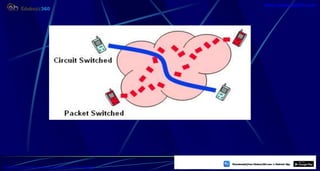
GPRS usage is typically charged based on volume of data transferred, contrasting with
circuit switched data, which is usually billed per minute of connection time.
6/27/2020 44
https://play.google.com/store/apps/details?id=com.sss.edubuzz360
www.edubuzz360.com
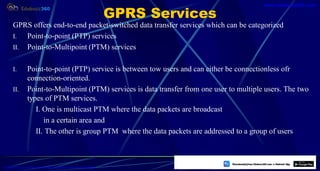
GPRS Services
GPRS offers end-to-end packet-switched data transfer services which can be categorized
I. Point-to-point (PTP) services
II. Point-to-Multipoint (PTM) services
I. Point-to-point (PTP) service is between tow users and can either be connectionless ofr
connection-oriented.
II. Point-to-Multipoint (PTM) services is data transfer from one user to multiple users. The two
types of PTM services.
I. One is multicast PTM where the data packets are broadcast
in a certain area and
II. The other is group PTM where the data packets are addressed to a group of users
45
https://play.google.com/store/apps/details?id=com.sss.edubuzz360
www.edubuzz360.com
6/27/2020 Department of Information Technology
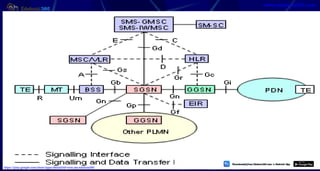
GPRS Architecture
46
https://play.google.com/store/apps/details?id=com.sss.edubuzz360
www.edubuzz360.com
6/27/2020 Department of Information Technology
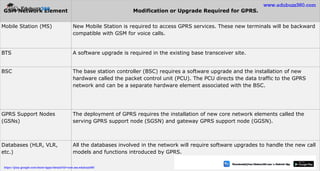
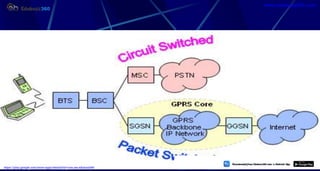
GSM Network Element Modification or Upgrade Required for GPRS.
Mobile Station (MS) New Mobile Station is required to access GPRS services. These new terminals will be backward
compatible with GSM for voice calls.
BTS A software upgrade is required in the existing base transceiver site.
BSC The base station controller (BSC) requires a software upgrade and the installation of new
hardware called the packet control unit (PCU). The PCU directs the data traffic to the GPRS
network and can be a separate hardware element associated with the BSC.
GPRS Support Nodes
(GSNs)
The deployment of GPRS requires the installation of new core network elements called the
serving GPRS support node (SGSN) and gateway GPRS support node (GGSN).
Databases (HLR, VLR,
etc.)
All the databases involved in the network will require software upgrades to handle the new call
models and functions introduced by GPRS.
47
https://play.google.com/store/apps/details?id=com.sss.edubuzz360
www.edubuzz360.com
48
https://play.google.com/store/apps/details?id=com.sss.edubuzz360
www.edubuzz360.com
6/27/2020 Department of Information Technology 49
https://play.google.com/store/apps/details?id=com.sss.edubuzz360
www.edubuzz360.com
6/27/2020 Department of Information Technology 50
https://play.google.com/store/apps/details?id=com.sss.edubuzz360
www.edubuzz360.com
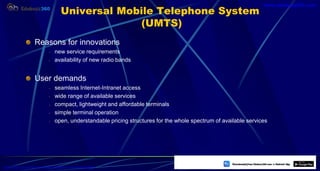
Universal Mobile Telephone System
(UMTS)
Reasons for innovations
- new service requirements
- availability of new radio bands
User demands
- seamless Internet-Intranet access
- wide range of available services
- compact, lightweight and affordable terminals
- simple terminal operation
- open, understandable pricing structures for the whole spectrum of available services
51
https://play.google.com/store/apps/details?id=com.sss.edubuzz360
www.edubuzz360.com
 The UMTS was developed mainly for countries with GSM networks and it is compatible
with GSMall
 All GSM networks will be upgraded to UMTS
 The UMTS network is different from the 2G networks in the following respects.
 Higher speech quality: In addition to speech traffic, it supports advanced data and
information service – true multimedia network
 Higher data rate: The UMTS supporst 2 Mbps data rate much higher than 2G
 Virtual home environment: A user roaming from his network to other UMTS network will
not feel any discontinuity or service diffrence – giving the feeling of being in the home
network. In 2G a user registered to a visitor location and is also charged a roaming
overheads.
52
https://play.google.com/store/apps/details?id=com.sss.edubuzz360
www.edubuzz360.com
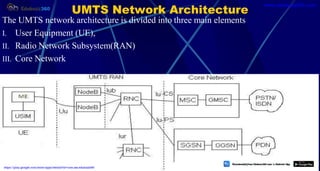
UMTS Network Architecture
The UMTS network architecture is divided into three main elements
I. User Equipment (UE),
II. Radio Network Subsystem(RAN)
III. Core Network
53
https://play.google.com/store/apps/details?id=com.sss.edubuzz360
www.edubuzz360.com
User Equipment (UE)
 UE incorporates greater functionality
 compared to a cell phone.
 It can be thought of as both a mobile phone used for talking and a data terminal
attached to a computer with no voce capability.
Radio Network Subsystem(RAN)
 The RNS is the equivalent of BSS in GSM.
 It provides and mages the wireless interface for the overall network.
Core Network
 The Core network is the equivalent of the GSM Network Switching Subsystem(NSS)
54
https://play.google.com/store/apps/details?id=com.sss.edubuzz360
www.edubuzz360.com
References
 Book: Prasant Kumar Pattnaik, Rajib Mall, “Fundamentals of Mobile Computing”,
PHI Learning Pvt. Ltd, New Delhi – 2012.
 cse.yeditepe.edu.tr/~sbaydere/courses_new/cse402/files/GSM.ppt
 www.harding.edu/white/classes_old/engr475/.../lecture_12_gsm.ppt
55
https://play.google.com/store/apps/details?id=com.sss.edubuzz360
www.edubuzz360.com

CS8601 2 MC NOTES.pdf

  • 1.
  • 2.
    2 UNIT II MOBILE TELECOMMUNICATION SYSTEM Introductionto cellular system- GSM – Services & Architecture –Protocol – Connection Establishment –Frequency Allocation – Routing –Mobile Management –Security - GPRS –UMTS –Architecture – Handover - Security https://play.google.com/store/apps/details?id=com.sss.edubuzz360 www.edubuzz360.com
  • 3.
    Cellular System • CellularSystems for mobile communications implement SDM, Each transmission typically called a base station, Covers a certain area are called cell. • • Cell Radio can vary from tens of meters in building, and hundreds of meter in cities, up to tens of kilometers in the country side. • Cellular systems implements Space Division Multiplexing Technique (SDM). Each transmitter is called a base station and can cover a fixed area called a cell. This area can vary from few meters to few kilometers. • Mobile network providers install several thousands of base stations each with a smaller cell instead of using power full transmitters with large cells because 3 https://play.google.com/store/apps/details?id=com.sss.edubuzz360 www.edubuzz360.com
  • 4.
    Advantages of cellularsystems Higher capacity • Smaller the size of the cell more the number of concurrent users i.e. huge cells do not allow for more concurrent users. Less transmission power • Huge cells require a greater transmission power than small cells. Local interference only • For huge cells there are a number of interfering signals, while for small cells there is limited interference only. Robustness • As cellular systems are decentralized, they are more robust against the failure of single components. 4 https://play.google.com/store/apps/details?id=com.sss.edubuzz360 www.edubuzz360.com
  • 5.
    Disadvantage cellular systems Infrastructureneeded • Small cells require a complex infrastructure to connect all base station. The infrastructure required includes switches for call forwarding, location registers etc. Handover needed • The mobile station has to perform a handover when changing from one cell to another very frequently. Frequency planning • To avoid interference, frequency spectrum should be distributed properly with a very less range of frequency spectrum. 5 https://play.google.com/store/apps/details?id=com.sss.edubuzz360 www.edubuzz360.com
  • 6.
    Cellular System Infrastructure •Early wireless systems had a high-power transmitter, covering the entire service area. • This required a very huge amount of power and was not suitable for many practical reasons. • The cellular system replaced a large zone with a number of smaller hexagonal cells with a single BS (base station) covering a fraction of the area. • Evolution of such a cellular system is shown in the given figures, with all wireless receivers located in a cell being served by a BS. 6 https://play.google.com/store/apps/details?id=com.sss.edubuzz360 www.edubuzz360.com
  • 7.
    • Wireless devicesneed to be supported for different types of services, the wireless device could be a wireless telephone laptop with wireless card, personal digital assistant (PDA), or web enabled phone. For simplicity, it could be called an MS. • In a cellular structure, a MS (mobile station) needs to communicate with the BS of the cell where the MS is currently located and the BS acts as a gateway to the rest of the world. • Therefore, to provide a link, the MS needs to be in the area of one of the cells (and hence a BS) so that mobility of the MS can be supported. 7 https://play.google.com/store/apps/details?id=com.sss.edubuzz360 www.edubuzz360.com
  • 8.
    • Several basestations are connected through hard-wires and are controlled by a BS controller (BSC), which in turn is connected to a mobile switching center (MSC). • Several mobile switching centers are interconnected to a PSTN (public switched telephone network) and the ATM (asynchronous transfer mode) backbone. • To provide a better perspective of wireless communication technology, simplified system infrastructure for cellular system is shown in the figure: 8 https://play.google.com/store/apps/details?id=com.sss.edubuzz360 www.edubuzz360.com
  • 9.
  • 10.
    A cellular systemrequires a fairly complex infrastructure. A generic block diagram in shown in the figure: 10 https://play.google.com/store/apps/details?id=com.sss.edubuzz360 www.edubuzz360.com
  • 11.
    • A BSconsists of a base transceiver system (BTS) and a BSC. Both tower and antenna are a part of the BTS, while all associated electronics are contained in the BSC. • The HLR (home location register) and VLR (visitor location register) are two sets of pointers that support mobility and enable the use of the same telephone numbers worldwide. • The AUC (authentication center) unit provides authentication and encryption parameters that verify the user's identity and ensure the confidentiality of each cell. 11 https://play.google.com/store/apps/details?id=com.sss.edubuzz360 www.edubuzz360.com
  • 12.
    • The EIR(equipment identity register) is a database that information about identity of mobile equipment. Both AUC and EIR can be implemented as individual stand-alone units or as a combined AUC/EIR unit. • The HLR is located at the MSC where MS is initially registered and is the initial home location for billing and access information. • In simple words, any incoming call, based on the calling number, is directed to the HLR of the home MS where the MS is registered. The HLR then points to the VLR of the MSC where the MS is currently located. 12 https://play.google.com/store/apps/details?id=com.sss.edubuzz360 www.edubuzz360.com
  • 13.
    Bidirectional HLR-VLR pointershelp in carrying out various functionalities, as illustrated in the figure: 13 https://play.google.com/store/apps/details?id=com.sss.edubuzz360 www.edubuzz360.com
  • 14.
    • The VLRcontains information about all MS visiting that particular MSC and hence points to the HLR of the visiting MSs for exchanging related information about the MS. • Such a pointer allows calls to be routed or rerouted to the MS, wherever it is located. • In cellular systems, a reverse direction pointer is needed that allows traversal of many control signals back and forth between the HLR and VLR such bidirectional HLR-VLR pointers help in carrying out various functionalities. 14 https://play.google.com/store/apps/details?id=com.sss.edubuzz360 www.edubuzz360.com
  • 15.
    GSM – GLOBALSYSTEM FOR MOBILE COMMUNICATION 15 https://play.google.com/store/apps/details?id=com.sss.edubuzz360 www.edubuzz360.com
  • 16.
    GSM SERVICE GSM providesthree categories of services. I. Bearer service II. Teleservices III. Supplementary services 16 https://play.google.com/store/apps/details?id=com.sss.edubuzz360 www.edubuzz360.com
  • 17.
    Bearer Services • BearerServices or Data services are used through a GSM phone to receive and send data is the essential building block leading to widespread mobile Internet access and mobile data transfer. • GSM currently has a data transfer rate of 9.6k. • New developments that will push up data transfer rates for GSM users are HSCSD (high speed circuit switched data) and GPRS (general packet radio service) are now available. 17 https://play.google.com/store/apps/details?id=com.sss.edubuzz360 www.edubuzz360.com
  • 18.
    Teleservices The abilities ofa Bearer Service are used by a teleservice to transport data. These services are further transited in the following ways: •Voice Calls The most basic Teleservice supported by GSM is telephony. This includes full-rate speech at 13 kbps •Emergency calls where the nearest emergency-service provider is notified by dialing three digits. 18 https://play.google.com/store/apps/details?id=com.sss.edubuzz360 www.edubuzz360.com
  • 19.
    •Short Text Messages SMSservice is a text messaging service that allows sending and receiving text messages on your GSM mobile phone. In addition to simple text messages, other text data including news, sports, financial, language, and location-based data can also be transmitted. •Facsimile or Fax: Using modem fax data is transmitted as digital data over the analog telephone network. 19 https://play.google.com/store/apps/details?id=com.sss.edubuzz360 www.edubuzz360.com
  • 20.
    Supplementary services • Supplementaryservices are additional services that are provided in addition to teleservices and bearer services. • These services include caller identification, call forwarding, call waiting, multi-party conversations, and barring of outgoing (international) calls 20 https://play.google.com/store/apps/details?id=com.sss.edubuzz360 www.edubuzz360.com
  • 21.
    Building Blocks AMPS –Advanced Mobile Phone System TACS – Total Access Communication System NMT – Nordic Mobile Telephone System 21 https://play.google.com/store/apps/details?id=com.sss.edubuzz360 www.edubuzz360.com
  • 22.
    Building Blocks contd. AMPS –Advanced Mobile Phone System analog technology used in North and South America and approximately 35 other countries operates in the 800 MHz band using FDMA technology https://play.google.com/store/apps/details?id=com.sss.edubuzz360 www.edubuzz360.com
  • 23.
    Building Blocks contd. TACS –Total Access Communication System variant of AMPS deployed in a number of countries primarily in the UK https://play.google.com/store/apps/details?id=com.sss.edubuzz360 www.edubuzz360.com
  • 24.
    Building Blocks contd. NMT –Nordic Mobile Telephone System analog technology deployed in the Benelux countries and Russia operates in the 450 and 900 MHz band first technology to offer international roaming – only within the Nordic countries 24 https://play.google.com/store/apps/details?id=com.sss.edubuzz360 www.edubuzz360.com
  • 25.
    System Architecture ofGSM The GSM System architecture consists of three major interconnected subsystems. The three main subsystems are I. Radio Subsystem (RSS) II. Networking and switching subsystem(NSS) III. Operation Subsystem (OSS) 25 https://play.google.com/store/apps/details?id=com.sss.edubuzz360 www.edubuzz360.com
  • 26.
    Functional architecture ofa GSM system 26 https://play.google.com/store/apps/details?id=com.sss.edubuzz360 www.edubuzz360.com
  • 27.
  • 28.
  • 29.
    6/27/2020 Department ofInformation Technology 29 https://play.google.com/store/apps/details?id=com.sss.edubuzz360 www.edubuzz360.com
  • 30.
    6/27/2020 Department ofInformation Technology https://play.google.com/store/apps/details?id=com.sss.edubuzz360 www.edubuzz360.com
  • 31.
    Radio Subsystem (RSS) Thissubsystem comprises all the radio specific entities. 1. Mobile Station (MS) 2. Base Station Subsystem(BSS) The Mobile Station is made up of two entities: I. Mobile Equipment (ME) II. Subscriber Identity Module (SIM) 31 https://play.google.com/store/apps/details?id=com.sss.edubuzz360 www.edubuzz360.com
  • 32.
    Mobile Equipment Produced bymany different manufacturers Must obtain approval from the standardization body Uniquely identified by an IMEI (International Mobile Equipment Identity) 32 https://play.google.com/store/apps/details?id=com.sss.edubuzz360 www.edubuzz360.com
  • 33.
    Subscriber Identity Module(SIM) Smart card containing the International Mobile Subscriber Identity (IMSI) Allows user to send and receive calls and receive other subscribed services Encoded network identification details Protected by a password or PIN Can be moved from phone to phone – contains key information to activate the phone 33 https://play.google.com/store/apps/details?id=com.sss.edubuzz360 www.edubuzz360.com
  • 34.
    Base Station Subsystem(BSS) Base Station Subsystem is composed of two parts that communicate across the standardized Abis interface allowing operation between components made by different suppliers 1. Base Transceiver Station (BTS) 2. Base Station Controller (BSC) https://play.google.com/store/apps/details?id=com.sss.edubuzz360 www.edubuzz360.com
  • 35.
    Base Transceiver Station(BTS) A BTS comprises all radio equipment such as antenna, signal processors and amplifiers that are necessary for radio transmission. It encodes the received signal, modulates it on a carrier wave and feeds the RF signals to the antenna. It communicates with both the mobile station and the BSC 35 https://play.google.com/store/apps/details?id=com.sss.edubuzz360 www.edubuzz360.com
  • 36.
    Base Station Controller(BSC) Manages Resources for BTS It assigns frequency and time slot for and MS for call set up It manages the handoff from one BTS to another within the BSS. BSC multiplexes the radio channel onto the fixed network connection to the Mobile Switching Centre. 36 https://play.google.com/store/apps/details?id=com.sss.edubuzz360 www.edubuzz360.com
  • 37.
    Network and SwitchingSubsystem(NSS) It is the heart of the GSM system. It connects the wireless networks to the standard public networks. It carries out usage based charging, accounting and also handles roaming. Mobile Switching Center (MSC) Heart of the network Switch speech and data connections between: Base Station Controllers Mobile Switching Centers GSM-networks Other external networks Three main jobs: 1) connects calls from sender to receiver 2) collects details of the calls made and received 3) supervises operation of the rest of the network components 37 https://play.google.com/store/apps/details?id=com.sss.edubuzz360 www.edubuzz360.com
  • 38.
    Home Location Registers(HLR) - contains administrative information of each subscriber - IMSI and current location of the mobile Visitor Location Registers (VLR) - A temporary database that is updated whenever a new MS enters its area by reaming. - contains selected administrative information from the HLR - authenticates the user - tracks which customers have the phone on and ready to receive a call - periodically updates the database on which phones are turned on and ready to receive calls 38 https://play.google.com/store/apps/details?id=com.sss.edubuzz360 www.edubuzz360.com
  • 39.
    The operation subsystemcontains all the function necessary for network operation and maintenance. Authentication Center (AUC) - mainly used for security - data storage location and functional part of the network - Ki is the primary element Equipment Identity Register (EIR) - Database that is used to track handsets using the IMEI (International Mobile Equipment Identity) - Made up of three sub-classes: The White List, The Black List and the Gray List - Optional database 39 Operation subsystem (OSS) https://play.google.com/store/apps/details?id=com.sss.edubuzz360 www.edubuzz360.com
  • 40.
    GSM Security Security inGSM is broadly supported at three levels: Operator level, Customer's level and System level. These three levels help oversee aspects such as correct billing, avoiding fraud, protecting services and ensuring anonymity. Authentication Protect the network against unauthorized use. Denying the possibility for intruders to impersonate authorized users. GSM network operator verify the identity , making it highly improbable to clone someone's mobile phone identity. Authentication can be achiced in a simple way by using a password such as PIN. 40 https://play.google.com/store/apps/details?id=com.sss.edubuzz360 www.edubuzz360.com
  • 41.
    Confidentiality GSM network protectsvoice, data and sensitive information against eavesdropping on the radio path. It is achieved by using encryption techniques by GSM designers. Data on the radio path is encrypted between the ME and BTS against eavesdropping. Anonymity GSM protects against someone tracking the location of a user or identifying calls made to the user by eavesdropping on the radio path. It is achieved by allocating Temporary Mobile Subscriber Identity (TMSIs) instead of permanent indentities. 41 https://play.google.com/store/apps/details?id=com.sss.edubuzz360 www.edubuzz360.com
  • 42.
    Advantages of GSM Crisper,cleaner quieter calls Security against fraud and eavesdropping International roaming capability in over 100 countries Improved battery life Efficient network design for less expensive system expansion Efficient use of spectrum Advanced features such as short messaging and caller ID A wide variety of handsets and accessories High stability mobile fax and data at up to 9600 baud Ease of use with over the air activation, and all account information is held in a smart card which can be moved from handset to handset 42 https://play.google.com/store/apps/details?id=com.sss.edubuzz360 www.edubuzz360.com
  • 43.
    General Packet RadioService GPRS 6/27/2020 43 https://play.google.com/store/apps/details?id=com.sss.edubuzz360 www.edubuzz360.com
  • 44.
    GPRS when integratedwith GSM significantly improves and simplifies Internet access. GPRS is a packet oriented mobile data service on the 2G and 3G cellular communication system's global system for mobile communications (GSM). GPRS was originally standardized by European Telecommunications Standards Institute (ETSI) in response to the earlier CDPD and i-mode packet-switched cellular technologies. It is now maintained by the 3rd Generation Partnership Project (3GPP). GPRS usage is typically charged based on volume of data transferred, contrasting with circuit switched data, which is usually billed per minute of connection time. 6/27/2020 44 https://play.google.com/store/apps/details?id=com.sss.edubuzz360 www.edubuzz360.com
  • 45.
    GPRS Services GPRS offersend-to-end packet-switched data transfer services which can be categorized I. Point-to-point (PTP) services II. Point-to-Multipoint (PTM) services I. Point-to-point (PTP) service is between tow users and can either be connectionless ofr connection-oriented. II. Point-to-Multipoint (PTM) services is data transfer from one user to multiple users. The two types of PTM services. I. One is multicast PTM where the data packets are broadcast in a certain area and II. The other is group PTM where the data packets are addressed to a group of users 45 https://play.google.com/store/apps/details?id=com.sss.edubuzz360 www.edubuzz360.com
  • 46.
    6/27/2020 Department ofInformation Technology GPRS Architecture 46 https://play.google.com/store/apps/details?id=com.sss.edubuzz360 www.edubuzz360.com
  • 47.
    6/27/2020 Department ofInformation Technology GSM Network Element Modification or Upgrade Required for GPRS. Mobile Station (MS) New Mobile Station is required to access GPRS services. These new terminals will be backward compatible with GSM for voice calls. BTS A software upgrade is required in the existing base transceiver site. BSC The base station controller (BSC) requires a software upgrade and the installation of new hardware called the packet control unit (PCU). The PCU directs the data traffic to the GPRS network and can be a separate hardware element associated with the BSC. GPRS Support Nodes (GSNs) The deployment of GPRS requires the installation of new core network elements called the serving GPRS support node (SGSN) and gateway GPRS support node (GGSN). Databases (HLR, VLR, etc.) All the databases involved in the network will require software upgrades to handle the new call models and functions introduced by GPRS. 47 https://play.google.com/store/apps/details?id=com.sss.edubuzz360 www.edubuzz360.com
  • 48.
  • 49.
    6/27/2020 Department ofInformation Technology 49 https://play.google.com/store/apps/details?id=com.sss.edubuzz360 www.edubuzz360.com
  • 50.
    6/27/2020 Department ofInformation Technology 50 https://play.google.com/store/apps/details?id=com.sss.edubuzz360 www.edubuzz360.com
  • 51.
    Universal Mobile TelephoneSystem (UMTS) Reasons for innovations - new service requirements - availability of new radio bands User demands - seamless Internet-Intranet access - wide range of available services - compact, lightweight and affordable terminals - simple terminal operation - open, understandable pricing structures for the whole spectrum of available services 51 https://play.google.com/store/apps/details?id=com.sss.edubuzz360 www.edubuzz360.com
  • 52.
     The UMTSwas developed mainly for countries with GSM networks and it is compatible with GSMall  All GSM networks will be upgraded to UMTS  The UMTS network is different from the 2G networks in the following respects.  Higher speech quality: In addition to speech traffic, it supports advanced data and information service – true multimedia network  Higher data rate: The UMTS supporst 2 Mbps data rate much higher than 2G  Virtual home environment: A user roaming from his network to other UMTS network will not feel any discontinuity or service diffrence – giving the feeling of being in the home network. In 2G a user registered to a visitor location and is also charged a roaming overheads. 52 https://play.google.com/store/apps/details?id=com.sss.edubuzz360 www.edubuzz360.com
  • 53.
    UMTS Network Architecture TheUMTS network architecture is divided into three main elements I. User Equipment (UE), II. Radio Network Subsystem(RAN) III. Core Network 53 https://play.google.com/store/apps/details?id=com.sss.edubuzz360 www.edubuzz360.com
  • 54.
    User Equipment (UE) UE incorporates greater functionality  compared to a cell phone.  It can be thought of as both a mobile phone used for talking and a data terminal attached to a computer with no voce capability. Radio Network Subsystem(RAN)  The RNS is the equivalent of BSS in GSM.  It provides and mages the wireless interface for the overall network. Core Network  The Core network is the equivalent of the GSM Network Switching Subsystem(NSS) 54 https://play.google.com/store/apps/details?id=com.sss.edubuzz360 www.edubuzz360.com
  • 55.
    References  Book: PrasantKumar Pattnaik, Rajib Mall, “Fundamentals of Mobile Computing”, PHI Learning Pvt. Ltd, New Delhi – 2012.  cse.yeditepe.edu.tr/~sbaydere/courses_new/cse402/files/GSM.ppt  www.harding.edu/white/classes_old/engr475/.../lecture_12_gsm.ppt 55 https://play.google.com/store/apps/details?id=com.sss.edubuzz360 www.edubuzz360.com