BASIC CAMERA HANDLING
A few tips and tricks.
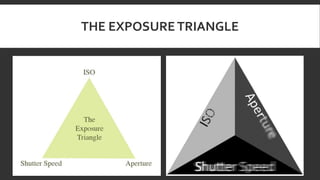
THE EXPOSURETRIANGLE
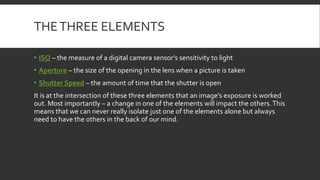
THETHREE ELEMENTS
 ISO – the measure of a digital camera sensor’s sensitivity to light
 Aperture – the size of the opening in the lens when a picture is taken
 Shutter Speed – the amount of time that the shutter is open
It is at the intersection of these three elements that an image’s exposure is worked
out. Most importantly – a change in one of the elements will impact the others.This
means that we can never really isolate just one of the elements alone but always
need to have the others in the back of our mind.
3 METAPHORS FOR UNDERSTANDINGTHE DIGITAL
PHOTOGRAPHY EXPOSURE TRIANGLE.
 The Window
Imagine your camera is like a window with shutters that open and close.
Aperture is the size of the window. If it’s bigger more light gets through and the
room is brighter.
Shutter Speed is the amount of time that the shutters of the window are open.The
longer you leave them open the more that comes in.
Now imagine that you’re inside the room and are wearing sunglasses.Your eyes
become desensitized to the light that comes in (it’s like a low ISO).
WHAT IS SHUTTER SPEED?
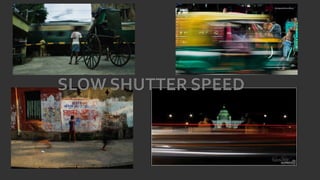
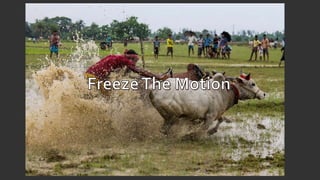
 Shutter speed is ‘the amount of time that the shutter is open’.
 Shutter speed is measured in seconds
 In most cases you’ll probably be using shutter speeds of 1/60th of a second or
faster.
 If you’re using a slow shutter speed (anything slower than 1/60) you will need
to either use a tripod or some some type of image stabilization
WHAT IS APERTURE?
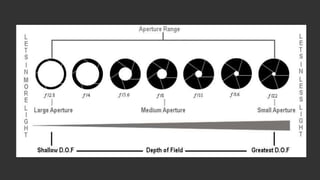
Put most simply – Aperture is ‘the opening in the lens.’
When you hit the shutter release button of your camera a hole opens up that allows
your cameras image sensor to catch a glimpse of the scene you’re wanting to
capture.The aperture that you set impacts the size of that hole.The larger the hole
the more light that gets in – the smaller the hole the less light.
Aperture is measured in ‘f-stops’. For example f/2.8, f/4, f/5.6,f/8,f/22 etc.
Moving from one f-stop to the next doubles or halves the size of the amount of
opening in your lens (and the amount of light getting through).
Keep in mind that a change in shutter speed from one stop to the next doubles or halves the
amount of light that gets in also – this means if you increase one and decrease the other you
let the same amount of light in – very handy to keep in mind).
WHICH IS A LARGER aperture?
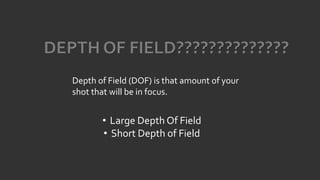
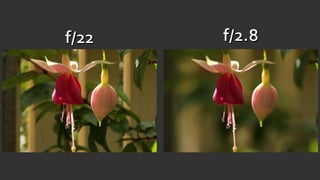
Depth of Field (DOF) is that amount of your
shot that will be in focus.
• Large Depth Of Field
• Short Depth of Field
WHAT IS ISO?
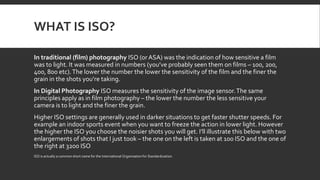
In traditional (film) photography ISO (orASA) was the indication of how sensitive a film
was to light. It was measured in numbers (you’ve probably seen them on films – 100, 200,
400, 800 etc).The lower the number the lower the sensitivity of the film and the finer the
grain in the shots you’re taking.
In Digital Photography ISO measures the sensitivity of the image sensor.The same
principles apply as in film photography – the lower the number the less sensitive your
camera is to light and the finer the grain.
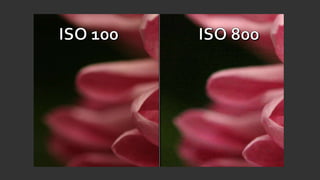
Higher ISO settings are generally used in darker situations to get faster shutter speeds. For
example an indoor sports event when you want to freeze the action in lower light. However
the higher the ISO you choose the noisier shots you will get. I’ll illustrate this below with two
enlargements of shots that I just took – the one on the left is taken at 100 ISO and the one of
the right at 3200 ISO
ISO is actually a common short name for the International Organisation for Standardization.
•FRAMING
•COMPOSITION
•LIGHTING
•THE STORY
THE 4 MUSKETEERS
RULES OF COMPOSITION
 The rule of thirds
 Golden triangles and spirals
 Rule of Odds
 Balancing Elements
 Leading Lines
 Symmetry and Patterns
 Fill the Frame
 Patterns
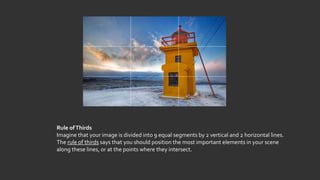
Rule ofThirds
Imagine that your image is divided into 9 equal segments by 2 vertical and 2 horizontal lines.
The rule of thirds says that you should position the most important elements in your scene
along these lines, or at the points where they intersect.
Breaking all the RULES.
“When words become unclear, I shall
focus with photographs.When images
become inadequate, I shall be content
with silence.”
― Ansel Adams

Basic camera handling - Few tips and tricks

  • 1.
    BASIC CAMERA HANDLING Afew tips and tricks.
  • 2.
  • 3.
    THETHREE ELEMENTS  ISO– the measure of a digital camera sensor’s sensitivity to light  Aperture – the size of the opening in the lens when a picture is taken  Shutter Speed – the amount of time that the shutter is open It is at the intersection of these three elements that an image’s exposure is worked out. Most importantly – a change in one of the elements will impact the others.This means that we can never really isolate just one of the elements alone but always need to have the others in the back of our mind.
  • 4.
    3 METAPHORS FORUNDERSTANDINGTHE DIGITAL PHOTOGRAPHY EXPOSURE TRIANGLE.  The Window Imagine your camera is like a window with shutters that open and close. Aperture is the size of the window. If it’s bigger more light gets through and the room is brighter. Shutter Speed is the amount of time that the shutters of the window are open.The longer you leave them open the more that comes in. Now imagine that you’re inside the room and are wearing sunglasses.Your eyes become desensitized to the light that comes in (it’s like a low ISO).
  • 5.
    WHAT IS SHUTTERSPEED?  Shutter speed is ‘the amount of time that the shutter is open’.  Shutter speed is measured in seconds  In most cases you’ll probably be using shutter speeds of 1/60th of a second or faster.  If you’re using a slow shutter speed (anything slower than 1/60) you will need to either use a tripod or some some type of image stabilization
  • 8.
    WHAT IS APERTURE? Putmost simply – Aperture is ‘the opening in the lens.’ When you hit the shutter release button of your camera a hole opens up that allows your cameras image sensor to catch a glimpse of the scene you’re wanting to capture.The aperture that you set impacts the size of that hole.The larger the hole the more light that gets in – the smaller the hole the less light. Aperture is measured in ‘f-stops’. For example f/2.8, f/4, f/5.6,f/8,f/22 etc. Moving from one f-stop to the next doubles or halves the size of the amount of opening in your lens (and the amount of light getting through). Keep in mind that a change in shutter speed from one stop to the next doubles or halves the amount of light that gets in also – this means if you increase one and decrease the other you let the same amount of light in – very handy to keep in mind).
  • 9.
    WHICH IS ALARGER aperture?
  • 11.
    Depth of Field(DOF) is that amount of your shot that will be in focus. • Large Depth Of Field • Short Depth of Field
  • 13.
    WHAT IS ISO? Intraditional (film) photography ISO (orASA) was the indication of how sensitive a film was to light. It was measured in numbers (you’ve probably seen them on films – 100, 200, 400, 800 etc).The lower the number the lower the sensitivity of the film and the finer the grain in the shots you’re taking. In Digital Photography ISO measures the sensitivity of the image sensor.The same principles apply as in film photography – the lower the number the less sensitive your camera is to light and the finer the grain. Higher ISO settings are generally used in darker situations to get faster shutter speeds. For example an indoor sports event when you want to freeze the action in lower light. However the higher the ISO you choose the noisier shots you will get. I’ll illustrate this below with two enlargements of shots that I just took – the one on the left is taken at 100 ISO and the one of the right at 3200 ISO ISO is actually a common short name for the International Organisation for Standardization.
  • 15.
  • 16.
    RULES OF COMPOSITION The rule of thirds  Golden triangles and spirals  Rule of Odds  Balancing Elements  Leading Lines  Symmetry and Patterns  Fill the Frame  Patterns
  • 17.
    Rule ofThirds Imagine thatyour image is divided into 9 equal segments by 2 vertical and 2 horizontal lines. The rule of thirds says that you should position the most important elements in your scene along these lines, or at the points where they intersect.
  • 18.
  • 19.
    “When words becomeunclear, I shall focus with photographs.When images become inadequate, I shall be content with silence.” ― Ansel Adams