Photography
LESSON ONE – THE
BASICS
What is Photography?
• The word photography derives from the Greek photos ("light")
and graphe ("drawing"). The term was invented by Hercules
Florence, a French painter and inventor, who used it in his diary
to describe the process.
• The term Photography is pretty simple to define – the art or
practise of taking and processing photographs – but
Photography itself is far more complicated due to its subversive
nature.
The Basics –
Camera
Functions
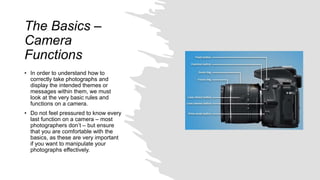
• In order to understand how to
correctly take photographs and
display the intended themes or
messages within them, we must
look at the very basic rules and
functions on a camera.
• Do not feel pressured to know every
last function on a camera – most
photographers don’t – but ensure
that you are comfortable with the
basics, as these are very important
if you want to manipulate your
photographs effectively.
The Basics –
Aperture, ISO and
Shutter Speed
• So let’s take a look at these 3
CRUCIAL pillars.
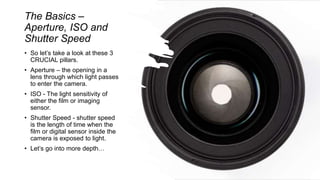
• Aperture – the opening in a
lens through which light passes
to enter the camera.
• ISO - The light sensitivity of
either the film or imaging
sensor.
• Shutter Speed - shutter speed
is the length of time when the
film or digital sensor inside the
camera is exposed to light.
• Let’s go into more depth…
Aperture
• It is an easy concept to understand if you just think about how your eyes
work. As you move between bright and dark environments, the iris in your
eyes either expands or shrinks, controlling the size of your pupil.
• In Photography, the “pupil” of your lens is called aperture. You can shrink or
enlarge the size of the aperture to allow more or less light to reach your
camera sensor.
• Aperture can add dimension to your photos by controlling depth of field. At
one extreme, aperture gives you a blurred background with a beautiful
shallow focus effect.
• At the other, it will give you sharp photos from the nearby foreground to the
distant horizon. On top of that, it also alters the exposure of your images by
making them brighter or darker.
• If your aperture is incorrect, it can leave your photograph overexposed or
underexposed, which we don’t want!
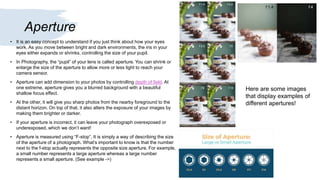
• Aperture is measured using “F-stop”. It is simply a way of describing the size
of the aperture of a photograph. What’s important to know is that the number
next to the f-stop actually represents the opposite size aperture. For example,
a small number represents a large aperture whereas a large number
represents a small aperture. (See example ->)
Here are some images
that display examples of
different apertures!
ISO
• When you change the ISO on a digital camera, you’re rendering the sensor more or less
sensitive to light. One of the greatest features of digital cameras — one that is often taken for
granted — is their ability to change ISO instantly. In the days of film, you were essentially
stuck with whatever film speed you loaded into your camera, at least until you finished that
particular roll.
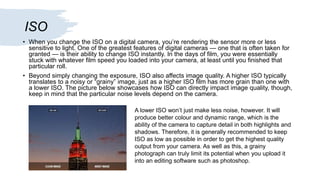
• Beyond simply changing the exposure, ISO also affects image quality. A higher ISO typically
translates to a noisy or “grainy” image, just as a higher ISO film has more grain than one with
a lower ISO. The picture below showcases how ISO can directly impact image quality, though,
keep in mind that the particular noise levels depend on the camera.
A lower ISO won’t just make less noise, however. It will
produce better colour and dynamic range, which is the
ability of the camera to capture detail in both highlights and
shadows. Therefore, it is generally recommended to keep
ISO as low as possible in order to get the highest quality
output from your camera. As well as this, a grainy
photograph can truly limit its potential when you upload it
into an editing software such as photoshop.
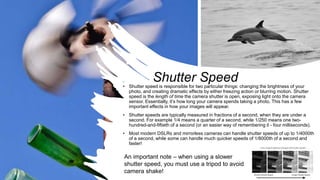
Shutter Speed• Shutter speed is responsible for two particular things: changing the brightness of your
photo, and creating dramatic effects by either freezing action or blurring motion. Shutter
speed is the length of time the camera shutter is open, exposing light onto the camera
sensor. Essentially, it’s how long your camera spends taking a photo. This has a few
important effects in how your images will appear.
• Shutter speeds are typically measured in fractions of a second, when they are under a
second. For example 1/4 means a quarter of a second, while 1/250 means one two-
hundred-and-fiftieth of a second (or an easier way of remembering it - four milliseconds).
• Most modern DSLRs and mirrorless cameras can handle shutter speeds of up to 1/4000th
of a second, while some can handle much quicker speeds of 1/8000th of a second and
faster!
An important note – when using a slower
shutter speed, you must use a tripod to avoid
camera shake!
The Three Pillars
• So, as you can tell, these three pillars do interact
CONSTANTLY and you must always consider all three when
taking a photograph, which can seem quite daunting. But the
easiest way to break it down is to ask yourself: “what is the
priority in my photographs?”. Do you require a deep or shallow
depth of field? Aperture. Do you need a blurry aspect to your
photo or a clean sharp effect? Shutter Speed. Do you want a
clean photo or a bit of noise for artistic effect? ISO.
The Basics - Elements
• There are seven basic elements to photography, though they are crucial when considering
your photos: Line, Shape, Form, Texture, Pattern, Colour, Space.
• Line - Can be vertical, horizontal, curved or jagged. Examples: roads, sunsets, bridges.
• Shape - Two-dimensional representation of objects. Examples: silhouetted photographs of
birds.
• Form - Three-dimensional representation of objects, usually through the use of lighting and
shadows.
• Texture - The use of lighting to bring out details of an object, making it easy to see whether a
surface is smooth or soft.
• Pattern - The use of repetition to create an interesting photo. Examples: photos of gardens or
flowers.
• Colour – Using warm or cool colours to create a mood. Example: Themes of red for
discomfort.
• Space - Either negative or positive space can be used to make a statement. Often seen when
using the rule of thirds.
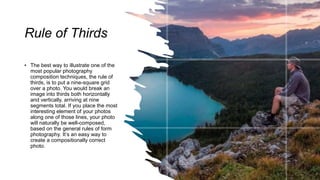
Rule of Thirds
• The best way to illustrate one of the
most popular photography
composition techniques, the rule of
thirds, is to put a nine-square grid
over a photo. You would break an
image into thirds both horizontally
and vertically, arriving at nine
segments total. If you place the most
interesting element of your photos
along one of those lines, your photo
will naturally be well-composed,
based on the general rules of form
photography. It’s an easy way to
create a compositionally correct
photo.
Lighting and Composition
• The seven basic elements of photography all come down to lighting and
composition. New photographers focus on these two items most. There
are many photography composition techniques in addition to the rule of
thirds, including symmetry, which utilizes tricks like reflections to make an
otherwise ordinary photo more interesting, and depth, which combines the
foreground and background in interesting ways to bring an image to life.
Another important form in photography is "shooting light." That means
looking for the way the light hits objects and featuring that in your photo.
As you begin to play with these seven elements of photography, these
professional techniques can take you from photographer to photographic
artist.
And that’s a wrap!

A Level Photography - The Basics

  • 1.
  • 2.
    What is Photography? •The word photography derives from the Greek photos ("light") and graphe ("drawing"). The term was invented by Hercules Florence, a French painter and inventor, who used it in his diary to describe the process. • The term Photography is pretty simple to define – the art or practise of taking and processing photographs – but Photography itself is far more complicated due to its subversive nature.
  • 3.
    The Basics – Camera Functions •In order to understand how to correctly take photographs and display the intended themes or messages within them, we must look at the very basic rules and functions on a camera. • Do not feel pressured to know every last function on a camera – most photographers don’t – but ensure that you are comfortable with the basics, as these are very important if you want to manipulate your photographs effectively.
  • 4.
    The Basics – Aperture,ISO and Shutter Speed • So let’s take a look at these 3 CRUCIAL pillars. • Aperture – the opening in a lens through which light passes to enter the camera. • ISO - The light sensitivity of either the film or imaging sensor. • Shutter Speed - shutter speed is the length of time when the film or digital sensor inside the camera is exposed to light. • Let’s go into more depth…
  • 5.
    Aperture • It isan easy concept to understand if you just think about how your eyes work. As you move between bright and dark environments, the iris in your eyes either expands or shrinks, controlling the size of your pupil. • In Photography, the “pupil” of your lens is called aperture. You can shrink or enlarge the size of the aperture to allow more or less light to reach your camera sensor. • Aperture can add dimension to your photos by controlling depth of field. At one extreme, aperture gives you a blurred background with a beautiful shallow focus effect. • At the other, it will give you sharp photos from the nearby foreground to the distant horizon. On top of that, it also alters the exposure of your images by making them brighter or darker. • If your aperture is incorrect, it can leave your photograph overexposed or underexposed, which we don’t want! • Aperture is measured using “F-stop”. It is simply a way of describing the size of the aperture of a photograph. What’s important to know is that the number next to the f-stop actually represents the opposite size aperture. For example, a small number represents a large aperture whereas a large number represents a small aperture. (See example ->) Here are some images that display examples of different apertures!
  • 6.
    ISO • When youchange the ISO on a digital camera, you’re rendering the sensor more or less sensitive to light. One of the greatest features of digital cameras — one that is often taken for granted — is their ability to change ISO instantly. In the days of film, you were essentially stuck with whatever film speed you loaded into your camera, at least until you finished that particular roll. • Beyond simply changing the exposure, ISO also affects image quality. A higher ISO typically translates to a noisy or “grainy” image, just as a higher ISO film has more grain than one with a lower ISO. The picture below showcases how ISO can directly impact image quality, though, keep in mind that the particular noise levels depend on the camera. A lower ISO won’t just make less noise, however. It will produce better colour and dynamic range, which is the ability of the camera to capture detail in both highlights and shadows. Therefore, it is generally recommended to keep ISO as low as possible in order to get the highest quality output from your camera. As well as this, a grainy photograph can truly limit its potential when you upload it into an editing software such as photoshop.
  • 7.
    Shutter Speed• Shutterspeed is responsible for two particular things: changing the brightness of your photo, and creating dramatic effects by either freezing action or blurring motion. Shutter speed is the length of time the camera shutter is open, exposing light onto the camera sensor. Essentially, it’s how long your camera spends taking a photo. This has a few important effects in how your images will appear. • Shutter speeds are typically measured in fractions of a second, when they are under a second. For example 1/4 means a quarter of a second, while 1/250 means one two- hundred-and-fiftieth of a second (or an easier way of remembering it - four milliseconds). • Most modern DSLRs and mirrorless cameras can handle shutter speeds of up to 1/4000th of a second, while some can handle much quicker speeds of 1/8000th of a second and faster! An important note – when using a slower shutter speed, you must use a tripod to avoid camera shake!
  • 8.
    The Three Pillars •So, as you can tell, these three pillars do interact CONSTANTLY and you must always consider all three when taking a photograph, which can seem quite daunting. But the easiest way to break it down is to ask yourself: “what is the priority in my photographs?”. Do you require a deep or shallow depth of field? Aperture. Do you need a blurry aspect to your photo or a clean sharp effect? Shutter Speed. Do you want a clean photo or a bit of noise for artistic effect? ISO.
  • 9.
    The Basics -Elements • There are seven basic elements to photography, though they are crucial when considering your photos: Line, Shape, Form, Texture, Pattern, Colour, Space. • Line - Can be vertical, horizontal, curved or jagged. Examples: roads, sunsets, bridges. • Shape - Two-dimensional representation of objects. Examples: silhouetted photographs of birds. • Form - Three-dimensional representation of objects, usually through the use of lighting and shadows. • Texture - The use of lighting to bring out details of an object, making it easy to see whether a surface is smooth or soft. • Pattern - The use of repetition to create an interesting photo. Examples: photos of gardens or flowers. • Colour – Using warm or cool colours to create a mood. Example: Themes of red for discomfort. • Space - Either negative or positive space can be used to make a statement. Often seen when using the rule of thirds.
  • 10.
    Rule of Thirds •The best way to illustrate one of the most popular photography composition techniques, the rule of thirds, is to put a nine-square grid over a photo. You would break an image into thirds both horizontally and vertically, arriving at nine segments total. If you place the most interesting element of your photos along one of those lines, your photo will naturally be well-composed, based on the general rules of form photography. It’s an easy way to create a compositionally correct photo.
  • 11.
    Lighting and Composition •The seven basic elements of photography all come down to lighting and composition. New photographers focus on these two items most. There are many photography composition techniques in addition to the rule of thirds, including symmetry, which utilizes tricks like reflections to make an otherwise ordinary photo more interesting, and depth, which combines the foreground and background in interesting ways to bring an image to life. Another important form in photography is "shooting light." That means looking for the way the light hits objects and featuring that in your photo. As you begin to play with these seven elements of photography, these professional techniques can take you from photographer to photographic artist.
  • 12.