
Exposure Theory
Exposure Defined 
Exposure: the quantity of light reaching a photographic 
film/sensor, as determined by shutter speed and lens 
aperture. 
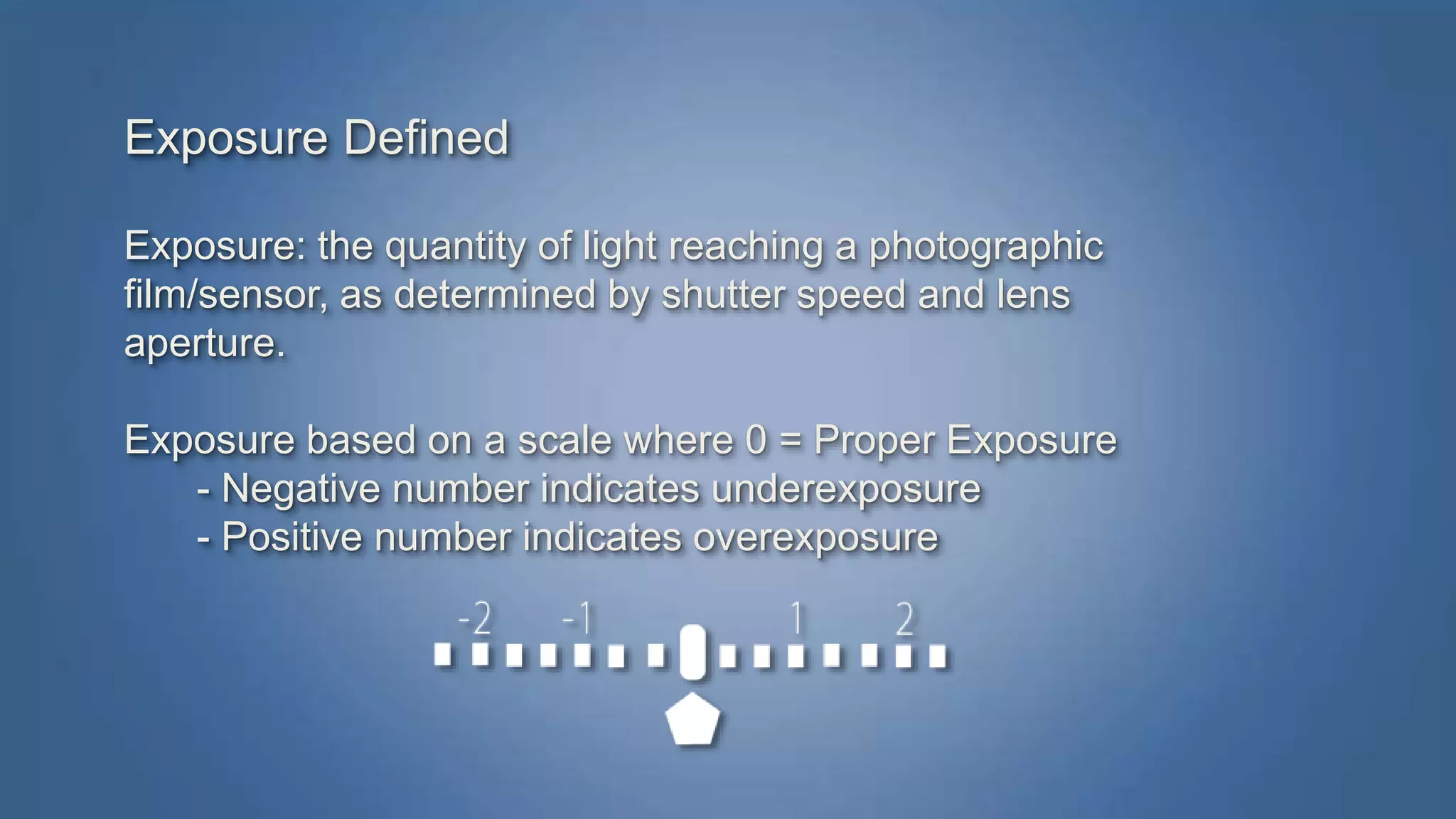
Exposure based on a scale where 0 = Proper Exposure 
- Negative number indicates underexposure 
- Positive number indicates overexposure
How a Camera Sensor Works 
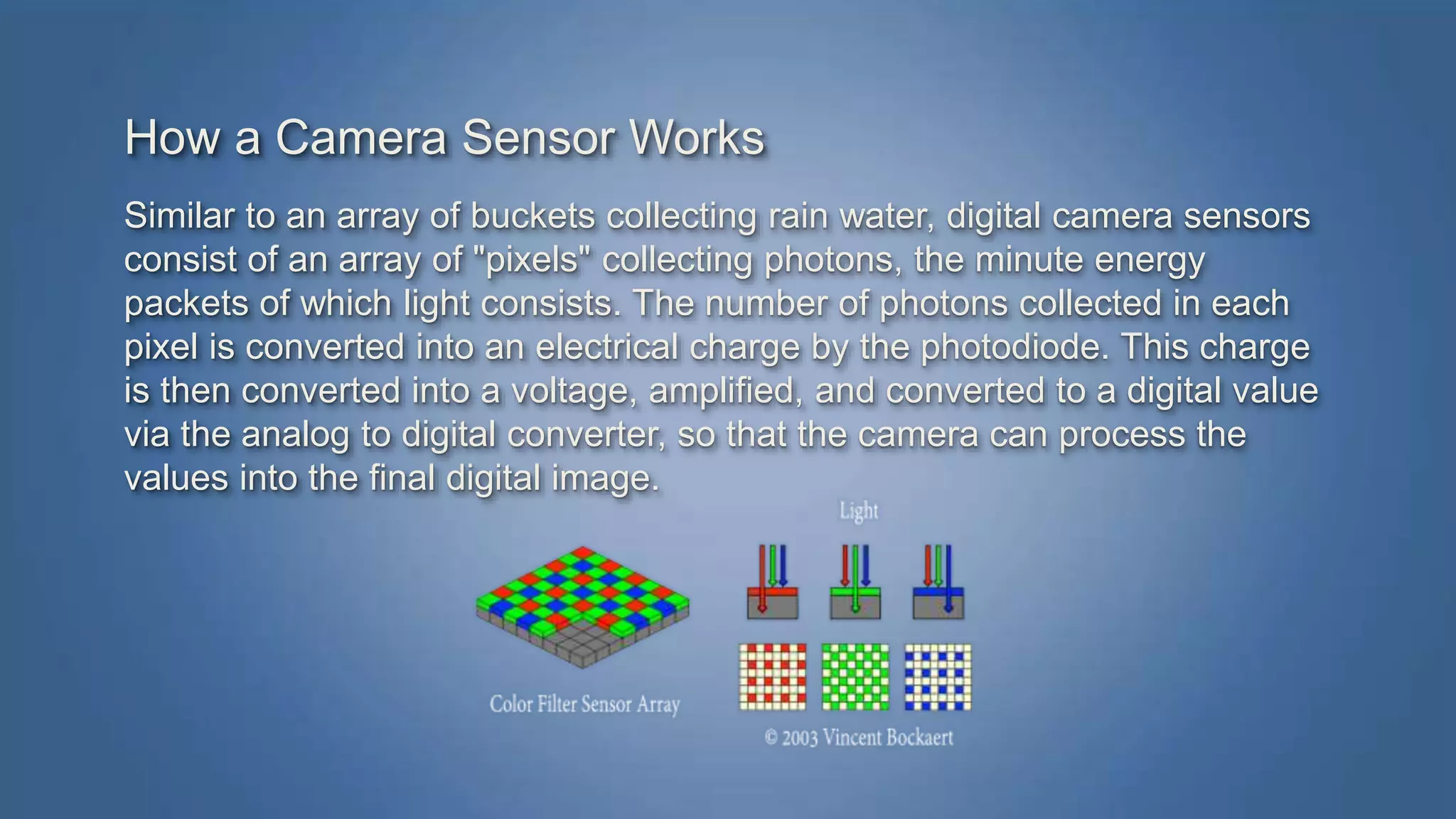
Similar to an array of buckets collecting rain water, digital camera sensors 
consist of an array of "pixels" collecting photons, the minute energy 
packets of which light consists. The number of photons collected in each 
pixel is converted into an electrical charge by the photodiode. This charge 
is then converted into a voltage, amplified, and converted to a digital value 
via the analog to digital converter, so that the camera can process the 
values into the final digital image.
Exposure Triangle 
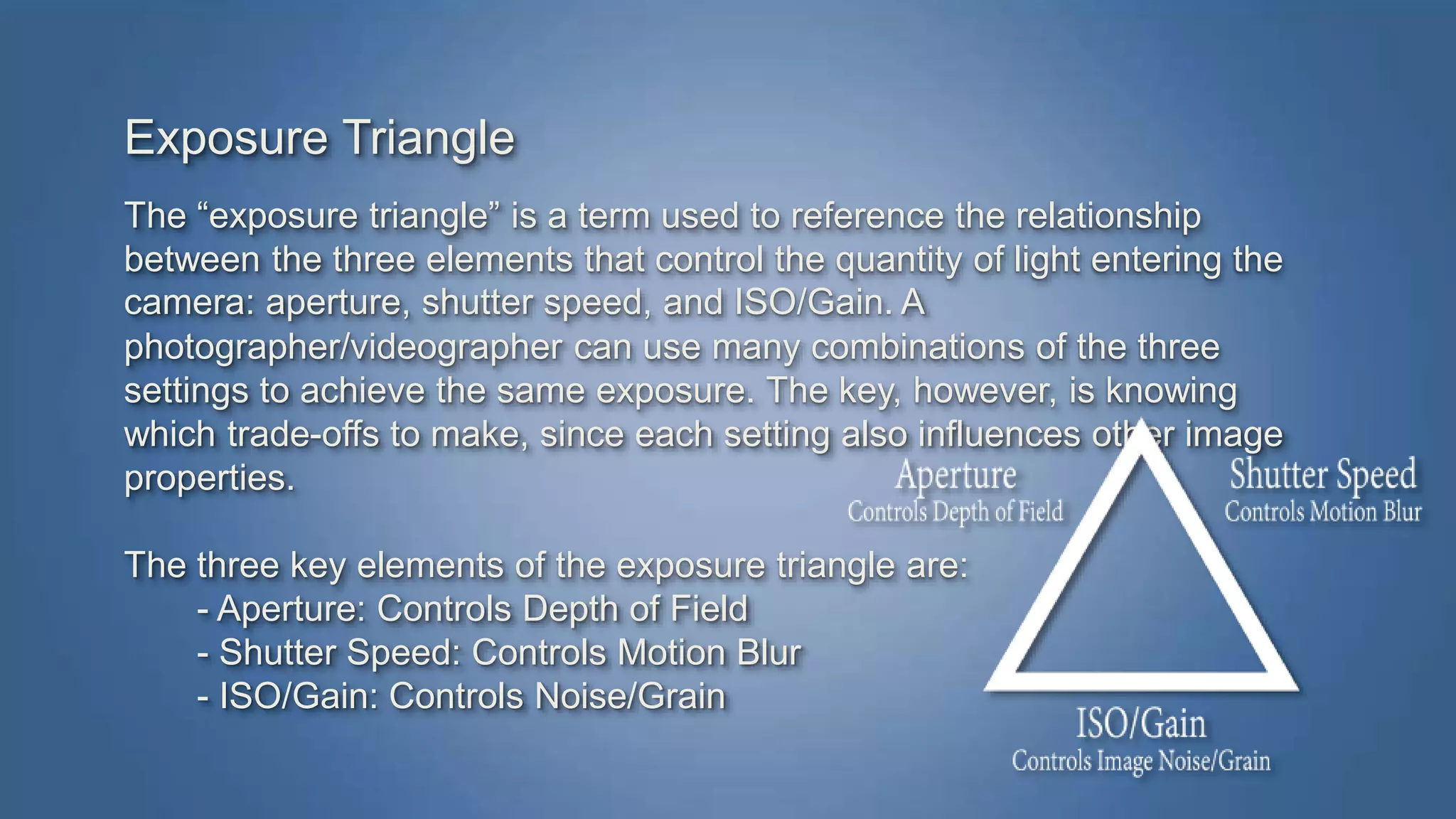
The “exposure triangle” is a term used to reference the relationship 
between the three elements that control the quantity of light entering the 
camera: aperture, shutter speed, and ISO/Gain. A 
photographer/videographer can use many combinations of the three 
settings to achieve the same exposure. The key, however, is knowing 
which trade-offs to make, since each setting also influences other image 
properties. 
The three key elements of the exposure triangle are: 
- Aperture: Controls Depth of Field 
- Shutter Speed: Controls Motion Blur 
- ISO/Gain: Controls Noise/Grain
Aperture Defined 
A camera's aperture setting controls the area over which light can pass 
through your camera lens. It is measured in terms of an f-stop value, which 
can at times be counterintuitive, because the area of the opening 
increases as the f-stop decreases. In photographer slang, when someone 
says they are "stopping down" or "opening up" their lens, they are referring 
to increasing and decreasing the f-stop value, respectively. 
Aperture: the unit of measurement that defines the size of the opening in 
the lens. 
Iris diaphragm: a thin opaque structure with an opening (aperture) at its 
center. 
F-number: the ratio of the focal length of a camera lens to the diameter of 
the aperture being used for a particular shot (e.g., f8, indicating that the
Aperture Process: F-Number Ratio 
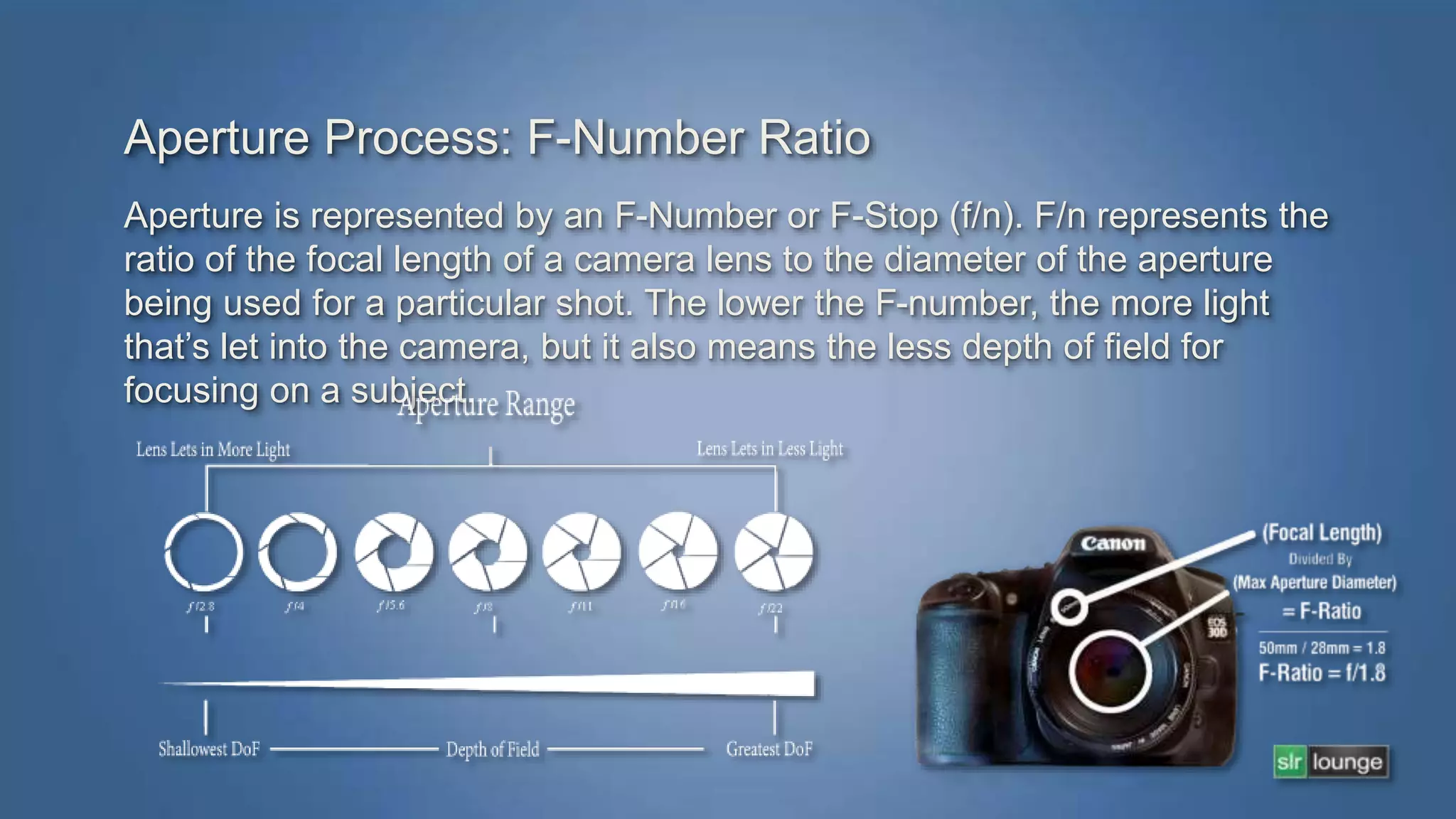
Aperture is represented by an F-Number or F-Stop (f/n). F/n represents the 
ratio of the focal length of a camera lens to the diameter of the aperture 
being used for a particular shot. The lower the F-number, the more light 
that’s let into the camera, but it also means the less depth of field for 
focusing on a subject.
Aperture Control: Depth of Field 
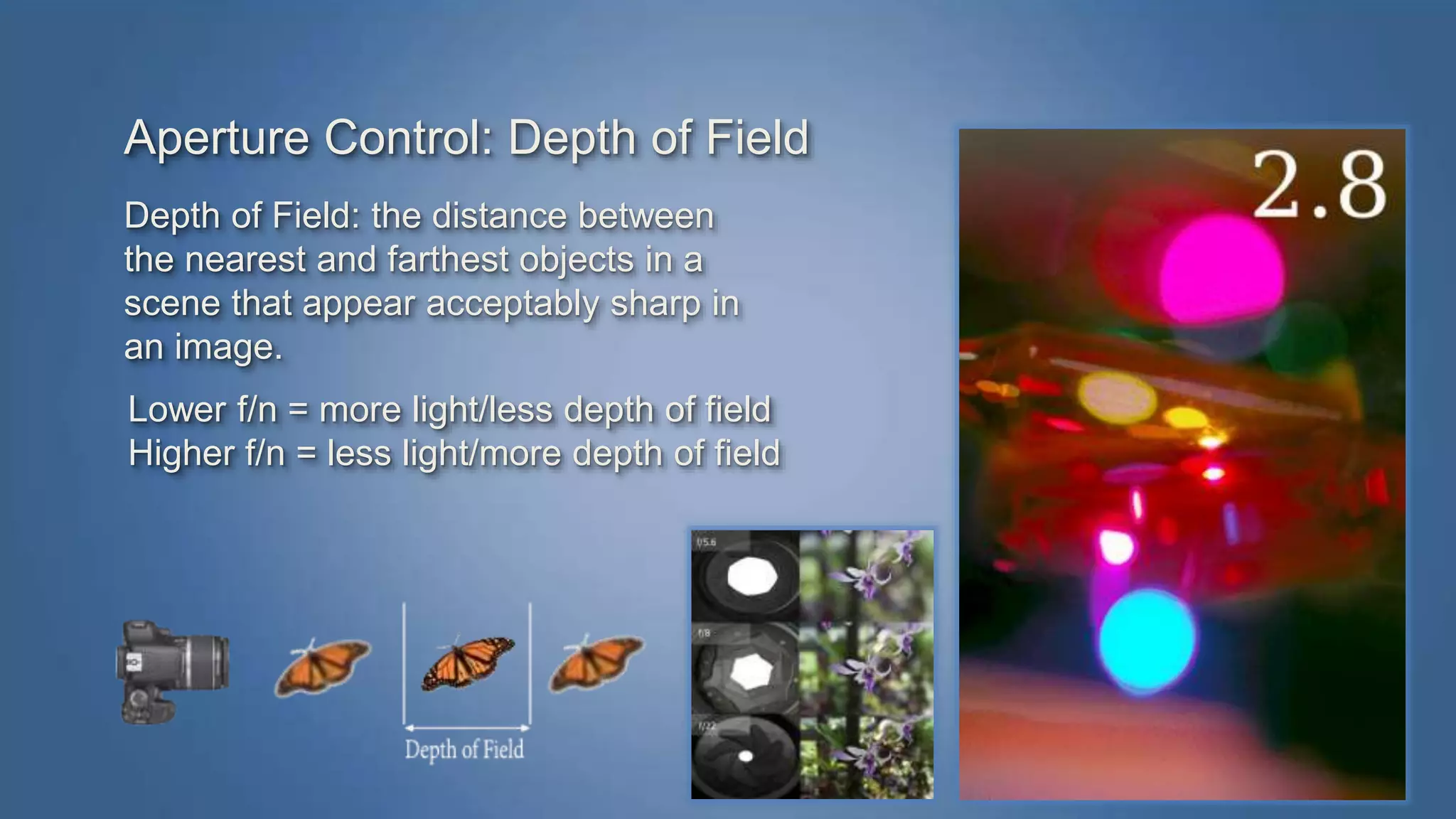
Depth of Field: the distance between 
the nearest and farthest objects in a 
scene that appear acceptably sharp in 
an image. 
Lower f/n = more light/less depth of field 
Higher f/n = less light/more depth of field
Shutter Speed Defined 
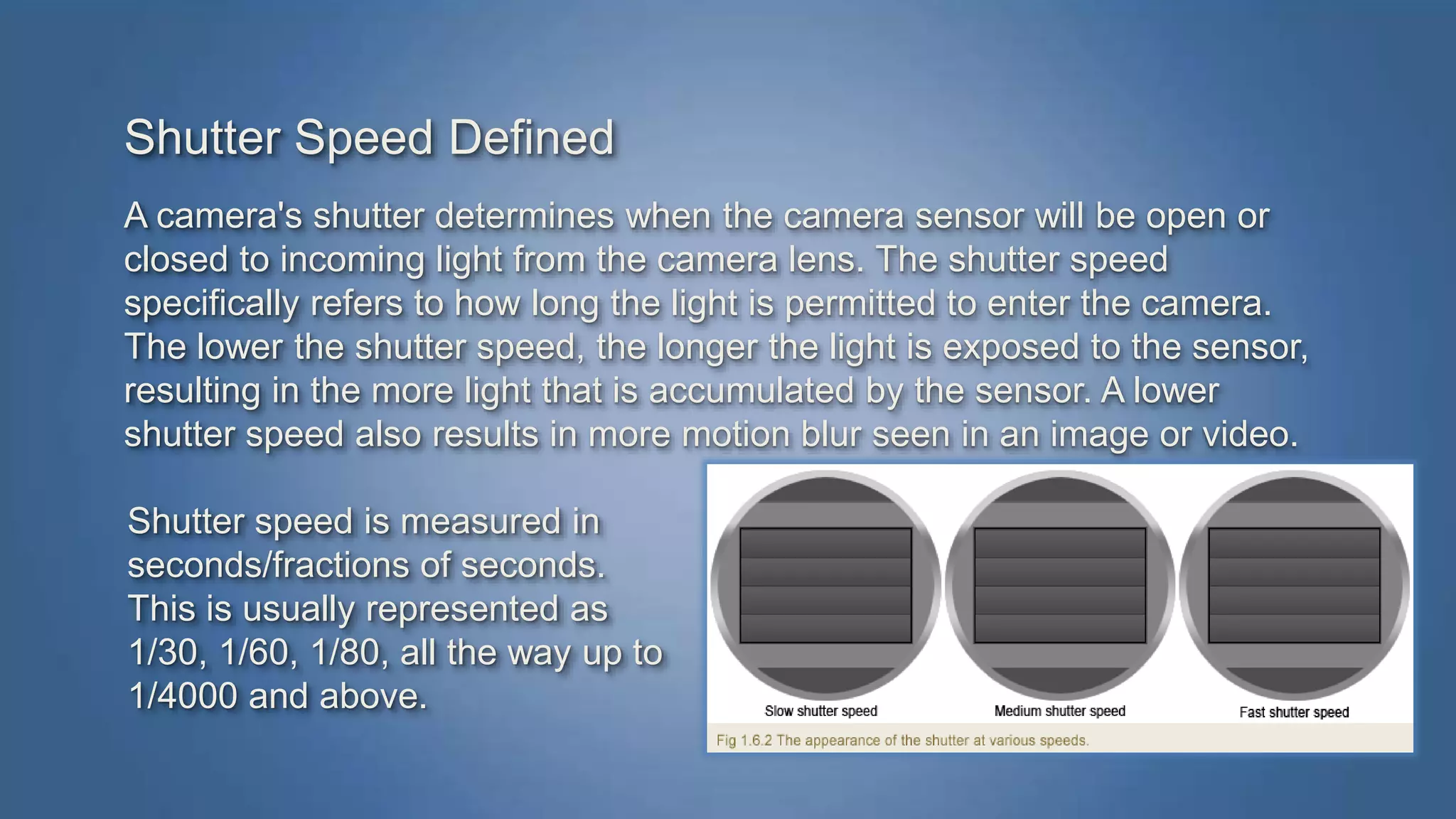
A camera's shutter determines when the camera sensor will be open or 
closed to incoming light from the camera lens. The shutter speed 
specifically refers to how long the light is permitted to enter the camera. 
The lower the shutter speed, the longer the light is exposed to the sensor, 
resulting in the more light that is accumulated by the sensor. A lower 
shutter speed also results in more motion blur seen in an image or video. 
Shutter speed is measured in 
seconds/fractions of seconds. 
This is usually represented as 
1/30, 1/60, 1/80, all the way up to 
1/4000 and above.
Shutter Speed Process: CMOS vs. CCD Sensors 
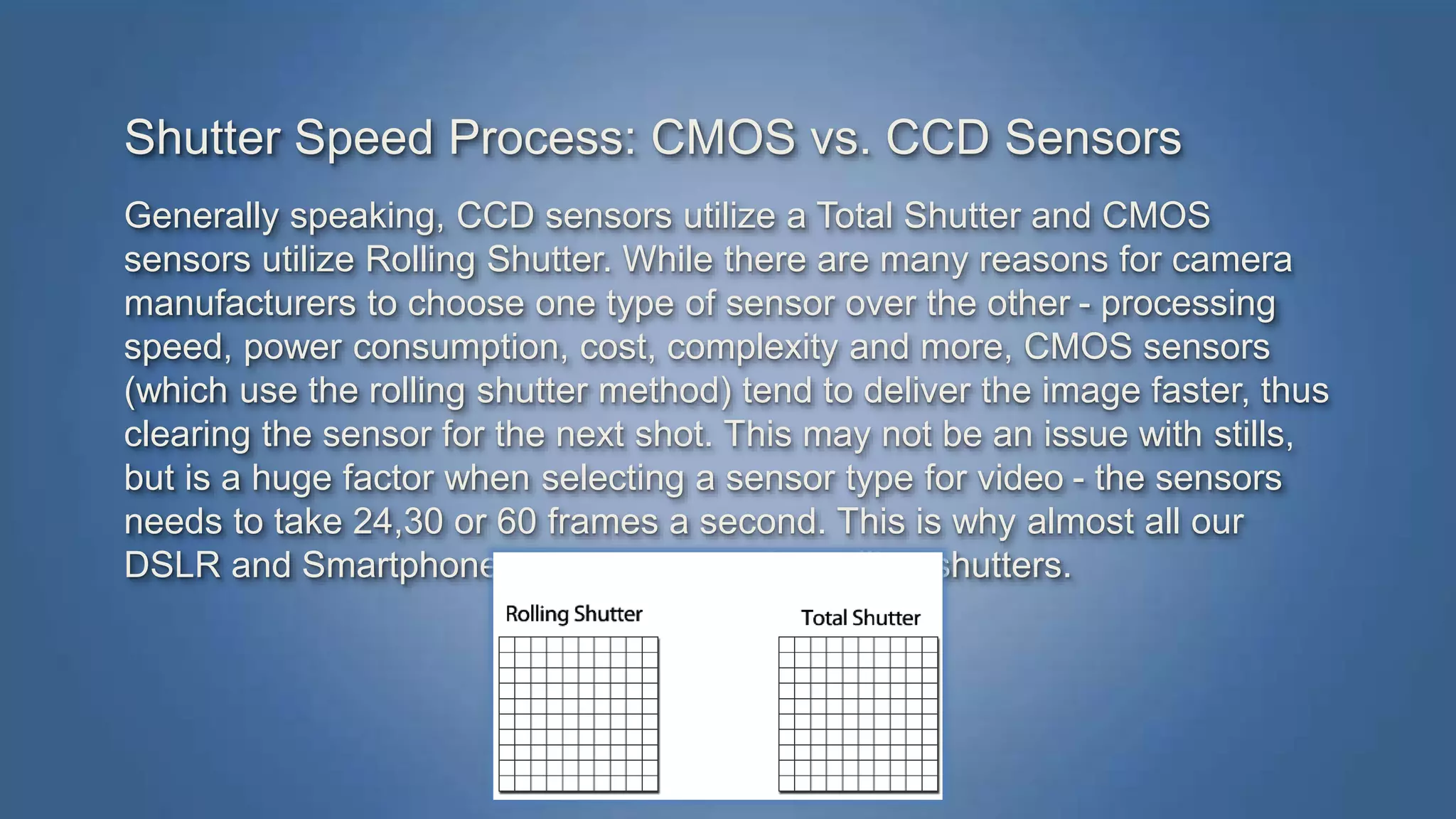
Generally speaking, CCD sensors utilize a Total Shutter and CMOS 
sensors utilize Rolling Shutter. While there are many reasons for camera 
manufacturers to choose one type of sensor over the other - processing 
speed, power consumption, cost, complexity and more, CMOS sensors 
(which use the rolling shutter method) tend to deliver the image faster, thus 
clearing the sensor for the next shot. This may not be an issue with stills, 
but is a huge factor when selecting a sensor type for video - the sensors 
needs to take 24,30 or 60 frames a second. This is why almost all our 
DSLR and Smartphones sensors are using rolling shutters.
Shutter Speed Control: Motion Blur 
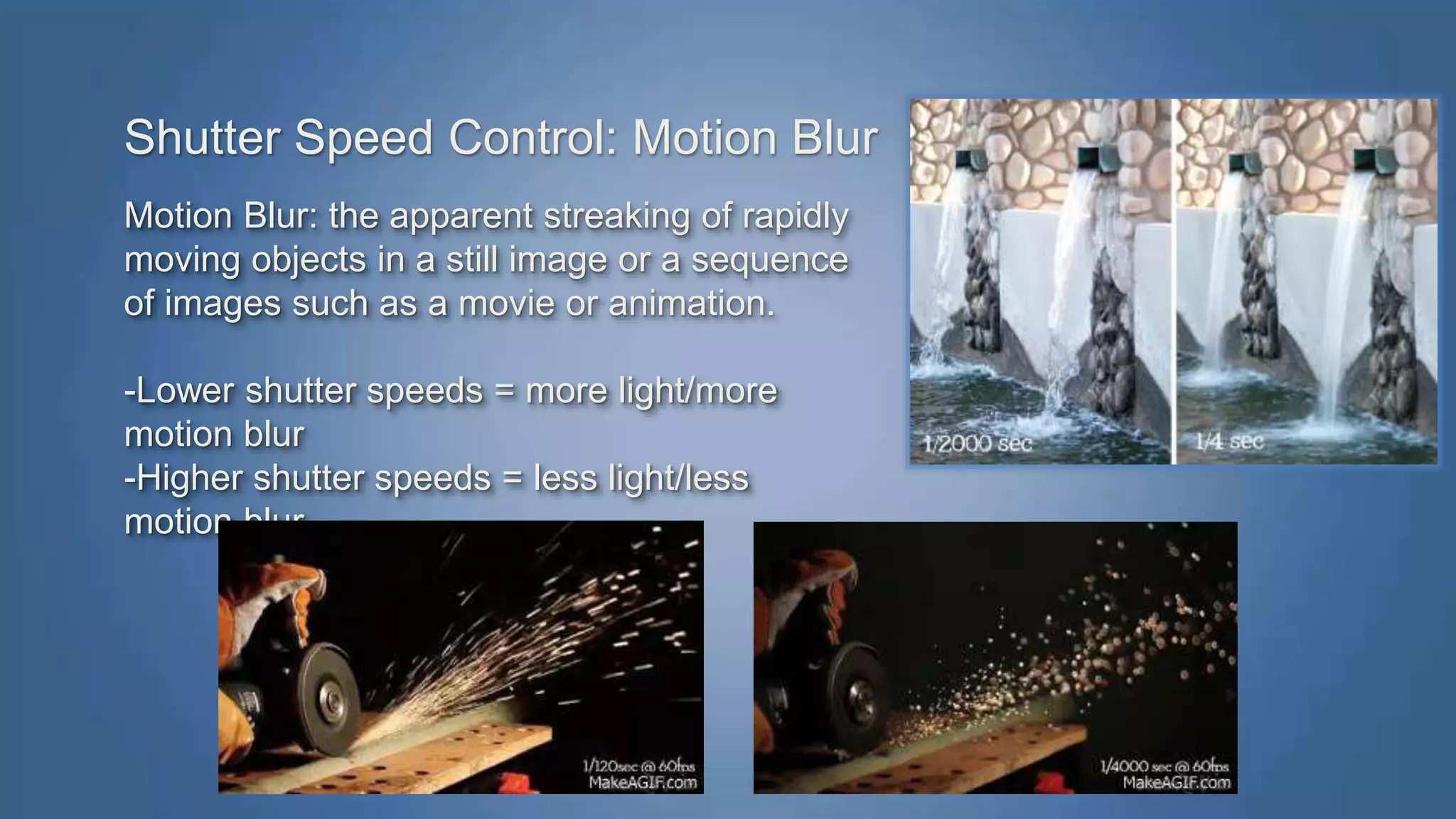
Motion Blur: the apparent streaking of rapidly 
moving objects in a still image or a sequence 
of images such as a movie or animation. 
-Lower shutter speeds = more light/more 
motion blur 
-Higher shutter speeds = less light/less 
motion blur
ISO/Gain Defined 
In Digital Photography ISO measures the sensitivity of the image sensor to 
light. The lower the number, the less sensitive your camera is to light and 
the finer the grain. Higher ISO settings are generally used in darker 
situations and/or to get faster shutter speeds, but results in a more grainy – 
or noisier – image. 
Gain is typically used interchangeably with ISO, but works a little differently 
to increase sensitivity. Gain increases the sensitivity by removing 
information from the underexposed background. As a result, the 
background loses detail. 
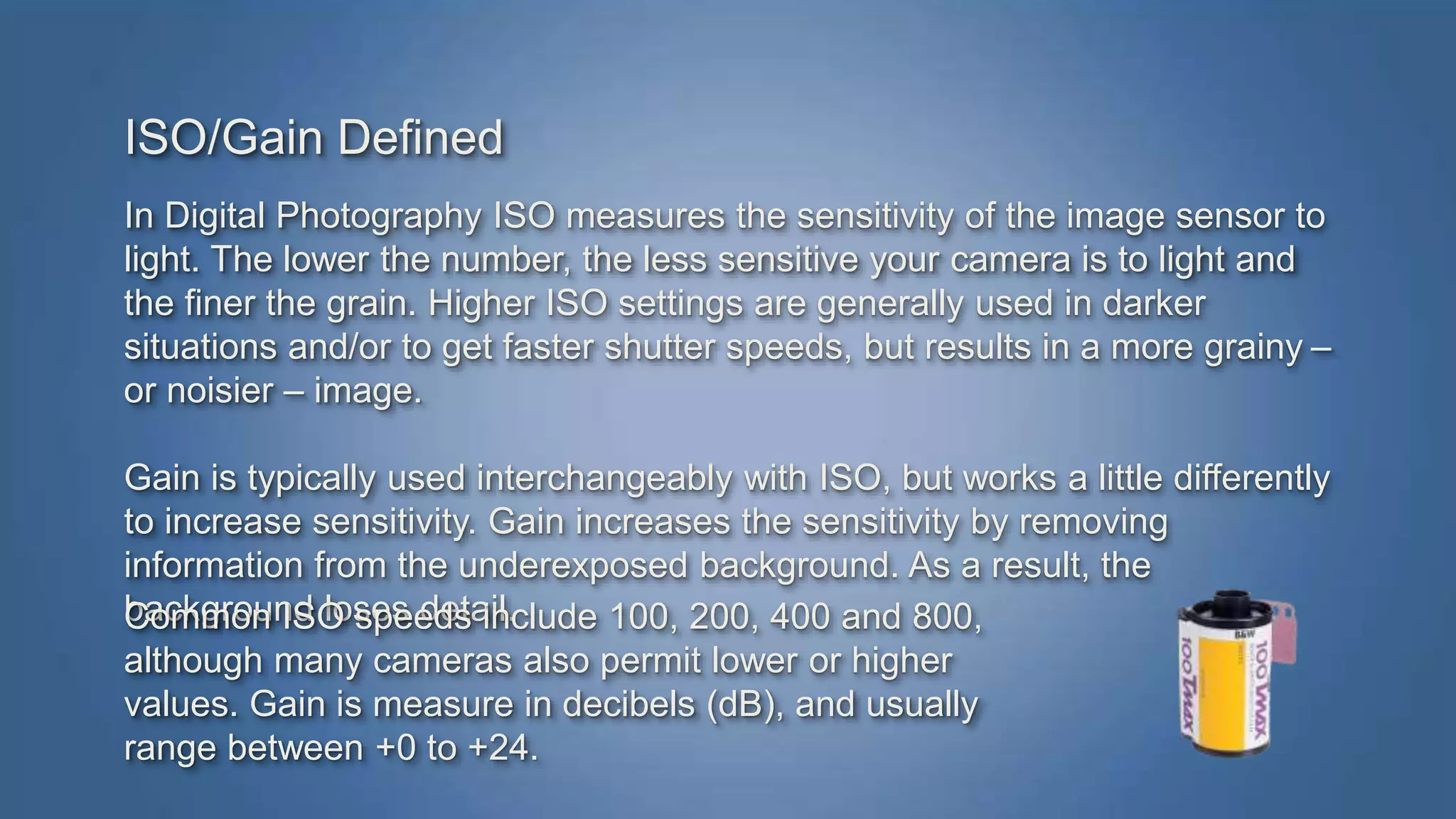
Common ISO speeds include 100, 200, 400 and 800, 
although many cameras also permit lower or higher 
values. Gain is measure in decibels (dB), and usually 
range between +0 to +24.
ISO/Gain Control: Image Noise 
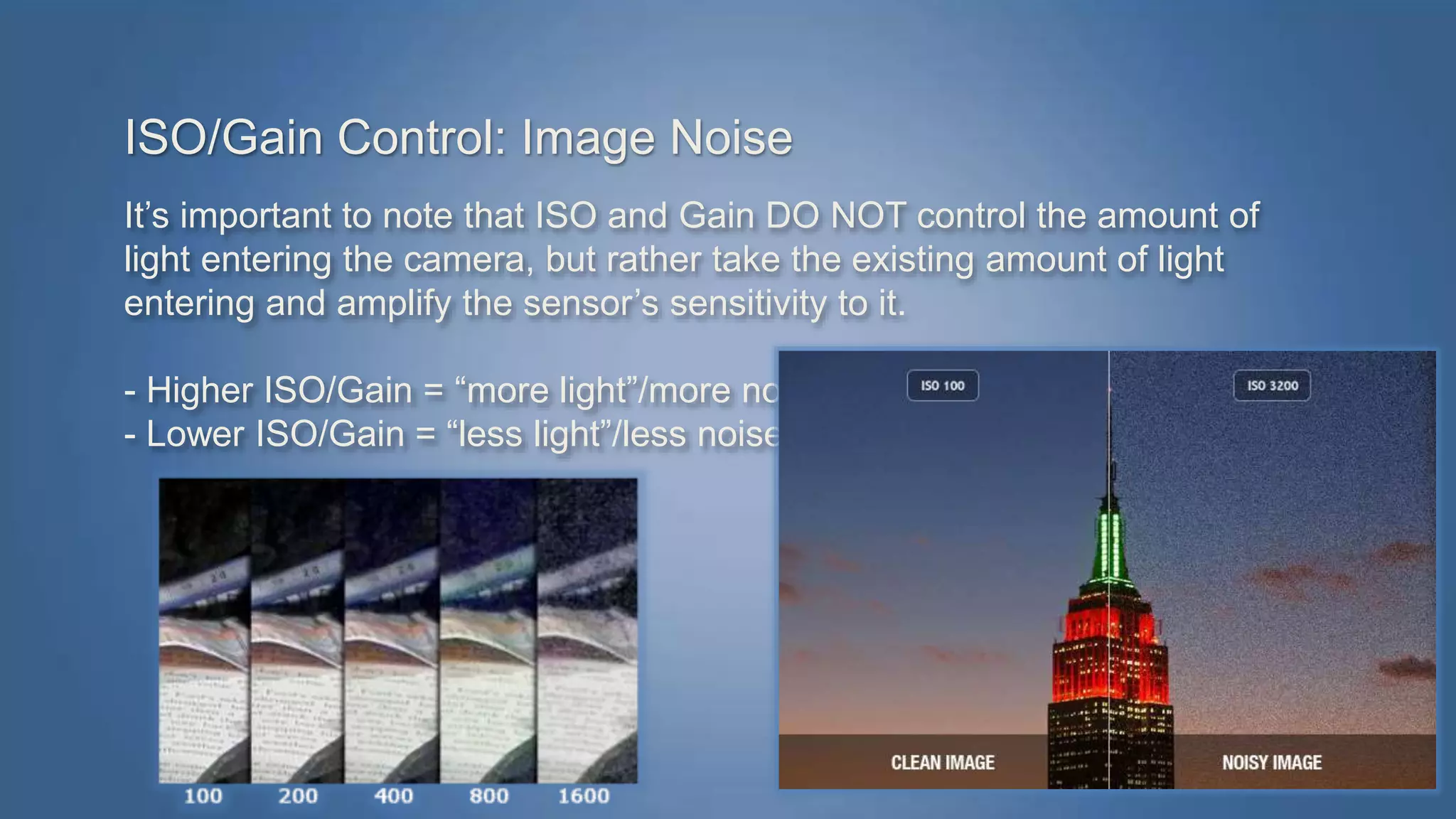
It’s important to note that ISO and Gain DO NOT control the amount of 
light entering the camera, but rather take the existing amount of light 
entering and amplify the sensor’s sensitivity to it. 
- Higher ISO/Gain = “more light”/more noise 
- Lower ISO/Gain = “less light”/less noise
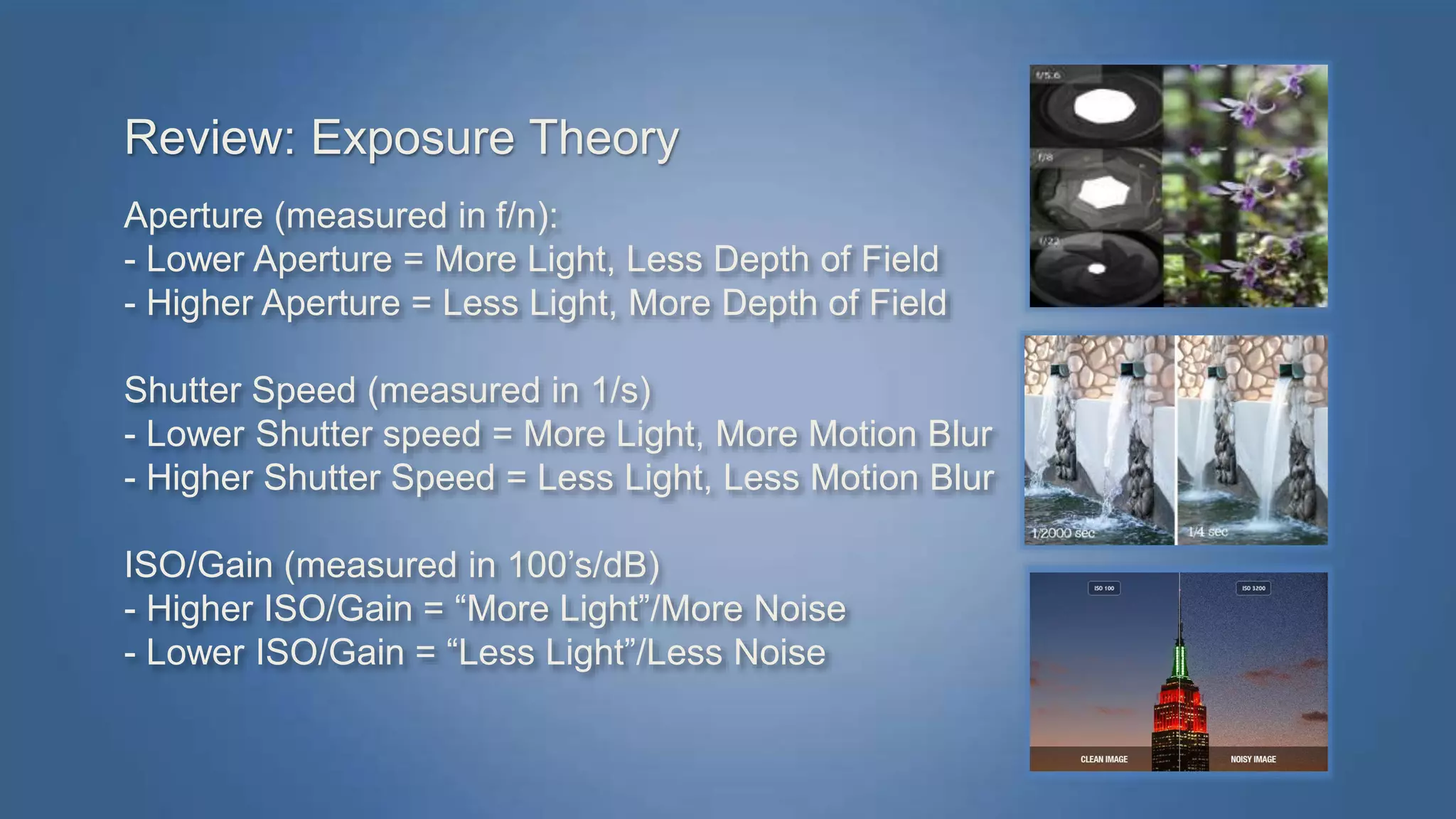
Review: Exposure Theory 
Aperture (measured in f/n): 
- Lower Aperture = More Light, Less Depth of Field 
- Higher Aperture = Less Light, More Depth of Field 
Shutter Speed (measured in 1/s) 
- Lower Shutter speed = More Light, More Motion Blur 
- Higher Shutter Speed = Less Light, Less Motion Blur 
ISO/Gain (measured in 100’s/dB) 
- Higher ISO/Gain = “More Light”/More Noise 
- Lower ISO/Gain = “Less Light”/Less Noise
Sources:

TMP100 U03: Exposure Theory

  • 1.
  • 2.
    Exposure Defined Exposure:the quantity of light reaching a photographic film/sensor, as determined by shutter speed and lens aperture. Exposure based on a scale where 0 = Proper Exposure - Negative number indicates underexposure - Positive number indicates overexposure
  • 3.
    How a CameraSensor Works Similar to an array of buckets collecting rain water, digital camera sensors consist of an array of "pixels" collecting photons, the minute energy packets of which light consists. The number of photons collected in each pixel is converted into an electrical charge by the photodiode. This charge is then converted into a voltage, amplified, and converted to a digital value via the analog to digital converter, so that the camera can process the values into the final digital image.
  • 4.
    Exposure Triangle The“exposure triangle” is a term used to reference the relationship between the three elements that control the quantity of light entering the camera: aperture, shutter speed, and ISO/Gain. A photographer/videographer can use many combinations of the three settings to achieve the same exposure. The key, however, is knowing which trade-offs to make, since each setting also influences other image properties. The three key elements of the exposure triangle are: - Aperture: Controls Depth of Field - Shutter Speed: Controls Motion Blur - ISO/Gain: Controls Noise/Grain
  • 5.
    Aperture Defined Acamera's aperture setting controls the area over which light can pass through your camera lens. It is measured in terms of an f-stop value, which can at times be counterintuitive, because the area of the opening increases as the f-stop decreases. In photographer slang, when someone says they are "stopping down" or "opening up" their lens, they are referring to increasing and decreasing the f-stop value, respectively. Aperture: the unit of measurement that defines the size of the opening in the lens. Iris diaphragm: a thin opaque structure with an opening (aperture) at its center. F-number: the ratio of the focal length of a camera lens to the diameter of the aperture being used for a particular shot (e.g., f8, indicating that the
  • 6.
    Aperture Process: F-NumberRatio Aperture is represented by an F-Number or F-Stop (f/n). F/n represents the ratio of the focal length of a camera lens to the diameter of the aperture being used for a particular shot. The lower the F-number, the more light that’s let into the camera, but it also means the less depth of field for focusing on a subject.
  • 7.
    Aperture Control: Depthof Field Depth of Field: the distance between the nearest and farthest objects in a scene that appear acceptably sharp in an image. Lower f/n = more light/less depth of field Higher f/n = less light/more depth of field
  • 8.
    Shutter Speed Defined A camera's shutter determines when the camera sensor will be open or closed to incoming light from the camera lens. The shutter speed specifically refers to how long the light is permitted to enter the camera. The lower the shutter speed, the longer the light is exposed to the sensor, resulting in the more light that is accumulated by the sensor. A lower shutter speed also results in more motion blur seen in an image or video. Shutter speed is measured in seconds/fractions of seconds. This is usually represented as 1/30, 1/60, 1/80, all the way up to 1/4000 and above.
  • 9.
    Shutter Speed Process:CMOS vs. CCD Sensors Generally speaking, CCD sensors utilize a Total Shutter and CMOS sensors utilize Rolling Shutter. While there are many reasons for camera manufacturers to choose one type of sensor over the other - processing speed, power consumption, cost, complexity and more, CMOS sensors (which use the rolling shutter method) tend to deliver the image faster, thus clearing the sensor for the next shot. This may not be an issue with stills, but is a huge factor when selecting a sensor type for video - the sensors needs to take 24,30 or 60 frames a second. This is why almost all our DSLR and Smartphones sensors are using rolling shutters.
  • 10.
    Shutter Speed Control:Motion Blur Motion Blur: the apparent streaking of rapidly moving objects in a still image or a sequence of images such as a movie or animation. -Lower shutter speeds = more light/more motion blur -Higher shutter speeds = less light/less motion blur
  • 11.
    ISO/Gain Defined InDigital Photography ISO measures the sensitivity of the image sensor to light. The lower the number, the less sensitive your camera is to light and the finer the grain. Higher ISO settings are generally used in darker situations and/or to get faster shutter speeds, but results in a more grainy – or noisier – image. Gain is typically used interchangeably with ISO, but works a little differently to increase sensitivity. Gain increases the sensitivity by removing information from the underexposed background. As a result, the background loses detail. Common ISO speeds include 100, 200, 400 and 800, although many cameras also permit lower or higher values. Gain is measure in decibels (dB), and usually range between +0 to +24.
  • 12.
    ISO/Gain Control: ImageNoise It’s important to note that ISO and Gain DO NOT control the amount of light entering the camera, but rather take the existing amount of light entering and amplify the sensor’s sensitivity to it. - Higher ISO/Gain = “more light”/more noise - Lower ISO/Gain = “less light”/less noise
  • 13.
    Review: Exposure Theory Aperture (measured in f/n): - Lower Aperture = More Light, Less Depth of Field - Higher Aperture = Less Light, More Depth of Field Shutter Speed (measured in 1/s) - Lower Shutter speed = More Light, More Motion Blur - Higher Shutter Speed = Less Light, Less Motion Blur ISO/Gain (measured in 100’s/dB) - Higher ISO/Gain = “More Light”/More Noise - Lower ISO/Gain = “Less Light”/Less Noise
  • 14.