three-point lighting
Three-point lighting is the standard method used in visual media such as film, still photography and computer-generated imagery. It is a simple but versatile system which forms the basis of most lighting.  Once you understand three-point lighting, you are well on the way to understanding all lighting.
The technique uses three lights called  the key light ,   the fill light   and the back light .
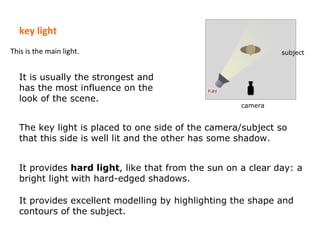
key light This is the main light.  It is usually the strongest and has the most influence on the look of the scene.  The key light is placed to one side of the camera/subject so that this side is well lit and the other has some shadow.  It provides excellent modelling by highlighting the shape and contours of the subject.  It provides  hard light , like that from the sun on a clear day: a bright light with hard-edged shadows.  camera subject
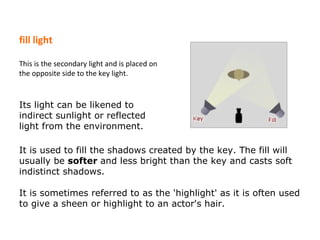
fill light This is the secondary light and is placed on the opposite side to the key light.  It is used to fill the shadows created by the key. The fill will usually be  softer  and less bright than the key and casts soft indistinct shadows. Its light can be likened to indirect sunlight or reflected light from the environment.  It is sometimes referred to as the 'highlight' as it is often used to give a sheen or highlight to an actor's hair.
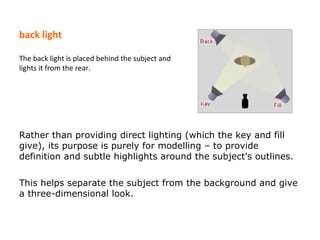
back light The back light is placed behind the subject and lights it from the rear.  Rather than providing direct lighting (which the key and fill give), its purpose is purely for modelling – to provide definition and subtle highlights around the subject's outlines.  This helps separate the subject from the background and give a three-dimensional look.

Three point lighting

  • 1.
  • 2.
    Three-point lighting isthe standard method used in visual media such as film, still photography and computer-generated imagery. It is a simple but versatile system which forms the basis of most lighting. Once you understand three-point lighting, you are well on the way to understanding all lighting.
  • 3.
    The technique usesthree lights called the key light , the fill light and the back light .
  • 4.
    key light Thisis the main light. It is usually the strongest and has the most influence on the look of the scene. The key light is placed to one side of the camera/subject so that this side is well lit and the other has some shadow. It provides excellent modelling by highlighting the shape and contours of the subject. It provides hard light , like that from the sun on a clear day: a bright light with hard-edged shadows. camera subject
  • 5.
    fill light Thisis the secondary light and is placed on the opposite side to the key light. It is used to fill the shadows created by the key. The fill will usually be softer and less bright than the key and casts soft indistinct shadows. Its light can be likened to indirect sunlight or reflected light from the environment. It is sometimes referred to as the 'highlight' as it is often used to give a sheen or highlight to an actor's hair.
  • 6.
    back light Theback light is placed behind the subject and lights it from the rear. Rather than providing direct lighting (which the key and fill give), its purpose is purely for modelling – to provide definition and subtle highlights around the subject's outlines. This helps separate the subject from the background and give a three-dimensional look.