Aircraft Performance:
Atmospheric Pressure
AVIATION SCIENCES
Atmosphere
Envelope surrounds earth
Air has mass, weight, indefinite shape
Atmosphere
•
•
•
–
–
–
78% Nitrogen
21% Oxygen
1% other gases (argon, helium, etc)
• Most oxygen < 35,000 ft
Atmospheric Pressure
Factors in:•
–
–
–
Weather
Aerodynamic Lift
Flight Instrument
•
•
•
•
Altimeter
Vertical Speed Indicator
Airspeed Indicator
Manifold Pressure Guage
Pressure
• Air has mass
– Affected by gravity
Air has weight : Force
Under Standard Atmospheric conditions
– at Sea Level weight of atmosphere = 14.7 psi
As air become less dense:
•
•
•
–
–
–
Reduces
Reduces
Reduces
engine power (engine takes in less air)
thrust (propeller is less efficient in thin air)
Lift (thin air exerts less force on the airfoils)
International Standard Atmosphere
(ISA)
Standard atmosphere at Sea level:
– Temperature 59 degrees F (15 degrees
– Pressure 29.92 in Hg (1013.2 mb)
C)
• Standard Temp Lapse Rate
– -3.5 degrees F (or 2 degrees C) per
gain
• Upto 36,000 ft (then constant)
Standard Pressure Lapse Rate
– -1 in Hg per 1000 ft altitude gain
1000 ft altitude
•
Non-standard Conditions
Correction factors must be applied•
• Note: aircraft performance is compared and
evaluated with respect to standard conditions
• Note: instruments calibrated for standard
conditions
Pressure
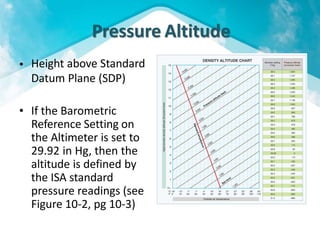
Height above Standard
Datum Plane (SDP)
Altitude
•
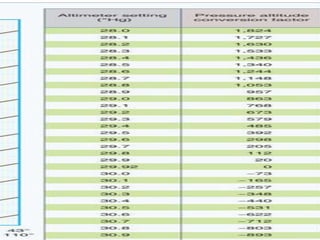
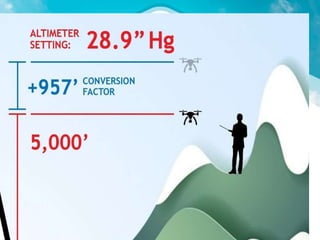
• If the Barometric
Reference Setting on
the Altimeter is set to
29.92 in Hg, then the
altitude is defined by
the ISA standard
pressure readings (see
Figure 10-2, pg 10-3)
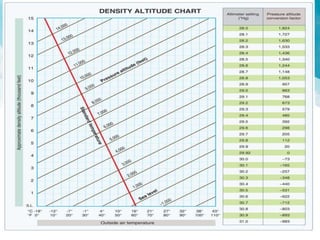
Density Altitude
Used for correlating aerodynamic performance
Density altitude = pressure altitude corrected for
non-standard temperature
Density Altitude is vertical distance above sea-
level (in standard conditions) at which a given
density is to be found
Aircraft performance increases as Density of air
increases (lower density altitude)
Aircraft performance decreases as Density of air
decreases (higher density altitude)
•
•
•
•
•
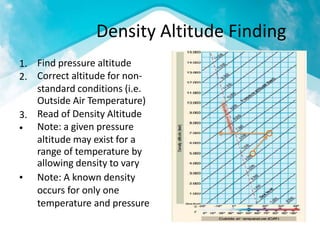
Density
Find pressure altitude
Correct altitude for non-
standard conditions (i.e.
Outside Air Temperature)
Read of Density Altitude
Note: a given pressure
altitude may exist for a
range of temperature by
allowing density to vary
Note: A known density
occurs for only one
temperature and pressure
Altitude Finding
1.
2.
3.
•
•
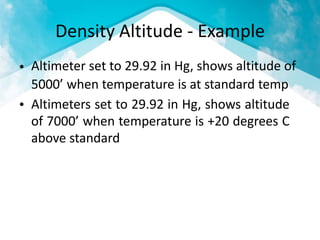
Density Altitude - Example
Altimeter set to 29.92 in Hg, shows altitude of
5000’ when temperature is at standard temp
Altimeters set to 29.92 in Hg, shows altitude
of 7000’ when temperature is +20 degrees C
above standard
•
•
High Density Altitude
performance)
High elevations
Low atmospheric pressures
High temperatures
(worse
•
•
•
Low Density Altitude
performance)
Lower elevations
High atmospheric pressure
Low humidity
(better
•
•
•
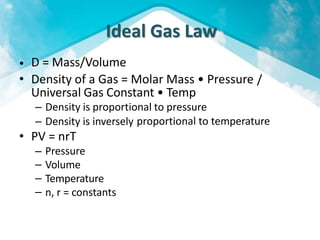
Ideal Gas Law
D = Mass/Volume
Density of a Gas = Molar Mass • Pressure
Universal Gas Constant • Temp
– Density is proportional to pressure
•
• /
– Density is inversely
PV = nrT
proportional to temperature
•
–
–
–
–
Pressure
Volume
Temperature
n, r = constants
Effects of Pressure on Density
Density is proportional to Pressure•
– At
•
•
constant temperature
2 X pressure = 2 X density
½ X pressure = ½ X density
Effect of Temp on Density
Density varies inversely with Temperature
– Increasing temp decreases density
– Decreasing temp increases density
•
Effect of Humidity on
Water vapor is lighter than air
– Moist air lighter than dry air
Humidity increases
Air density
– Reduces performance
Density
•
•
decreases
• Humidity defined as % of maximum amount
water the air can hold
– Varies with temperature
• Warm air holds more water vapor
• Cold air holds less water vapor
of

Atmosphere aviation science density temperature

  • 1.
  • 2.
    Atmosphere Envelope surrounds earth Airhas mass, weight, indefinite shape Atmosphere • • • – – – 78% Nitrogen 21% Oxygen 1% other gases (argon, helium, etc) • Most oxygen < 35,000 ft
  • 3.
    Atmospheric Pressure Factors in:• – – – Weather AerodynamicLift Flight Instrument • • • • Altimeter Vertical Speed Indicator Airspeed Indicator Manifold Pressure Guage
  • 4.
    Pressure • Air hasmass – Affected by gravity Air has weight : Force Under Standard Atmospheric conditions – at Sea Level weight of atmosphere = 14.7 psi As air become less dense: • • • – – – Reduces Reduces Reduces engine power (engine takes in less air) thrust (propeller is less efficient in thin air) Lift (thin air exerts less force on the airfoils)
  • 5.
    International Standard Atmosphere (ISA) Standardatmosphere at Sea level: – Temperature 59 degrees F (15 degrees – Pressure 29.92 in Hg (1013.2 mb) C) • Standard Temp Lapse Rate – -3.5 degrees F (or 2 degrees C) per gain • Upto 36,000 ft (then constant) Standard Pressure Lapse Rate – -1 in Hg per 1000 ft altitude gain 1000 ft altitude •
  • 6.
    Non-standard Conditions Correction factorsmust be applied• • Note: aircraft performance is compared and evaluated with respect to standard conditions • Note: instruments calibrated for standard conditions
  • 7.
    Pressure Height above Standard DatumPlane (SDP) Altitude • • If the Barometric Reference Setting on the Altimeter is set to 29.92 in Hg, then the altitude is defined by the ISA standard pressure readings (see Figure 10-2, pg 10-3)
  • 10.
    Density Altitude Used forcorrelating aerodynamic performance Density altitude = pressure altitude corrected for non-standard temperature Density Altitude is vertical distance above sea- level (in standard conditions) at which a given density is to be found Aircraft performance increases as Density of air increases (lower density altitude) Aircraft performance decreases as Density of air decreases (higher density altitude) • • • • •
  • 12.
    Density Find pressure altitude Correctaltitude for non- standard conditions (i.e. Outside Air Temperature) Read of Density Altitude Note: a given pressure altitude may exist for a range of temperature by allowing density to vary Note: A known density occurs for only one temperature and pressure Altitude Finding 1. 2. 3. • •
  • 13.
    Density Altitude -Example Altimeter set to 29.92 in Hg, shows altitude of 5000’ when temperature is at standard temp Altimeters set to 29.92 in Hg, shows altitude of 7000’ when temperature is +20 degrees C above standard • •
  • 14.
    High Density Altitude performance) Highelevations Low atmospheric pressures High temperatures (worse • • •
  • 15.
    Low Density Altitude performance) Lowerelevations High atmospheric pressure Low humidity (better • • •
  • 16.
    Ideal Gas Law D= Mass/Volume Density of a Gas = Molar Mass • Pressure Universal Gas Constant • Temp – Density is proportional to pressure • • / – Density is inversely PV = nrT proportional to temperature • – – – – Pressure Volume Temperature n, r = constants
  • 17.
    Effects of Pressureon Density Density is proportional to Pressure• – At • • constant temperature 2 X pressure = 2 X density ½ X pressure = ½ X density
  • 18.
    Effect of Tempon Density Density varies inversely with Temperature – Increasing temp decreases density – Decreasing temp increases density •
  • 19.
    Effect of Humidityon Water vapor is lighter than air – Moist air lighter than dry air Humidity increases Air density – Reduces performance Density • • decreases • Humidity defined as % of maximum amount water the air can hold – Varies with temperature • Warm air holds more water vapor • Cold air holds less water vapor of