AERO 157 -Introduction to Aviation Technology 2
Structure of the Atmosphere
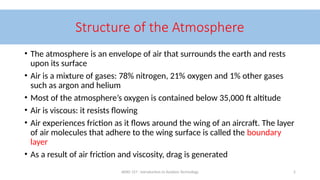
• The atmosphere is an envelope of air that surrounds the earth and rests
upon its surface
• Air is a mixture of gases: 78% nitrogen, 21% oxygen and 1% other gases
such as argon and helium
• Most of the atmosphere’s oxygen is contained below 35,000 ft altitude
• Air is viscous: it resists flowing
• Air experiences friction as it flows around the wing of an aircraft. The layer
of air molecules that adhere to the wing surface is called the boundary
layer
• As a result of air friction and viscosity, drag is generated
3.
AERO 157 -Introduction to Aviation Technology 3
The Standard Atmosphere
• Atmospheric vehicles, and even space vehicles (on leaving and approaching
the earth) encounter the earth’s atmosphere
• During the design and performance of these vehicles, the properties of the
atmosphere must be taken into account
• The earth’s atmosphere is a dynamically changing system: The pressure and
temperature depend on altitude, location, time of day, season
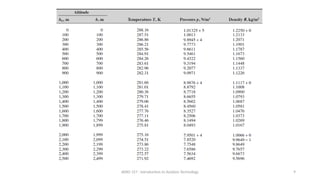
• A standard atmosphere is defined in order to relate flight tests, wind tunnel
results, and general airplane design and performance to a common reference
• It gives mean values of pressure, temperature, density as functions of
altitude. To a reasonable degree, it reflects average atmospheric conditions
4.
AERO 157 -Introduction to Aviation Technology 4
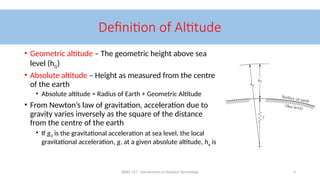
Definition of Altitude
• Geometric altitude – The geometric height above sea
level (hG)
• Absolute altitude – Height as measured from the centre
of the earth
• Absolute altitude = Radius of Earth + Geometric Altitude
• From Newton’s law of gravitation, acceleration due to
gravity varies inversely as the square of the distance
from the centre of the earth
• If g0 is the gravitational acceleration at sea level, the local
gravitational acceleration, g, at a given absolute altitude, ha is
5.
AERO 157 -Introduction to Aviation Technology 5
The Hydrostatic Equation
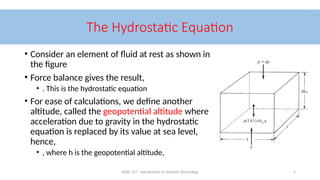
• Consider an element of fluid at rest as shown in
the figure
• Force balance gives the result,
• . This is the hydrostatic equation
• For ease of calculations, we define another
altitude, called the geopotential altitude where
acceleration due to gravity in the hydrostatic
equation is replaced by its value at sea level,
hence,
• , where h is the geopotential altitude,
6.
AERO 157 -Introduction to Aviation Technology 6
Definition of the Standard Atmosphere
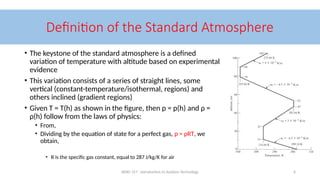
• The keystone of the standard atmosphere is a defined
variation of temperature with altitude based on experimental
evidence
• This variation consists of a series of straight lines, some
vertical (constant-temperature/isothermal, regions) and
others inclined (gradient regions)
• Given T = T(h) as shown in the figure, then p = p(h) and ρ =
ρ(h) follow from the laws of physics:
• From,
• Dividing by the equation of state for a perfect gas, p = ρRT, we
obtain,
• R is the specific gas constant, equal to 287 J/kg/K for air
7.
AERO 157 -Introduction to Aviation Technology 7
Isothermal Regions
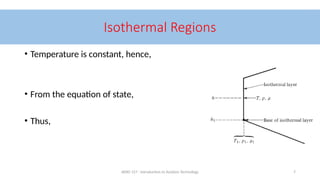
• Temperature is constant, hence,
• From the equation of state,
• Thus,
8.
AERO 157 -Introduction to Aviation Technology 8
Gradient Layers
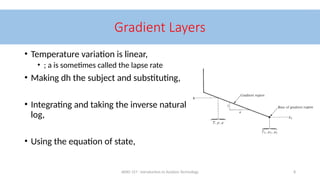
• Temperature variation is linear,
• ; a is sometimes called the lapse rate
• Making dh the subject and substituting,
• Integrating and taking the inverse natural
log,
• Using the equation of state,
AERO 157 -Introduction to Aviation Technology 10
Examples
• Calculate the standard atmosphere values of T, p, and ρ at a
geopotential altitude of 14 km
• An approximate equation for estimating the density at any altitude is
given by, , where h is the geometric altitude, is the standard sea-level
density and n is a constant
• Derive the value of n so that the equation gives the exact density at an
altitude of 2,500 m
• Using this value of n, calculate the density at 500 m, 1000 m, 1500 m and
2000 m; compare your results with the exact numerical values from a table of
the standard values
11.
AERO 157 -Introduction to Aviation Technology 11
Production of Lift
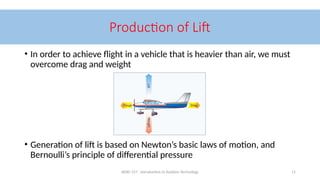
• In order to achieve flight in a vehicle that is heavier than air, we must
overcome drag and weight
• Generation of lift is based on Newton’s basic laws of motion, and
Bernoulli’s principle of differential pressure
12.
AERO 157 -Introduction to Aviation Technology 12
Newton’s Laws of Motion
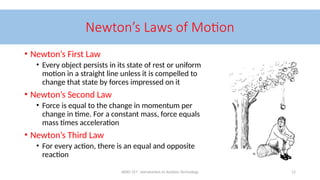
• Newton’s First Law
• Every object persists in its state of rest or uniform
motion in a straight line unless it is compelled to
change that state by forces impressed on it
• Newton’s Second Law
• Force is equal to the change in momentum per
change in time. For a constant mass, force equals
mass times acceleration
• Newton’s Third Law
• For every action, there is an equal and opposite
reaction
13.
AERO 157 -Introduction to Aviation Technology 13
Bernoulli’s Principle of Differential Pressure
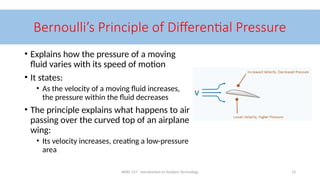
• Explains how the pressure of a moving
fluid varies with its speed of motion
• It states:
• As the velocity of a moving fluid increases,
the pressure within the fluid decreases
• The principle explains what happens to air
passing over the curved top of an airplane
wing:
• Its velocity increases, creating a low-pressure
area
14.
AERO 157 -Introduction to Aviation Technology 14
Airfoil Design
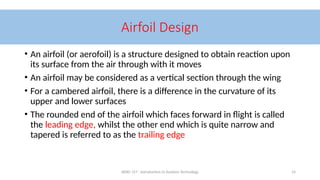
• An airfoil (or aerofoil) is a structure designed to obtain reaction upon
its surface from the air through with it moves
• An airfoil may be considered as a vertical section through the wing
• For a cambered airfoil, there is a difference in the curvature of its
upper and lower surfaces
• The rounded end of the airfoil which faces forward in flight is called
the leading edge, whilst the other end which is quite narrow and
tapered is referred to as the trailing edge
15.
AERO 157 -Introduction to Aviation Technology 15
Airfoil Design
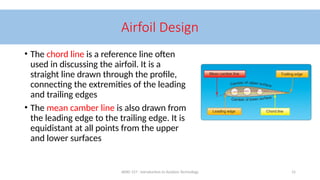
• The chord line is a reference line often
used in discussing the airfoil. It is a
straight line drawn through the profile,
connecting the extremities of the leading
and trailing edges
• The mean camber line is also drawn from
the leading edge to the trailing edge. It is
equidistant at all points from the upper
and lower surfaces
16.
AERO 157 -Introduction to Aviation Technology 16
Airfoil Design
• Different airfoils have different flight characteristics
• The weight, speed and purpose of an aircraft dictate the shape of its
airfoil
• The most efficient airfoil for producing the greatest lift is one that has
a concave lower surface
• A perfectly streamlined airfoil offers little wind resistance but may not
have enough lifting power to take the plane off the ground
• Secondary lifting surfaces such as flaps alter the shape of the airfoil
leading to the production of more lift at lower speeds
Editor's Notes
#2 *No matter how smooth the surface of the wing may appear, it is rough when viewed under a microscope
#3 *Space vehicles encounter the earth’s atmosphere when leaving or returning to earth
#5 *radius of the earth, r = 6356.766 km at latitude 45 degrees
#6 *A perfect gas is one in which intermolecular forces are negligible
#12 *First law – nothing starts or stops moving until some outside force causes it to do so
An aircraft at rest on the ramp remains at rest unless a force strong enough to overcome its inertia is applied
Once it’s moving, its inertia keeps it moving, subject to the various other forces acting to add to its motion, slow it down, or change its direction
*Third law – the propeller moves and pushes back the air, and so, the air pushes the propeller (and hence the airplane) forward; Same for a jet airplane