




BASEL II
Presented by Group 5: Harsh Chitroda, Trupesh Dhamsania & Nisarg Jadhav
Overview
• What is Basel II ?
• Objectives
• Introduction: Three pillars of Basel II
• Pillar 1: regulatory capital requirements
• Minimum capital adequacy ratio (CAR)
• Approaches for Market RWA
• Computing Market RWA
• FRTB Standardized Approach
• Approaches for Operational RWA
• Pillar 2: Supervisory Review
• Main Features of Pillar 2
• Pillar 3: Market Discipline
• Basel II.5 (2.5)
• Basel 2.5’s four main features
• References
• Thank you
What is the Basel II ?
international banking
regulations put forth by the Basel
Committee on Bank Supervision
introduced following substantial
losses in the international markets
since 1992
mandatory for financial institutions
to use standardized measurements
for credit, market risk, and
operational risk
Objectives
• Ensuring that capital allocation is more risk-
sensitive
• Enhancing disclosure requirements which would
allow market participants to assess the capital
adequacy of an institution
• Ensuring that credit risk, operational
risk and market risk are quantified based on data
and formal techniques
• Attempting to align economic and regulatory
capital more closely to reduce the scope
for regulatory arbitrage
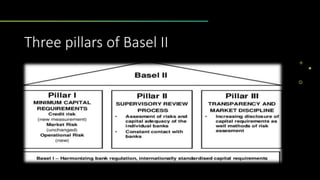
Three pillars of Basel II
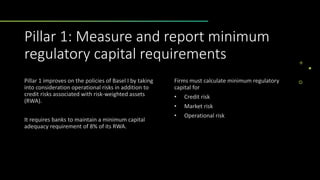
Pillar 1: Measure and report minimum
regulatory capital requirements
Pillar 1 improves on the policies of Basel I by taking
into consideration operational risks in addition to
credit risks associated with risk-weighted assets
(RWA).
It requires banks to maintain a minimum capital
adequacy requirement of 8% of its RWA.
Firms must calculate minimum regulatory
capital for
• Credit risk
• Market risk
• Operational risk
Minimum capital adequacy ratio (CAR)
Banks are required to maintain a total capital ratio (Tier 1 + 2 + 3) of minimum 8 percent
Tier 1: Capital is the main measure of a bank’s financial strength from a regulatory point of view.
Tier 2: capital is regarded as the second most reliable form of capital from a regulatory point of view.
Tier 3: capital consists of short-term subordinated debt
Capital Adequacy Ratio ≤
Capital (Tier 1+Tier 2+Tier 3) − Adjustments
RWA Credit Risk + RWA Operational Risk+ RWA Concentration Risk
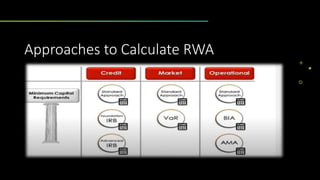
Approaches to Calculate RWA
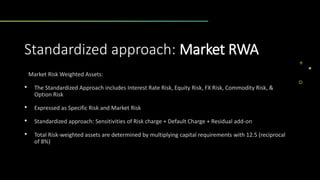
Standardized approach: Market RWA
Market Risk Weighted Assets:
• The Standardized Approach includes Interest Rate Risk, Equity Risk, FX Risk, Commodity Risk, &
Option Risk
• Expressed as Specific Risk and Market Risk
• Standardized approach: Sensitivities of Risk charge + Default Charge + Residual add-on
• Total Risk-weighted assets are determined by multiplying capital requirements with 12.5 (reciprocal
of 8%)
FRTB Standardized Approach
o 3 risk measures: Delta, Vega and Curvature
o 7 risk classes
• General interest rate risk (GII)
• Credit spread risk
• Credit spread risk: non-correlated securitization
• Credit spread risk: correlated securitization
• Equity risk
• Commodity risk
• Foreign exchange risk
• Sensitivity based risk charge: be calculated separately for each risk class and each risk measure
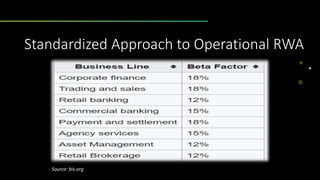
Standardized Approach to Operational RWA
Source: bis.org
Pillar 2: Supervisory Review
• Pillar 2 is the supervisory review process. It sets broad principles
and some specific rules that force regulators and banks to go
beyond the mechanical application of Pillar 1.
• Under Pillar 2, banks are obligated to assess the internal capital
adequacy for covering all risks they can potentially face during
their operations. The supervisor is responsible for ascertaining
whether the bank uses appropriate assessment approaches and
covers all risks associated.
Main Features of Pillar 2
• Internal Capital Adequacy Assessment Process (ICAAP)
• Supervisory Review and Evaluation Process (SREP)
• Minimum Capital Level
• Supervisor’s interventions
Pillar 3: Market Discipline
• Pillar 3 aims to ensure market discipline by making it mandatory to
disclose relevant market information. This is done to make sure
that the users of financial information receive the relevant
information to make informed trading decisions and ensure market
discipline.
• The Greater transparency in banks’ financial reporting will allow
marketplace participants to better reward well-managed banks
and penalize poorly-managed ones.
Basel II.5 (2.5)
• Post the great financial crisis a bunch of reforms to Basel 2 were
agreed in July 2009. It was called the Basel 2.5. It’s essentially a
revision of Basel II norms, as the existing norms often failed to
correctly address the market risks that banks took on their trading
books. Basel II.5’s main aim was to strengthen the capital base,
and so the banks’ ability to withstand risk, by increasing the
banks’ capital requirements. The reforms included measures
relating to securitization and trading book exposures and were
implemented by Dec 2011. This was done to better align trading
and banking books’ capital treatments.
Basel 2.5’s four main features
• An additional charge—incremental risk charge (or IRC)—
was introduced. to estimate and capture default and credit
migration risk.
• An additional charge for comprehensive risk measure was
introduced to correctly measure how one risk is related to
other risks.
• Basel II.5 introduced stressed value at risk (or SVaR) as an
additional requirement to calculate capital requirements.
• Basel II.5 also introduces standardized charges for
securitization and re-securitization positions.
References
• Report by: Deutsche Bank, Basel accords: yesterday, today and tomorrow
• Moody's Analytics: Regulation guide introduction
• Investopedia, Laws & Regulations, Basel II
• Basel Committee Banking Supervision, The Standardized Approach to Credit Risk
• Bank of International Settlements, calculation of RWA for market risk
• Investopedia: Everything about BASEL II
• SAMA's Guidance Document Concerning Implémentation, Basel 2 5 Réf. BCS 25478
• Why Basel II.5 corrected Basel II to improve banking regulations, Saul Perez
• Basel 2.5: Potential Benefits and Unintended Consequences, Giovanni Pepe
Thank you

Basel II

  • 1.
    BASEL II Presented byGroup 5: Harsh Chitroda, Trupesh Dhamsania & Nisarg Jadhav
  • 2.
    Overview • What isBasel II ? • Objectives • Introduction: Three pillars of Basel II • Pillar 1: regulatory capital requirements • Minimum capital adequacy ratio (CAR) • Approaches for Market RWA • Computing Market RWA • FRTB Standardized Approach • Approaches for Operational RWA • Pillar 2: Supervisory Review • Main Features of Pillar 2 • Pillar 3: Market Discipline • Basel II.5 (2.5) • Basel 2.5’s four main features • References • Thank you
  • 3.
    What is theBasel II ? international banking regulations put forth by the Basel Committee on Bank Supervision introduced following substantial losses in the international markets since 1992 mandatory for financial institutions to use standardized measurements for credit, market risk, and operational risk
  • 4.
    Objectives • Ensuring thatcapital allocation is more risk- sensitive • Enhancing disclosure requirements which would allow market participants to assess the capital adequacy of an institution • Ensuring that credit risk, operational risk and market risk are quantified based on data and formal techniques • Attempting to align economic and regulatory capital more closely to reduce the scope for regulatory arbitrage
  • 5.
  • 6.
    Pillar 1: Measureand report minimum regulatory capital requirements Pillar 1 improves on the policies of Basel I by taking into consideration operational risks in addition to credit risks associated with risk-weighted assets (RWA). It requires banks to maintain a minimum capital adequacy requirement of 8% of its RWA. Firms must calculate minimum regulatory capital for • Credit risk • Market risk • Operational risk
  • 7.
    Minimum capital adequacyratio (CAR) Banks are required to maintain a total capital ratio (Tier 1 + 2 + 3) of minimum 8 percent Tier 1: Capital is the main measure of a bank’s financial strength from a regulatory point of view. Tier 2: capital is regarded as the second most reliable form of capital from a regulatory point of view. Tier 3: capital consists of short-term subordinated debt Capital Adequacy Ratio ≤ Capital (Tier 1+Tier 2+Tier 3) − Adjustments RWA Credit Risk + RWA Operational Risk+ RWA Concentration Risk
  • 8.
  • 9.
    Standardized approach: MarketRWA Market Risk Weighted Assets: • The Standardized Approach includes Interest Rate Risk, Equity Risk, FX Risk, Commodity Risk, & Option Risk • Expressed as Specific Risk and Market Risk • Standardized approach: Sensitivities of Risk charge + Default Charge + Residual add-on • Total Risk-weighted assets are determined by multiplying capital requirements with 12.5 (reciprocal of 8%)
  • 10.
    FRTB Standardized Approach o3 risk measures: Delta, Vega and Curvature o 7 risk classes • General interest rate risk (GII) • Credit spread risk • Credit spread risk: non-correlated securitization • Credit spread risk: correlated securitization • Equity risk • Commodity risk • Foreign exchange risk • Sensitivity based risk charge: be calculated separately for each risk class and each risk measure
  • 11.
    Standardized Approach toOperational RWA Source: bis.org
  • 12.
    Pillar 2: SupervisoryReview • Pillar 2 is the supervisory review process. It sets broad principles and some specific rules that force regulators and banks to go beyond the mechanical application of Pillar 1. • Under Pillar 2, banks are obligated to assess the internal capital adequacy for covering all risks they can potentially face during their operations. The supervisor is responsible for ascertaining whether the bank uses appropriate assessment approaches and covers all risks associated.
  • 13.
    Main Features ofPillar 2 • Internal Capital Adequacy Assessment Process (ICAAP) • Supervisory Review and Evaluation Process (SREP) • Minimum Capital Level • Supervisor’s interventions
  • 14.
    Pillar 3: MarketDiscipline • Pillar 3 aims to ensure market discipline by making it mandatory to disclose relevant market information. This is done to make sure that the users of financial information receive the relevant information to make informed trading decisions and ensure market discipline. • The Greater transparency in banks’ financial reporting will allow marketplace participants to better reward well-managed banks and penalize poorly-managed ones.
  • 15.
    Basel II.5 (2.5) •Post the great financial crisis a bunch of reforms to Basel 2 were agreed in July 2009. It was called the Basel 2.5. It’s essentially a revision of Basel II norms, as the existing norms often failed to correctly address the market risks that banks took on their trading books. Basel II.5’s main aim was to strengthen the capital base, and so the banks’ ability to withstand risk, by increasing the banks’ capital requirements. The reforms included measures relating to securitization and trading book exposures and were implemented by Dec 2011. This was done to better align trading and banking books’ capital treatments.
  • 16.
    Basel 2.5’s fourmain features • An additional charge—incremental risk charge (or IRC)— was introduced. to estimate and capture default and credit migration risk. • An additional charge for comprehensive risk measure was introduced to correctly measure how one risk is related to other risks. • Basel II.5 introduced stressed value at risk (or SVaR) as an additional requirement to calculate capital requirements. • Basel II.5 also introduces standardized charges for securitization and re-securitization positions.
  • 17.
    References • Report by:Deutsche Bank, Basel accords: yesterday, today and tomorrow • Moody's Analytics: Regulation guide introduction • Investopedia, Laws & Regulations, Basel II • Basel Committee Banking Supervision, The Standardized Approach to Credit Risk • Bank of International Settlements, calculation of RWA for market risk • Investopedia: Everything about BASEL II • SAMA's Guidance Document Concerning Implémentation, Basel 2 5 Réf. BCS 25478 • Why Basel II.5 corrected Basel II to improve banking regulations, Saul Perez • Basel 2.5: Potential Benefits and Unintended Consequences, Giovanni Pepe
  • 18.