Overview of Basel II
- Why, What, How and When -
2
Agenda
● Introduction and background (why?)
● Main elements of Basel II (what?)
● Building the road to Basel II implementation (how?)
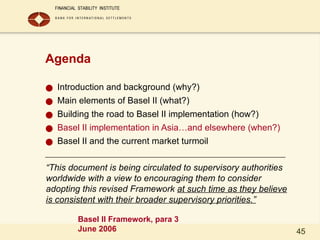
● Basel II implementation in Asia…and elsewhere (when?)
● Basel II and the current market turmoil
“Basel II introduces a far more comprehensive framework for
regulatory capital and risk management than we have ever
known”
Former Basel Committee Chairman Jaime Caruana
11 May 2004
3
Capital Adequacy
Supervisors must set prudent and appropriate minimum
capital adequacy requirements for banks that reflect the risks
that the bank undertakes, and must define the components of
capital, bearing in mind its ability to absorb losses. At least for
internationally active banks, these requirements must not be
less than those established in the applicable Basel
requirement.

Core Principle 6, Core Principles for Effective Banking
Supervision, October 2006
4
The Case for a Capital Framework
● Financial instability is costly to the economy, such as…
– Disruption in the distribution of funds
– Breakdown in the payment systems
– Possibility of international contagion
● Therefore, the need for supervision and capital regulation
– But the objective should not be to assure that banks
will never fail
● Capital regulation can have competitive implications
– The need to have internationally harmonised rules for
internationally active banks competing with each other
– International versus domestic banks
5
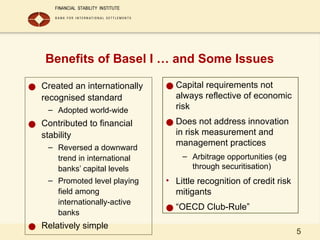
Benefits of Basel I … and Some Issues
● Created an internationally
recognised standard
– Adopted world-wide
● Contributed to financial
stability
– Reversed a downward
trend in international
banks’ capital levels
– Promoted level playing
field among
internationally-active
banks
● Relatively simple
● Capital requirements not
always reflective of economic
risk
● Does not address innovation
in risk measurement and
management practices
– Arbitrage opportunities (eg
through securitisation)
• Little recognition of credit risk
mitigants
● “OECD Club-Rule”
6
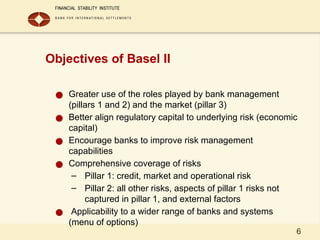
Objectives of Basel II
● Greater use of the roles played by bank management
(pillars 1 and 2) and the market (pillar 3)
● Better align regulatory capital to underlying risk (economic
capital)
● Encourage banks to improve risk management
capabilities
● Comprehensive coverage of risks
– Pillar 1: credit, market and operational risk
– Pillar 2: all other risks, aspects of pillar 1 risks not
captured in pillar 1, and external factors
● Applicability to a wider range of banks and systems
(menu of options)
7
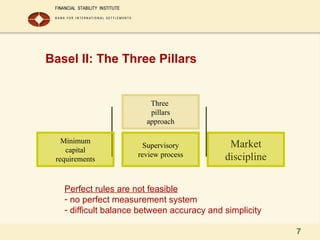
Basel II: The Three Pillars
Three
pillars
approach
Minimum
capital
requirements
Supervisory
review process
Market
discipline
Perfect rules are not feasible
- no perfect measurement system
- difficult balance between accuracy and simplicity
8
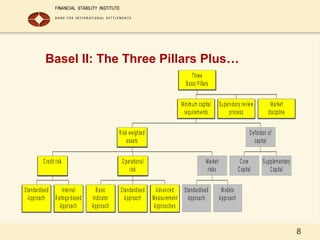
Basel II: The Three Pillars Plus…
9
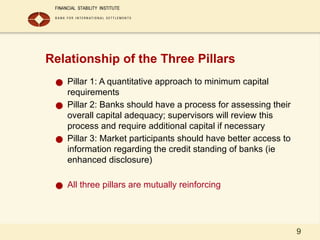
Relationship of the Three Pillars
● Pillar 1: A quantitative approach to minimum capital
requirements
● Pillar 2: Banks should have a process for assessing their
overall capital adequacy; supervisors will review this
process and require additional capital if necessary
● Pillar 3: Market participants should have better access to
information regarding the credit standing of banks (ie
enhanced disclosure)
● All three pillars are mutually reinforcing
10
Potential Implications of Basel II
● Major improvement in capital regulation
– Intended to enhance safety and soundness of the banking
system
– Implementation poses significant challenges
● Capital requirements more aligned to underlying risks
– Less incentives for regulatory arbitrage
– Transactions likely to be motivated more by funding and
credit risk management needs
– Better risk management and pricing by institutions
– More efficient allocation of capital
11
Agenda
● Introduction and background (why?)
● Main elements of Basel II (what?)
● Building the road to Basel II implementation (how?)
● Basel II implementation in Asia…and elsewhere (when?)
● Basel II and the current market turmoil
12
Main elements of Basel II
● Based on three pillars
● Revised capital requirements for credit risk, new ones for
operational risk, and hardly changed ones for market risks
(1996 amendment)
● Menu of approaches for the measurement of risks
● More recognition of drivers of credit risk
13
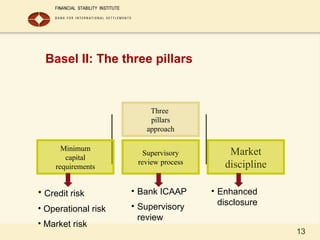
Basel II: The three pillars
Three
pillars
approach
Minimum
capital
requirements
Supervisory
review process
Market
discipline
• Credit risk
• Operational risk
• Market risk
• Bank ICAAP
• Supervisory
review
• Enhanced
disclosure
14
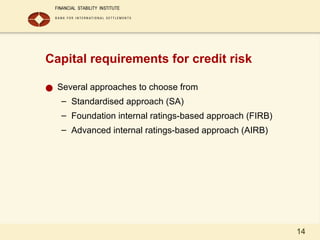
Capital requirements for credit risk
● Several approaches to choose from
– Standardised approach (SA)
– Foundation internal ratings-based approach (FIRB)
– Advanced internal ratings-based approach (AIRB)
15
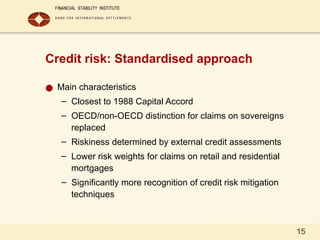
Credit risk: Standardised approach
● Main characteristics
– Closest to 1988 Capital Accord
– OECD/non-OECD distinction for claims on sovereigns
replaced
– Riskiness determined by external credit assessments
– Lower risk weights for claims on retail and residential
mortgages
– Significantly more recognition of credit risk mitigation
techniques
16
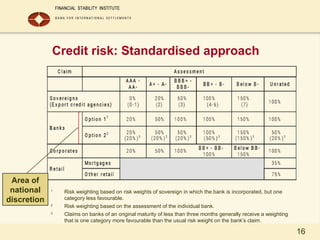
1
Risk weighting based on risk weights of sovereign in which the bank is incorporated, but one
category less favourable.
2
Risk weighting based on the assessment of the individual bank.
3
Claims on banks of an original maturity of less than three months generally receive a weighting
that is one category more favourable than the usual risk weight on the bank’s claim.
Credit risk: Standardised approach
Area of
national
discretion
17
Credit risk: IRB approach
Basic principles
● Relies on a bank‘s internal ratings system
● Based on three main elements
– Risk components (e.g. PD, LGD, EAD)
– Risk weight functions
– Minimum requirements
● Separate approaches for each portfolio of assets
● Subject to supervisory validation and approval
18
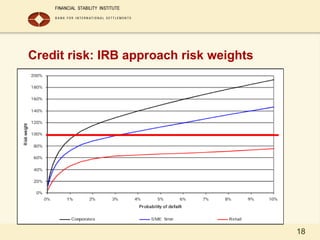
Credit risk: IRB approach risk weights
19
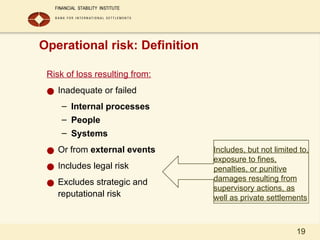
Operational risk: Definition
Risk of loss resulting from:
● Inadequate or failed
– Internal processes
– People
– Systems
● Or from external events
● Includes legal risk
● Excludes strategic and
reputational risk
Includes, but not limited to,
exposure to fines,
penalties, or punitive
damages resulting from
supervisory actions, as
well as private settlements
20
Operational risk: It is not new …. however,
● New complex financial products and strategies
● Growing reliance on automated technology
● Cost reduction strategies
● Mergers
● Migration to outsourcing
Banks are increasing their
operational risk exposure
21
Operational risk: Pillar 1 approaches
● Choice of three approaches…
– Basic indicator (15% of average gross income over 3
years)
– Standardised approach (based on separate scaling
factors for gross income from defined business lines
between 12% and 18% gross income)
– Range of advanced methods based on loss
experience, subject to additional risk control criteria
22
Pillar 2 – Supervisory review process
• The three pillars together are intended to achieve a level
of capital commensurate with a bank‘s overall risk profile
• Pillar 2 is based on four key principles:
– Banks‘ own assessment of capital adequacy
– Supervisors‘ review of banks‘ capital adequacy
assessment
– Capital above regulatory minimums
– Supervisory intervention
Foundation = existing supervisory guidance, especially
Core Principles for Effective Banking Supervision
23
Rationale for Pillar 2
● Encourage banks to utilise better risk management
techniques
● Ensure banks have adequate capital to support all risks
● Focus on internal, not regulatory, capital
● Accommodate differences between banks
24
Capital above regulatory minimums
● Pillar 1 requirements include a buffer for uncertainties that
affect the banking population as a whole
● All banks are expected to operate ABOVE the minimum
requirement (i.e. not just at 8%!)
● Supervisors will need to consider whether the particular
features of their banks/markets are adequately covered
25
Pillar 3 – Market Discipline
● Disclosure requirements allow market participants to
assess key information relating to:
– Scope of application
– Capital
– Risk exposures
– Risk assessment process
● Both quantitative and qualitative disclosures
● Some disclosures are required in order to use the more
advanced Pillar 1 approaches
26
Pillar 3 – Market Discipline
● Particularly relevant because internal methodologies allow
banks discretion in assessing capital requirements
● Disclosures should be consistent with how management
and the board assess and manage risks
● Pillar 3 disclosures based upon Basel II framework inform
the market about a bank’s exposure to risk in a consistent
and understandable manner (ie enhanced comparability)
27
Pillar 3 - Achieving Appropriate Disclosures
● Supervisors have different powers available to achieve
disclosure requirements
– Disclosure on safety and soundness grounds
– Disclosure of regulatory reports
● Mechanisms to enforce requirements
– Moral suasion (to change behavior)
– Enforcement actions
– Financial penalties
● Nature of exact measures will depend upon legal powers
of the supervisor and nature of any deficiency
● Refer to Basel Committee Disclosure Surveys
28
Agenda
● Introduction and background (why?)
● Main elements of Basel II (what?)
● Building the road to Basel II implementation (how?)
● Basel II implementation in Asia…and elsewhere (when?)
● Basel II and the current market turmoil
“The implementation of the Basel II framework provides an
opportunity for banks and supervisors to strengthen the
resilience of the banking system…”
Basel Committee Chairman Nout Wellink
4 March 2008
29
Building the Road to the Implementation of
Basel II
30
Necessary Steps for Building a Road
1) Assessing the current environment
2) Making a plan:
a) Where should the road lead to?
b) What kind of road are we building?
3) Setting up a project:
a) What is the time schedule for building the road?
b) What is required to build the road to Basel II?
4) Testing (and, if need be, improving) the foundation
5) Constructing the road
31
Where Should the Road Lead To?
● Adequately capitalised banks
● A sounder and safer banking (and financial) system as a
precondition for a stable economy and economic growth
32
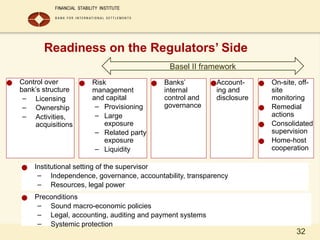
Readiness on the Regulators’ Side
● Preconditions
– Sound macro-economic policies
– Legal, accounting, auditing and payment systems
– Systemic protection
● Institutional setting of the supervisor
– Independence, governance, accountability, transparency
– Resources, legal power
● Control over
bank’s structure
– Licensing
– Ownership
– Activities,
acquisitions
● Risk
management
and capital
– Provisioning
– Large
exposure
– Related party
exposure
– Liquidity
● Banks’
internal
control and
governance
●Account-
ing and
disclosure
● On-site, off-
site
monitoring
● Remedial
actions
● Consolidated
supervision
● Home-host
cooperation
Basel II framework
33
What Kind of Road are we
Building?
34
What Kind of Road are we
Building?
35
What Kind of Road are we
Building?
The superhighway appears attractive, but traveling at
high speeds brings great risks!!
36
What Kind of Road are we Building?
● Approaches for credit risk
– Simplified standardised approach
– Standardised approach
– Foundation internal ratings-based approach
– Advanced internal ratings-based approach
● Approach for operational risk
– Basic Indicator approach
– Standardised approach
– Alternative standardised approach
– Advanced measurement approaches
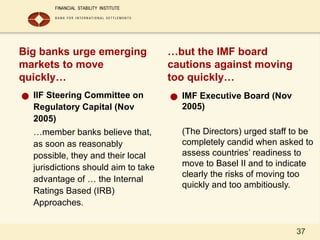
● There is not one way to implement Basel II
37
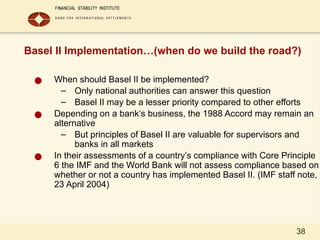
Big banks urge emerging
markets to move
quickly…
● IIF Steering Committee on
Regulatory Capital (Nov
2005)
…member banks believe that,
as soon as reasonably
possible, they and their local
jurisdictions should aim to take
advantage of … the Internal
Ratings Based (IRB)
Approaches.
…but the IMF board
cautions against moving
too quickly…
● IMF Executive Board (Nov
2005)
(The Directors) urged staff to be
completely candid when asked to
assess countries’ readiness to
move to Basel II and to indicate
clearly the risks of moving too
quickly and too ambitiously.
38
Basel II Implementation…(when do we build the road?)
● When should Basel II be implemented?
– Only national authorities can answer this question
– Basel II may be a lesser priority compared to other efforts
● Depending on a bank‘s business, the 1988 Accord may remain an
alternative
– But principles of Basel II are valuable for supervisors and
banks in all markets
● In their assessments of a country’s compliance with Core Principle
6 the IMF and the World Bank will not assess compliance based on
whether or not a country has implemented Basel II. (IMF staff note,
23 April 2004)
39
What is Required to Build the Basel II Road?
● Implementing Basel II is a major challenge for banks and
supervisors
● Assessing resource and training needs
– Human resources
– Financial resources
– Information systems
● Ongoing communication between supervisors and
between supervisors and banks
40
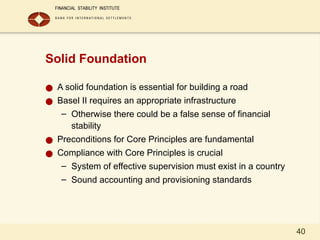
Solid Foundation
● A solid foundation is essential for building a road
● Basel II requires an appropriate infrastructure
– Otherwise there could be a false sense of financial
stability
● Preconditions for Core Principles are fundamental
● Compliance with Core Principles is crucial
– System of effective supervision must exist in a country
– Sound accounting and provisioning standards
41
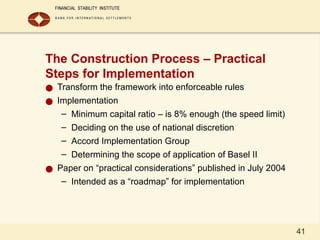
The Construction Process – Practical
Steps for Implementation
● Transform the framework into enforceable rules
● Implementation
– Minimum capital ratio – is 8% enough (the speed limit)
– Deciding on the use of national discretion
– Accord Implementation Group
– Determining the scope of application of Basel II
● Paper on “practical considerations” published in July 2004
– Intended as a “roadmap” for implementation
42
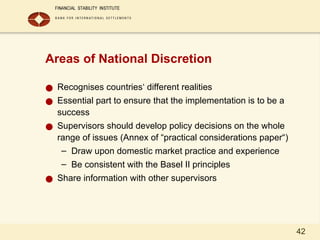
Areas of National Discretion
● Recognises countries‘ different realities
● Essential part to ensure that the implementation is to be a
success
● Supervisors should develop policy decisions on the whole
range of issues (Annex of “practical considerations paper“)
– Draw upon domestic market practice and experience
– Be consistent with the Basel II principles
● Share information with other supervisors
43
Think About the Intersections
44
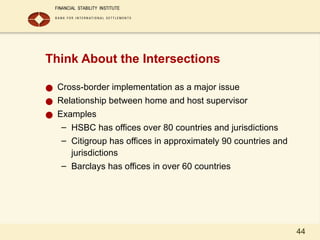
Think About the Intersections
● Cross-border implementation as a major issue
● Relationship between home and host supervisor
● Examples
– HSBC has offices over 80 countries and jurisdictions
– Citigroup has offices in approximately 90 countries and
jurisdictions
– Barclays has offices in over 60 countries
45
Agenda
● Introduction and background (why?)
● Main elements of Basel II (what?)
● Building the road to Basel II implementation (how?)
● Basel II implementation in Asia…and elsewhere (when?)
● Basel II and the current market turmoil
“This document is being circulated to supervisory authorities
worldwide with a view to encouraging them to consider
adopting this revised Framework at such time as they believe
is consistent with their broader supervisory priorities.”
Basel II Framework, para 3
June 2006
46
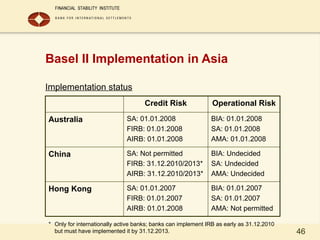
Basel II Implementation in Asia
Implementation status
Credit Risk Operational Risk
Australia SA: 01.01.2008
FIRB: 01.01.2008
AIRB: 01.01.2008
BIA: 01.01.2008
SA: 01.01.2008
AMA: 01.01.2008
China SA: Not permitted
FIRB: 31.12.2010/2013*
AIRB: 31.12.2010/2013*
BIA: Undecided
SA: Undecided
AMA: Undecided
Hong Kong SA: 01.01.2007
FIRB: 01.01.2007
AIRB: 01.01.2008
BIA: 01.01.2007
SA: 01.01.2007
AMA: Not permitted
* Only for internationally active banks; banks can implement IRB as early as 31.12.2010
but must have implemented it by 31.12.2013.
47
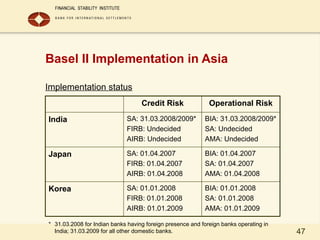
Basel II Implementation in Asia
Implementation status
Credit Risk Operational Risk
India SA: 31.03.2008/2009*
FIRB: Undecided
AIRB: Undecided
BIA: 31.03.2008/2009*
SA: Undecided
AMA: Undecided
Japan SA: 01.04.2007
FIRB: 01.04.2007
AIRB: 01.04.2008
BIA: 01.04.2007
SA: 01.04.2007
AMA: 01.04.2008
Korea SA: 01.01.2008
FIRB: 01.01.2008
AIRB: 01.01.2009
BIA: 01.01.2008
SA: 01.01.2008
AMA: 01.01.2009
* 31.03.2008 for Indian banks having foreign presence and foreign banks operating in
India; 31.03.2009 for all other domestic banks.
48
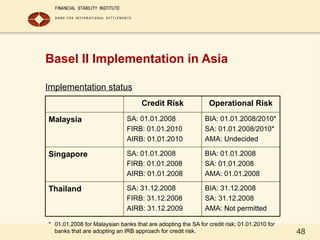
Basel II Implementation in Asia
Implementation status
Credit Risk Operational Risk
Malaysia SA: 01.01.2008
FIRB: 01.01.2010
AIRB: 01.01.2010
BIA: 01.01.2008/2010*
SA: 01.01.2008/2010*
AMA: Undecided
Singapore SA: 01.01.2008
FIRB: 01.01.2008
AIRB: 01.01.2008
BIA: 01.01.2008
SA: 01.01.2008
AMA: 01.01.2008
Thailand SA: 31.12.2008
FIRB: 31.12.2008
AIRB: 31.12.2009
BIA: 31.12.2008
SA: 31.12.2008
AMA: Not permitted
* 01.01.2008 for Malaysian banks that are adopting the SA for credit risk; 01.01.2010 for
banks that are adopting an IRB approach for credit risk.
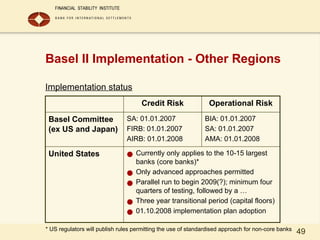
49
Basel II Implementation - Other Regions
Implementation status
Credit Risk Operational Risk
Basel Committee
(ex US and Japan)
SA: 01.01.2007
FIRB: 01.01.2007
AIRB: 01.01.2008
BIA: 01.01.2007
SA: 01.01.2007
AMA: 01.01.2008
United States ● Currently only applies to the 10-15 largest
banks (core banks)*
● Only advanced approaches permitted
● Parallel run to begin 2009(?); minimum four
quarters of testing, followed by a …
● Three year transitional period (capital floors)
● 01.10.2008 implementation plan adoption
* US regulators will publish rules permitting the use of standardised approach for non-core banks
50
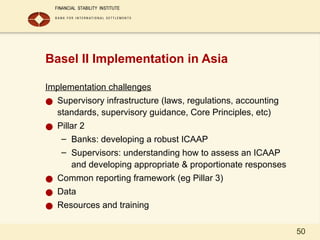
Basel II Implementation in Asia
Implementation challenges
● Supervisory infrastructure (laws, regulations, accounting
standards, supervisory guidance, Core Principles, etc)
● Pillar 2
– Banks: developing a robust ICAAP
– Supervisors: understanding how to assess an ICAAP
and developing appropriate & proportionate responses
● Common reporting framework (eg Pillar 3)
● Data
● Resources and training
51
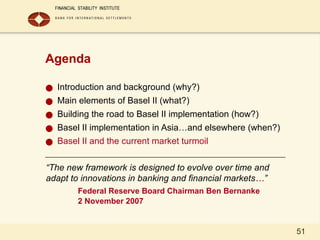
Agenda
● Introduction and background (why?)
● Main elements of Basel II (what?)
● Building the road to Basel II implementation (how?)
● Basel II implementation in Asia…and elsewhere (when?)
● Basel II and the current market turmoil
“The new framework is designed to evolve over time and
adapt to innovations in banking and financial markets…”
Federal Reserve Board Chairman Ben Bernanke
2 November 2007
52
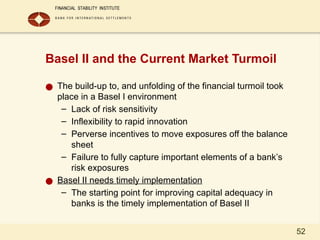
Basel II and the Current Market Turmoil
● The build-up to, and unfolding of the financial turmoil took
place in a Basel I environment
– Lack of risk sensitivity
– Inflexibility to rapid innovation
– Perverse incentives to move exposures off the balance
sheet
– Failure to fully capture important elements of a bank’s
risk exposures
● Basel II needs timely implementation
– The starting point for improving capital adequacy in
banks is the timely implementation of Basel II
53
Basel II and the Current Market Turmoil
Pillar 1 (minimum capital requirements)
● The Basel Committee will revise Basel II to…
– Establish higher capital requirements for complex
structured products
• These have produced a majority of the losses
– Strengthen the capital treatment of liquidity facilities
extended to support off-balance sheet vehicles (2008)
– Strengthen the capital requirements in the trading book
• Trading assets, especially complex, less liquid
products, have increased significantly
54
Basel II and the Current Market Turmoil
Pillar 2 (risk management practices)
● The market turmoil has revealed significant risk
management weaknesses in financial institutions
● Pillar 2 provides supervisors with tools to assess risk
management and internal capital management processes
● The Basel Committee will issue Pillar 2 guidance to help
strengthen risk management and supervisory processes
– Management of firm-wide risks
– Stress testing practices and capital planning processes
– Management of off-balance sheet exposures
– Supervisory assessment of valuation practices
55
Basel II and the Current Market Turmoil
Pillar 3 (disclosure practices)
● Weaknesses in bank transparency for complex products
contributed to the build-up of concentrations in illiquid
structured credit products
● Enhanced disclosures relating to (2009)…
– Complex securitisation exposures
– ABCP conduits
– Sponsorship of off-balance sheet vehicles (eg SIVs)
Other
● The Basel Committee will assess the level and cyclicality
of capital requirements over time (2008)
Overview of Basel II
- Why, What, How and When -
Jason George
Financial Stability Institute
Bank for International Settlements
Representative Office for Asia and the Pacific
Hong Kong SAR
jason.george@bis.org
(852) 2878 7109

Basel II information detailed presentation

  • 1.
    Overview of BaselII - Why, What, How and When -
  • 2.
    2 Agenda ● Introduction andbackground (why?) ● Main elements of Basel II (what?) ● Building the road to Basel II implementation (how?) ● Basel II implementation in Asia…and elsewhere (when?) ● Basel II and the current market turmoil “Basel II introduces a far more comprehensive framework for regulatory capital and risk management than we have ever known” Former Basel Committee Chairman Jaime Caruana 11 May 2004
  • 3.
    3 Capital Adequacy Supervisors mustset prudent and appropriate minimum capital adequacy requirements for banks that reflect the risks that the bank undertakes, and must define the components of capital, bearing in mind its ability to absorb losses. At least for internationally active banks, these requirements must not be less than those established in the applicable Basel requirement. Core Principle 6, Core Principles for Effective Banking Supervision, October 2006

  • 4.
    4 The Case fora Capital Framework ● Financial instability is costly to the economy, such as… – Disruption in the distribution of funds – Breakdown in the payment systems – Possibility of international contagion ● Therefore, the need for supervision and capital regulation – But the objective should not be to assure that banks will never fail ● Capital regulation can have competitive implications – The need to have internationally harmonised rules for internationally active banks competing with each other – International versus domestic banks
  • 5.
    5 Benefits of BaselI … and Some Issues ● Created an internationally recognised standard – Adopted world-wide ● Contributed to financial stability – Reversed a downward trend in international banks’ capital levels – Promoted level playing field among internationally-active banks ● Relatively simple ● Capital requirements not always reflective of economic risk ● Does not address innovation in risk measurement and management practices – Arbitrage opportunities (eg through securitisation) • Little recognition of credit risk mitigants ● “OECD Club-Rule”
  • 6.
    6 Objectives of BaselII ● Greater use of the roles played by bank management (pillars 1 and 2) and the market (pillar 3) ● Better align regulatory capital to underlying risk (economic capital) ● Encourage banks to improve risk management capabilities ● Comprehensive coverage of risks – Pillar 1: credit, market and operational risk – Pillar 2: all other risks, aspects of pillar 1 risks not captured in pillar 1, and external factors ● Applicability to a wider range of banks and systems (menu of options)
  • 7.
    7 Basel II: TheThree Pillars Three pillars approach Minimum capital requirements Supervisory review process Market discipline Perfect rules are not feasible - no perfect measurement system - difficult balance between accuracy and simplicity
  • 8.
    8 Basel II: TheThree Pillars Plus…
  • 9.
    9 Relationship of theThree Pillars ● Pillar 1: A quantitative approach to minimum capital requirements ● Pillar 2: Banks should have a process for assessing their overall capital adequacy; supervisors will review this process and require additional capital if necessary ● Pillar 3: Market participants should have better access to information regarding the credit standing of banks (ie enhanced disclosure) ● All three pillars are mutually reinforcing
  • 10.
    10 Potential Implications ofBasel II ● Major improvement in capital regulation – Intended to enhance safety and soundness of the banking system – Implementation poses significant challenges ● Capital requirements more aligned to underlying risks – Less incentives for regulatory arbitrage – Transactions likely to be motivated more by funding and credit risk management needs – Better risk management and pricing by institutions – More efficient allocation of capital
  • 11.
    11 Agenda ● Introduction andbackground (why?) ● Main elements of Basel II (what?) ● Building the road to Basel II implementation (how?) ● Basel II implementation in Asia…and elsewhere (when?) ● Basel II and the current market turmoil
  • 12.
    12 Main elements ofBasel II ● Based on three pillars ● Revised capital requirements for credit risk, new ones for operational risk, and hardly changed ones for market risks (1996 amendment) ● Menu of approaches for the measurement of risks ● More recognition of drivers of credit risk
  • 13.
    13 Basel II: Thethree pillars Three pillars approach Minimum capital requirements Supervisory review process Market discipline • Credit risk • Operational risk • Market risk • Bank ICAAP • Supervisory review • Enhanced disclosure
  • 14.
    14 Capital requirements forcredit risk ● Several approaches to choose from – Standardised approach (SA) – Foundation internal ratings-based approach (FIRB) – Advanced internal ratings-based approach (AIRB)
  • 15.
    15 Credit risk: Standardisedapproach ● Main characteristics – Closest to 1988 Capital Accord – OECD/non-OECD distinction for claims on sovereigns replaced – Riskiness determined by external credit assessments – Lower risk weights for claims on retail and residential mortgages – Significantly more recognition of credit risk mitigation techniques
  • 16.
    16 1 Risk weighting basedon risk weights of sovereign in which the bank is incorporated, but one category less favourable. 2 Risk weighting based on the assessment of the individual bank. 3 Claims on banks of an original maturity of less than three months generally receive a weighting that is one category more favourable than the usual risk weight on the bank’s claim. Credit risk: Standardised approach Area of national discretion
  • 17.
    17 Credit risk: IRBapproach Basic principles ● Relies on a bank‘s internal ratings system ● Based on three main elements – Risk components (e.g. PD, LGD, EAD) – Risk weight functions – Minimum requirements ● Separate approaches for each portfolio of assets ● Subject to supervisory validation and approval
  • 18.
    18 Credit risk: IRBapproach risk weights
  • 19.
    19 Operational risk: Definition Riskof loss resulting from: ● Inadequate or failed – Internal processes – People – Systems ● Or from external events ● Includes legal risk ● Excludes strategic and reputational risk Includes, but not limited to, exposure to fines, penalties, or punitive damages resulting from supervisory actions, as well as private settlements
  • 20.
    20 Operational risk: Itis not new …. however, ● New complex financial products and strategies ● Growing reliance on automated technology ● Cost reduction strategies ● Mergers ● Migration to outsourcing Banks are increasing their operational risk exposure
  • 21.
    21 Operational risk: Pillar1 approaches ● Choice of three approaches… – Basic indicator (15% of average gross income over 3 years) – Standardised approach (based on separate scaling factors for gross income from defined business lines between 12% and 18% gross income) – Range of advanced methods based on loss experience, subject to additional risk control criteria
  • 22.
    22 Pillar 2 –Supervisory review process • The three pillars together are intended to achieve a level of capital commensurate with a bank‘s overall risk profile • Pillar 2 is based on four key principles: – Banks‘ own assessment of capital adequacy – Supervisors‘ review of banks‘ capital adequacy assessment – Capital above regulatory minimums – Supervisory intervention Foundation = existing supervisory guidance, especially Core Principles for Effective Banking Supervision
  • 23.
    23 Rationale for Pillar2 ● Encourage banks to utilise better risk management techniques ● Ensure banks have adequate capital to support all risks ● Focus on internal, not regulatory, capital ● Accommodate differences between banks
  • 24.
    24 Capital above regulatoryminimums ● Pillar 1 requirements include a buffer for uncertainties that affect the banking population as a whole ● All banks are expected to operate ABOVE the minimum requirement (i.e. not just at 8%!) ● Supervisors will need to consider whether the particular features of their banks/markets are adequately covered
  • 25.
    25 Pillar 3 –Market Discipline ● Disclosure requirements allow market participants to assess key information relating to: – Scope of application – Capital – Risk exposures – Risk assessment process ● Both quantitative and qualitative disclosures ● Some disclosures are required in order to use the more advanced Pillar 1 approaches
  • 26.
    26 Pillar 3 –Market Discipline ● Particularly relevant because internal methodologies allow banks discretion in assessing capital requirements ● Disclosures should be consistent with how management and the board assess and manage risks ● Pillar 3 disclosures based upon Basel II framework inform the market about a bank’s exposure to risk in a consistent and understandable manner (ie enhanced comparability)
  • 27.
    27 Pillar 3 -Achieving Appropriate Disclosures ● Supervisors have different powers available to achieve disclosure requirements – Disclosure on safety and soundness grounds – Disclosure of regulatory reports ● Mechanisms to enforce requirements – Moral suasion (to change behavior) – Enforcement actions – Financial penalties ● Nature of exact measures will depend upon legal powers of the supervisor and nature of any deficiency ● Refer to Basel Committee Disclosure Surveys
  • 28.
    28 Agenda ● Introduction andbackground (why?) ● Main elements of Basel II (what?) ● Building the road to Basel II implementation (how?) ● Basel II implementation in Asia…and elsewhere (when?) ● Basel II and the current market turmoil “The implementation of the Basel II framework provides an opportunity for banks and supervisors to strengthen the resilience of the banking system…” Basel Committee Chairman Nout Wellink 4 March 2008
  • 29.
    29 Building the Roadto the Implementation of Basel II
  • 30.
    30 Necessary Steps forBuilding a Road 1) Assessing the current environment 2) Making a plan: a) Where should the road lead to? b) What kind of road are we building? 3) Setting up a project: a) What is the time schedule for building the road? b) What is required to build the road to Basel II? 4) Testing (and, if need be, improving) the foundation 5) Constructing the road
  • 31.
    31 Where Should theRoad Lead To? ● Adequately capitalised banks ● A sounder and safer banking (and financial) system as a precondition for a stable economy and economic growth
  • 32.
    32 Readiness on theRegulators’ Side ● Preconditions – Sound macro-economic policies – Legal, accounting, auditing and payment systems – Systemic protection ● Institutional setting of the supervisor – Independence, governance, accountability, transparency – Resources, legal power ● Control over bank’s structure – Licensing – Ownership – Activities, acquisitions ● Risk management and capital – Provisioning – Large exposure – Related party exposure – Liquidity ● Banks’ internal control and governance ●Account- ing and disclosure ● On-site, off- site monitoring ● Remedial actions ● Consolidated supervision ● Home-host cooperation Basel II framework
  • 33.
    33 What Kind ofRoad are we Building?
  • 34.
    34 What Kind ofRoad are we Building?
  • 35.
    35 What Kind ofRoad are we Building? The superhighway appears attractive, but traveling at high speeds brings great risks!!
  • 36.
    36 What Kind ofRoad are we Building? ● Approaches for credit risk – Simplified standardised approach – Standardised approach – Foundation internal ratings-based approach – Advanced internal ratings-based approach ● Approach for operational risk – Basic Indicator approach – Standardised approach – Alternative standardised approach – Advanced measurement approaches ● There is not one way to implement Basel II
  • 37.
    37 Big banks urgeemerging markets to move quickly… ● IIF Steering Committee on Regulatory Capital (Nov 2005) …member banks believe that, as soon as reasonably possible, they and their local jurisdictions should aim to take advantage of … the Internal Ratings Based (IRB) Approaches. …but the IMF board cautions against moving too quickly… ● IMF Executive Board (Nov 2005) (The Directors) urged staff to be completely candid when asked to assess countries’ readiness to move to Basel II and to indicate clearly the risks of moving too quickly and too ambitiously.
  • 38.
    38 Basel II Implementation…(whendo we build the road?) ● When should Basel II be implemented? – Only national authorities can answer this question – Basel II may be a lesser priority compared to other efforts ● Depending on a bank‘s business, the 1988 Accord may remain an alternative – But principles of Basel II are valuable for supervisors and banks in all markets ● In their assessments of a country’s compliance with Core Principle 6 the IMF and the World Bank will not assess compliance based on whether or not a country has implemented Basel II. (IMF staff note, 23 April 2004)
  • 39.
    39 What is Requiredto Build the Basel II Road? ● Implementing Basel II is a major challenge for banks and supervisors ● Assessing resource and training needs – Human resources – Financial resources – Information systems ● Ongoing communication between supervisors and between supervisors and banks
  • 40.
    40 Solid Foundation ● Asolid foundation is essential for building a road ● Basel II requires an appropriate infrastructure – Otherwise there could be a false sense of financial stability ● Preconditions for Core Principles are fundamental ● Compliance with Core Principles is crucial – System of effective supervision must exist in a country – Sound accounting and provisioning standards
  • 41.
    41 The Construction Process– Practical Steps for Implementation ● Transform the framework into enforceable rules ● Implementation – Minimum capital ratio – is 8% enough (the speed limit) – Deciding on the use of national discretion – Accord Implementation Group – Determining the scope of application of Basel II ● Paper on “practical considerations” published in July 2004 – Intended as a “roadmap” for implementation
  • 42.
    42 Areas of NationalDiscretion ● Recognises countries‘ different realities ● Essential part to ensure that the implementation is to be a success ● Supervisors should develop policy decisions on the whole range of issues (Annex of “practical considerations paper“) – Draw upon domestic market practice and experience – Be consistent with the Basel II principles ● Share information with other supervisors
  • 43.
    43 Think About theIntersections
  • 44.
    44 Think About theIntersections ● Cross-border implementation as a major issue ● Relationship between home and host supervisor ● Examples – HSBC has offices over 80 countries and jurisdictions – Citigroup has offices in approximately 90 countries and jurisdictions – Barclays has offices in over 60 countries
  • 45.
    45 Agenda ● Introduction andbackground (why?) ● Main elements of Basel II (what?) ● Building the road to Basel II implementation (how?) ● Basel II implementation in Asia…and elsewhere (when?) ● Basel II and the current market turmoil “This document is being circulated to supervisory authorities worldwide with a view to encouraging them to consider adopting this revised Framework at such time as they believe is consistent with their broader supervisory priorities.” Basel II Framework, para 3 June 2006
  • 46.
    46 Basel II Implementationin Asia Implementation status Credit Risk Operational Risk Australia SA: 01.01.2008 FIRB: 01.01.2008 AIRB: 01.01.2008 BIA: 01.01.2008 SA: 01.01.2008 AMA: 01.01.2008 China SA: Not permitted FIRB: 31.12.2010/2013* AIRB: 31.12.2010/2013* BIA: Undecided SA: Undecided AMA: Undecided Hong Kong SA: 01.01.2007 FIRB: 01.01.2007 AIRB: 01.01.2008 BIA: 01.01.2007 SA: 01.01.2007 AMA: Not permitted * Only for internationally active banks; banks can implement IRB as early as 31.12.2010 but must have implemented it by 31.12.2013.
  • 47.
    47 Basel II Implementationin Asia Implementation status Credit Risk Operational Risk India SA: 31.03.2008/2009* FIRB: Undecided AIRB: Undecided BIA: 31.03.2008/2009* SA: Undecided AMA: Undecided Japan SA: 01.04.2007 FIRB: 01.04.2007 AIRB: 01.04.2008 BIA: 01.04.2007 SA: 01.04.2007 AMA: 01.04.2008 Korea SA: 01.01.2008 FIRB: 01.01.2008 AIRB: 01.01.2009 BIA: 01.01.2008 SA: 01.01.2008 AMA: 01.01.2009 * 31.03.2008 for Indian banks having foreign presence and foreign banks operating in India; 31.03.2009 for all other domestic banks.
  • 48.
    48 Basel II Implementationin Asia Implementation status Credit Risk Operational Risk Malaysia SA: 01.01.2008 FIRB: 01.01.2010 AIRB: 01.01.2010 BIA: 01.01.2008/2010* SA: 01.01.2008/2010* AMA: Undecided Singapore SA: 01.01.2008 FIRB: 01.01.2008 AIRB: 01.01.2008 BIA: 01.01.2008 SA: 01.01.2008 AMA: 01.01.2008 Thailand SA: 31.12.2008 FIRB: 31.12.2008 AIRB: 31.12.2009 BIA: 31.12.2008 SA: 31.12.2008 AMA: Not permitted * 01.01.2008 for Malaysian banks that are adopting the SA for credit risk; 01.01.2010 for banks that are adopting an IRB approach for credit risk.
  • 49.
    49 Basel II Implementation- Other Regions Implementation status Credit Risk Operational Risk Basel Committee (ex US and Japan) SA: 01.01.2007 FIRB: 01.01.2007 AIRB: 01.01.2008 BIA: 01.01.2007 SA: 01.01.2007 AMA: 01.01.2008 United States ● Currently only applies to the 10-15 largest banks (core banks)* ● Only advanced approaches permitted ● Parallel run to begin 2009(?); minimum four quarters of testing, followed by a … ● Three year transitional period (capital floors) ● 01.10.2008 implementation plan adoption * US regulators will publish rules permitting the use of standardised approach for non-core banks
  • 50.
    50 Basel II Implementationin Asia Implementation challenges ● Supervisory infrastructure (laws, regulations, accounting standards, supervisory guidance, Core Principles, etc) ● Pillar 2 – Banks: developing a robust ICAAP – Supervisors: understanding how to assess an ICAAP and developing appropriate & proportionate responses ● Common reporting framework (eg Pillar 3) ● Data ● Resources and training
  • 51.
    51 Agenda ● Introduction andbackground (why?) ● Main elements of Basel II (what?) ● Building the road to Basel II implementation (how?) ● Basel II implementation in Asia…and elsewhere (when?) ● Basel II and the current market turmoil “The new framework is designed to evolve over time and adapt to innovations in banking and financial markets…” Federal Reserve Board Chairman Ben Bernanke 2 November 2007
  • 52.
    52 Basel II andthe Current Market Turmoil ● The build-up to, and unfolding of the financial turmoil took place in a Basel I environment – Lack of risk sensitivity – Inflexibility to rapid innovation – Perverse incentives to move exposures off the balance sheet – Failure to fully capture important elements of a bank’s risk exposures ● Basel II needs timely implementation – The starting point for improving capital adequacy in banks is the timely implementation of Basel II
  • 53.
    53 Basel II andthe Current Market Turmoil Pillar 1 (minimum capital requirements) ● The Basel Committee will revise Basel II to… – Establish higher capital requirements for complex structured products • These have produced a majority of the losses – Strengthen the capital treatment of liquidity facilities extended to support off-balance sheet vehicles (2008) – Strengthen the capital requirements in the trading book • Trading assets, especially complex, less liquid products, have increased significantly
  • 54.
    54 Basel II andthe Current Market Turmoil Pillar 2 (risk management practices) ● The market turmoil has revealed significant risk management weaknesses in financial institutions ● Pillar 2 provides supervisors with tools to assess risk management and internal capital management processes ● The Basel Committee will issue Pillar 2 guidance to help strengthen risk management and supervisory processes – Management of firm-wide risks – Stress testing practices and capital planning processes – Management of off-balance sheet exposures – Supervisory assessment of valuation practices
  • 55.
    55 Basel II andthe Current Market Turmoil Pillar 3 (disclosure practices) ● Weaknesses in bank transparency for complex products contributed to the build-up of concentrations in illiquid structured credit products ● Enhanced disclosures relating to (2009)… – Complex securitisation exposures – ABCP conduits – Sponsorship of off-balance sheet vehicles (eg SIVs) Other ● The Basel Committee will assess the level and cyclicality of capital requirements over time (2008)
  • 56.
    Overview of BaselII - Why, What, How and When - Jason George Financial Stability Institute Bank for International Settlements Representative Office for Asia and the Pacific Hong Kong SAR jason.george@bis.org (852) 2878 7109

Editor's Notes

  • #7 Part of three pillars - intended to compliment other 2 pillars – MCR & market discipline Talk about philosophy of Pillar 2
  • #13 Part of three pillars - intended to compliment other 2 pillars – MCR & market discipline Talk about philosophy of Pillar 2
  • #56 Introduce self and role at the BIS Thank the RMA for inviting me to speak at the January Open Forum. The topic of provisioning is an important and very timely one and, judging by the good turnout that we have today, one that is of interest to you. I would also like to thank the Bank of China for hosting this event. Before I get started, I would like to say that we have allocated 1 ½ hours for this session. My preference would be to take questions as we go along rather than be barraged at the end. So, if there is anything that is not clear or that you would like me to discuss further, please do not hesitate to stop me. Similarly, since I am relatively new in Asia, I may like to ask for your views on various issues as they relate to loan provisioning. Of course if there is time at the end, I would be happy to open up the floor to a general discussion and exchange.