BASEL NORMS

PRESESTERS:
MOHD RAFEEQ BHAT
SOURAV BOSE
PRINCY AGGARWAL
NAVDEEP SINGH
AMAR KUMAR
Basel Committee on Banking Supervision
• Basel Committee was constituted by the Central Bank
Governors of the G-10 countries
• Established in 1975 in Basel, Switzerland
• The committee’s Secretariat is located at the Bank
for International Settlements in Basel, Switzerland
• Its objective is to enhance understanding of key
supervisory issues and quality improvement of
banking supervision worldwide
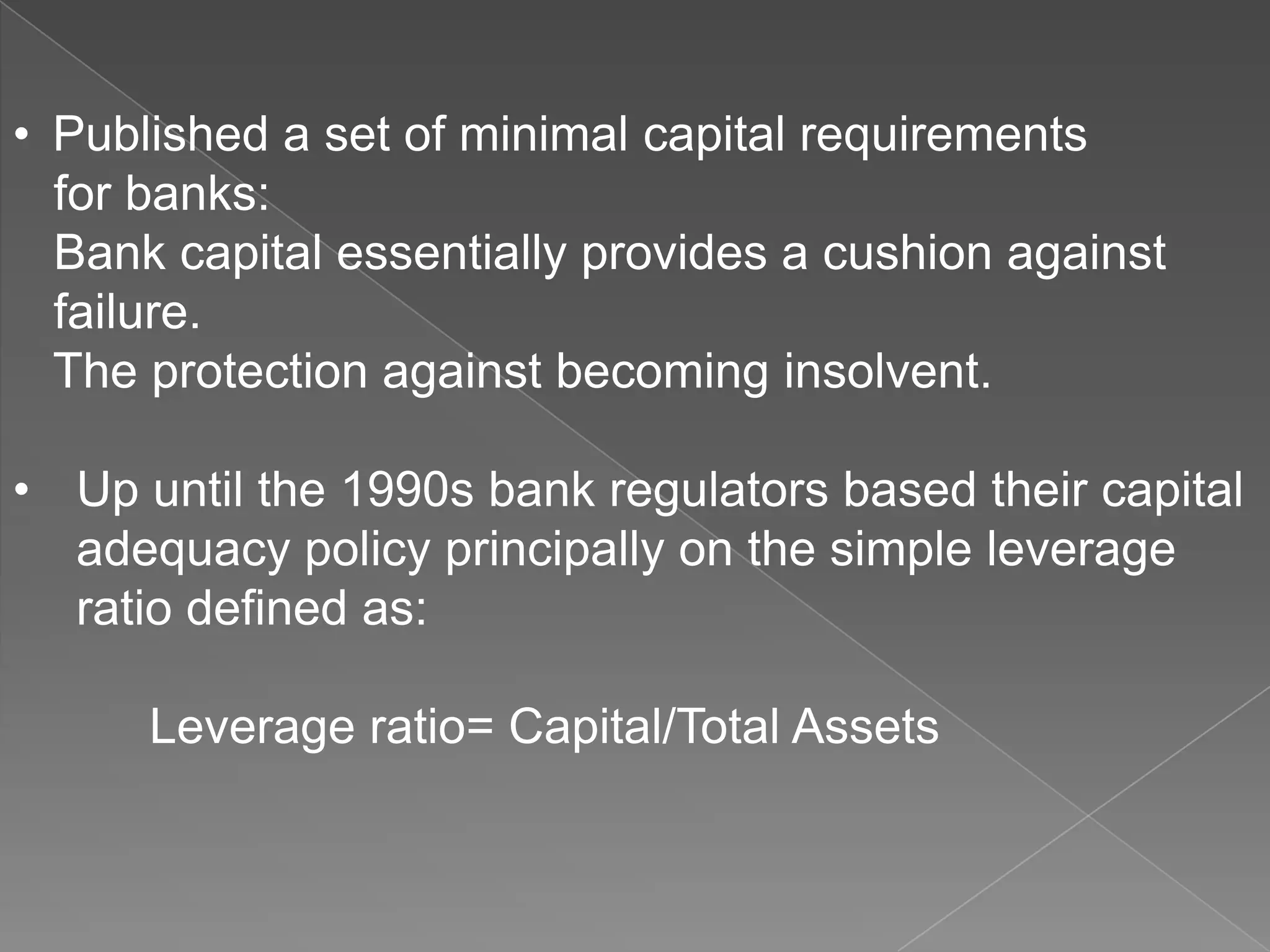
• Published a set of minimal capital requirements
for banks:
Bank capital essentially provides a cushion against
failure.
The protection against becoming insolvent.
• Up until the 1990s bank regulators based their capital
adequacy policy principally on the simple leverage
ratio defined as:
Leverage ratio= Capital/Total Assets
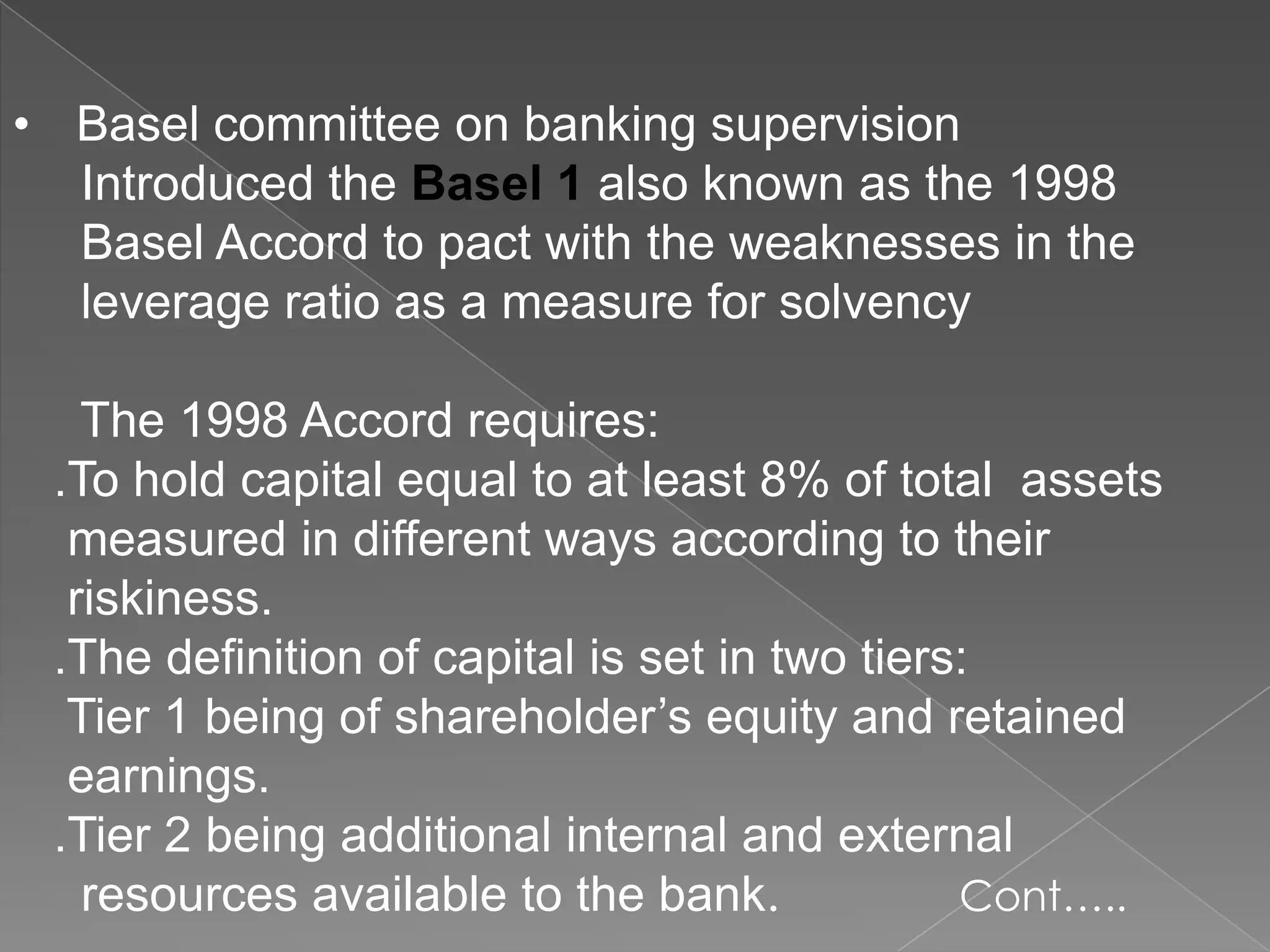
• Basel committee on banking supervision
Introduced the Basel 1 also known as the 1998
Basel Accord to pact with the weaknesses in the
leverage ratio as a measure for solvency
The 1998 Accord requires:
.To hold capital equal to at least 8% of total assets
measured in different ways according to their
riskiness.
.The definition of capital is set in two tiers:
Tier 1 being of shareholder’s equity and retained
earnings.
.Tier 2 being additional internal and external
resources available to the bank.
Cont…..
•

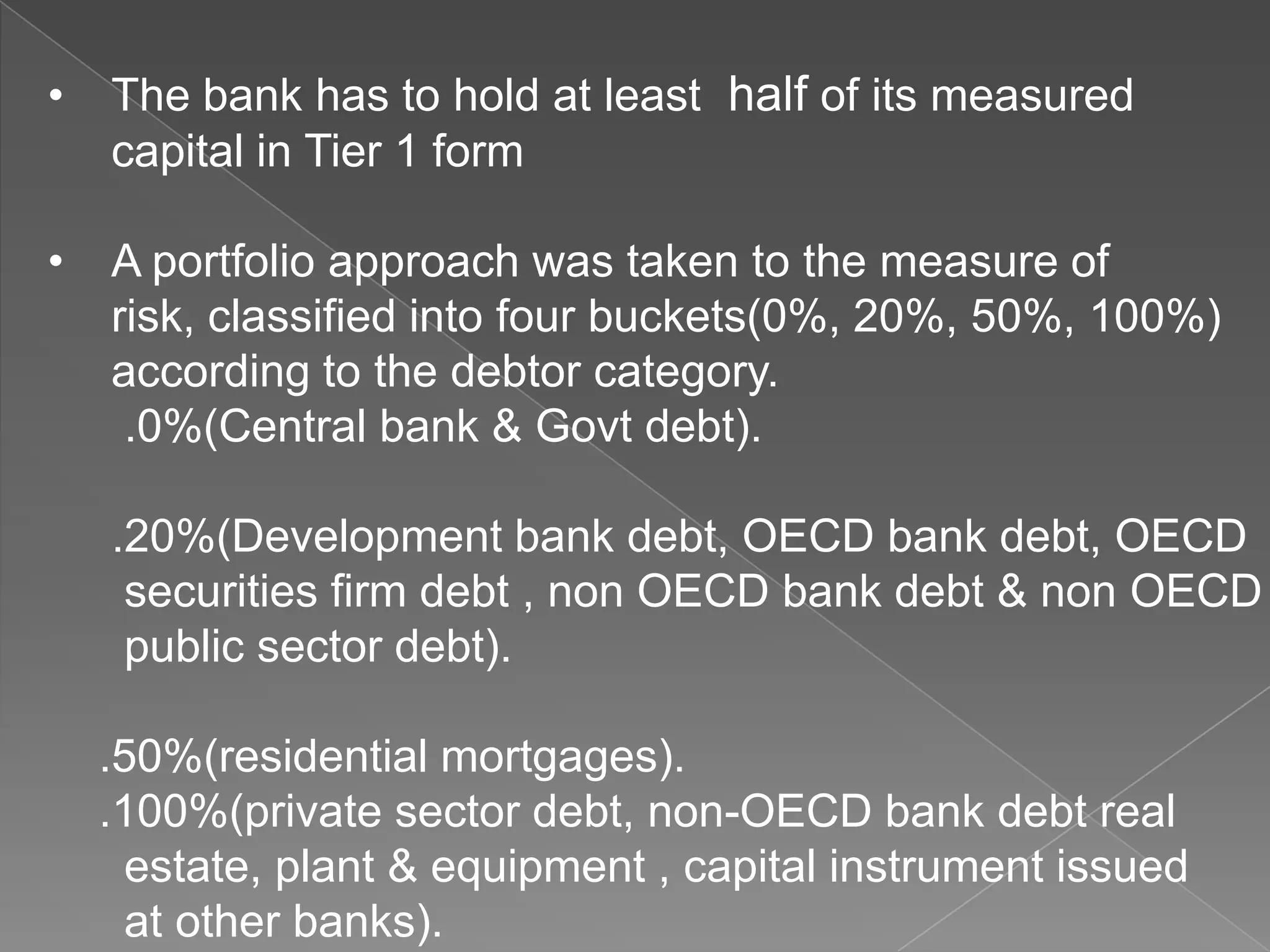
The bank has to hold at least half of its measured
capital in Tier 1 form

•

A portfolio approach was taken to the measure of
risk, classified into four buckets(0%, 20%, 50%, 100%)
according to the debtor category.
.0%(Central bank & Govt debt).
.20%(Development bank debt, OECD bank debt, OECD
securities firm debt , non OECD bank debt & non OECD
public sector debt).
.50%(residential mortgages).
.100%(private sector debt, non-OECD bank debt real
estate, plant & equipment , capital instrument issued
at other banks).
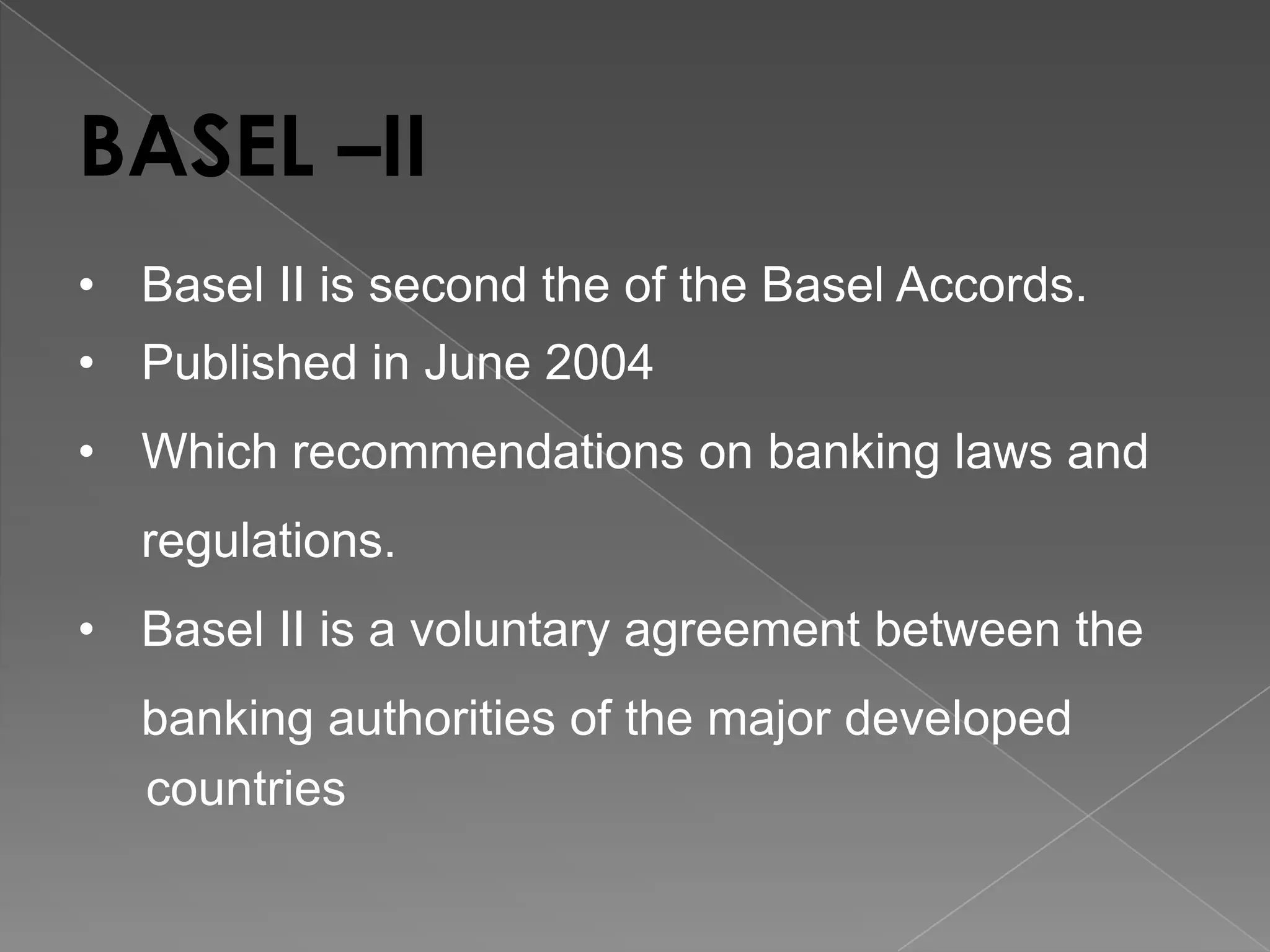
BASEL –II
• Basel II is second the of the Basel Accords.
• Published in June 2004
• Which recommendations on banking laws and
regulations.
• Basel II is a voluntary agreement between the
banking authorities of the major developed
countries
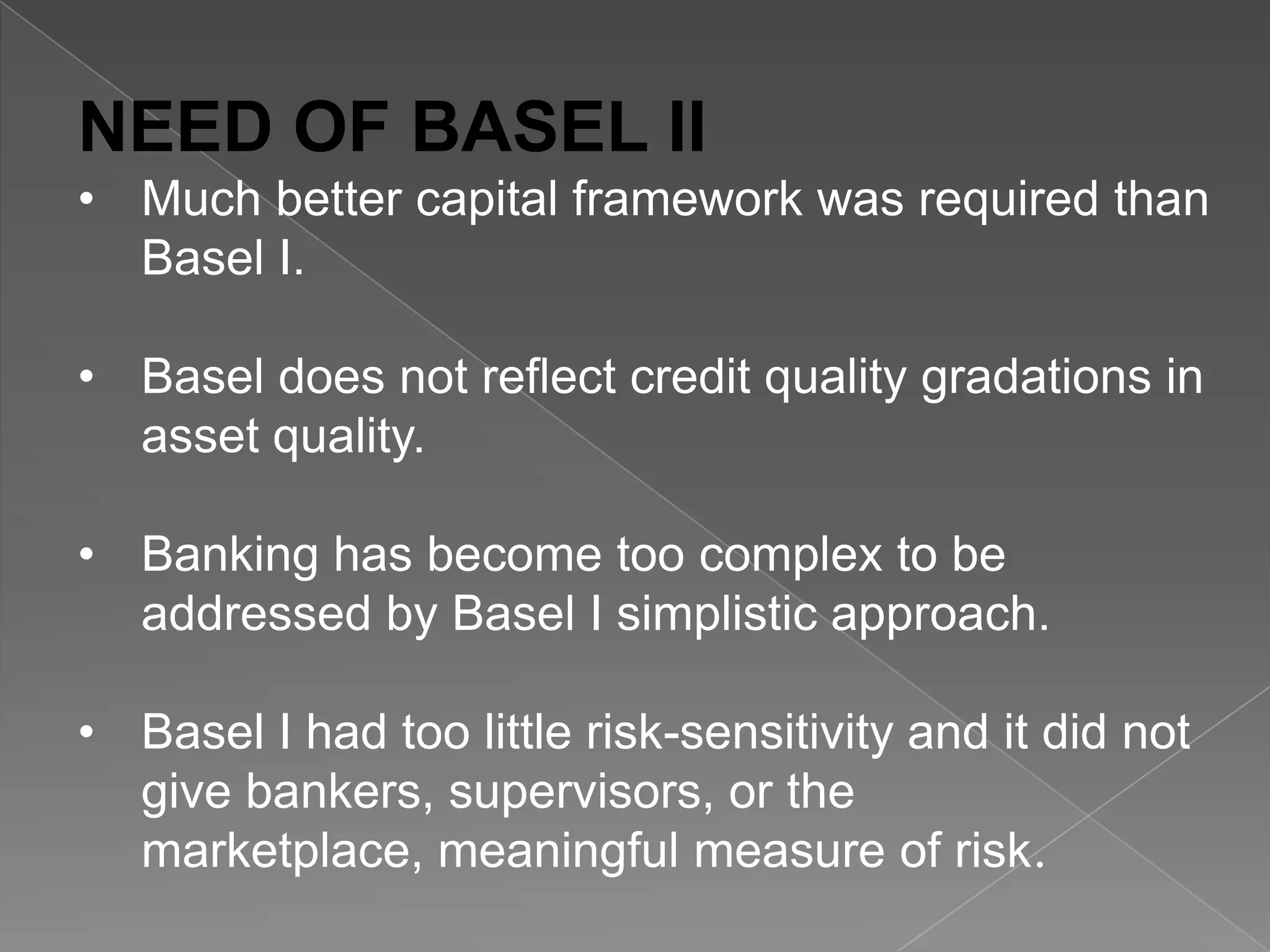
NEED OF BASEL II
• Much better capital framework was required than
Basel I.
• Basel does not reflect credit quality gradations in
asset quality.
• Banking has become too complex to be
addressed by Basel I simplistic approach.

• Basel I had too little risk-sensitivity and it did not
give bankers, supervisors, or the
marketplace, meaningful measure of risk.
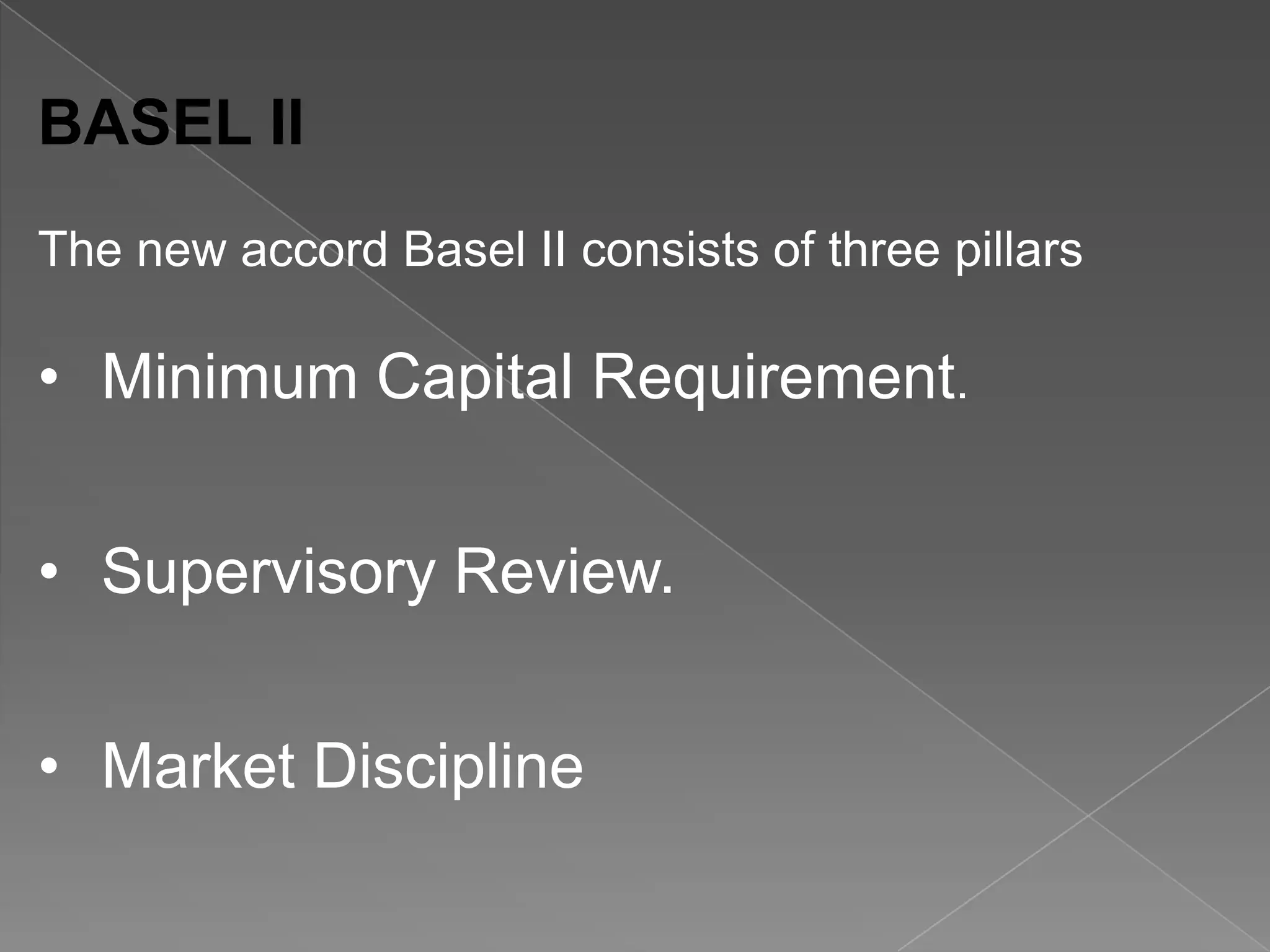
BASEL II
The new accord Basel II consists of three pillars

• Minimum Capital Requirement.
• Supervisory Review.
• Market Discipline
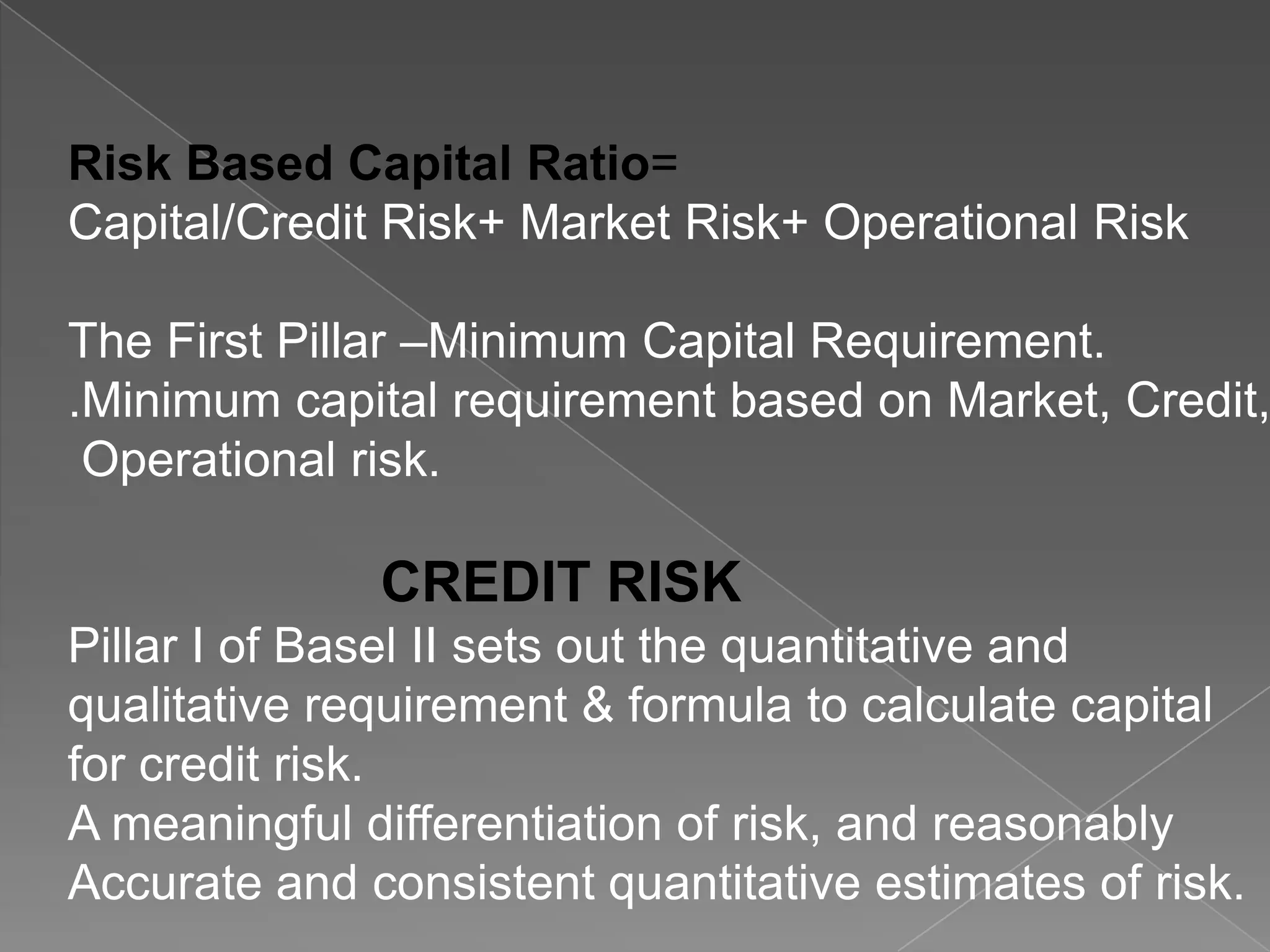
Risk Based Capital Ratio=
Capital/Credit Risk+ Market Risk+ Operational Risk

The First Pillar –Minimum Capital Requirement.
.Minimum capital requirement based on Market, Credit,
Operational risk.

CREDIT RISK
Pillar I of Basel II sets out the quantitative and
qualitative requirement & formula to calculate capital
for credit risk.
A meaningful differentiation of risk, and reasonably
Accurate and consistent quantitative estimates of risk.
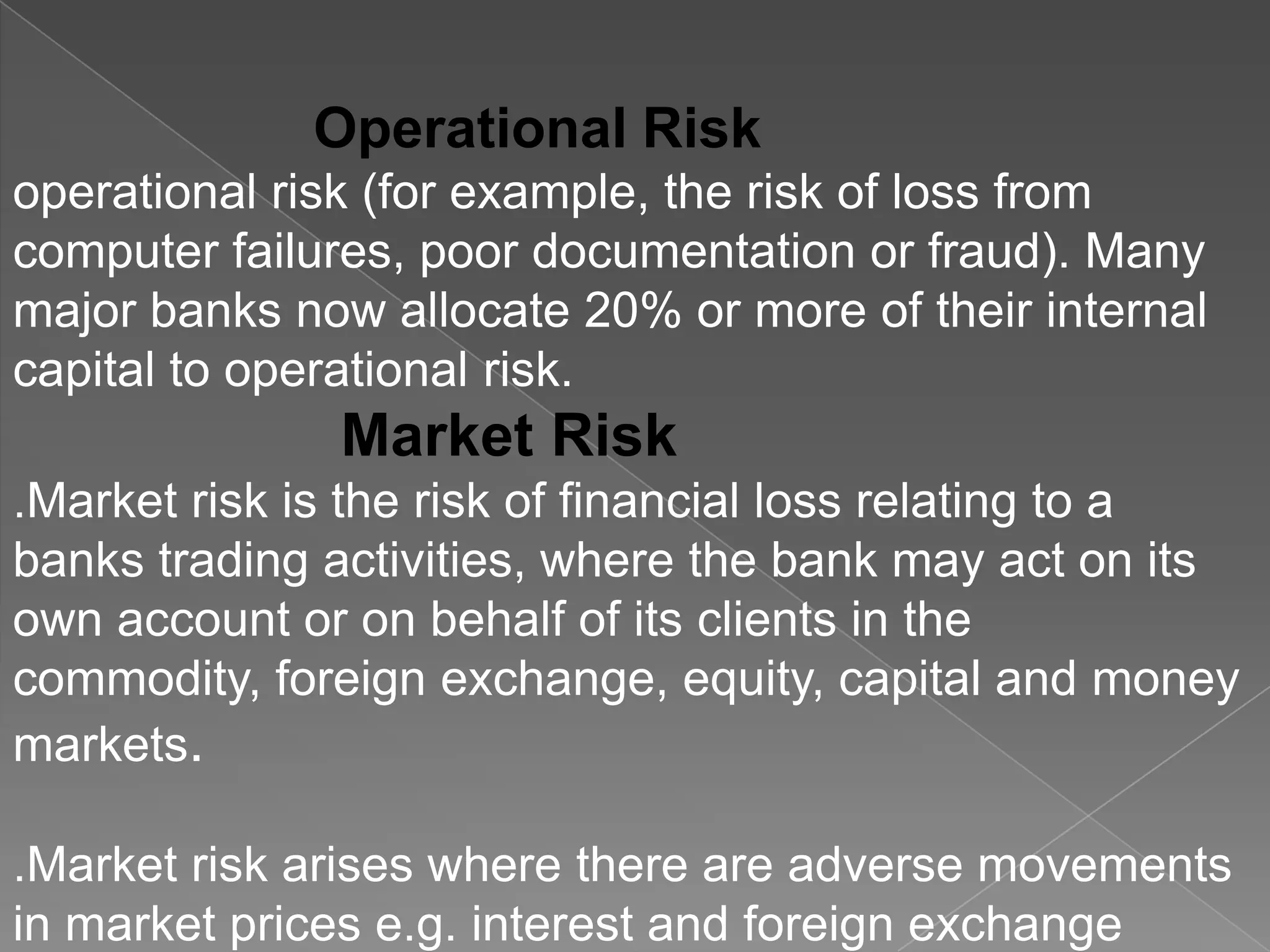
Operational Risk
operational risk (for example, the risk of loss from
computer failures, poor documentation or fraud). Many
major banks now allocate 20% or more of their internal
capital to operational risk.

Market Risk
.Market risk is the risk of financial loss relating to a
banks trading activities, where the bank may act on its
own account or on behalf of its clients in the
commodity, foreign exchange, equity, capital and money
markets.
.Market risk arises where there are adverse movements
in market prices e.g. interest and foreign exchange
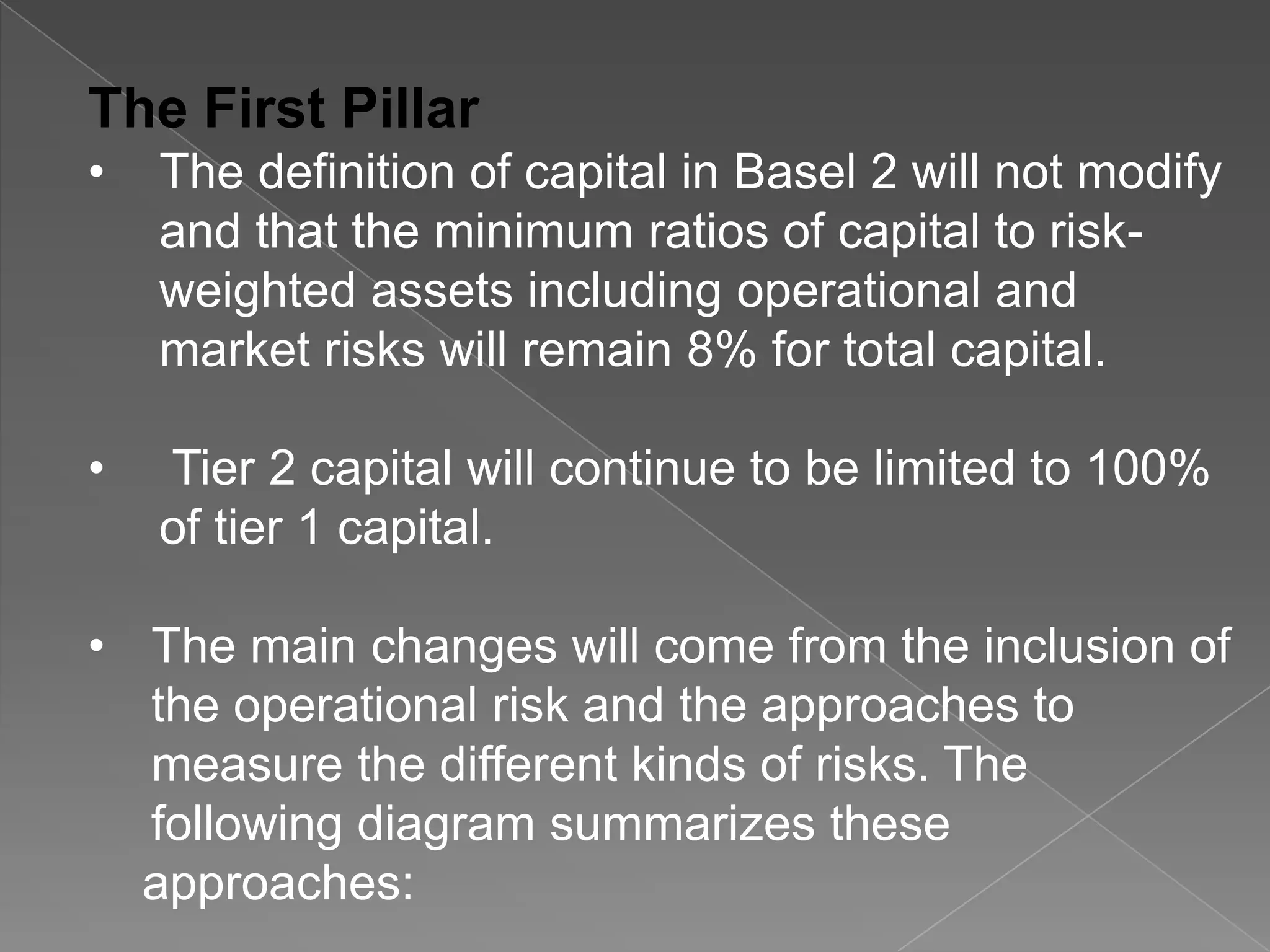
The First Pillar
•

The definition of capital in Basel 2 will not modify
and that the minimum ratios of capital to riskweighted assets including operational and
market risks will remain 8% for total capital.

•

Tier 2 capital will continue to be limited to 100%
of tier 1 capital.

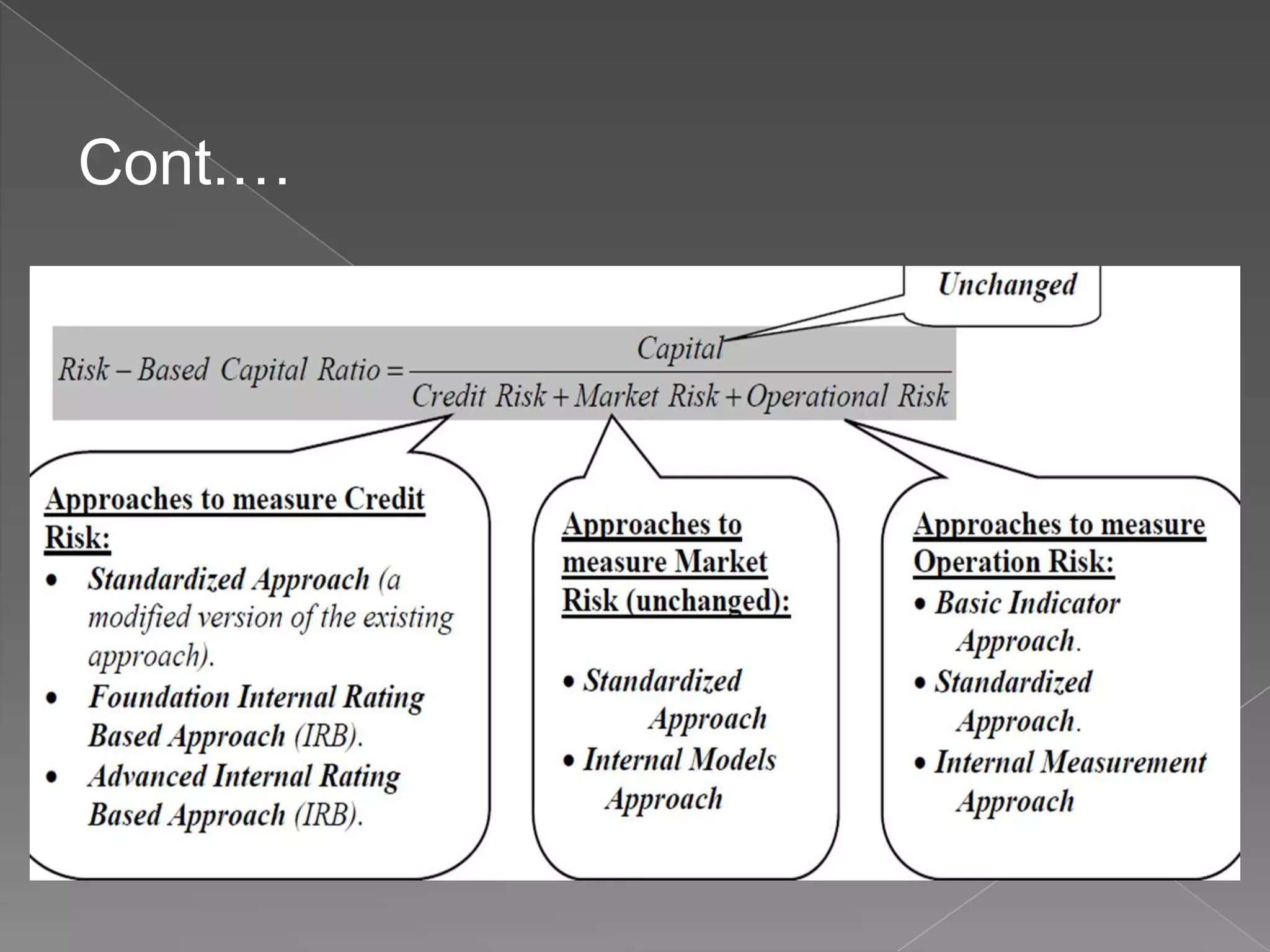
• The main changes will come from the inclusion of
the operational risk and the approaches to
measure the different kinds of risks. The
following diagram summarizes these
approaches:
Cont.…
The Second Pillar: Supervisory Review Process

In Basel 2 the bank can choose from a menu of
approaches to measure the credit, market and
operational risks. This process of choosing the
approach requires the review of the availability of the
minimum requirements to implement the approach.
The Third Pillar: Market Discipline

The third pillar in Basel 2 aims to bolster market
discipline through enhanced disclosure by banks.
Effective disclosure is essential to ensure that market
participants can better understand banks’ risk profiles
and the adequacy of their capital positions.
Basel norms

Basel norms

  • 1.
    BASEL NORMS PRESESTERS: MOHD RAFEEQBHAT SOURAV BOSE PRINCY AGGARWAL NAVDEEP SINGH AMAR KUMAR
  • 2.
    Basel Committee onBanking Supervision • Basel Committee was constituted by the Central Bank Governors of the G-10 countries • Established in 1975 in Basel, Switzerland • The committee’s Secretariat is located at the Bank for International Settlements in Basel, Switzerland • Its objective is to enhance understanding of key supervisory issues and quality improvement of banking supervision worldwide
  • 3.
    • Published aset of minimal capital requirements for banks: Bank capital essentially provides a cushion against failure. The protection against becoming insolvent. • Up until the 1990s bank regulators based their capital adequacy policy principally on the simple leverage ratio defined as: Leverage ratio= Capital/Total Assets
  • 4.
    • Basel committeeon banking supervision Introduced the Basel 1 also known as the 1998 Basel Accord to pact with the weaknesses in the leverage ratio as a measure for solvency The 1998 Accord requires: .To hold capital equal to at least 8% of total assets measured in different ways according to their riskiness. .The definition of capital is set in two tiers: Tier 1 being of shareholder’s equity and retained earnings. .Tier 2 being additional internal and external resources available to the bank. Cont…..
  • 5.
    • The bank hasto hold at least half of its measured capital in Tier 1 form • A portfolio approach was taken to the measure of risk, classified into four buckets(0%, 20%, 50%, 100%) according to the debtor category. .0%(Central bank & Govt debt). .20%(Development bank debt, OECD bank debt, OECD securities firm debt , non OECD bank debt & non OECD public sector debt). .50%(residential mortgages). .100%(private sector debt, non-OECD bank debt real estate, plant & equipment , capital instrument issued at other banks).
  • 6.
    BASEL –II • BaselII is second the of the Basel Accords. • Published in June 2004 • Which recommendations on banking laws and regulations. • Basel II is a voluntary agreement between the banking authorities of the major developed countries
  • 7.
    NEED OF BASELII • Much better capital framework was required than Basel I. • Basel does not reflect credit quality gradations in asset quality. • Banking has become too complex to be addressed by Basel I simplistic approach. • Basel I had too little risk-sensitivity and it did not give bankers, supervisors, or the marketplace, meaningful measure of risk.
  • 8.
    BASEL II The newaccord Basel II consists of three pillars • Minimum Capital Requirement. • Supervisory Review. • Market Discipline
  • 9.
    Risk Based CapitalRatio= Capital/Credit Risk+ Market Risk+ Operational Risk The First Pillar –Minimum Capital Requirement. .Minimum capital requirement based on Market, Credit, Operational risk. CREDIT RISK Pillar I of Basel II sets out the quantitative and qualitative requirement & formula to calculate capital for credit risk. A meaningful differentiation of risk, and reasonably Accurate and consistent quantitative estimates of risk.
  • 10.
    Operational Risk operational risk(for example, the risk of loss from computer failures, poor documentation or fraud). Many major banks now allocate 20% or more of their internal capital to operational risk. Market Risk .Market risk is the risk of financial loss relating to a banks trading activities, where the bank may act on its own account or on behalf of its clients in the commodity, foreign exchange, equity, capital and money markets. .Market risk arises where there are adverse movements in market prices e.g. interest and foreign exchange
  • 11.
    The First Pillar • Thedefinition of capital in Basel 2 will not modify and that the minimum ratios of capital to riskweighted assets including operational and market risks will remain 8% for total capital. • Tier 2 capital will continue to be limited to 100% of tier 1 capital. • The main changes will come from the inclusion of the operational risk and the approaches to measure the different kinds of risks. The following diagram summarizes these approaches:
  • 12.
  • 13.
    The Second Pillar:Supervisory Review Process In Basel 2 the bank can choose from a menu of approaches to measure the credit, market and operational risks. This process of choosing the approach requires the review of the availability of the minimum requirements to implement the approach. The Third Pillar: Market Discipline The third pillar in Basel 2 aims to bolster market discipline through enhanced disclosure by banks. Effective disclosure is essential to ensure that market participants can better understand banks’ risk profiles and the adequacy of their capital positions.