Presented By:SIMRANJEET SINGH50802063LMTSOM
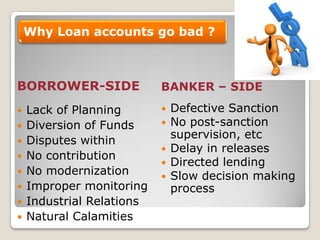
BORROWER-SIDELack of PlanningDiversion of FundsDisputes withinNo contribution No modernizationImproper monitoringIndustrial RelationsNatural Calamities BANKER – SIDEDefective SanctionNo post-sanction supervision, etcDelay in releasesDirected lending Slow decision making process
An account does not disclose any problems and carry more than normal risk attached to the businessAll loan facilities which are regular !
NPA is defined as a credit facility in respect of which the interest and/or installment of principal has remained ‘past due’ for a specified period of time.An asset, including a leased asset, becomes non-performing when it ceases to generate incomefor the bank.In accounting, originally Bad & Doubtful Debts
For agricultural purpose: interest or installment of principal remains overdue for two harvest seasons but for a period not exceeding two half years in the case of an advance granted for agricultural purpose
any amount to be received remains overdue for a period of more than 90 days in respect of other accounts.
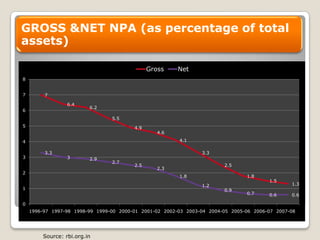
Earlier it was more than 3% of total assets and now it is 0.6%.OUT OF ORDERAn account should be treated as out of order if the outstanding balance remains continuously in excess of sanctioned limit /drawing power.OVERDUEAny amount due to the bank under any credit facility is ‘overdue’ if it is not paid on due date fixed by the bank.
Gross NPA:  Gross NPAs are the sum total of all loan assets that are classified as NPAs as per RBI guidelines as on Balance Sheet date. Gross NPA reflects the quality of the loans made by banks.It consists of all the non standard assets like as sub-standard, doubtful, and loss assets.Gross NPAs    Gross NPAs___                         Gross Advances
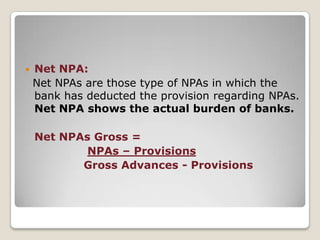
Net NPA:  Net NPAs are those type of NPAs in which the bank has deducted the provision regarding NPAs. Net NPA shows the actual burden of banks.	Net NPAs Gross =NPAs – Provisions                Gross Advances - Provisions
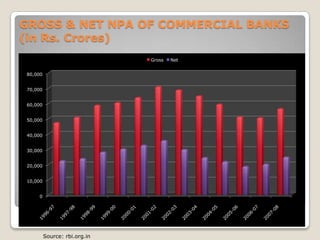
GROSS & NET NPA OF COMMERCIAL BANKS (in Rs. Crores)Source: rbi.org.in
Source: rbi.org.in
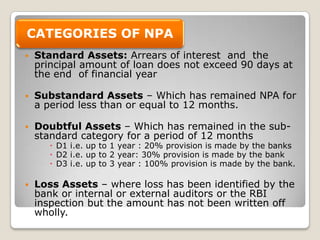
Standard Assets: Arrears of interest  and  the principal amount of loan does not exceed 90 days at the end  of financial year
Substandard Assets – Which has remained NPA for a period less than or equal to 12 months.
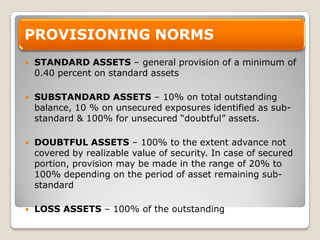
Doubtful Assets – Which has remained in the sub-standard category for a period of 12 monthsD1 i.e. up to 1 year : 20% provision is made by the banksD2 i.e. up to 2 year: 30% provision is made by the bank D3 i.e. up to 3 year : 100% provision is made by the bank.Loss Assets – where loss has been identified by the bank or internal or external auditors or the RBI inspection but the amount has not been written off wholly.STANDARD ASSETS – general provision of a minimum of 0.40 percent on standard assetsSUBSTANDARD ASSETS – 10% on total outstanding balance, 10 % on unsecured exposures identified as sub-standard & 100% for unsecured “doubtful” assets.DOUBTFUL ASSETS – 100% to the extent advance not covered by realizable value of security. In case of secured portion, provision may be made in the range of 20% to 100% depending on the period of asset remaining sub-standardLOSS ASSETS – 100% of the outstanding
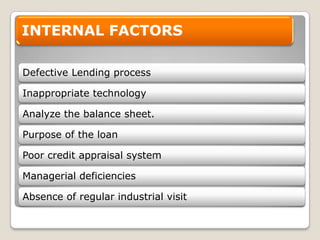
The banking sector has been facing the serious problems of the rising NPAs. But the problem of NPAs is more in public sector banks when compared to private sector banks and foreign banks.INTERNAL FACTORS
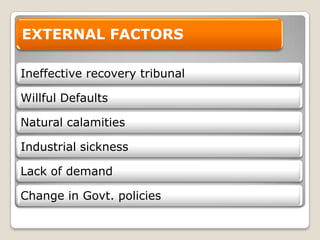
EXTERNAL FACTORS
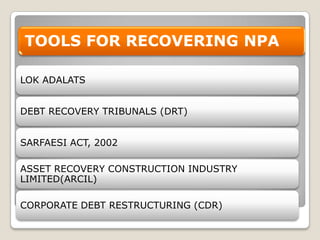
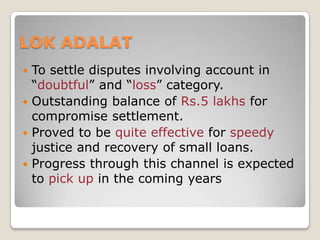
LOK ADALATTo settle disputes involving account in “doubtful” and “loss” category.Outstanding balance of Rs.5 lakhsfor compromise settlement.Proved to be quite effective for speedy justice and recovery of small loans. Progress through this channel is expected to pick up in the coming years
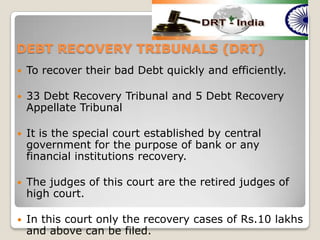
DEBT RECOVERY TRIBUNALS (DRT)To recover their bad Debt quickly and efficiently.33 Debt Recovery Tribunal and 5 Debt Recovery Appellate TribunalIt is the special court established by central government for the purpose of bank or any financial institutions recovery.The judges of this court are the retired judges of high court.In this court only the recovery cases of Rs.10 lakhs and above can be filed.
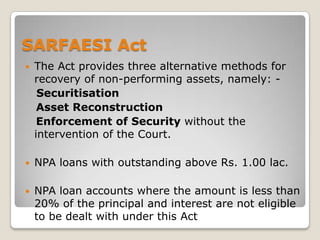
SARFAESI ActThe Act provides three alternative methods for recovery of non-performing assets, namely: -Securitisation   Asset Reconstruction     Enforcement of Security without the intervention of the Court.NPA loans with outstanding above Rs. 1.00 lac. NPA loan accounts where the amount is less than 20% of the principal and interest are not eligible to be dealt with under this Act
This Act empowers the Bank:To issue demand notice to the defaulting borrower and guarantor, calling upon them to discharge their dues in full within 60 days from the date of the notice.  To give notice to any person who has acquired any of the secured assets from the borrower to surrender the same to the Bank.  To ask any debtor of the borrower to pay any sum due or becoming due to the borrower.  Any Security Interest created over Agricultural Land cannot be proceeded with.
ARCILA company which is set up with the objective of taking over distressed assets (NPA) from banks or financial institutions and to reconstruct or re-pack these assets to make those assets saleable.To buy out troubled loans from banks and make special efforts at recovering value from the assets, if necessary by special legislation, with special powers for recovery.Restructuring of weak banks to divest the bad loan portfolio.India’s first ARC with an initial equity of Rs.10 crore with ICICI bank, IDBI and SBI.Incorporated as a public limited company on February 11, 2002
OBJECTIVESUnlocking capital for the banking system and the economyCreating a vibrant market for distressed debt assets /securities in India offering a trading platform for LendersTo evolve and create significant capacity in the system for quicker resolution of NPAs by deploying the assets optimallywww.arcil.co.in
CORPORATE DEBT RESTRUCTURING (CDR)For the revival of the corporate as well as for the safety of the money lent by the banks and FI.Based on the experience in other countries like the U.K., Thailand,Korea, etc.Objective was to ensure timely and transparent mechanism for restructuring of the corporate debtsCDR mechanism will be a voluntary system based on debtor creditor agreement and inter-creditor agreement.

NPA

  • 1.
  • 2.
    BORROWER-SIDELack of PlanningDiversionof FundsDisputes withinNo contribution No modernizationImproper monitoringIndustrial RelationsNatural Calamities BANKER – SIDEDefective SanctionNo post-sanction supervision, etcDelay in releasesDirected lending Slow decision making process
  • 3.
    An account doesnot disclose any problems and carry more than normal risk attached to the businessAll loan facilities which are regular !
  • 4.
    NPA is definedas a credit facility in respect of which the interest and/or installment of principal has remained ‘past due’ for a specified period of time.An asset, including a leased asset, becomes non-performing when it ceases to generate incomefor the bank.In accounting, originally Bad & Doubtful Debts
  • 5.
    For agricultural purpose:interest or installment of principal remains overdue for two harvest seasons but for a period not exceeding two half years in the case of an advance granted for agricultural purpose
  • 6.
    any amount tobe received remains overdue for a period of more than 90 days in respect of other accounts.
  • 7.
    Earlier it wasmore than 3% of total assets and now it is 0.6%.OUT OF ORDERAn account should be treated as out of order if the outstanding balance remains continuously in excess of sanctioned limit /drawing power.OVERDUEAny amount due to the bank under any credit facility is ‘overdue’ if it is not paid on due date fixed by the bank.
  • 8.
    Gross NPA: Gross NPAs are the sum total of all loan assets that are classified as NPAs as per RBI guidelines as on Balance Sheet date. Gross NPA reflects the quality of the loans made by banks.It consists of all the non standard assets like as sub-standard, doubtful, and loss assets.Gross NPAs Gross NPAs___ Gross Advances
  • 9.
    Net NPA: Net NPAs are those type of NPAs in which the bank has deducted the provision regarding NPAs. Net NPA shows the actual burden of banks. Net NPAs Gross =NPAs – Provisions Gross Advances - Provisions
  • 10.
    GROSS & NETNPA OF COMMERCIAL BANKS (in Rs. Crores)Source: rbi.org.in
  • 11.
  • 12.
    Standard Assets: Arrearsof interest and the principal amount of loan does not exceed 90 days at the end of financial year
  • 13.
    Substandard Assets –Which has remained NPA for a period less than or equal to 12 months.
  • 14.
    Doubtful Assets –Which has remained in the sub-standard category for a period of 12 monthsD1 i.e. up to 1 year : 20% provision is made by the banksD2 i.e. up to 2 year: 30% provision is made by the bank D3 i.e. up to 3 year : 100% provision is made by the bank.Loss Assets – where loss has been identified by the bank or internal or external auditors or the RBI inspection but the amount has not been written off wholly.STANDARD ASSETS – general provision of a minimum of 0.40 percent on standard assetsSUBSTANDARD ASSETS – 10% on total outstanding balance, 10 % on unsecured exposures identified as sub-standard & 100% for unsecured “doubtful” assets.DOUBTFUL ASSETS – 100% to the extent advance not covered by realizable value of security. In case of secured portion, provision may be made in the range of 20% to 100% depending on the period of asset remaining sub-standardLOSS ASSETS – 100% of the outstanding
  • 15.
    The banking sectorhas been facing the serious problems of the rising NPAs. But the problem of NPAs is more in public sector banks when compared to private sector banks and foreign banks.INTERNAL FACTORS
  • 16.
  • 21.
    LOK ADALATTo settledisputes involving account in “doubtful” and “loss” category.Outstanding balance of Rs.5 lakhsfor compromise settlement.Proved to be quite effective for speedy justice and recovery of small loans. Progress through this channel is expected to pick up in the coming years
  • 22.
    DEBT RECOVERY TRIBUNALS(DRT)To recover their bad Debt quickly and efficiently.33 Debt Recovery Tribunal and 5 Debt Recovery Appellate TribunalIt is the special court established by central government for the purpose of bank or any financial institutions recovery.The judges of this court are the retired judges of high court.In this court only the recovery cases of Rs.10 lakhs and above can be filed.
  • 23.
    SARFAESI ActThe Actprovides three alternative methods for recovery of non-performing assets, namely: -Securitisation Asset Reconstruction  Enforcement of Security without the intervention of the Court.NPA loans with outstanding above Rs. 1.00 lac. NPA loan accounts where the amount is less than 20% of the principal and interest are not eligible to be dealt with under this Act
  • 24.
    This Act empowersthe Bank:To issue demand notice to the defaulting borrower and guarantor, calling upon them to discharge their dues in full within 60 days from the date of the notice.  To give notice to any person who has acquired any of the secured assets from the borrower to surrender the same to the Bank.  To ask any debtor of the borrower to pay any sum due or becoming due to the borrower.  Any Security Interest created over Agricultural Land cannot be proceeded with.
  • 25.
    ARCILA company whichis set up with the objective of taking over distressed assets (NPA) from banks or financial institutions and to reconstruct or re-pack these assets to make those assets saleable.To buy out troubled loans from banks and make special efforts at recovering value from the assets, if necessary by special legislation, with special powers for recovery.Restructuring of weak banks to divest the bad loan portfolio.India’s first ARC with an initial equity of Rs.10 crore with ICICI bank, IDBI and SBI.Incorporated as a public limited company on February 11, 2002
  • 26.
    OBJECTIVESUnlocking capital forthe banking system and the economyCreating a vibrant market for distressed debt assets /securities in India offering a trading platform for LendersTo evolve and create significant capacity in the system for quicker resolution of NPAs by deploying the assets optimallywww.arcil.co.in
  • 27.
    CORPORATE DEBT RESTRUCTURING(CDR)For the revival of the corporate as well as for the safety of the money lent by the banks and FI.Based on the experience in other countries like the U.K., Thailand,Korea, etc.Objective was to ensure timely and transparent mechanism for restructuring of the corporate debtsCDR mechanism will be a voluntary system based on debtor creditor agreement and inter-creditor agreement.