


Rutvij
Kritika
Jyoti
Himani
Eisha
Overview of BASEL
Committee founded in 1974.
By Central Bank Governors of G10.
Focus – Banking Supervision.
Objective - Adequate supervision.
Meet 4 Times in a year.
Around 30 working groups/Task Force.
Location at Secretariat : Basel, Switzerland.
Conti….
4 Sub-committees
Standard Implementation Group
Policy Development Group
Accounting Task Force
Basel Committee Group
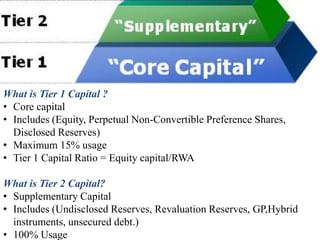
What is Tier 1 Capital ?
• Core capital
• Includes (Equity, Perpetual Non-Convertible Preference Shares,
Disclosed Reserves)
• Maximum 15% usage
• Tier 1 Capital Ratio = Equity capital/RWA
What is Tier 2 Capital?
• Supplementary Capital
• Includes (Undisclosed Reserves, Revaluation Reserves, GP,Hybrid
instruments, unsecured debt.)
• 100% Usage
Basel Accord 1
 Introduced in 1988 by BCBS.
Objectives of Basel Accord 1 are as follows:
• To ensure an adequate level of capital in the
international banking system.
• To strengthen the competitive markets, under which
banks could no longer build in adequate business volumes
without adequate capital backing.
 According to Basel 1, banks are required to hold capital
equal to 8% of the risk-weighted assets.
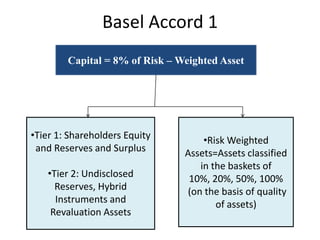
Basel Accord 1
Capital = 8% of Risk – Weighted Asset
•Tier 1: Shareholders Equity
and Reserves and Surplus
•Tier 2: Undisclosed
Reserves, Hybrid
Instruments and
Revaluation Assets
•Risk Weighted
Assets=Assets classified
in the baskets of
10%, 20%, 50%, 100%
(on the basis of quality
of assets)
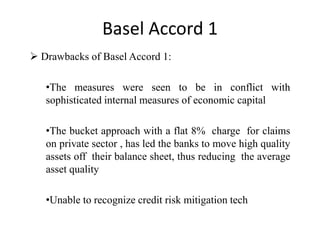
Basel Accord 1
 Drawbacks of Basel Accord 1:
•The measures were seen to be in conflict with
sophisticated internal measures of economic capital
•The bucket approach with a flat 8% charge for claims
on private sector , has led the banks to move high quality
assets off their balance sheet, thus reducing the average
asset quality
•Unable to recognize credit risk mitigation tech
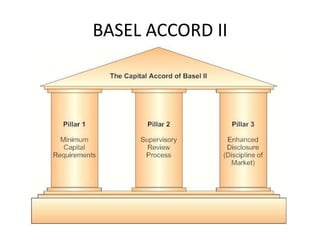
BASEL ACCORD II
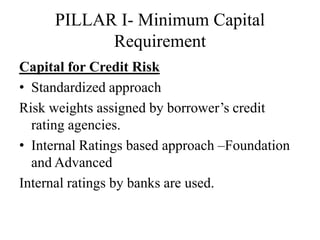
PILLAR I- Minimum Capital
Requirement
Capital for Credit Risk
• Standardized approach
Risk weights assigned by borrower’s credit
rating agencies.
• Internal Ratings based approach –Foundation
and Advanced
Internal ratings by banks are used.
Capital for Operational Risk
• Basic Indicator Approach
Fixed percentage of the average of gross income
for 3 years
• Standardized Approach
Risk measured based on division of Bank’s
business into 8 lines and respective exposure
• Advanced Measurement Approach
Risk measure generated by internal operational
risk measurement system
Capital for Market Risk
VaR measure
Value At Risk measure is calculated on the
bank’s current portfolio to measure the impact
of the current market factors on the portfolio.
Based on historical data for past 12 months
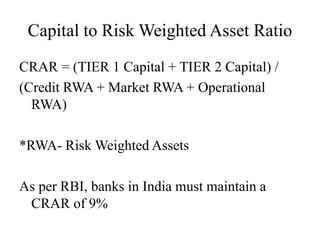
Capital to Risk Weighted Asset Ratio
CRAR = (TIER 1 Capital + TIER 2 Capital) /
(Credit RWA + Market RWA + Operational
RWA)
*RWA- Risk Weighted Assets
As per RBI, banks in India must maintain a
CRAR of 9%
Pillar 2
SUPERVISORY REVIEW PROCESS
• It is a regulatory response to the first pillar.
• Ensures maintenance of minimum capital by
banks.
• Monitors and guides banks on risk
management of its assets.
Functions of supervisor
Ensuring banks have a process to assess
minimum capital requirements.
Reviewing these assessments.
Ensure banks maintain capital above the
minimum requirement.
Prevent capital from falling below the
minimum levels.
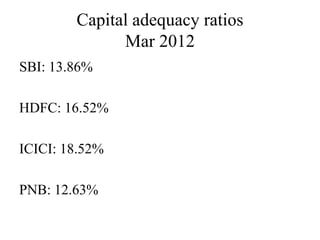
Capital adequacy ratios
Mar 2012
SBI: 13.86%
HDFC: 16.52%
ICICI: 18.52%
PNB: 12.63%
Pillar 3 : Market Discipline
Transparency
Monitor risk-taking behavior of banks
Institutional framework
Information
Incentives
Control
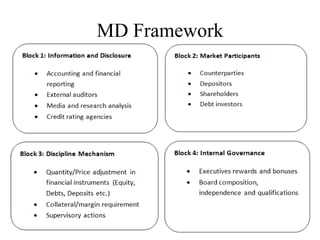
MD Framework
BASEL III
Thank you..

Basel

  • 1.
  • 2.
    Overview of BASEL Committeefounded in 1974. By Central Bank Governors of G10. Focus – Banking Supervision. Objective - Adequate supervision. Meet 4 Times in a year. Around 30 working groups/Task Force. Location at Secretariat : Basel, Switzerland.
  • 3.
    Conti…. 4 Sub-committees Standard ImplementationGroup Policy Development Group Accounting Task Force Basel Committee Group
  • 4.
    What is Tier1 Capital ? • Core capital • Includes (Equity, Perpetual Non-Convertible Preference Shares, Disclosed Reserves) • Maximum 15% usage • Tier 1 Capital Ratio = Equity capital/RWA What is Tier 2 Capital? • Supplementary Capital • Includes (Undisclosed Reserves, Revaluation Reserves, GP,Hybrid instruments, unsecured debt.) • 100% Usage
  • 5.
    Basel Accord 1 Introduced in 1988 by BCBS. Objectives of Basel Accord 1 are as follows: • To ensure an adequate level of capital in the international banking system. • To strengthen the competitive markets, under which banks could no longer build in adequate business volumes without adequate capital backing.  According to Basel 1, banks are required to hold capital equal to 8% of the risk-weighted assets.
  • 6.
    Basel Accord 1 Capital= 8% of Risk – Weighted Asset •Tier 1: Shareholders Equity and Reserves and Surplus •Tier 2: Undisclosed Reserves, Hybrid Instruments and Revaluation Assets •Risk Weighted Assets=Assets classified in the baskets of 10%, 20%, 50%, 100% (on the basis of quality of assets)
  • 7.
    Basel Accord 1 Drawbacks of Basel Accord 1: •The measures were seen to be in conflict with sophisticated internal measures of economic capital •The bucket approach with a flat 8% charge for claims on private sector , has led the banks to move high quality assets off their balance sheet, thus reducing the average asset quality •Unable to recognize credit risk mitigation tech
  • 8.
  • 9.
    PILLAR I- MinimumCapital Requirement Capital for Credit Risk • Standardized approach Risk weights assigned by borrower’s credit rating agencies. • Internal Ratings based approach –Foundation and Advanced Internal ratings by banks are used.
  • 10.
    Capital for OperationalRisk • Basic Indicator Approach Fixed percentage of the average of gross income for 3 years • Standardized Approach Risk measured based on division of Bank’s business into 8 lines and respective exposure • Advanced Measurement Approach Risk measure generated by internal operational risk measurement system
  • 11.
    Capital for MarketRisk VaR measure Value At Risk measure is calculated on the bank’s current portfolio to measure the impact of the current market factors on the portfolio. Based on historical data for past 12 months
  • 12.
    Capital to RiskWeighted Asset Ratio CRAR = (TIER 1 Capital + TIER 2 Capital) / (Credit RWA + Market RWA + Operational RWA) *RWA- Risk Weighted Assets As per RBI, banks in India must maintain a CRAR of 9%
  • 13.
    Pillar 2 SUPERVISORY REVIEWPROCESS • It is a regulatory response to the first pillar. • Ensures maintenance of minimum capital by banks. • Monitors and guides banks on risk management of its assets.
  • 14.
    Functions of supervisor Ensuringbanks have a process to assess minimum capital requirements. Reviewing these assessments. Ensure banks maintain capital above the minimum requirement. Prevent capital from falling below the minimum levels.
  • 15.
    Capital adequacy ratios Mar2012 SBI: 13.86% HDFC: 16.52% ICICI: 18.52% PNB: 12.63%
  • 16.
    Pillar 3 :Market Discipline Transparency Monitor risk-taking behavior of banks Institutional framework Information Incentives Control
  • 17.
  • 18.
  • 20.