BASEL II NORMS
MANAGEMENT OF FINANCIAL
INSTITUTUIONS
BY
Rasmi Ranjan Mishra
BASEL ACCORDS
 Refers to banking supervision Accords
(recommendations on banking laws and
regulations), Basel I and Basel II issued
by the Basel Committee on Banking
Supervision(BCBS).
 Called the Basel Accords as the BCBS
maintains its secretariat at the Bank of
International Settlements in Basel,
Switzerland
Background
 Under capital requirements rules, credit institutions
like banks must at all times maintain minimum
financial capital, to cover the risks

 Aim - to ensure financial soundness of such
institutions, maintain customer confidence in the
solvency of the institutions, ensure stability of
financial system at large, and protect depositors
against losses.
 Basel Committee on Banking Supervision
established in 1974 to provide a forum for banking
supervisory matters. Members are from Belgium,
Canada, France, Germany, Italy, Japan, Luxembourg,
the Netherlands, Spain, Sweden, Switzerland, UK
and USA.
Background
 Basel Committee not a formal regulatory
authority, but has great influence over supervising
authorities in many countries.
 Committee hopes to achieve common approaches
and common standards across member
countries, without detailed harmonisation of each
member country's supervisory techniques.
 In 1988, recognising the emergence of larger more
global financial services companies, the Committee
introduced Basel Capital Accord (Basel I) to
strengthen soundness and stability of international
banking system by requiring higher capital ratios.
Background
 Since 1988, the framework of Basel I progressively
introduced not only in member countries but also in
virtually all other countries with active international
banks.
 In June 1999, proposal issued for a new Capital
Adequacy framework to replace Basel I.
 After extensive communication with banks and
industry groups, the revised framework, Basel II
issued in 2004.
 Basel II has been or will be implemented by
regulators in most jurisdictions but with varying
timelines and may be restricted methodologies.
BASEL II
 The second of the Basel Accords.
 Purpose is to create an international standard that banking
regulators can use when creating regulations about capital banks
to be put aside to guard against financial and operational risks
 An international standard can help protect the international
financial system from possible problems should a major bank or a
series of banks collapse.
 Basel II attempts to accomplish this by setting up rigorous risk and
capital management requirements to ensure that a bank holds
capital reserves appropriate to the risk the bank exposes itself to
through lending and investment practices.
 Greater the risk greater the amount of capital bank needs to hold to
safeguard its solvency and overall economic stability.
FINAL OBJECTIVE
 Ensuring that capital allocation is more risk
sensitive
 Separating operational risk from credit risk,
and quantifying both
 Attempting to align economic and
regulatory capital more closely to reduce
scope for regulatory arbitrage
Why BASEL II
 Basel I Accord succeeded in raising total level of
equity capital in the system.
 However, it also pushed unintended consequences.
 Since it does not differentiate risks very well, it
perversely encouraged risk seeking. All loans given
to corporate borrowers were subject to the same
capital requirement, without taking into account
ability of the counterparties to repay.
 It ignored credit rating, credit history, risk
management and corporate governance structure of
all corporate borrowers. All were treated as private
corporations.
 It also promoted loan securitization that led to the
unwinding in the subprime market.
Why BASEL II
 Basel II much more risk sensitive, as it is aligning capital
requirements to risks of loss. Better risk management in a bank
means bank may be able to allocate less regulatory capital.
 The objective of Basel II is to modernise existing capital
requirements framework to make it more comprehensive and
risk sensitive.
 The Basel II framework therefore designed to be more sensitive
to the real risks that firms face than Basel I.
 Apart from looking at financial figures, it also considers
operational risks, such as risk of systems breaking down or
people doing the wrong things, and also market risk.
•Pillar 1 sets out the minimum capital requirements firms will be
required to meet to cover credit, market and operational risk.
•Pillar 2 sets out a new supervisory review process. Requires
financial institutions to have their own internal processes to assess
their overall capital adequacy in relation to their risk profile.
•Pillar 3 cements Pillars 1 and 2 and is designed to improve market
discipline by requiring firms to publish certain details of their
risks, capital and risk management as to how senior management
and the Board assess and will manage the institution's risks.
Three Pillars of Basel II Framework
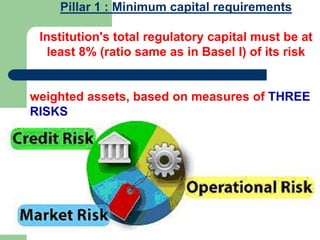
Pillar 1 : Minimum capital requirements
Institution's total regulatory capital must be at
least 8% (ratio same as in Basel I) of its risk
weighted assets, based on measures of THREE
RISKS
Measure of Risks
Measuring credit risk
 Banks can assess risk using three different ways of varying
degree of sophistication
– Standardised approach
– Foundation IRB(Internal Rating-Based Approach)
– Advanced IRB
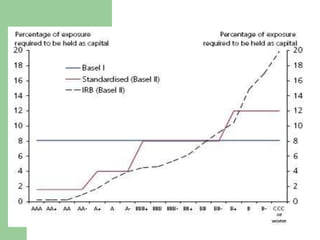
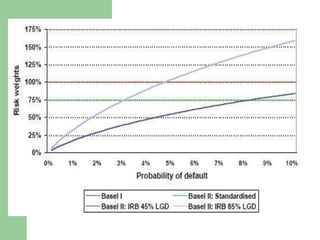
 Standardised approach sets out specific risk weights for
certain types of credit risk, e.g. 0% for short term government
bonds, 20% for exposures to OECD Banks, 50% for residential
mortgages and 100% weighting on unsecured commercial
loans(as in BASEL I)
 A new 150% rating comes in for borrowers with poor credit
ratings
 Minimum capital requirement (the percentage of risk weighted
assets to be held as capital) remains at 8%.
 Banks adopt standardised ratings approach will be forced to
rely on the ratings generated by external agencies. Certain
Banks are developing the IRB approach as a result.
Measure of Risks
Measuring operational risk
 Operational risk is risk of loss resulting from
inadequate or failed internal processes,
people and systems or from external
events. It includes legal risk, such as
exposure to fines, penalties and private
settlements. It does not, however, include
strategic or reputational risk.
 Three methods to measure operational risk
– Basic Indicator Approach
– Standardised Approach
– Advanced Measurement Approach
Measure of Risks
Measuring market risk
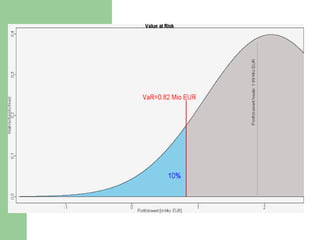
 Institutions may be obliged to make a series of
disclosures about their risk profiles and regulatory
capital procedures available to market participants,
while balancing between meaningful disclosures and
need to protect confidential and proprietary
information. Preferred approach is VaR( Value at
Risk)
 As the Basel 2 recommendations are phased in by
the banking industry it will move from standardised
requirements to more refined and specific
requirements that have been developed for each risk
category by each individual bank
Pillar 2 : Supervisory Review
 Covers Supervisory Review Process, describing principles for
effective supervision.
 Supervisors obliged to evaluate activities, corporate
governance, risk management and risk profiles of banks to
determine whether they have to change or to allocate more
capital for their risks (called Pillar 2 capital)
 Deals with regulatory response to the first pillar, giving
regulators much improved 'tools' over those available to them
under Basel I
 Also provides framework for dealing with all the other risks a
bank may face, such as Systemic risk, pension risk,
concentration risk, strategic risk, reputation risk, liquidity risk
and legal risk, which the accord combines under the title of
residual risk
 It gives banks a power to review their risk management
system.
Pillar 3 : Market Discipline
 Covers transparency and the obligation of
banks to disclose meaningful information
to all stakeholders
 Clients and shareholders should have
sufficient understanding of activities of
banks, and the way they manage their
risks
Implementation progress
 Implementation has to accommodate differing cultures, varying
structural models, and complexities of public policy and
existing regulation. Corporate strategy will be implemented
based in part on how Basel II is ultimately interpreted by
various countries' legislatures and regulators.
 The USA’s various regulators have agreed on a final approach.
They have required the Internal Ratings-Based approach for the
largest banks, and the standardized approach will not be
available to anyone.
 In India, RBI implemented Basel II standardized norms on 31st
March 2009 and is moving to internal ratings in credit and AMA
norms for operational risks in banks.
 EU has already implemented the Accord via the EU Capital
Requirements Directives. Many European banks already report
capital adequacy ratios according to the new system. All credit
institutions adopted it by 2008.
CONCLUSION
 Basel II Framework lays down a more comprehensive
measure and minimum standard for capital adequacy
 Seeks to improve on existing rules by aligning regulatory
capital requirements more closely to underlying risks that
banks face.
 In addition, it intends to promote a more forward-looking
approach to capital supervision, that encourages banks to
identify the present and future risks, and develop or
improve their ability to manage them.
 Hence intended to be more flexible and better able to
evolve with advances in markets and risk management
practices.
 Basel II Accord attempts to fix glaring problems with the
original accord. It does this by more accurately defining
risk, but at the cost of considerable rule complexity

Baseliinorms ppt-110522002247-phpapp02

  • 1.
    BASEL II NORMS MANAGEMENTOF FINANCIAL INSTITUTUIONS BY Rasmi Ranjan Mishra
  • 2.
    BASEL ACCORDS  Refersto banking supervision Accords (recommendations on banking laws and regulations), Basel I and Basel II issued by the Basel Committee on Banking Supervision(BCBS).  Called the Basel Accords as the BCBS maintains its secretariat at the Bank of International Settlements in Basel, Switzerland
  • 3.
    Background  Under capitalrequirements rules, credit institutions like banks must at all times maintain minimum financial capital, to cover the risks   Aim - to ensure financial soundness of such institutions, maintain customer confidence in the solvency of the institutions, ensure stability of financial system at large, and protect depositors against losses.  Basel Committee on Banking Supervision established in 1974 to provide a forum for banking supervisory matters. Members are from Belgium, Canada, France, Germany, Italy, Japan, Luxembourg, the Netherlands, Spain, Sweden, Switzerland, UK and USA.
  • 4.
    Background  Basel Committeenot a formal regulatory authority, but has great influence over supervising authorities in many countries.  Committee hopes to achieve common approaches and common standards across member countries, without detailed harmonisation of each member country's supervisory techniques.  In 1988, recognising the emergence of larger more global financial services companies, the Committee introduced Basel Capital Accord (Basel I) to strengthen soundness and stability of international banking system by requiring higher capital ratios.
  • 5.
    Background  Since 1988,the framework of Basel I progressively introduced not only in member countries but also in virtually all other countries with active international banks.  In June 1999, proposal issued for a new Capital Adequacy framework to replace Basel I.  After extensive communication with banks and industry groups, the revised framework, Basel II issued in 2004.  Basel II has been or will be implemented by regulators in most jurisdictions but with varying timelines and may be restricted methodologies.
  • 6.
    BASEL II  Thesecond of the Basel Accords.  Purpose is to create an international standard that banking regulators can use when creating regulations about capital banks to be put aside to guard against financial and operational risks  An international standard can help protect the international financial system from possible problems should a major bank or a series of banks collapse.  Basel II attempts to accomplish this by setting up rigorous risk and capital management requirements to ensure that a bank holds capital reserves appropriate to the risk the bank exposes itself to through lending and investment practices.  Greater the risk greater the amount of capital bank needs to hold to safeguard its solvency and overall economic stability.
  • 7.
    FINAL OBJECTIVE  Ensuringthat capital allocation is more risk sensitive  Separating operational risk from credit risk, and quantifying both  Attempting to align economic and regulatory capital more closely to reduce scope for regulatory arbitrage
  • 8.
    Why BASEL II Basel I Accord succeeded in raising total level of equity capital in the system.  However, it also pushed unintended consequences.  Since it does not differentiate risks very well, it perversely encouraged risk seeking. All loans given to corporate borrowers were subject to the same capital requirement, without taking into account ability of the counterparties to repay.  It ignored credit rating, credit history, risk management and corporate governance structure of all corporate borrowers. All were treated as private corporations.  It also promoted loan securitization that led to the unwinding in the subprime market.
  • 9.
    Why BASEL II Basel II much more risk sensitive, as it is aligning capital requirements to risks of loss. Better risk management in a bank means bank may be able to allocate less regulatory capital.  The objective of Basel II is to modernise existing capital requirements framework to make it more comprehensive and risk sensitive.  The Basel II framework therefore designed to be more sensitive to the real risks that firms face than Basel I.  Apart from looking at financial figures, it also considers operational risks, such as risk of systems breaking down or people doing the wrong things, and also market risk.
  • 10.
    •Pillar 1 setsout the minimum capital requirements firms will be required to meet to cover credit, market and operational risk. •Pillar 2 sets out a new supervisory review process. Requires financial institutions to have their own internal processes to assess their overall capital adequacy in relation to their risk profile. •Pillar 3 cements Pillars 1 and 2 and is designed to improve market discipline by requiring firms to publish certain details of their risks, capital and risk management as to how senior management and the Board assess and will manage the institution's risks. Three Pillars of Basel II Framework
  • 11.
    Pillar 1 :Minimum capital requirements Institution's total regulatory capital must be at least 8% (ratio same as in Basel I) of its risk weighted assets, based on measures of THREE RISKS
  • 12.
    Measure of Risks Measuringcredit risk  Banks can assess risk using three different ways of varying degree of sophistication – Standardised approach – Foundation IRB(Internal Rating-Based Approach) – Advanced IRB  Standardised approach sets out specific risk weights for certain types of credit risk, e.g. 0% for short term government bonds, 20% for exposures to OECD Banks, 50% for residential mortgages and 100% weighting on unsecured commercial loans(as in BASEL I)  A new 150% rating comes in for borrowers with poor credit ratings  Minimum capital requirement (the percentage of risk weighted assets to be held as capital) remains at 8%.  Banks adopt standardised ratings approach will be forced to rely on the ratings generated by external agencies. Certain Banks are developing the IRB approach as a result.
  • 15.
    Measure of Risks Measuringoperational risk  Operational risk is risk of loss resulting from inadequate or failed internal processes, people and systems or from external events. It includes legal risk, such as exposure to fines, penalties and private settlements. It does not, however, include strategic or reputational risk.  Three methods to measure operational risk – Basic Indicator Approach – Standardised Approach – Advanced Measurement Approach
  • 16.
    Measure of Risks Measuringmarket risk  Institutions may be obliged to make a series of disclosures about their risk profiles and regulatory capital procedures available to market participants, while balancing between meaningful disclosures and need to protect confidential and proprietary information. Preferred approach is VaR( Value at Risk)  As the Basel 2 recommendations are phased in by the banking industry it will move from standardised requirements to more refined and specific requirements that have been developed for each risk category by each individual bank
  • 18.
    Pillar 2 :Supervisory Review  Covers Supervisory Review Process, describing principles for effective supervision.  Supervisors obliged to evaluate activities, corporate governance, risk management and risk profiles of banks to determine whether they have to change or to allocate more capital for their risks (called Pillar 2 capital)  Deals with regulatory response to the first pillar, giving regulators much improved 'tools' over those available to them under Basel I  Also provides framework for dealing with all the other risks a bank may face, such as Systemic risk, pension risk, concentration risk, strategic risk, reputation risk, liquidity risk and legal risk, which the accord combines under the title of residual risk  It gives banks a power to review their risk management system.
  • 19.
    Pillar 3 :Market Discipline  Covers transparency and the obligation of banks to disclose meaningful information to all stakeholders  Clients and shareholders should have sufficient understanding of activities of banks, and the way they manage their risks
  • 20.
    Implementation progress  Implementationhas to accommodate differing cultures, varying structural models, and complexities of public policy and existing regulation. Corporate strategy will be implemented based in part on how Basel II is ultimately interpreted by various countries' legislatures and regulators.  The USA’s various regulators have agreed on a final approach. They have required the Internal Ratings-Based approach for the largest banks, and the standardized approach will not be available to anyone.  In India, RBI implemented Basel II standardized norms on 31st March 2009 and is moving to internal ratings in credit and AMA norms for operational risks in banks.  EU has already implemented the Accord via the EU Capital Requirements Directives. Many European banks already report capital adequacy ratios according to the new system. All credit institutions adopted it by 2008.
  • 21.
    CONCLUSION  Basel IIFramework lays down a more comprehensive measure and minimum standard for capital adequacy  Seeks to improve on existing rules by aligning regulatory capital requirements more closely to underlying risks that banks face.  In addition, it intends to promote a more forward-looking approach to capital supervision, that encourages banks to identify the present and future risks, and develop or improve their ability to manage them.  Hence intended to be more flexible and better able to evolve with advances in markets and risk management practices.  Basel II Accord attempts to fix glaring problems with the original accord. It does this by more accurately defining risk, but at the cost of considerable rule complexity