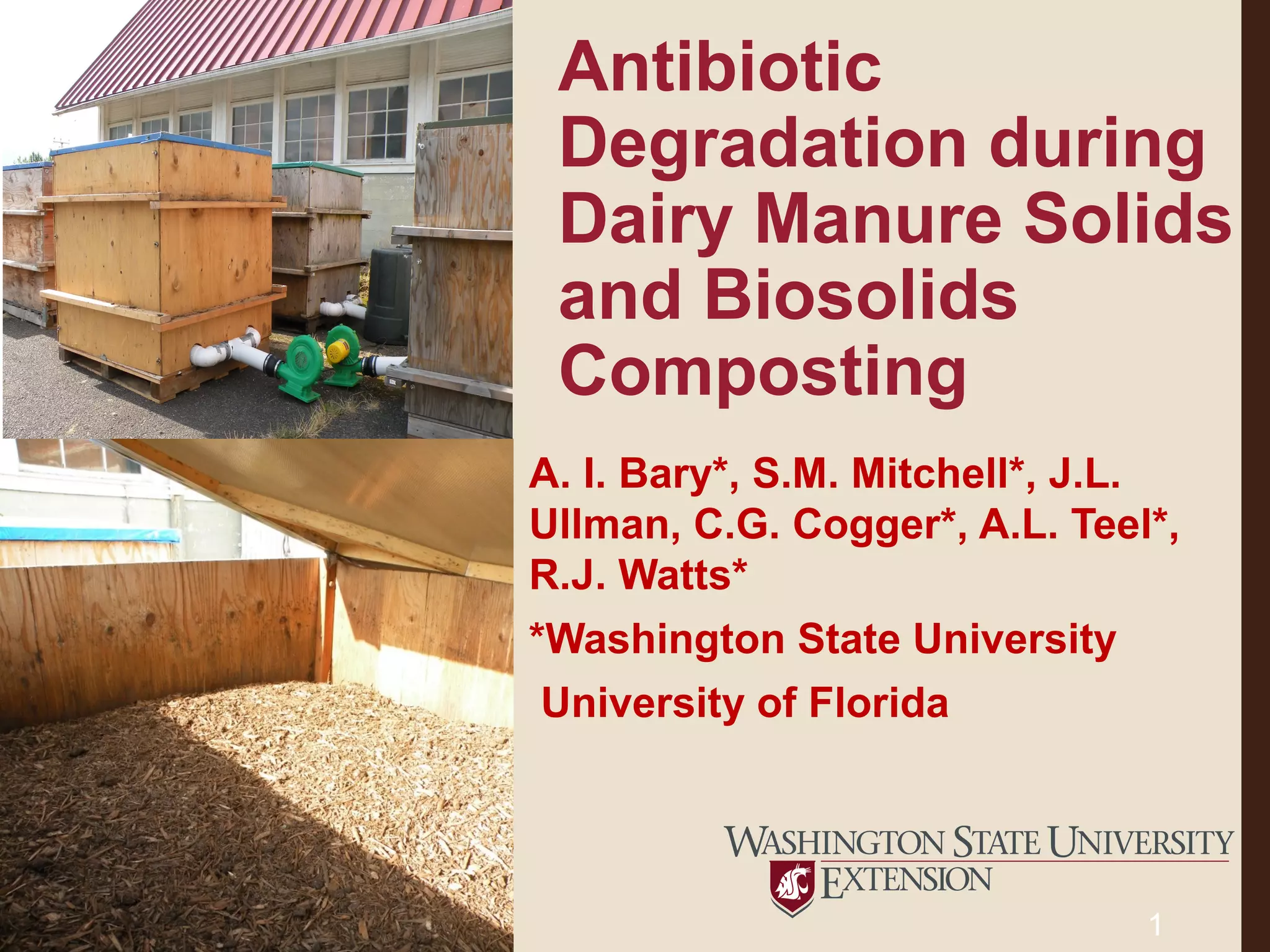
Antibiotic
Degradation during
Dairy Manure Solids
and Biosolids
Composting
A. I. Bary*, S.M. Mitchell*, J.L.
Ullman, C.G. Cogger*, A.L. Teel*,
R.J. Watts*
*Washington State University
University of Florida
1
Introduction
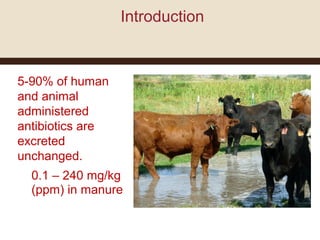
• 5-90% of human
and animal
administered
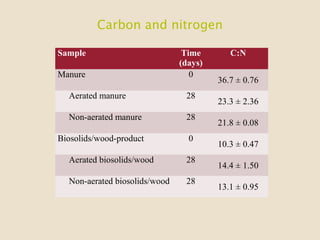
antibiotics are
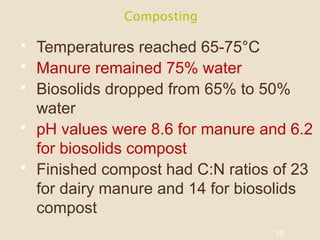
excreted
unchanged.
• 0.1 – 240 mg/kg
(ppm) in manure
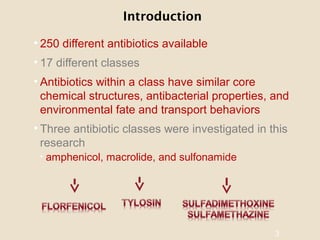
• 250 different antibiotics available
• 17 different classes
• Antibiotics within a class have similar core
chemical structures, antibacterial properties, and
environmental fate and transport behaviors
• Three antibiotic classes were investigated in this
research
• amphenicol, macrolide, and sulfonamide
3
Introduction
4
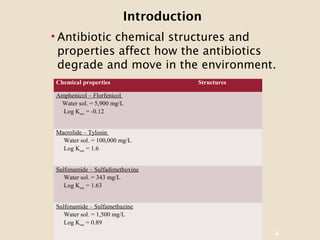
Chemical properties Structures
Amphenicol – Florfenicol
Water sol. = 5,900 mg/L
Log Kow = -0.12
Macrolide – Tylosin
Water sol. = 100,000 mg/L
Log Kow = 1.6
Sulfonamide – Sulfadimethoxine
Water sol. = 343 mg/L
Log Kow = 1.63
Sulfonamide – Sulfamethazine
Water sol. = 1,500 mg/L
Log Kow = 0.89
• Antibiotic chemical structures and
properties affect how the antibiotics
degrade and move in the environment.
Introduction
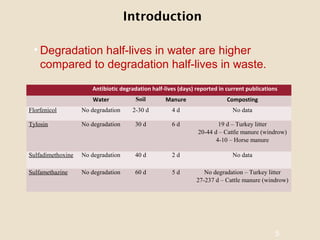
• Degradation half-lives in water are higher
compared to degradation half-lives in waste.
5
Antibiotic degradation half-lives (days) reported in current publications
Water Soil Manure Composting
Florfenicol No degradation 2-30 d 4 d No data
Tylosin No degradation 30 d 6 d 19 d – Turkey litter
20-44 d – Cattle manure (windrow)
4-10 – Horse manure
Sulfadimethoxine No degradation 40 d 2 d No data
Sulfamethazine No degradation 60 d 5 d No degradation – Turkey litter
27-237 d – Cattle manure (windrow)
Introduction
6
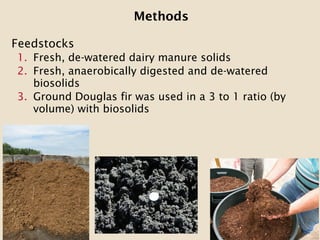
Feedstocks
1. Fresh, de-watered dairy manure solids
2. Fresh, anaerobically digested and de-watered
biosolids
3. Ground Douglas fir was used in a 3 to 1 ratio (by
volume) with biosolids
Methods
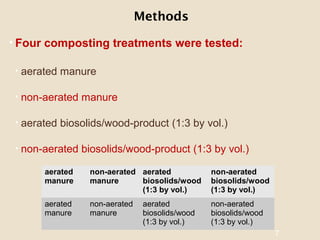
• Four composting treatments were tested:
• aerated manure
• non-aerated manure
• aerated biosolids/wood-product (1:3 by vol.)
• non-aerated biosolids/wood-product (1:3 by vol.)
7
aerated
manure
non-aerated
manure
aerated
biosolids/wood
(1:3 by vol.)
non-aerated
biosolids/wood
(1:3 by vol.)
aerated
manure
non-aerated
manure
aerated
biosolids/wood
(1:3 by vol.)
non-aerated
biosolids/wood
(1:3 by vol.)
Methods
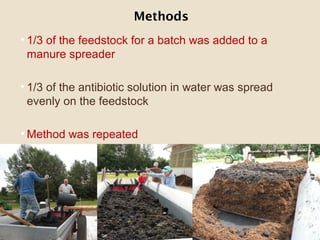
• 1/3 of the feedstock for a batch was added to a
manure spreader
• 1/3 of the antibiotic solution in water was spread
evenly on the feedstock
• Method was repeated
8
Methods
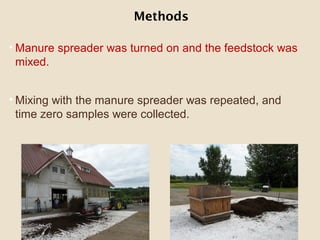
• Manure spreader was turned on and the feedstock was
mixed.
• Mixing with the manure spreader was repeated, and
time zero samples were collected.
9
Methods
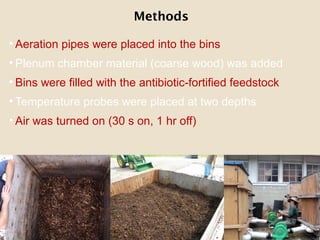
• Aeration pipes were placed into the bins
• Plenum chamber material (coarse wood) was added
• Bins were filled with the antibiotic-fortified feedstock
• Temperature probes were placed at two depths
• Air was turned on (30 s on, 1 hr off)
10
Methods
Results: Temperature
11
20
30
40
50
60
70
80
90
0 5 10 15 20 25 30
Aerated manure
Non-aerated manure
Aerated biosolids/wood
Non-aerated biosolids/wood
Temperature(°C)
Time (days)
Oxygen concentration
0.0
5.0
10.0
15.0
20.0
25.0
5 10 15 20 25 30
Data 1
Aerated manure
Non-aerated manure
Aerated biosoids/wood
Non-aerated biosolids/wood
OxygenConcentration(%)
Time (days)
Moisture content
40%
50%
60%
70%
80%
90%
0 4 8 12 16 20 24 28
Aerated manure
Non-aerated manure
Aerated biosolids/wood
Non-aerated biosolids/wood
Moisturecontent
Time (days)
Sample Time (days) pH
Manure 0
8.2
Aerated manure 28
8.5
Non-aerated manure 28
8.6
Biosolids/wood-product 0
7.8
Aerated biosolids/wood 28
6.2
Non-aerated biosolids/wood 28
6.4
Results: pH
Sample Time
(days)
C:N
Manure 0
36.7 ± 0.76
Aerated manure 28
23.3 ± 2.36
Non-aerated manure 28
21.8 ± 0.08
Biosolids/wood-product 0
10.3 ± 0.47
Aerated biosolids/wood 28
14.4 ± 1.50
Non-aerated biosolids/wood 28
13.1 ± 0.95
Carbon and nitrogen
Composting
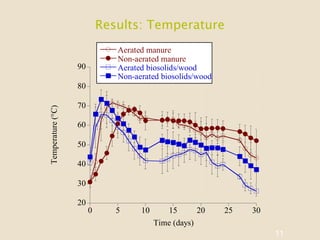
 Temperatures reached 65-75°C
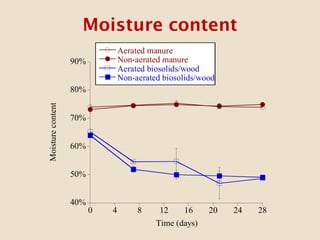
 Manure remained 75% water
 Biosolids dropped from 65% to 50%
water
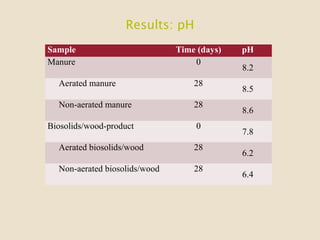
 pH values were 8.6 for manure and 6.2
for biosolids compost
 Finished compost had C:N ratios of 23
for dairy manure and 14 for biosolids
compost
16
Antibiotic concentration over time
17
0.0
0.2
0.4
0.6
0.8
1.0
1.2
0 4 8 12 16 20 24 28
Aerated manure
Non-aerated manure
Aerabted biosolids
Non-aerated biosolids
[Florfenicol]/[Florfenicol]
0
Time (days)
0.0
0.2
0.4
0.6
0.8
1.0
1.2
0 4 8 12 16 20 24 28
[Sulfadimethoxine]/[Sulfadimethoxine]
0
Time (days)
0.0
0.2
0.4
0.6
0.8
1.0
1.2
0 4 8 12 16 20 24 28
[Sulfamethazine]/[Sulfamethazine]
0
Time (days)
0.0
0.2
0.4
0.6
0.8
1.0
1.2
0 4 8 12 16 20 24 28
[Tylosin]/[Tylosin]
0
Time (days)
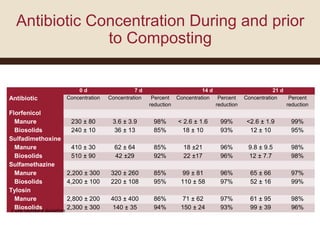
Antibiotic Concentration During and prior
to Composting
  0 d 7 d 14 d 21 d
Antibiotic Concentration Concentration Percent
reduction
Concentration Percent
reduction
Concentration Percent
reduction
Florfenicol
   Manure 230 ± 80 3.6 ± 3.9 98% < 2.6 ± 1.6 99% <2.6 ± 1.9 99%
   Biosolids 240 ± 10 36 ± 13 85% 18 ± 10 93% 12 ± 10 95%
Sulfadimethoxine
   Manure 410 ± 30 62 ± 64 85% 18 ±21 96% 9.8 ± 9.5 98%
   Biosolids 510 ± 90 42 ±29 92% 22 ±17 96% 12 ± 7.7 98%
Sulfamethazine
   Manure 2,200 ± 300 320 ± 260 85% 99 ± 81 96% 65 ± 66 97%
   Biosolids 4,200 ± 100 220 ± 108 95% 110 ± 58 97% 52 ± 16 99%
Tylosin
   Manure 2,800 ± 200 403 ± 400 86% 71 ± 62 97% 61 ± 95 98%
   Biosolids 2,300 ± 300 140 ± 35 94% 150 ± 24 93% 99 ± 39 96%± one standard deviation
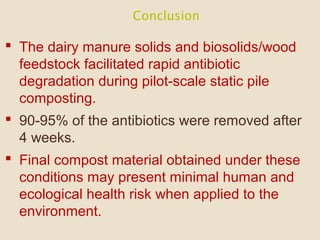
Conclusion
 The dairy manure solids and biosolids/wood
feedstock facilitated rapid antibiotic
degradation during pilot-scale static pile
composting.
 90-95% of the antibiotics were removed after
4 weeks.
 Final compost material obtained under these
conditions may present minimal human and
ecological health risk when applied to the
environment.
Thank You!

Antibiotic Losses during Thermophilic Composting

  • 1.
    Antibiotic Degradation during Dairy ManureSolids and Biosolids Composting A. I. Bary*, S.M. Mitchell*, J.L. Ullman, C.G. Cogger*, A.L. Teel*, R.J. Watts* *Washington State University University of Florida 1
  • 2.
    Introduction • 5-90% ofhuman and animal administered antibiotics are excreted unchanged. • 0.1 – 240 mg/kg (ppm) in manure
  • 3.
    • 250 differentantibiotics available • 17 different classes • Antibiotics within a class have similar core chemical structures, antibacterial properties, and environmental fate and transport behaviors • Three antibiotic classes were investigated in this research • amphenicol, macrolide, and sulfonamide 3 Introduction
  • 4.
    4 Chemical properties Structures Amphenicol– Florfenicol Water sol. = 5,900 mg/L Log Kow = -0.12 Macrolide – Tylosin Water sol. = 100,000 mg/L Log Kow = 1.6 Sulfonamide – Sulfadimethoxine Water sol. = 343 mg/L Log Kow = 1.63 Sulfonamide – Sulfamethazine Water sol. = 1,500 mg/L Log Kow = 0.89 • Antibiotic chemical structures and properties affect how the antibiotics degrade and move in the environment. Introduction
  • 5.
    • Degradation half-livesin water are higher compared to degradation half-lives in waste. 5 Antibiotic degradation half-lives (days) reported in current publications Water Soil Manure Composting Florfenicol No degradation 2-30 d 4 d No data Tylosin No degradation 30 d 6 d 19 d – Turkey litter 20-44 d – Cattle manure (windrow) 4-10 – Horse manure Sulfadimethoxine No degradation 40 d 2 d No data Sulfamethazine No degradation 60 d 5 d No degradation – Turkey litter 27-237 d – Cattle manure (windrow) Introduction
  • 6.
    6 Feedstocks 1. Fresh, de-watereddairy manure solids 2. Fresh, anaerobically digested and de-watered biosolids 3. Ground Douglas fir was used in a 3 to 1 ratio (by volume) with biosolids Methods
  • 7.
    • Four compostingtreatments were tested: • aerated manure • non-aerated manure • aerated biosolids/wood-product (1:3 by vol.) • non-aerated biosolids/wood-product (1:3 by vol.) 7 aerated manure non-aerated manure aerated biosolids/wood (1:3 by vol.) non-aerated biosolids/wood (1:3 by vol.) aerated manure non-aerated manure aerated biosolids/wood (1:3 by vol.) non-aerated biosolids/wood (1:3 by vol.) Methods
  • 8.
    • 1/3 ofthe feedstock for a batch was added to a manure spreader • 1/3 of the antibiotic solution in water was spread evenly on the feedstock • Method was repeated 8 Methods
  • 9.
    • Manure spreaderwas turned on and the feedstock was mixed. • Mixing with the manure spreader was repeated, and time zero samples were collected. 9 Methods
  • 10.
    • Aeration pipeswere placed into the bins • Plenum chamber material (coarse wood) was added • Bins were filled with the antibiotic-fortified feedstock • Temperature probes were placed at two depths • Air was turned on (30 s on, 1 hr off) 10 Methods
  • 11.
    Results: Temperature 11 20 30 40 50 60 70 80 90 0 510 15 20 25 30 Aerated manure Non-aerated manure Aerated biosolids/wood Non-aerated biosolids/wood Temperature(°C) Time (days)
  • 12.
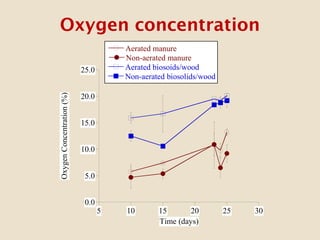
    Oxygen concentration 0.0 5.0 10.0 15.0 20.0 25.0 5 1015 20 25 30 Data 1 Aerated manure Non-aerated manure Aerated biosoids/wood Non-aerated biosolids/wood OxygenConcentration(%) Time (days)
  • 13.
    Moisture content 40% 50% 60% 70% 80% 90% 0 48 12 16 20 24 28 Aerated manure Non-aerated manure Aerated biosolids/wood Non-aerated biosolids/wood Moisturecontent Time (days)
  • 14.
    Sample Time (days)pH Manure 0 8.2 Aerated manure 28 8.5 Non-aerated manure 28 8.6 Biosolids/wood-product 0 7.8 Aerated biosolids/wood 28 6.2 Non-aerated biosolids/wood 28 6.4 Results: pH
  • 15.
    Sample Time (days) C:N Manure 0 36.7± 0.76 Aerated manure 28 23.3 ± 2.36 Non-aerated manure 28 21.8 ± 0.08 Biosolids/wood-product 0 10.3 ± 0.47 Aerated biosolids/wood 28 14.4 ± 1.50 Non-aerated biosolids/wood 28 13.1 ± 0.95 Carbon and nitrogen
  • 16.
    Composting  Temperatures reached65-75°C  Manure remained 75% water  Biosolids dropped from 65% to 50% water  pH values were 8.6 for manure and 6.2 for biosolids compost  Finished compost had C:N ratios of 23 for dairy manure and 14 for biosolids compost 16
  • 17.
    Antibiotic concentration overtime 17 0.0 0.2 0.4 0.6 0.8 1.0 1.2 0 4 8 12 16 20 24 28 Aerated manure Non-aerated manure Aerabted biosolids Non-aerated biosolids [Florfenicol]/[Florfenicol] 0 Time (days) 0.0 0.2 0.4 0.6 0.8 1.0 1.2 0 4 8 12 16 20 24 28 [Sulfadimethoxine]/[Sulfadimethoxine] 0 Time (days) 0.0 0.2 0.4 0.6 0.8 1.0 1.2 0 4 8 12 16 20 24 28 [Sulfamethazine]/[Sulfamethazine] 0 Time (days) 0.0 0.2 0.4 0.6 0.8 1.0 1.2 0 4 8 12 16 20 24 28 [Tylosin]/[Tylosin] 0 Time (days)
  • 18.
    Antibiotic Concentration Duringand prior to Composting   0 d 7 d 14 d 21 d Antibiotic Concentration Concentration Percent reduction Concentration Percent reduction Concentration Percent reduction Florfenicol    Manure 230 ± 80 3.6 ± 3.9 98% < 2.6 ± 1.6 99% <2.6 ± 1.9 99%    Biosolids 240 ± 10 36 ± 13 85% 18 ± 10 93% 12 ± 10 95% Sulfadimethoxine    Manure 410 ± 30 62 ± 64 85% 18 ±21 96% 9.8 ± 9.5 98%    Biosolids 510 ± 90 42 ±29 92% 22 ±17 96% 12 ± 7.7 98% Sulfamethazine    Manure 2,200 ± 300 320 ± 260 85% 99 ± 81 96% 65 ± 66 97%    Biosolids 4,200 ± 100 220 ± 108 95% 110 ± 58 97% 52 ± 16 99% Tylosin    Manure 2,800 ± 200 403 ± 400 86% 71 ± 62 97% 61 ± 95 98%    Biosolids 2,300 ± 300 140 ± 35 94% 150 ± 24 93% 99 ± 39 96%± one standard deviation
  • 19.
    Conclusion  The dairymanure solids and biosolids/wood feedstock facilitated rapid antibiotic degradation during pilot-scale static pile composting.  90-95% of the antibiotics were removed after 4 weeks.  Final compost material obtained under these conditions may present minimal human and ecological health risk when applied to the environment.
  • 20.

Editor's Notes

  • #13 78 The percent oxygen was 5% or greater from 10-25 days, so all the bins were operating under aerobic conditions. The type of feedstock material had a large effect on the temperature. The less dense biosolids and wood mixture compost had higher oxygen concentrations compared to the less dense manure compost. The forced aeration treatments were only slightly higher than the passive aeration treatments. This may be due to the low volume pilot-scale bins that were used.
  • #14 79 The moisture content remained at 73% in the manure compost. The biosolids and wood mixture compost started out at about 65% water and then decreased to about 50%. Again, there was no difference between the aerated vs. non-aerated treatments.
  • #15 80 The pH of the manure started out at 8.2 and the pH increased to about 8.6 after the 28 d composting period. The pH of the biosolids and wood mixture started out at about 7.8 and it decreased to about 6.3.
  • #16 81 The carbon to nitrogen ratio in the manure was 37 and it dropped to about 22. The C:N in the biosolids and wood mixture was 10 and it increased to about 14.
  • #21 91 That concludes my dissertation presentation. I would like to acknowledge the EPA STAR fellowship program for 3 years of funding, and I want to thank my committee members and lab group as well. Thank you for your attention. Are there any questions?