Disinfection
By S.D.Mankar
Assistant Professor
Pravra Rural College of Pharmacy,Loni
Disinfection is the process of destruction or
removal of microorganism and reducing
them to a level not harmful to health.
Generally kills vegetative cells but not heat
resistant endospores.
If the object is inanimate e.g working
areas,dishes, benches etc. the chemical
agent is known as disinfectant.
Chemical classification
Acid & Alkali:-
The germicidal activity of acid is
proportional to H+ ion concentration of
there solution.
Mainly HCL, H2SO4 HNO3 and phosphorous
acid act as generator for H+ ions.
Similarly germicidal action of alkalis is
depends on dissociation & release of OH-
ions in solution.
Halogens:-
Chlorine, iodine,bromine& fluorine in the free
state as well as there compounds strongly act
germicidal.
Chlorine & Iodine are effective antimicrobial
agent.
Iodine is one of the oldest & Most effective
antiseptics.
It is effective against all kind of bacteria,
endospore, fungi, & some viruses.
Also skin disinfectant & for cold sterilization of
surgical sutures.
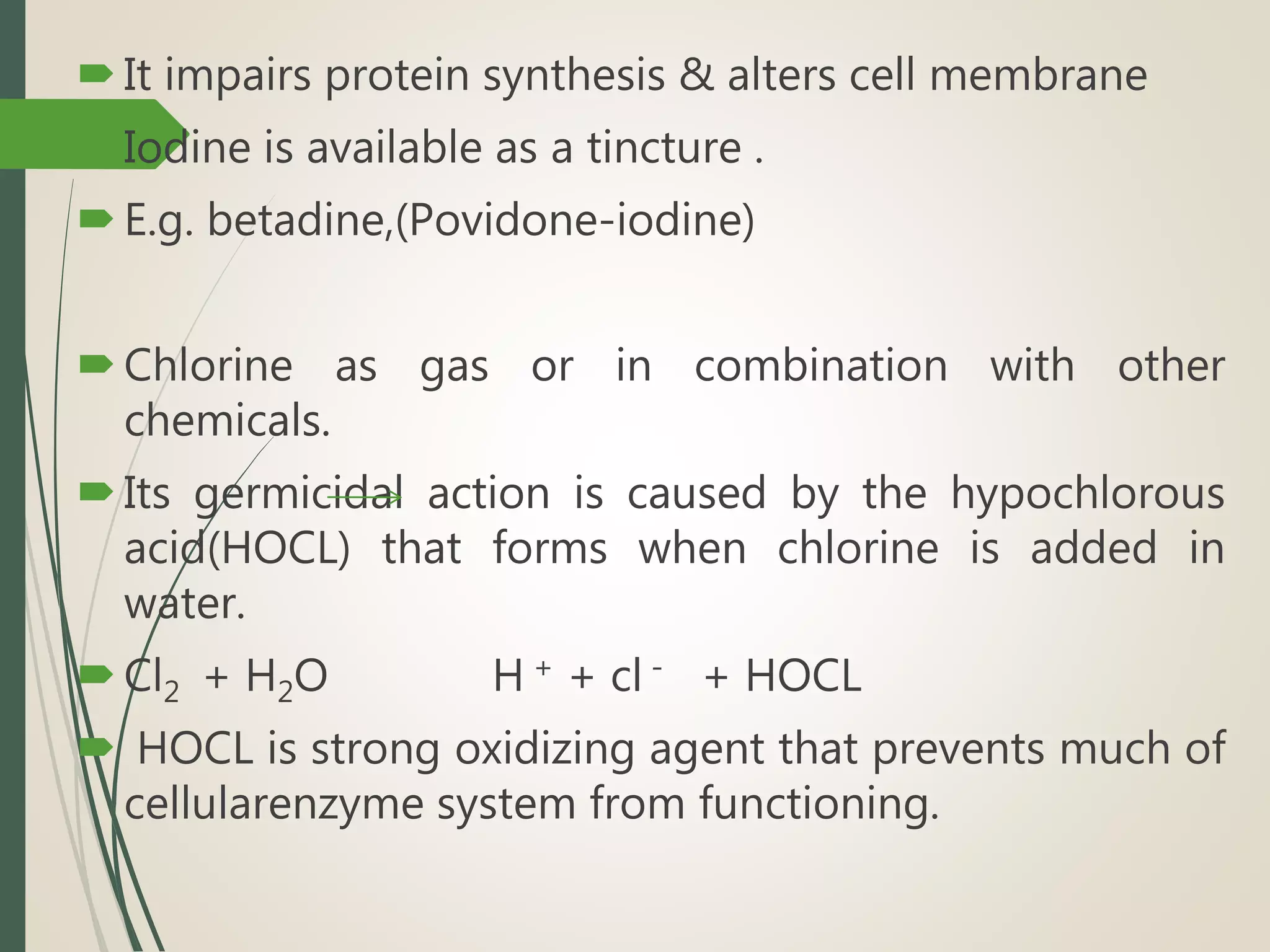
It impairs protein synthesis & alters cell membrane
Iodine is available as a tincture .
E.g. betadine,(Povidone-iodine)
Chlorine as gas or in combination with other
chemicals.
Its germicidal action is caused by the hypochlorous
acid(HOCL) that forms when chlorine is added in
water.
Cl2 + H2O H + + cl - + HOCL
 HOCL is strong oxidizing agent that prevents much of
cellularenzyme system from functioning.
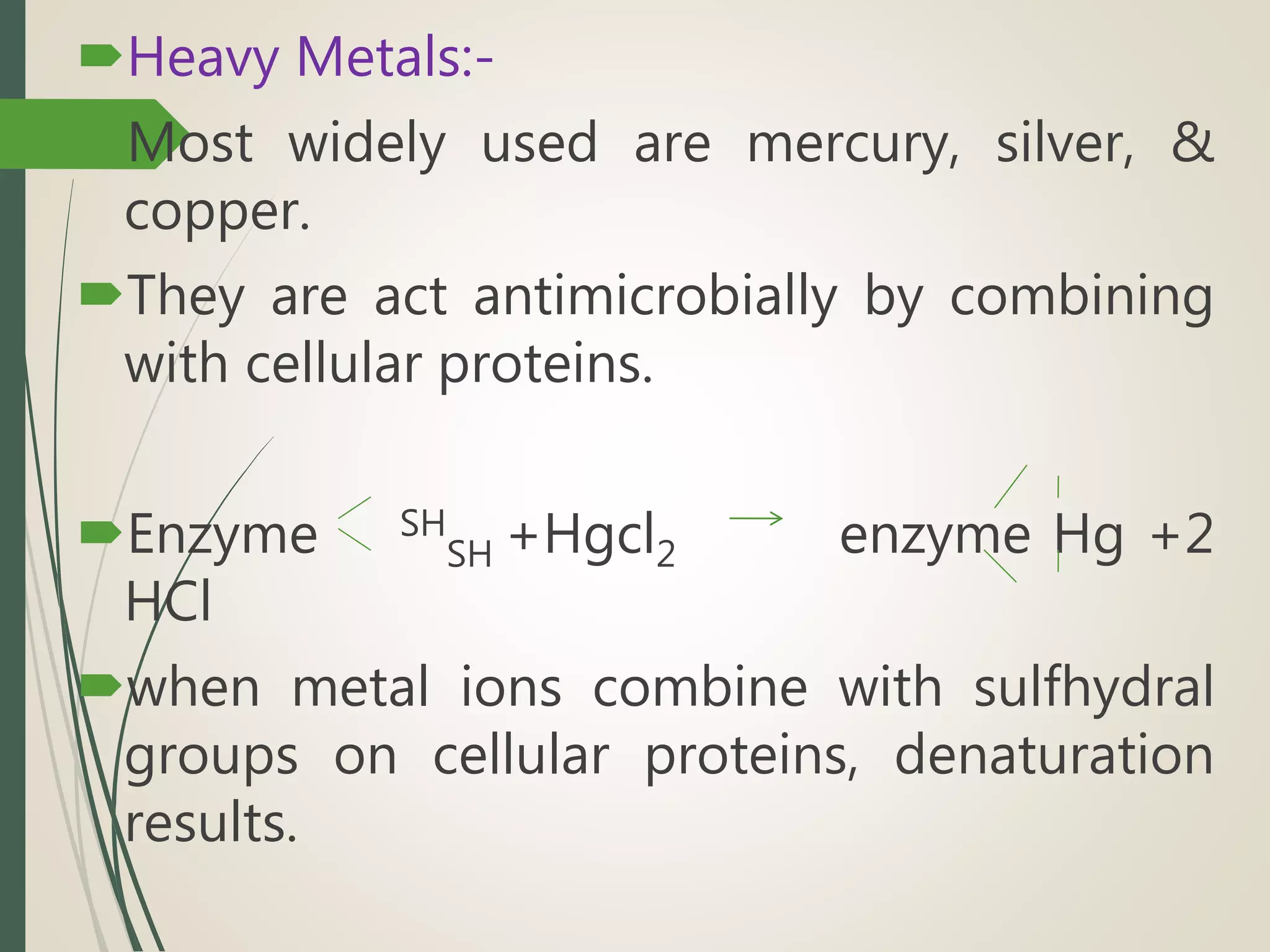
Heavy Metals:-
Most widely used are mercury, silver, &
copper.
They are act antimicrobially by combining
with cellular proteins.
Enzyme SH
SH +Hgcl2 enzyme Hg +2
HCl
when metal ions combine with sulfhydral
groups on cellular proteins, denaturation
results.
Phenol & Its derivatives:-
These are obtained by distillation of coal tar &
have powerful microbiocidal action.
Many derivatives of phenols are more
effective and less costly such as cresol are
more germicidal than phenol when they are
emulsified in liquid soaps & alkalies.
Phenolic compound mainly destroy M.O. by
process of disruption of cells, ppt. pf cell
protein & inactivation of enzyme.
5. Alcohol:-
 They have rapid bacteriocidal action
against vegetative bacteria when dil. To conc.
To 60 to 70 % v/v with water.
Ethanol & isopropanaol are used as skin
disinfectants while methanol used as
fungicidal.
Alcohols are protein denaturants & damage
lipid complex in cell membrane.
6. Aldehyde:-
 formaldehyde is main aldehyde use for
disinfectant action.
It is effective as gas or as an aq.sol.
Containing 34-38% w/w of H.CHO.
Glutaraldehyde is a dialdehyde with rapid
sporicidal and tuberculocidal action.
It is used 2 % aq.solution.
7. Quaternary Ammonium compounds:-
Most of cationic detergents are . Quaternary
Ammonium compounds and they are highly active
against gram + ve bacteria ant quite active against
gram –Ve bacteria.
There mode of action is disruption of cell wall and
membranes and also denaturation of proteins &
inactivation of enzymes.
Are widely used for control of M.O.on floors, walls,
nursing homes & other public places

Also used as skin antiseptic and as sanitizing agent in
dairy, egg & fishing industries.
8. Dyes:-
Number of dyes have been uses to inhibit the
bacterial growth.
Basic dyes are more effective bacteriocides
than acidic dyes.
E.g.Triphenyl methane, acridine.
9.Dteregent and soaps:-
They are widely used as Surface active agents,
wetting agents, and emulsifiers.
They are mainly classified in four classes.
1. Anionic
2.Catioinic
3.Non-ionic
4.Amphoteric
 most imp. Antimicrobial agent are cationic
surfactants.
E.g.benzylammonium chloride.
The most important antibacterial agents are
the cationic surface active agents. Eg:
cetrimide, benzalkonium chloride etc.
 Soaps and sodium lauryl sulfate are
anionic compounds.
Soaps prepared from saturated fatty acids
are more effective against gram negative
bacilli while those prepared from
unsaturated acids have greater action
against gram positive.
 Nonionic detergents are not ionized.
However these substances do not posses
significient anti-microbial activity.
 Amphoteric compounds have the
detergent properties of anionic surfactants
combined with disinfectant properties of
cationic surfactants.
Eg: Tego compounds.
Factors affecting on Disinfectant action:-
1.conc. Of disinfectant
2.temp.
3. time of exposure
4. pH of environment
5.Surface tension
6.Formulation of disinfectant
7.Chemical structure of disinfectant
8. types an no of M.O. present
9.interfering sub.in environment
10.potentiation, synergism, antagonism.
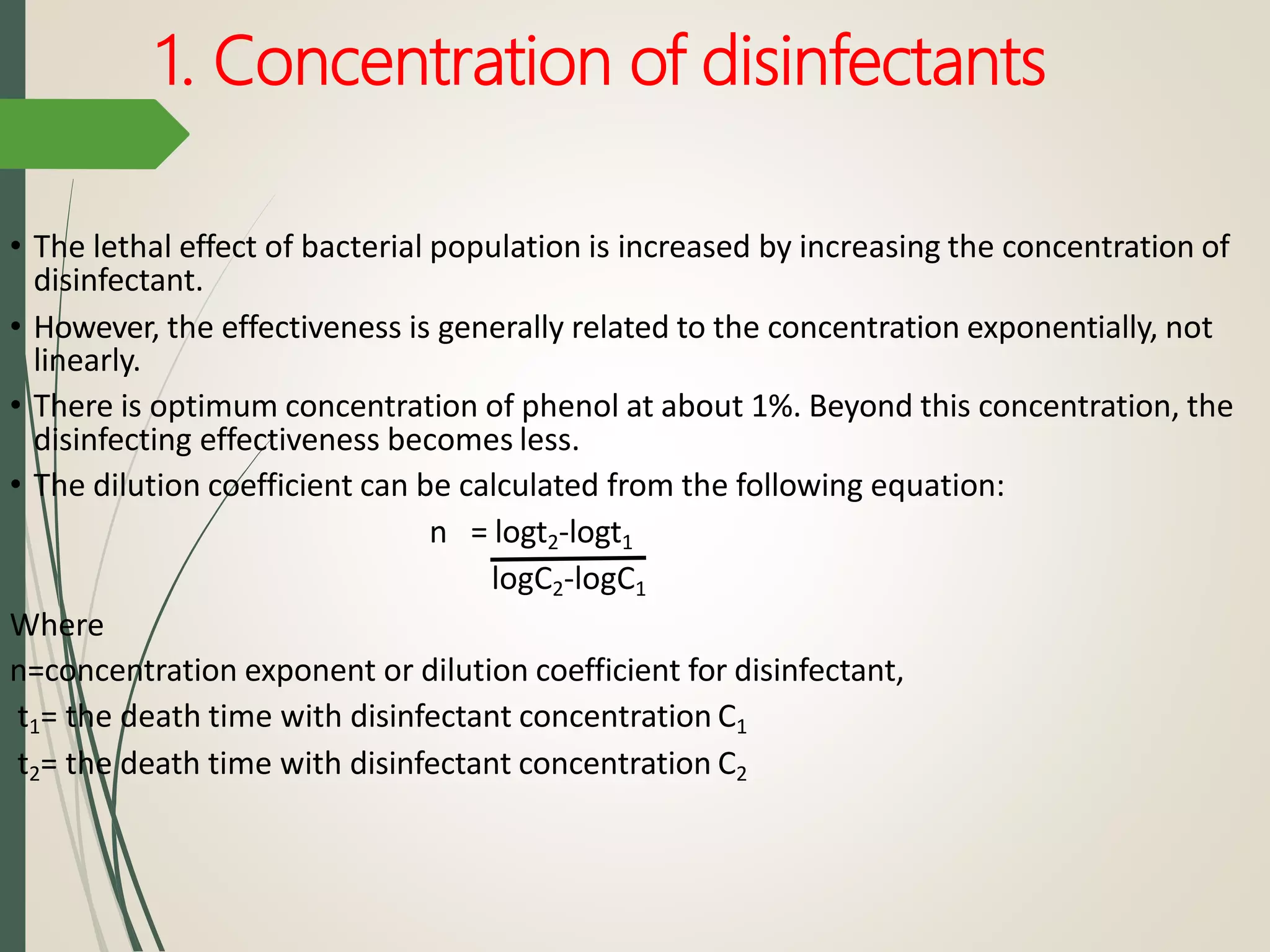
1. Concentration of disinfectants
• The lethal effect of bacterial population is increased by increasing the concentration of
disinfectant.
• However, the effectiveness is generally related to the concentration exponentially, not
linearly.
• There is optimum concentration of phenol at about 1%. Beyond this concentration, the
disinfecting effectiveness becomes less.
• The dilution coefficient can be calculated from the following equation:
n = logt2-logt1
logC2-logC1
Where
n=concentration exponent or dilution coefficient for disinfectant,
t1= the death time with disinfectant concentration C1
t2= the death time with disinfectant concentration C2
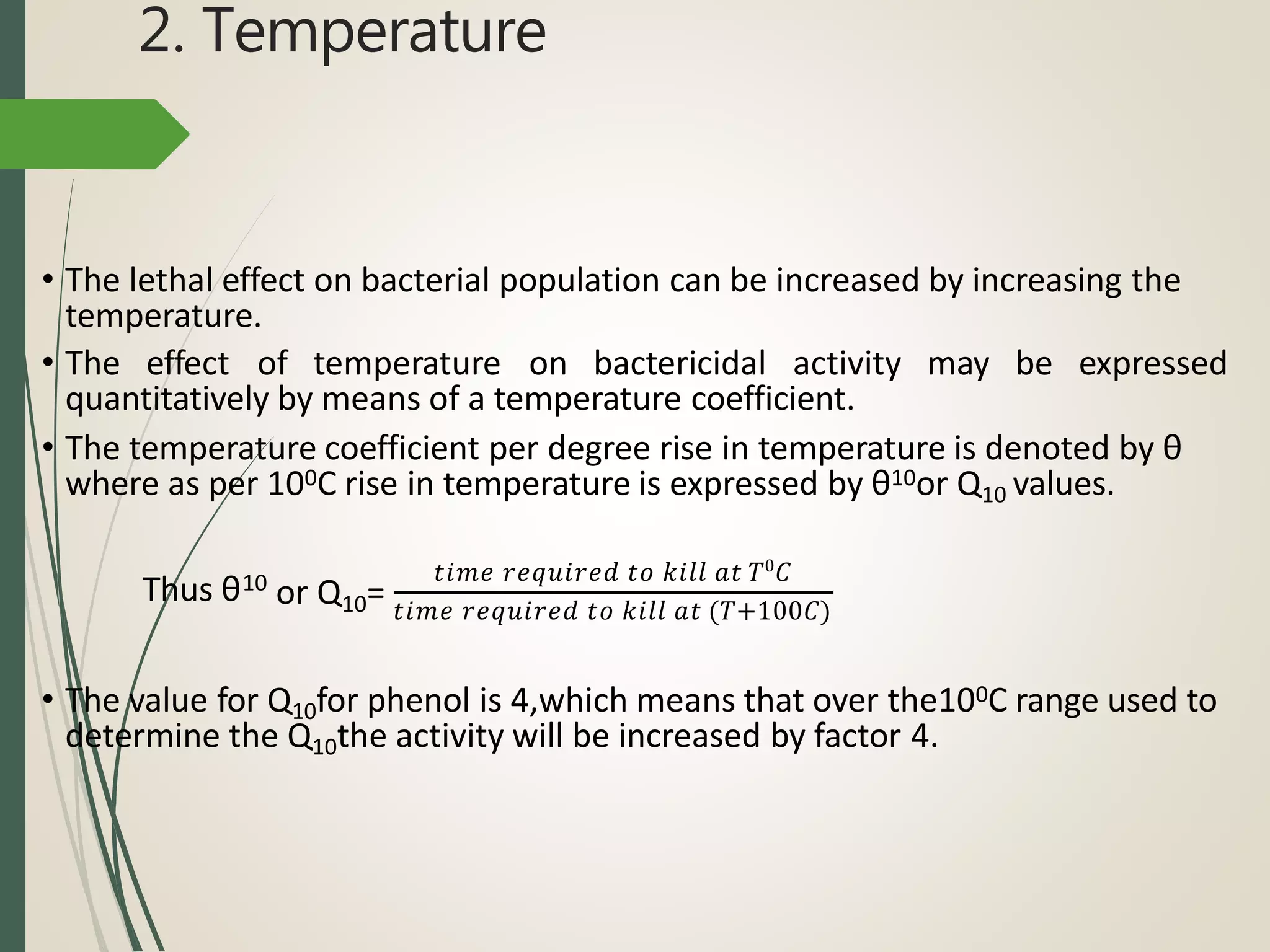
2. Temperature
• The lethal effect on bacterial population can be increased by increasing the
temperature.
• The effect of temperature on bactericidal activity may be expressed
quantitatively by means of a temperature coefficient.
• The temperature coefficient per degree rise in temperature is denoted by θ
where as per 100C rise in temperature is expressed by θ10or Q10 values.
Thus θ10 𝑡𝑖𝑚𝑒 𝑟𝑒𝑞𝑢𝑖𝑟𝑒𝑑 𝑡𝑜 𝑘𝑖𝑙𝑙 𝑎𝑡 𝑇0
𝐶
or Q10= 𝑡𝑖𝑚𝑒 𝑟𝑒𝑞𝑢𝑖𝑟𝑒𝑑 𝑡𝑜 𝑘𝑖𝑙𝑙 𝑎𝑡 (𝑇+100𝐶)
• The value for Q10for phenol is 4,which means that over the100C range used to
determine the Q10the activity will be increased by factor 4.
3. Time of contact
• Sufficient time of contact must be allowed for the disinfectant to exert its
action.
4. pH of the environment
• A change of pH during the disinfection process can affect the rate of growth
inoculum.
• A pH of 6-8 is optimal for the growth of many bacteria and the rate of
growth declines on either side of the range.
• Phenolic and acidic antimicrobial agents usually have greatest activity in
acidic conditions.
• Acridine dyes and quaternary ammonium compounds are usually more
active in alkaline then in acidic solutions.
• Amphoteric antimicrobials (Tego compounds) have optimum activities at
widely differing pH values.
5. Chemical structure of disinfectant
• Chemical structures of compounds affects the disinfectant activity.
• Substitution of an alkyl chain upto 6 carbons in length in para
position to phenolic –OH group increases activity but greater than 6
carbons in length decreases water solubility and disinfectant
activity.
• Generally, halogenation increases the antibacterial activity of phenol
but nitration increases antibacterial activity and systematic toxicity
also.
6. Formulation of Disinfectant
• Formulation may be imp. Of the effective use of disinfectant.
• E.g.chlorhexadine shows 70 % more effectiveness in alcohol than aq.
Solution.
7. Types and number of micro-organisms
present
• The efficiency of disinfection greatly depends on the nature and
the number of contaminating microorganisms and especially on
the presence and absence of bacterial spores.
• It can be seen that most vegetative bacteria are rapidly killed by
most chemical disinfectants.
• Bacterial spores are difficult to destroy but some disinfectants e.g
aldehyde are sporicidal.
8. Interfering substances in the env.
• Material such as blood, body fluids, pus, milk, food residues or
colloidal proteins may reduce the effectiveness of disinfectant if
present in small amounts.
• The presence of oil and fat markedly reduces the disinfecting ability
of phenolics.
9. Potentiation, synergism and antagonism of
disinfactants
• Potentiation of a disinfectant leads to enhanced antimicrobial activity.
• Synergistics effects are often shown by two antimicrobial agents which is
giving an increased activity.
• Antagonism effects are often shown by two antimicrobial agents which is
giving an decreased activity.
Evaluation of antimicrobial agent &
Disinfectants:-
1. Tube dilution and agar plate method.
2. Cup plate method or Cylinder plate method.
3. Ditch- Plate method.
4. Gradient plate technique.
5. Phenol coefficient method (Rideal-Walker test)
Evaluation of antimicrobial agent &
Disinfectants:-
1.Tube dilution & Agar plate method:-
Chemical agent is incorporated into nutrient
broth or agar medium and inoculated with test
M.O.
This tube are incubated at 30-35 C for 2-3 days.
Observed result for turbidity of colonies.
2. filter paper, cup plate & cylindrical plate
method:-
Agar is melted, cooled at 45 C – inoculated
with test M.O. and poured into sterile Petri
plate.
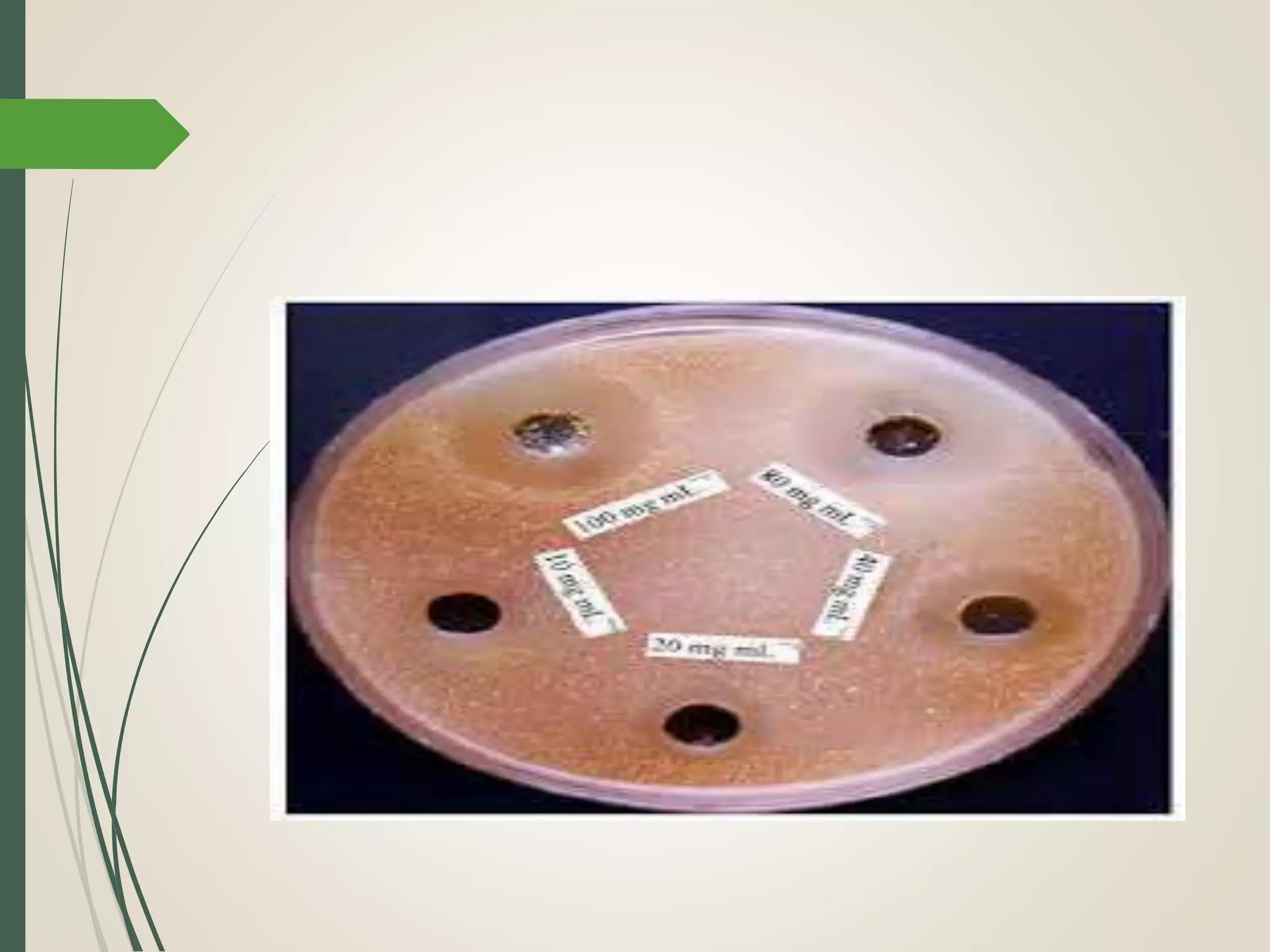
Cup plate method- make holes with cork
and antimicrobial agent is directly placed in to
holes.
Filter paper or cylindrical method spread
antimicrobial agent over solidified agar
medium.
Observe zone of inhibition 30-35 C for 2-3
days.
3. Ditch plate method:-
A solution of antimicrobial agent is carefully
run into ditch which is prepared into agar
A loopful of each M.O. is then stricked from
ditch on agar surface.
The width of zone of inhibition indicates
activity.
4. Phenol- coefficient test:-
In this method test chemical is rated for its
microbial property with reference to phenol
under identical condition.
In this test similar quantity of M.O are added
rising dilution of phenol and of the disinfectant
to be tested.
The phenol coefficient test includes
1.Rideal- walker test
2.Chick martin test
3.USFDA test
4.USAPOAC test
 this test is suitable for testing disinfectant miscible
with water and exert there antimicrobial action in a
manner similar to that phenol.
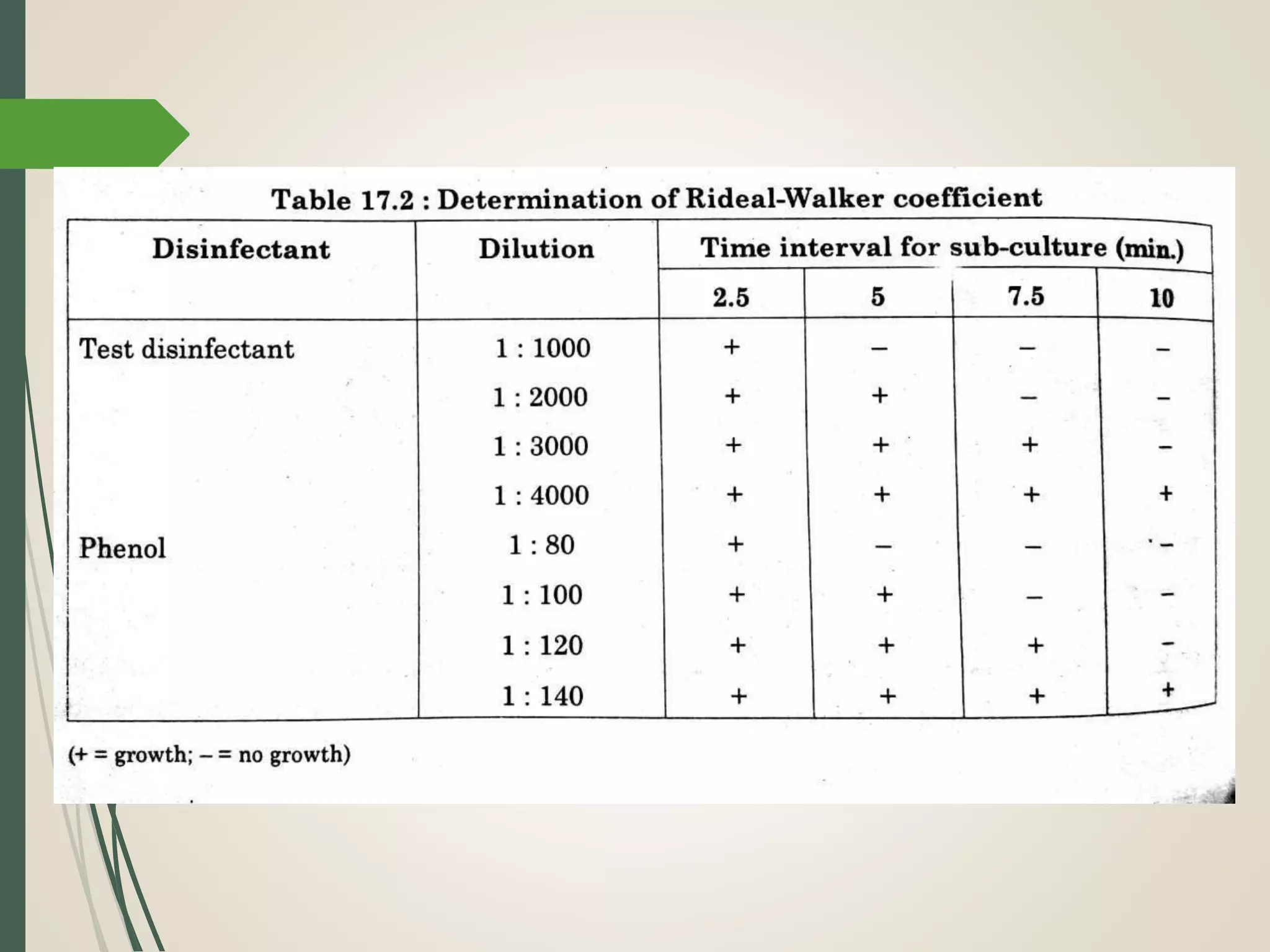
The phenol coefficient of test disinfectant may be
calculated by radial walker test, that use radial
walker broth and salmonella typhi as a sensitive
M.O.
Different dilution of test disinfectant and phenol
are prepared and 5 ml of each dilution is
inoculated with 0.5 ml of 24 hrs of broth culture of
organisms.
 all tubes are placed in 17.5 C in water bath.
Subcultured of each reaction mixture are taken
an transferred to 5 ml of sterile broth after 2.5,
5, 7.5, 10 mins.
The broth culture tubes are incubated at 37 C
for 48-72 hrs and are examined for presence or
absence of growth.
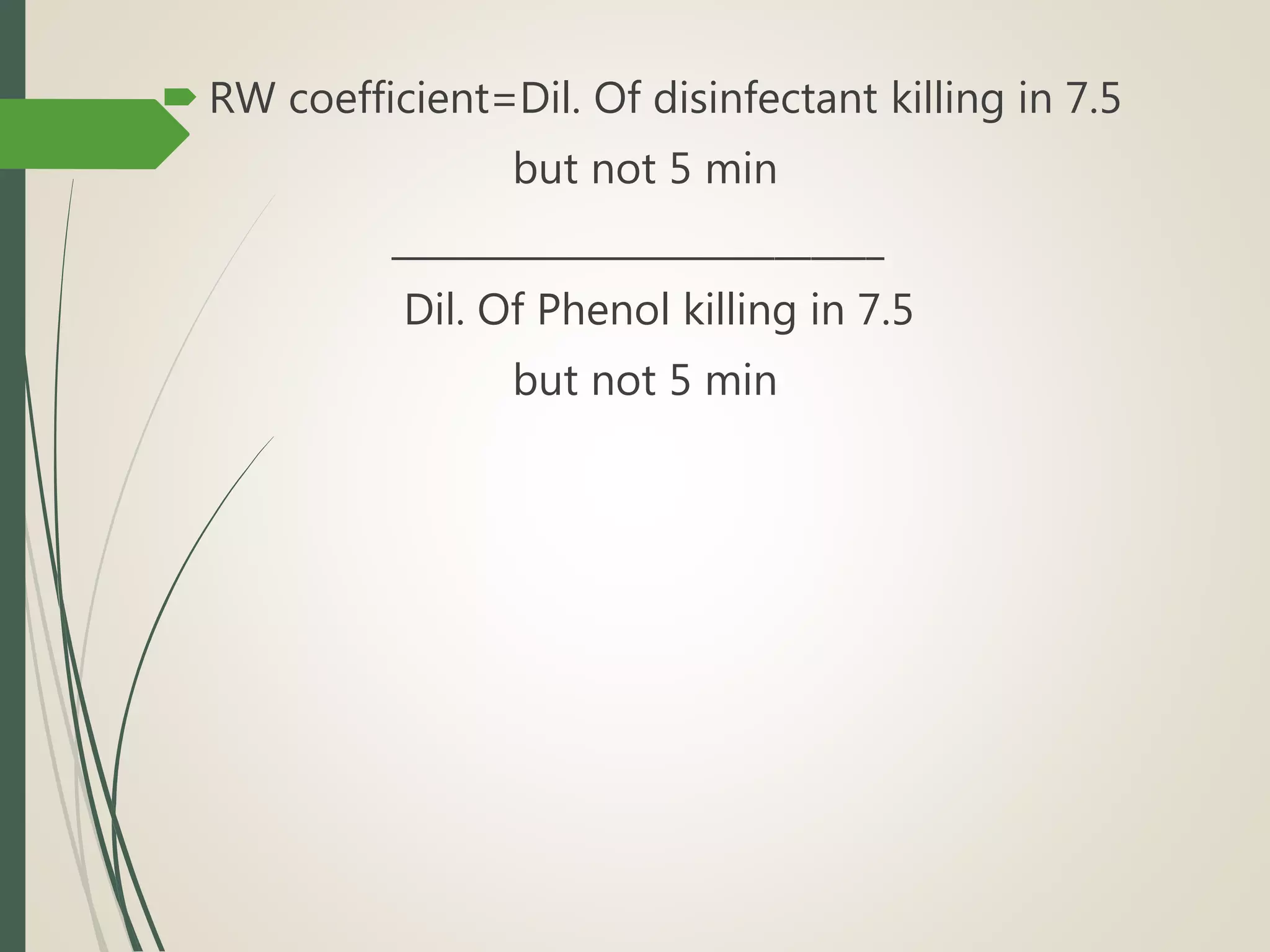
 RW coefficient=Dil. Of disinfectant killing in 7.5
but not 5 min
___________________________
Dil. Of Phenol killing in 7.5
but not 5 min
If the phenol coefficient of the test
disinfectant is one means that disinfectant
has effectiveness as phenol.
If less than one that means less effective &
more than one means more effective than
phenol.
Advantages:-
Inexpensive & easily performed
Reproducible result can be possible
Valuable to eliminate useless product and
supply std. for crude prpn.
Disadvantages:-
Choice of test organism
There is no indication of the activity of
disinfectant in the presence of organic
matter.
No information related to tissue toxicity.
Sampling errors are large.

Disinfection, Definition, classification,Mode of action, factors affecting & Evaluation of disinfectant

  • 1.
  • 2.
    Disinfection is theprocess of destruction or removal of microorganism and reducing them to a level not harmful to health. Generally kills vegetative cells but not heat resistant endospores. If the object is inanimate e.g working areas,dishes, benches etc. the chemical agent is known as disinfectant.
  • 3.
    Chemical classification Acid &Alkali:- The germicidal activity of acid is proportional to H+ ion concentration of there solution. Mainly HCL, H2SO4 HNO3 and phosphorous acid act as generator for H+ ions. Similarly germicidal action of alkalis is depends on dissociation & release of OH- ions in solution.
  • 4.
    Halogens:- Chlorine, iodine,bromine& fluorinein the free state as well as there compounds strongly act germicidal. Chlorine & Iodine are effective antimicrobial agent. Iodine is one of the oldest & Most effective antiseptics. It is effective against all kind of bacteria, endospore, fungi, & some viruses. Also skin disinfectant & for cold sterilization of surgical sutures.
  • 5.
    It impairs proteinsynthesis & alters cell membrane Iodine is available as a tincture . E.g. betadine,(Povidone-iodine) Chlorine as gas or in combination with other chemicals. Its germicidal action is caused by the hypochlorous acid(HOCL) that forms when chlorine is added in water. Cl2 + H2O H + + cl - + HOCL  HOCL is strong oxidizing agent that prevents much of cellularenzyme system from functioning.
  • 6.
    Heavy Metals:- Most widelyused are mercury, silver, & copper. They are act antimicrobially by combining with cellular proteins. Enzyme SH SH +Hgcl2 enzyme Hg +2 HCl when metal ions combine with sulfhydral groups on cellular proteins, denaturation results.
  • 7.
    Phenol & Itsderivatives:- These are obtained by distillation of coal tar & have powerful microbiocidal action. Many derivatives of phenols are more effective and less costly such as cresol are more germicidal than phenol when they are emulsified in liquid soaps & alkalies. Phenolic compound mainly destroy M.O. by process of disruption of cells, ppt. pf cell protein & inactivation of enzyme.
  • 8.
    5. Alcohol:-  Theyhave rapid bacteriocidal action against vegetative bacteria when dil. To conc. To 60 to 70 % v/v with water. Ethanol & isopropanaol are used as skin disinfectants while methanol used as fungicidal. Alcohols are protein denaturants & damage lipid complex in cell membrane.
  • 9.
    6. Aldehyde:-  formaldehydeis main aldehyde use for disinfectant action. It is effective as gas or as an aq.sol. Containing 34-38% w/w of H.CHO. Glutaraldehyde is a dialdehyde with rapid sporicidal and tuberculocidal action. It is used 2 % aq.solution.
  • 10.
    7. Quaternary Ammoniumcompounds:- Most of cationic detergents are . Quaternary Ammonium compounds and they are highly active against gram + ve bacteria ant quite active against gram –Ve bacteria. There mode of action is disruption of cell wall and membranes and also denaturation of proteins & inactivation of enzymes. Are widely used for control of M.O.on floors, walls, nursing homes & other public places
  • 11.
     Also used asskin antiseptic and as sanitizing agent in dairy, egg & fishing industries.
  • 12.
    8. Dyes:- Number ofdyes have been uses to inhibit the bacterial growth. Basic dyes are more effective bacteriocides than acidic dyes. E.g.Triphenyl methane, acridine. 9.Dteregent and soaps:- They are widely used as Surface active agents, wetting agents, and emulsifiers.
  • 13.
    They are mainlyclassified in four classes. 1. Anionic 2.Catioinic 3.Non-ionic 4.Amphoteric  most imp. Antimicrobial agent are cationic surfactants. E.g.benzylammonium chloride.
  • 14.
    The most importantantibacterial agents are the cationic surface active agents. Eg: cetrimide, benzalkonium chloride etc.  Soaps and sodium lauryl sulfate are anionic compounds. Soaps prepared from saturated fatty acids are more effective against gram negative bacilli while those prepared from unsaturated acids have greater action against gram positive.
  • 15.
     Nonionic detergentsare not ionized. However these substances do not posses significient anti-microbial activity.  Amphoteric compounds have the detergent properties of anionic surfactants combined with disinfectant properties of cationic surfactants. Eg: Tego compounds.
  • 16.
    Factors affecting onDisinfectant action:- 1.conc. Of disinfectant 2.temp. 3. time of exposure 4. pH of environment 5.Surface tension 6.Formulation of disinfectant 7.Chemical structure of disinfectant 8. types an no of M.O. present 9.interfering sub.in environment 10.potentiation, synergism, antagonism.
  • 17.
    1. Concentration ofdisinfectants • The lethal effect of bacterial population is increased by increasing the concentration of disinfectant. • However, the effectiveness is generally related to the concentration exponentially, not linearly. • There is optimum concentration of phenol at about 1%. Beyond this concentration, the disinfecting effectiveness becomes less. • The dilution coefficient can be calculated from the following equation: n = logt2-logt1 logC2-logC1 Where n=concentration exponent or dilution coefficient for disinfectant, t1= the death time with disinfectant concentration C1 t2= the death time with disinfectant concentration C2
  • 18.
    2. Temperature • Thelethal effect on bacterial population can be increased by increasing the temperature. • The effect of temperature on bactericidal activity may be expressed quantitatively by means of a temperature coefficient. • The temperature coefficient per degree rise in temperature is denoted by θ where as per 100C rise in temperature is expressed by θ10or Q10 values. Thus θ10 𝑡𝑖𝑚𝑒 𝑟𝑒𝑞𝑢𝑖𝑟𝑒𝑑 𝑡𝑜 𝑘𝑖𝑙𝑙 𝑎𝑡 𝑇0 𝐶 or Q10= 𝑡𝑖𝑚𝑒 𝑟𝑒𝑞𝑢𝑖𝑟𝑒𝑑 𝑡𝑜 𝑘𝑖𝑙𝑙 𝑎𝑡 (𝑇+100𝐶) • The value for Q10for phenol is 4,which means that over the100C range used to determine the Q10the activity will be increased by factor 4.
  • 19.
    3. Time ofcontact • Sufficient time of contact must be allowed for the disinfectant to exert its action. 4. pH of the environment • A change of pH during the disinfection process can affect the rate of growth inoculum. • A pH of 6-8 is optimal for the growth of many bacteria and the rate of growth declines on either side of the range. • Phenolic and acidic antimicrobial agents usually have greatest activity in acidic conditions. • Acridine dyes and quaternary ammonium compounds are usually more active in alkaline then in acidic solutions. • Amphoteric antimicrobials (Tego compounds) have optimum activities at widely differing pH values.
  • 20.
    5. Chemical structureof disinfectant • Chemical structures of compounds affects the disinfectant activity. • Substitution of an alkyl chain upto 6 carbons in length in para position to phenolic –OH group increases activity but greater than 6 carbons in length decreases water solubility and disinfectant activity. • Generally, halogenation increases the antibacterial activity of phenol but nitration increases antibacterial activity and systematic toxicity also.
  • 21.
    6. Formulation ofDisinfectant • Formulation may be imp. Of the effective use of disinfectant. • E.g.chlorhexadine shows 70 % more effectiveness in alcohol than aq. Solution.
  • 22.
    7. Types andnumber of micro-organisms present • The efficiency of disinfection greatly depends on the nature and the number of contaminating microorganisms and especially on the presence and absence of bacterial spores. • It can be seen that most vegetative bacteria are rapidly killed by most chemical disinfectants. • Bacterial spores are difficult to destroy but some disinfectants e.g aldehyde are sporicidal.
  • 23.
    8. Interfering substancesin the env. • Material such as blood, body fluids, pus, milk, food residues or colloidal proteins may reduce the effectiveness of disinfectant if present in small amounts. • The presence of oil and fat markedly reduces the disinfecting ability of phenolics.
  • 24.
    9. Potentiation, synergismand antagonism of disinfactants • Potentiation of a disinfectant leads to enhanced antimicrobial activity. • Synergistics effects are often shown by two antimicrobial agents which is giving an increased activity. • Antagonism effects are often shown by two antimicrobial agents which is giving an decreased activity.
  • 25.
    Evaluation of antimicrobialagent & Disinfectants:- 1. Tube dilution and agar plate method. 2. Cup plate method or Cylinder plate method. 3. Ditch- Plate method. 4. Gradient plate technique. 5. Phenol coefficient method (Rideal-Walker test)
  • 26.
    Evaluation of antimicrobialagent & Disinfectants:- 1.Tube dilution & Agar plate method:- Chemical agent is incorporated into nutrient broth or agar medium and inoculated with test M.O. This tube are incubated at 30-35 C for 2-3 days. Observed result for turbidity of colonies.
  • 27.
    2. filter paper,cup plate & cylindrical plate method:- Agar is melted, cooled at 45 C – inoculated with test M.O. and poured into sterile Petri plate. Cup plate method- make holes with cork and antimicrobial agent is directly placed in to holes. Filter paper or cylindrical method spread antimicrobial agent over solidified agar medium. Observe zone of inhibition 30-35 C for 2-3 days.
  • 29.
    3. Ditch platemethod:- A solution of antimicrobial agent is carefully run into ditch which is prepared into agar A loopful of each M.O. is then stricked from ditch on agar surface. The width of zone of inhibition indicates activity.
  • 30.
    4. Phenol- coefficienttest:- In this method test chemical is rated for its microbial property with reference to phenol under identical condition. In this test similar quantity of M.O are added rising dilution of phenol and of the disinfectant to be tested. The phenol coefficient test includes 1.Rideal- walker test 2.Chick martin test 3.USFDA test 4.USAPOAC test
  • 31.
     this testis suitable for testing disinfectant miscible with water and exert there antimicrobial action in a manner similar to that phenol. The phenol coefficient of test disinfectant may be calculated by radial walker test, that use radial walker broth and salmonella typhi as a sensitive M.O. Different dilution of test disinfectant and phenol are prepared and 5 ml of each dilution is inoculated with 0.5 ml of 24 hrs of broth culture of organisms.
  • 32.
     all tubesare placed in 17.5 C in water bath. Subcultured of each reaction mixture are taken an transferred to 5 ml of sterile broth after 2.5, 5, 7.5, 10 mins. The broth culture tubes are incubated at 37 C for 48-72 hrs and are examined for presence or absence of growth.
  • 33.
     RW coefficient=Dil.Of disinfectant killing in 7.5 but not 5 min ___________________________ Dil. Of Phenol killing in 7.5 but not 5 min
  • 35.
    If the phenolcoefficient of the test disinfectant is one means that disinfectant has effectiveness as phenol. If less than one that means less effective & more than one means more effective than phenol. Advantages:- Inexpensive & easily performed Reproducible result can be possible Valuable to eliminate useless product and supply std. for crude prpn.
  • 36.
    Disadvantages:- Choice of testorganism There is no indication of the activity of disinfectant in the presence of organic matter. No information related to tissue toxicity. Sampling errors are large.