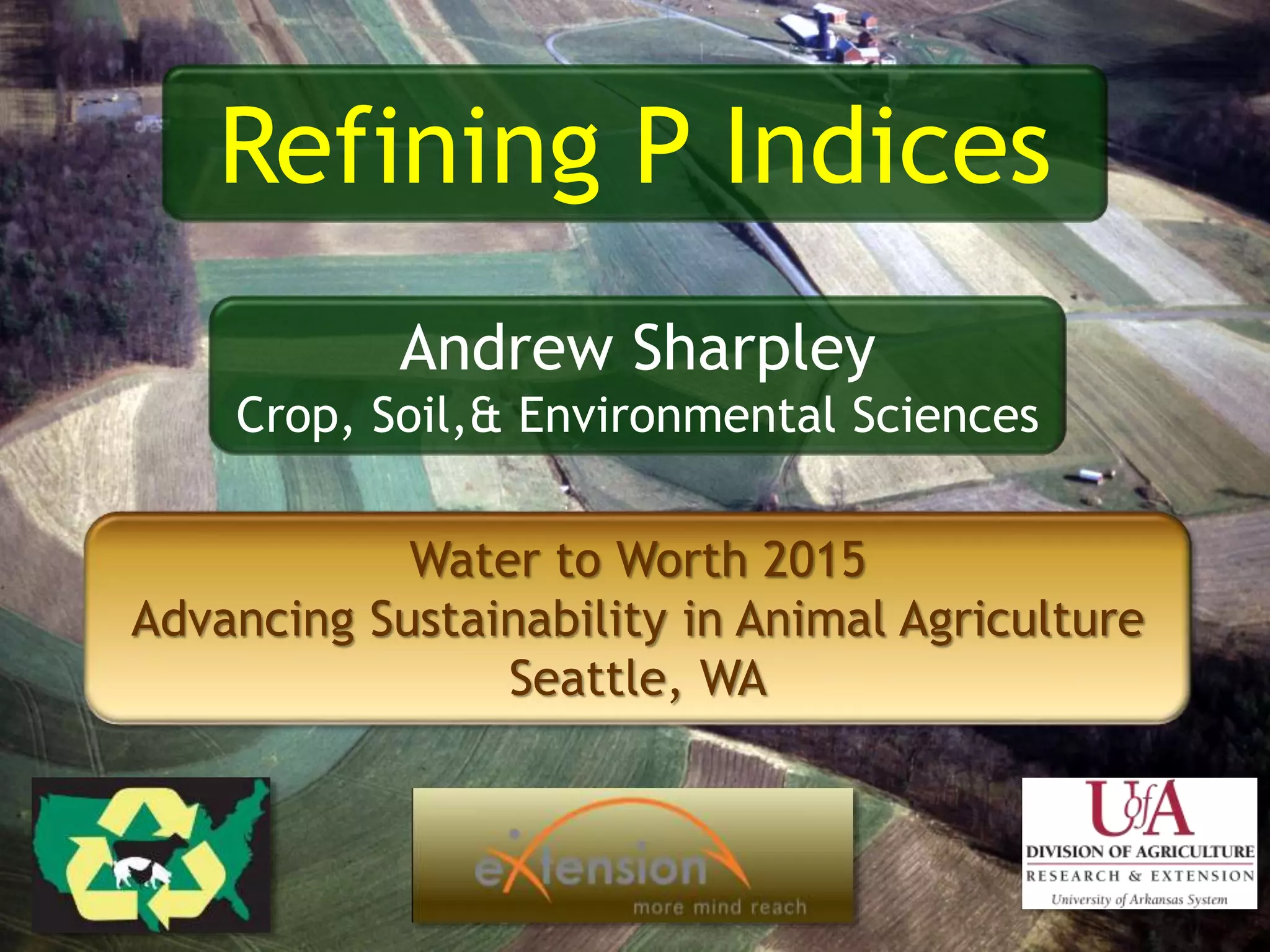
Water to Worth 2015
Advancing Sustainability in Animal Agriculture
Seattle, WA
Refining P Indices
Andrew Sharpley
Crop, Soil,& Environmental Sciences
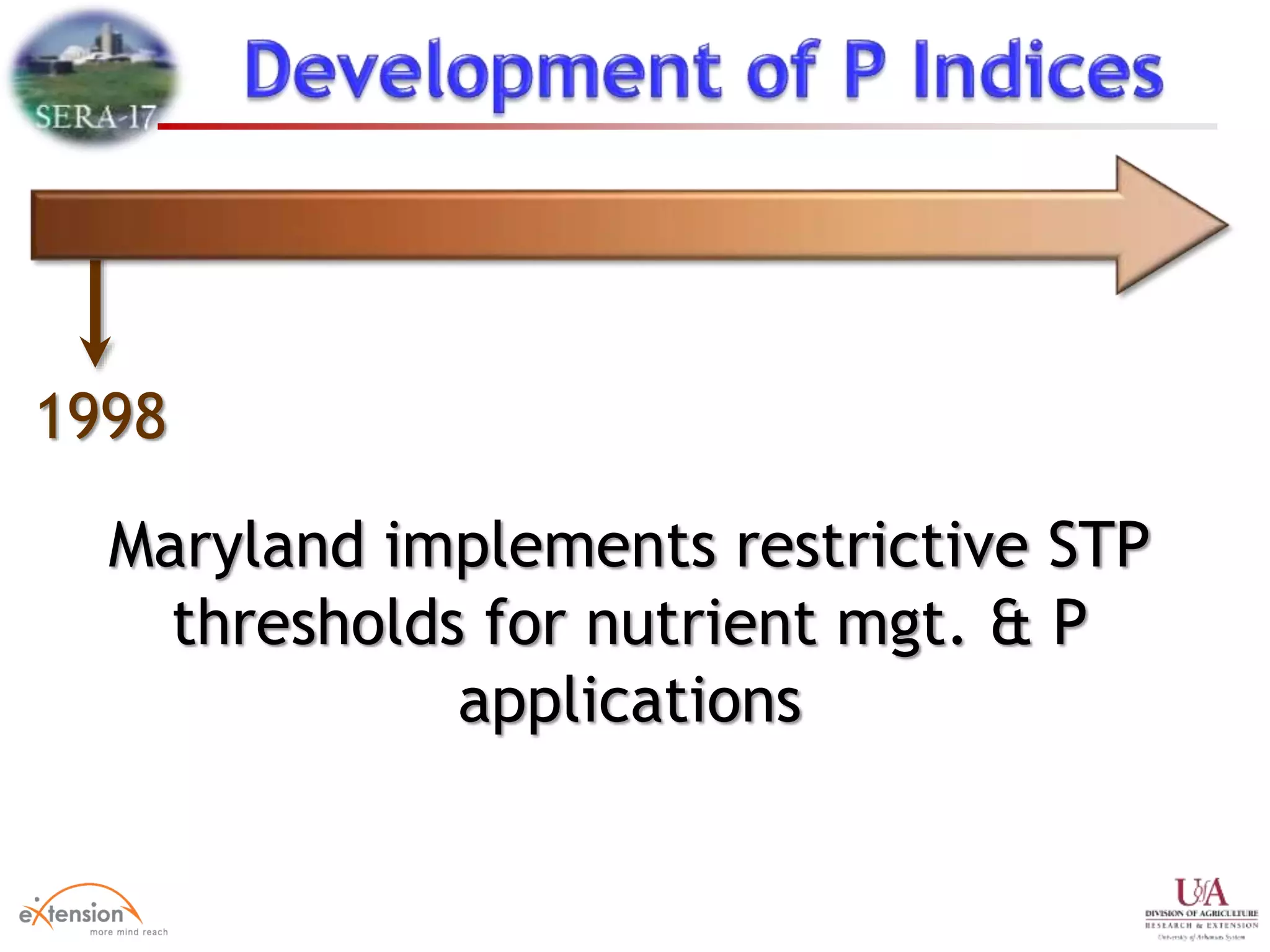
Maryland implements restrictive STP
thresholds for nutrient mgt. & P
applications
1998
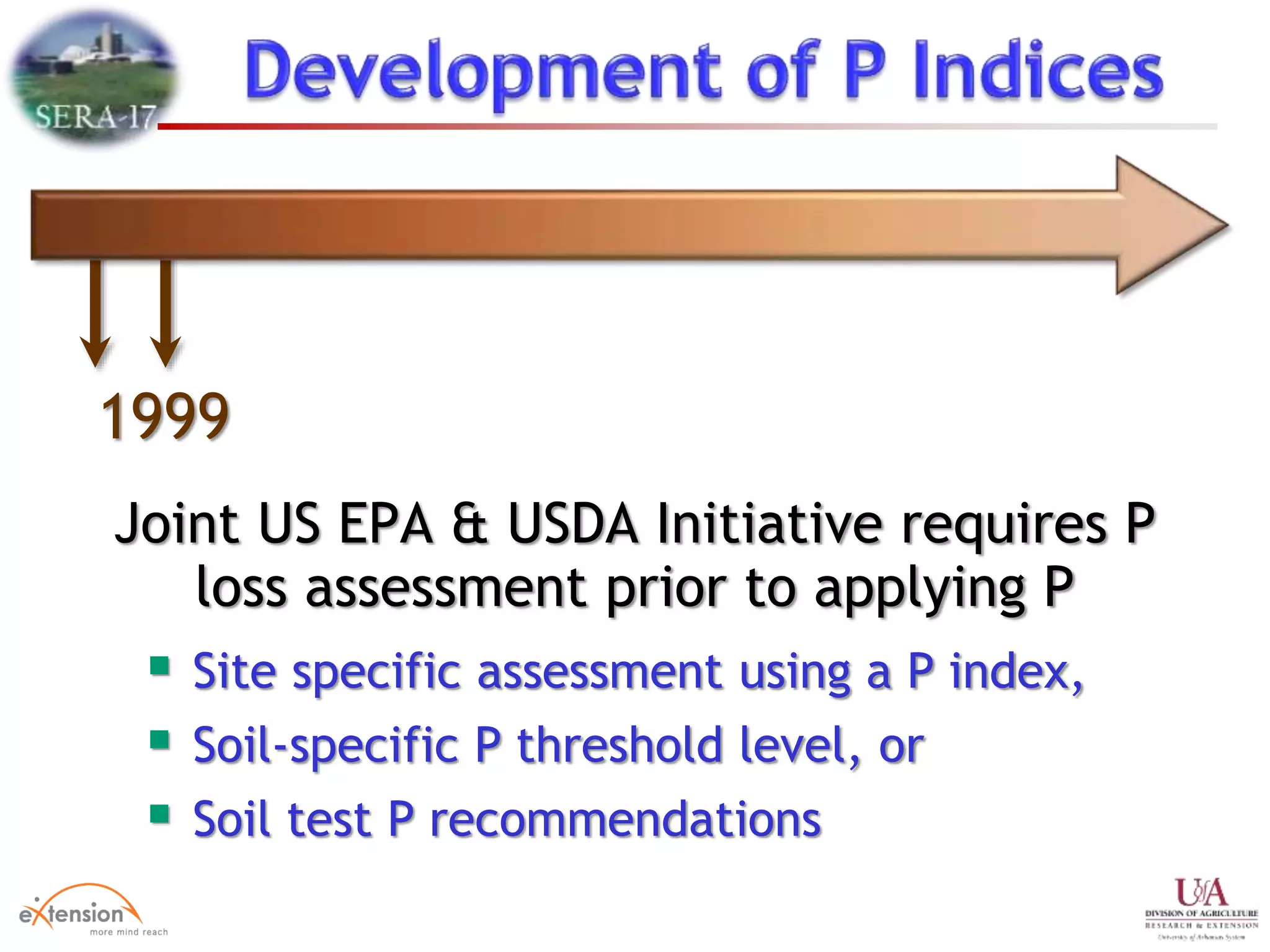
1999
Joint US EPA & USDA Initiative requires P
loss assessment prior to applying P
 Site specific assessment using a P index,
 Soil-specific P threshold level, or
 Soil test P recommendations
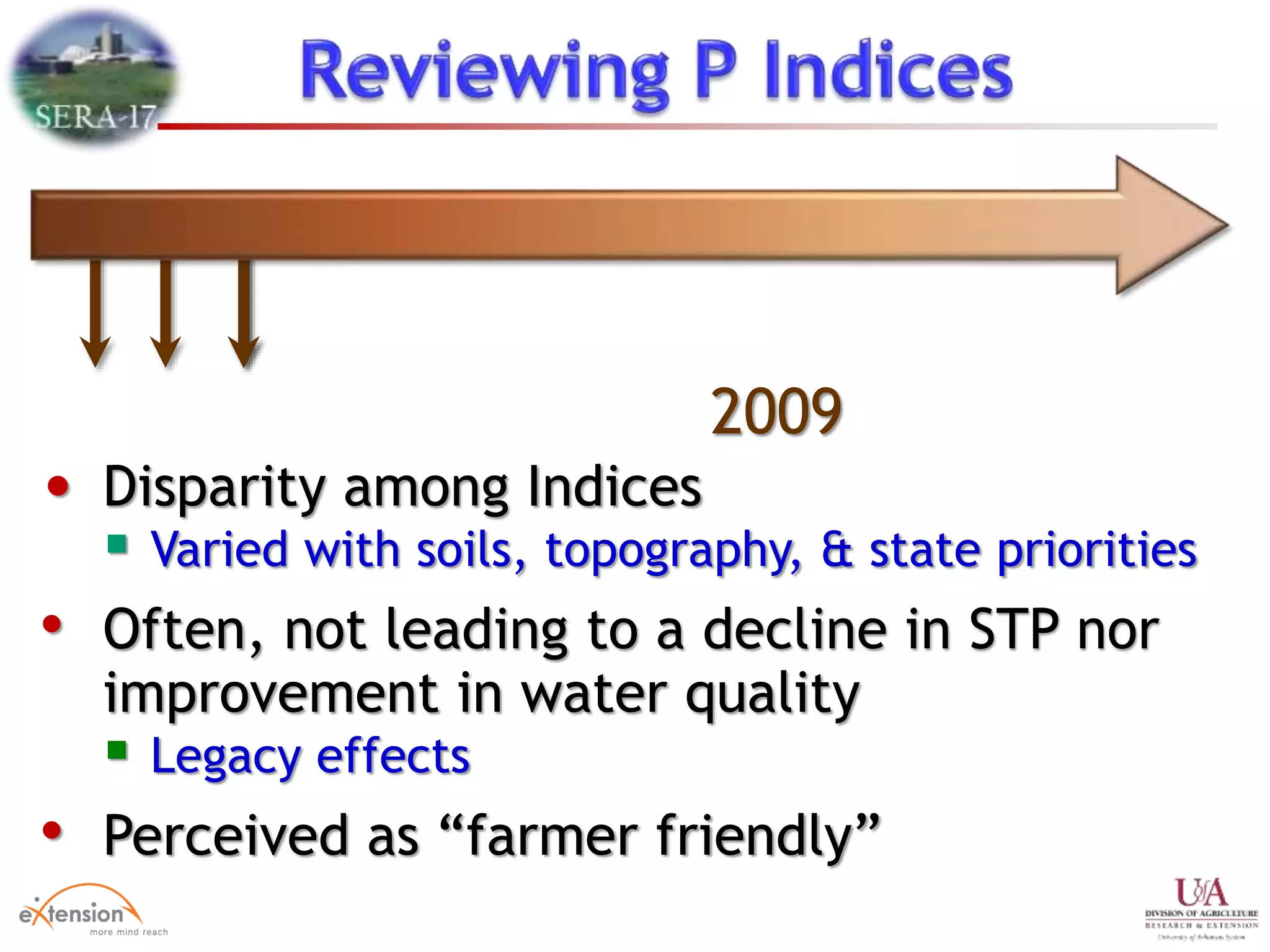
2009
• Disparity among Indices
 Varied with soils, topography, & state priorities
• Often, not leading to a decline in STP nor
improvement in water quality
 Legacy effects
• Perceived as “farmer friendly”
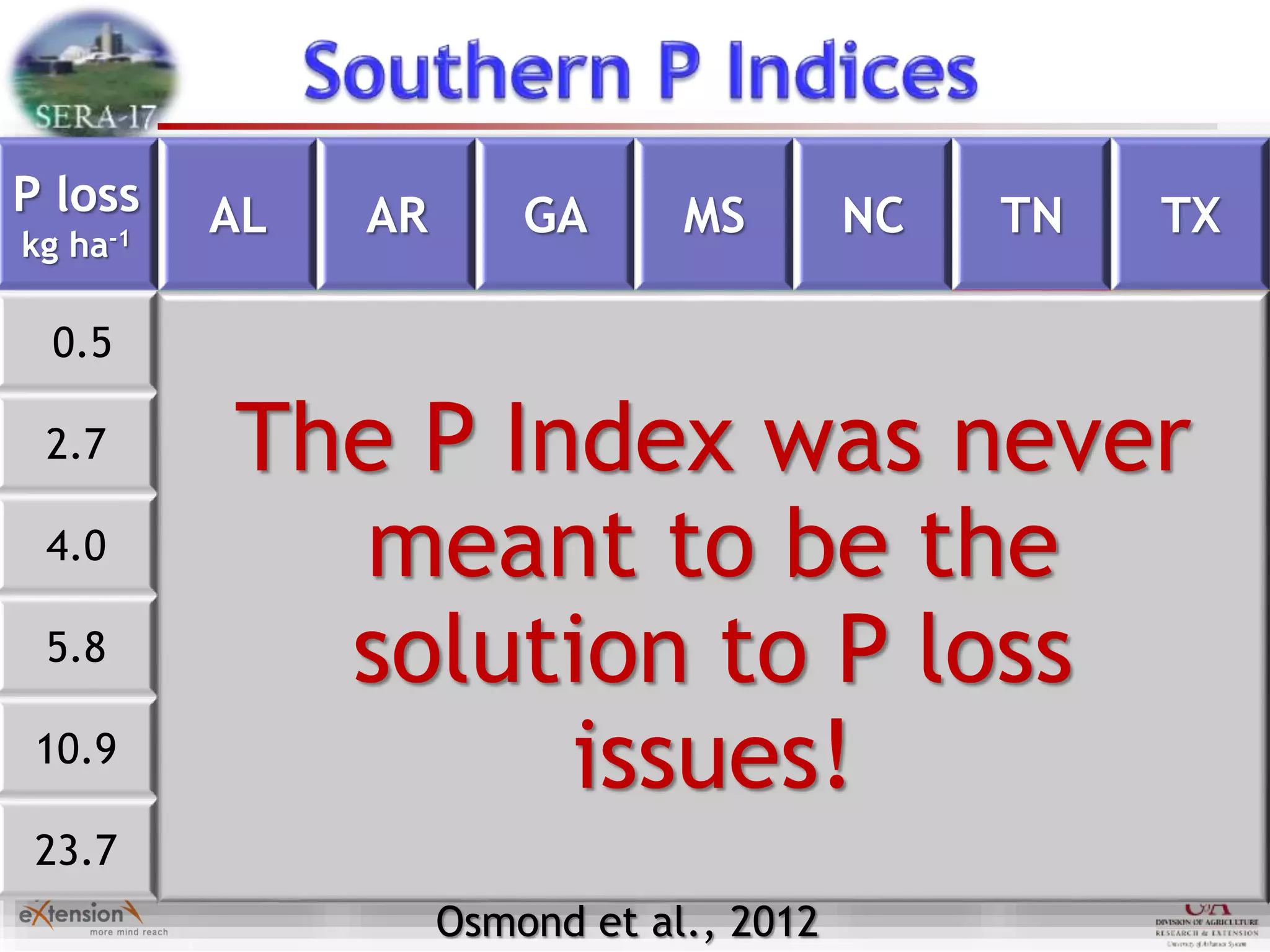
P loss
kg ha-1
AL AR GA MS NC TN TX
0.5 Low Low Low Low Low High Med.
2.7 Med. High High Low Low V. High High
4.0 Low High Med. Low Low V. high High
5.8 Low V. high V. high Low Med. V. high High
10.9 Low V. high V. high Low Med. V. high High
23.7 Low V. high V. high Low High V. high High
Osmond et al., 2012
The P Index was never
meant to be the
solution to P loss
issues!
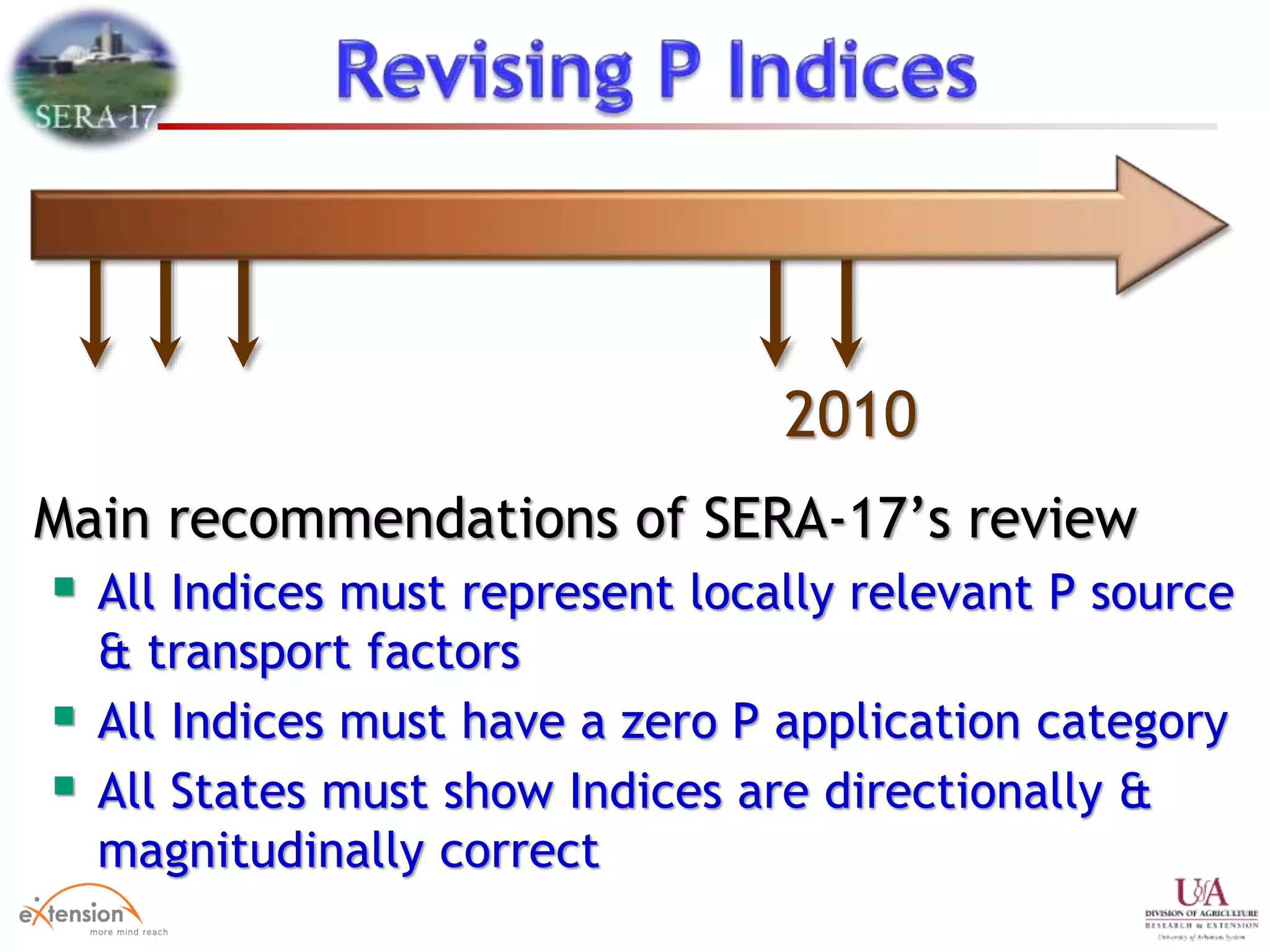
Main recommendations of SERA-17’s review
 All Indices must represent locally relevant P source
& transport factors
 All Indices must have a zero P application category
 All States must show Indices are directionally &
magnitudinally correct
2010
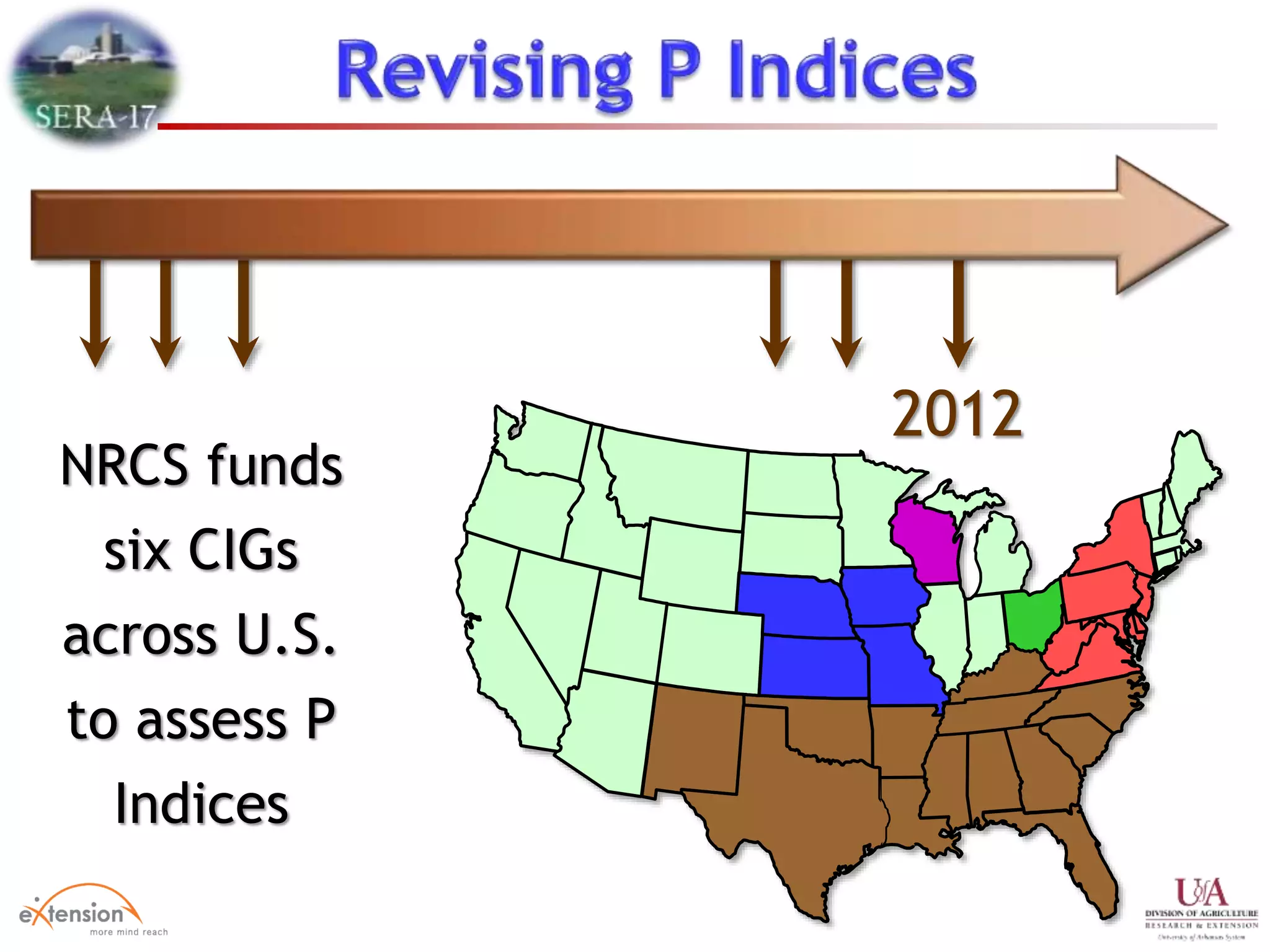
2012
NRCS funds
six CIGs
across U.S.
to assess P
Indices
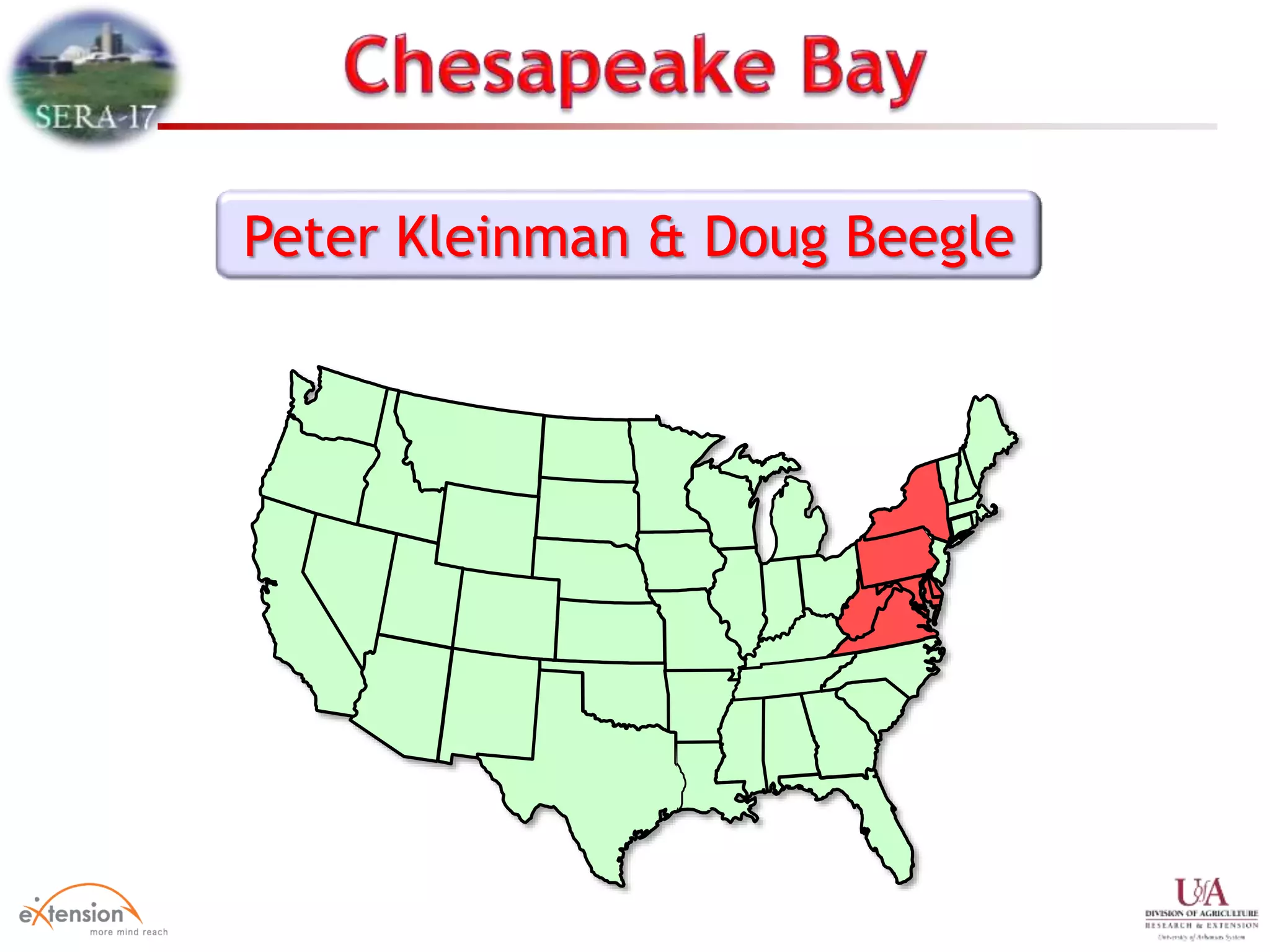
Peter Kleinman & Doug Beegle
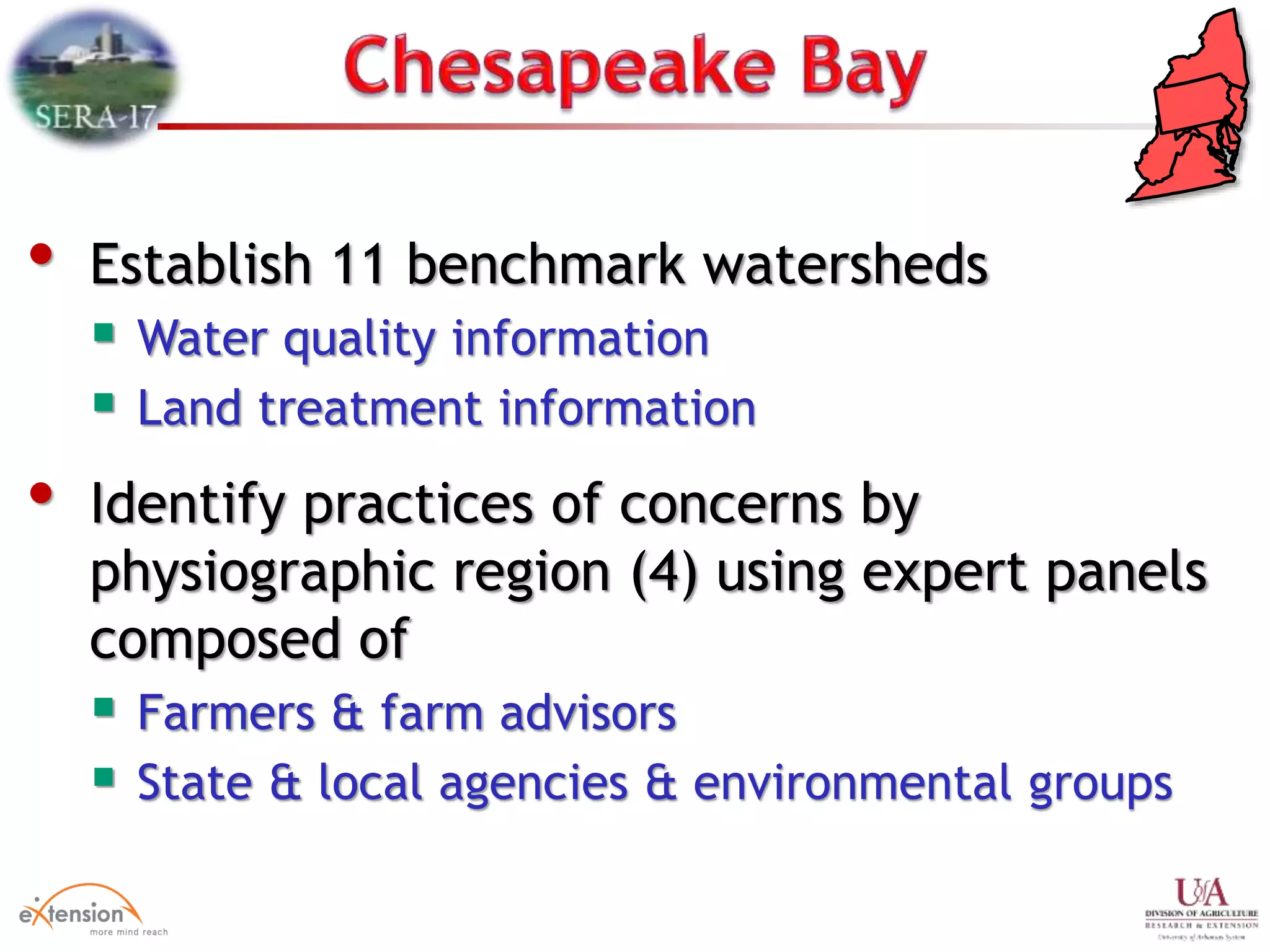
• Establish 11 benchmark watersheds
 Water quality information
 Land treatment information
• Identify practices of concerns by
physiographic region (4) using expert panels
composed of
 Farmers & farm advisors
 State & local agencies & environmental groups
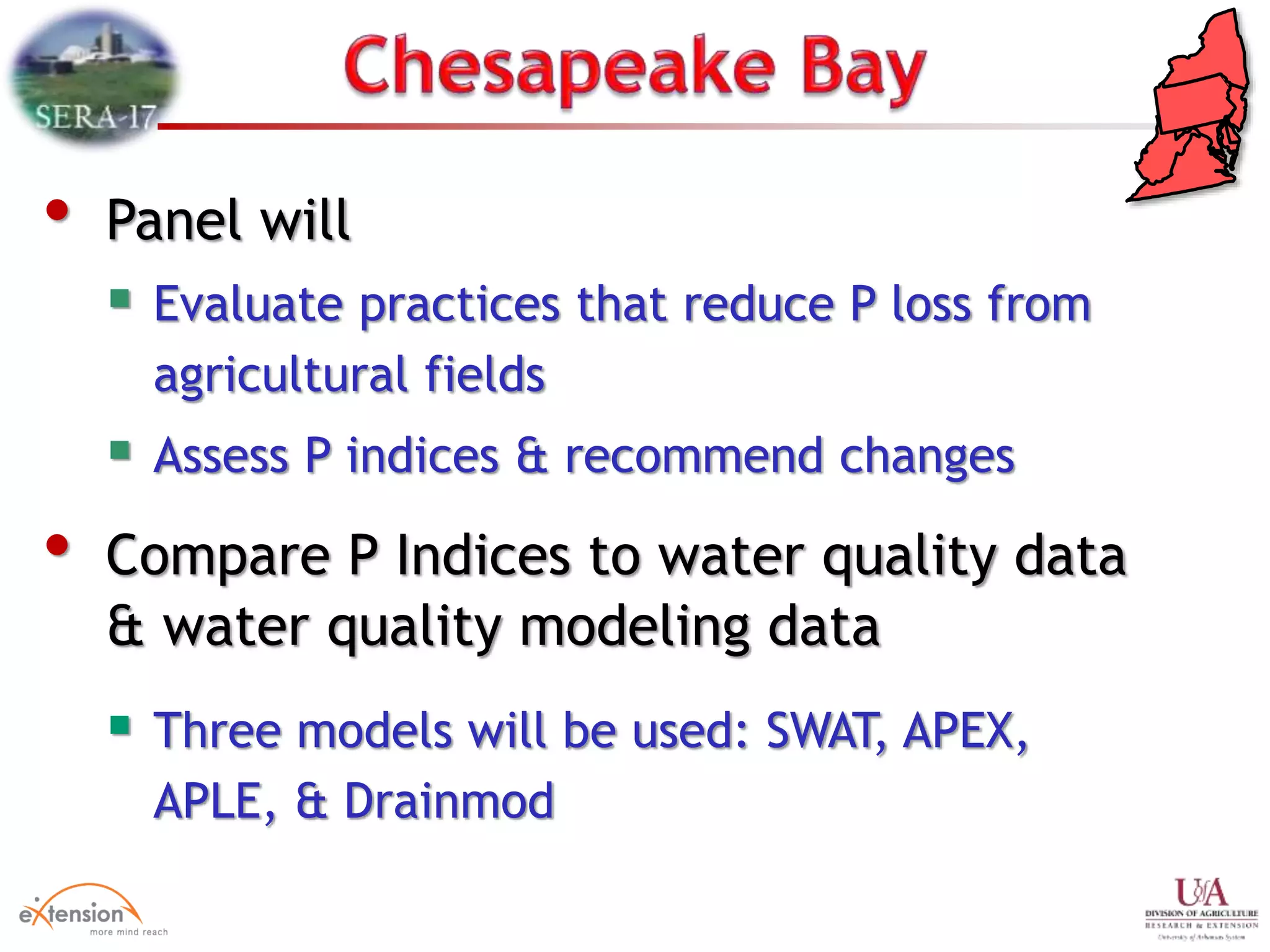
• Panel will
 Evaluate practices that reduce P loss from
agricultural fields
 Assess P indices & recommend changes
• Compare P Indices to water quality data
& water quality modeling data
 Three models will be used: SWAT, APEX,
APLE, & Drainmod
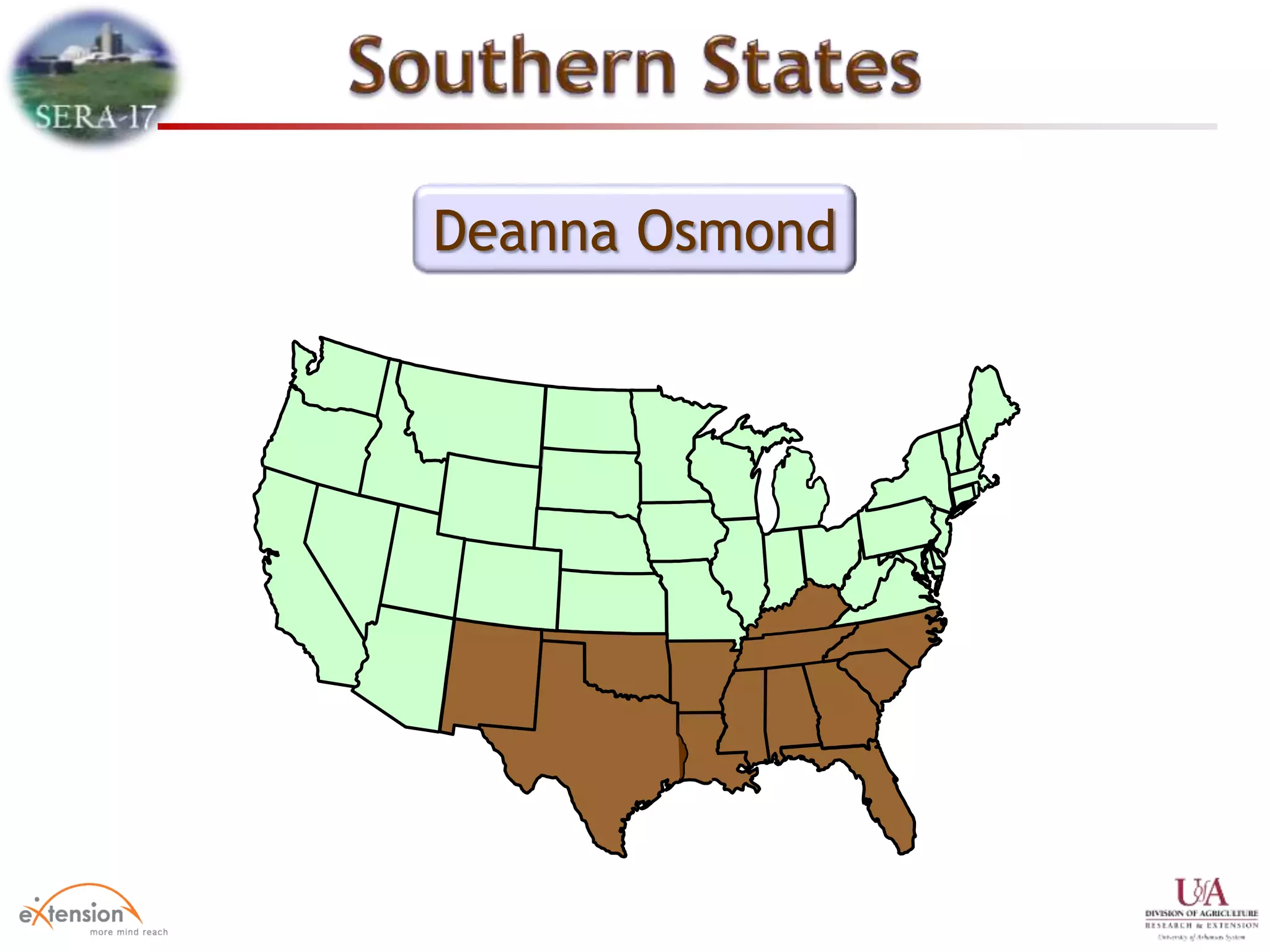
Deanna Osmond
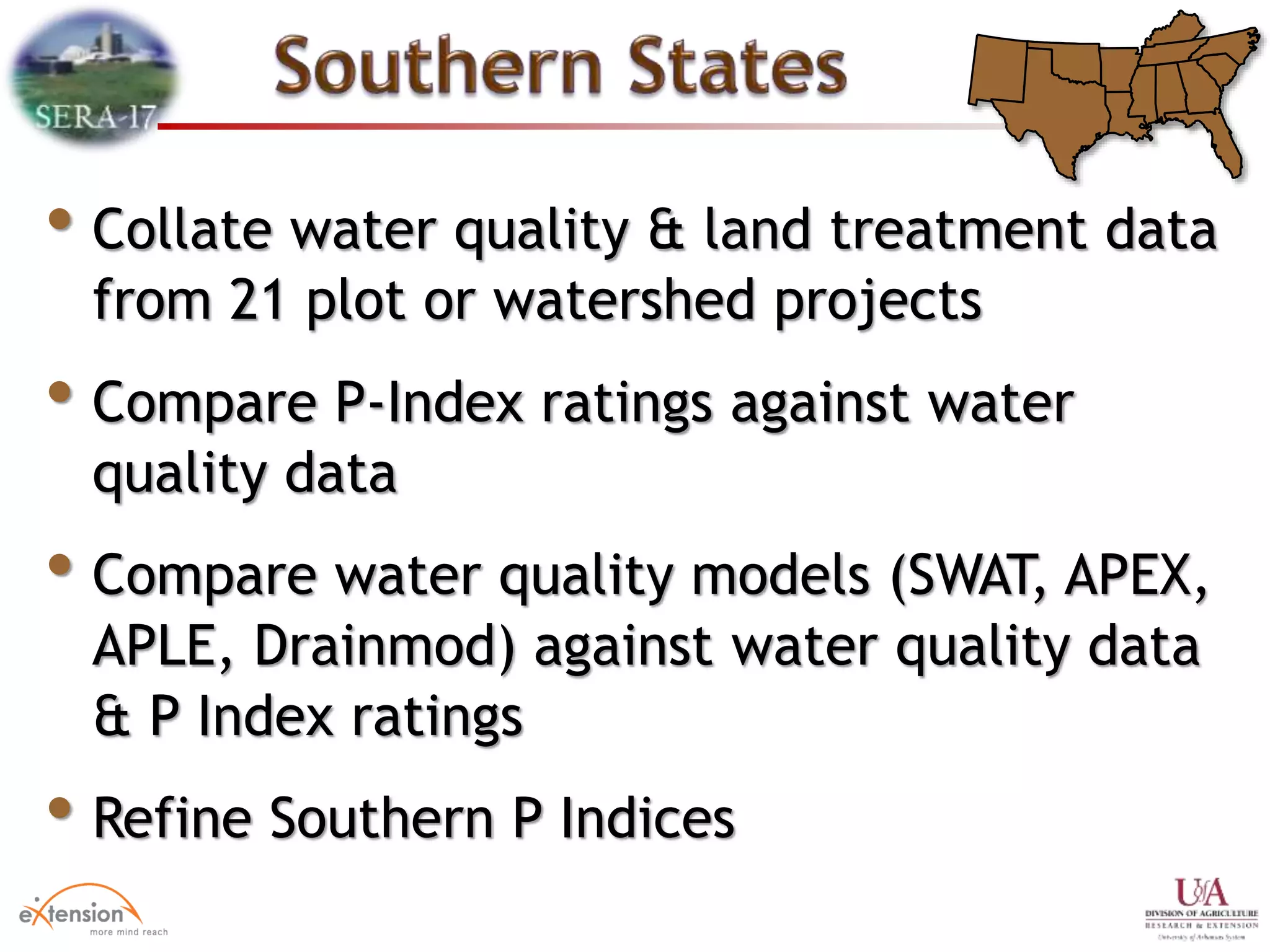
• Collate water quality & land treatment data
from 21 plot or watershed projects
• Compare P-Index ratings against water
quality data
• Compare water quality models (SWAT, APEX,
APLE, Drainmod) against water quality data
& P Index ratings
• Refine Southern P Indices
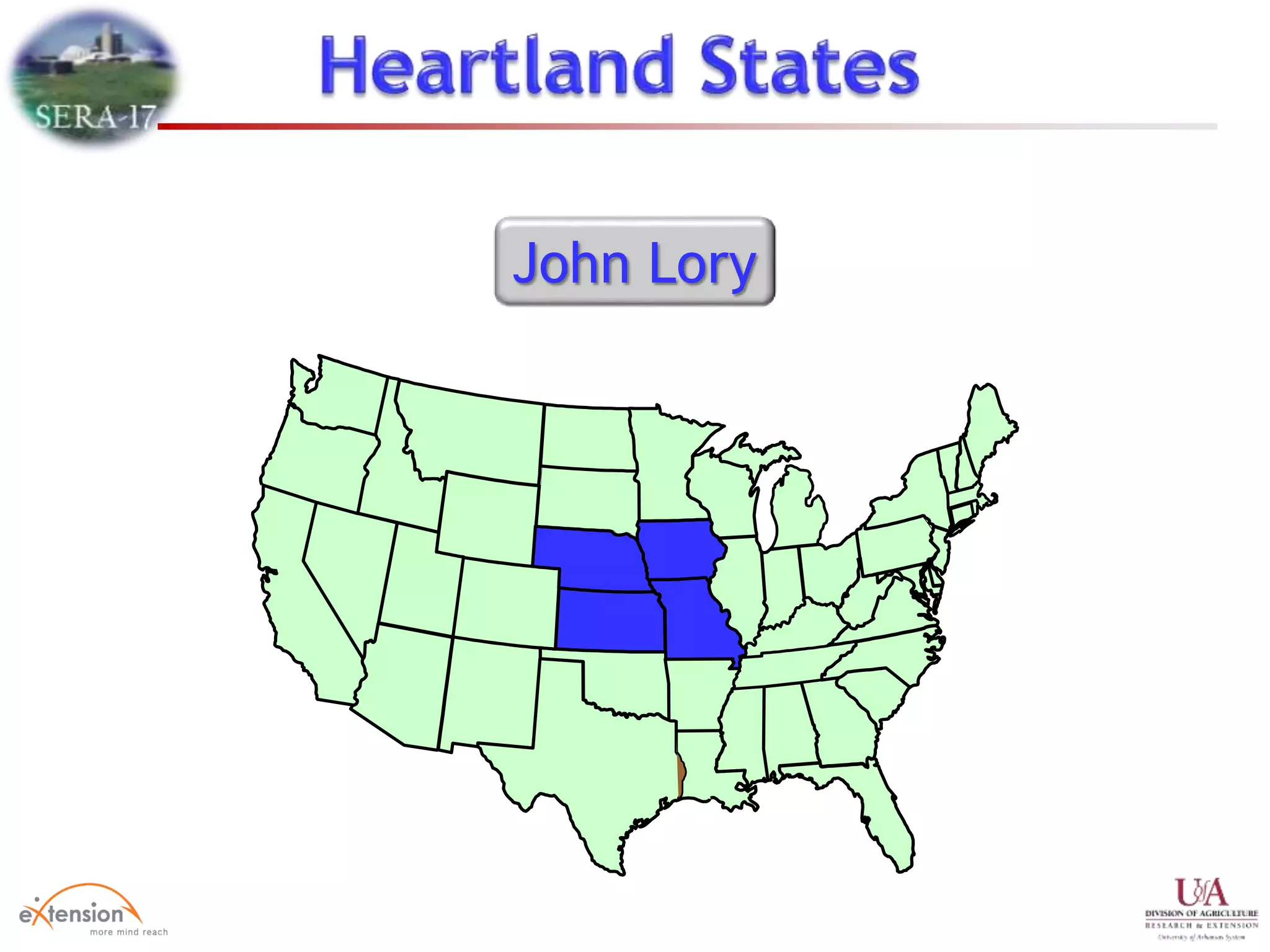
John Lory
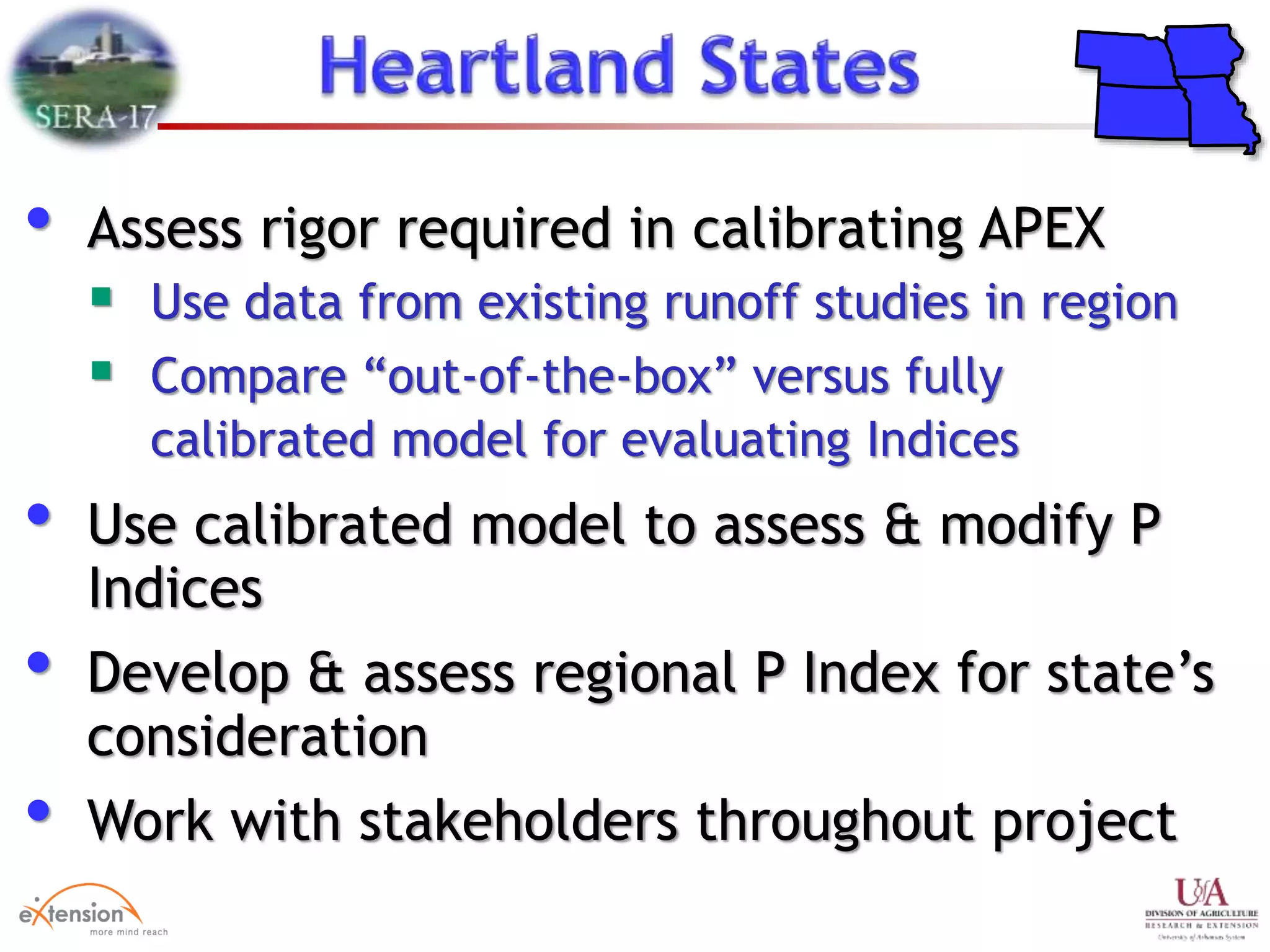
• Assess rigor required in calibrating APEX
 Use data from existing runoff studies in region
 Compare “out-of-the-box” versus fully
calibrated model for evaluating Indices
• Use calibrated model to assess & modify P
Indices
• Develop & assess regional P Index for state’s
consideration
• Work with stakeholders throughout project
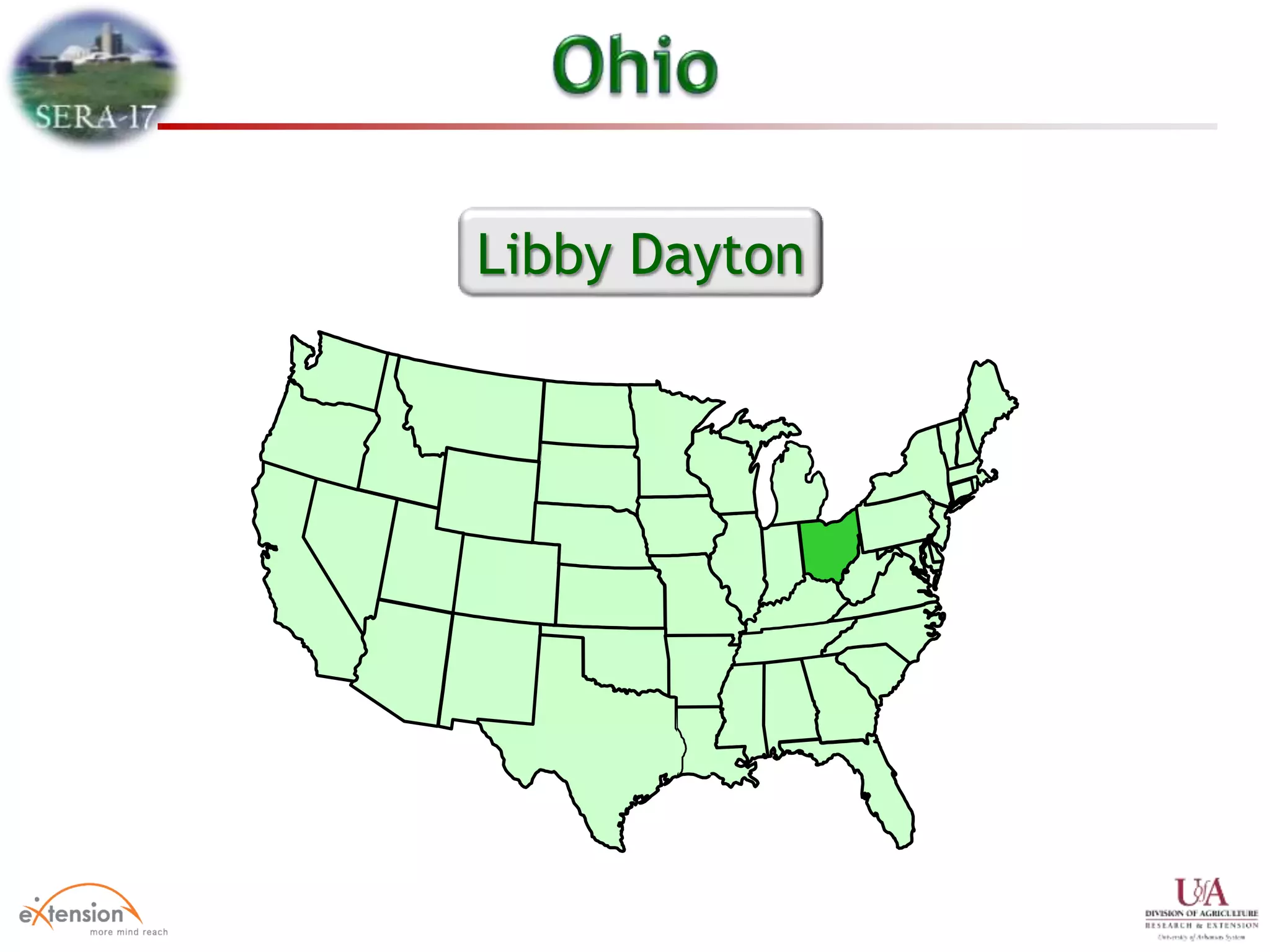
Libby Dayton
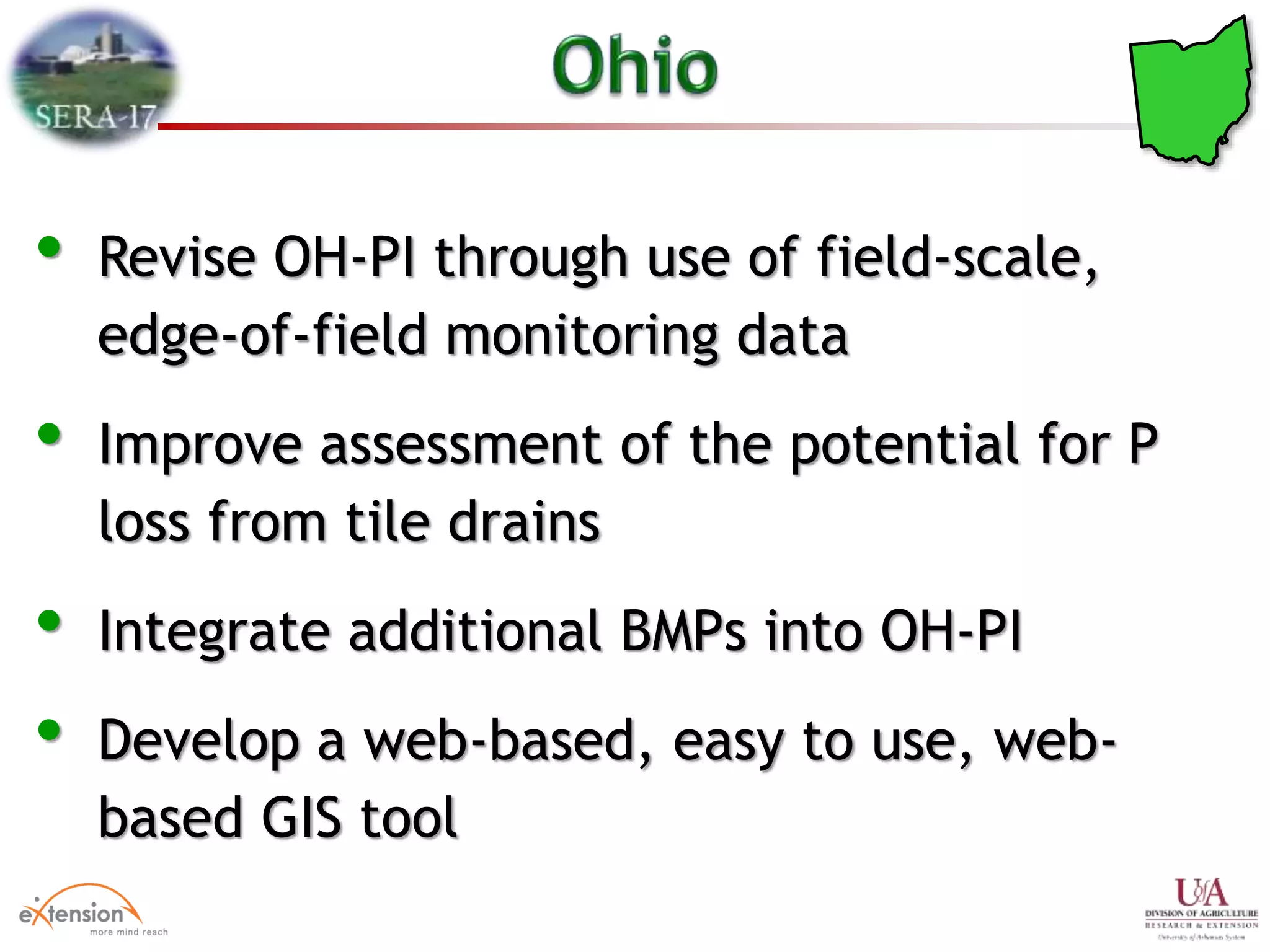
• Revise OH-PI through use of field-scale,
edge-of-field monitoring data
• Improve assessment of the potential for P
loss from tile drains
• Integrate additional BMPs into OH-PI
• Develop a web-based, easy to use, web-
based GIS tool
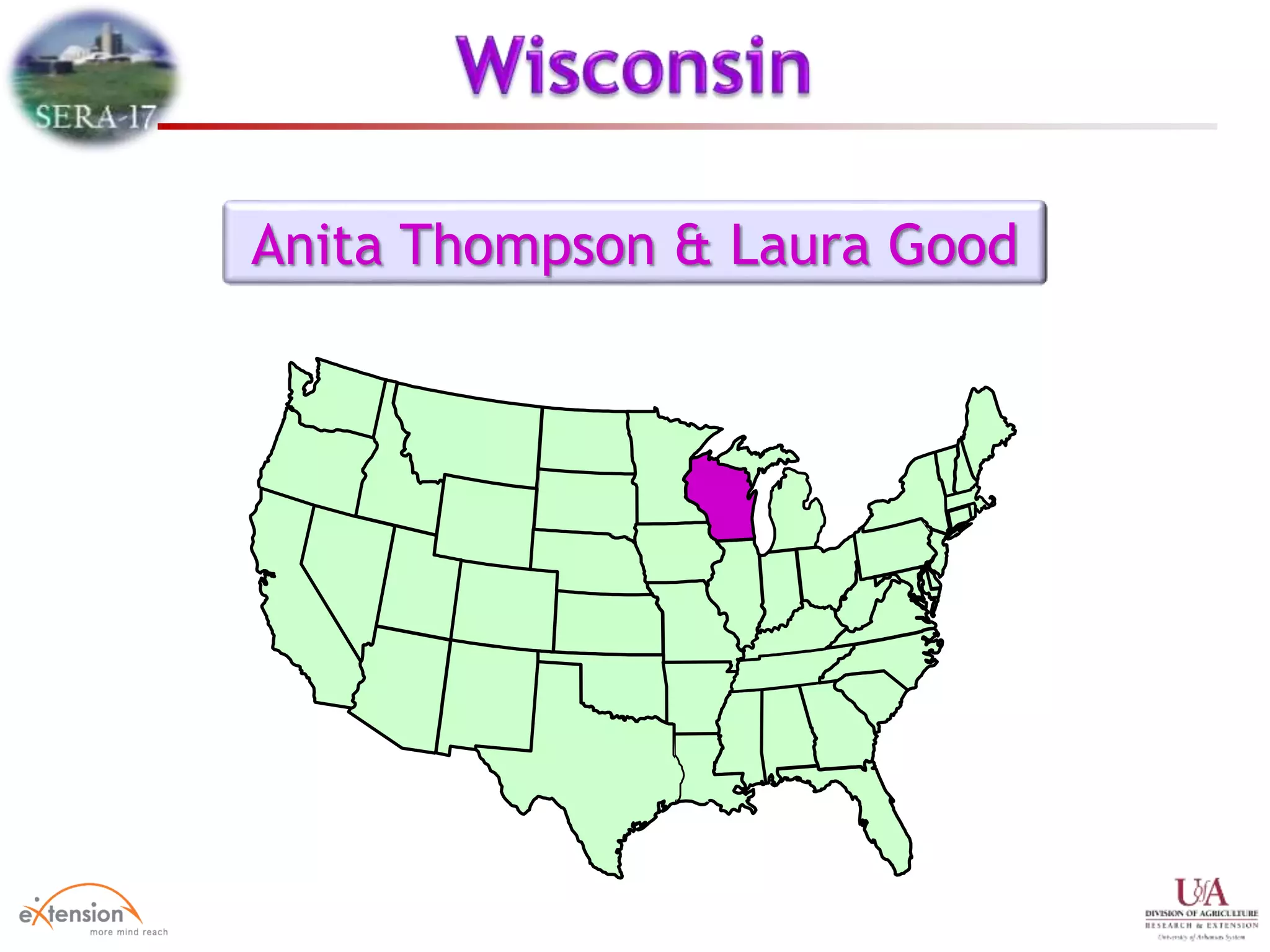
Anita Thompson & Laura Good
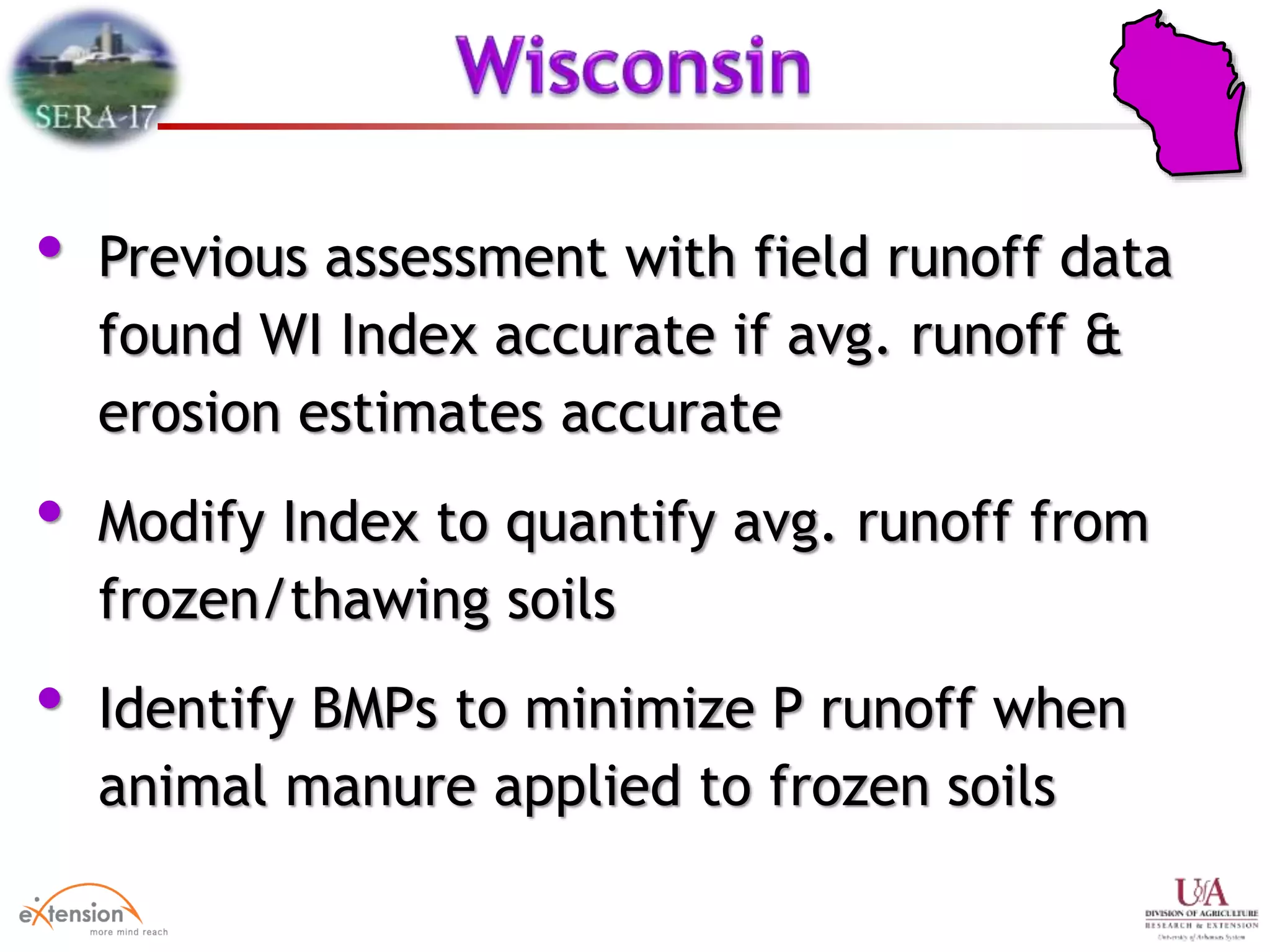
• Previous assessment with field runoff data
found WI Index accurate if avg. runoff &
erosion estimates accurate
• Modify Index to quantify avg. runoff from
frozen/thawing soils
• Identify BMPs to minimize P runoff when
animal manure applied to frozen soils
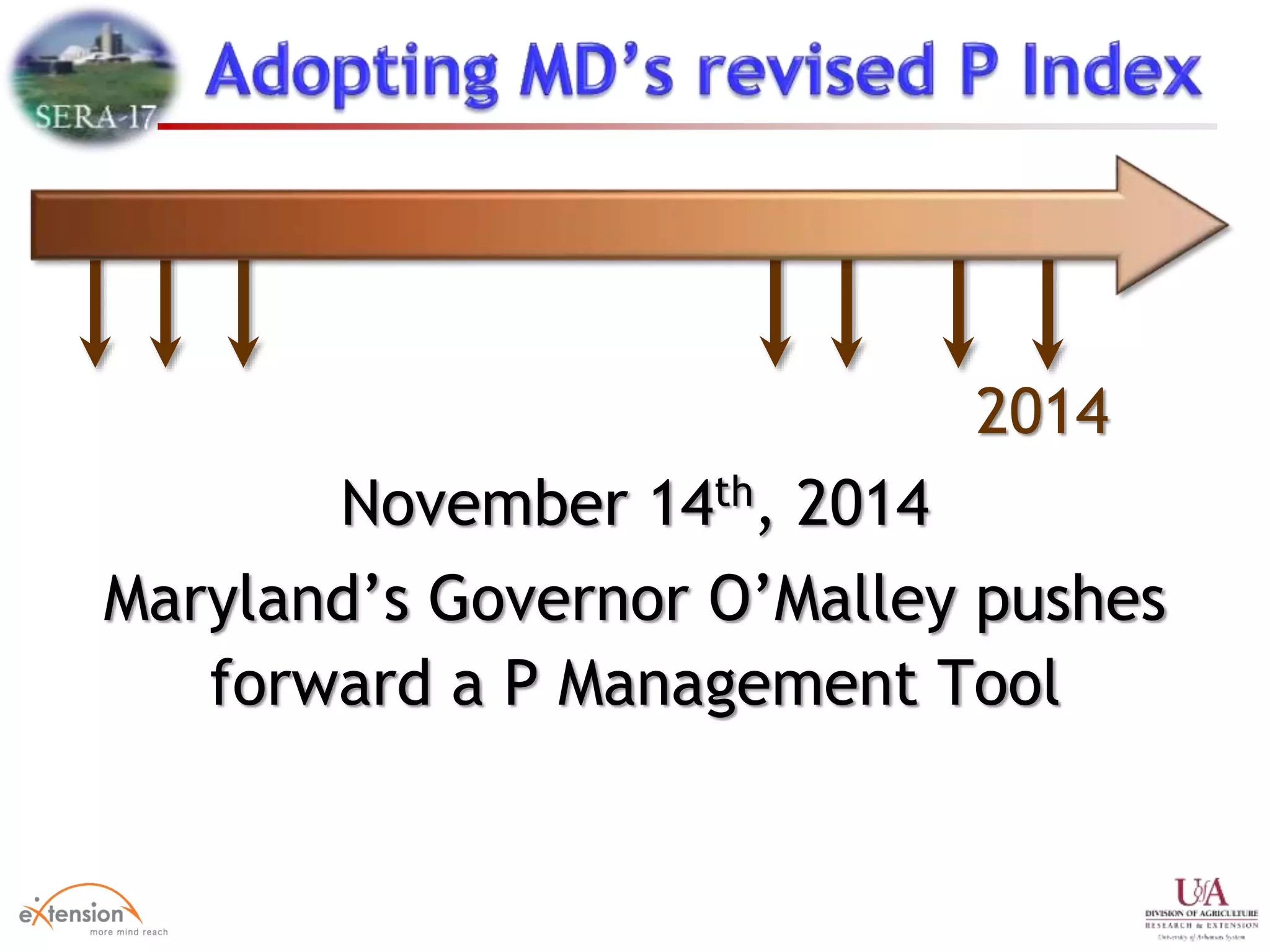
November 14th, 2014
Maryland’s Governor O’Malley pushes
forward a P Management Tool
2014
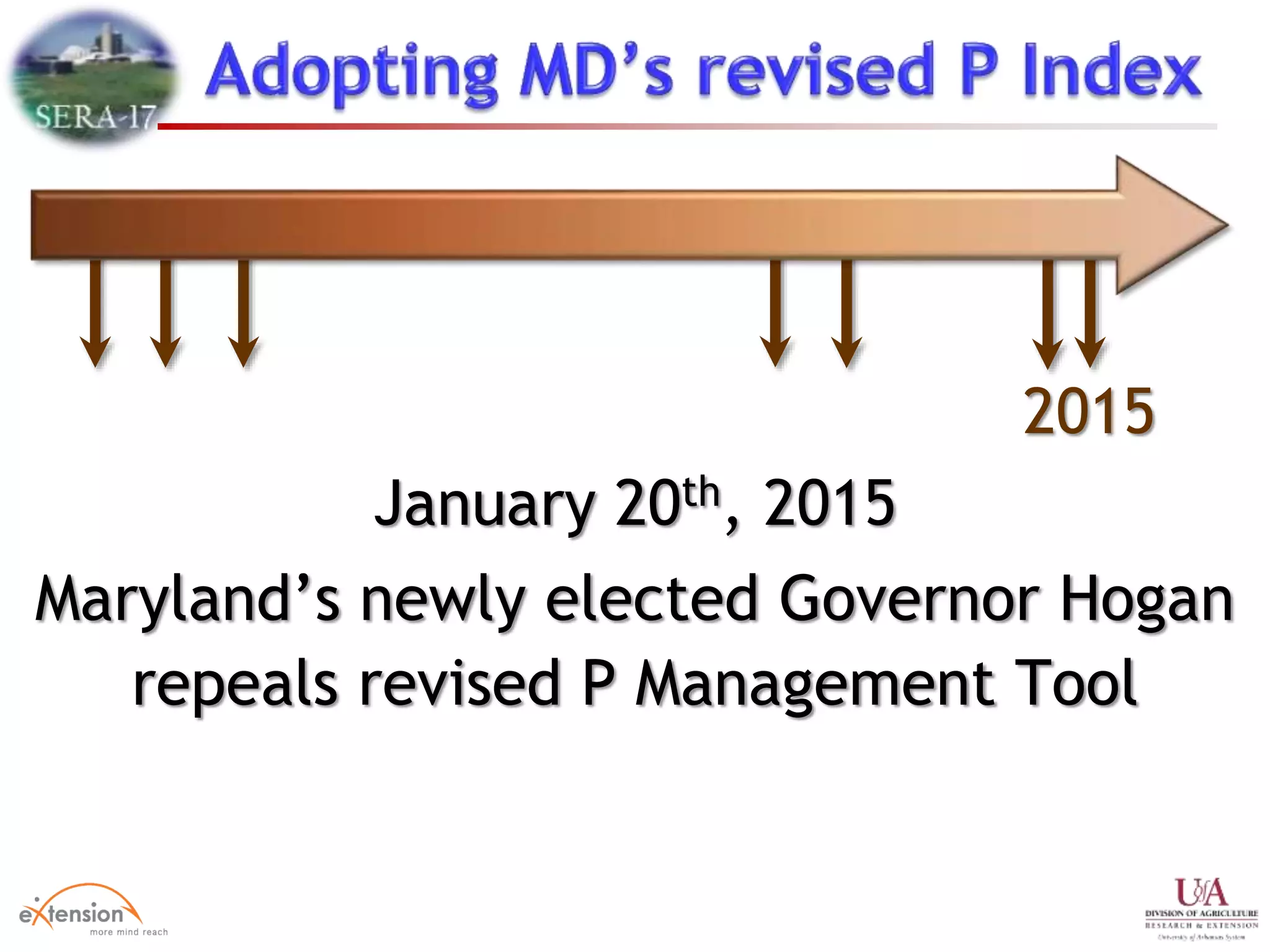
January 20th, 2015
Maryland’s newly elected Governor Hogan
repeals revised P Management Tool
2015
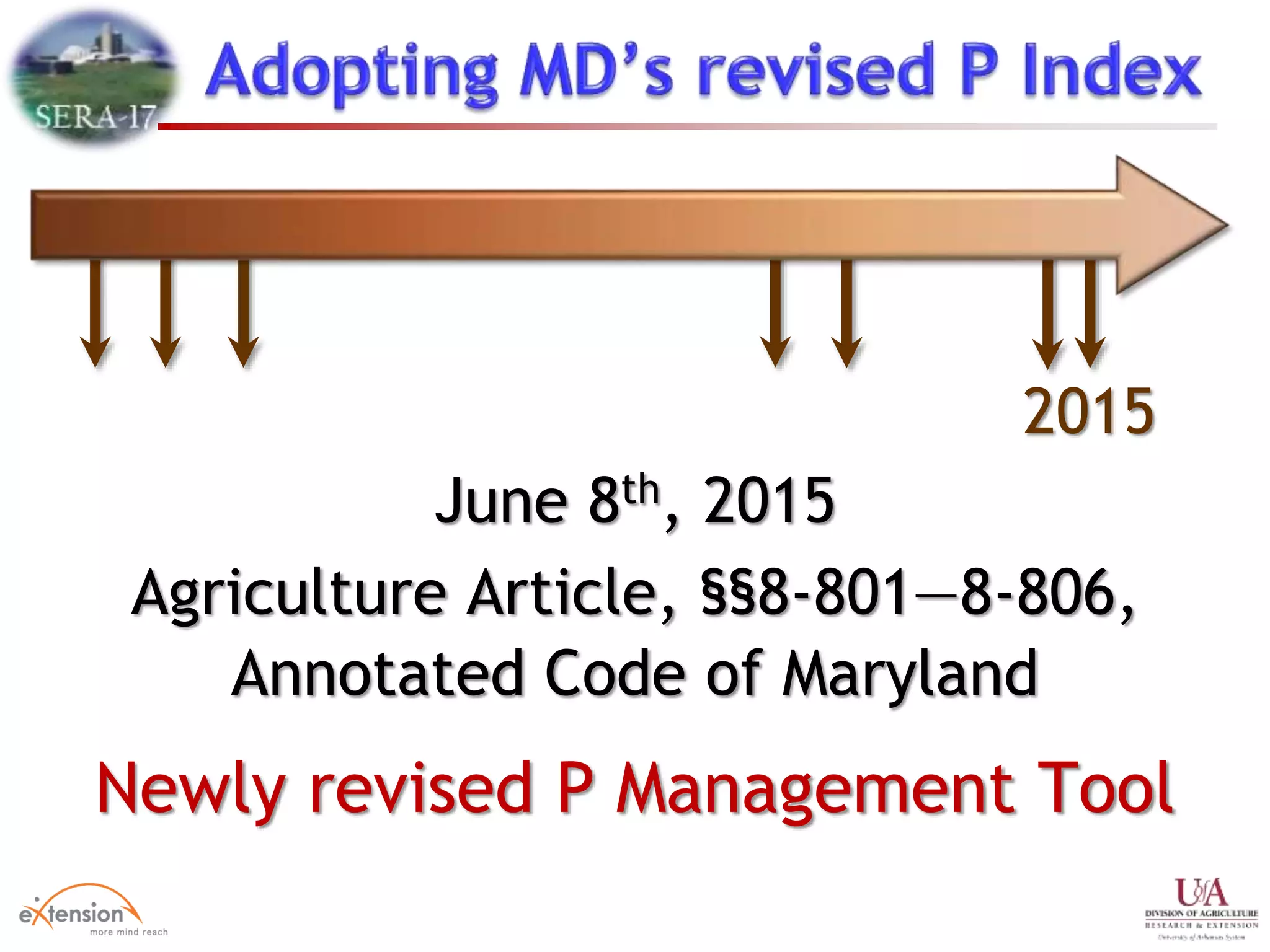
June 8th, 2015
Agriculture Article, §§8-801—8-806,
Annotated Code of Maryland
Newly revised P Management Tool
2015
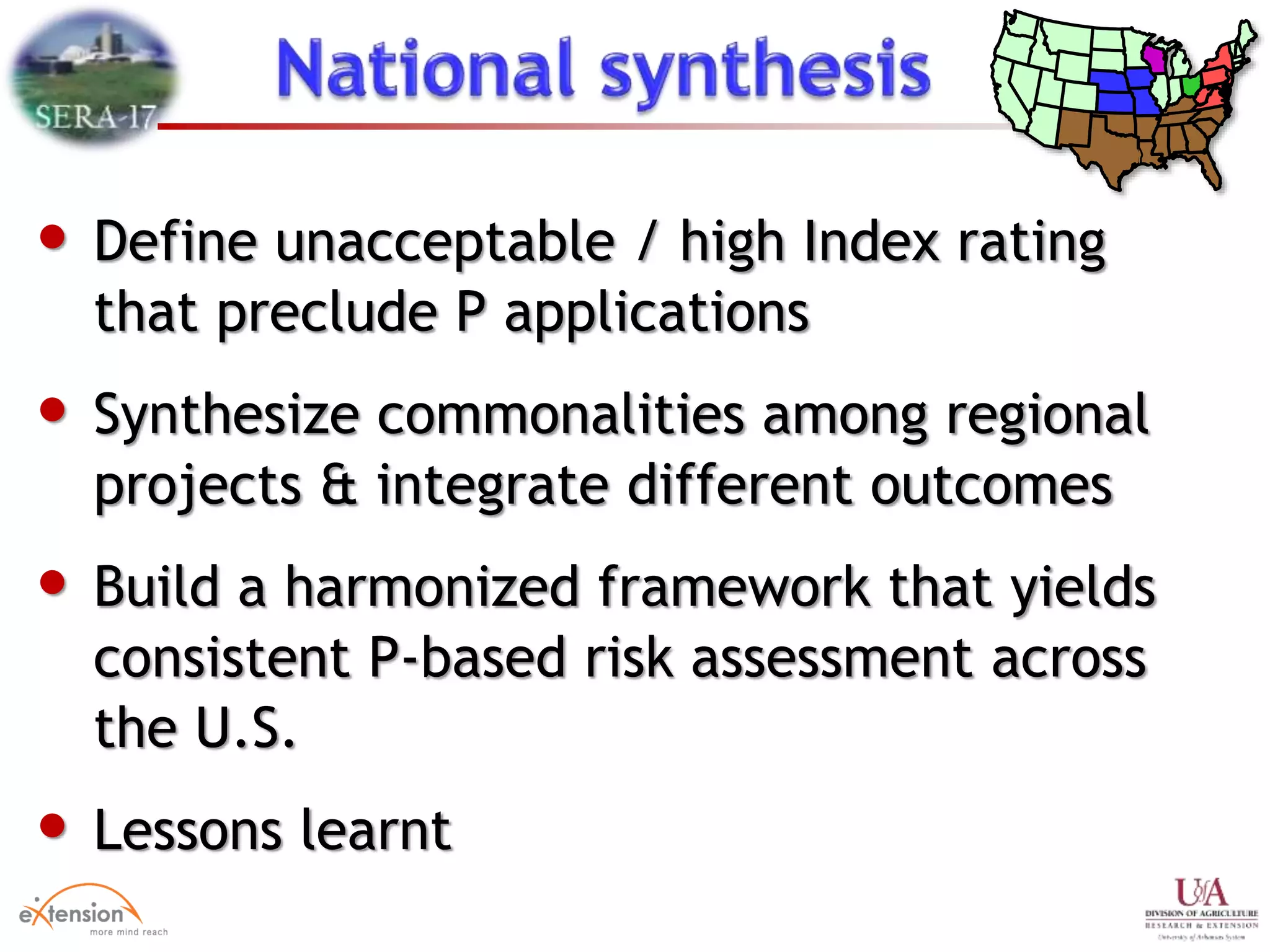
• Define unacceptable / high Index rating
that preclude P applications
• Synthesize commonalities among regional
projects & integrate different outcomes
• Build a harmonized framework that yields
consistent P-based risk assessment across
the U.S.
• Lessons learnt
Identify and synthesize methods to refine phosphorus indices from three regional indexing efforts

Identify and synthesize methods to refine phosphorus indices from three regional indexing efforts

  • 1.
    Water to Worth2015 Advancing Sustainability in Animal Agriculture Seattle, WA Refining P Indices Andrew Sharpley Crop, Soil,& Environmental Sciences
  • 2.
    Maryland implements restrictiveSTP thresholds for nutrient mgt. & P applications 1998
  • 3.
    1999 Joint US EPA& USDA Initiative requires P loss assessment prior to applying P  Site specific assessment using a P index,  Soil-specific P threshold level, or  Soil test P recommendations
  • 4.
    2009 • Disparity amongIndices  Varied with soils, topography, & state priorities • Often, not leading to a decline in STP nor improvement in water quality  Legacy effects • Perceived as “farmer friendly”
  • 5.
    P loss kg ha-1 ALAR GA MS NC TN TX 0.5 Low Low Low Low Low High Med. 2.7 Med. High High Low Low V. High High 4.0 Low High Med. Low Low V. high High 5.8 Low V. high V. high Low Med. V. high High 10.9 Low V. high V. high Low Med. V. high High 23.7 Low V. high V. high Low High V. high High Osmond et al., 2012 The P Index was never meant to be the solution to P loss issues!
  • 6.
    Main recommendations ofSERA-17’s review  All Indices must represent locally relevant P source & transport factors  All Indices must have a zero P application category  All States must show Indices are directionally & magnitudinally correct 2010
  • 7.
    2012 NRCS funds six CIGs acrossU.S. to assess P Indices
  • 8.
    Peter Kleinman &Doug Beegle
  • 9.
    • Establish 11benchmark watersheds  Water quality information  Land treatment information • Identify practices of concerns by physiographic region (4) using expert panels composed of  Farmers & farm advisors  State & local agencies & environmental groups
  • 10.
    • Panel will Evaluate practices that reduce P loss from agricultural fields  Assess P indices & recommend changes • Compare P Indices to water quality data & water quality modeling data  Three models will be used: SWAT, APEX, APLE, & Drainmod
  • 11.
  • 12.
    • Collate waterquality & land treatment data from 21 plot or watershed projects • Compare P-Index ratings against water quality data • Compare water quality models (SWAT, APEX, APLE, Drainmod) against water quality data & P Index ratings • Refine Southern P Indices
  • 13.
  • 14.
    • Assess rigorrequired in calibrating APEX  Use data from existing runoff studies in region  Compare “out-of-the-box” versus fully calibrated model for evaluating Indices • Use calibrated model to assess & modify P Indices • Develop & assess regional P Index for state’s consideration • Work with stakeholders throughout project
  • 15.
  • 16.
    • Revise OH-PIthrough use of field-scale, edge-of-field monitoring data • Improve assessment of the potential for P loss from tile drains • Integrate additional BMPs into OH-PI • Develop a web-based, easy to use, web- based GIS tool
  • 17.
    Anita Thompson &Laura Good
  • 18.
    • Previous assessmentwith field runoff data found WI Index accurate if avg. runoff & erosion estimates accurate • Modify Index to quantify avg. runoff from frozen/thawing soils • Identify BMPs to minimize P runoff when animal manure applied to frozen soils
  • 19.
    November 14th, 2014 Maryland’sGovernor O’Malley pushes forward a P Management Tool 2014
  • 20.
    January 20th, 2015 Maryland’snewly elected Governor Hogan repeals revised P Management Tool 2015
  • 21.
    June 8th, 2015 AgricultureArticle, §§8-801—8-806, Annotated Code of Maryland Newly revised P Management Tool 2015
  • 22.
    • Define unacceptable/ high Index rating that preclude P applications • Synthesize commonalities among regional projects & integrate different outcomes • Build a harmonized framework that yields consistent P-based risk assessment across the U.S. • Lessons learnt