User Capabilities and
Next Generation
Phosphorus Indices
Waste to Worth
April 2, 2015
John A. Lory
University of Missouri
Nathan O. Nelson
Kansas State University
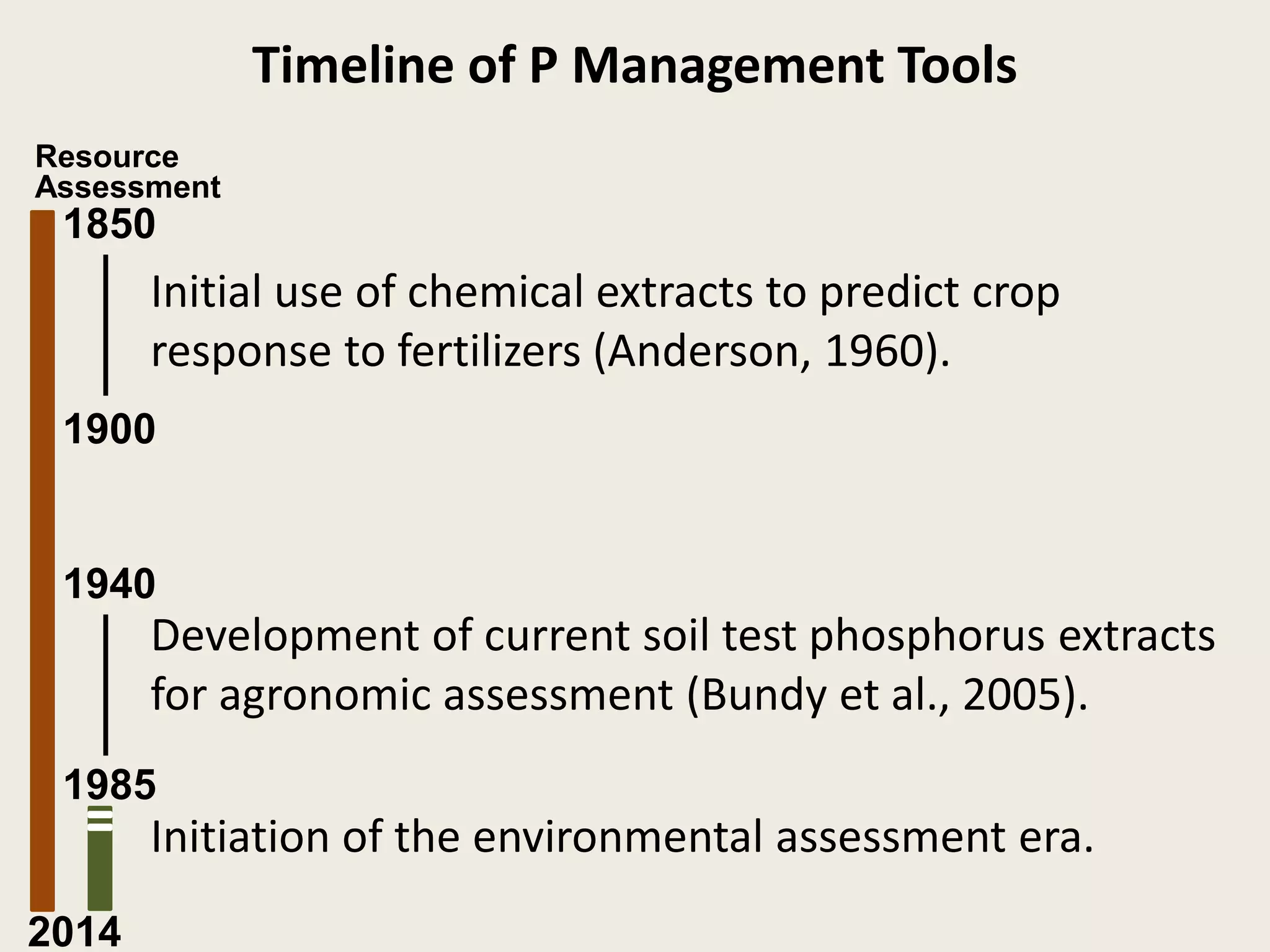
Timeline of P Management Tools
Initial use of chemical extracts to predict crop
response to fertilizers (Anderson, 1960).
Development of current soil test phosphorus extracts
for agronomic assessment (Bundy et al., 2005).
Initiation of the environmental assessment era.
Resource
Assessment
1850
1900
1940
1985
2014
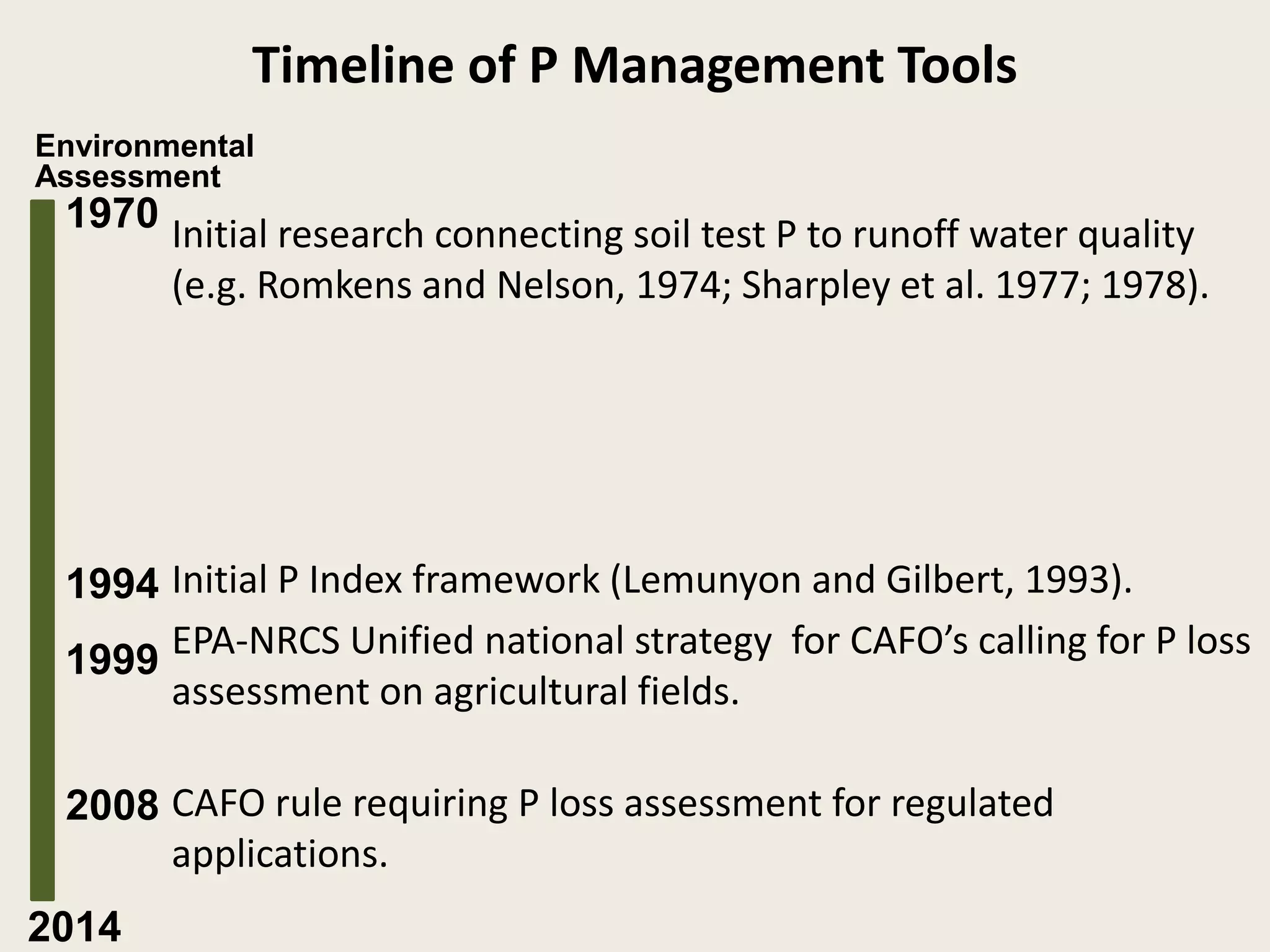
Timeline of P Management Tools
Initial research connecting soil test P to runoff water quality
(e.g. Romkens and Nelson, 1974; Sharpley et al. 1977; 1978).
Initial P Index framework (Lemunyon and Gilbert, 1993).
EPA-NRCS Unified national strategy for CAFO’s calling for P loss
assessment on agricultural fields.
CAFO rule requiring P loss assessment for regulated
applications.
Environmental
Assessment
1970
1994
1999
2008
2014
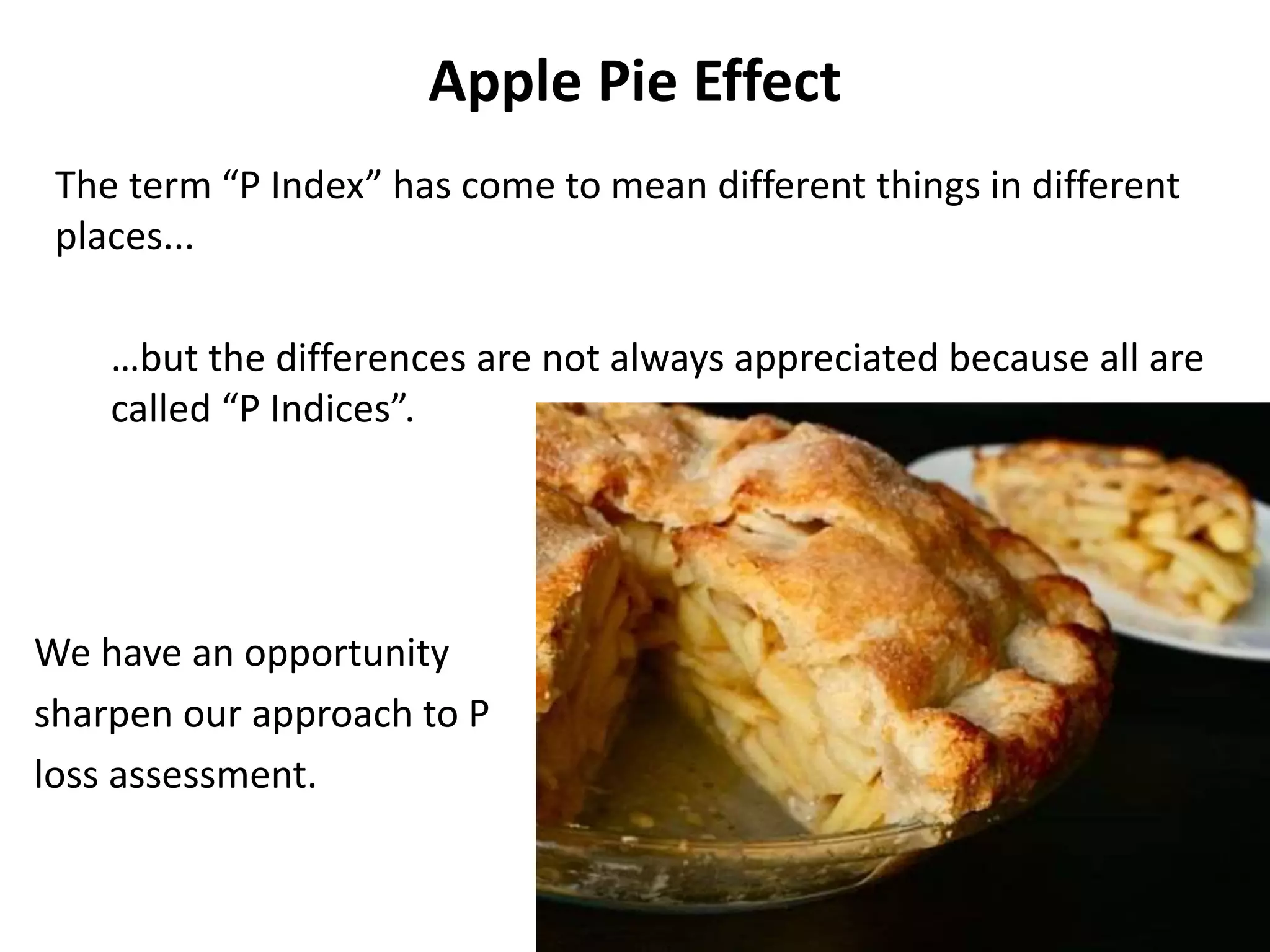
Apple Pie Effect
The term “P Index” has come to mean different things in different
places...
…but the differences are not always appreciated because all are
called “P Indices”.
We have an opportunity
sharpen our approach to P
loss assessment.
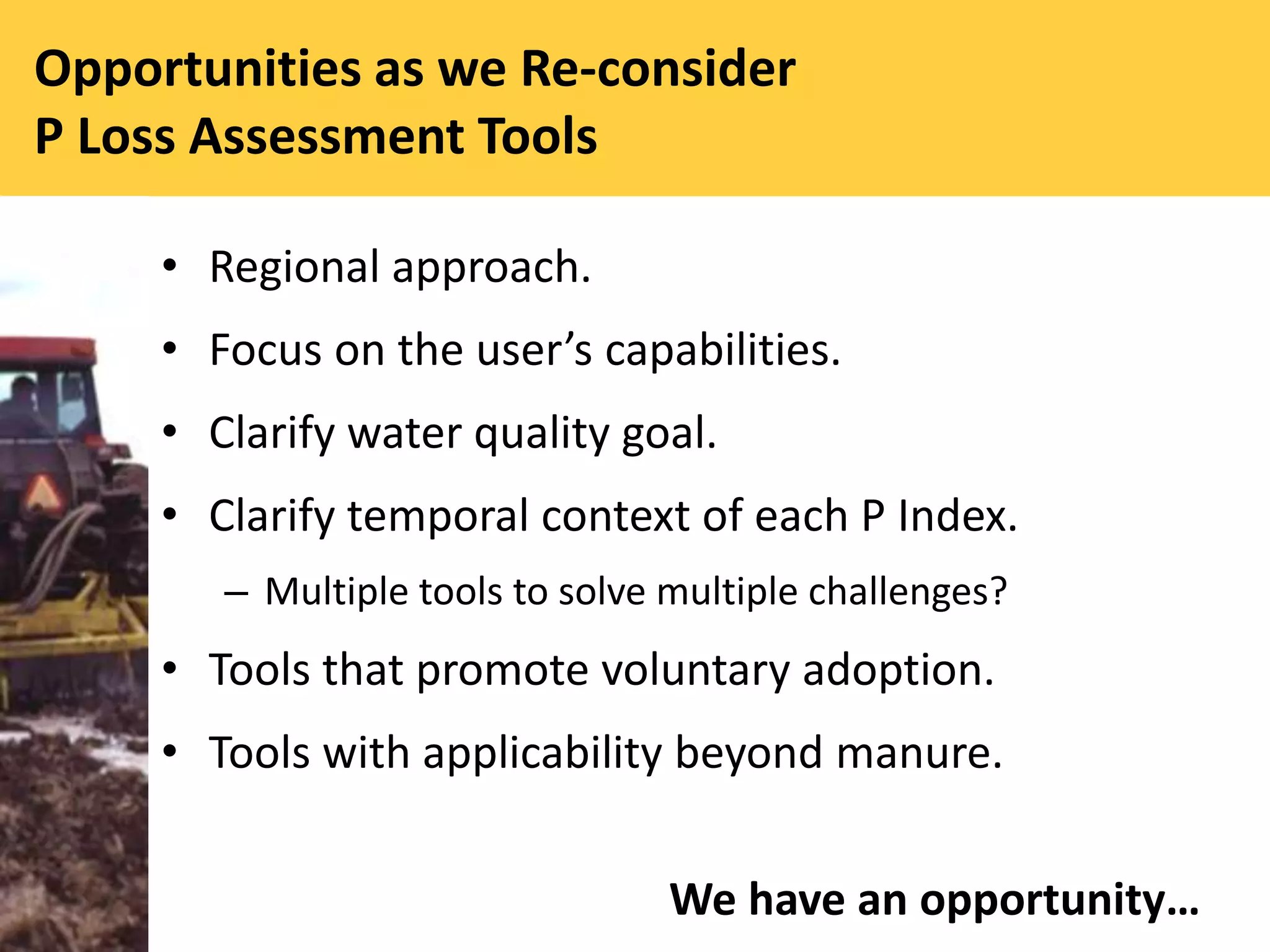
Opportunities as we Re-consider
P Loss Assessment Tools
• Regional approach.
• Focus on the user’s capabilities.
• Clarify water quality goal.
• Clarify temporal context of each P Index.
– Multiple tools to solve multiple challenges?
• Tools that promote voluntary adoption.
• Tools with applicability beyond manure.
We have an opportunity…
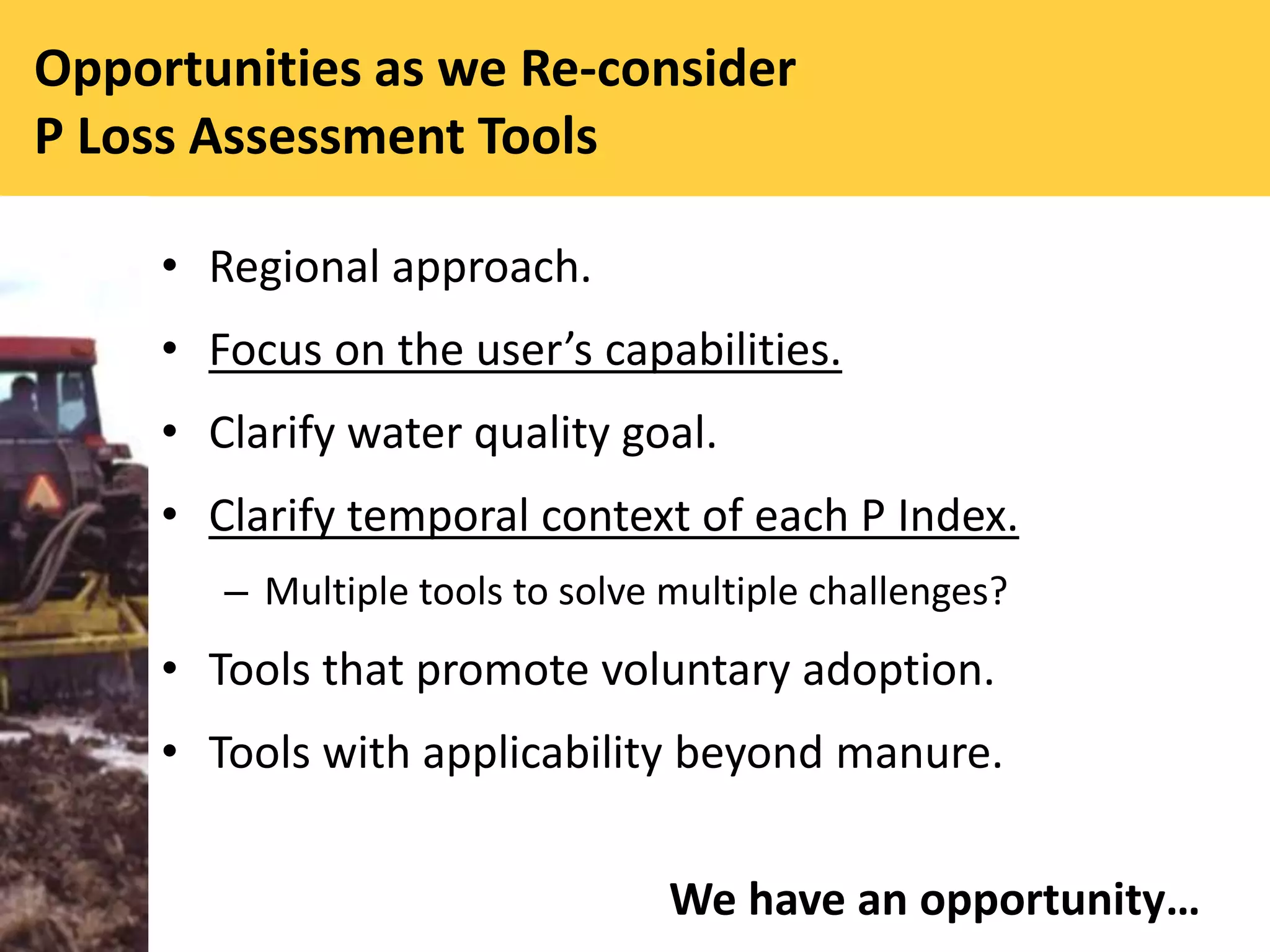
Opportunities as we Re-consider
P Loss Assessment Tools
• Regional approach.
• Focus on the user’s capabilities.
• Clarify water quality goal.
• Clarify temporal context of each P Index.
– Multiple tools to solve multiple challenges?
• Tools that promote voluntary adoption.
• Tools with applicability beyond manure.
We have an opportunity…
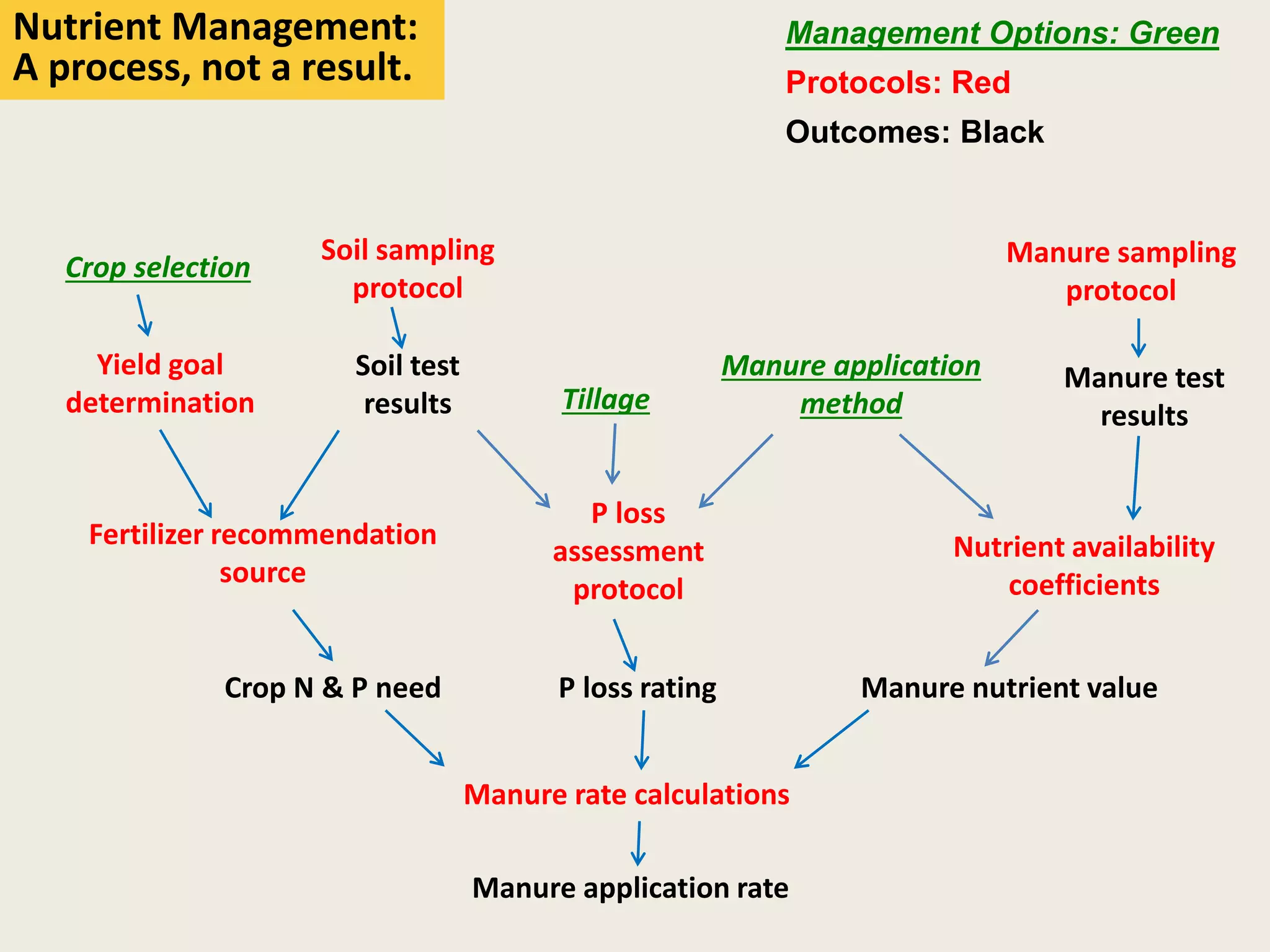
Soil sampling
protocol
Fertilizer recommendation
source
Crop N & P need
Manure sampling
protocol
P loss
assessment
protocol
Nutrient availability
coefficients
Manure nutrient valueP loss rating
Manure application rate
Manure rate calculations
Manure test
results
Soil test
results
Manure application
methodTillage
Yield goal
determination
Crop selection
Management Options: Green
Protocols: Red
Outcomes: Black
Nutrient Management:
A process, not a result.
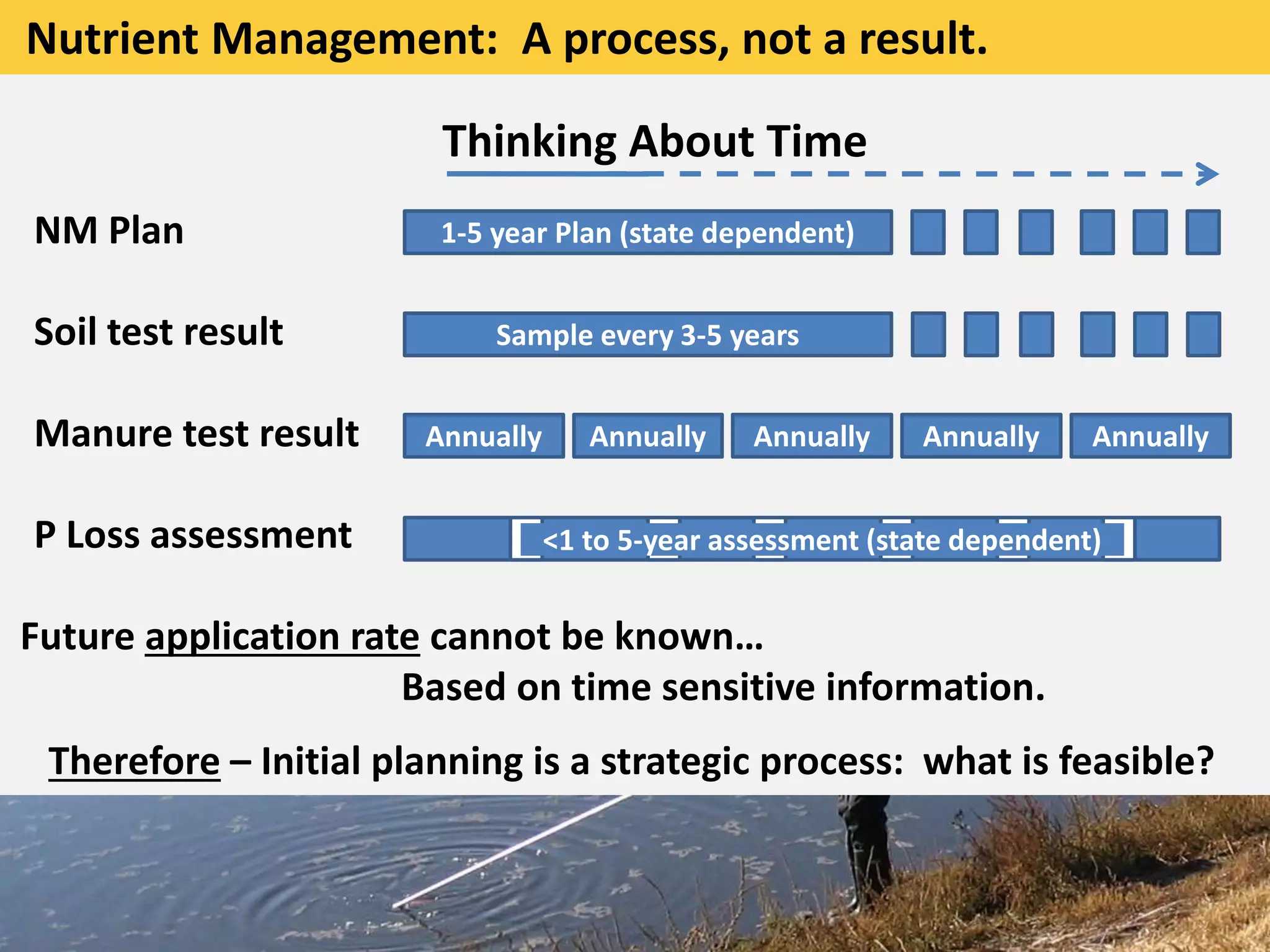
Thinking About Time
NM Plan
Soil test result
Manure test result
P Loss assessment
1-5 year Plan (state dependent)
Sample every 3-5 years
Annually Annually Annually AnnuallyAnnually
<1 to 5-year assessment (state dependent)
Future application rate cannot be known…
Based on time sensitive information.
Therefore – Initial planning is a strategic process: what is feasible?
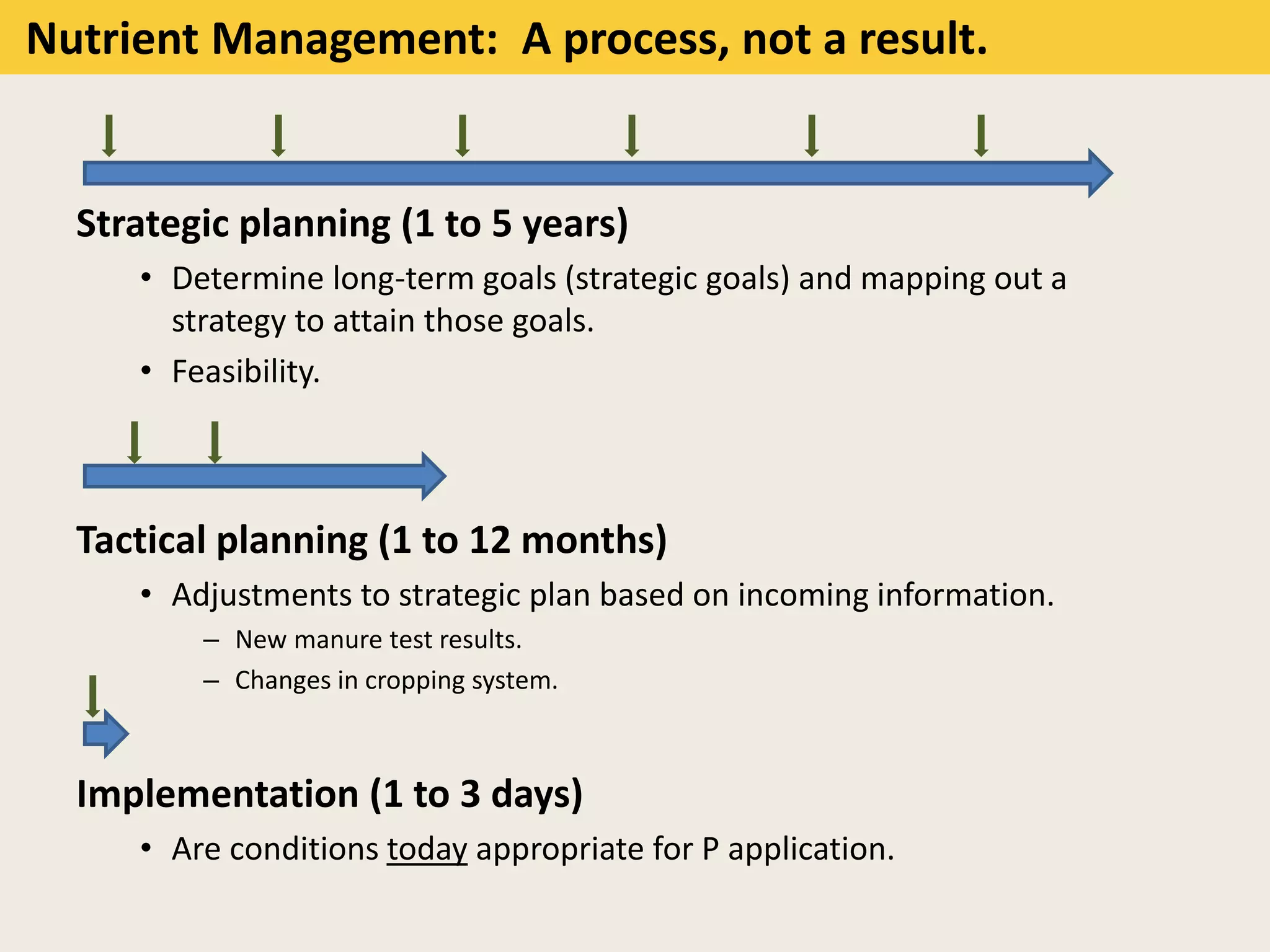
Nutrient Management: A process, not a result.
Strategic planning (1 to 5 years)
• Determine long-term goals (strategic goals) and mapping out a
strategy to attain those goals.
• Feasibility.
Tactical planning (1 to 12 months)
• Adjustments to strategic plan based on incoming information.
– New manure test results.
– Changes in cropping system.
Implementation (1 to 3 days)
• Are conditions today appropriate for P application.
Nutrient Management: A process, not a result.
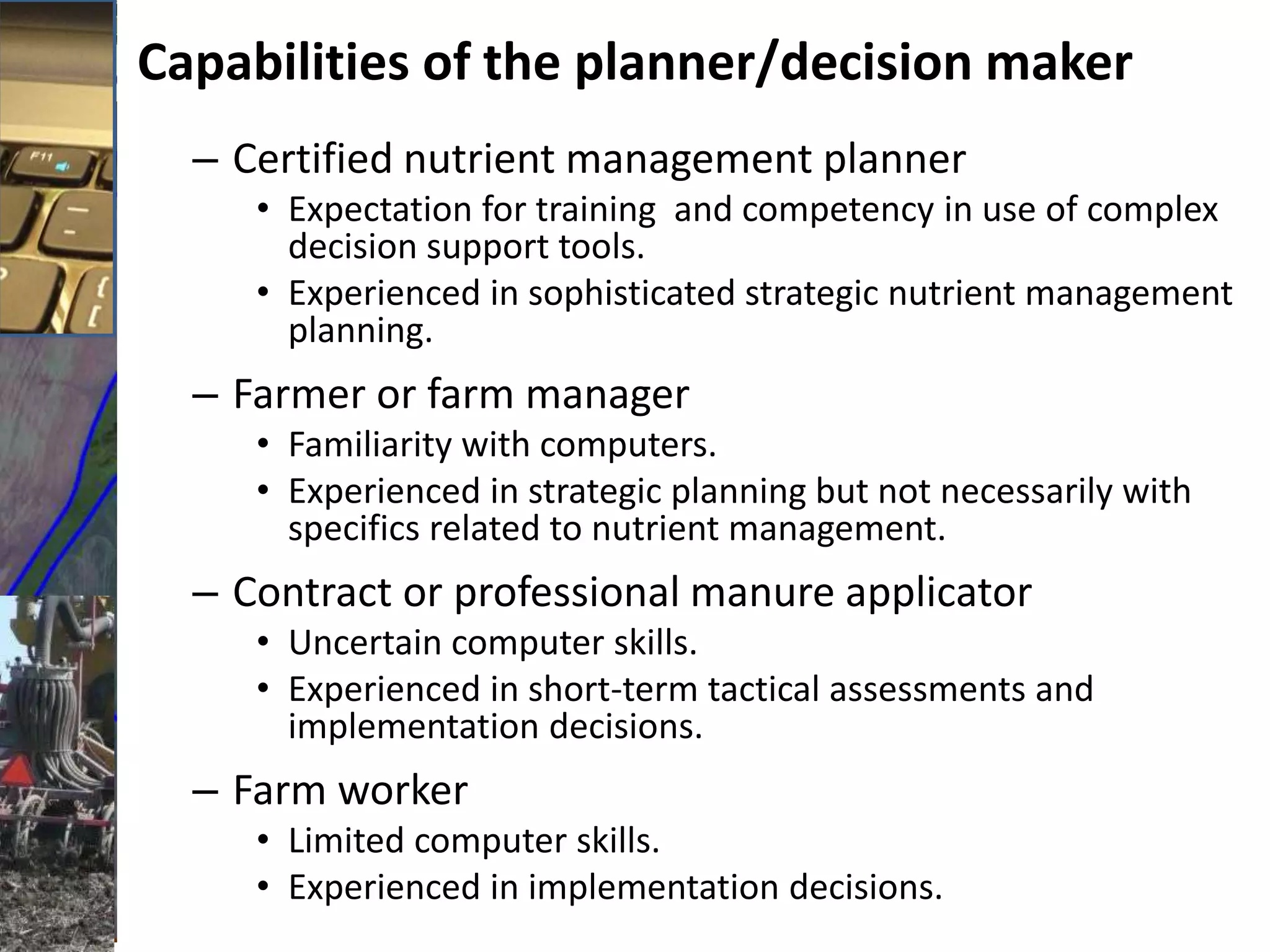
Capabilities of the planner/decision maker
– Certified nutrient management planner
• Expectation for training and competency in use of complex
decision support tools.
• Experienced in sophisticated strategic nutrient management
planning.
– Farmer or farm manager
• Familiarity with computers.
• Experienced in strategic planning but not necessarily with
specifics related to nutrient management.
– Contract or professional manure applicator
• Uncertain computer skills.
• Experienced in short-term tactical assessments and
implementation decisions.
– Farm worker
• Limited computer skills.
• Experienced in implementation decisions.
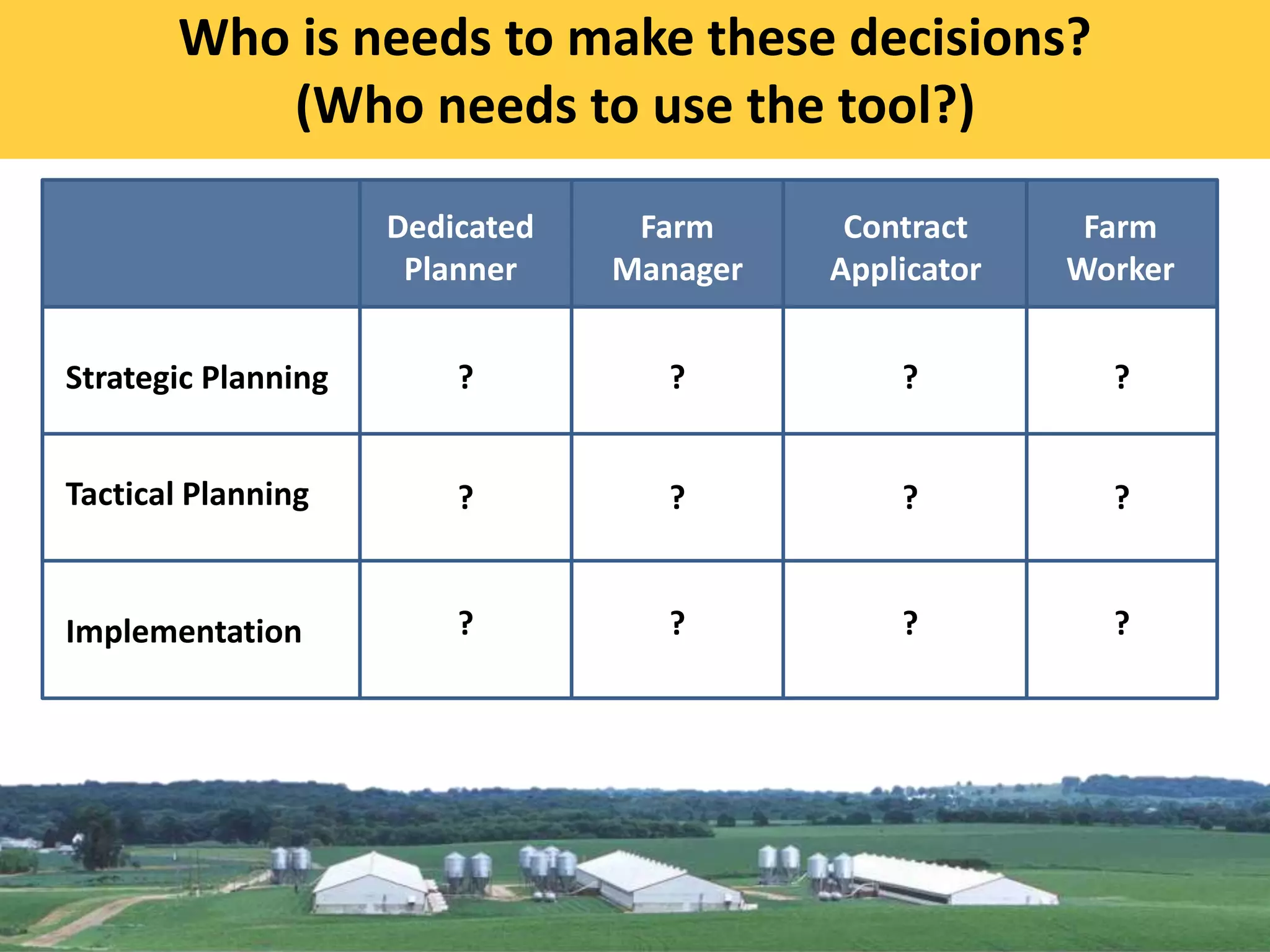
Strategic Planning
Tactical Planning
Implementation
Dedicated
Planner
Farm
Manager
Contract
Applicator
Farm
Worker
?
?
?
Who is needs to make these decisions?
(Who needs to use the tool?)
?
?
?
?
?
?
?
?
?
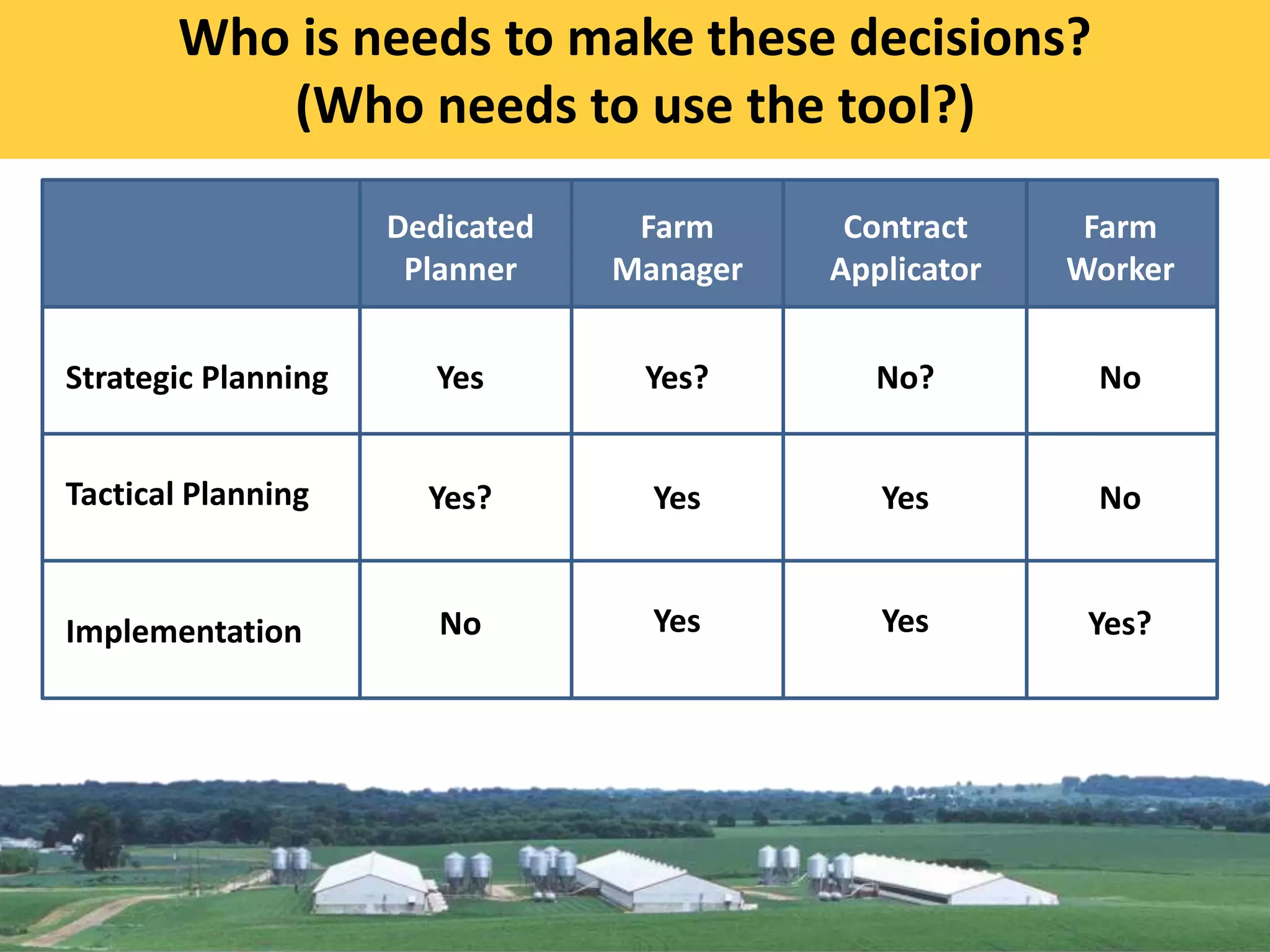
Strategic Planning
Tactical Planning
Implementation
Dedicated
Planner
Farm
Manager
Contract
Applicator
Farm
Worker
Yes Yes? No? No
Yes YesYes?
Yes Yes Yes?
No
No
Who is needs to make these decisions?
(Who needs to use the tool?)
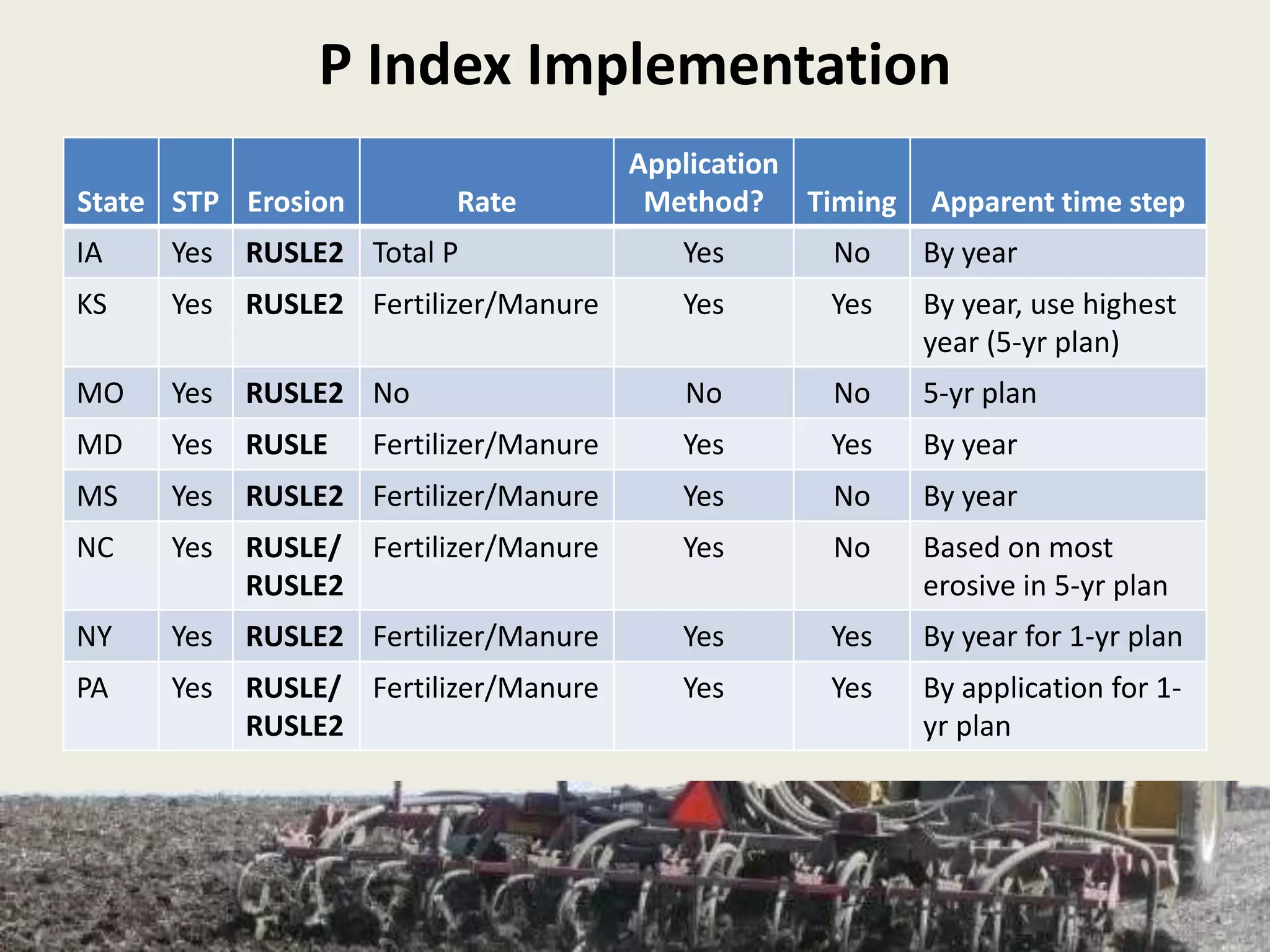
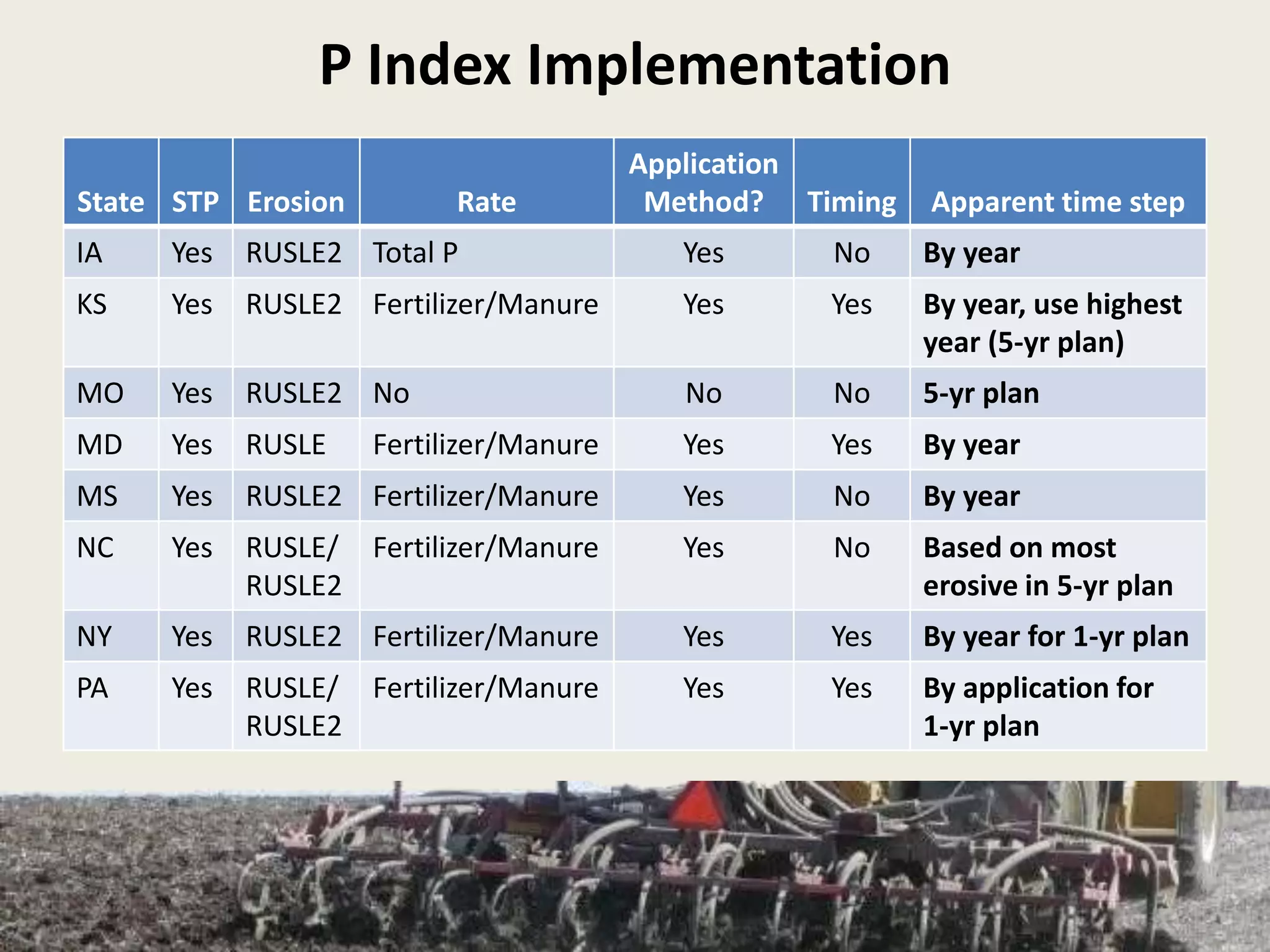
P Index Implementation
State STP Erosion Rate
Application
Method? Timing Apparent time step
IA Yes RUSLE2 Total P Yes No By year
KS Yes RUSLE2 Fertilizer/Manure Yes Yes By year, use highest
year (5-yr plan)
MO Yes RUSLE2 No No No 5-yr plan
MD Yes RUSLE Fertilizer/Manure Yes Yes By year
MS Yes RUSLE2 Fertilizer/Manure Yes No By year
NC Yes RUSLE/
RUSLE2
Fertilizer/Manure Yes No Based on most
erosive in 5-yr plan
NY Yes RUSLE2 Fertilizer/Manure Yes Yes By year for 1-yr plan
PA Yes RUSLE/
RUSLE2
Fertilizer/Manure Yes Yes By application for 1-
yr plan
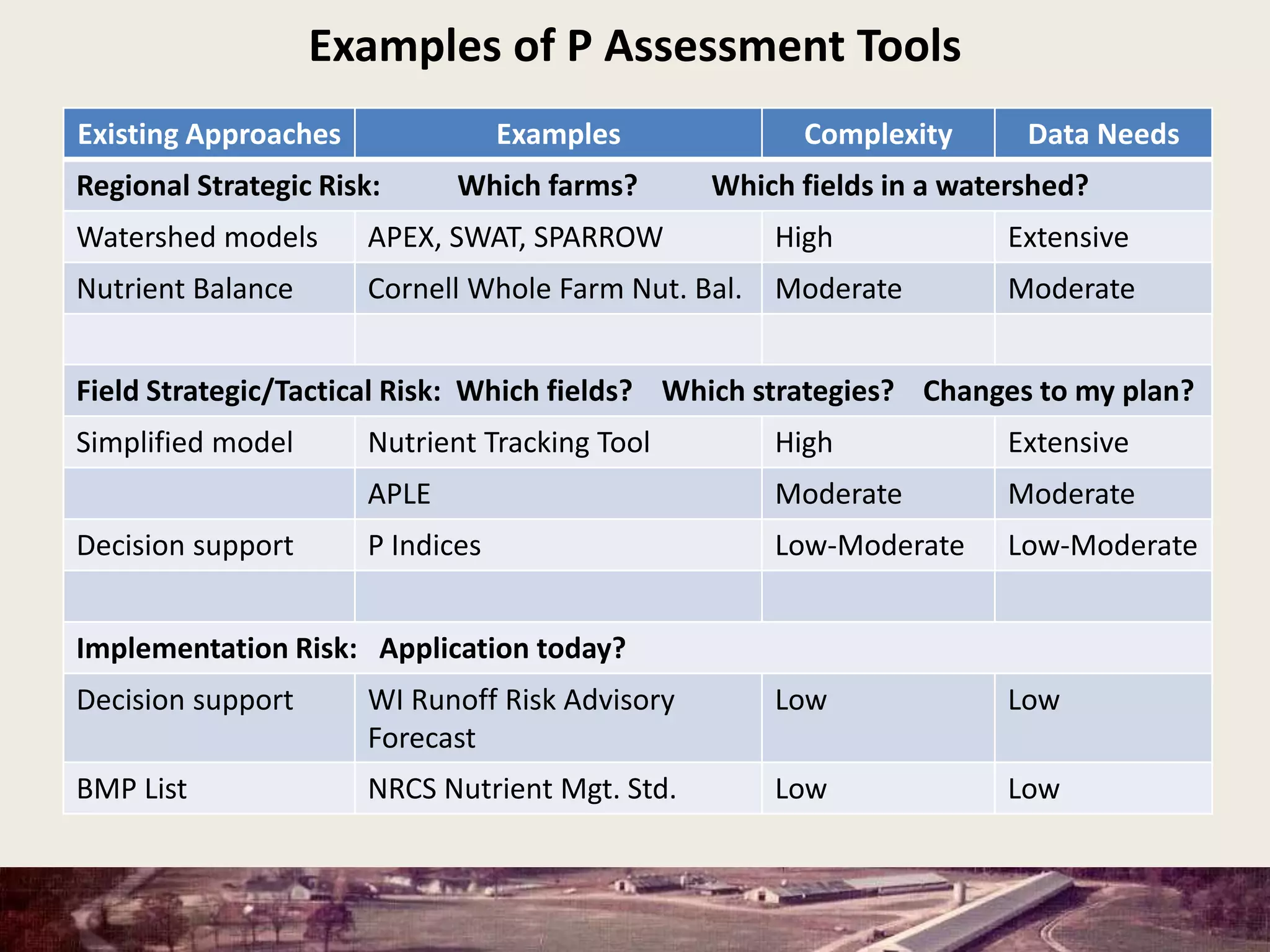
Examples of P Assessment Tools
Existing Approaches Examples Complexity Data Needs
Regional Strategic Risk: Which farms? Which fields in a watershed?
Watershed models APEX, SWAT, SPARROW High Extensive
Nutrient Balance Cornell Whole Farm Nut. Bal. Moderate Moderate
Field Strategic/Tactical Risk: Which fields? Which strategies? Changes to my plan?
Simplified model Nutrient Tracking Tool High Extensive
APLE Moderate Moderate
Decision support P Indices Low-Moderate Low-Moderate
Implementation Risk: Application today?
Decision support WI Runoff Risk Advisory
Forecast
Low Low
BMP List NRCS Nutrient Mgt. Std. Low Low
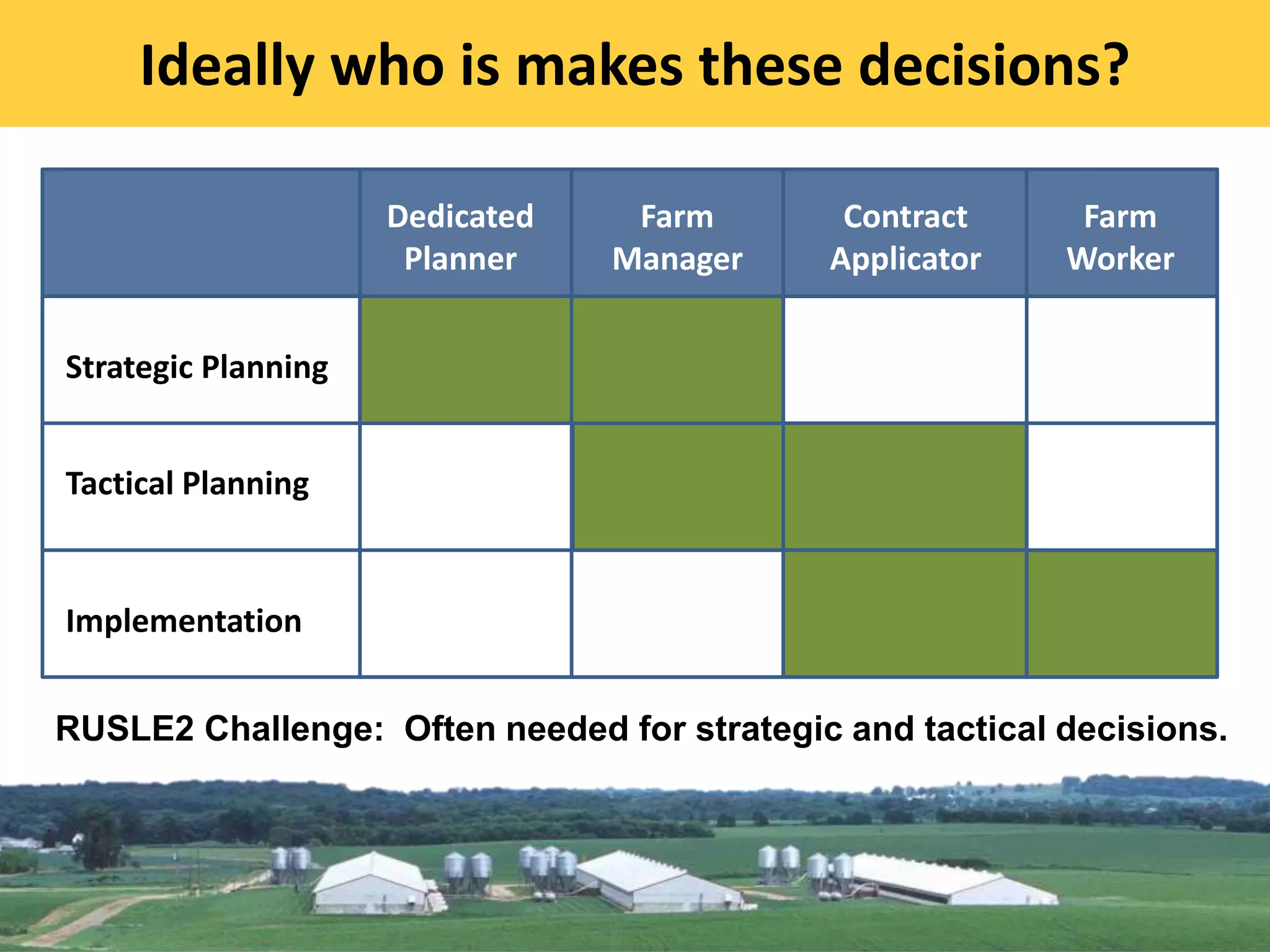
Strategic Planning
Tactical Planning
Implementation
Dedicated
Planner
Farm
Manager
Contract
Applicator
Farm
Worker
RUSLE2 Challenge: Often needed for strategic and tactical decisions.
Ideally who is makes these decisions?
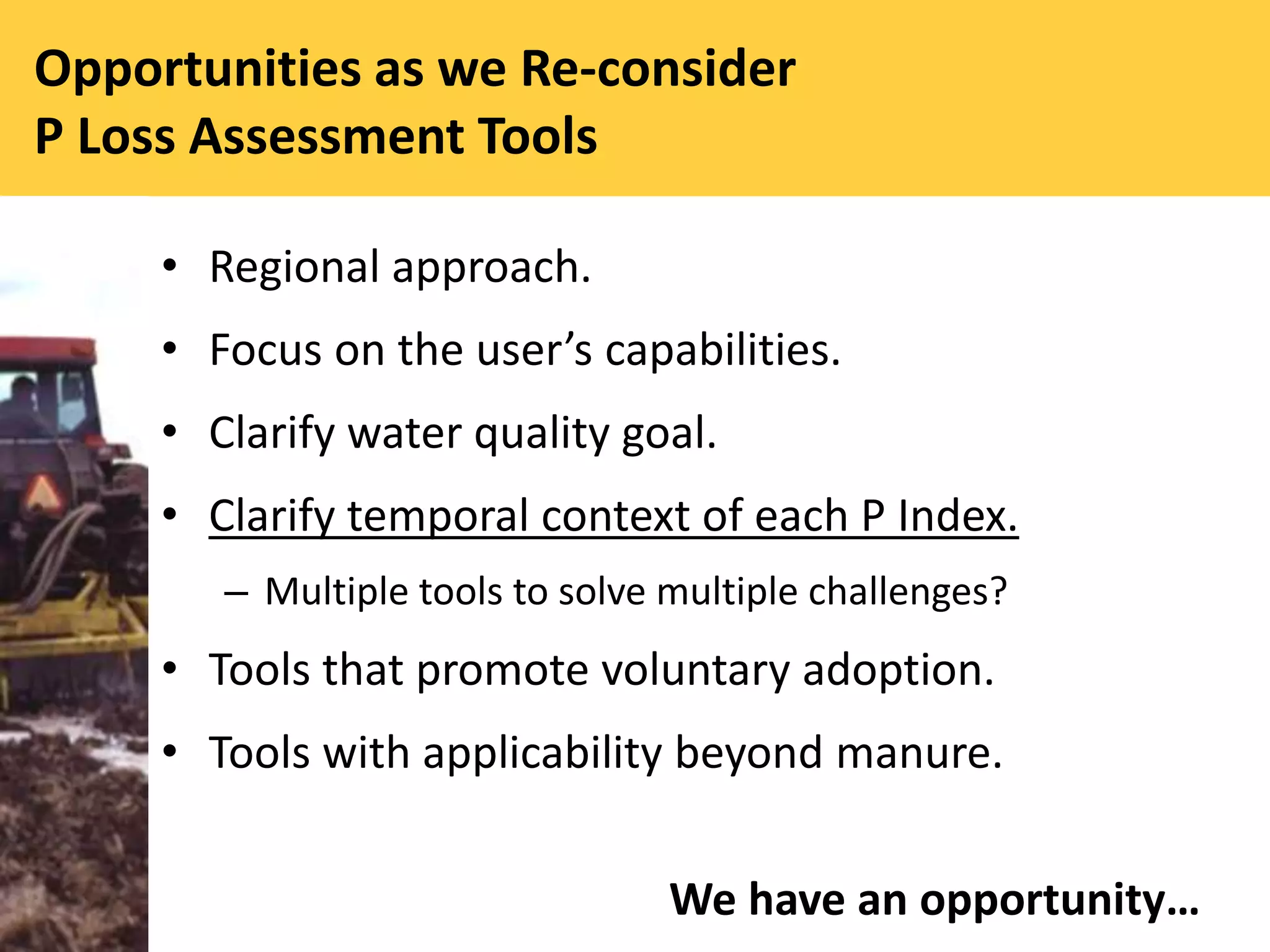
Opportunities as we Re-consider
P Loss Assessment Tools
• Regional approach.
• Focus on the user’s capabilities.
• Clarify water quality goal.
• Clarify temporal context of each P Index.
– Multiple tools to solve multiple challenges?
• Tools that promote voluntary adoption.
• Tools with applicability beyond manure.
We have an opportunity…
P Index Implementation
State STP Erosion Rate
Application
Method? Timing Apparent time step
IA Yes RUSLE2 Total P Yes No By year
KS Yes RUSLE2 Fertilizer/Manure Yes Yes By year, use highest
year (5-yr plan)
MO Yes RUSLE2 No No No 5-yr plan
MD Yes RUSLE Fertilizer/Manure Yes Yes By year
MS Yes RUSLE2 Fertilizer/Manure Yes No By year
NC Yes RUSLE/
RUSLE2
Fertilizer/Manure Yes No Based on most
erosive in 5-yr plan
NY Yes RUSLE2 Fertilizer/Manure Yes Yes By year for 1-yr plan
PA Yes RUSLE/
RUSLE2
Fertilizer/Manure Yes Yes By application for
1-yr plan
Strategic Planning
Tactical Planning
Implementation
Long-term
Average
Rotational
Losses
Long-term
Annual or
Seasonal
Losses
Seasonal
Forecasting
Short-term
Weather
Forecast
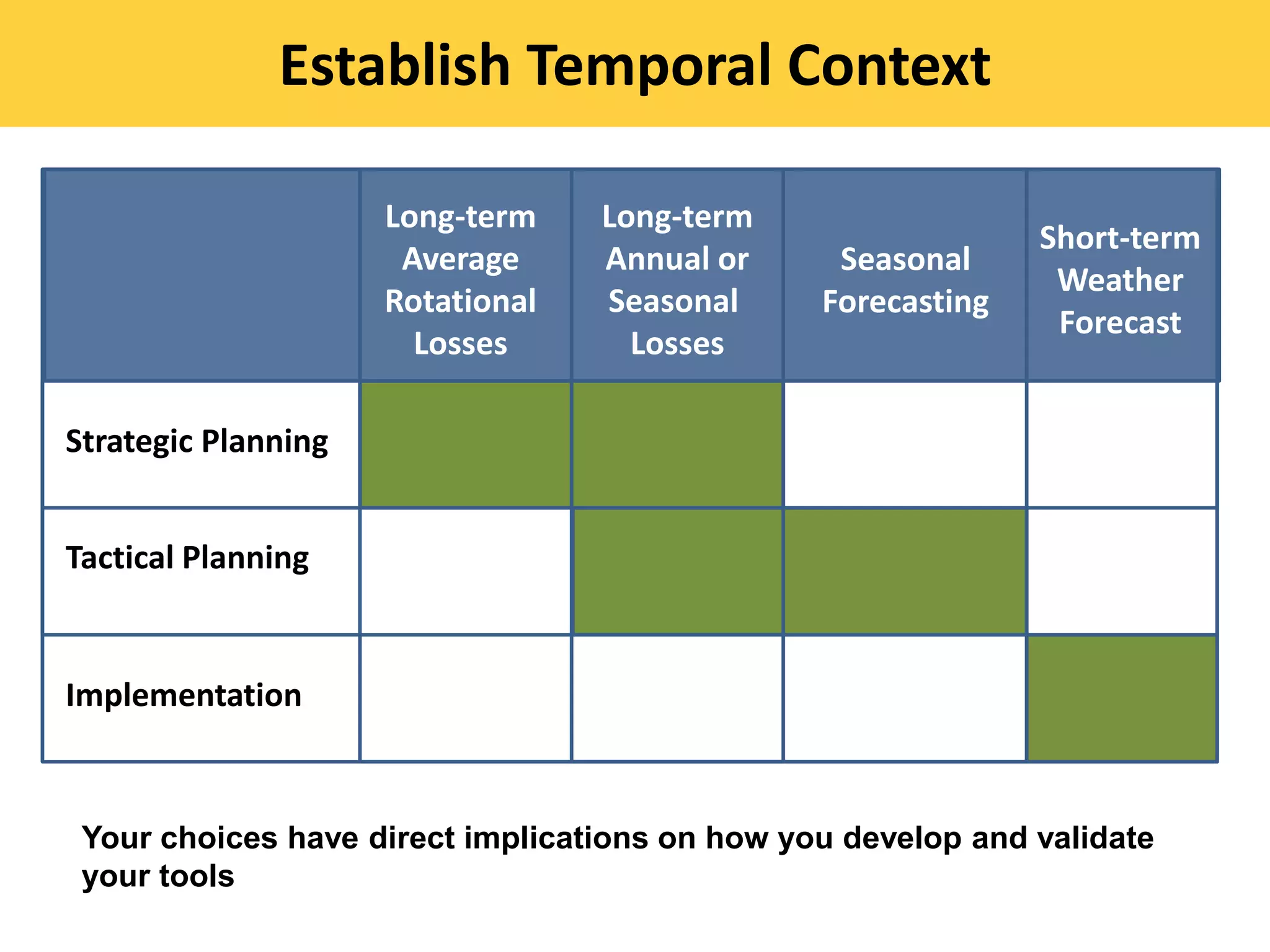
Your choices have direct implications on how you develop and validate
your tools
Establish Temporal Context
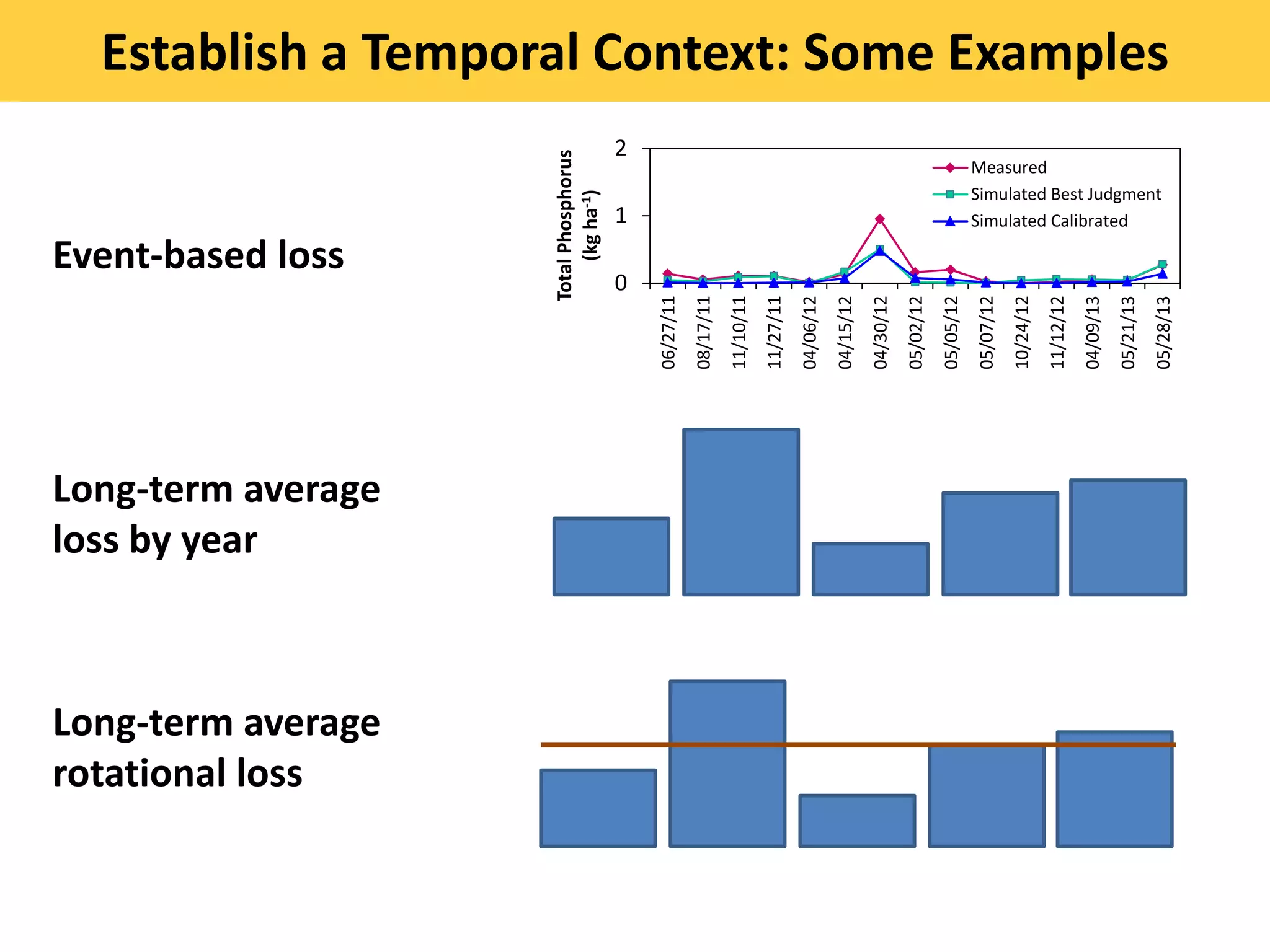
Event-based loss
Long-term average
loss by year
Long-term average
rotational loss
0
1
2
06/27/11
08/17/11
11/10/11
11/27/11
04/06/12
04/15/12
04/30/12
05/02/12
05/05/12
05/07/12
10/24/12
11/12/12
04/09/13
05/21/13
05/28/13
TotalPhosphorus
(kgha-1)
Measured
Simulated Best Judgment
Simulated Calibrated
Establish a Temporal Context: Some Examples
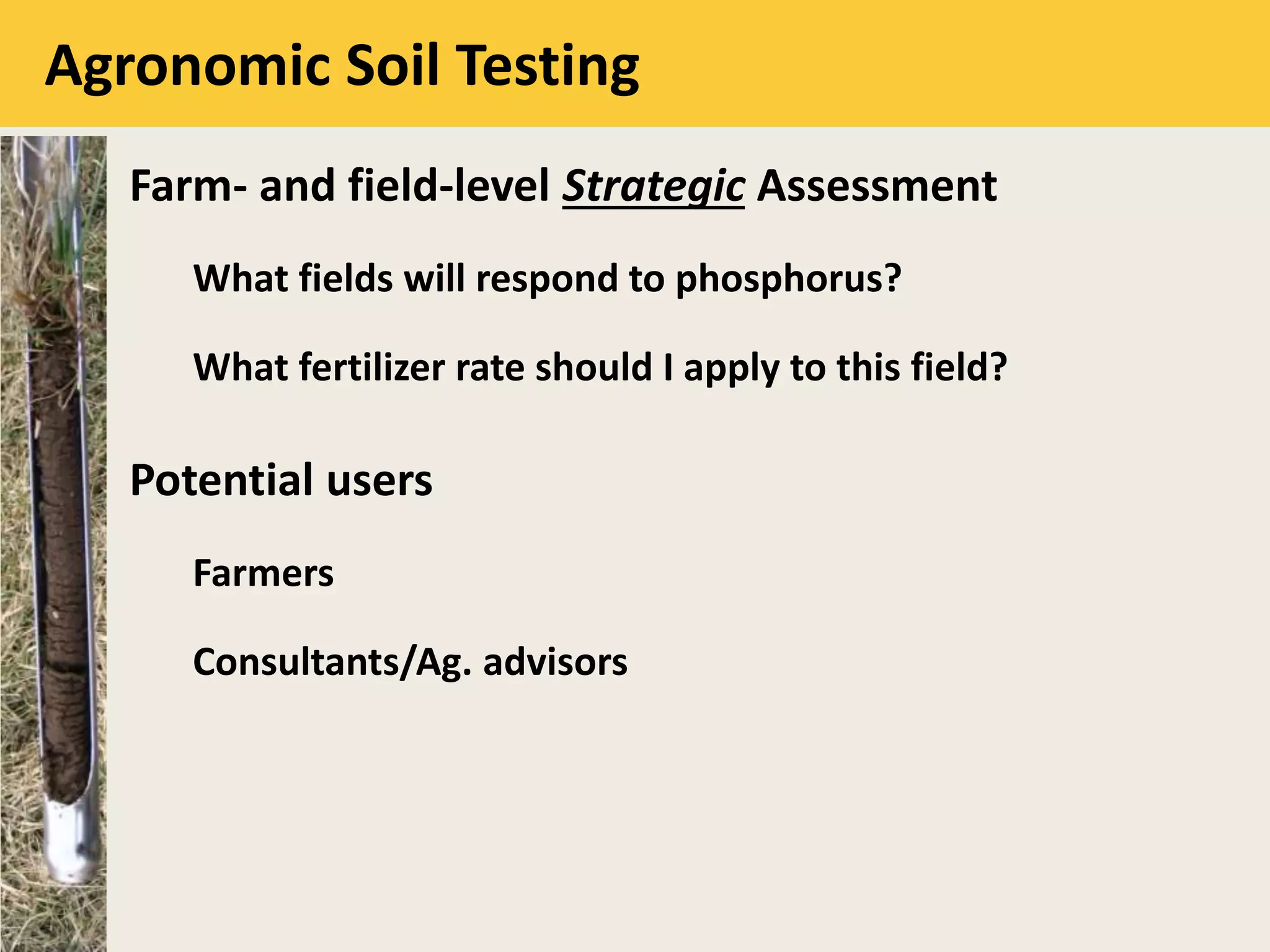
Agronomic Soil Testing
Farm- and field-level Strategic Assessment
What fields will respond to phosphorus?
What fertilizer rate should I apply to this field?
Potential users
Farmers
Consultants/Ag. advisors
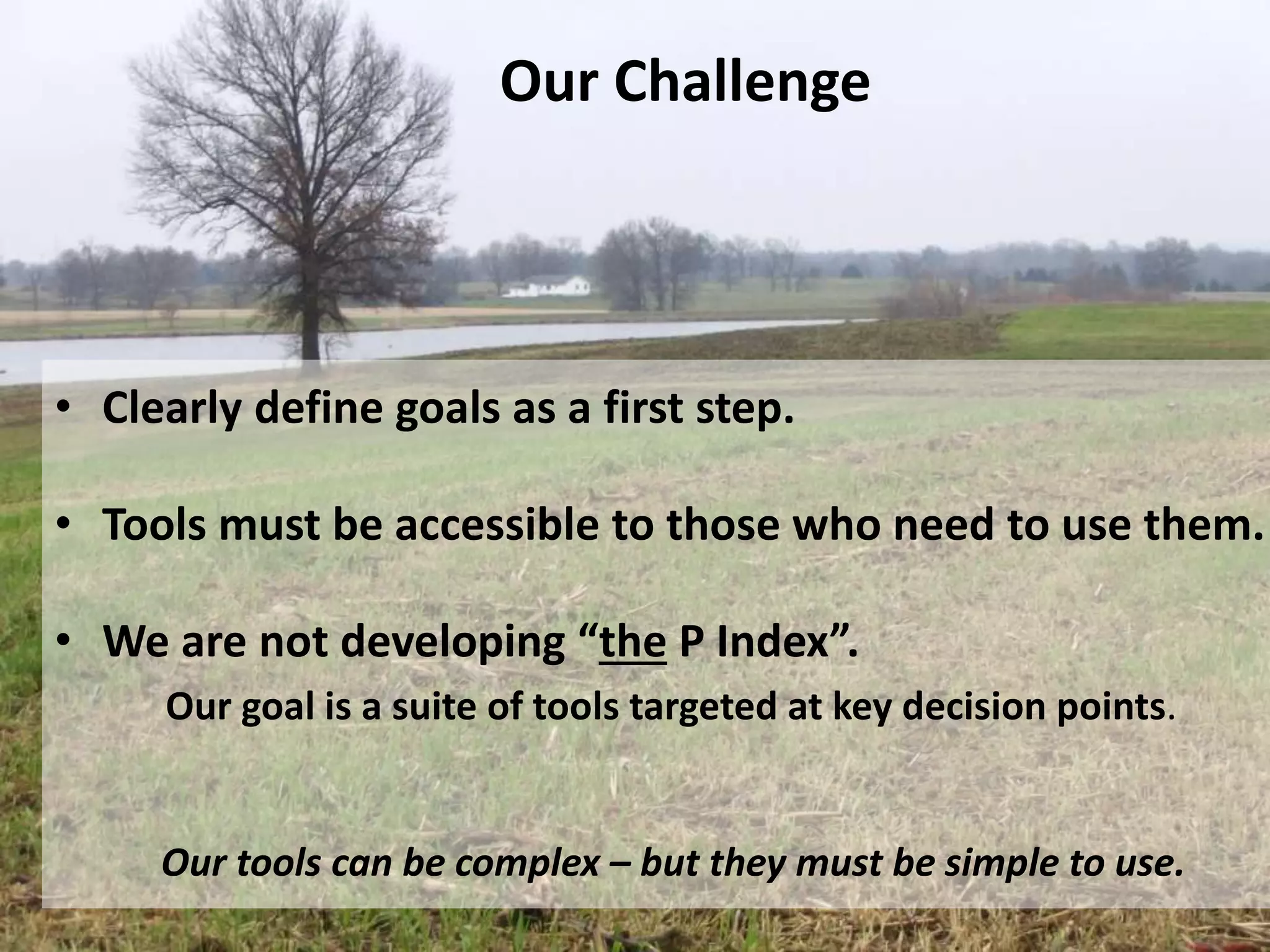
Our Challenge
• Clearly define goals as a first step.
• Tools must be accessible to those who need to use them.
• We are not developing “the P Index”.
Our goal is a suite of tools targeted at key decision points.
Our tools can be complex – but they must be simple to use.

User capabilities and next generation phosphorus (p) indices

  • 1.
    User Capabilities and NextGeneration Phosphorus Indices Waste to Worth April 2, 2015 John A. Lory University of Missouri Nathan O. Nelson Kansas State University
  • 2.
    Timeline of PManagement Tools Initial use of chemical extracts to predict crop response to fertilizers (Anderson, 1960). Development of current soil test phosphorus extracts for agronomic assessment (Bundy et al., 2005). Initiation of the environmental assessment era. Resource Assessment 1850 1900 1940 1985 2014
  • 3.
    Timeline of PManagement Tools Initial research connecting soil test P to runoff water quality (e.g. Romkens and Nelson, 1974; Sharpley et al. 1977; 1978). Initial P Index framework (Lemunyon and Gilbert, 1993). EPA-NRCS Unified national strategy for CAFO’s calling for P loss assessment on agricultural fields. CAFO rule requiring P loss assessment for regulated applications. Environmental Assessment 1970 1994 1999 2008 2014
  • 4.
    Apple Pie Effect Theterm “P Index” has come to mean different things in different places... …but the differences are not always appreciated because all are called “P Indices”. We have an opportunity sharpen our approach to P loss assessment.
  • 5.
    Opportunities as weRe-consider P Loss Assessment Tools • Regional approach. • Focus on the user’s capabilities. • Clarify water quality goal. • Clarify temporal context of each P Index. – Multiple tools to solve multiple challenges? • Tools that promote voluntary adoption. • Tools with applicability beyond manure. We have an opportunity…
  • 6.
    Opportunities as weRe-consider P Loss Assessment Tools • Regional approach. • Focus on the user’s capabilities. • Clarify water quality goal. • Clarify temporal context of each P Index. – Multiple tools to solve multiple challenges? • Tools that promote voluntary adoption. • Tools with applicability beyond manure. We have an opportunity…
  • 7.
    Soil sampling protocol Fertilizer recommendation source CropN & P need Manure sampling protocol P loss assessment protocol Nutrient availability coefficients Manure nutrient valueP loss rating Manure application rate Manure rate calculations Manure test results Soil test results Manure application methodTillage Yield goal determination Crop selection Management Options: Green Protocols: Red Outcomes: Black Nutrient Management: A process, not a result.
  • 8.
    Thinking About Time NMPlan Soil test result Manure test result P Loss assessment 1-5 year Plan (state dependent) Sample every 3-5 years Annually Annually Annually AnnuallyAnnually <1 to 5-year assessment (state dependent) Future application rate cannot be known… Based on time sensitive information. Therefore – Initial planning is a strategic process: what is feasible? Nutrient Management: A process, not a result.
  • 9.
    Strategic planning (1to 5 years) • Determine long-term goals (strategic goals) and mapping out a strategy to attain those goals. • Feasibility. Tactical planning (1 to 12 months) • Adjustments to strategic plan based on incoming information. – New manure test results. – Changes in cropping system. Implementation (1 to 3 days) • Are conditions today appropriate for P application. Nutrient Management: A process, not a result.
  • 10.
    Capabilities of theplanner/decision maker – Certified nutrient management planner • Expectation for training and competency in use of complex decision support tools. • Experienced in sophisticated strategic nutrient management planning. – Farmer or farm manager • Familiarity with computers. • Experienced in strategic planning but not necessarily with specifics related to nutrient management. – Contract or professional manure applicator • Uncertain computer skills. • Experienced in short-term tactical assessments and implementation decisions. – Farm worker • Limited computer skills. • Experienced in implementation decisions.
  • 11.
  • 12.
    Strategic Planning Tactical Planning Implementation Dedicated Planner Farm Manager Contract Applicator Farm Worker YesYes? No? No Yes YesYes? Yes Yes Yes? No No Who is needs to make these decisions? (Who needs to use the tool?)
  • 13.
    P Index Implementation StateSTP Erosion Rate Application Method? Timing Apparent time step IA Yes RUSLE2 Total P Yes No By year KS Yes RUSLE2 Fertilizer/Manure Yes Yes By year, use highest year (5-yr plan) MO Yes RUSLE2 No No No 5-yr plan MD Yes RUSLE Fertilizer/Manure Yes Yes By year MS Yes RUSLE2 Fertilizer/Manure Yes No By year NC Yes RUSLE/ RUSLE2 Fertilizer/Manure Yes No Based on most erosive in 5-yr plan NY Yes RUSLE2 Fertilizer/Manure Yes Yes By year for 1-yr plan PA Yes RUSLE/ RUSLE2 Fertilizer/Manure Yes Yes By application for 1- yr plan
  • 14.
    Examples of PAssessment Tools Existing Approaches Examples Complexity Data Needs Regional Strategic Risk: Which farms? Which fields in a watershed? Watershed models APEX, SWAT, SPARROW High Extensive Nutrient Balance Cornell Whole Farm Nut. Bal. Moderate Moderate Field Strategic/Tactical Risk: Which fields? Which strategies? Changes to my plan? Simplified model Nutrient Tracking Tool High Extensive APLE Moderate Moderate Decision support P Indices Low-Moderate Low-Moderate Implementation Risk: Application today? Decision support WI Runoff Risk Advisory Forecast Low Low BMP List NRCS Nutrient Mgt. Std. Low Low
  • 15.
    Strategic Planning Tactical Planning Implementation Dedicated Planner Farm Manager Contract Applicator Farm Worker RUSLE2Challenge: Often needed for strategic and tactical decisions. Ideally who is makes these decisions?
  • 16.
    Opportunities as weRe-consider P Loss Assessment Tools • Regional approach. • Focus on the user’s capabilities. • Clarify water quality goal. • Clarify temporal context of each P Index. – Multiple tools to solve multiple challenges? • Tools that promote voluntary adoption. • Tools with applicability beyond manure. We have an opportunity…
  • 17.
    P Index Implementation StateSTP Erosion Rate Application Method? Timing Apparent time step IA Yes RUSLE2 Total P Yes No By year KS Yes RUSLE2 Fertilizer/Manure Yes Yes By year, use highest year (5-yr plan) MO Yes RUSLE2 No No No 5-yr plan MD Yes RUSLE Fertilizer/Manure Yes Yes By year MS Yes RUSLE2 Fertilizer/Manure Yes No By year NC Yes RUSLE/ RUSLE2 Fertilizer/Manure Yes No Based on most erosive in 5-yr plan NY Yes RUSLE2 Fertilizer/Manure Yes Yes By year for 1-yr plan PA Yes RUSLE/ RUSLE2 Fertilizer/Manure Yes Yes By application for 1-yr plan
  • 18.
    Strategic Planning Tactical Planning Implementation Long-term Average Rotational Losses Long-term Annualor Seasonal Losses Seasonal Forecasting Short-term Weather Forecast Your choices have direct implications on how you develop and validate your tools Establish Temporal Context
  • 19.
    Event-based loss Long-term average lossby year Long-term average rotational loss 0 1 2 06/27/11 08/17/11 11/10/11 11/27/11 04/06/12 04/15/12 04/30/12 05/02/12 05/05/12 05/07/12 10/24/12 11/12/12 04/09/13 05/21/13 05/28/13 TotalPhosphorus (kgha-1) Measured Simulated Best Judgment Simulated Calibrated Establish a Temporal Context: Some Examples
  • 20.
    Agronomic Soil Testing Farm-and field-level Strategic Assessment What fields will respond to phosphorus? What fertilizer rate should I apply to this field? Potential users Farmers Consultants/Ag. advisors
  • 21.
    Our Challenge • Clearlydefine goals as a first step. • Tools must be accessible to those who need to use them. • We are not developing “the P Index”. Our goal is a suite of tools targeted at key decision points. Our tools can be complex – but they must be simple to use.