How Legacy Nutrients
Affect Farm Conservation
Measures
Andrew Sharpley
Crop, Soil,& Environmental Sciences
Water to Worth 2015
Advancing Sustainability
in Animal Agriculture
Seattle, WA
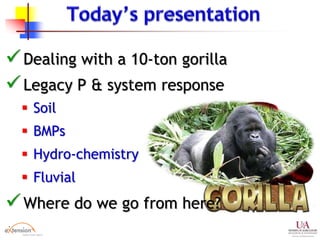
Dealing with a 10-ton gorilla
Legacy P & system response
 Soil
 BMPs
 Hydro-chemistry
 Fluvial
Where do we go from here?
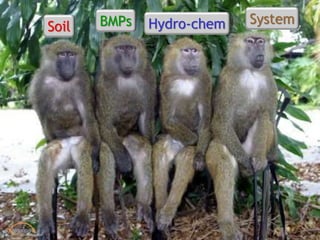
Soil Hydro-chemBMPs System
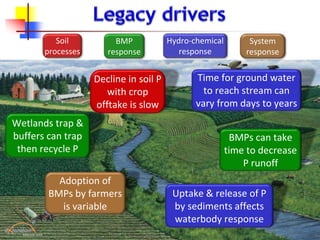
Uptake & release of P
by sediments affects
waterbody response
Decline in soil P
with crop
offtake is slow
Adoption of
BMPs by farmers
is variable
BMPs can take
time to decrease
P runoff
Soil
processes
Hydro-chemical
response
System
response
BMP
response
Wetlands trap &
buffers can trap
then recycle P
Time for ground water
to reach stream can
vary from days to years
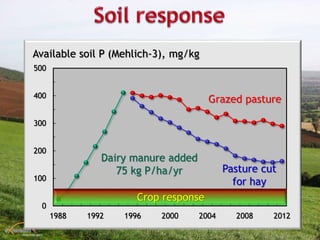
0
100
200
300
400
500
1988 1992 1996 2000 2004 2008 2012
Available soil P (Mehlich-3), mg/kg
Grazed pasture
Dairy manure added
75 kg P/ha/yr Pasture cut
for hay
Crop response
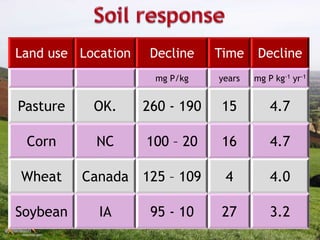
Land use Location Decline Time Decline
mg P/kg years mg P kg-1 yr-1
Pasture OK. 260 - 190 15 4.7
Corn NC 100 – 20 16 4.7
Wheat Canada 125 – 109 4 4.0
Soybean IA 95 - 10 27 3.2
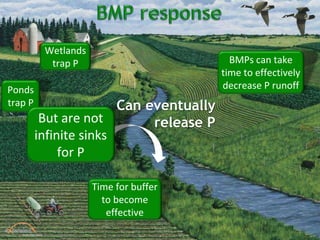
BMPs can take
time to effectively
decrease P runoffPonds
trap P
Time for buffer
to become
effective
Wetlands
trap P
But are not
infinite sinks
for P
Can eventually
release P
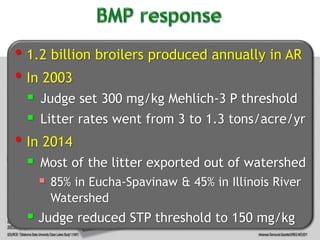
• 1.2 billion broilers produced annually in AR
• In 2003
 Judge set 300 mg/kg Mehlich-3 P threshold
 Litter rates went from 3 to 1.3 tons/acre/yr
• In 2014
 Most of the litter exported out of watershed
 85% in Eucha-Spavinaw & 45% in Illinois River
Watershed
 Judge reduced STP threshold to 150 mg/kg
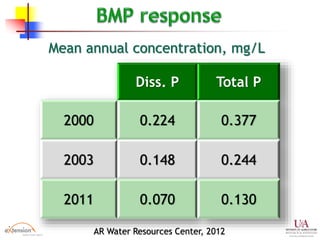
AR Water Resources Center, 2012
Diss. P Total P
2000 0.224 0.377
2003 0.148 0.244
2011 0.070 0.130
Mean annual concentration, mg/L
Time for water body
to biologically
respond to P input
Response to
BMPs takes
time
Variable delivery
time from source to
point of impact
36
48
15
Baseflow dissolved P, µg/L
27
Stormflow dissolved P, µg/L
170
124
304
202
I mile
0
50
100
150
200
250
300
1990 1995 2000 2005 2010
Lake P
µg/L Recovery phase
Internal recycling of
‘legacy’ P (10-15 y)
Water
quality
target
met
P input
reduced 60%
Water quality target
40 µg/L
Loch Leven, Scotland;
Linda May & Bryan Spears, CEH
Lakes (c.5-30 yr)
Groundwater
(<1 – 50 yr)
In-channel (<1 yr)
Riparian & floodplains
(<1 – 1000 yr)
Soils & hillslopes
(c.5-30 yr)
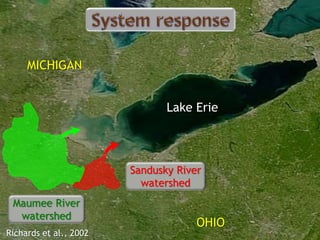
Maumee River
watershed
Sandusky River
watershed
MICHIGAN
Lake Erie
OHIO
Richards et al., 2002
3
4
5
6
7
1975 1980 1985 1990 1995
15
20
25
30
35
40
1975 1980 1985 1990 1995
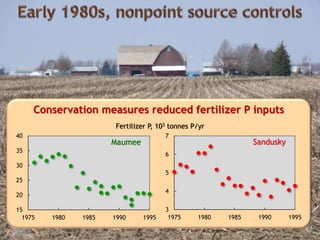
Conservation measures reduced fertilizer P inputs
Maumee Sandusky
Fertilizer P, 103 tonnes P/yr
1975 1980 1985 1990 1995 2000 2005 2010
0.00
0.02
0.04
0.06
0.08
0.10
0.12
0.14
Maumee River
1975 1980 1985 1990 1995 2000 2005 2010
0.00
0.02
0.04
0.06
0.08
0.10
0.12
0.14
Sandusky River
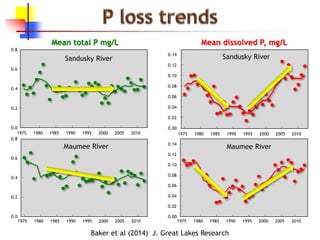
Baker et al (2014) J. Great Lakes Research
Mean total P mg/L
1975 1980 1985 1990 1995 2000 2005 2010
0.0
0.2
0.4
0.6
0.8
Maumee River
1975 1980 1985 1990 1995 2000 2005 2010
0.0
0.2
0.4
0.6
0.8
Sandusky River
Mean dissolved P, mg/L
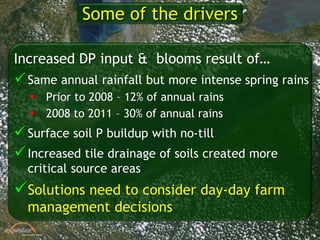
Some of the drivers
Increased DP input & blooms result of…
Same annual rainfall but more intense spring rains
 Prior to 2008 – 12% of annual rains
 2008 to 2011 – 30% of annual rains
Surface soil P buildup with no-till
Increased tile drainage of soils created more
critical source areas
Solutions need to consider day-day farm
management decisions
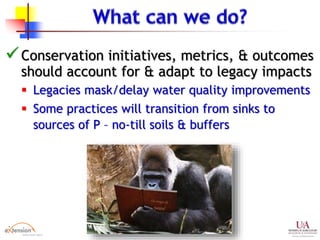
Conservation initiatives, metrics, & outcomes
should account for & adapt to legacy impacts
 Legacies mask/delay water quality improvements
 Some practices will transition from sinks to
sources of P – no-till soils & buffers
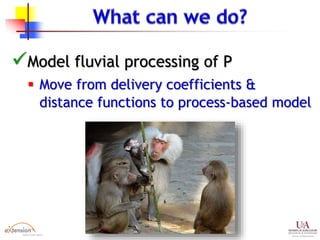
Model fluvial processing of P
 Move from delivery coefficients &
distance functions to process-based model
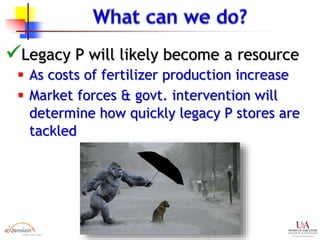
Legacy P will likely become a resource
 As costs of fertilizer production increase
 Market forces & govt. intervention will
determine how quickly legacy P stores are
tackled
Need better understanding of
 Spatial & temporal aspects of watershed
response to nutrient load reductions
 Scale at which responses may occur in a more
timely fashion
Local water quality & quantity benefits
evident more quickly at a smaller scale
Important to demonstrate change & foster
accountability & ultimately wider adoption
of conservation practices
How legacy nutrients affect farm conservation measures

How legacy nutrients affect farm conservation measures

  • 1.
    How Legacy Nutrients AffectFarm Conservation Measures Andrew Sharpley Crop, Soil,& Environmental Sciences Water to Worth 2015 Advancing Sustainability in Animal Agriculture Seattle, WA
  • 2.
    Dealing with a10-ton gorilla Legacy P & system response  Soil  BMPs  Hydro-chemistry  Fluvial Where do we go from here?
  • 3.
  • 4.
    Uptake & releaseof P by sediments affects waterbody response Decline in soil P with crop offtake is slow Adoption of BMPs by farmers is variable BMPs can take time to decrease P runoff Soil processes Hydro-chemical response System response BMP response Wetlands trap & buffers can trap then recycle P Time for ground water to reach stream can vary from days to years
  • 5.
    0 100 200 300 400 500 1988 1992 19962000 2004 2008 2012 Available soil P (Mehlich-3), mg/kg Grazed pasture Dairy manure added 75 kg P/ha/yr Pasture cut for hay Crop response
  • 6.
    Land use LocationDecline Time Decline mg P/kg years mg P kg-1 yr-1 Pasture OK. 260 - 190 15 4.7 Corn NC 100 – 20 16 4.7 Wheat Canada 125 – 109 4 4.0 Soybean IA 95 - 10 27 3.2
  • 7.
    BMPs can take timeto effectively decrease P runoffPonds trap P Time for buffer to become effective Wetlands trap P But are not infinite sinks for P Can eventually release P
  • 8.
    • 1.2 billionbroilers produced annually in AR • In 2003  Judge set 300 mg/kg Mehlich-3 P threshold  Litter rates went from 3 to 1.3 tons/acre/yr • In 2014  Most of the litter exported out of watershed  85% in Eucha-Spavinaw & 45% in Illinois River Watershed  Judge reduced STP threshold to 150 mg/kg
  • 9.
    AR Water ResourcesCenter, 2012 Diss. P Total P 2000 0.224 0.377 2003 0.148 0.244 2011 0.070 0.130 Mean annual concentration, mg/L
  • 10.
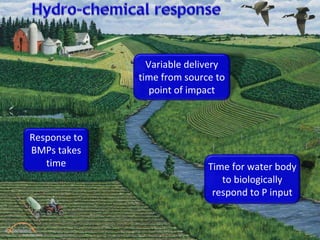
    Time for waterbody to biologically respond to P input Response to BMPs takes time Variable delivery time from source to point of impact
  • 11.
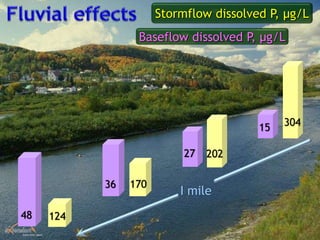
    36 48 15 Baseflow dissolved P,µg/L 27 Stormflow dissolved P, µg/L 170 124 304 202 I mile
  • 12.
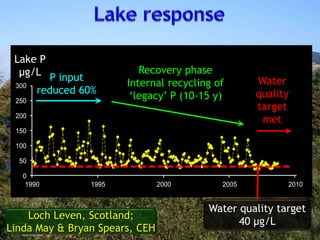
    0 50 100 150 200 250 300 1990 1995 20002005 2010 Lake P µg/L Recovery phase Internal recycling of ‘legacy’ P (10-15 y) Water quality target met P input reduced 60% Water quality target 40 µg/L Loch Leven, Scotland; Linda May & Bryan Spears, CEH
  • 13.
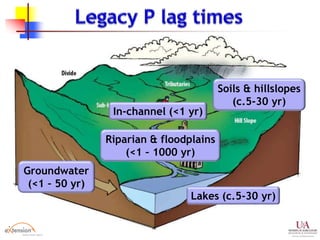
    Lakes (c.5-30 yr) Groundwater (<1– 50 yr) In-channel (<1 yr) Riparian & floodplains (<1 – 1000 yr) Soils & hillslopes (c.5-30 yr)
  • 14.
  • 15.
    3 4 5 6 7 1975 1980 19851990 1995 15 20 25 30 35 40 1975 1980 1985 1990 1995 Conservation measures reduced fertilizer P inputs Maumee Sandusky Fertilizer P, 103 tonnes P/yr
  • 16.
    1975 1980 19851990 1995 2000 2005 2010 0.00 0.02 0.04 0.06 0.08 0.10 0.12 0.14 Maumee River 1975 1980 1985 1990 1995 2000 2005 2010 0.00 0.02 0.04 0.06 0.08 0.10 0.12 0.14 Sandusky River Baker et al (2014) J. Great Lakes Research Mean total P mg/L 1975 1980 1985 1990 1995 2000 2005 2010 0.0 0.2 0.4 0.6 0.8 Maumee River 1975 1980 1985 1990 1995 2000 2005 2010 0.0 0.2 0.4 0.6 0.8 Sandusky River Mean dissolved P, mg/L
  • 17.
    Some of thedrivers Increased DP input & blooms result of… Same annual rainfall but more intense spring rains  Prior to 2008 – 12% of annual rains  2008 to 2011 – 30% of annual rains Surface soil P buildup with no-till Increased tile drainage of soils created more critical source areas Solutions need to consider day-day farm management decisions
  • 19.
    Conservation initiatives, metrics,& outcomes should account for & adapt to legacy impacts  Legacies mask/delay water quality improvements  Some practices will transition from sinks to sources of P – no-till soils & buffers
  • 20.
    Model fluvial processingof P  Move from delivery coefficients & distance functions to process-based model
  • 21.
    Legacy P willlikely become a resource  As costs of fertilizer production increase  Market forces & govt. intervention will determine how quickly legacy P stores are tackled
  • 22.
    Need better understandingof  Spatial & temporal aspects of watershed response to nutrient load reductions  Scale at which responses may occur in a more timely fashion Local water quality & quantity benefits evident more quickly at a smaller scale Important to demonstrate change & foster accountability & ultimately wider adoption of conservation practices