DISINFECTION
DR. CHHAVI BAJAJ
DENTAL SURGEON
AIILSG
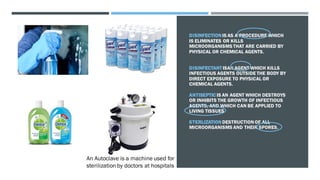
DISINFECTIONIS AS A PROCEDURE WHICH
IS ELIMINATES OR KILLS
MICROORGANISMS THAT ARE CARRIED BY
PHYSICAL OR CHEMICAL AGENTS.
DISINFECTANT ISAN AGENT WHICH KILLS
INFECTIOUS AGENTS OUTSIDE THE BODY BY
DIRECT EXPOSURE TO PHYSICAL OR
CHEMICAL AGENTS.
ANTISEPTIC IS AN AGENT WHICH DESTROYS
OR INHIBITS THE GROWTH OF INFECTIOUS
AGENTS, AND WHICH CAN BE APPLIED TO
LIVING TISSUES
STERLIZATIONDESTRUCTION OF ALL
MICROORGANISMS AND THEIR SPORES.
An Autoclave is a machine used for
sterilization by doctors at hospitals
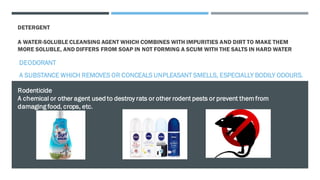
DETERGENT
A WATER-SOLUBLE CLEANSING AGENT WHICH COMBINES WITH IMPURITIES AND DIRT TO MAKE THEM
MORE SOLUBLE, AND DIFFERS FROM SOAP IN NOT FORMING A SCUM WITH THE SALTS IN HARD WATER
DEODORANT
A SUBSTANCE WHICH REMOVES OR CONCEALS UNPLEASANT SMELLS, ESPECIALLY BODILY ODOURS.
Rodenticide
A chemical or other agent used to destroy rats or other rodent pests or prevent themfrom
damaging food, crops, etc.
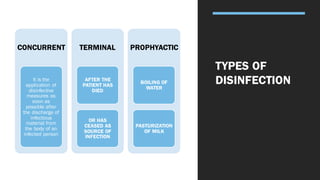
TYPES OF
DISINFECTION
CONCURRENT
It is the
application of
disinfective
measures as
soon as
possible after
the discharge of
infectious
material from
the body of an
infected person
TERMINAL
AFTER THE
PATIENT HAS
DIED
OR HAS
CEASED AS
SOURCE OF
INFECTION
PROPHYACTIC
BOILING OF
WATER
PASTURIZATION
OF MILK
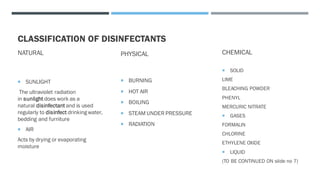
CLASSIFICATION OF DISINFECTANTS
NATURAL
 SUNLIGHT
The ultraviolet radiation
in sunlight does work as a
natural disinfectant and is used
regularly to disinfect drinking water,
bedding and furniture
 AIR
Acts by drying or evaporating
moisture
PHYSICAL
 BURNING
 HOT AIR
 BOILING
 STEAM UNDER PRESSURE
 RADIATION
CHEMICAL
 SOLID
LIME
BLEACHING POWDER
PHENYL
MERCURIC NITRATE
 GASES
FORMALIN
CHLORINE
ETHYLENE OXIDE
 LIQUID
(TO BE CONTINUED ON slide no 7)
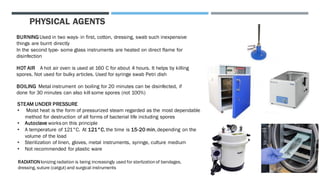
PHYSICAL AGENTS
BURNING Used in two ways- in first, cotton, dressing, swab such inexpensive
things are burnt directly
In the second type- some glass instruments are heated on direct flame for
disinfection
HOT AIR A hot air oven is used at 160 C for about 4 hours. It helps by killing
spores. Not used for bulky articles. Used for syringe swab Petri dish
BOILING Metal instrument on boiling for 20 minutes can be disinfected, if
done for 30 minutes can also kill some spores (not 100%)
STEAM UNDER PRESSURE
• Moist heat is the form of pressurized steam regarded as the most dependable
method for destruction of all forms of bacterial life including spores
• Autoclave works on this principle
• A temperature of 121°C. At 121°C,the time is 15-20 min,depending on the
volume of the load
• Sterilization of linen, gloves, metal instruments, syringe, culture medium
• Not recommended for plastic ware
RADIATIONIonizing radiation is being increasingly used for sterlizationof bandages,
dressing, suture (catgut) and surgical instruments
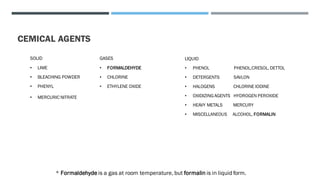
CEMICAL AGENTS
SOLID
• LIME
• BLEACHING POWDER
• PHENYL
• MERCURIC NITRATE
GASES
• FORMALDEHYDE
• CHLORINE
• ETHYLENE OXIDE
LIQUID
• PHENOL PHENOL,CRESOL, DETTOL
• DETERGENTS SAVLON
• HALOGENS CHLORINE IODINE
• OXIDIZINGAGENTS HYDROGEN PEROXIDE
• HEAVY METALS MERCURY
• MISCELLANEOUS ALCOHOL, FORMALIN
* Formaldehyde is a gas at room temperature, but formalin is in liquid form.
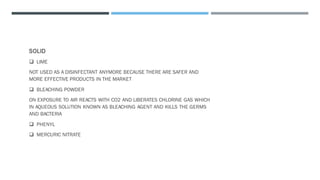
SOLID
❑ LIME
NOT USED AS A DISINFECTANT ANYMORE BECAUSE THERE ARE SAFER AND
MORE EFFECTIVE PRODUCTS IN THE MARKET
❑ BLEACHING POWDER
ON EXPOSURE TO AIR REACTS WITH CO2 AND LIBERATES CHLORINE GAS WHICH
IN AQUEOUS SOLUTION KNOWN AS BLEACHING AGENT AND KILLS THE GERMS
AND BACTERIA
❑ PHENYL
❑ MERCURIC NITRATE
GASES
 FORMALDEHYDE
Reliable sterilization using formaldehyde is achieved when performed
with a high concentration of gas, at a temperature between 60o and
80°C and with a relative humidity of 75 to 100%.
 CHLORINE
 ETHYLENE OXIDE
It is most commonly used to sterilize instruments with long lumens
such as endoscopes and all materials that have to be sterilized but
cannot withstand higher temperature
 Phenol It is cheap and effective.
Commonly used for bacteria.
Less effective towards spores
 Cresol Excellent disinfectant
10 times more powerful
5 % concentration is used for general disinfection
 Cresol emulsion When used with soap- saponified cresol
Lysol contains 50-60% cresol
Very powerful disinfectant
 Hibitane Works better against gram positive bacteria
Incorporated in liquid soaps and detergent creams
 Chlorhexidine Used for both gram positive and negative bacteria
 Dettol Nontoxic antiseptic. Used at 5% conc for sterilization for 30 minutes
PHENOL AND RELATED COMPOUNDS
 Detergent
 Soap
 Cetrimide is cetavion
 Savlon is made of cetavion and hibitane
 Halogen
 Chlorine in water supplies
 Iodine is commonly used betadine or povidone iodine
 Heavy metals
 Mercurochrome poor disinfectant, non-irritating 2%
 Methanolate for instruments sterilization
 Oxidizing agents
 Hydrogen peroxide releases nascent oxygen
MISCELLANEOUS
 Alcohol is used as 70% ethyl alcohol whereas isopropyl is more bactericidal
 Methylated spirit 5-20% methyl alcohol in ethyl alcohol
 Formalin 40% formaldehyde in water, pungent
 Others
 Acetone is mild antibacterial
 Ether is bactericidal, not for skin
 Dyes are not very effective
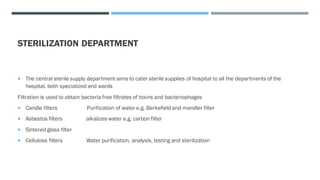
STERILIZATION DEPARTMENT
 The central sterile supply department aims to cater sterile supplies of hospital to all the departments of the
hospital, both specialized and wards
Filtration is used to obtain bacteria free filtrates of toxins and bacteriophages
 Candle filters Purification of water e.g. Berkefield and mandler filter
 Asbestos filters alkalizes water e.g. carbon filter
 Sintered glass filter
 Cellulose filters Water purification, analysis, testing and sterilization
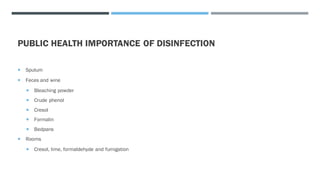
PUBLIC HEALTH IMPORTANCE OF DISINFECTION
 Sputum
 Feces and wine
 Bleaching powder
 Crude phenol
 Cresol
 Formalin
 Bedpans
 Rooms
 Cresol, lime, formaldehyde and fumigation
THANK YOU
CHHAVIBAJAJ.CB@GMAIL.COM

Disinfection and Its types

  • 1.
  • 2.
    DISINFECTIONIS AS APROCEDURE WHICH IS ELIMINATES OR KILLS MICROORGANISMS THAT ARE CARRIED BY PHYSICAL OR CHEMICAL AGENTS. DISINFECTANT ISAN AGENT WHICH KILLS INFECTIOUS AGENTS OUTSIDE THE BODY BY DIRECT EXPOSURE TO PHYSICAL OR CHEMICAL AGENTS. ANTISEPTIC IS AN AGENT WHICH DESTROYS OR INHIBITS THE GROWTH OF INFECTIOUS AGENTS, AND WHICH CAN BE APPLIED TO LIVING TISSUES STERLIZATIONDESTRUCTION OF ALL MICROORGANISMS AND THEIR SPORES. An Autoclave is a machine used for sterilization by doctors at hospitals
  • 3.
    DETERGENT A WATER-SOLUBLE CLEANSINGAGENT WHICH COMBINES WITH IMPURITIES AND DIRT TO MAKE THEM MORE SOLUBLE, AND DIFFERS FROM SOAP IN NOT FORMING A SCUM WITH THE SALTS IN HARD WATER DEODORANT A SUBSTANCE WHICH REMOVES OR CONCEALS UNPLEASANT SMELLS, ESPECIALLY BODILY ODOURS. Rodenticide A chemical or other agent used to destroy rats or other rodent pests or prevent themfrom damaging food, crops, etc.
  • 4.
    TYPES OF DISINFECTION CONCURRENT It isthe application of disinfective measures as soon as possible after the discharge of infectious material from the body of an infected person TERMINAL AFTER THE PATIENT HAS DIED OR HAS CEASED AS SOURCE OF INFECTION PROPHYACTIC BOILING OF WATER PASTURIZATION OF MILK
  • 5.
    CLASSIFICATION OF DISINFECTANTS NATURAL SUNLIGHT The ultraviolet radiation in sunlight does work as a natural disinfectant and is used regularly to disinfect drinking water, bedding and furniture  AIR Acts by drying or evaporating moisture PHYSICAL  BURNING  HOT AIR  BOILING  STEAM UNDER PRESSURE  RADIATION CHEMICAL  SOLID LIME BLEACHING POWDER PHENYL MERCURIC NITRATE  GASES FORMALIN CHLORINE ETHYLENE OXIDE  LIQUID (TO BE CONTINUED ON slide no 7)
  • 6.
    PHYSICAL AGENTS BURNING Usedin two ways- in first, cotton, dressing, swab such inexpensive things are burnt directly In the second type- some glass instruments are heated on direct flame for disinfection HOT AIR A hot air oven is used at 160 C for about 4 hours. It helps by killing spores. Not used for bulky articles. Used for syringe swab Petri dish BOILING Metal instrument on boiling for 20 minutes can be disinfected, if done for 30 minutes can also kill some spores (not 100%) STEAM UNDER PRESSURE • Moist heat is the form of pressurized steam regarded as the most dependable method for destruction of all forms of bacterial life including spores • Autoclave works on this principle • A temperature of 121°C. At 121°C,the time is 15-20 min,depending on the volume of the load • Sterilization of linen, gloves, metal instruments, syringe, culture medium • Not recommended for plastic ware RADIATIONIonizing radiation is being increasingly used for sterlizationof bandages, dressing, suture (catgut) and surgical instruments
  • 7.
    CEMICAL AGENTS SOLID • LIME •BLEACHING POWDER • PHENYL • MERCURIC NITRATE GASES • FORMALDEHYDE • CHLORINE • ETHYLENE OXIDE LIQUID • PHENOL PHENOL,CRESOL, DETTOL • DETERGENTS SAVLON • HALOGENS CHLORINE IODINE • OXIDIZINGAGENTS HYDROGEN PEROXIDE • HEAVY METALS MERCURY • MISCELLANEOUS ALCOHOL, FORMALIN * Formaldehyde is a gas at room temperature, but formalin is in liquid form.
  • 8.
    SOLID ❑ LIME NOT USEDAS A DISINFECTANT ANYMORE BECAUSE THERE ARE SAFER AND MORE EFFECTIVE PRODUCTS IN THE MARKET ❑ BLEACHING POWDER ON EXPOSURE TO AIR REACTS WITH CO2 AND LIBERATES CHLORINE GAS WHICH IN AQUEOUS SOLUTION KNOWN AS BLEACHING AGENT AND KILLS THE GERMS AND BACTERIA ❑ PHENYL ❑ MERCURIC NITRATE
  • 9.
    GASES  FORMALDEHYDE Reliable sterilizationusing formaldehyde is achieved when performed with a high concentration of gas, at a temperature between 60o and 80°C and with a relative humidity of 75 to 100%.  CHLORINE  ETHYLENE OXIDE It is most commonly used to sterilize instruments with long lumens such as endoscopes and all materials that have to be sterilized but cannot withstand higher temperature
  • 10.
     Phenol Itis cheap and effective. Commonly used for bacteria. Less effective towards spores  Cresol Excellent disinfectant 10 times more powerful 5 % concentration is used for general disinfection  Cresol emulsion When used with soap- saponified cresol Lysol contains 50-60% cresol Very powerful disinfectant  Hibitane Works better against gram positive bacteria Incorporated in liquid soaps and detergent creams  Chlorhexidine Used for both gram positive and negative bacteria  Dettol Nontoxic antiseptic. Used at 5% conc for sterilization for 30 minutes PHENOL AND RELATED COMPOUNDS
  • 11.
     Detergent  Soap Cetrimide is cetavion  Savlon is made of cetavion and hibitane  Halogen  Chlorine in water supplies  Iodine is commonly used betadine or povidone iodine  Heavy metals  Mercurochrome poor disinfectant, non-irritating 2%  Methanolate for instruments sterilization  Oxidizing agents  Hydrogen peroxide releases nascent oxygen
  • 12.
    MISCELLANEOUS  Alcohol isused as 70% ethyl alcohol whereas isopropyl is more bactericidal  Methylated spirit 5-20% methyl alcohol in ethyl alcohol  Formalin 40% formaldehyde in water, pungent  Others  Acetone is mild antibacterial  Ether is bactericidal, not for skin  Dyes are not very effective
  • 13.
    STERILIZATION DEPARTMENT  Thecentral sterile supply department aims to cater sterile supplies of hospital to all the departments of the hospital, both specialized and wards Filtration is used to obtain bacteria free filtrates of toxins and bacteriophages  Candle filters Purification of water e.g. Berkefield and mandler filter  Asbestos filters alkalizes water e.g. carbon filter  Sintered glass filter  Cellulose filters Water purification, analysis, testing and sterilization
  • 14.
    PUBLIC HEALTH IMPORTANCEOF DISINFECTION  Sputum  Feces and wine  Bleaching powder  Crude phenol  Cresol  Formalin  Bedpans  Rooms  Cresol, lime, formaldehyde and fumigation
  • 15.