Composting
.
Presented by;
Laxmi hebballi
UGS20AGR9909
S. No. Parameters Quantity
1. Organic matter 70 %
2. pH 7.5
3. Organic carbon 33.11%
4. Nitrogen 1.82 %
5. Phosphorus 1.29 %
6. Potassium 1.25 %
7. Fe (ppm) 1019
8. Mn (ppm) 111
9. Cu (ppm) 180
10. Zn (ppm) 280
Nutrient profile of Compost
Compost
Benefits of Compost
Improves the biological properties of soil
• Supplies food and encourages the growth of beneficial
microorganisms and earthworms.
• Helps suppress certain plant diseases, soil borne diseases,
and parasites.
• Research has shown that composts can help control plant
diseases (e.g. Pythium root rot, Rhizoctonia root rot, chili
wilt, and parasitic nematode) and reduce crop losses.
Enhances the Chemical Properties of Soils
• Enables soils to hold more plant nutrients and
increases the cation exchange capacity (CEC), anion
exchange capacity (AEC), and buffering capacity of
soils for longer periods of time after composts are
applied to soils. This is important mainly for soils
containing little clay and organic matter.
• Stabilizes the volatile nitrogen of raw materials into
large protein particles during composting, thereby
reducing N losses.
Improves the physical properties of soil
• Reduces the soil bulk density and improves the soil
structure directly by loosening heavy soils with
organic matter, and indirectly by means of
aggregate-stabilizing humus contained in
composts.
• Improves water holding capacity of soil
• Improves the soil aeration and thus supplies Enough
oxygen to roots and escape excess carbondioxide
from the root space
Parameters in Composting
Carbon: nitrogen ratio 30:1
Ideal moisture 50 – 60%
Ph 6 – 8
Temperature 55 – 75C (thermophile range)
Oxygen availability 5 -15%
Mechanism of Composting
Composting is a biochemical process
in which aerobic and anaerobic
microorganism decomposes organic
matter into valuable manure called
as compost.
Organic matter
Release heat
(Thermophilic state, which
helps to destroy pathogens)
Temp 55-60o c
Organic matter compost
(Mesophilic state ,Temp. 25-
30o c, promote mesophilic
microbes for rapid
decomposition )
Compost
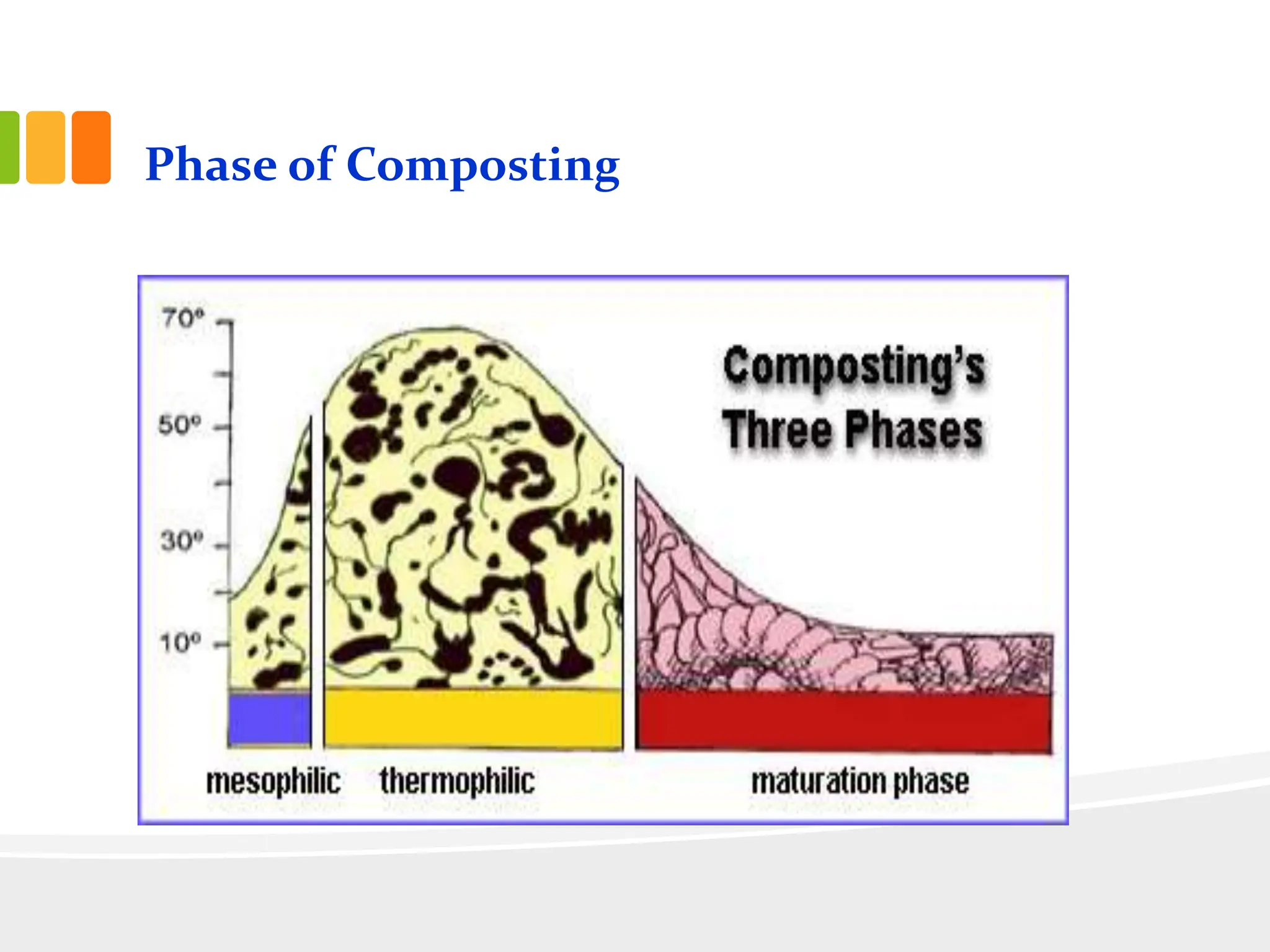
Phase of Composting
Organisms involved in composting
Bacteria
 are the smallest living organisms and the most numerous in compost;
 responsible for most of the decomposition and heat generation in compost.
 At the beginning of the composting process (0-40°C), mesophilic bacteria
predominate. heats up above 40°C, thermophilic bacteria take over.
 dominated by members of the genus Bacillus.
 At the highest compost temperatures, bacteria of the genus Thermus
dominates.
 Eg: Bacillus brevis, B. subtilis
Actinomycetes
 characteristic earthy smell of soil is caused by actinomycetes.
 organisms that resemble fungi but actually are filamentous bacteria.
 play an important role in degrading complex organics such as cellulose,
lignin, chitin, and proteins.
 Some species appear during the thermophilic phase, and others become
important during the cooler curing phase.
 Eg: Actinobifida chromogena, Microbispora bispora
Fungi
 they are responsible for the decomposition of many complex plant polymers
in soil and compost.
 Fungal species are numerous during both mesophilic and thermophilic
phases of composting.
 Most fungi live in the outer layer of compost when temperatures are high.
 Eg: Aspergillus fumigatus, Humicola grisea
Microorganism Involved in Composting
Anaerobes
Which decompose organic
matter in absence of oxygen
Two type of microbes which help in composting process are:
Aerobes
Which decompose organic
matter in presence of oxygen
Compost
Vermicomposting
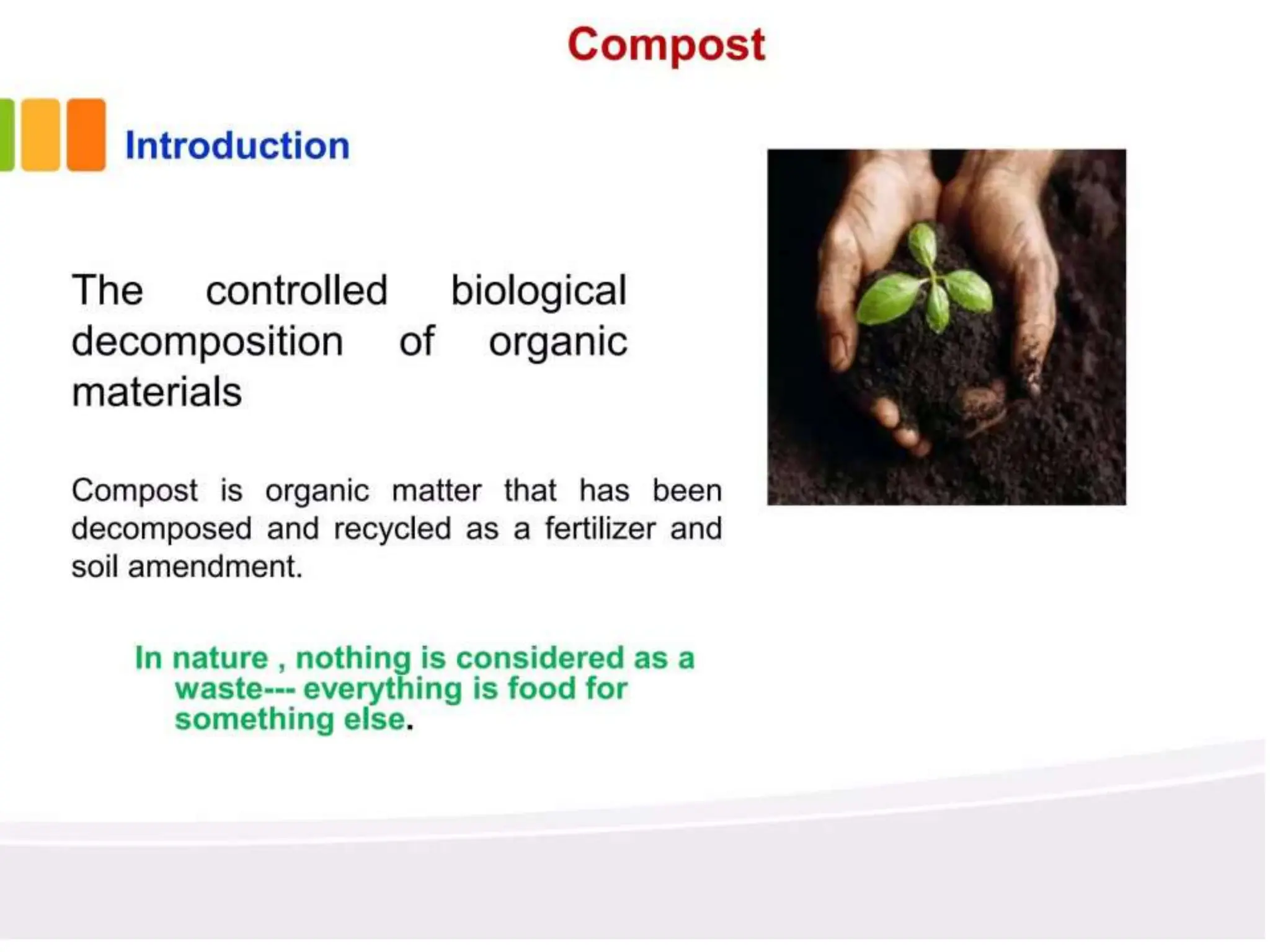
• Worm composting is using worms to recycle organic
material into a valuable soil amendment called
vermicompost.
• It is a mesophilic process, utilizing microorganisms and
earthworms that are active at 10–32°C.
• The process is faster than composting; because the material
passes through the earthworm gut,whereby the resulting
earthworm castings ie, rich in nutrients.
• Earthworms consume various organic wastes and reduce
the volume by 40–60%.
Material required for Composting
Farm refuses
• Weeds
• Stubbles bhusa
• Crop residues
• Remnents of
fodder
• Hedge clipping
Town refuse
• Night soil
• Street refuse
• Municipal fuse
Animal dung
• Cow dung
• Buffalo dung
• Poultry dung
Compost
Bioinputs For composting
• Biomineralizer consortium contains groups of
microorganisms, which accelerate the composting process.
• For one ton of crop wastes 2 kg of Biomineralizer is
recommended. This two kg Biomineralizer should be
mixed with 20 liters of water and made slurry.
• Cow dung slurry is also a good source for
microbialinoculum l. For one ton crop residues40 kg fresh
cow dung is required. This 40 kg fresh cow dung is mixed
with 1001itres of water and it should be thoroughly poured
over the waste material.
Methods of Preparation of Compost
This method was
developed by A.
Howard and Y. D.
Wad at the Institute
of Plant industry,
Indore, India
Demonstration of
this method at large
scale was initiated
at J. N. Krishi
Vidyalaya, Indore.
This method was
worked out by L. N.
Acharya at Indian
Institute of Science,
Bangalore.
Indore Method Bangalore Method
NADEP
Method
Compost
Coimbatore
method
Introduced by
manickam
1967
Size of the pit
Breadth - 6-8 feet
Depth - 2-3 feet ( not more than 3 feet)
Length - 10 feet or more as per requirement
Indore method
Compost
Raw material
Mix plant residues, weeds, sugarcane leaves,
grass, wood ashes, bran etc.
Animal dung
Wood ashes
Water
Urine soaked mud
Indore method
Compost
Filling the composting pits
One more layer of bedding material with
wood ash and urinated mud should be
added.
First of all, spread dry wastes with
cattle dung and soil in ratio of 4:2:1
up to 2 inch layer in Composting pit.
Afterwards, sprinkle the water over the materials
Pit is filled with above materials
up to 1 foot above the ground
level
Indore method
Compost
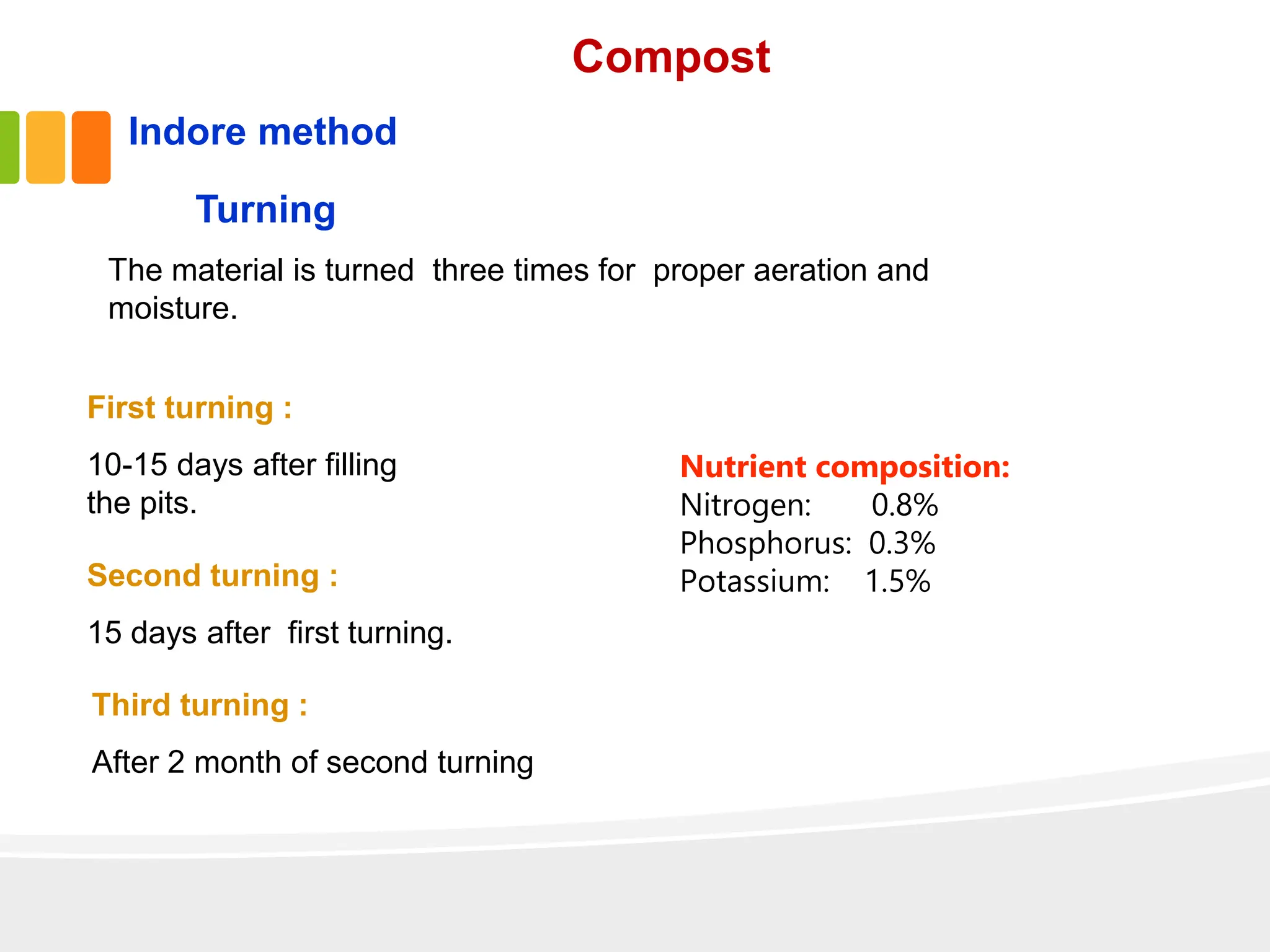
Turning
The material is turned three times for proper aeration and
moisture.
First turning :
10-15 days after filling
the pits.
Second turning :
15 days after first turning.
Third turning :
After 2 month of second turning
Indore method
Compost
Nutrient composition:
Nitrogen: 0.8%
Phosphorus: 0.3%
Potassium: 1.5%
Bangalore method
This method saves labour
cost because there is no
need of turning and regular
sprinkling of water.
.
Compost
Method of Filling the Composting Pits
 Spread the moist farm refuse at the bottom of the pit up to one inch.
 Then, spread two inch of cattle dung and urinated mud followed by 1
or 2 inch layer of soil.
 This heap is made up to 1.5-2.0 feet above the ground level
following above process.
 Finally the heap is covered with 1 inch thick mud.
Nutrient composition of the Bangalore compost:
• Nitrogen = 1.5%
• Phosphorus = 1%
• Potassium = 1.5%
Bangalore method
Compost
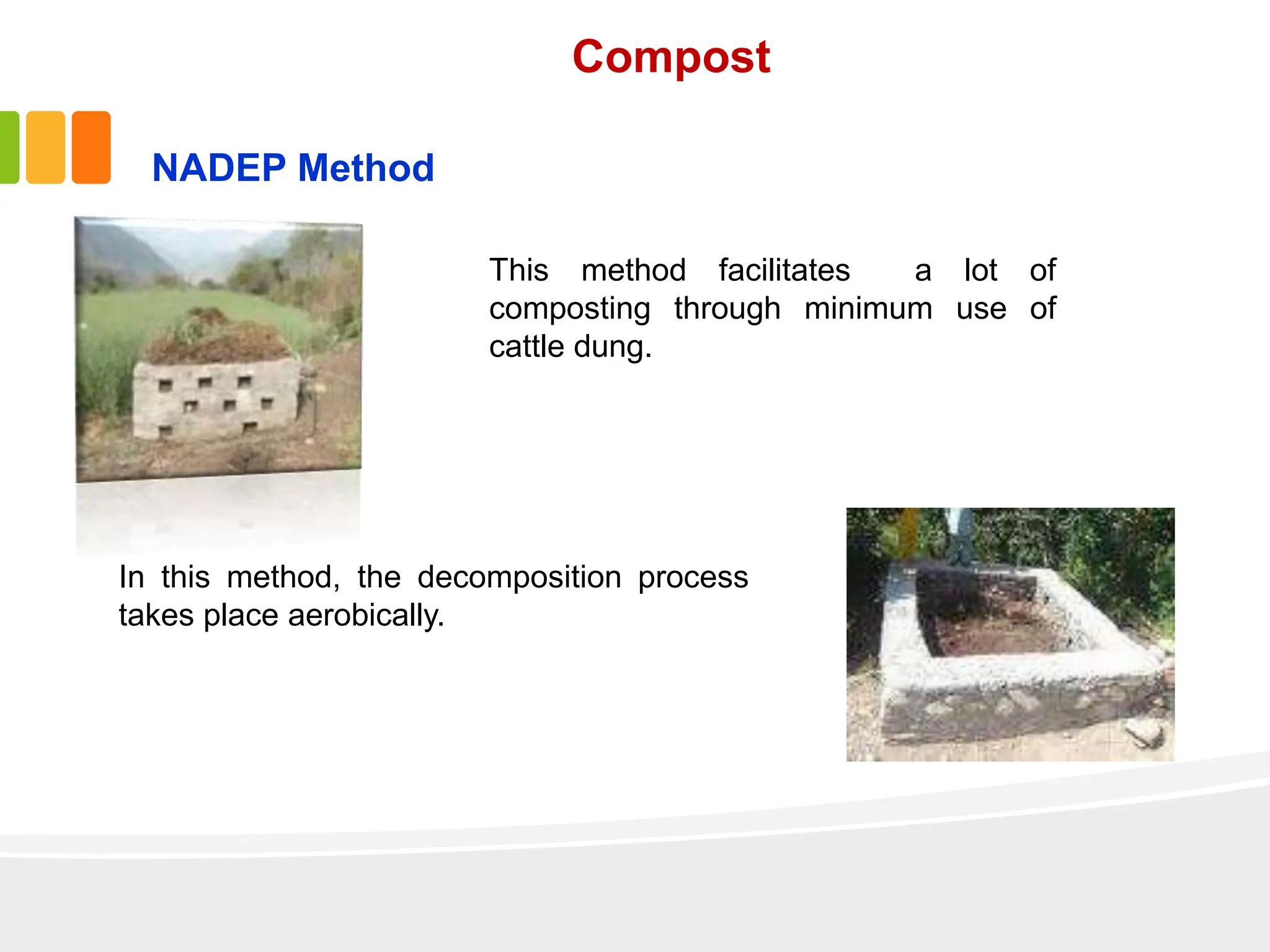
NADEP Method
This method facilitates a lot of
composting through minimum use of
cattle dung.
In this method, the decomposition process
takes place aerobically.
Compost
Coimbatore method
 composting is done in pits of different sizes depending on the waste material
available.
 A layer of waste materials is first laid in the pit.
 It is moistened with a suspension of 5-10 kg cow dung in 2.5 to 5.0 I of water and
0.5 to 1.0 kg fine bone meal sprinkled over it uniformly.
 Similar layers are laid one over the other till the material rises 0.75 m above the
ground level. It is finally plastered with wet mud and left undisturbed for 8 to 10
weeks
 . Plaster is then removed, material moistened with water, given a turning and made
into a rectangular heap under a shade.
 It is left undisturbed till its use
Laxmi hebballi report on road price in india in india

Laxmi hebballi report on road price in india in india

  • 1.
  • 3.
    S. No. ParametersQuantity 1. Organic matter 70 % 2. pH 7.5 3. Organic carbon 33.11% 4. Nitrogen 1.82 % 5. Phosphorus 1.29 % 6. Potassium 1.25 % 7. Fe (ppm) 1019 8. Mn (ppm) 111 9. Cu (ppm) 180 10. Zn (ppm) 280 Nutrient profile of Compost Compost
  • 4.
    Benefits of Compost Improvesthe biological properties of soil • Supplies food and encourages the growth of beneficial microorganisms and earthworms. • Helps suppress certain plant diseases, soil borne diseases, and parasites. • Research has shown that composts can help control plant diseases (e.g. Pythium root rot, Rhizoctonia root rot, chili wilt, and parasitic nematode) and reduce crop losses.
  • 5.
    Enhances the ChemicalProperties of Soils • Enables soils to hold more plant nutrients and increases the cation exchange capacity (CEC), anion exchange capacity (AEC), and buffering capacity of soils for longer periods of time after composts are applied to soils. This is important mainly for soils containing little clay and organic matter. • Stabilizes the volatile nitrogen of raw materials into large protein particles during composting, thereby reducing N losses.
  • 6.
    Improves the physicalproperties of soil • Reduces the soil bulk density and improves the soil structure directly by loosening heavy soils with organic matter, and indirectly by means of aggregate-stabilizing humus contained in composts. • Improves water holding capacity of soil • Improves the soil aeration and thus supplies Enough oxygen to roots and escape excess carbondioxide from the root space
  • 7.
    Parameters in Composting Carbon:nitrogen ratio 30:1 Ideal moisture 50 – 60% Ph 6 – 8 Temperature 55 – 75C (thermophile range) Oxygen availability 5 -15%
  • 8.
    Mechanism of Composting Compostingis a biochemical process in which aerobic and anaerobic microorganism decomposes organic matter into valuable manure called as compost. Organic matter Release heat (Thermophilic state, which helps to destroy pathogens) Temp 55-60o c Organic matter compost (Mesophilic state ,Temp. 25- 30o c, promote mesophilic microbes for rapid decomposition ) Compost
  • 9.
  • 10.
    Organisms involved incomposting Bacteria  are the smallest living organisms and the most numerous in compost;  responsible for most of the decomposition and heat generation in compost.  At the beginning of the composting process (0-40°C), mesophilic bacteria predominate. heats up above 40°C, thermophilic bacteria take over.  dominated by members of the genus Bacillus.  At the highest compost temperatures, bacteria of the genus Thermus dominates.  Eg: Bacillus brevis, B. subtilis
  • 11.
    Actinomycetes  characteristic earthysmell of soil is caused by actinomycetes.  organisms that resemble fungi but actually are filamentous bacteria.  play an important role in degrading complex organics such as cellulose, lignin, chitin, and proteins.  Some species appear during the thermophilic phase, and others become important during the cooler curing phase.  Eg: Actinobifida chromogena, Microbispora bispora Fungi  they are responsible for the decomposition of many complex plant polymers in soil and compost.  Fungal species are numerous during both mesophilic and thermophilic phases of composting.  Most fungi live in the outer layer of compost when temperatures are high.  Eg: Aspergillus fumigatus, Humicola grisea
  • 12.
    Microorganism Involved inComposting Anaerobes Which decompose organic matter in absence of oxygen Two type of microbes which help in composting process are: Aerobes Which decompose organic matter in presence of oxygen Compost
  • 13.
    Vermicomposting • Worm compostingis using worms to recycle organic material into a valuable soil amendment called vermicompost. • It is a mesophilic process, utilizing microorganisms and earthworms that are active at 10–32°C. • The process is faster than composting; because the material passes through the earthworm gut,whereby the resulting earthworm castings ie, rich in nutrients. • Earthworms consume various organic wastes and reduce the volume by 40–60%.
  • 14.
    Material required forComposting Farm refuses • Weeds • Stubbles bhusa • Crop residues • Remnents of fodder • Hedge clipping Town refuse • Night soil • Street refuse • Municipal fuse Animal dung • Cow dung • Buffalo dung • Poultry dung Compost
  • 15.
    Bioinputs For composting •Biomineralizer consortium contains groups of microorganisms, which accelerate the composting process. • For one ton of crop wastes 2 kg of Biomineralizer is recommended. This two kg Biomineralizer should be mixed with 20 liters of water and made slurry. • Cow dung slurry is also a good source for microbialinoculum l. For one ton crop residues40 kg fresh cow dung is required. This 40 kg fresh cow dung is mixed with 1001itres of water and it should be thoroughly poured over the waste material.
  • 16.
    Methods of Preparationof Compost This method was developed by A. Howard and Y. D. Wad at the Institute of Plant industry, Indore, India Demonstration of this method at large scale was initiated at J. N. Krishi Vidyalaya, Indore. This method was worked out by L. N. Acharya at Indian Institute of Science, Bangalore. Indore Method Bangalore Method NADEP Method Compost Coimbatore method Introduced by manickam 1967
  • 17.
    Size of thepit Breadth - 6-8 feet Depth - 2-3 feet ( not more than 3 feet) Length - 10 feet or more as per requirement Indore method Compost
  • 18.
    Raw material Mix plantresidues, weeds, sugarcane leaves, grass, wood ashes, bran etc. Animal dung Wood ashes Water Urine soaked mud Indore method Compost
  • 19.
    Filling the compostingpits One more layer of bedding material with wood ash and urinated mud should be added. First of all, spread dry wastes with cattle dung and soil in ratio of 4:2:1 up to 2 inch layer in Composting pit. Afterwards, sprinkle the water over the materials Pit is filled with above materials up to 1 foot above the ground level Indore method Compost
  • 20.
    Turning The material isturned three times for proper aeration and moisture. First turning : 10-15 days after filling the pits. Second turning : 15 days after first turning. Third turning : After 2 month of second turning Indore method Compost Nutrient composition: Nitrogen: 0.8% Phosphorus: 0.3% Potassium: 1.5%
  • 21.
    Bangalore method This methodsaves labour cost because there is no need of turning and regular sprinkling of water. . Compost
  • 22.
    Method of Fillingthe Composting Pits  Spread the moist farm refuse at the bottom of the pit up to one inch.  Then, spread two inch of cattle dung and urinated mud followed by 1 or 2 inch layer of soil.  This heap is made up to 1.5-2.0 feet above the ground level following above process.  Finally the heap is covered with 1 inch thick mud. Nutrient composition of the Bangalore compost: • Nitrogen = 1.5% • Phosphorus = 1% • Potassium = 1.5% Bangalore method Compost
  • 23.
    NADEP Method This methodfacilitates a lot of composting through minimum use of cattle dung. In this method, the decomposition process takes place aerobically. Compost
  • 24.
    Coimbatore method  compostingis done in pits of different sizes depending on the waste material available.  A layer of waste materials is first laid in the pit.  It is moistened with a suspension of 5-10 kg cow dung in 2.5 to 5.0 I of water and 0.5 to 1.0 kg fine bone meal sprinkled over it uniformly.  Similar layers are laid one over the other till the material rises 0.75 m above the ground level. It is finally plastered with wet mud and left undisturbed for 8 to 10 weeks  . Plaster is then removed, material moistened with water, given a turning and made into a rectangular heap under a shade.  It is left undisturbed till its use