
BALANCE
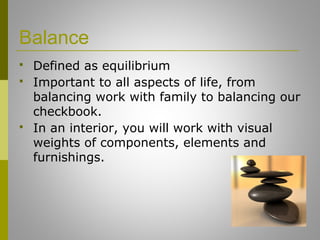
Balance
 Defined as equilibrium
 Important to all aspects of life, from
balancing work with family to balancing our
checkbook.
 In an interior, you will work with visual
weights of components, elements and
furnishings.
Visual Weights
 Does not necessarily relate to the physical weight
of an object. It is determined more by the
psychological impact it makes on us and the
attention it demands.
 Groupings of small objects can counterbalance a large
mass.
 Busy or heavy texture will hold more attention than a
smooth plain surface
 Objects placed above eye level appear heavier than those
placed below
 Brightly lit areas attract more attention than dim ones
Three Types of Balance
 Symmetrical
 Asymmetrical
 Radial
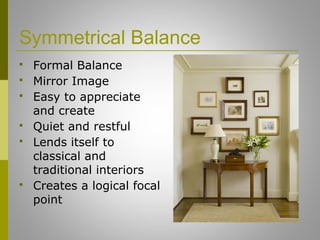
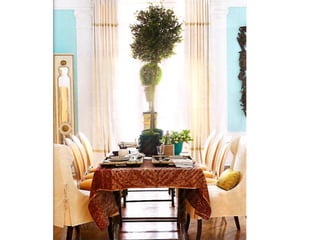
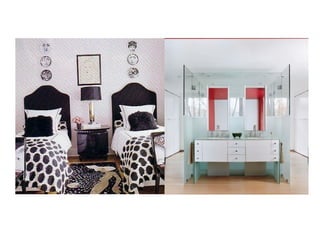
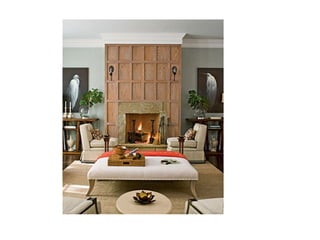
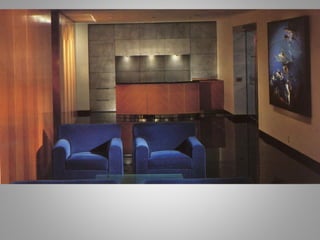
Symmetrical Balance
 Formal Balance
 Mirror Image
 Easy to appreciate
and create
 Quiet and restful
 Lends itself to
classical and
traditional interiors
 Creates a logical focal
point
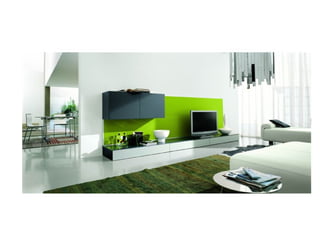
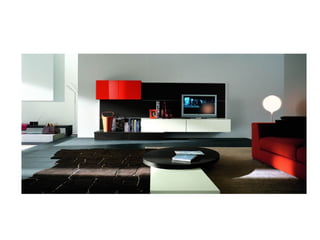
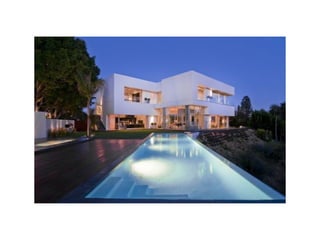
Asymmetrical Balance
 Informal Balance
 Visual weights are equal
 Elements differ on each side of the axis
 Suggest movement, arouses our curiosity
 Provokes thought
 Has more lasting appeal
 Less obvious than symmetrical balance
 Found in contemporary rooms
 Relies totally on a “sense or feeling of being balanced.”
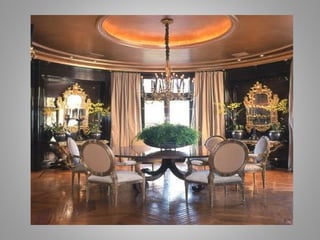
Radial Balance
 All parts are
balanced and
repeated around a
center point.
 Offers a refreshing
counterpoint to
rectangularity.
 spokes on a bicycle
 Chairs around a circular
table.
THANK
YOU

Balance in interior design

  • 1.
  • 2.
    Balance  Defined asequilibrium  Important to all aspects of life, from balancing work with family to balancing our checkbook.  In an interior, you will work with visual weights of components, elements and furnishings.
  • 3.
    Visual Weights  Doesnot necessarily relate to the physical weight of an object. It is determined more by the psychological impact it makes on us and the attention it demands.  Groupings of small objects can counterbalance a large mass.  Busy or heavy texture will hold more attention than a smooth plain surface  Objects placed above eye level appear heavier than those placed below  Brightly lit areas attract more attention than dim ones
  • 4.
    Three Types ofBalance  Symmetrical  Asymmetrical  Radial
  • 5.
    Symmetrical Balance  FormalBalance  Mirror Image  Easy to appreciate and create  Quiet and restful  Lends itself to classical and traditional interiors  Creates a logical focal point
  • 9.
    Asymmetrical Balance  InformalBalance  Visual weights are equal  Elements differ on each side of the axis  Suggest movement, arouses our curiosity  Provokes thought  Has more lasting appeal  Less obvious than symmetrical balance  Found in contemporary rooms  Relies totally on a “sense or feeling of being balanced.”
  • 14.
    Radial Balance  Allparts are balanced and repeated around a center point.  Offers a refreshing counterpoint to rectangularity.  spokes on a bicycle  Chairs around a circular table.
  • 16.