SUBMITTED TO : DR. RANJEETA BHARI
SUBMITTED BY : NAVPREET
M.Sc.(HONS.) BIOTECHNOLOGY
SEMESTER 3
ROLL NO .: 19011003
CHARACTERISTIC OF YEAST
• Unicellular fungi
• Shape – cylindrical, spherical or oval.
• Diameter- about 8 μm.
• Double layered cell wall
• Reproduction- budding
• Enzymes formed – maltase , invertase, zymase
complex.
YEAST physiology
• .
 Ability to grow rapidly at room temperature of
about 20-250C
 Easy dispensability in water
 Ability to produce large amount of CO2 in flour
dough rather than alcohol.
 Good keeping quality.
 High potential glycolytic activity.
 Ability to adapt rapidly to changing substrates.
 High enzyme activity.
 Ability to grow and synthesize enzymes and
coenzymes under the anaerobic conditions for
dough
 Ability to resist the osmotic effect of sugars and
salts in dough
 High yield in terms of dry weight per unit of
substrate used
METHODS USED FOR BAKERS
YEAST PRODUCTION
• There are various methods known for the
production of yeast.
• They are as follows:
- Molasses ammonia process
- Heijkenakjold method
raw materials
• CARBON SOURCES (cane and beet molasses)
• NITROGEN SOURCE ( ammonium sulphate or
phosphate)
• minerals phosphorus in the form of ammonium
phosphates
• VITAMINS.
• FERMENTATION ACTIVATORS AND INHIBITORS
VARIOUS TYPES OF MEDIA FOR YEAST
PROPAGATION
• GRAIN WORT MEDIUM
• MOLASSES SALT MEDIUM
• GLUCOSE SALT MEDIIUM
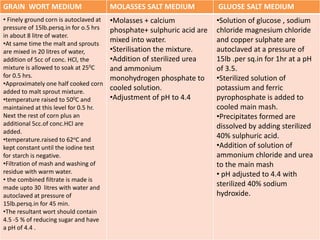
GRAIN WORT MEDIUM MOLASSES SALT MEDIUM GLUOSE SALT MEDIUM
• Finely ground corn is autoclaved at
pressure of 15lb.persq.in for o.5 hrs
in about 8 litre of water.
•At same time the malt and sprouts
are mixed in 20 litres of water,
addition of 5cc of conc. HCl, the
mixture is allowed to soak at 250C
for 0.5 hrs.
•Approximately one half cooked corn
added to malt sprout mixture.
•temperature raised to 500C and
maintained at this level for 0.5 hr.
Next the rest of corn plus an
additional 5cc.of conc.HCl are
added.
•temperature.raised to 62oC and
kept constant until the iodine test
for starch is negative.
•Filtration of mash and washing of
residue with warm water.
• the combined filtrate is made is
made upto 30 litres with water and
autoclaved at pressure of
15lb.persq.in for 45 min.
•The resultant wort should contain
4.5 -5 % of reducing sugar and have
a pH of 4.4 .
•Molasses + calcium
phosphate+ sulphuric acid are
mixed into water.
•Sterilisation the mixture.
•Addition of sterilized urea
and ammonium
monohydrogen phosphate to
cooled solution.
•Adjustment of pH to 4.4
•Solution of glucose , sodium
chloride magnesium chloride
and copper sulphate are
autoclaved at a pressure of
15lb .per sq.in for 1hr at a pH
of 3.5.
•Sterilized solution of
potassium and ferric
pyrophosphate is added to
cooled main mash.
•Precipitates formed are
dissolved by adding sterilized
40% sulphuric acid.
•Addition of solution of
ammonium chloride and urea
to the main mash
• pH adjusted to 4.4 with
sterilized 40% sodium
hydroxide.
PRODUCTION PROCESS
• The production process can be understood in
three steps namely
- Preparation of fermentation media
- The fermentation process
- Harvesting of cells
- Mixing extruding and packaging of yeast cells.
PREPRATION OF FERMENTATION MEDIA
• Cane molasses or beet molasses is received With a usual
Brix of 80,molasses cannot be pumped if the
temperature is too low.
• The molasses is diluted with water to 30-40 Brix for its
clarification.
• Dilution permits easier pumping and facilitates
clarification
• The pH is adjusted to about 5 with acids such as
sulphuric acid
• The clarified molasses wort is then sterilized in a heat
exchanger. From a temperature of 950C, to 145oC.
• It is held at this temperature for about 4 seconds and then
cooled back to 95oC
• The mineral supplements are either added to the molasses
wort or they are fed separately.
• Ammonia as a nitrogen source is fed separately into the
fermenter.
•
FERMENTATION PROCESS
• The fermentation process comprises of stage fermentation process
combined with aeration, cooling,defoaming and feed rates in the
system.
• Fermentation tanks used for the process are generally made up of
stainless steel with cooling coils and have agitator and sparger systems.
• Yeast fermentations are carried out in fed batch mode
• Baker's yeast fermentations generate heat, about 3.5-4.4 kcal/g of
yeast solids grown. thus Extensive cooling is required with internal
cooling coils wound in spiral fashion along the fermenter wall.
• Oxygen being a critical factor is supplied in the system. Mechanical
agitation by top or bottom mounted motors greatly increases
the efficiency of air utilization.
• DEFOAMING . The large volumes of air results into
foaming –defoaming compounds.such as silicones or
fatty acid derivatives are used. They tend to depress
oxygen transfer coefficients, but increase the total
interfacial area between air bubbles and fermenter
liquid .
• ETHANOL UTILIZATION- Overfeeding or under aeration
of fermentation leads to the formation of ethanol.
Alcohol levels up to 0.05% indicate satisfactory
performance, but levels above 0.1%result in some loss
of yield.
• Yeast cells are separated from the fermenter liquor of the final
fermentation by centrifugation.
• During the first pass through such centrifuges the yeast
concentration can be tripled and on additional passes a
concentration of 18 to 20% yeast solids can be obtained. This liquid
has a whitish appearance is called yeast “cream.”
HARVESTING OF CELLS
•Yeast from the cream is further concentrated by filtration . carried
out with plate and frame filter presses . surface must be coated
with an edible material since very small concentrations of this
coating may be found in the press cake.
•. Such filters produce a press cake of about 27 to 28% solids
•The osmotic effect of the salt treatment reduces the moisture
content of the cells. The salt is then removed directly by water
sprays. The resulting crumbly mass of yeast cells is called a press
cake.
MIXING, EXTRUDING AND PACKAGING OF YEAST CELLS
• The pressed yeast or the filter cake are
dropped into a mixer, Small amounts of water
may be added to adjust the moisture content
to 70%.
• Small amounts of edible oil may be added as
emulsifiers such as diglycerides
• lt is then cut automatically into individual 1-
pound cakes . The yeast cakes are wrapped in
wax paper and the ends are heat sealed.and
stored to a temperature below 4°C.
• Alternatively, the mixed yeast mass may be merely
crumbled and packed into 25 or 50 pound bags.
• Both yeast cakes and crumbled yeast must be kept
refrigerated until delivered to the bakery .
references
• www.google.com

Bakers yeast

  • 1.
    SUBMITTED TO :DR. RANJEETA BHARI SUBMITTED BY : NAVPREET M.Sc.(HONS.) BIOTECHNOLOGY SEMESTER 3 ROLL NO .: 19011003
  • 2.
    CHARACTERISTIC OF YEAST •Unicellular fungi • Shape – cylindrical, spherical or oval. • Diameter- about 8 μm. • Double layered cell wall • Reproduction- budding • Enzymes formed – maltase , invertase, zymase complex.
  • 3.
    YEAST physiology • . Ability to grow rapidly at room temperature of about 20-250C  Easy dispensability in water  Ability to produce large amount of CO2 in flour dough rather than alcohol.  Good keeping quality.  High potential glycolytic activity.
  • 4.
     Ability toadapt rapidly to changing substrates.  High enzyme activity.  Ability to grow and synthesize enzymes and coenzymes under the anaerobic conditions for dough  Ability to resist the osmotic effect of sugars and salts in dough  High yield in terms of dry weight per unit of substrate used
  • 5.
    METHODS USED FORBAKERS YEAST PRODUCTION • There are various methods known for the production of yeast. • They are as follows: - Molasses ammonia process - Heijkenakjold method
  • 6.
    raw materials • CARBONSOURCES (cane and beet molasses) • NITROGEN SOURCE ( ammonium sulphate or phosphate) • minerals phosphorus in the form of ammonium phosphates • VITAMINS. • FERMENTATION ACTIVATORS AND INHIBITORS
  • 7.
    VARIOUS TYPES OFMEDIA FOR YEAST PROPAGATION • GRAIN WORT MEDIUM • MOLASSES SALT MEDIUM • GLUCOSE SALT MEDIIUM
  • 8.
    GRAIN WORT MEDIUMMOLASSES SALT MEDIUM GLUOSE SALT MEDIUM • Finely ground corn is autoclaved at pressure of 15lb.persq.in for o.5 hrs in about 8 litre of water. •At same time the malt and sprouts are mixed in 20 litres of water, addition of 5cc of conc. HCl, the mixture is allowed to soak at 250C for 0.5 hrs. •Approximately one half cooked corn added to malt sprout mixture. •temperature raised to 500C and maintained at this level for 0.5 hr. Next the rest of corn plus an additional 5cc.of conc.HCl are added. •temperature.raised to 62oC and kept constant until the iodine test for starch is negative. •Filtration of mash and washing of residue with warm water. • the combined filtrate is made is made upto 30 litres with water and autoclaved at pressure of 15lb.persq.in for 45 min. •The resultant wort should contain 4.5 -5 % of reducing sugar and have a pH of 4.4 . •Molasses + calcium phosphate+ sulphuric acid are mixed into water. •Sterilisation the mixture. •Addition of sterilized urea and ammonium monohydrogen phosphate to cooled solution. •Adjustment of pH to 4.4 •Solution of glucose , sodium chloride magnesium chloride and copper sulphate are autoclaved at a pressure of 15lb .per sq.in for 1hr at a pH of 3.5. •Sterilized solution of potassium and ferric pyrophosphate is added to cooled main mash. •Precipitates formed are dissolved by adding sterilized 40% sulphuric acid. •Addition of solution of ammonium chloride and urea to the main mash • pH adjusted to 4.4 with sterilized 40% sodium hydroxide.
  • 9.
    PRODUCTION PROCESS • Theproduction process can be understood in three steps namely - Preparation of fermentation media - The fermentation process - Harvesting of cells - Mixing extruding and packaging of yeast cells.
  • 10.
    PREPRATION OF FERMENTATIONMEDIA • Cane molasses or beet molasses is received With a usual Brix of 80,molasses cannot be pumped if the temperature is too low. • The molasses is diluted with water to 30-40 Brix for its clarification. • Dilution permits easier pumping and facilitates clarification • The pH is adjusted to about 5 with acids such as sulphuric acid
  • 11.
    • The clarifiedmolasses wort is then sterilized in a heat exchanger. From a temperature of 950C, to 145oC. • It is held at this temperature for about 4 seconds and then cooled back to 95oC • The mineral supplements are either added to the molasses wort or they are fed separately. • Ammonia as a nitrogen source is fed separately into the fermenter. •
  • 12.
    FERMENTATION PROCESS • Thefermentation process comprises of stage fermentation process combined with aeration, cooling,defoaming and feed rates in the system. • Fermentation tanks used for the process are generally made up of stainless steel with cooling coils and have agitator and sparger systems. • Yeast fermentations are carried out in fed batch mode • Baker's yeast fermentations generate heat, about 3.5-4.4 kcal/g of yeast solids grown. thus Extensive cooling is required with internal cooling coils wound in spiral fashion along the fermenter wall. • Oxygen being a critical factor is supplied in the system. Mechanical agitation by top or bottom mounted motors greatly increases the efficiency of air utilization.
  • 13.
    • DEFOAMING .The large volumes of air results into foaming –defoaming compounds.such as silicones or fatty acid derivatives are used. They tend to depress oxygen transfer coefficients, but increase the total interfacial area between air bubbles and fermenter liquid . • ETHANOL UTILIZATION- Overfeeding or under aeration of fermentation leads to the formation of ethanol. Alcohol levels up to 0.05% indicate satisfactory performance, but levels above 0.1%result in some loss of yield.
  • 14.
    • Yeast cellsare separated from the fermenter liquor of the final fermentation by centrifugation. • During the first pass through such centrifuges the yeast concentration can be tripled and on additional passes a concentration of 18 to 20% yeast solids can be obtained. This liquid has a whitish appearance is called yeast “cream.” HARVESTING OF CELLS
  • 15.
    •Yeast from thecream is further concentrated by filtration . carried out with plate and frame filter presses . surface must be coated with an edible material since very small concentrations of this coating may be found in the press cake. •. Such filters produce a press cake of about 27 to 28% solids •The osmotic effect of the salt treatment reduces the moisture content of the cells. The salt is then removed directly by water sprays. The resulting crumbly mass of yeast cells is called a press cake.
  • 16.
    MIXING, EXTRUDING ANDPACKAGING OF YEAST CELLS • The pressed yeast or the filter cake are dropped into a mixer, Small amounts of water may be added to adjust the moisture content to 70%. • Small amounts of edible oil may be added as emulsifiers such as diglycerides • lt is then cut automatically into individual 1- pound cakes . The yeast cakes are wrapped in wax paper and the ends are heat sealed.and stored to a temperature below 4°C.
  • 17.
    • Alternatively, themixed yeast mass may be merely crumbled and packed into 25 or 50 pound bags. • Both yeast cakes and crumbled yeast must be kept refrigerated until delivered to the bakery .
  • 18.