




Starter Cultures
• Traditionally the fermenting organisms came from the natural
microflora or a portion of the previous fermentation.
• In many cases the natural microflora is either inefficient,
uncontrollable, and unpredictable, or is destroyed during preparation
of the sample prior to fermentation (e.g. pasteurization).
• A starter culture can provide particular characteristics in a more
controlled and predictable fermentation.
What is a starter culture and why use it?
• A starter culture is a milk product which:
• - contains lactic acid bacteria
• - controls the souring of milk.
Why use a starter culture?
• To control fermentation.
Raw milk always contains different microorganisms.
These microorganisms turn your milk sour but you cannot
control the fermentation.
Pasteurization kills most of these microorganisms.
By using a commercial starter culture with pasteurized milk, you
can control the souring of milk
Starter Cultures
• Lactic starters always include bacteria that convert sugars to
lactic acid, usually:
• Lactococcus lactis subsp. lactis,
• Lactococcus lactis subsp. cremoris or
• Lactococccus lactis subsp. lactis biovar diacetylactis.
• Where flavour and aroma compounds such as diacetyl are
desired the lactic acid starter will include heterofermentative
organisms such as:
• Leuconostoc citrovorum or
• Leuconostoc dextranicum.
What types of starter culture are there?
• There are many types of starter culture and we can group them in
different ways.
• - local conditions
• - the product you want to make.
Types of Starter Cultures
Optimum growth temperature
• Mesophilic cultures grow best at about 30 C.
• Thermophilic cultures grow best at about 43 C.
Types of Starter Cultures
Physical state
• Starter cultures can be:
• - liquids
• - solid (deep-frozen)
• - powders (freeze-dried)
Powder cultures are useful because:
- they have good keeping qualities (more than 6 months at -20 C)
- you can send them long distances by airmail.
Types of Starter Cultures
Pure/mixed
Pure cultures have one species of lactic acid bacteria.
Mixed cultures (more common) have two or more species.
Types of Starter Cultures
Type of lactic acid bacteria
• Some lactic acid bacteria produce only lactic acid.
• Others produce lactic acid gas and aromatic compounds.
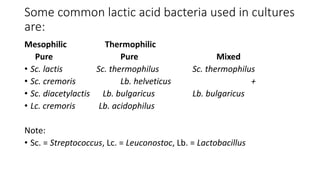
Some common lactic acid bacteria used in cultures
are:
Mesophilic Thermophilic
Pure Pure Mixed
• Sc. lactis Sc. thermophilus Sc. thermophilus
• Sc. cremoris Lb. helveticus +
• Sc. diacetylactis Lb. bulgaricus Lb. bulgaricus
• Lc. cremoris Lb. acidophilus
Note:
• Sc. = Streptococcus, Lc. = Leuconostoc, Lb. = Lactobacillus
Starter Cultures
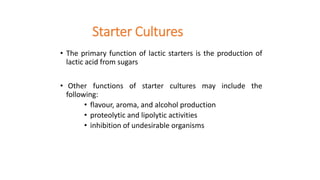
• The primary function of lactic starters is the production of
lactic acid from sugars
• Other functions of starter cultures may include the
following:
• flavour, aroma, and alcohol production
• proteolytic and lipolytic activities
• inhibition of undesirable organisms
How do you prepare and maintain a starter
culture?
• disinfected equipment, clean, sterilize and rinse with boiling water all
utensils before using.
• Any dirt or chemicals will change the action of the starter culture.
• the correct starter culture and high quality milk
• to do the right things at the right time.
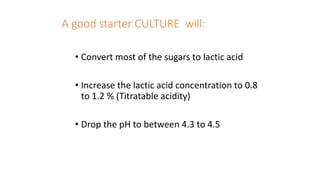
A good starter CULTURE will:
• Convert most of the sugars to lactic acid
• Increase the lactic acid concentration to 0.8
to 1.2 % (Titratable acidity)
• Drop the pH to between 4.3 to 4.5