FOOD BIOTECHNOLOGY
Topic: Glucose syrup and invert
Sugar Syrups
Presented to:- Dr. RS Singh
Presented By:-Simranjit Kaur
Roll no: 19011020
M.Sc (hons.)Biotech 2nd yr
WHAT IS A SYRUP?
• A thick, sweet ,concentrated solution of sugar
in water.
• high fructose syrup and corn syrup. eg
2
Glucose syrup
• Glucose syrup, also known as confectioner's
glucose, is a syrup made from the hydrolysis
of starch, containing over 90% glucose
depending on the grade, and can typically
contain 10% to 43% glucose.
• raw material
• Maize,potatoes and wheat,barley, rice and cas
sava.
3
Production process of glucose syrup
• Preparation
• Soaking
• Gelatinization
• Hydrolysis
• Clarification
• Evaporation
4
Preparation
• Before conversion of starch to glucose begin,
the starch must be exposed to the enzymes.
• This includes pre processing of raw materials
for the removal of fibres and mechanical
grinding
5
• Soaking:- The starch needs to be swelled to allow
the enzymes or acid to act upon it. When grain is
used, sulphur dioxide is added to prevent spoilage.
• Gelatinization:- By heating the ground, cleaned
feedstock, starch gelatinization takes place and the
intermolecular bonds of the starch molecules are
broken down,
• This irreversibly dissolves the starch granule, so the
chains begin to separate into an amorphous form.
6
Hydrolysis
• Glucose syrup can be produced by
• acid hydrolysis,
• enzyme hydrolysis
• with dilute hydrochloric acid, and then heating
the mixture under pressure.
• with α-amylase by bacterium Bacillus and
Glucoamylase by Aspergillus
7
• Clarification:- After hydrolysis, the dilute
syrup is passed through columns to remove
impurities, improving its colour and stability.
• Evaporation:-The dilute glucose syrup is finally
evaporated under vacuum to raise the solids
concentration.
8
Uses
• as a thickener, sweetener.
• manufacture of a variety of candy products.
• as a stabilizer
• as a texture enhancer
• creating fake blood for films and television.
9
Invert syrup
• Invert syrup or invert sugar syrup is a sucrose
based syrup.
• Invert Syrup contains equal proportions of the
invert (reducing) sugars: glucose and fructose.
• thatswhy it is known as invert syrup.
• It is pale in color.
10
Production of invert syrup
• Invert syrup is produced by the process of
inversion of sucrose solution.
• Two main methods of inversions:-
Acid inversion
Bio inversion/enzymatic process.
11
Acid inversion
• Conventional method of manufacturing.Inversion can be
made by adding one gram of citric acid or ascorbic acid
per kg of sugar. Cream of tartar or fresh lemon juice can
be added.
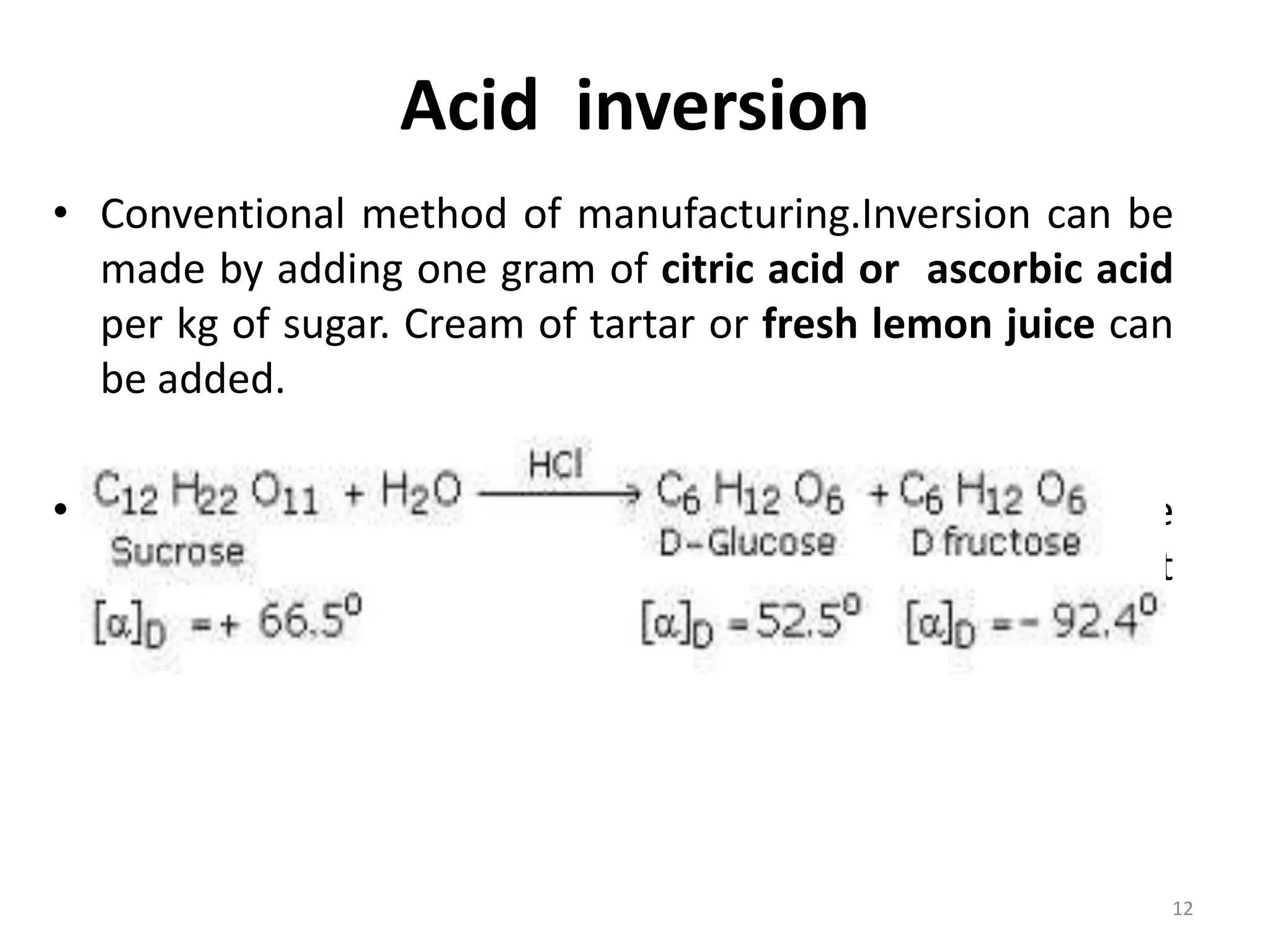
• Acid hydrolysis of sucrose. it yields glucose and fructose
in equimolar concentrations. temp. can be maintained at
50-60˚C.
12
Disadvantages of acid inversion
• Low conversion efficiency.(25-30%)
• High energy consumption.
• High production cost.
• Acid hydrolyzed product contain impurities
13
Bioconversion /Enzymatic Process
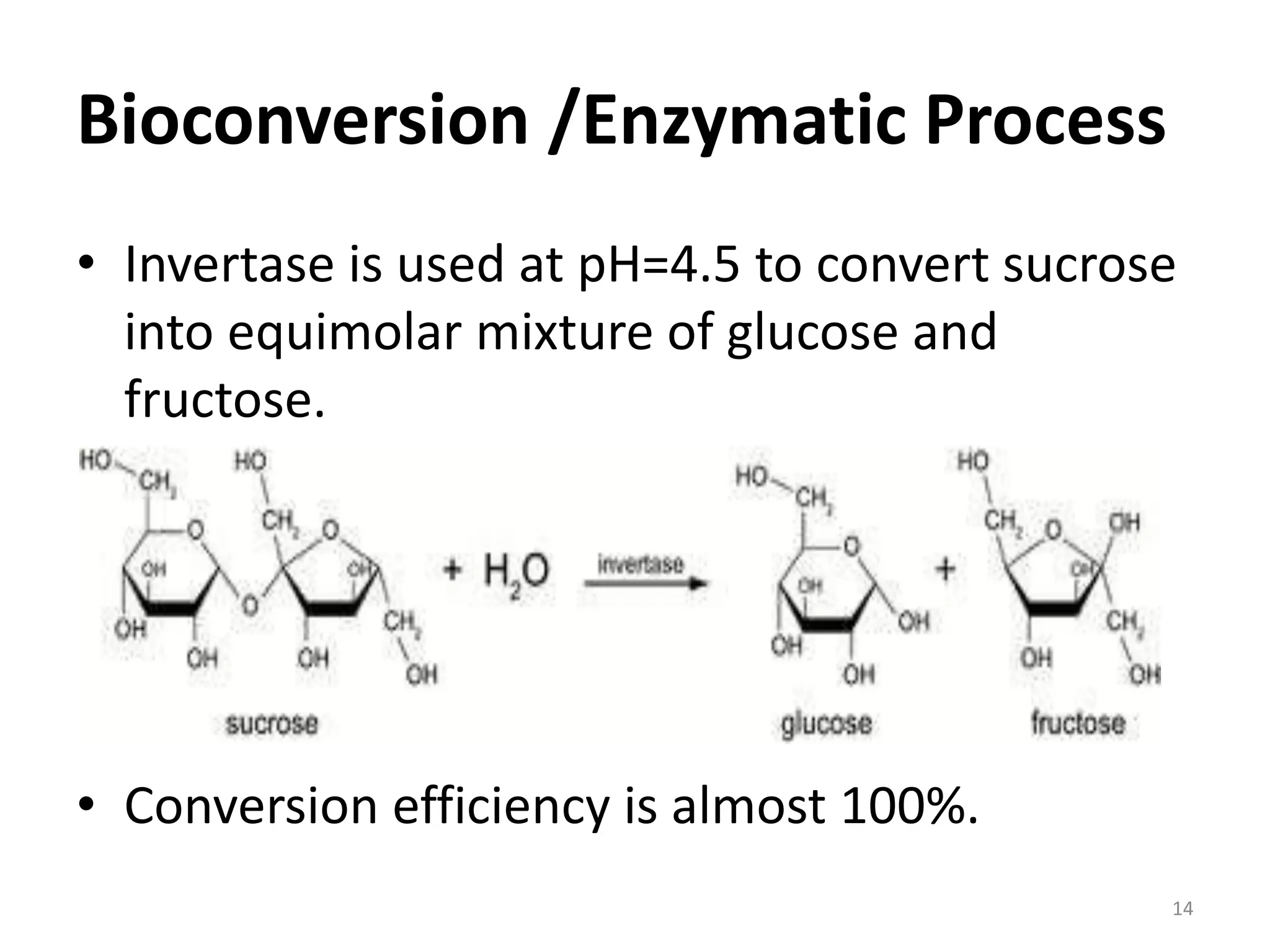
• Invertase is used at pH=4.5 to convert sucrose
into equimolar mixture of glucose and
fructose.
• Conversion efficiency is almost 100%.
14
Advantages of enzymatic process
• Near 100% yield.
• Low temp. and low energy cost.
• No impurity.
• Better taste of product.
• Easy handling.
15
Properties of invert syrup
 Moistness/ Humectancy
Invert Syrup has a high affinity for water, i.e., it retains water for long. For
this reason, invert syrup is used to keep products moist, extending
acceptable shelf life of your products.
 Crystallization Control
Invert Syrup can be used to slow down and minimize Crystallization.
• For example, in icings and fondants that are required to stay smooth
during their shelf life.
 Flavor Enhancement
The Fructose in the Invert Syrup has a Natural Affinity to acid or fruit
flavors and enhances these in drinks and bakery, confectionery products.
16
 increased Sweetness :
Medium Invert Sugar (A 50% Inverted Syrup) has an increased sweetness
of 10%, when compared to Pure sugar.
• This extra Sweetness is of benefit in fruit flavored drinks where around
20% less carbohydrate Sweetener can be used as against usage of
Ordinary sugar.
 High Osmotic Pressure :
High water activity makes products liable to microbial spoilage & shorter
shelf-life.
• Invert sugar increases the Osmotic Pressure much more than sucrose.
Water is present but with a higher osmotic pressure which thus inhibits
Microbial Growth in Products increasing the Shelf Life.
 Freezing Point Depression :
The affinity of water for Invert Syrup prevents the formation of large ice
crystals in Products like Ice Creams, Sorbets, Cocktails, Frozen Baked
Goods, Fillings, Toppings etc.
17
Applications of invert syrup
CANDY CONFECTIONERY AND
SWEET MAKING
• Ice creams
• Gold syrups
• (56%invert syrup + 44% sucrose)
• Jam, jellies, chewing gums and canned
fruits.
18
 FLAVOURING
• Flavouring and moistening
agent in chewing tobacco.
• mouth freshening
formulations.
• Substitute for honey.
19
PHARMACEUTICALS
• In Cough syrups.
• In Vitamin bound
tonics.
•
20
REFERENCES
• http://onlinelibrary.wiley.com/doi/10.1002/foo
d.19950390407/abstract
• www.ncbi.nlm.nih.gov/pubmed/15051594
• https://www.healthline.com/nutrition/invert-
sugar#the-basics
• https://www.healthline.com/nutrition/glucose-
sugar#the-basics
21
THANK YOU

Glucose syrup and invert syrup Production

  • 1.
    FOOD BIOTECHNOLOGY Topic: Glucosesyrup and invert Sugar Syrups Presented to:- Dr. RS Singh Presented By:-Simranjit Kaur Roll no: 19011020 M.Sc (hons.)Biotech 2nd yr
  • 2.
    WHAT IS ASYRUP? • A thick, sweet ,concentrated solution of sugar in water. • high fructose syrup and corn syrup. eg 2
  • 3.
    Glucose syrup • Glucosesyrup, also known as confectioner's glucose, is a syrup made from the hydrolysis of starch, containing over 90% glucose depending on the grade, and can typically contain 10% to 43% glucose. • raw material • Maize,potatoes and wheat,barley, rice and cas sava. 3
  • 4.
    Production process ofglucose syrup • Preparation • Soaking • Gelatinization • Hydrolysis • Clarification • Evaporation 4
  • 5.
    Preparation • Before conversionof starch to glucose begin, the starch must be exposed to the enzymes. • This includes pre processing of raw materials for the removal of fibres and mechanical grinding 5
  • 6.
    • Soaking:- Thestarch needs to be swelled to allow the enzymes or acid to act upon it. When grain is used, sulphur dioxide is added to prevent spoilage. • Gelatinization:- By heating the ground, cleaned feedstock, starch gelatinization takes place and the intermolecular bonds of the starch molecules are broken down, • This irreversibly dissolves the starch granule, so the chains begin to separate into an amorphous form. 6
  • 7.
    Hydrolysis • Glucose syrupcan be produced by • acid hydrolysis, • enzyme hydrolysis • with dilute hydrochloric acid, and then heating the mixture under pressure. • with α-amylase by bacterium Bacillus and Glucoamylase by Aspergillus 7
  • 8.
    • Clarification:- Afterhydrolysis, the dilute syrup is passed through columns to remove impurities, improving its colour and stability. • Evaporation:-The dilute glucose syrup is finally evaporated under vacuum to raise the solids concentration. 8
  • 9.
    Uses • as athickener, sweetener. • manufacture of a variety of candy products. • as a stabilizer • as a texture enhancer • creating fake blood for films and television. 9
  • 10.
    Invert syrup • Invertsyrup or invert sugar syrup is a sucrose based syrup. • Invert Syrup contains equal proportions of the invert (reducing) sugars: glucose and fructose. • thatswhy it is known as invert syrup. • It is pale in color. 10
  • 11.
    Production of invertsyrup • Invert syrup is produced by the process of inversion of sucrose solution. • Two main methods of inversions:- Acid inversion Bio inversion/enzymatic process. 11
  • 12.
    Acid inversion • Conventionalmethod of manufacturing.Inversion can be made by adding one gram of citric acid or ascorbic acid per kg of sugar. Cream of tartar or fresh lemon juice can be added. • Acid hydrolysis of sucrose. it yields glucose and fructose in equimolar concentrations. temp. can be maintained at 50-60˚C. 12
  • 13.
    Disadvantages of acidinversion • Low conversion efficiency.(25-30%) • High energy consumption. • High production cost. • Acid hydrolyzed product contain impurities 13
  • 14.
    Bioconversion /Enzymatic Process •Invertase is used at pH=4.5 to convert sucrose into equimolar mixture of glucose and fructose. • Conversion efficiency is almost 100%. 14
  • 15.
    Advantages of enzymaticprocess • Near 100% yield. • Low temp. and low energy cost. • No impurity. • Better taste of product. • Easy handling. 15
  • 16.
    Properties of invertsyrup  Moistness/ Humectancy Invert Syrup has a high affinity for water, i.e., it retains water for long. For this reason, invert syrup is used to keep products moist, extending acceptable shelf life of your products.  Crystallization Control Invert Syrup can be used to slow down and minimize Crystallization. • For example, in icings and fondants that are required to stay smooth during their shelf life.  Flavor Enhancement The Fructose in the Invert Syrup has a Natural Affinity to acid or fruit flavors and enhances these in drinks and bakery, confectionery products. 16
  • 17.
     increased Sweetness: Medium Invert Sugar (A 50% Inverted Syrup) has an increased sweetness of 10%, when compared to Pure sugar. • This extra Sweetness is of benefit in fruit flavored drinks where around 20% less carbohydrate Sweetener can be used as against usage of Ordinary sugar.  High Osmotic Pressure : High water activity makes products liable to microbial spoilage & shorter shelf-life. • Invert sugar increases the Osmotic Pressure much more than sucrose. Water is present but with a higher osmotic pressure which thus inhibits Microbial Growth in Products increasing the Shelf Life.  Freezing Point Depression : The affinity of water for Invert Syrup prevents the formation of large ice crystals in Products like Ice Creams, Sorbets, Cocktails, Frozen Baked Goods, Fillings, Toppings etc. 17
  • 18.
    Applications of invertsyrup CANDY CONFECTIONERY AND SWEET MAKING • Ice creams • Gold syrups • (56%invert syrup + 44% sucrose) • Jam, jellies, chewing gums and canned fruits. 18
  • 19.
     FLAVOURING • Flavouringand moistening agent in chewing tobacco. • mouth freshening formulations. • Substitute for honey. 19
  • 20.
    PHARMACEUTICALS • In Coughsyrups. • In Vitamin bound tonics. • 20
  • 21.
    REFERENCES • http://onlinelibrary.wiley.com/doi/10.1002/foo d.19950390407/abstract • www.ncbi.nlm.nih.gov/pubmed/15051594 •https://www.healthline.com/nutrition/invert- sugar#the-basics • https://www.healthline.com/nutrition/glucose- sugar#the-basics 21
  • 22.